BLUE MANGOES
Piyush Khemka, Prachi Poddar, Snigdha
Kamal, Sharang Bhat
MUSIC RECOMMENDATION
SYSTEM
Based on Million Song Dataset*
*labrosa.ee.columbia.edu/millionsong/
Background and Motivation
Growth in Music streaming consumption among consumers
Plethora of options available - Spotify, Pandora, 8tracks
*http://www.riaa.com/reports/riaa-2015-year-end-sales-shipments-data-report-riaa/
RIAA - Recording Industry Association of America
Background and Motivation
Music Recommendations - excellent feature for any music application.
Better Recommendations - Better Conversions, More engagement
Develop a music recommendation system based on the Million Song
Dataset using various recommendation methodologies and draw a
comparative analysis between them
Dataset Description
The Million Song Dataset User Taste Profile
Dataset
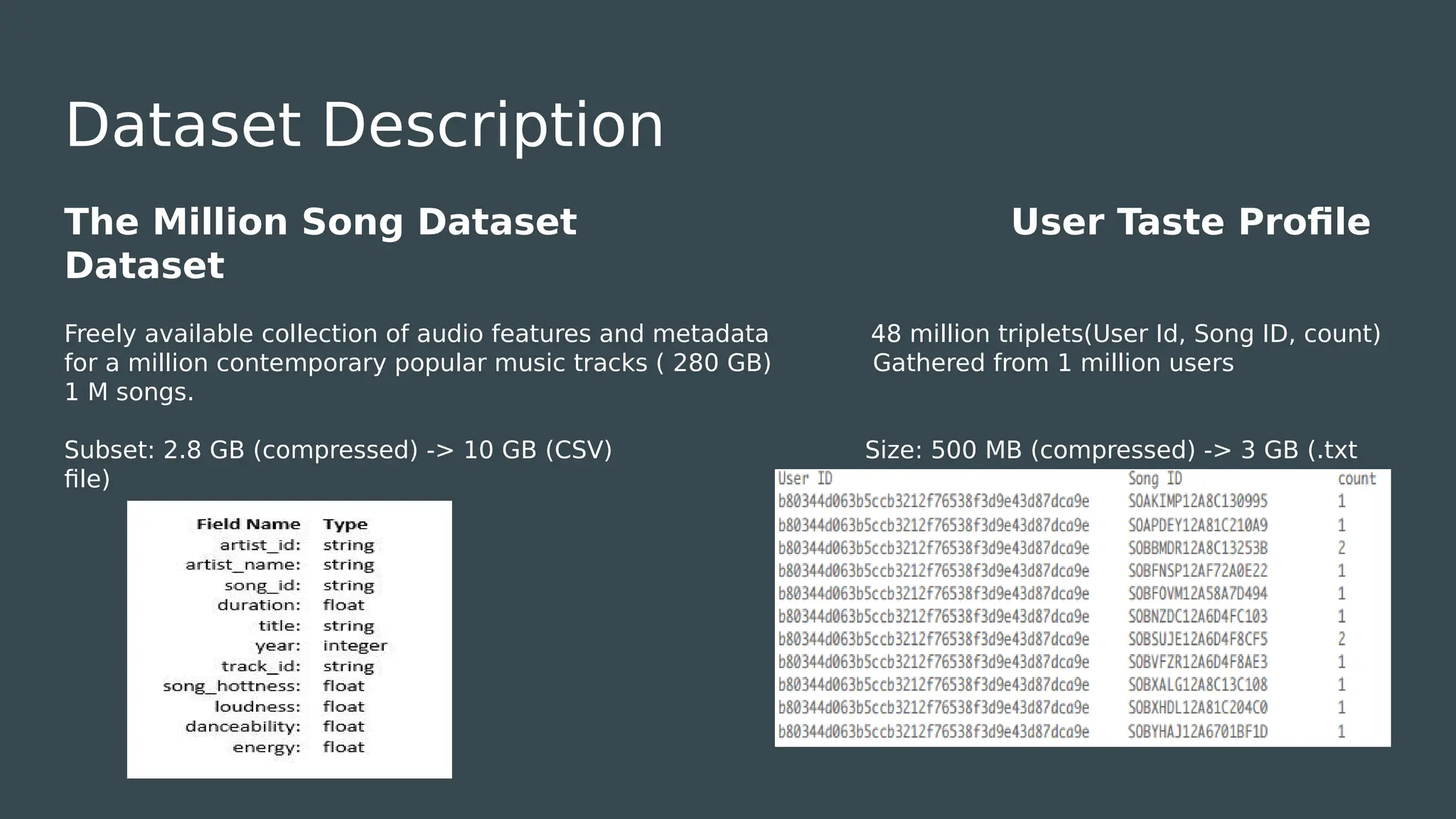
Freely available collection of audio features and metadata 48 million triplets(User Id, Song ID, count)
for a million contemporary popular music tracks ( 280 GB) Gathered from 1 million users
1 M songs.
Subset: 2.8 GB (compressed) -> 10 GB (CSV) Size: 500 MB (compressed) -> 3 GB (.txt
file)
Project Pipeline
Collaborative Filtering
The Collaborative Filtering method uses previous user choices, and
choices of similar users to predict the possible future song
selections
Data was first fed through a data cleaning module, which removed
erroneous entries, such as missing values for both Song and User
ID’s.
ID’s were then mapped to a unique integer via a dictionary as Spark
functions require numeric values
Collaborative Filtering
Used Matrix Factorization instead of the conventional distance
function
Latent factor methods were used to train on some known data
K User Features (latent) were extracted , which in this case was the
song count
Assumption-Song Count represents all the factors that could have
contributed to a user choosing to listen to a song
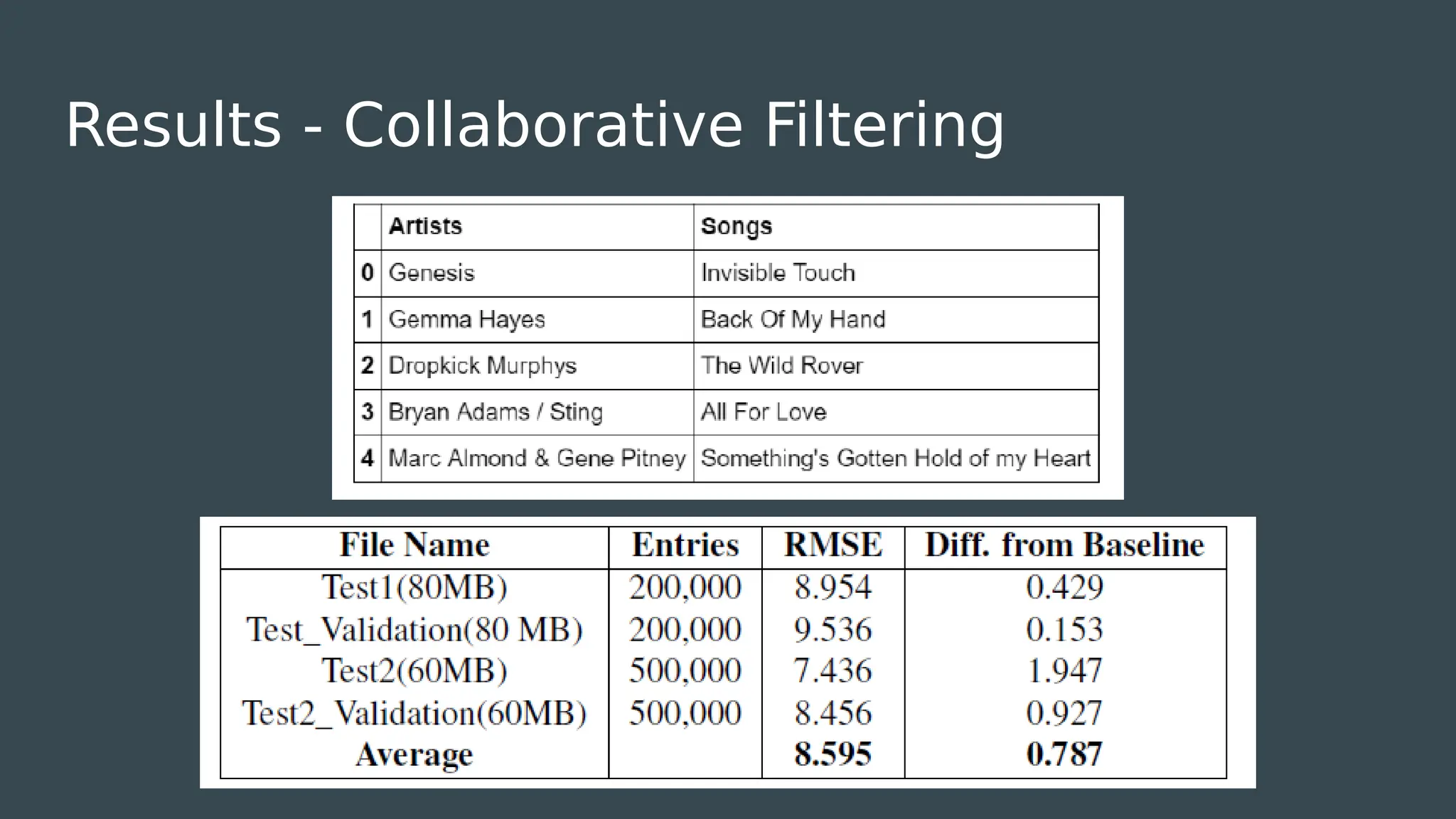
Results - Collaborative Filtering
Content Based Recommendation
We extracted certain features from the dataset, which describes
features of a song
Normalized those features by taking its product with its confidence to
get a final value, such as mode and mode confidence to get a final
mode estimate
Removed features not related to audio features
Clustered songs in a higher dimensional space, and found similar
songs within each cluster
Content Based Recommendation
Training Method- Cross Validation
User-triples dataset was split in a ratio of 80:20.
80% of the dataset was used to train a clustering model
Created a profile for each user by merging the user-song dataset
Each user profile consisted of a “mean” of all songs heard by a user in
his lifetime (as per the dataset)
Clustered using K-means
Content Based Recommendation
Testing
Generated 10 nearest neighbours for each user
Evaluated by comparing recommendations to actual values present in
the dataset
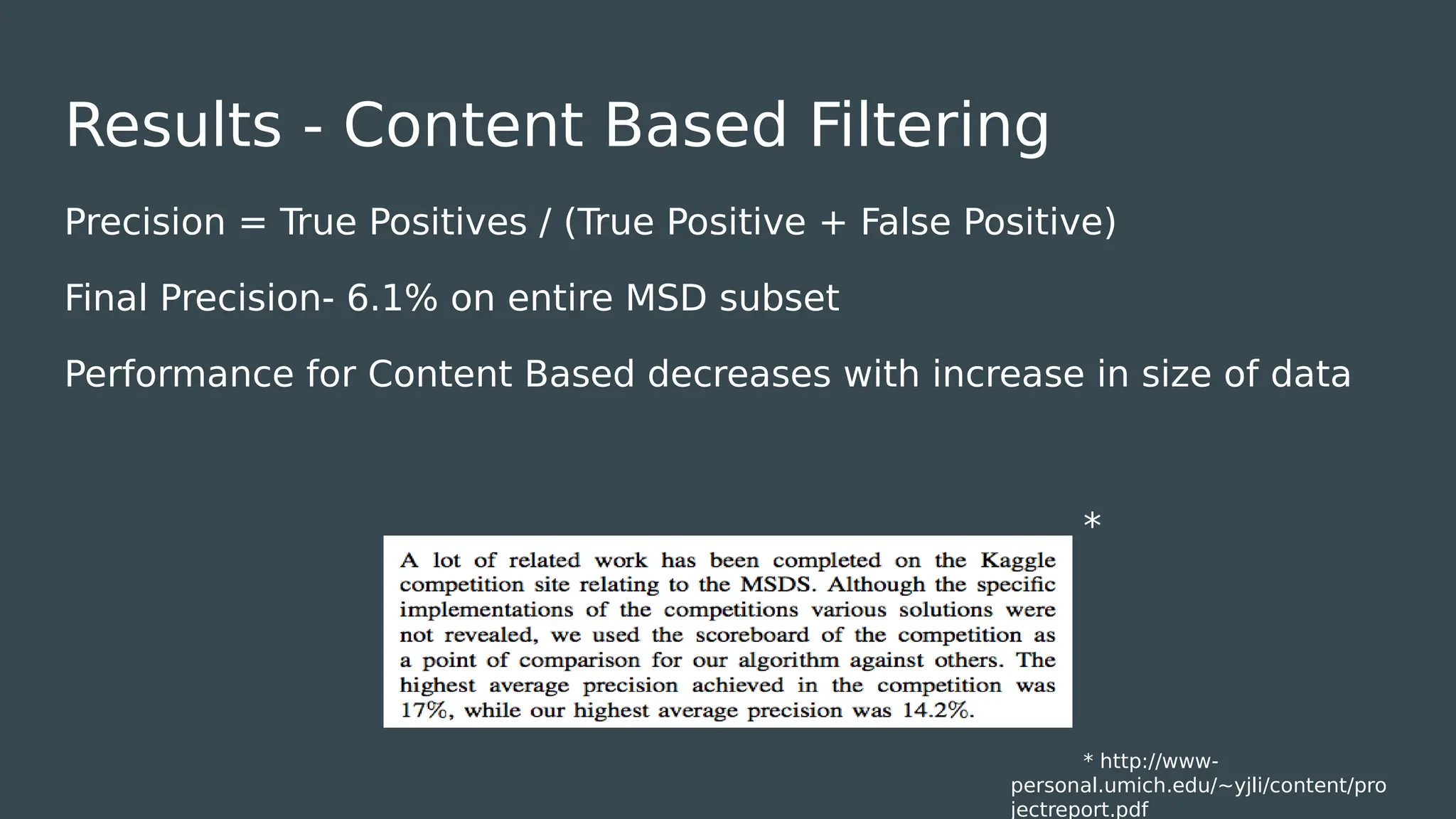
Results - Content Based Filtering
Precision = True Positives / (True Positive + False Positive)
Final Precision- 6.1% on entire MSD subset
Performance for Content Based decreases with increase in size of data
*
* http://www-
personal.umich.edu/~yjli/content/pro
jectreport.pdf
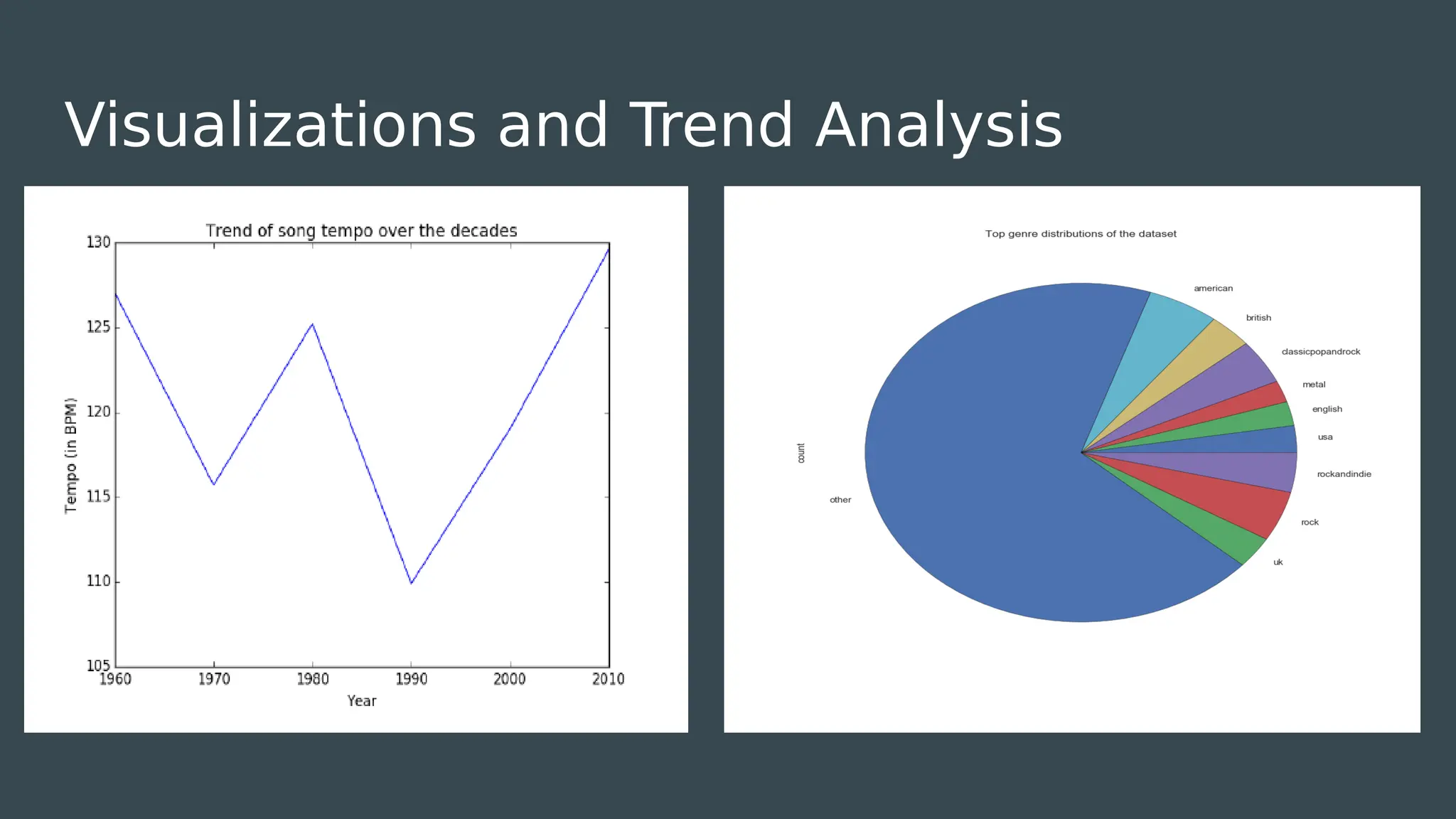
Visualizations and Trend Analysis
Team Work
- Scoping the project, data extraction, data cleaning - All
- Collaborative Filtering - Sharang
- Content Based Filtering - Piyush
- Trend Analysis & Visualizations - Prachi, Snigdha
- Conclusion, Report, Presentation - All
- Asking questions on Piazza - Anonymous
Conclusion
Eye opener on big data and its difficulties
We were fairly satisfied with our results, we managed to reduce the
RMSE by almost 1, and virtually predicted how many times a user
will play a song
We fairly satisfied with a precision of 6.1 % considering we tried a new
recommendation methodology
Collaborative Filtering was easier to implement and evaluate
THANK YOU

music recommendation system ,Based on Million Song Dataset

  • 1.
    BLUE MANGOES Piyush Khemka,Prachi Poddar, Snigdha Kamal, Sharang Bhat
  • 2.
    MUSIC RECOMMENDATION SYSTEM Based onMillion Song Dataset* *labrosa.ee.columbia.edu/millionsong/
  • 3.
    Background and Motivation Growthin Music streaming consumption among consumers Plethora of options available - Spotify, Pandora, 8tracks *http://www.riaa.com/reports/riaa-2015-year-end-sales-shipments-data-report-riaa/ RIAA - Recording Industry Association of America
  • 4.
    Background and Motivation MusicRecommendations - excellent feature for any music application. Better Recommendations - Better Conversions, More engagement Develop a music recommendation system based on the Million Song Dataset using various recommendation methodologies and draw a comparative analysis between them
  • 5.
    Dataset Description The MillionSong Dataset User Taste Profile Dataset Freely available collection of audio features and metadata 48 million triplets(User Id, Song ID, count) for a million contemporary popular music tracks ( 280 GB) Gathered from 1 million users 1 M songs. Subset: 2.8 GB (compressed) -> 10 GB (CSV) Size: 500 MB (compressed) -> 3 GB (.txt file)
  • 6.
  • 7.
    Collaborative Filtering The CollaborativeFiltering method uses previous user choices, and choices of similar users to predict the possible future song selections Data was first fed through a data cleaning module, which removed erroneous entries, such as missing values for both Song and User ID’s. ID’s were then mapped to a unique integer via a dictionary as Spark functions require numeric values
  • 8.
    Collaborative Filtering Used MatrixFactorization instead of the conventional distance function Latent factor methods were used to train on some known data K User Features (latent) were extracted , which in this case was the song count Assumption-Song Count represents all the factors that could have contributed to a user choosing to listen to a song
  • 9.
  • 10.
    Content Based Recommendation Weextracted certain features from the dataset, which describes features of a song Normalized those features by taking its product with its confidence to get a final value, such as mode and mode confidence to get a final mode estimate Removed features not related to audio features Clustered songs in a higher dimensional space, and found similar songs within each cluster
  • 11.
    Content Based Recommendation TrainingMethod- Cross Validation User-triples dataset was split in a ratio of 80:20. 80% of the dataset was used to train a clustering model Created a profile for each user by merging the user-song dataset Each user profile consisted of a “mean” of all songs heard by a user in his lifetime (as per the dataset) Clustered using K-means
  • 12.
    Content Based Recommendation Testing Generated10 nearest neighbours for each user Evaluated by comparing recommendations to actual values present in the dataset
  • 13.
    Results - ContentBased Filtering Precision = True Positives / (True Positive + False Positive) Final Precision- 6.1% on entire MSD subset Performance for Content Based decreases with increase in size of data * * http://www- personal.umich.edu/~yjli/content/pro jectreport.pdf
  • 14.
  • 15.
  • 16.
    Team Work - Scopingthe project, data extraction, data cleaning - All - Collaborative Filtering - Sharang - Content Based Filtering - Piyush - Trend Analysis & Visualizations - Prachi, Snigdha - Conclusion, Report, Presentation - All - Asking questions on Piazza - Anonymous
  • 17.
    Conclusion Eye opener onbig data and its difficulties We were fairly satisfied with our results, we managed to reduce the RMSE by almost 1, and virtually predicted how many times a user will play a song We fairly satisfied with a precision of 6.1 % considering we tried a new recommendation methodology Collaborative Filtering was easier to implement and evaluate
  • 18.