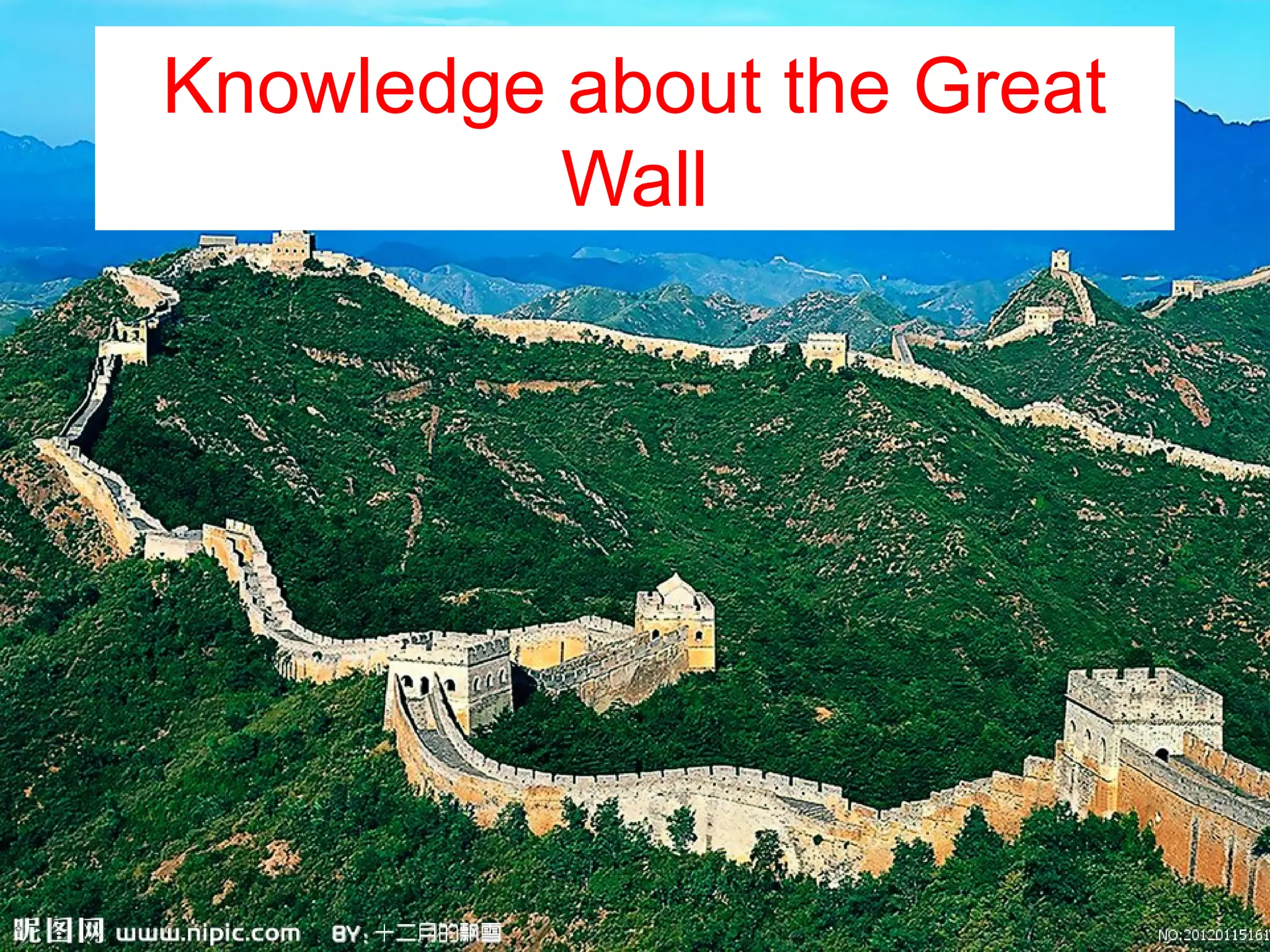
Knowledge about the Great
Wall
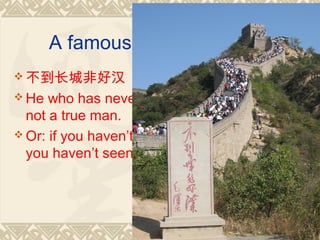
A famous saying in China
 不到长城非好汉
 He who has never been to the Great Wall in
not a true man.
 Or: if you haven’t climbed the Great Wall,
you haven’t seen China.
Those who succeeded in climbing the wall
today are often regarded as "real heroes",
from this we should realize the difficulty in
climbing the wall, but can you imagine
how even more difficult it is to build the
Great Wall without modern machinery?
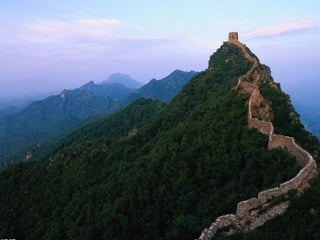
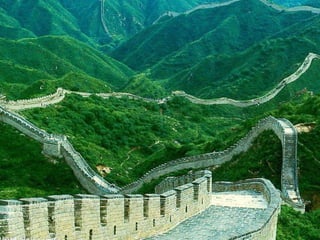
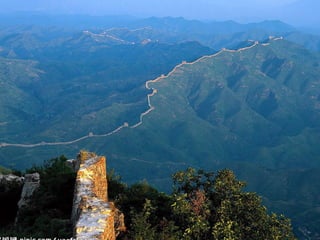
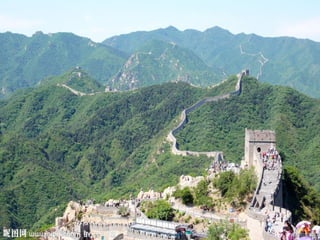
The Great Wall of China is a series
of fortifications made of stone,
brick, tamped earth, wood and
other materials, generally built
along an east-to-west line across
the history northern borders of
China in part to protect the Chinese
Empire.
History of the Great Wall
The Great Wall of the Qin Dynasty
Qin Shi Huang conquered all opposing states and
unified China in 221 BC, establishing the Qin
Dynasty. To protect the empire against
intrusions by the Xiongnu people from the north,
he ordered the building of a new wall along the
empire’s northern frontier.
 There are no surviving historical records
indicating the exact length and course of the Qin
Dynasty walls. Most of the ancient walls have
eroded away over the centuries, and very few
sections remain today. The human cost of the
construction is unknown, but it has been
estimated by some authors that hundreds of
thousands, if not up to a million, workers died
building the Qin wall.
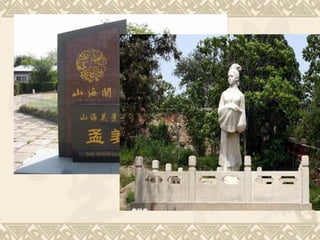
A legend
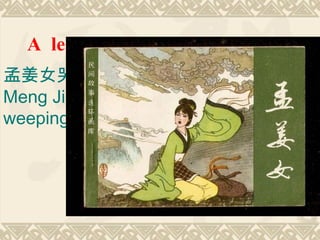
孟姜女哭长城
Meng Jiangnv’s bitter
weeping
 On the night of their wedding, Fan Xiliang, Meng Jiangnu's
husband, was pressganged to build the Great Wall by the Qin
soldiers. Before Wan Xiliang went away, Lady Meng took her
white jade hairpin and broke it into two halves and gave her
husband one half as a token of love.
 One day, when lady Meng stayed at home, she had a bad dream,
she dreamed that her husband was constantly yelling: "Cold,
cold!" She recalled that her husband was wearing very thin
clothes. Very soon, she made some padded clothes and left home
to look for her husband. She didn t expect that her husband had
already died, so she burst into tears. The Great Wall was moved
and it collasped for more than 20 Km, revealing the dead bodies
of her husband and many others. On seeing this, she wrapped her
husband's dead body in arm and committed suicide by jumping
into the sea.
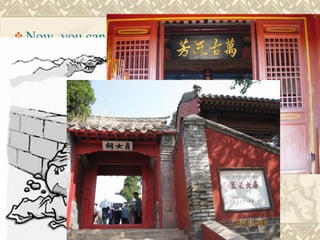
 Now, you can find a temple built at Shanhaiguan
Pass near the sea in memory of this loyal lady.
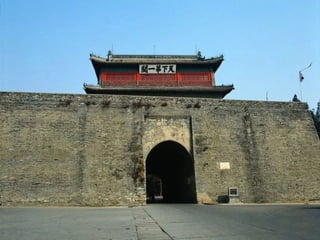
 Then there are the Great Walls in Han and Ming
dynasties.
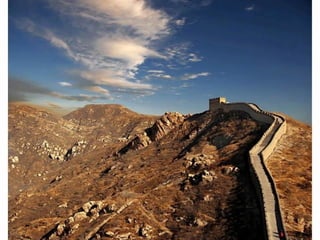
 The Ming Dynasty was the last dynasty in Chinese
history when large scale construction of the Great Wall
took place, and most of the walls we see today were
built in the Ming Dynasty. The Ming Great Wall
stretched from the Yalu River in the east to Jiayuguan
in the west, covering a total length of more than 5,000
Km. At present, however, Shanhaiguan Pass is
generally considered as the eastern end of the Great
Wall because the section from Shanhaiguan Pass to the
Yalu River was poorly built and maintained.
Shanhaiguan Pass is also considered as "the First Pass
Under Heaven".
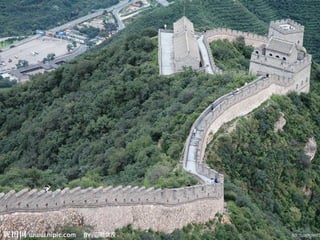
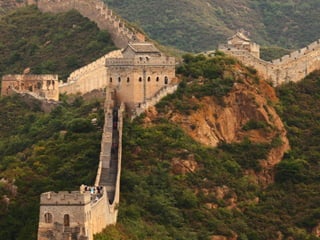
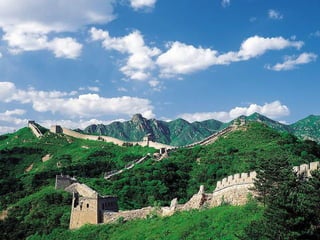
In Beijing, the Great Wall is 629 Km long,
five sections of the Great Wall have been
opened to visitors. There are Badaling
Section, Simatai Section, Mutianyu
Section, Jinshanling Section and Gubeikou
Section. Of all these five sections, the
Great Wall at Badaling Section is the most
famous and best preserved.
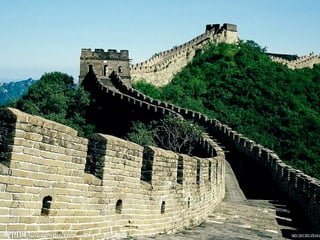
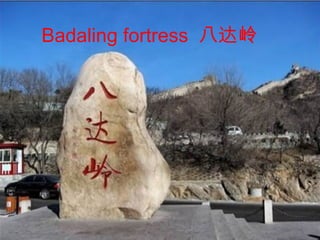
Badaling fortress 八达岭
The Badaling fortress is about
600 meters above sea level.
East of the fortress is a huge
rock seven meters long and two
meters high. It is called
Looking-towrd Beijing Rock.( 望
京石 )
Muralla China

Muralla China

  • 1.
  • 19.
    A famous sayingin China  不到长城非好汉  He who has never been to the Great Wall in not a true man.  Or: if you haven’t climbed the Great Wall, you haven’t seen China.
  • 20.
    Those who succeededin climbing the wall today are often regarded as "real heroes", from this we should realize the difficulty in climbing the wall, but can you imagine how even more difficult it is to build the Great Wall without modern machinery?
  • 21.
    The Great Wallof China is a series of fortifications made of stone, brick, tamped earth, wood and other materials, generally built along an east-to-west line across the history northern borders of China in part to protect the Chinese Empire.
  • 22.
    History of theGreat Wall The Great Wall of the Qin Dynasty Qin Shi Huang conquered all opposing states and unified China in 221 BC, establishing the Qin Dynasty. To protect the empire against intrusions by the Xiongnu people from the north, he ordered the building of a new wall along the empire’s northern frontier.
  • 23.
     There areno surviving historical records indicating the exact length and course of the Qin Dynasty walls. Most of the ancient walls have eroded away over the centuries, and very few sections remain today. The human cost of the construction is unknown, but it has been estimated by some authors that hundreds of thousands, if not up to a million, workers died building the Qin wall.
  • 24.
  • 25.
     On thenight of their wedding, Fan Xiliang, Meng Jiangnu's husband, was pressganged to build the Great Wall by the Qin soldiers. Before Wan Xiliang went away, Lady Meng took her white jade hairpin and broke it into two halves and gave her husband one half as a token of love.  One day, when lady Meng stayed at home, she had a bad dream, she dreamed that her husband was constantly yelling: "Cold, cold!" She recalled that her husband was wearing very thin clothes. Very soon, she made some padded clothes and left home to look for her husband. She didn t expect that her husband had already died, so she burst into tears. The Great Wall was moved and it collasped for more than 20 Km, revealing the dead bodies of her husband and many others. On seeing this, she wrapped her husband's dead body in arm and committed suicide by jumping into the sea.
  • 26.
     Now, youcan find a temple built at Shanhaiguan Pass near the sea in memory of this loyal lady.
  • 28.
     Then thereare the Great Walls in Han and Ming dynasties.  The Ming Dynasty was the last dynasty in Chinese history when large scale construction of the Great Wall took place, and most of the walls we see today were built in the Ming Dynasty. The Ming Great Wall stretched from the Yalu River in the east to Jiayuguan in the west, covering a total length of more than 5,000 Km. At present, however, Shanhaiguan Pass is generally considered as the eastern end of the Great Wall because the section from Shanhaiguan Pass to the Yalu River was poorly built and maintained. Shanhaiguan Pass is also considered as "the First Pass Under Heaven".
  • 30.
    In Beijing, theGreat Wall is 629 Km long, five sections of the Great Wall have been opened to visitors. There are Badaling Section, Simatai Section, Mutianyu Section, Jinshanling Section and Gubeikou Section. Of all these five sections, the Great Wall at Badaling Section is the most famous and best preserved.
  • 31.
  • 33.
    The Badaling fortressis about 600 meters above sea level. East of the fortress is a huge rock seven meters long and two meters high. It is called Looking-towrd Beijing Rock.( 望 京石 )