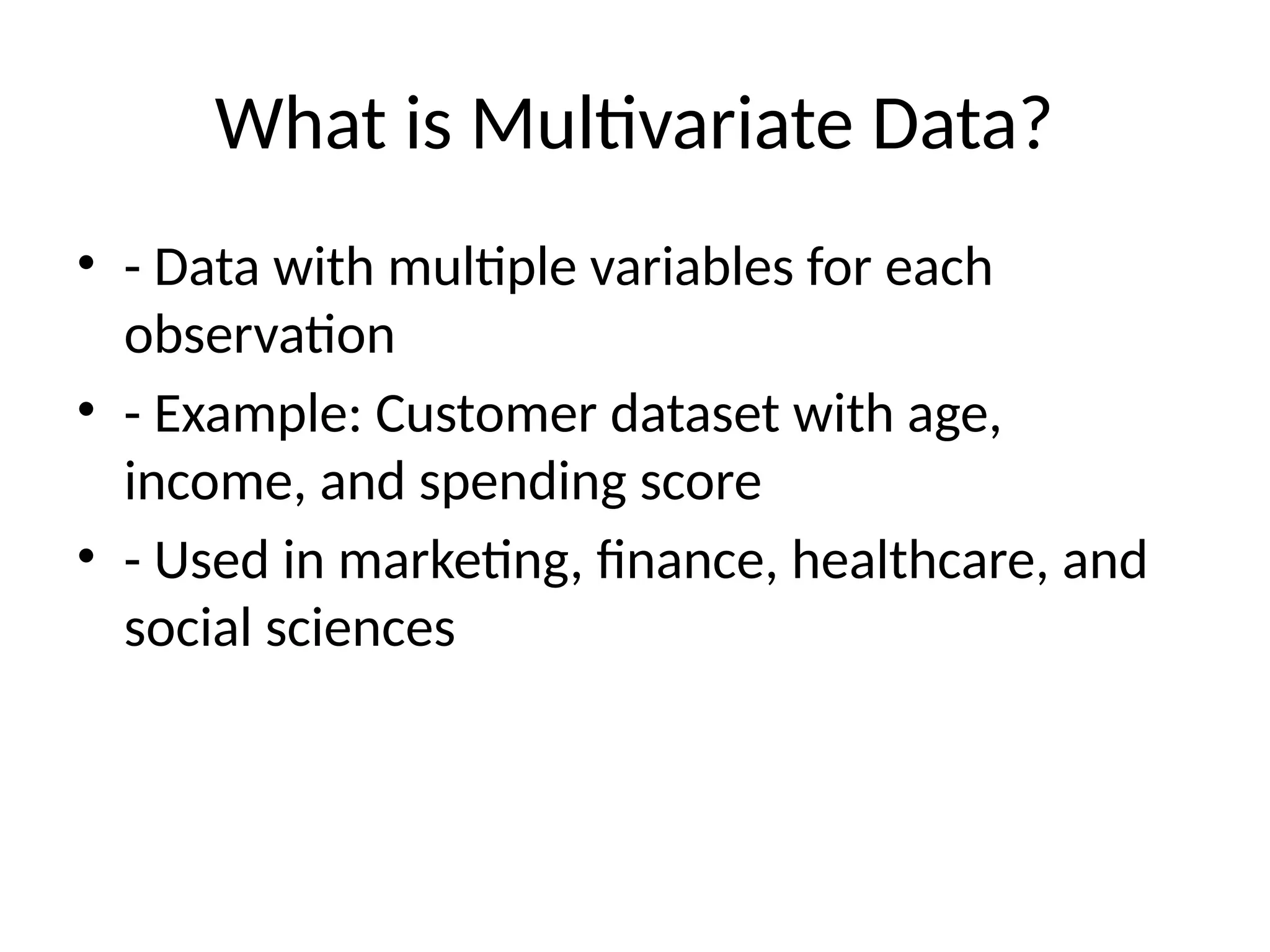
- Data with multiple variables for each observation
- Example: Customer dataset with age, income, and spending score
- Used in marketing, finance, healthcare, and social sciences
What is MultivariateData?
• - Data with multiple variables for each
observation
• - Example: Customer dataset with age,
income, and spending score
• - Used in marketing, finance, healthcare, and
social sciences
3.
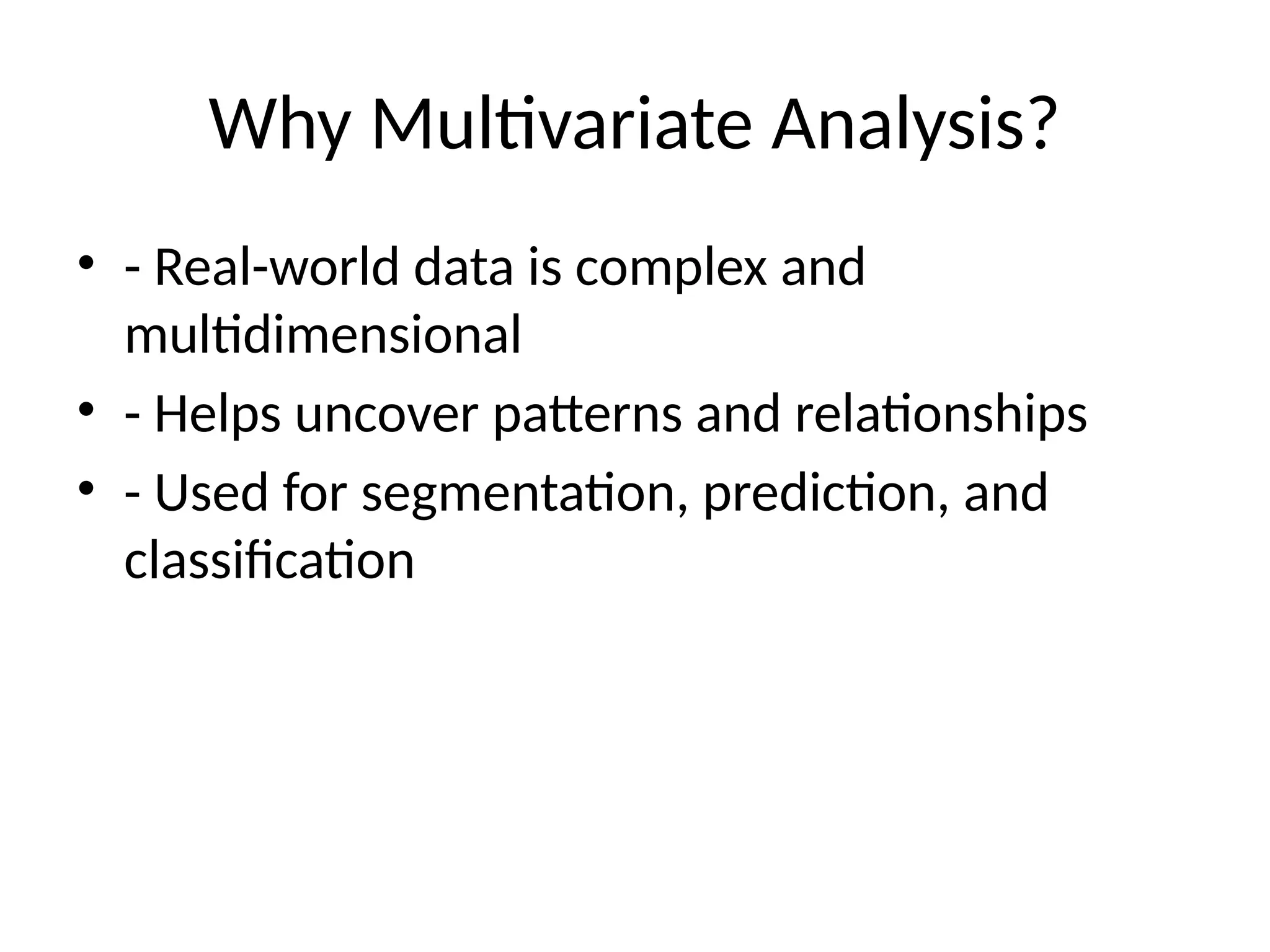
Why Multivariate Analysis?
•- Real-world data is complex and
multidimensional
• - Helps uncover patterns and relationships
• - Used for segmentation, prediction, and
classification
Hands-on Factor Analysis
•- Perform Factor Analysis using:
• 1. Excel
• 2. SPSS
• 3. Python (PCA)
• - Identify key factors from a dataset
• - Interpret the results using Scree Plot &
Factor Loadings
8.
Real-World Applications ofFactor
Analysis
• - Marketing: Identifying key factors in
customer behavior
• - Finance: Risk assessment and investment
analysis
• - Healthcare: Grouping symptoms to diagnose
diseases
• - Social Sciences: Personality trait
identification
9.
Classroom Activity
• -Work in groups with a dataset
• - Perform Factor Analysis using a tool of choice
• - Identify key factors and present findings
• - Discuss interpretations with the class
10.
Summary & KeyTakeaways
• - Multivariate Analysis helps understand
complex datasets
• - Factor Analysis is useful for dimensionality
reduction
• - Hands-on experience with Excel, SPSS, or
Python
• - Applications in marketing, finance,
healthcare, and more



![[DSC Europe 25] Dusan Jovicic - AI Story: From on-prem to cloud and back agai...](https://cdn.slidesharecdn.com/ss_thumbnails/8kp49m6uq22ifnbwhfnk-2-251205085715-964d11a6-thumbnail.jpg?width=640&height=640&fit=bounds)

![[DSC Europe 25] Vid Stimac - Policy Parsimony: Between Oversimplifying and Ov...](https://cdn.slidesharecdn.com/ss_thumbnails/eqlepagzqp2rhg3gbluh-dsc-stimac-251120-251205090438-059e7f54-thumbnail.jpg?width=640&height=640&fit=bounds)

![[DSC Europe 25] Bogdan Daniel Maruneac - AI - It starts with you.pptx](https://cdn.slidesharecdn.com/ss_thumbnails/odov3snhrcqs9hx5ny2n-4-251205085715-f1daacfe-thumbnail.jpg?width=640&height=640&fit=bounds)

![[DSC Europe 25] Boris Perkovic - Lost in performance.pptx](https://cdn.slidesharecdn.com/ss_thumbnails/uq5hrp7vsuahqkxzifux-1-251204082258-fd2ee09d-thumbnail.jpg?width=640&height=640&fit=bounds)
![[DSC Europe 25] Jim Sterne - Adopting Generative AI Capabilities Into the Ent...](https://cdn.slidesharecdn.com/ss_thumbnails/sxhpofuorcagxsaulkmt-3-251204082258-7e66bc48-thumbnail.jpg?width=640&height=640&fit=bounds)


![[DSC Europe 25] Dragan Vucic - Building the Learning Organization - How AI Tr...](https://cdn.slidesharecdn.com/ss_thumbnails/8brigo2sbu6qur6gxrra-7-251205085715-6ae07d24-thumbnail.jpg?width=640&height=640&fit=bounds)
![[DSC Europe 25] Max Talanov - Non digital NNs.pptx](https://cdn.slidesharecdn.com/ss_thumbnails/wif8tr3gtua74qvtopke-non-digital-nns-251205090438-26b0eea6-thumbnail.jpg?width=640&height=640&fit=bounds)


![[DSC Europe 25] Andy Cotgreave - Nothing is new in analytics.pptx](https://cdn.slidesharecdn.com/ss_thumbnails/mba4vzcurvoh5lfrd5zw-6-251205194645-341bbbbe-thumbnail.jpg?width=640&height=640&fit=bounds)