Neuroscience of Multisensory
Integration
M2 NPES 2024/2025
Quentin Moreau, PhD
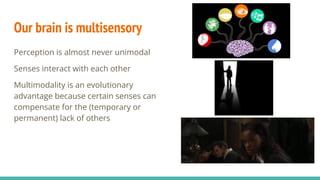
Our brain is multisensory
Perception is almost never unimodal
Senses interact with each other
Multimodality is an evolutionary
advantage because certain senses can
compensate for the (temporary or
permanent) lack of others
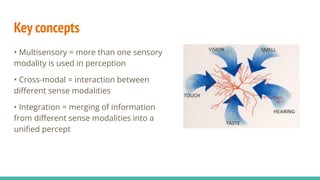
Key concepts
• Multisensory = more than one sensory
modality is used in perception
• Cross-modal = interaction between
different sense modalities
• Integration = merging of information
from different sense modalities into a
unified percept
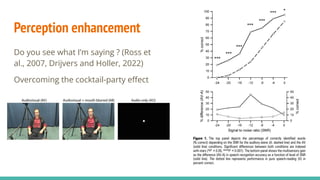
Perception enhancement
Do you see what I’m saying ? (Ross et
al., 2007, Drijvers and Holler, 2022)
Overcoming the cocktail-party effect
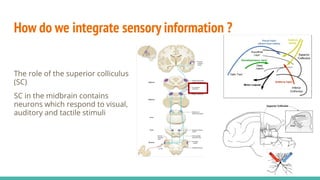
How do we integrate sensory information ?
The role of the superior colliculus
(SC)
SC in the midbrain contains
neurons which respond to visual,
auditory and tactile stimuli
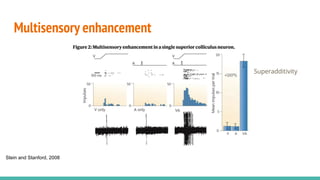
Multisensory enhancement
Superadditivity
Stein and Stanford, 2008
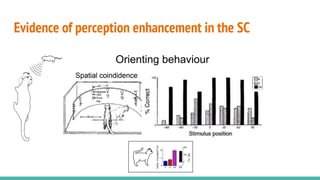
Evidence of perception enhancement in the SC
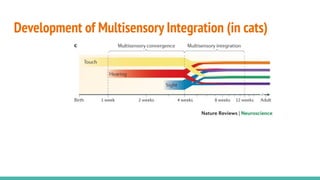
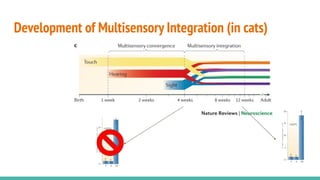
Development of Multisensory Integration (in cats)
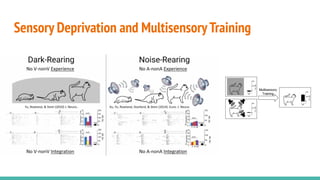
Sensory Deprivation and MultisensoryTraining
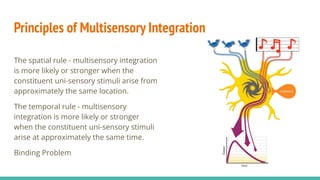
Principles of Multisensory Integration
The spatial rule - multisensory integration
is more likely or stronger when the
constituent uni-sensory stimuli arise from
approximately the same location.
The temporal rule - multisensory
integration is more likely or stronger
when the constituent uni-sensory stimuli
arise at approximately the same time.
Binding Problem
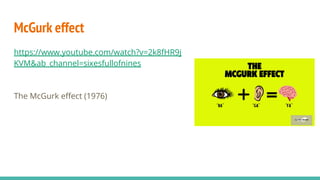
McGurk effect
https://www.youtube.com/watch?v=2k8fHR9j
KVM&ab_channel=sixesfullofnines
The McGurk effect (1976)
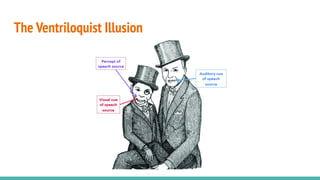
The Ventriloquist Illusion
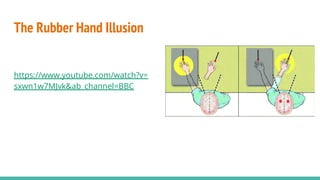
The Rubber Hand Illusion
https://www.youtube.com/watch?v=
sxwn1w7MJvk&ab_channel=BBC
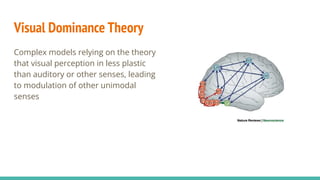
Visual Dominance Theory
Complex models relying on the theory
that visual perception in less plastic
than auditory or other senses, leading
to modulation of other unimodal
senses
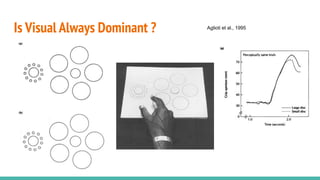
Is Visual Always Dominant ? Aglioti et al., 1995
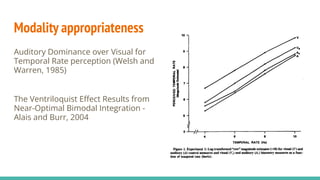
Modality appropriateness
Auditory Dominance over Visual for
Temporal Rate perception (Welsh and
Warren, 1985)
The Ventriloquist Effect Results from
Near-Optimal Bimodal Integration -
Alais and Burr, 2004
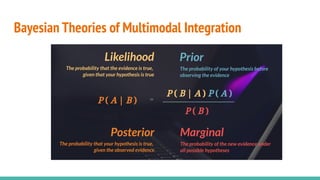
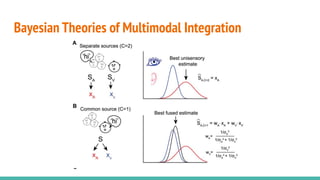
Bayesian Theories of Multimodal Integration
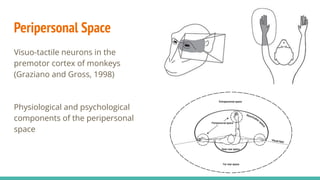
Peripersonal Space
Visuo-tactile neurons in the
premotor cortex of monkeys
(Graziano and Gross, 1998)
Physiological and psychological
components of the peripersonal
space
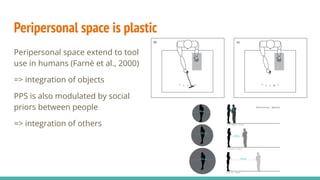
Peripersonal space is plastic
Peripersonal space extend to tool
use in humans (Farnè et al., 2000)
=> integration of objects
PPS is also modulated by social
priors between people
=> integration of others
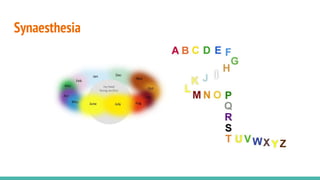
Synaesthesia
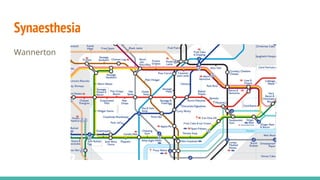
Synaesthesia
Wannerton
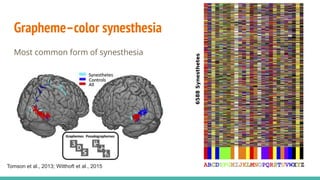
Grapheme–color synesthesia
Most common form of synesthesia
Tomson et al., 2013; Witthoft et al., 2015
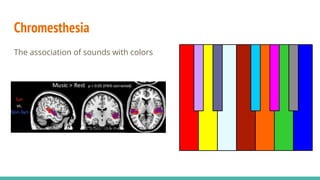
Chromesthesia
The association of sounds with colors
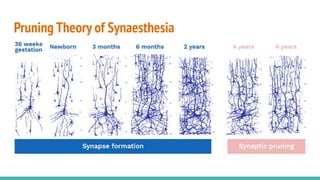
Pruning Theory of Synaesthesia
Summary
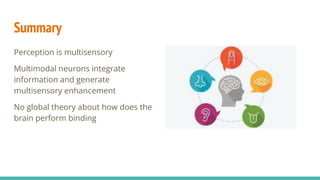
Perception is multisensory
Multimodal neurons integrate
information and generate
multisensory enhancement
No global theory about how does the
brain perform binding

Multisensory Integration - Master Level lecture