Multipoint Video Conferencing
    A Deeper Dive into VC’s Most Talked About Feature

    Robb Woods


1
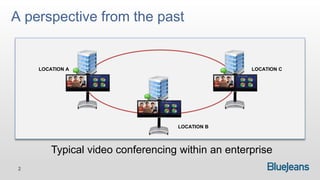
A perspective from the past


     LOCATION A                                    LOCATION C


                                   LOCATION B


         Typical video conferencing within an enterprise
 2
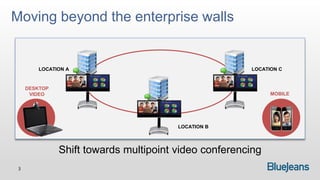
Moving beyond the enterprise walls


         LOCATION A                                    LOCATION C


     DESKTOP
      VIDEO                                                  MOBILE


                                        LOCATION B


               Shift towards multipoint video conferencing
 3
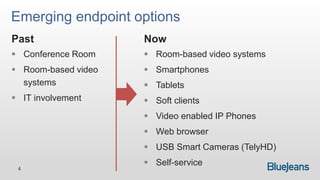
Emerging endpoint options
Past                 Now
 Conference Room     Room-based video systems
 Room-based video    Smartphones
  systems             Tablets
 IT involvement      Soft clients
                      Video enabled IP Phones
                      Web browser
                      USB Smart Cameras (TelyHD)
                      Self-service
 4
Business drivers for multipoint video conferencing
  Business is global
  Executives are on the move
  Teleworking is on the rise
  Video is proven to be more effective


 5
Trends driving multipoint conferencing
      241M wireless video-enabled devices expected
       by 2015
      Desktop and Laptop capabilities
      Network speed & availability continues increase
      BYOD (Bring your own Device)
      BYOA (Bring your own Application)
 6
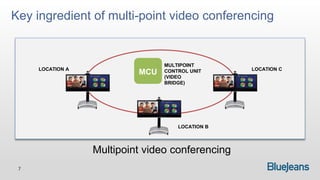
Key ingredient of multi-point video conferencing


                                 MULTIPOINT
     LOCATION A                                   LOCATION C
                           MCU   CONTROL UNIT
                                 (VIDEO
                                 BRIDGE)


                                     LOCATION B


                  Multipoint video conferencing
 7
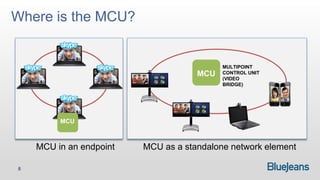
Where is the MCU?


                                           MULTIPOINT
                                     MCU   CONTROL UNIT
                                           (VIDEO
                                           BRIDGE)


         MCU


    MCU in an endpoint   MCU as a standalone network element

8
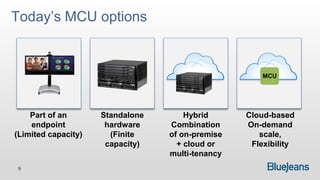
Today’s MCU options


                                                      MCU


    Part of an       Standalone       Hybrid      Cloud-based
    endpoint          hardware    Combination     On-demand
(Limited capacity)     (Finite    of on-premise      scale,
                      capacity)     + cloud or     Flexibility
                                  multi-tenancy
9
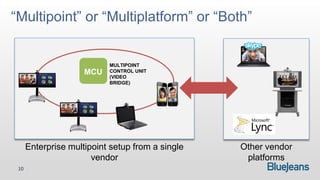
“Multipoint” or “Multiplatform” or “Both”


                           MULTIPOINT
                     MCU   CONTROL UNIT
                           (VIDEO
                           BRIDGE)


      Enterprise multipoint setup from a single   Other vendor
                       vendor                      platforms
 10
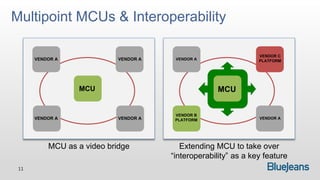
Multipoint MCUs & Interoperability

                                                                 VENDOR C
      VENDOR A              VENDOR A    VENDOR A                 PLATFORM


                 MCU                                 MCU


                                        VENDOR B
      VENDOR A              VENDOR A    PLATFORM                 VENDOR A


          MCU as a video bridge           Extending MCU to take over
                                       “interoperability” as a key feature
 11
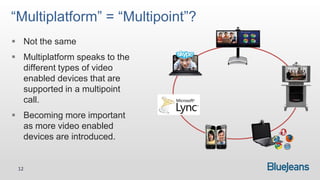
“Multiplatform” = “Multipoint”?
 Not the same
 Multiplatform speaks to the
  different types of video
  enabled devices that are
  supported in a multipoint
  call.
 Becoming more important
  as more video enabled
  devices are introduced.


 12
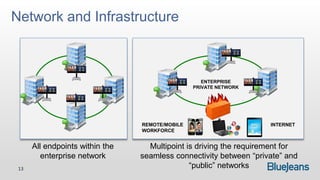
Network and Infrastructure


                                                    ENTERPRISE
                                                 PRIVATE NETWORK


                                 REMOTE/MOBILE                      INTERNET
                                 WORKFORCE


      All endpoints within the     Multipoint is driving the requirement for
         enterprise network      seamless connectivity between “private” and
 13                                            “public” networks
Today’s MCU options – Standalone hardware
            More capacity/compute power – software license to
             open up additional capacity
            Limited by finite capacity upgrades
            Demands dedicated resources for management
            CAPEX intensive
            Limited update cycles
            More options being added around:
                Interoperability support
                Firewall traversal/Border gateway
14
Today’s MCU options – Hybrid
            Multi-tenant architecture and/or on-premises + cloud
             hybrid model
            Less CAPEX compared to standalone hardware option
            Limits additional CAPEX with growth
            Somewhat easier to use when used as a service
            Dependencies
            Capacity, performance and resiliency capped by the
             underlying hardware


 15
Today’s MCU options – Cloud
            New technology - apprehension for some
            SaaS - Software as a Service

     MCU
            Limited OPEX and almost no CAPEX
            Scale as you grow
            Wider interoperability options through software
            Globally accessible – being in the cloud
            High availability – easy to build redundancy and failover
            Faster update cycles – more agile
            Self Service or IT Control options
16          Ease of use
Summary
 Why multipoint?

 Why consider multiplatform?

 MCU options

 What is right for you?


17
Questions?

     Robb Woods
       robb@bluejeans.com


18
Next videocast will be
Check back on       March 19:
BlueJeans.com for   The Core of
the recorded        Multipoint VC,
videocast           the MCU


19
bluejeans.com
       bluejeans.com/blog
     twitter @bluejeansnet

20

Multipoint Video Conferencing - Blue Jeans

  • 1.
    Multipoint Video Conferencing A Deeper Dive into VC’s Most Talked About Feature Robb Woods 1
  • 2.
    A perspective fromthe past LOCATION A LOCATION C LOCATION B Typical video conferencing within an enterprise 2
  • 3.
    Moving beyond theenterprise walls LOCATION A LOCATION C DESKTOP VIDEO MOBILE LOCATION B Shift towards multipoint video conferencing 3
  • 4.
    Emerging endpoint options Past Now  Conference Room  Room-based video systems  Room-based video  Smartphones systems  Tablets  IT involvement  Soft clients  Video enabled IP Phones  Web browser  USB Smart Cameras (TelyHD)  Self-service 4
  • 5.
    Business drivers formultipoint video conferencing  Business is global  Executives are on the move  Teleworking is on the rise  Video is proven to be more effective 5
  • 6.
    Trends driving multipointconferencing  241M wireless video-enabled devices expected by 2015  Desktop and Laptop capabilities  Network speed & availability continues increase  BYOD (Bring your own Device)  BYOA (Bring your own Application) 6
  • 7.
    Key ingredient ofmulti-point video conferencing MULTIPOINT LOCATION A LOCATION C MCU CONTROL UNIT (VIDEO BRIDGE) LOCATION B Multipoint video conferencing 7
  • 8.
    Where is theMCU? MULTIPOINT MCU CONTROL UNIT (VIDEO BRIDGE) MCU MCU in an endpoint MCU as a standalone network element 8
  • 9.
    Today’s MCU options MCU Part of an Standalone Hybrid Cloud-based endpoint hardware Combination On-demand (Limited capacity) (Finite of on-premise scale, capacity) + cloud or Flexibility multi-tenancy 9
  • 10.
    “Multipoint” or “Multiplatform”or “Both” MULTIPOINT MCU CONTROL UNIT (VIDEO BRIDGE) Enterprise multipoint setup from a single Other vendor vendor platforms 10
  • 11.
    Multipoint MCUs &Interoperability VENDOR C VENDOR A VENDOR A VENDOR A PLATFORM MCU MCU VENDOR B VENDOR A VENDOR A PLATFORM VENDOR A MCU as a video bridge Extending MCU to take over “interoperability” as a key feature 11
  • 12.
    “Multiplatform” = “Multipoint”? Not the same  Multiplatform speaks to the different types of video enabled devices that are supported in a multipoint call.  Becoming more important as more video enabled devices are introduced. 12
  • 13.
    Network and Infrastructure ENTERPRISE PRIVATE NETWORK REMOTE/MOBILE INTERNET WORKFORCE All endpoints within the Multipoint is driving the requirement for enterprise network seamless connectivity between “private” and 13 “public” networks
  • 14.
    Today’s MCU options– Standalone hardware  More capacity/compute power – software license to open up additional capacity  Limited by finite capacity upgrades  Demands dedicated resources for management  CAPEX intensive  Limited update cycles  More options being added around:  Interoperability support  Firewall traversal/Border gateway 14
  • 15.
    Today’s MCU options– Hybrid  Multi-tenant architecture and/or on-premises + cloud hybrid model  Less CAPEX compared to standalone hardware option  Limits additional CAPEX with growth  Somewhat easier to use when used as a service  Dependencies  Capacity, performance and resiliency capped by the underlying hardware 15
  • 16.
    Today’s MCU options– Cloud  New technology - apprehension for some  SaaS - Software as a Service MCU  Limited OPEX and almost no CAPEX  Scale as you grow  Wider interoperability options through software  Globally accessible – being in the cloud  High availability – easy to build redundancy and failover  Faster update cycles – more agile  Self Service or IT Control options 16  Ease of use
  • 17.
    Summary  Why multipoint? Why consider multiplatform?  MCU options  What is right for you? 17
  • 18.
    Questions? Robb Woods robb@bluejeans.com 18
  • 19.
    Next videocast willbe Check back on March 19: BlueJeans.com for The Core of the recorded Multipoint VC, videocast the MCU 19
  • 20.
    bluejeans.com bluejeans.com/blog twitter @bluejeansnet 20