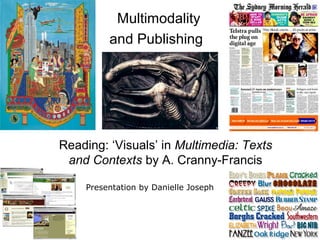
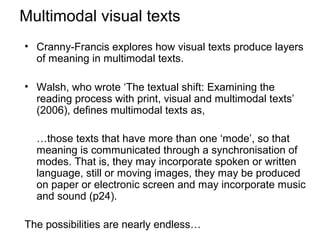
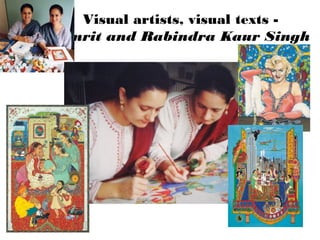
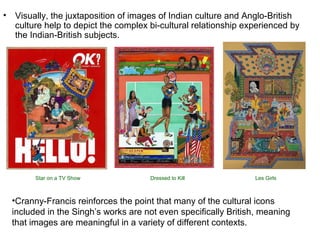
Multimodality
and Publishing
Reading: ‘Visuals’ in Multimedia: Texts
and Contexts by A. Cranny-Francis
Presentation by Danielle Joseph
Multimodal visual texts
• Cranny-Francis explores how visual texts produce layers
of meaning in multimodal texts.
• Walsh, who wrote ‘The textual shift: Examining the
reading process with print, visual and multimodal texts’
(2006), defines multimodal texts as,
…those texts that have more than one ‘mode’, so that
meaning is communicated through a synchronisation of
modes. That is, they may incorporate spoken or written
language, still or moving images, they may be produced
on paper or electronic screen and may incorporate music
and sound (p24).
The possibilities are nearly endless…
• Visual texts are compared to verbal texts:
Similarly they engage viewers throughout history, reflecting
contemporary attitudes, beliefs, fears and desires.
• Visual Strategies: such as layout, colour font, image, etc.
The strategies encourage viewers to make meaning of the text.
• In order to explore this meaning-making process, Cranny-Francis
uses concepts of genre, intertextuality and discourse to discuss a
visual text’s potential layers of meanings.
• The concepts and strategies assist in offering meanings of a visual
text to a viewer, in addition to their (viewer/reader/user’s) own
subjective viewing.
• Visual conventions: visual genres, histories and various cultural
associations etc.
Visual artists, visual texts -
Amrit and Rabindra Kaur Singh
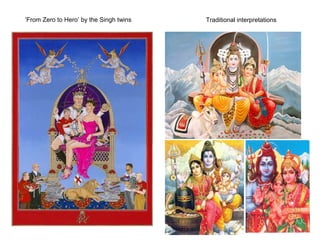
• Visually, the juxtaposition of images of Indian culture and Anglo-British
culture help to depict the complex bi-cultural relationship experienced by
the Indian-British subjects.
•Cranny-Francis reinforces the point that many of the cultural icons
included in the Singh’s works are not even specifically British, meaning
that images are meaningful in a variety of different contexts.
Star on a TV Show Dressed to Kill Les Girls
‘From Zero to Hero’ by the Singh twins Traditional interpretations
H.R.Giger
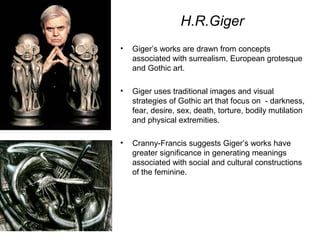
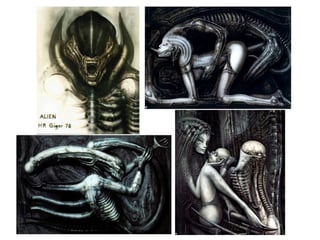
• Giger’s works are drawn from concepts
associated with surrealism, European grotesque
and Gothic art.
• Giger uses traditional images and visual
strategies of Gothic art that focus on - darkness,
fear, desire, sex, death, torture, bodily mutilation
and physical extremities.
• Cranny-Francis suggests Giger’s works have
greater significance in generating meanings
associated with social and cultural constructions
of the feminine.
Discourse
• Cranny-Francis also stresses the importance of discourse in
creating meaning from a visual text. He explains the term discourse,
to refer to the kinds of meanings a text can make available to
viewers/users.
• ‘Discourse is a term that can be used to describe meaning-making
across a range of modalities and so is particularly useful in the study
of multi-modal texts’ (p 41).
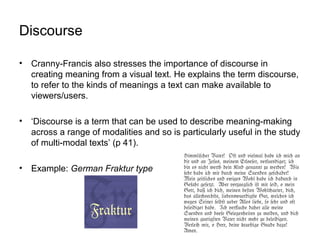
• Example: German Fraktur type
Genre, sub-genres and websites -
History Wired
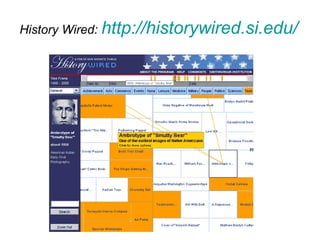
•The website has its own meaning-making practices.
•Cranny identifies that a website needs to communicate to the user and does so
through visual strategies that provide the user information about the websites
purpose and usability.
•Websites have sub-genres that are determined by the function and purpose of
the site. Eg. government, commercial, fan, educational websites, etc.
Cranny-Francis states,
Those different functions and purposes mean that they can address users
differently, employ different textual strategies, work to construct specific identities
in accordance with their function (p44).
History Wired: http://historywired.si.edu/
Conclusion
• Cranny-Francis argues that like literacy and grammar,
visual texts also have conventions that produce meaning
for a viewer.
• Visual genres, histories and various cultural associations
etc, all contribute to the individual’s meaning-making
process.
• To explore this meaning-making process, he uses
concepts of genre, intertextuality and discourse to
discuss the potential layers of meanings.
• These concepts and visual strategies, such as layout,
colour, font, image etc, assist in offering meanings of a
visual text to a viewer, in addition to their own
subjectivity, social and cultural influences.
Thank you
Bibliography Amrit and Rabindra are contemporary British artists
• Amrit and Rabindra Kaur Singh, contemporary British Artists. http://www.singhtwins.co.uk/ (Profile, commentary and
gallery of the Singh twins’ paintings)
• H.R. Giger Website http://www.hrgiger.com/frame.htm (Biography, galleries, products, etc. of Giger’s works)
• http://www.morscher.com/3r/fonts/fraktur.htm (provides different examples of German Fraktur font )
• http://historywired.si.edu/ History Wired website.
• Walsh, Maureen. The 'Textual Shift': Examining the Reading Process with Print, Visual and Multimodal Texts [online].
Australian Journal of Language and Literacy, The; Volume 29, Issue 1; Feb 2006; 24-37. Availability:
http://search.informit.com.au.ezproxy1.library.usyd.edu.au/documentSummary;dn=063500573261111;res=IELHSS ISSN:
1038-1562. [cited 08 Sep 09]. ( Extended reading in the study of multimodal texts)
• Bateman, John. Multimodality and Genre: A Foundation for the Systematic Analysis of Multimodal Documents. Palgrave
Macmillan, 2008. Palgrave Connect. Palgrave Macmillan. 08 Sep 2009
http://www.palgraveconnect.com/pc/doifinder/10.1057/9780230582323 ( Extended reading in the study of multimodal texts)
• Knox, John. Visual-verbal communication on online newspaper home pages. Visual Communication, February 2007; 6: 19 -
53. ( Extended reading in the study of multimodal texts)
• Howells, Richard. Visual culture. http://books.google.com/books?
id=386rdRM24iYC&pg=PA1&dq=visual+text#v=onepage&q=visual%20text&f=false (Online abstract of this book about
visual literacy)
•
By Multimodal interaction with virtual environments http://www.youtube.com/watch?v=fxA_CkV-iWU&feature=related
(digital example of multimodal text)
•
Visual Literacy http://www.youtube.com/watch?v=s-KFYatVgZk (Video of Lecture on Visual literacy. Poor video quality but
good audio)

Multimodality And Publishing Presentation

  • 1.
    Multimodality and Publishing Reading: ‘Visuals’in Multimedia: Texts and Contexts by A. Cranny-Francis Presentation by Danielle Joseph
  • 2.
    Multimodal visual texts •Cranny-Francis explores how visual texts produce layers of meaning in multimodal texts. • Walsh, who wrote ‘The textual shift: Examining the reading process with print, visual and multimodal texts’ (2006), defines multimodal texts as, …those texts that have more than one ‘mode’, so that meaning is communicated through a synchronisation of modes. That is, they may incorporate spoken or written language, still or moving images, they may be produced on paper or electronic screen and may incorporate music and sound (p24). The possibilities are nearly endless…
  • 3.
    • Visual textsare compared to verbal texts: Similarly they engage viewers throughout history, reflecting contemporary attitudes, beliefs, fears and desires. • Visual Strategies: such as layout, colour font, image, etc. The strategies encourage viewers to make meaning of the text. • In order to explore this meaning-making process, Cranny-Francis uses concepts of genre, intertextuality and discourse to discuss a visual text’s potential layers of meanings. • The concepts and strategies assist in offering meanings of a visual text to a viewer, in addition to their (viewer/reader/user’s) own subjective viewing. • Visual conventions: visual genres, histories and various cultural associations etc.
  • 4.
    Visual artists, visualtexts - Amrit and Rabindra Kaur Singh
  • 5.
    • Visually, thejuxtaposition of images of Indian culture and Anglo-British culture help to depict the complex bi-cultural relationship experienced by the Indian-British subjects. •Cranny-Francis reinforces the point that many of the cultural icons included in the Singh’s works are not even specifically British, meaning that images are meaningful in a variety of different contexts. Star on a TV Show Dressed to Kill Les Girls
  • 6.
    ‘From Zero toHero’ by the Singh twins Traditional interpretations
  • 7.
    H.R.Giger • Giger’s worksare drawn from concepts associated with surrealism, European grotesque and Gothic art. • Giger uses traditional images and visual strategies of Gothic art that focus on - darkness, fear, desire, sex, death, torture, bodily mutilation and physical extremities. • Cranny-Francis suggests Giger’s works have greater significance in generating meanings associated with social and cultural constructions of the feminine.
  • 9.
    Discourse • Cranny-Francis alsostresses the importance of discourse in creating meaning from a visual text. He explains the term discourse, to refer to the kinds of meanings a text can make available to viewers/users. • ‘Discourse is a term that can be used to describe meaning-making across a range of modalities and so is particularly useful in the study of multi-modal texts’ (p 41). • Example: German Fraktur type
  • 10.
    Genre, sub-genres andwebsites - History Wired •The website has its own meaning-making practices. •Cranny identifies that a website needs to communicate to the user and does so through visual strategies that provide the user information about the websites purpose and usability. •Websites have sub-genres that are determined by the function and purpose of the site. Eg. government, commercial, fan, educational websites, etc. Cranny-Francis states, Those different functions and purposes mean that they can address users differently, employ different textual strategies, work to construct specific identities in accordance with their function (p44).
  • 11.
  • 12.
    Conclusion • Cranny-Francis arguesthat like literacy and grammar, visual texts also have conventions that produce meaning for a viewer. • Visual genres, histories and various cultural associations etc, all contribute to the individual’s meaning-making process. • To explore this meaning-making process, he uses concepts of genre, intertextuality and discourse to discuss the potential layers of meanings. • These concepts and visual strategies, such as layout, colour, font, image etc, assist in offering meanings of a visual text to a viewer, in addition to their own subjectivity, social and cultural influences. Thank you
  • 13.
    Bibliography Amrit andRabindra are contemporary British artists • Amrit and Rabindra Kaur Singh, contemporary British Artists. http://www.singhtwins.co.uk/ (Profile, commentary and gallery of the Singh twins’ paintings) • H.R. Giger Website http://www.hrgiger.com/frame.htm (Biography, galleries, products, etc. of Giger’s works) • http://www.morscher.com/3r/fonts/fraktur.htm (provides different examples of German Fraktur font ) • http://historywired.si.edu/ History Wired website. • Walsh, Maureen. The 'Textual Shift': Examining the Reading Process with Print, Visual and Multimodal Texts [online]. Australian Journal of Language and Literacy, The; Volume 29, Issue 1; Feb 2006; 24-37. Availability: http://search.informit.com.au.ezproxy1.library.usyd.edu.au/documentSummary;dn=063500573261111;res=IELHSS ISSN: 1038-1562. [cited 08 Sep 09]. ( Extended reading in the study of multimodal texts) • Bateman, John. Multimodality and Genre: A Foundation for the Systematic Analysis of Multimodal Documents. Palgrave Macmillan, 2008. Palgrave Connect. Palgrave Macmillan. 08 Sep 2009 http://www.palgraveconnect.com/pc/doifinder/10.1057/9780230582323 ( Extended reading in the study of multimodal texts) • Knox, John. Visual-verbal communication on online newspaper home pages. Visual Communication, February 2007; 6: 19 - 53. ( Extended reading in the study of multimodal texts) • Howells, Richard. Visual culture. http://books.google.com/books? id=386rdRM24iYC&pg=PA1&dq=visual+text#v=onepage&q=visual%20text&f=false (Online abstract of this book about visual literacy) • By Multimodal interaction with virtual environments http://www.youtube.com/watch?v=fxA_CkV-iWU&feature=related (digital example of multimodal text) • Visual Literacy http://www.youtube.com/watch?v=s-KFYatVgZk (Video of Lecture on Visual literacy. Poor video quality but good audio)