MKS Instruments
MultiGas 2030 FTIR


                MKS Instruments
           On-Line Product Group

                        Presented by:
                        Jim Belanger
            jim_belanger@mksinst.com
MultiGas 2030 Features
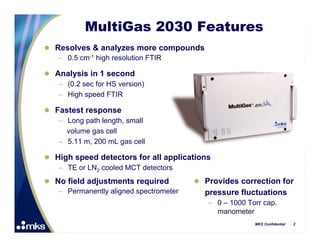
 Resolves & analyzes more compounds
   – 0.5 cm-1 high resolution FTIR

 Analysis in 1 second
   – (0.2 sec for HS version)
   – High speed FTIR

 Fastest response
   – Long path length, small
     volume gas cell
   – 5.11 m, 200 mL gas cell

 High speed detectors for all applications
   – TE or LN2 cooled MCT detectors
 No field adjustments required          Provides correction for
   – Permanently aligned spectrometer     pressure fluctuations
                                           – 0 – 1000 Torr cap.
                                             manometer
                                                        MKS Confidential   2
MultiGas Features, continued
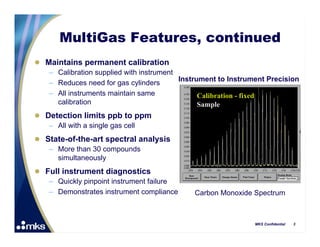
 Maintains permanent calibration
   – Calibration supplied with instrument
                                          Instrument to Instrument Precision
   – Reduces need for gas cylinders
   – All instruments maintain same              Calibration - fixed
     calibration                                Sample
 Detection limits ppb to ppm
   – All with a single gas cell
 State-of-the-art spectral analysis
   – More than 30 compounds
     simultaneously
 Full instrument diagnostics
   – Quickly pinpoint instrument failure
   – Demonstrates instrument compliance       Carbon Monoxide Spectrum


                                                               MKS Confidential   3
MultiGas 2030
Hardware Overview
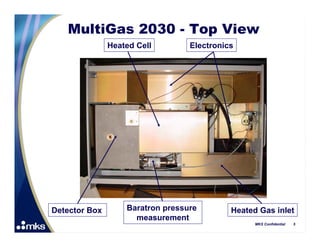
MultiGas 2030 - Top View
               Heated Cell        Electronics


Detector Box       Baratron pressure        Heated Gas inlet
                     measurement
                                                  MKS Confidential   5
MultiGas Cell Advantage
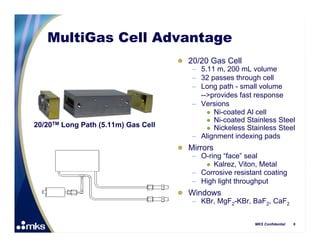
                                      20/20 Gas Cell
                                        – 5.11 m, 200 mL volume
                                        – 32 passes through cell
                                        – Long path - small volume
                                          -->provides fast response
                                        – Versions
                                             Ni-coated Al cell
                                             Ni-coated Stainless Steel
20/20TM Long Path (5.11m) Gas Cell           Nickeless Stainless Steel
                                        – Alignment indexing pads
                                      Mirrors
                                        – O-ring “face” seal
                                             Kalrez, Viton, Metal
                                        – Corrosive resistant coating
                                        – High light throughput
                                      Windows
                                       – KBr, MgF2-KBr, BaF2, CaF2


                                                           MKS Confidential   6
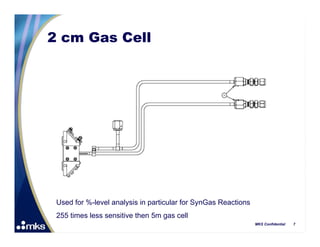
2 cm Gas Cell


 Used for %-level analysis in particular for SynGas Reactions
 255 times less sensitive then 5m gas cell
                                                                MKS Confidential   7
MG2030 MCT Detectors
 LN2 Cooled Detectors
   – Larger Range:
       Greater number of detectable species
       500 cm-1 cut off (16μ)
   – High Sensitivity: Lower minimum level of detection
   – Maintenance
       12 hour coolant refill require
       3-5 days coolant refill with 5L extended dewar


 TE Cooled Detectors
   – Narrow Range:
       Smaller number of detectable species
       2000 cm-1 (5μ), 1350 cm-1 (7.4μ) or 1100 cm-1 (9.2μ)
   – Highest Sensitivity - 2000 cm-1 (5μ),
       Lowest minimum level of detection
       Unable to detect species such as NH3
   – Maintenance - None
                                                               MKS Confidential   8
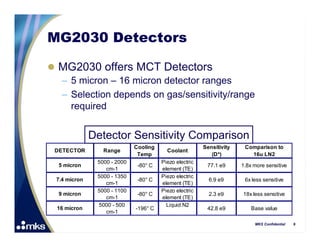
MG2030 Detectors

 MG2030 offers MCT Detectors
  – 5 micron – 16 micron detector ranges
  – Selection depends on gas/sensitivity/range
    required


              Detector Sensitivity Comparison
                             Cooling                    Sensitivity    Comparison to
 DETECTOR        Range                   Coolant
                              Temp                         (D*)          16u LN2
               5000 - 2000             Piezo electric
  5 micron                    -80° C                     77.1 e9      1.8x more sensitive
                  cm-1                 element (TE)
               5000 - 1350             Piezo electric
 7.4 micron                   -80° C                      6.9 e9       6x less sensitive
                  cm-1                 element (TE)
               5000 - 1100             Piezo electric
  9 micron                    -80° C                      2.3 e9      18x less sensitive
                  cm-1                 element (TE)
               5000 - 500                Liquid N2
  16 micron                  -196° C                     42.8 e9          Base value
                  cm-1

                                                                           MKS Confidential   9
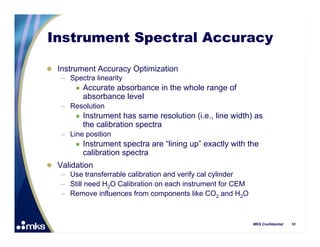
Instrument Spectral Accuracy

 Instrument Accuracy Optimization
   – Spectra linearity
           Accurate absorbance in the whole range of
            absorbance level
    – Resolution
           Instrument has same resolution (i.e., line width) as
            the calibration spectra
    – Line position
           Instrument spectra are “lining up” exactly with the
            calibration spectra
 Validation
   – Use transferrable calibration and verify cal cylinder
   – Still need H2O Calibration on each instrument for CEM
   – Remove influences from components like CO2 and H2O


                                                             MKS Confidential   10
Field Analysis Using FTIR
 Monitoring VOCs
   –   CH4 ranges from 500 up to 3000 ppm
   –   C2H6 in the hundreds of ppm
   –   Propane on the order of 50 ppm and below
   –   Need to speciate to remove Methane and Ethane
   –   Unburned Propane largest VOC contribution after catalyst

 Monitoring HAPs
   – Formaldehyde easy to measure by FTIR

 Conventional Total Hydrocarbon (THC) analyzers
   – Can not separate Propane from Methane or Ethane
   – Use Methane Analyzer then subtracts the rest – Not sensitive
   – Unable to detect all HCs (e.g. formaldehyde)


                                                         MKS Confidential   11
Field Deployable FTIR

 Advantages
  – Multiple species – one instrument
         SO2, NH3, NO, HCl, HF, CO, CO2, H2O, and VOCs
   – Analyze components in high CO2 and H2O
   – Direct analysis – no chemical conversion or “fudge
     factors”
   – Analysis method minimizes interferents
   – Flexibility in Changing in Method
         Customer can easily modify
         Transferable calibrations


                                                MKS Confidential   12
How Can MKS OLT Support You?
 MKS On-Line Products
   – Dedicated to your gas analysis success
 Numerous Applications
   – Compliance
   – Engineering
   – Ambient air
 Support Resources
   – MKS Applications Team
   – MKS Field Services Team
   – Outside Applications Team
 Industry Standard Technology
   – Field proven rugged FTIR analyzer
   – Industry leading software and analysis algorithms
 Financing Assistance Available
   – Capital partners


                                                         MKS Confidential   13
Thank You!

MultiGas 2030 General Overview

  • 1.
    MKS Instruments MultiGas 2030FTIR MKS Instruments On-Line Product Group Presented by: Jim Belanger jim_belanger@mksinst.com
  • 2.
    MultiGas 2030 Features Resolves & analyzes more compounds – 0.5 cm-1 high resolution FTIR  Analysis in 1 second – (0.2 sec for HS version) – High speed FTIR  Fastest response – Long path length, small volume gas cell – 5.11 m, 200 mL gas cell  High speed detectors for all applications – TE or LN2 cooled MCT detectors  No field adjustments required  Provides correction for – Permanently aligned spectrometer pressure fluctuations – 0 – 1000 Torr cap. manometer MKS Confidential 2
  • 3.
    MultiGas Features, continued Maintains permanent calibration – Calibration supplied with instrument Instrument to Instrument Precision – Reduces need for gas cylinders – All instruments maintain same Calibration - fixed calibration Sample  Detection limits ppb to ppm – All with a single gas cell  State-of-the-art spectral analysis – More than 30 compounds simultaneously  Full instrument diagnostics – Quickly pinpoint instrument failure – Demonstrates instrument compliance Carbon Monoxide Spectrum MKS Confidential 3
  • 4.
  • 5.
    MultiGas 2030 -Top View Heated Cell Electronics Detector Box Baratron pressure Heated Gas inlet measurement MKS Confidential 5
  • 6.
    MultiGas Cell Advantage  20/20 Gas Cell – 5.11 m, 200 mL volume – 32 passes through cell – Long path - small volume -->provides fast response – Versions  Ni-coated Al cell  Ni-coated Stainless Steel 20/20TM Long Path (5.11m) Gas Cell  Nickeless Stainless Steel – Alignment indexing pads  Mirrors – O-ring “face” seal  Kalrez, Viton, Metal – Corrosive resistant coating – High light throughput  Windows – KBr, MgF2-KBr, BaF2, CaF2 MKS Confidential 6
  • 7.
    2 cm GasCell Used for %-level analysis in particular for SynGas Reactions 255 times less sensitive then 5m gas cell MKS Confidential 7
  • 8.
    MG2030 MCT Detectors LN2 Cooled Detectors – Larger Range:  Greater number of detectable species  500 cm-1 cut off (16μ) – High Sensitivity: Lower minimum level of detection – Maintenance  12 hour coolant refill require  3-5 days coolant refill with 5L extended dewar  TE Cooled Detectors – Narrow Range:  Smaller number of detectable species  2000 cm-1 (5μ), 1350 cm-1 (7.4μ) or 1100 cm-1 (9.2μ) – Highest Sensitivity - 2000 cm-1 (5μ),  Lowest minimum level of detection  Unable to detect species such as NH3 – Maintenance - None MKS Confidential 8
  • 9.
    MG2030 Detectors  MG2030offers MCT Detectors – 5 micron – 16 micron detector ranges – Selection depends on gas/sensitivity/range required Detector Sensitivity Comparison Cooling Sensitivity Comparison to DETECTOR Range Coolant Temp (D*) 16u LN2 5000 - 2000 Piezo electric 5 micron -80° C 77.1 e9 1.8x more sensitive cm-1 element (TE) 5000 - 1350 Piezo electric 7.4 micron -80° C 6.9 e9 6x less sensitive cm-1 element (TE) 5000 - 1100 Piezo electric 9 micron -80° C 2.3 e9 18x less sensitive cm-1 element (TE) 5000 - 500 Liquid N2 16 micron -196° C 42.8 e9 Base value cm-1 MKS Confidential 9
  • 10.
    Instrument Spectral Accuracy Instrument Accuracy Optimization – Spectra linearity  Accurate absorbance in the whole range of absorbance level – Resolution  Instrument has same resolution (i.e., line width) as the calibration spectra – Line position  Instrument spectra are “lining up” exactly with the calibration spectra  Validation – Use transferrable calibration and verify cal cylinder – Still need H2O Calibration on each instrument for CEM – Remove influences from components like CO2 and H2O MKS Confidential 10
  • 11.
    Field Analysis UsingFTIR  Monitoring VOCs – CH4 ranges from 500 up to 3000 ppm – C2H6 in the hundreds of ppm – Propane on the order of 50 ppm and below – Need to speciate to remove Methane and Ethane – Unburned Propane largest VOC contribution after catalyst  Monitoring HAPs – Formaldehyde easy to measure by FTIR  Conventional Total Hydrocarbon (THC) analyzers – Can not separate Propane from Methane or Ethane – Use Methane Analyzer then subtracts the rest – Not sensitive – Unable to detect all HCs (e.g. formaldehyde) MKS Confidential 11
  • 12.
    Field Deployable FTIR Advantages – Multiple species – one instrument  SO2, NH3, NO, HCl, HF, CO, CO2, H2O, and VOCs – Analyze components in high CO2 and H2O – Direct analysis – no chemical conversion or “fudge factors” – Analysis method minimizes interferents – Flexibility in Changing in Method  Customer can easily modify  Transferable calibrations MKS Confidential 12
  • 13.
    How Can MKSOLT Support You?  MKS On-Line Products – Dedicated to your gas analysis success  Numerous Applications – Compliance – Engineering – Ambient air  Support Resources – MKS Applications Team – MKS Field Services Team – Outside Applications Team  Industry Standard Technology – Field proven rugged FTIR analyzer – Industry leading software and analysis algorithms  Financing Assistance Available – Capital partners MKS Confidential 13
  • 14.