Multicollniarity
Venkat Reddy
Note
• This presentation is just the lecture notes form the corporate training on
Regression Analysis
• The best way to treat this is as a high-level summary; the actual session went more
in depth and contained other information.
• Most of this material was written as informal notes, not intended for publication
• Please send your questions/comments/corrections to
venkat@trenwiseanalytics.com or 21.venkat@gmail.com
• Please check my website for latest version of this document
-Venkat Reddy
Contents
• What is “Multicollinearity”?
• Causes
• Detection
• Effects
• Redemption
What is “Multicollinearity”?
• Multicollinearity (or inter correlation) exists when at least some of the
predictor variables are correlated among themselves
• A “linear” relation between the predictors. Predictors are usually related to
some extent, it is a matter of degree.
Multicollinearity-Illustration
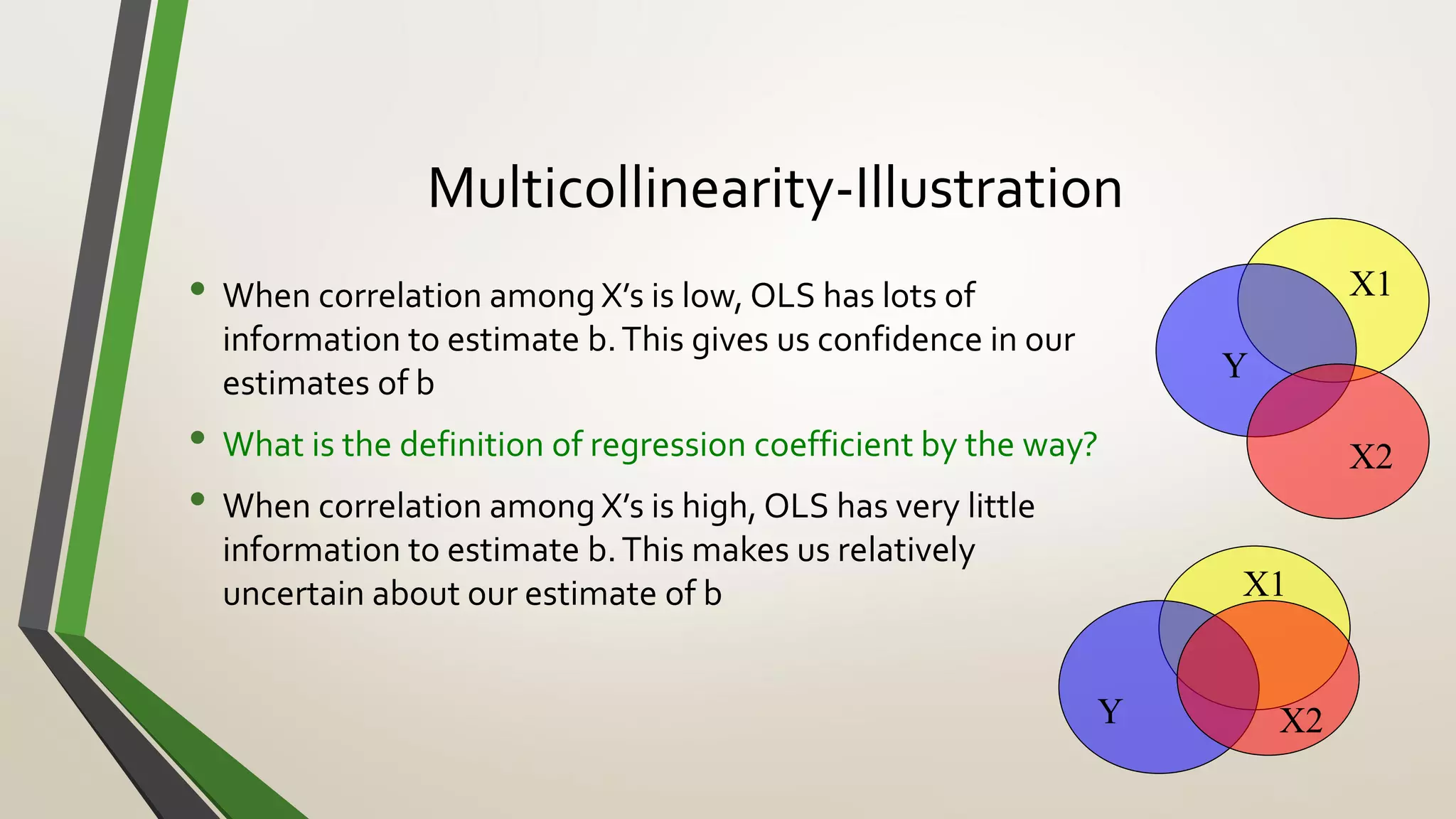
• When correlation among X’s is low, OLS has lots of
information to estimate b.This gives us confidence in our
estimates of b
• What is the definition of regression coefficient by the way?
• When correlation among X’s is high, OLS has very little
information to estimate b.This makes us relatively
uncertain about our estimate of b
Y
X1
X2
Y
X1
X2
Perfect Multicollinearity
• Recall to estimate b, the matrix (X’X)-1 had to exist
• What is OLS estimate of b or beta ?
• This meant that the matrix X had to be of full rank
• That is, none of the X’s could be a perfect linear function of any combination
of the other X’s
• If so, then b is undefined- But this is very rare
Causes of Multicollinearity
• Statistical model specification: adding polynomial terms or trend indicators.
• Too many variables in the model – X’s measure the same conceptual
variable.
• Data collection methods employed.
How to detect Multicollinearity
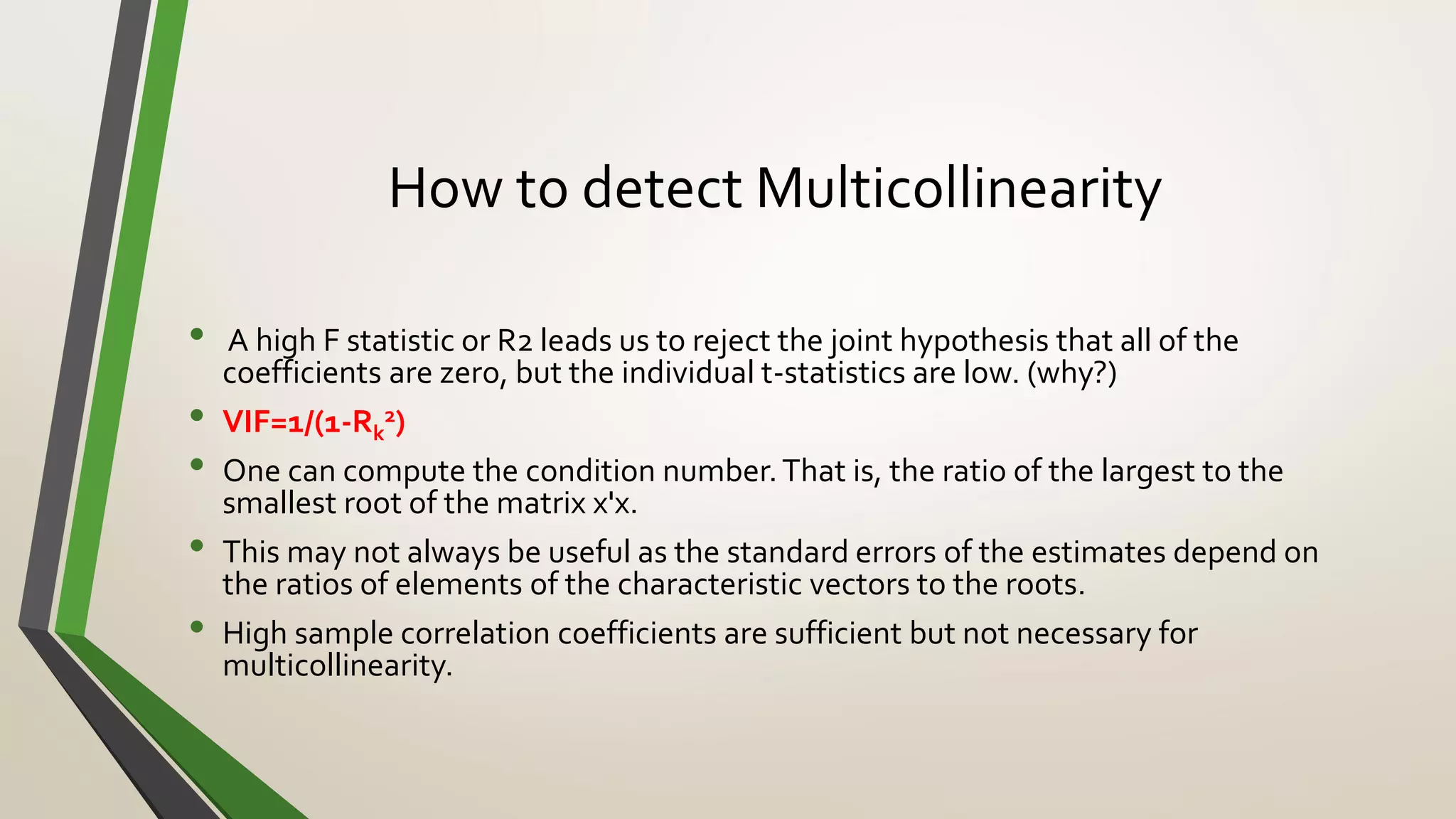
• A high F statistic or R2 leads us to reject the joint hypothesis that all of the
coefficients are zero, but the individual t-statistics are low. (why?)
• VIF=1/(1-Rk
2)
• One can compute the condition number.That is, the ratio of the largest to the
smallest root of the matrix x'x.
• This may not always be useful as the standard errors of the estimates depend on
the ratios of elements of the characteristic vectors to the roots.
• High sample correlation coefficients are sufficient but not necessary for
multicollinearity.
Effects of Multicollinearity
• Even in the presence of multicollinearity, OLS is BLUE and consistent.
• Standard errors of the estimates tend to be large.
• Large standard errors mean large confidence intervals. Large standard
errors mean small observed test statistics. The researcher will accept too
many null hypotheses.The probability of a type II error is large.
• Estimates of standard errors and parameters tend to be sensitive to changes
in the data and the specification of the model.
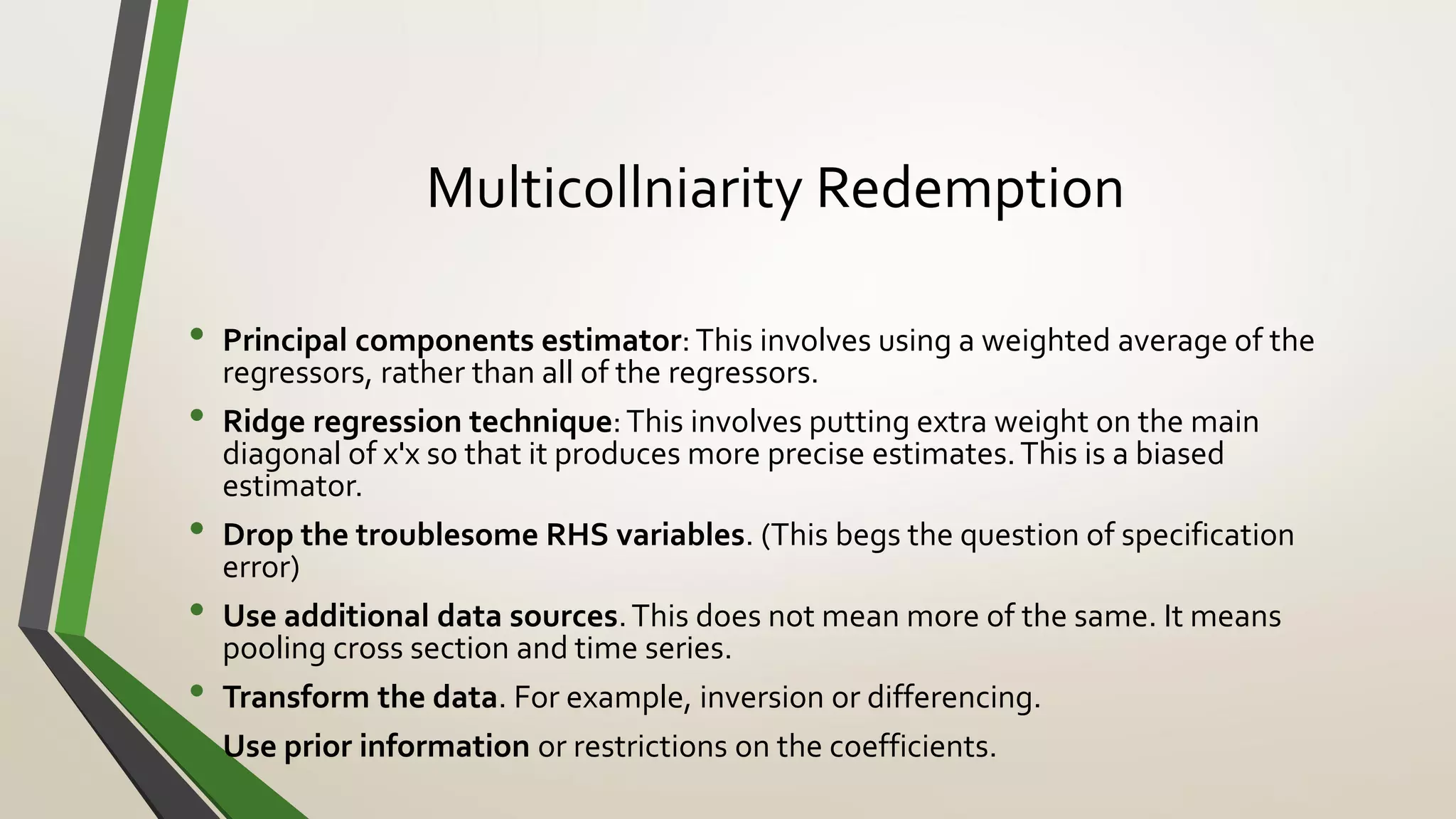
Multicollniarity Redemption
• Principal components estimator: This involves using a weighted average of the
regressors, rather than all of the regressors.
• Ridge regression technique:This involves putting extra weight on the main
diagonal of x'x so that it produces more precise estimates.This is a biased
estimator.
• Drop the troublesome RHS variables. (This begs the question of specification
error)
• Use additional data sources.This does not mean more of the same. It means
pooling cross section and time series.
• Transform the data. For example, inversion or differencing.
• Use prior information or restrictions on the coefficients.

Multicolliniaritymultipleregression

  • 1.
  • 2.
    Note • This presentationis just the lecture notes form the corporate training on Regression Analysis • The best way to treat this is as a high-level summary; the actual session went more in depth and contained other information. • Most of this material was written as informal notes, not intended for publication • Please send your questions/comments/corrections to venkat@trenwiseanalytics.com or 21.venkat@gmail.com • Please check my website for latest version of this document -Venkat Reddy
  • 3.
    Contents • What is“Multicollinearity”? • Causes • Detection • Effects • Redemption
  • 4.
    What is “Multicollinearity”? •Multicollinearity (or inter correlation) exists when at least some of the predictor variables are correlated among themselves • A “linear” relation between the predictors. Predictors are usually related to some extent, it is a matter of degree.
  • 5.
    Multicollinearity-Illustration • When correlationamong X’s is low, OLS has lots of information to estimate b.This gives us confidence in our estimates of b • What is the definition of regression coefficient by the way? • When correlation among X’s is high, OLS has very little information to estimate b.This makes us relatively uncertain about our estimate of b Y X1 X2 Y X1 X2
  • 6.
    Perfect Multicollinearity • Recallto estimate b, the matrix (X’X)-1 had to exist • What is OLS estimate of b or beta ? • This meant that the matrix X had to be of full rank • That is, none of the X’s could be a perfect linear function of any combination of the other X’s • If so, then b is undefined- But this is very rare
  • 7.
    Causes of Multicollinearity •Statistical model specification: adding polynomial terms or trend indicators. • Too many variables in the model – X’s measure the same conceptual variable. • Data collection methods employed.
  • 8.
    How to detectMulticollinearity • A high F statistic or R2 leads us to reject the joint hypothesis that all of the coefficients are zero, but the individual t-statistics are low. (why?) • VIF=1/(1-Rk 2) • One can compute the condition number.That is, the ratio of the largest to the smallest root of the matrix x'x. • This may not always be useful as the standard errors of the estimates depend on the ratios of elements of the characteristic vectors to the roots. • High sample correlation coefficients are sufficient but not necessary for multicollinearity.
  • 9.
    Effects of Multicollinearity •Even in the presence of multicollinearity, OLS is BLUE and consistent. • Standard errors of the estimates tend to be large. • Large standard errors mean large confidence intervals. Large standard errors mean small observed test statistics. The researcher will accept too many null hypotheses.The probability of a type II error is large. • Estimates of standard errors and parameters tend to be sensitive to changes in the data and the specification of the model.
  • 10.
    Multicollniarity Redemption • Principalcomponents estimator: This involves using a weighted average of the regressors, rather than all of the regressors. • Ridge regression technique:This involves putting extra weight on the main diagonal of x'x so that it produces more precise estimates.This is a biased estimator. • Drop the troublesome RHS variables. (This begs the question of specification error) • Use additional data sources.This does not mean more of the same. It means pooling cross section and time series. • Transform the data. For example, inversion or differencing. • Use prior information or restrictions on the coefficients.