











linkedin.com/in/ludoviccharbonnel
twitter.com/ludocharbonnel
fr.slideshare.net/LudovicCharbonnel
ludovic.charbonnel@gmail.com
SOME DATAS
3 APPROACHES
IMPACT
CASE STUDY
SOME DATAS
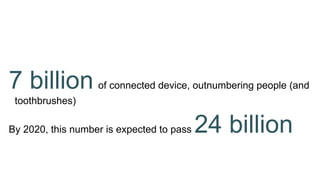
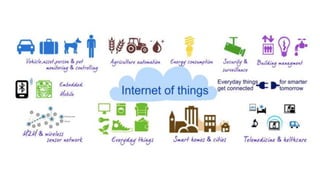
7 billion of connected device, outnumbering people (and
toothbrushes)
By 2020, this number is expected to pass 24 billion
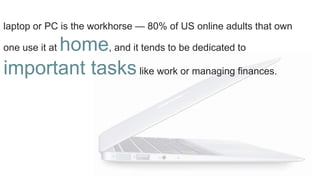
laptop or PC is the workhorse — 80% of US online adults that own
one use it at home, and it tends to be dedicated to
important taskslike work or managing finances.
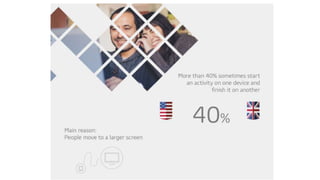
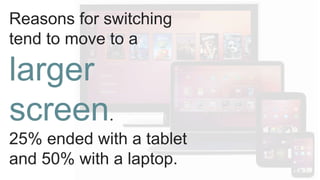
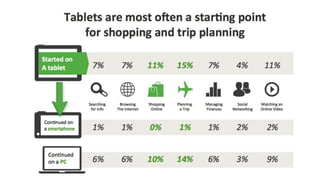
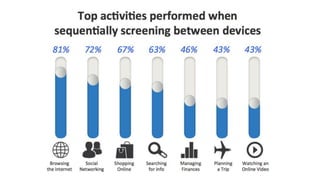
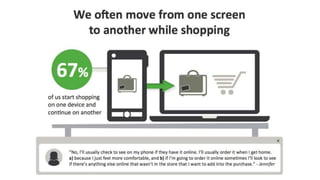
Reasons for switching
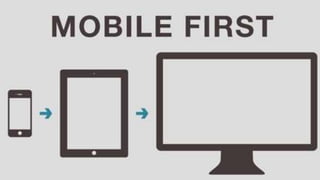
tend to move to a
larger
screen.
25% ended with a tablet
and 50% with a laptop.
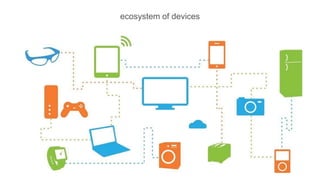
ecosystem of devices
10 Major insights
media consume are radically changed.
Users are more in control of their content grasping.
amplify experiences, share, connect with others, do
multitasking or simply get things done.
the need to adapt to
this new multi-
screening scenario in a
way that we could
engage our consumers
catching up in the right
moment and in the right
way.
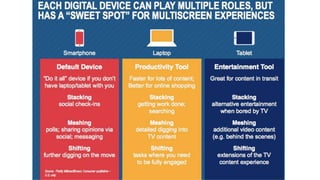
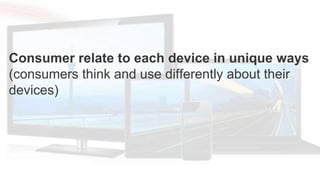
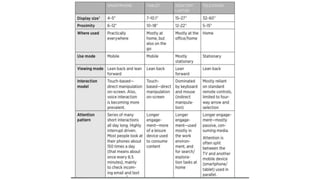
Consumer relate to each device in unique ways
(consumers think and use differently about their
devices)
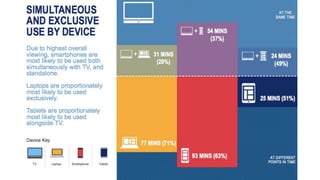
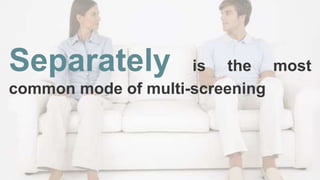
Separately is the most
common mode of multi-screening
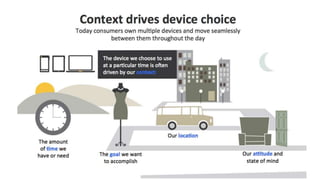
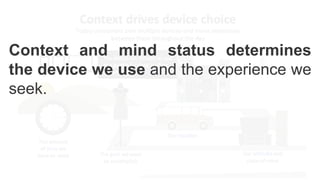
Context and mind status determines
the device we use and the experience we
seek.
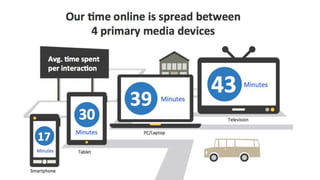
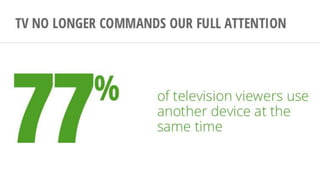
Televisionis not longer the
full-attention media it used to be
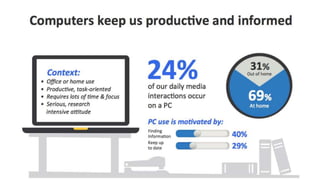
Computer.
information based and
productivityoriented
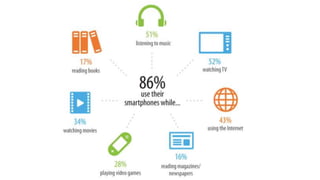
Smartphone
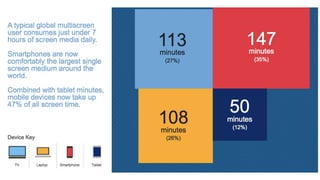
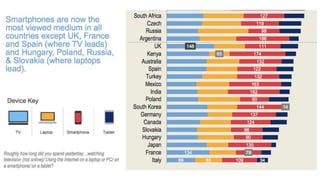
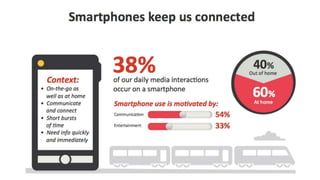
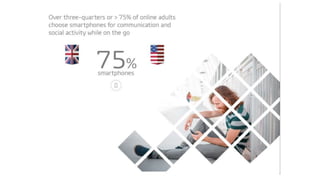
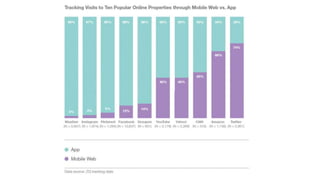
Are the backbone of our daily media
interactions, the most common
companion in all simultaneous multi-screening
behaviour.
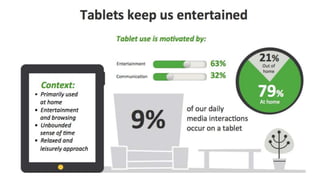
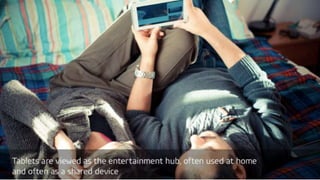
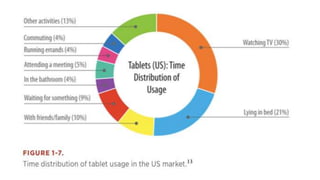
tablet
Is the device most focused on
entertainment activities and
content, and is primarily used at home
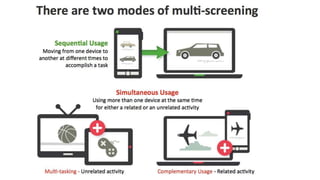
3 modes of multi-screening
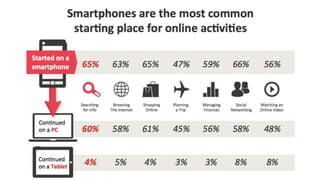
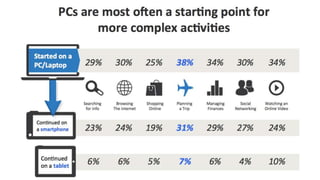
Sequentially moves from one device to another at
different times to accomplish a task
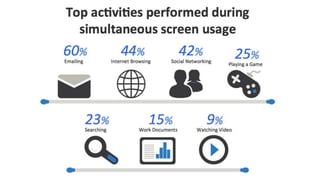
Simultaneously when using more than one device
at the same time
Separately using more than one device at the same
time (simultaneously), but for separated unrelated activities
3 APPROACHES
OF MULTI SCREEN
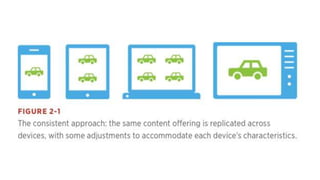
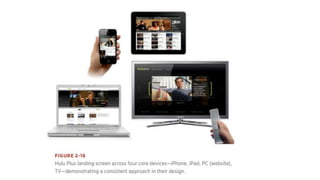
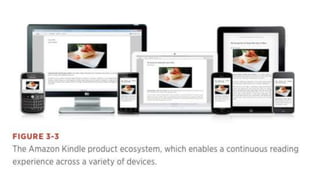
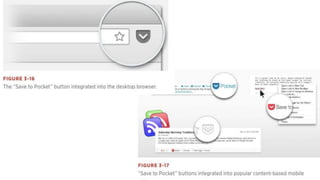
Two key principles of consistent design are:
Offering the same experience across various devices,
porting
the same content and core features in a like manner .
Using informed visual changes and subtle functional
adjust- ments to accommodate the different devices’
screen sizes, form factor, and interaction model (not
identical experiences) .
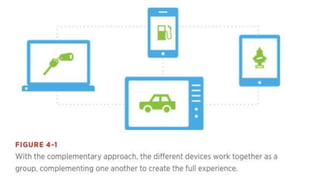
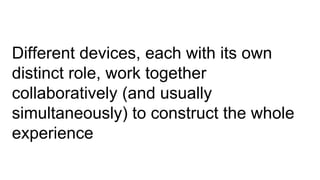
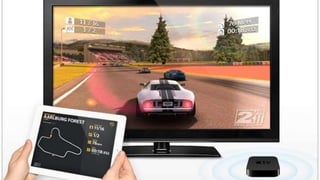
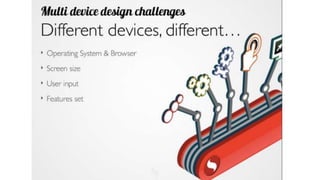
Different devices, each with its own
distinct role, work together
collaboratively (and usually
simultaneously) to construct the whole
experience
IMPACT
with people constantly moving between
devices, it is important for marketers to
reach their audience across all
platforms.
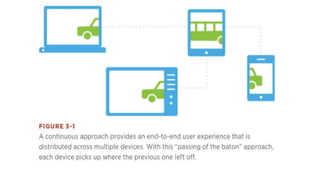
Brand experiences should be consistent, allowing
for people to begin an activity on one device and
finish on another.
simplify the experience on
each device, and provide an overall
connected experience that is greater
than its parts
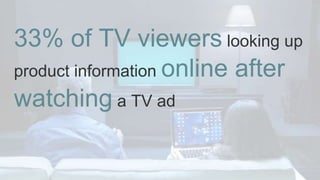
33% of TV viewers looking up
product information online after
watching a TV ad
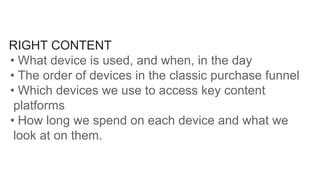
RIGHT CONTENT
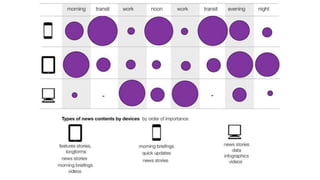
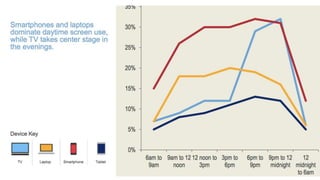
• What device is used, and when, in the day
• The order of devices in the classic purchase funnel
• Which devices we use to access key content
platforms
• How long we spend on each device and what we
look at on them.
While it is clearly critical to get the experience
right for each device, the most important
element is actually removing the constraints
created by this kind of strategy and
centering it on the customer
once again
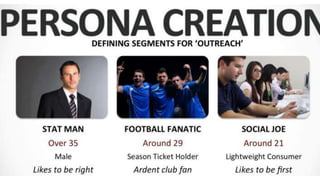
Start with the user:
personas
Personas: specific archetypes of people in the
target audience. The attributes identified across the
group are collected to give birth to a single entity
that represents these users. A persona has a
descriptive name and is meant to be thought of like
someone that actually exists. They are generally a
composite of people that do exist.
understand
whenand wherethey
interact with which particular devices in
their daily lives.
Do I have content to suit each of the personas that make up our
customer base?
Have we thought of ideas for every content type relevant to our
audience and brand (e.g. ebooks, infographics, articles)?
Do we have ideas that will suit mobile, tablet, and desktop needs?
Have we got a plan for the long tail based on what people are
searching for?
Do we know what evergreen content we need and how often we will
revisit and improve it?
Is our educational content designed for all Learning Types (e.g.
kinetic, auditory, etc.)?
Does your content and story translate to other platforms? For
example, games, with good content or stories, can deliver more
engagement.
SOURCE
HTTP://IT-EBOOKS.INFO/BOOK/3314/
HTTP://WWW.MILLWARDBROWN.COM/ADREACTION/2014/REPORT/
MILLWARD-BROWN_ADREACTION-2014_GLOBAL.PDF
HTTP://THINK.WITHGOOGLE.COM/DATABOARD/MEDIA/PDFS/THE-
NEW-MULTI-SCREEN-WORLD-STUDY_RESEARCH-STUDIES.PDF
HTTP://WWW.UX-LADY.COM/GOOGLE-AND-MICROSOFT-MULTI-
SCREEN-EXPERIENCE/
CASE STUDY
CASE STUDY
Choisir un thème
Identifier un persona cible
Définir un scénario d’usage basé sur le multi
device
Définir les types d’usage et les fonctionnalités de chaque
device
Quelques idées marketing selon le scénario
Identifier la concurrence
Quelle est la valeur ajouté de votre offre vs concurrence
Multi Device

Multi Device