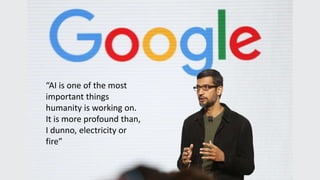
“AI is one of the most
important things
humanity is working on.
It is more profound than,
I dunno, electricity or
fire”
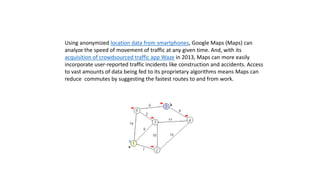
Using anonymized location data from smartphones, Google Maps (Maps) can
analyze the speed of movement of traffic at any given time. And, with its
acquisition of crowdsourced traffic app Waze in 2013, Maps can more easily
incorporate user-reported traffic incidents like construction and accidents. Access
to vast amounts of data being fed to its proprietary algorithms means Maps can
reduce commutes by suggesting the fastest routes to and from work.
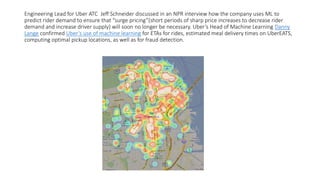
Engineering Lead for Uber ATC Jeff Schneider discussed in an NPR interview how the company uses ML to
predict rider demand to ensure that “surge pricing”(short periods of sharp price increases to decrease rider
demand and increase driver supply) will soon no longer be necessary. Uber’s Head of Machine Learning Danny
Lange confirmed Uber’s use of machine learning for ETAs for rides, estimated meal delivery times on UberEATS,
computing optimal pickup locations, as well as for fraud detection.
Commercial Flights Use an AI Autopilot
AI autopilots in commercial airlines is a surprisingly early use of
AI technology that dates as far back as 1914, depending on how loosely
you define autopilot. The New York Times reports that the average
flight of a Boeing plane involves only seven minutes of human-steered
flight, which is typically reserved only for takeoff and landing.
Your email inbox seems like an unlikely place for AI, but the technology
is largely powering one of its most important features: the spam filter.
Simple rules-based filters (i.e. “filter out messages with the words
‘online pharmacy’ and ‘Nigerian prince’ that come from unknown
addresses”) aren’t effective against spam, because spammers can
quickly update their messages to work around them. Instead, spam
filters must continuously learn from a variety of signals, such as the
words in the message, message metadata (where it’s sent from, who
sent it, etc.).
Can your inbox reply to emails for you? Google thinks so, which is why
it introduced smart reply to Inbox in 2015, a next-generation email
interface. Smart reply uses machine learning to automatically suggest
three different brief (but customized) responses to answer the email.
In June 2016, Facebook announced a new AI initiative: DeepText, a text
understanding engine that, the company claims “can understand with
near-human accuracy the textual content of several thousand posts per
second, spanning more than 20 languages.” DeepText is used in
Facebook Messenger to detect intent—for instance, by allowing you to
hail an Uber from within the app when you message “I need a ride” but
not when you say, “I like to ride donkeys.”

IA DC4 day 3 - 25 05

  • 14.
    “AI is oneof the most important things humanity is working on. It is more profound than, I dunno, electricity or fire”
  • 15.
    Using anonymized locationdata from smartphones, Google Maps (Maps) can analyze the speed of movement of traffic at any given time. And, with its acquisition of crowdsourced traffic app Waze in 2013, Maps can more easily incorporate user-reported traffic incidents like construction and accidents. Access to vast amounts of data being fed to its proprietary algorithms means Maps can reduce commutes by suggesting the fastest routes to and from work.
  • 16.
    Engineering Lead forUber ATC Jeff Schneider discussed in an NPR interview how the company uses ML to predict rider demand to ensure that “surge pricing”(short periods of sharp price increases to decrease rider demand and increase driver supply) will soon no longer be necessary. Uber’s Head of Machine Learning Danny Lange confirmed Uber’s use of machine learning for ETAs for rides, estimated meal delivery times on UberEATS, computing optimal pickup locations, as well as for fraud detection.
  • 17.
    Commercial Flights Usean AI Autopilot AI autopilots in commercial airlines is a surprisingly early use of AI technology that dates as far back as 1914, depending on how loosely you define autopilot. The New York Times reports that the average flight of a Boeing plane involves only seven minutes of human-steered flight, which is typically reserved only for takeoff and landing.
  • 18.
    Your email inboxseems like an unlikely place for AI, but the technology is largely powering one of its most important features: the spam filter. Simple rules-based filters (i.e. “filter out messages with the words ‘online pharmacy’ and ‘Nigerian prince’ that come from unknown addresses”) aren’t effective against spam, because spammers can quickly update their messages to work around them. Instead, spam filters must continuously learn from a variety of signals, such as the words in the message, message metadata (where it’s sent from, who sent it, etc.).
  • 19.
    Can your inboxreply to emails for you? Google thinks so, which is why it introduced smart reply to Inbox in 2015, a next-generation email interface. Smart reply uses machine learning to automatically suggest three different brief (but customized) responses to answer the email.
  • 20.
    In June 2016,Facebook announced a new AI initiative: DeepText, a text understanding engine that, the company claims “can understand with near-human accuracy the textual content of several thousand posts per second, spanning more than 20 languages.” DeepText is used in Facebook Messenger to detect intent—for instance, by allowing you to hail an Uber from within the app when you message “I need a ride” but not when you say, “I like to ride donkeys.”