by Dr. Sean Carton
Navigating the Multi-
Screen Universe
August 2015
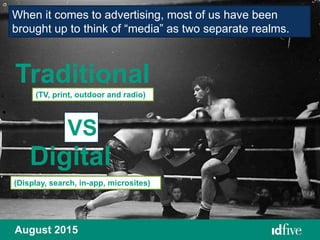
When it comes to advertising, most of us have been
brought up to think of “media” as two separate realms.
Traditional
Digital
VS
(TV, print, outdoor and radio)
(Display, search, in-app, microsites)
August 2015
We tend to think that each medium and each
format within that medium exists on its own.
Television separate from radio
Search separate from online display

Mobile web ads separate from mobile video ads
Unfortunately in today’s media universe, thinking in
terms of these divisions is dead wrong. The world’s
moved on. We’re in a whole new media universe.
August 2015
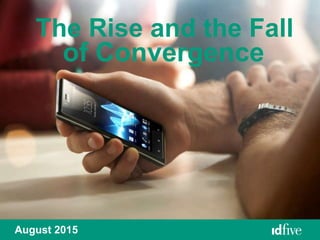
The Rise and the Fall
August 2015
of Convergence
August 2015
As web usage in the early 1990s spread people
began to use it as a way to publish their own
content…
Overtime people began putting video, music, games
and other digital content online…making it not a
medium but a metamedium (a medium of media).
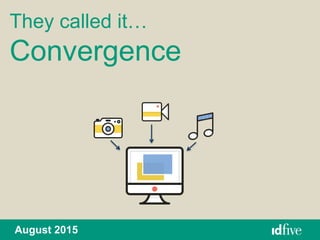
They called it…
Convergence
August 2015
New types of screens started to pop up,
screens that allowed us to access content
over the Internet in a way that didn’t feel
like using a computer and didn't feel like
television. Screens that were a lot smaller,
more portable, and personal.
Then something changed…
August 2015
August 2015
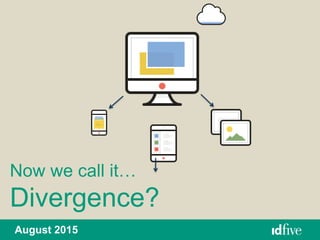
Now we call it…
Divergence?
August 2015
Instead of one screen convergence we got
multiple screens that allowed us to multitask our
content consumption in a very personal way.
The advent of the smartphone and tablet marked
the beginning of the multi-screen universe we
find ourselves in today.
Then, everything
started to look
totally different.
August 2015
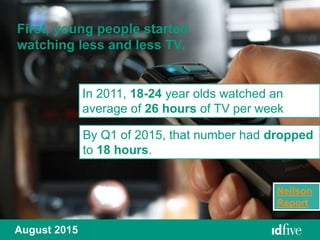
First, young people started
watching less and less TV.
In 2011, 18-24 year olds watched an
average of 26 hours of TV per week
By Q1 of 2015, that number had dropped
to 18 hours.
Neilson
Report
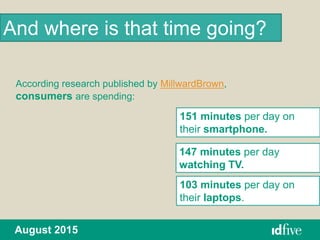
According research published by MillwardBrown,
consumers are spending:
151 minutes per day on
their smartphone.
147 minutes per day
watching TV.
103 minutes per day on
their laptops.
August 2015
And where is that time going?
But the real question isn’t what are we doing instead of
watching TV, but what are we doing while watching TV?
August 2015
In a study done by YuMe the test
group spent just 53% of the time
singularly watching TV when
other devices were
available…after only 4 minutes,
they spent 19% of the time
watching TV.
So why does our attention
wander so quickly?
August 2015
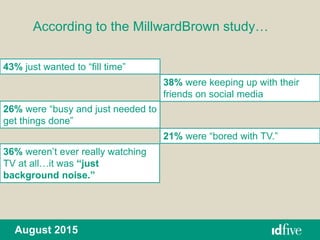
According to the MillwardBrown study…
43% just wanted to “fill time”
26% were “busy and just needed to
get things done”
36% weren’t ever really watching
TV at all…it was “just
background noise.”
August 2015
21% were “bored with TV.”
38% were keeping up with their
friends on social media
August 2015
Not good right?
Simply put, if these numbers are generalized to the
entire TV watching population (or, in the very least,
the 64% who own smartphones, it means that a big
chunk of the TV audience aren’t watching TV at all.
The TV’s on, but nobody’s home.
August 2015
As unfortunate as this may be, this is still our
audience, and we need to target them.
So let’s get busy.
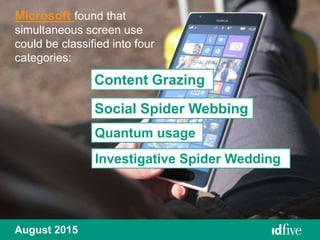
Microsoft found that
simultaneous screen use
could be classified into four
categories:
August 2015
Content Grazing
Social Spider Webbing
Quantum usage
Investigative Spider Wedding
August 2015
Content Grazing (68% of respondents)
Engaging in behavior to distract themselves.
August 2015
Social Spider Webbing (39% of respondents)
Connecting and sharing with others while doing
something else.
August 2015
Investigative Spider Wedding (57% of respondents)
Simultaneous usage for gathering information on a topic
or discovering new things (e.g. Researching actors on
IMDB.com while watching a movie.
August 2015
Quantum usage (46% of respondents)
Sequential, content based browsing.
Moving from one link to another.
August 2015
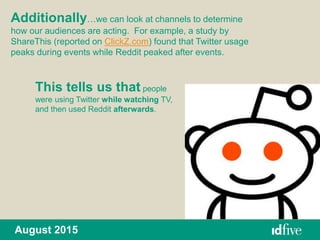
Additionally…we can look at channels to determine
how our audiences are acting. For example, a study by
ShareThis (reported on ClickZ.com) found that Twitter usage
peaks during events while Reddit peaked after events.
This tells us that people
were using Twitter while watching TV,
and then used Reddit afterwards.
August 2015
Reaching these fragmented audiences
requires advertisers to understand what
device the target audience is using and
what they’re using it for. It requires us to
locate them.
August 2015
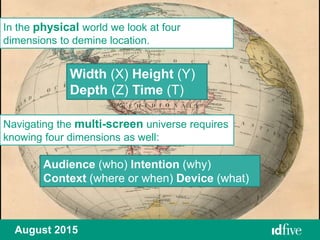
In the physical world we look at four
dimensions to demine location.
Width (X) Height (Y)
Depth (Z) Time (T)
Navigating the multi-screen universe requires
knowing four dimensions as well:
Audience (who) Intention (why)
Context (where or when) Device (what)
August 2015
1. Age
2. Sex
3. Ethnicity
4. Income
5. Etc.
Audience:
August 2015
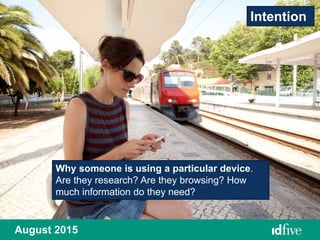
Why someone is using a particular device.
Are they research? Are they browsing? How
much information do they need?
Intention
August 2015
How the persons
environment is effective
them…are they on their
lunch break? Are they
with their family? Are
they in a rush?
Context
August 2015
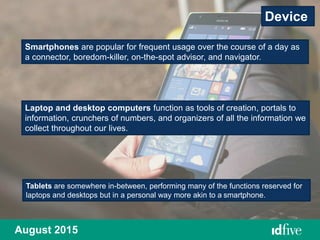
Smartphones are popular for frequent usage over the course of a day as
a connector, boredom-killer, on-the-spot advisor, and navigator.
Device
Laptop and desktop computers function as tools of creation, portals to
information, crunchers of numbers, and organizers of all the information we
collect throughout our lives.
Tablets are somewhere in-between, performing many of the functions reserved for
laptops and desktops but in a personal way more akin to a smartphone.
So let’s take a test…
Say we want to reach prospective
undergraduate students of a college.
They have an idea of what type of
school they want and are trying to
narrow their list down to their top five
schools. They have to start applying
in a month.
August 2015
Audience: prospective students between 16-18
who are interested in attending college.
Intention: they want to pick a college that’s right
for them.
Context: in their home (or primary domicile)
focused on searching
Device: laptop or desktop, either in their
bedroom or in a public area in the home.
August 2015
Given these four dimensions, how can
we reach our audience?
August 2015
Since they’re engaged in a search, use paid
search or listings on college ranking web
sites.
Because they’re home they have time to read more
information than they would if they were reading off
their phone and they probably have some older
adults to share their findings with.
With access to a laptop or desktop we can offer them
more processor-intensive, immersive experiences
such as high definition video or graphically-intense
interactive pieces (e.g. virtual tours of a campus).
August 2015
In advertising we’re constantly trying to navigate an ever-changing media
landscape to find our audience. While the massive cultural shifts of the
past few years make the landscape of the future less predictable, if we
understand the dimensions we need to navigate we can begin mapping
out the territory.
Read the full
Whitepaper at:
August 2015
http://idfive.com/navigating-the-multi-screen-universe/
Sign up for idfive’s
monthly whitepaper

Navigating the Multi-Screen Universe

  • 1.
    by Dr. SeanCarton Navigating the Multi- Screen Universe
  • 2.
    August 2015 When itcomes to advertising, most of us have been brought up to think of “media” as two separate realms. Traditional Digital VS (TV, print, outdoor and radio) (Display, search, in-app, microsites)
  • 3.
    August 2015 We tendto think that each medium and each format within that medium exists on its own. Television separate from radio Search separate from online display Mobile web ads separate from mobile video ads
  • 4.
    Unfortunately in today’smedia universe, thinking in terms of these divisions is dead wrong. The world’s moved on. We’re in a whole new media universe. August 2015
  • 5.
    The Rise andthe Fall August 2015 of Convergence
  • 6.
    August 2015 As webusage in the early 1990s spread people began to use it as a way to publish their own content… Overtime people began putting video, music, games and other digital content online…making it not a medium but a metamedium (a medium of media).
  • 7.
  • 8.
    New types ofscreens started to pop up, screens that allowed us to access content over the Internet in a way that didn’t feel like using a computer and didn't feel like television. Screens that were a lot smaller, more portable, and personal. Then something changed… August 2015
  • 9.
    August 2015 Now wecall it… Divergence?
  • 10.
    August 2015 Instead ofone screen convergence we got multiple screens that allowed us to multitask our content consumption in a very personal way. The advent of the smartphone and tablet marked the beginning of the multi-screen universe we find ourselves in today. Then, everything started to look totally different.
  • 11.
    August 2015 First, youngpeople started watching less and less TV. In 2011, 18-24 year olds watched an average of 26 hours of TV per week By Q1 of 2015, that number had dropped to 18 hours. Neilson Report
  • 12.
    According research publishedby MillwardBrown, consumers are spending: 151 minutes per day on their smartphone. 147 minutes per day watching TV. 103 minutes per day on their laptops. August 2015 And where is that time going?
  • 13.
    But the realquestion isn’t what are we doing instead of watching TV, but what are we doing while watching TV? August 2015 In a study done by YuMe the test group spent just 53% of the time singularly watching TV when other devices were available…after only 4 minutes, they spent 19% of the time watching TV.
  • 14.
    So why doesour attention wander so quickly? August 2015
  • 15.
    According to theMillwardBrown study… 43% just wanted to “fill time” 26% were “busy and just needed to get things done” 36% weren’t ever really watching TV at all…it was “just background noise.” August 2015 21% were “bored with TV.” 38% were keeping up with their friends on social media
  • 16.
    August 2015 Not goodright? Simply put, if these numbers are generalized to the entire TV watching population (or, in the very least, the 64% who own smartphones, it means that a big chunk of the TV audience aren’t watching TV at all. The TV’s on, but nobody’s home.
  • 17.
    August 2015 As unfortunateas this may be, this is still our audience, and we need to target them. So let’s get busy.
  • 18.
    Microsoft found that simultaneousscreen use could be classified into four categories: August 2015 Content Grazing Social Spider Webbing Quantum usage Investigative Spider Wedding
  • 19.
    August 2015 Content Grazing(68% of respondents) Engaging in behavior to distract themselves.
  • 20.
    August 2015 Social SpiderWebbing (39% of respondents) Connecting and sharing with others while doing something else.
  • 21.
    August 2015 Investigative SpiderWedding (57% of respondents) Simultaneous usage for gathering information on a topic or discovering new things (e.g. Researching actors on IMDB.com while watching a movie.
  • 22.
    August 2015 Quantum usage(46% of respondents) Sequential, content based browsing. Moving from one link to another.
  • 23.
    August 2015 Additionally…we canlook at channels to determine how our audiences are acting. For example, a study by ShareThis (reported on ClickZ.com) found that Twitter usage peaks during events while Reddit peaked after events. This tells us that people were using Twitter while watching TV, and then used Reddit afterwards.
  • 24.
    August 2015 Reaching thesefragmented audiences requires advertisers to understand what device the target audience is using and what they’re using it for. It requires us to locate them.
  • 25.
    August 2015 In thephysical world we look at four dimensions to demine location. Width (X) Height (Y) Depth (Z) Time (T) Navigating the multi-screen universe requires knowing four dimensions as well: Audience (who) Intention (why) Context (where or when) Device (what)
  • 26.
    August 2015 1. Age 2.Sex 3. Ethnicity 4. Income 5. Etc. Audience:
  • 27.
    August 2015 Why someoneis using a particular device. Are they research? Are they browsing? How much information do they need? Intention
  • 28.
    August 2015 How thepersons environment is effective them…are they on their lunch break? Are they with their family? Are they in a rush? Context
  • 29.
    August 2015 Smartphones arepopular for frequent usage over the course of a day as a connector, boredom-killer, on-the-spot advisor, and navigator. Device Laptop and desktop computers function as tools of creation, portals to information, crunchers of numbers, and organizers of all the information we collect throughout our lives. Tablets are somewhere in-between, performing many of the functions reserved for laptops and desktops but in a personal way more akin to a smartphone.
  • 30.
    So let’s takea test… Say we want to reach prospective undergraduate students of a college. They have an idea of what type of school they want and are trying to narrow their list down to their top five schools. They have to start applying in a month. August 2015
  • 31.
    Audience: prospective studentsbetween 16-18 who are interested in attending college. Intention: they want to pick a college that’s right for them. Context: in their home (or primary domicile) focused on searching Device: laptop or desktop, either in their bedroom or in a public area in the home. August 2015 Given these four dimensions, how can we reach our audience?
  • 32.
    August 2015 Since they’reengaged in a search, use paid search or listings on college ranking web sites. Because they’re home they have time to read more information than they would if they were reading off their phone and they probably have some older adults to share their findings with. With access to a laptop or desktop we can offer them more processor-intensive, immersive experiences such as high definition video or graphically-intense interactive pieces (e.g. virtual tours of a campus).
  • 33.
    August 2015 In advertisingwe’re constantly trying to navigate an ever-changing media landscape to find our audience. While the massive cultural shifts of the past few years make the landscape of the future less predictable, if we understand the dimensions we need to navigate we can begin mapping out the territory.
  • 34.
    Read the full Whitepaperat: August 2015 http://idfive.com/navigating-the-multi-screen-universe/
  • 35.
    Sign up foridfive’s monthly whitepaper