
The Need for High Resolution Digital Elevation Data for Precision Conservation in Minnesota Dr. David Mulla Professor and W.E. Larson Chair for Soil and Water Resources Department of Soil, Water, & Climate University of Minnesota
Precision Conservation Precision Conservation allows small portions of the landscape that have a disproportionate effect on water quality or wildlife habitat to be targeted with Best Management Practices (BMPs) Best Management Practices placed on critical landscapes can help treat small areas that produce disproportionate amounts of pollution Identifying critical landscape areas can best be achieved using high resolution digital elevation data, although information about existing management practices is also important
Precision Conservation   (compared to Precision Ag) (From  Berry, 2008 )
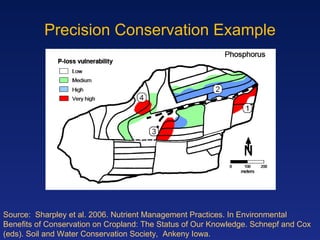
Precision Conservation Example Source:  Sharpley et al. 2006. Nutrient Management Practices. In Environmental Benefits of Conservation on Cropland: The Status of Our Knowledge. Schnepf and Cox (eds). Soil and Water Conservation Society,  Ankeny Iowa.
 
Precision Conservation Example Sites of Biodiversity Significance Wildlife Management Areas 250m buffer around current  WMAs and Biodiversity Sites
Clean Water Funding Initiatives Passage of the Clean Water Legacy Amendment provides badly needed funding for protection, restoration and enhancement of impaired waters and damaged wildlife habitat Funding from the Clean Water Legacy Amendment should be spent on the most critical landscapes and sources of degradation rather than spread evenly across the state There is a pressing need to identify critical sources of water quality degradation and their locations in order to select and implement BMPs
The 2008 Impaired Waters list  contains 1,469 impairments including: 500 lakes 25 listed for multiple pollutants 336 rivers & streams 603 “reaches” w/many pollutants
Lake Pepin Watershed TMDL Sediment Phosphorus
Existing BMP Programs RIM program involved 203,000 acres enrolled in 5,300 conservation easements Program is heavily focused on Minnesota River Basin riparian areas and wetlands
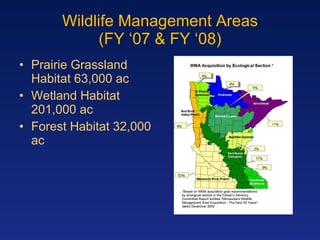
Wildlife Management Areas (FY ‘07 & FY ‘08) Prairie Grassland Habitat 63,000 ac Wetland Habitat 201,000 ac Forest Habitat 32,000 ac
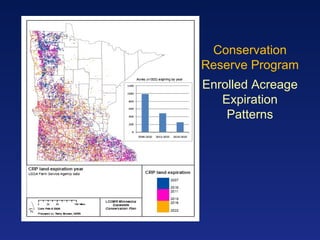
Conservation Reserve Program Enrolled Acreage Expiration Patterns
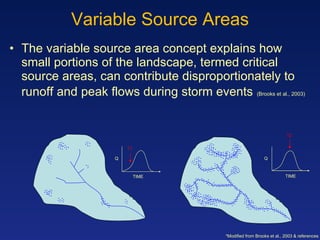
Variable Source Areas The variable source area concept explains how small portions of the landscape, termed critical source areas, can contribute disproportionately to runoff and peak flows during storm events   (Brooks et al., 2003)  Q TIME Q TIME T2 T1 *Modified from Brooks et al., 2003 & references
Critical Source Areas Critical source areas can include upland depressions, riparian areas, open culverts and tile outlets, gullies, ravines, eroding stream banks and slumping stream bluffs
Critical Area Problem Studies suggest that small areas of the agricultural landscape (5-25%) generate a disproportionately large amount of erosion or phosphorus The reduction of nonpoint source pollution loads at the outlet of agricultural watersheds is dependent on the implementation of best management practices (BMPs) in critical source areas of nonpoint source pollution Defining critical source areas is a challenge, but terrain analysis of digital elevation models (DEMs) is promising
Converging/Diverging Flows
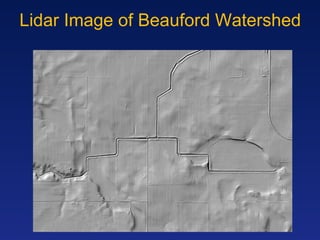
Lidar Image of Beauford Watershed
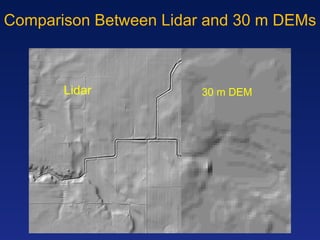
Comparison Between Lidar and 30 m DEMs Lidar 30 m DEM
Terrain Attributes for Precision Conservation Terrain attributes can be derived from DEMs using… ESRI’s AcrGIS v. 9.2 TAUDEM v. 3.1  (Tarboton, 2005) D∞ method of flow routing (Tarboten, 1997) Critical source area data layers can be created by combining… Different thresholds applied to terrain attributes Ancillary GIS data (Soils drainage, Landuse/Landcover)
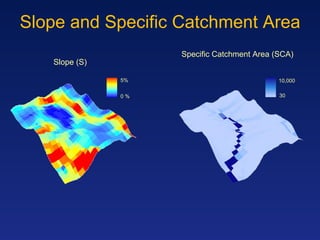
Slope (S) Specific Catchment Area (SCA) Slope and Specific Catchment Area 5% 0 % 30 10,000
Landscape slope Affects overland flow and erosion potential
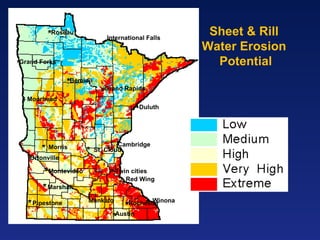
Sheet & Rill Water Erosion Potential Duluth Bemidji Cambridge Twin cities Grand Forks Winona Rochester Pipestone Marshall Montevideo St. Cloud Roseau Moorhead Austin Mankato Morris Grand Rapids International Falls Ortonville Red Wing
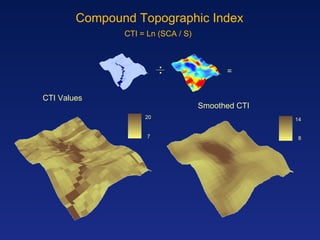
CTI Values Smoothed CTI Compound Topographic Index 7 20 8 14 CTI = Ln (SCA / S) =
Characterizes soil water content and surface saturation zones Compound Topographic Index CTI = ln(As/tan S) As is specific catchment S is slope
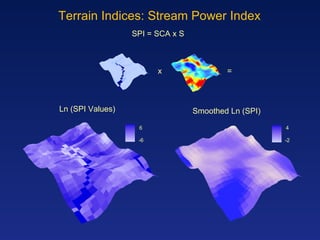
Terrain Indices: Stream Power Index Ln (SPI Values) Smoothed Ln (SPI) -6 6 -2 4 SPI = SCA x S x =
Stream Power Index SPI = As tanS As is specific catchment area, S is slope Measures erosive power of overland flow
Types of Water Erosion Upland sheet and rill erosion Construction site erosion Gully and ravine erosion Stream bank erosion Stream bluff erosion
Deposition from Sheet & Rill Erosion
Construction Site Erosion
Ravine Erosion
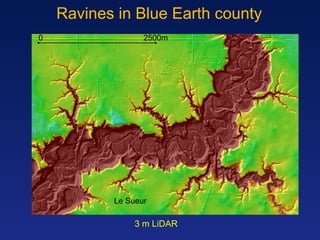
Ravines in Blue Earth county 3 m LiDAR Le Sueur 0   2500m
Ravines in Blue Earth county 30 m DEM Le Sueur 0   2500m
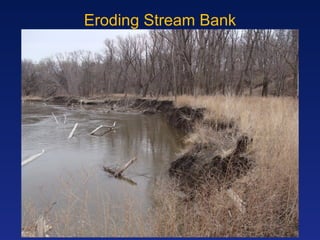
Eroding Stream Bank
Stream Bluff Erosion
Disproportionalities The Le Sueur contributes a disproportionate amount of non-point source pollution to the Minnesota River Only comprises 7% of the basin land surface area 53% TSS 31% Total P 20% NO 3 -N (MRBDC, 2005)   Data Source: ESRI & MN DNR Le Sueur River Watershed N Km 0 15 30 0 100 200 Km
Cobb River Slumping Bluff
Appendix D
Ravine Sediment Sources Digitized  from Blue Earth county Lidar by Patrick Belmont - NCED
8 14 Upland Depressions Delineation Smoothed CTI > 11.5 Drainage = “Poorly Drained” = Upland Depressions + Upland Depressions Critical Areas
Upland Depressions Covers nearly 20,000 ha (7%) in the Le Sueur Watershed 85% of upland depressions are in ag production Upland Depressions Critical Areas N Data source: MN DNR 0 20 40 Km
Upland Depressions Data source: MN DNR & MN LMIC N Upland Depressions Critical Areas 0 15 30 Km 0 2.5 5 Km 0 500 1,000 Meters
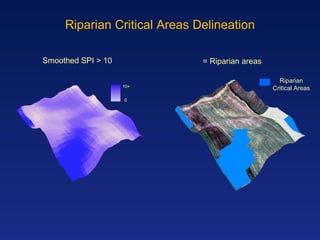
Riparian Critical Areas Delineation Smoothed SPI > 10 = Riparian areas 0 10+ Riparian Critical Areas
Critical Riparian Areas Riparian Critical Areas Covers over 25% of the watershed (~74,000ha) 59% of riparian critical areas are in ag production When combined with erosion potential, gives high priority areas needing BMPs N Data source: MN DNR 0 20 40 Km
Conclusions Disproportionate amounts of sediment and phosphorus are generated from small areas of the watershed The effectiveness of BMPs depends on placing them in vulnerable portions of the landscape Precision conservation strategies involving terrain analysis may prove very helpful in the future to guide conservation efforts tailored to specific landscapes and to maximize efficiency of their placement Lidar based DEMs can help improve the accuracy of identifying critical landscapes and targeting BMPs to critical areas
Thank You.  Questions?

Mulla - Precision Conservation

  • 1.
    The Need forHigh Resolution Digital Elevation Data for Precision Conservation in Minnesota Dr. David Mulla Professor and W.E. Larson Chair for Soil and Water Resources Department of Soil, Water, & Climate University of Minnesota
  • 2.
    Precision Conservation PrecisionConservation allows small portions of the landscape that have a disproportionate effect on water quality or wildlife habitat to be targeted with Best Management Practices (BMPs) Best Management Practices placed on critical landscapes can help treat small areas that produce disproportionate amounts of pollution Identifying critical landscape areas can best be achieved using high resolution digital elevation data, although information about existing management practices is also important
  • 3.
    Precision Conservation (compared to Precision Ag) (From Berry, 2008 )
  • 4.
    Precision Conservation ExampleSource: Sharpley et al. 2006. Nutrient Management Practices. In Environmental Benefits of Conservation on Cropland: The Status of Our Knowledge. Schnepf and Cox (eds). Soil and Water Conservation Society, Ankeny Iowa.
  • 5.
  • 6.
    Precision Conservation ExampleSites of Biodiversity Significance Wildlife Management Areas 250m buffer around current WMAs and Biodiversity Sites
  • 7.
    Clean Water FundingInitiatives Passage of the Clean Water Legacy Amendment provides badly needed funding for protection, restoration and enhancement of impaired waters and damaged wildlife habitat Funding from the Clean Water Legacy Amendment should be spent on the most critical landscapes and sources of degradation rather than spread evenly across the state There is a pressing need to identify critical sources of water quality degradation and their locations in order to select and implement BMPs
  • 8.
    The 2008 ImpairedWaters list contains 1,469 impairments including: 500 lakes 25 listed for multiple pollutants 336 rivers & streams 603 “reaches” w/many pollutants
  • 9.
    Lake Pepin WatershedTMDL Sediment Phosphorus
  • 10.
    Existing BMP ProgramsRIM program involved 203,000 acres enrolled in 5,300 conservation easements Program is heavily focused on Minnesota River Basin riparian areas and wetlands
  • 11.
    Wildlife Management Areas(FY ‘07 & FY ‘08) Prairie Grassland Habitat 63,000 ac Wetland Habitat 201,000 ac Forest Habitat 32,000 ac
  • 12.
    Conservation Reserve ProgramEnrolled Acreage Expiration Patterns
  • 13.
    Variable Source AreasThe variable source area concept explains how small portions of the landscape, termed critical source areas, can contribute disproportionately to runoff and peak flows during storm events (Brooks et al., 2003) Q TIME Q TIME T2 T1 *Modified from Brooks et al., 2003 & references
  • 14.
    Critical Source AreasCritical source areas can include upland depressions, riparian areas, open culverts and tile outlets, gullies, ravines, eroding stream banks and slumping stream bluffs
  • 15.
    Critical Area ProblemStudies suggest that small areas of the agricultural landscape (5-25%) generate a disproportionately large amount of erosion or phosphorus The reduction of nonpoint source pollution loads at the outlet of agricultural watersheds is dependent on the implementation of best management practices (BMPs) in critical source areas of nonpoint source pollution Defining critical source areas is a challenge, but terrain analysis of digital elevation models (DEMs) is promising
  • 16.
  • 17.
    Lidar Image ofBeauford Watershed
  • 18.
    Comparison Between Lidarand 30 m DEMs Lidar 30 m DEM
  • 19.
    Terrain Attributes forPrecision Conservation Terrain attributes can be derived from DEMs using… ESRI’s AcrGIS v. 9.2 TAUDEM v. 3.1 (Tarboton, 2005) D∞ method of flow routing (Tarboten, 1997) Critical source area data layers can be created by combining… Different thresholds applied to terrain attributes Ancillary GIS data (Soils drainage, Landuse/Landcover)
  • 20.
    Slope (S) SpecificCatchment Area (SCA) Slope and Specific Catchment Area 5% 0 % 30 10,000
  • 21.
    Landscape slope Affectsoverland flow and erosion potential
  • 22.
    Sheet & RillWater Erosion Potential Duluth Bemidji Cambridge Twin cities Grand Forks Winona Rochester Pipestone Marshall Montevideo St. Cloud Roseau Moorhead Austin Mankato Morris Grand Rapids International Falls Ortonville Red Wing
  • 23.
    CTI Values SmoothedCTI Compound Topographic Index 7 20 8 14 CTI = Ln (SCA / S) =
  • 24.
    Characterizes soil watercontent and surface saturation zones Compound Topographic Index CTI = ln(As/tan S) As is specific catchment S is slope
  • 25.
    Terrain Indices: StreamPower Index Ln (SPI Values) Smoothed Ln (SPI) -6 6 -2 4 SPI = SCA x S x =
  • 26.
    Stream Power IndexSPI = As tanS As is specific catchment area, S is slope Measures erosive power of overland flow
  • 27.
    Types of WaterErosion Upland sheet and rill erosion Construction site erosion Gully and ravine erosion Stream bank erosion Stream bluff erosion
  • 28.
    Deposition from Sheet& Rill Erosion
  • 29.
  • 30.
  • 31.
    Ravines in BlueEarth county 3 m LiDAR Le Sueur 0 2500m
  • 32.
    Ravines in BlueEarth county 30 m DEM Le Sueur 0 2500m
  • 33.
  • 34.
  • 35.
    Disproportionalities The LeSueur contributes a disproportionate amount of non-point source pollution to the Minnesota River Only comprises 7% of the basin land surface area 53% TSS 31% Total P 20% NO 3 -N (MRBDC, 2005) Data Source: ESRI & MN DNR Le Sueur River Watershed N Km 0 15 30 0 100 200 Km
  • 36.
  • 37.
  • 38.
    Ravine Sediment SourcesDigitized from Blue Earth county Lidar by Patrick Belmont - NCED
  • 39.
    8 14 UplandDepressions Delineation Smoothed CTI > 11.5 Drainage = “Poorly Drained” = Upland Depressions + Upland Depressions Critical Areas
  • 40.
    Upland Depressions Coversnearly 20,000 ha (7%) in the Le Sueur Watershed 85% of upland depressions are in ag production Upland Depressions Critical Areas N Data source: MN DNR 0 20 40 Km
  • 41.
    Upland Depressions Datasource: MN DNR & MN LMIC N Upland Depressions Critical Areas 0 15 30 Km 0 2.5 5 Km 0 500 1,000 Meters
  • 42.
    Riparian Critical AreasDelineation Smoothed SPI > 10 = Riparian areas 0 10+ Riparian Critical Areas
  • 43.
    Critical Riparian AreasRiparian Critical Areas Covers over 25% of the watershed (~74,000ha) 59% of riparian critical areas are in ag production When combined with erosion potential, gives high priority areas needing BMPs N Data source: MN DNR 0 20 40 Km
  • 44.
    Conclusions Disproportionate amountsof sediment and phosphorus are generated from small areas of the watershed The effectiveness of BMPs depends on placing them in vulnerable portions of the landscape Precision conservation strategies involving terrain analysis may prove very helpful in the future to guide conservation efforts tailored to specific landscapes and to maximize efficiency of their placement Lidar based DEMs can help improve the accuracy of identifying critical landscapes and targeting BMPs to critical areas
  • 45.
    Thank You. Questions?

Editor's Notes

  • #10 Agriculture or cultivated lands are sources of sediment and nutrients Hay, pasture, grassland, forest and lakes are minor contributors to this issue. Bogs and forested wetlands are sources of tannic acid. Urban areas provide sediment particles, and nutrients.
  • #13 The full spectrum of human activities on the land: conservancy and restoration activity low impact design in urban and shoreland development and redevelopment BMPs in agriculture and other land use Besides cost benefit, need critical evaluation of opportunities and benefits of improved regulation of major land altering uses and activities Value - Information needs to be distilled, synthesized and make accessible and understandable to users The potential to reduce the adverse effects of land use practices is significant
  • #21 These primary terrain attributes are the basis for terrain indices employed throughout this analysis. (Here slope is presented in percent but in subsequent calculations, this value was divided by 100 to equate to the tangent of slope angle. To avoid data errors in secondary attribute calculation, slope values of 0 were reclassified to 0.001. ) Specific catchment area, also known as contributing area or flow accumulation, represents the total upslope land area that drains into any single cell. SCA was calculated based on the D∞ algorithm of flow routing (Tarboton, 1997).
  • #24 The compound topographic index, also known as the topographic wetness index, is a secondary terrain attribute which identifies areas on the landscape with a potential for ponding or saturation.
  • #26 Stream Power Index is a secondary terrain attribute that measures the erosive power of flowing water. Stream power itself is a misnomer; this index does not quantify the power of streams, but the power of overland flow.
  • #30 Construction site runoff
  • #40 This layer was created using a threshold of greater than 11.5 applied to smoothed CTI values and the condition of “poorly drained” or “very poorly drained” soils, based on SSURGO soils data.
  • #41 When present in an agricultural field, these depressional features are typically dealt with by installing open surface inlets that route water underground to subsurface drain tiles. Prior to agricultural drainage, these topographic features held water, which reduced peak flows due to temporary storage and evapotranspiration. These features also improved the quality of water by removing sediments and NO3. Open surface inlets increase the volume of water generated from the landscape and also decrease the natural ability of these landscape features to improve water quality. These areas could benefit by replacing drain inlets with rock inlets or French drains that regulate water flows and filter sediments (ag production = cultivated land/pasture in the 2001 National Land Cover Dataset)
  • #42 Here is an example of such features on the landscape. Notice (in the photos) how the critical area on the left identifies an active wetland and it’s drainage inlet. The critical area on the right identifies an agricultural field that likely contributes a lot of subsurface drainage during storm events. This layer is also useful for a rapid method of identifying wetland restoration sites.
  • #43 Riparian critical areas can be used to locate probable transport pathways for contaminants during periods of heavy rainfall or peak flows. These features are often found near streams, but the term riparian does not imply these features are only limited to stream/landscape interfaces. These features would benefit from conservation efforts such as vegetative buffers or when present in an agricultural field, they may be sites well suited for becoming grassed waterways