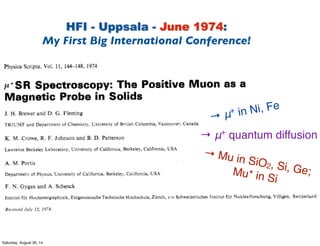
HFI - Uppsala - June 1974:
My First Big International Conference!
→ Mu in SiO2, Si, Ge;Mu* in Si
→ μ+
quantum diffusion
→ μ+ in Ni, Fe
Saturday, August 30, 14
HOWTO of µSR methods
developed at
2014 Sep 21-26 International Conference on Hyperfine Interactions & Nuclear Quadrupole Interactions
Owned and operated as a joint venture by a consortium of Canadian universities via a
contribution through the National Research Council Canada
1
A science fiction adventure story
by
Jess H. Brewer
Saturday, August 30, 14
2014 Sep 21-26 International Conference on Hyperfine Interactions & Nuclear Quadrupole Interactions
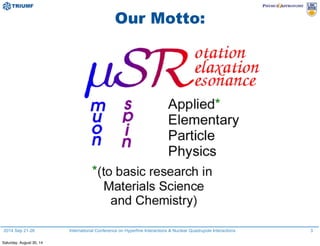
Our Motto:
3
Saturday, August 30, 14
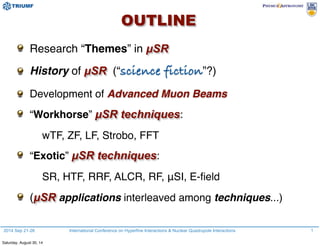
OUTLINE
2014 Sep 21-26 International Conference on Hyperfine Interactions & Nuclear Quadrupole Interactions 1
Research “Themes” in µSR
History of µSR (“science fiction”?)
Development of Advanced Muon Beams
“Workhorse” µSR techniques:
wTF, ZF, LF, Strobo, FFT
“Exotic” µSR techniques:
SR, HTF, RRF, ALCR, RF, μSI, E-field
(µSR applications interleaved among techniques...)
Saturday, August 30, 14
2014 Sep 21-26 International Conference on Hyperfine Interactions & Nuclear Quadrupole Interactions
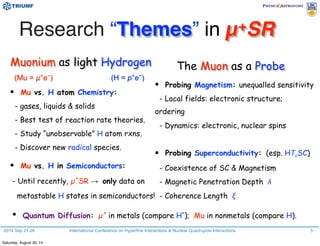
Muonium as light Hydrogen
(Mu = µ+
e−
) (H = p+
e−
)
! Mu vs. H atom Chemistry:
- gases, liquids & solids
- Best test of reaction rate theories.
- Study “unobservable” H atom rxns.
- Discover new radical species.
! Mu vs. H in Semiconductors:
- Until recently, µ +
SR → only data on
metastable H states in semiconductors!
The Muon as a Probe
! Quantum Diffusion: µ +
in metals (compare H+
); Mu in nonmetals (compare H).
! Probing Magnetism: unequalled sensitivity
- Local fields: electronic structure;
ordering
- Dynamics: electronic, nuclear spins
! Probing Superconductivity: (esp. HTcSC)
- Coexistence of SC & Magnetism
- Magnetic Penetration Depth λ
- Coherence Length ξ
Research “Themes” in µ+SR
5
Saturday, August 30, 14
2014 Sep 21-26 International Conference on Hyperfine Interactions & Nuclear Quadrupole Interactions
And then there’s µ−SR ...
6
... but there’s not enough time.
:-(
Saturday, August 30, 14
2014 Sep 21-26 International Conference on Hyperfine Interactions & Nuclear Quadrupole Interactions 7
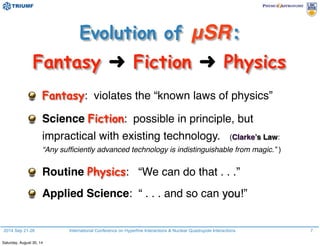
Fantasy: violates the “known laws of physics”
Science Fiction: possible in principle, but
impractical with existing technology. (Clarke’s Law:
“Any sufficiently advanced technology is indistinguishable from magic.” )
Routine Physics: “We can do that . . .”
Applied Science: “ . . . and so can you!”
Evolution of μSR:
Fantasy ➜ Fiction ➜ Physics
Saturday, August 30, 14
2014 Sep 21-26 International Conference on Hyperfine Interactions & Nuclear Quadrupole Interactions 8
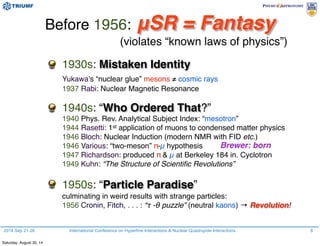
Before 1956: μSR = Fantasy
(violates “known laws of physics”)
1930s: Mistaken Identity
Yukawa’s “nuclear glue” mesons ≠ cosmic rays
1937 Rabi: Nuclear Magnetic Resonance
1940s: “Who Ordered That?”
1940 Phys. Rev. Analytical Subject Index: “mesotron”
1944 Rasetti: 1st application of muons to condensed matter physics
1946 Bloch: Nuclear Induction (modern NMR with FID etc.)
1946 Various: “two-meson” π-µ hypothesis
1947 Richardson: produced π & µ at Berkeley 184 in. Cyclotron
1949 Kuhn: “The Structure of Scientific Revolutions”
1950s: “Particle Paradise”
culminating in weird results with strange particles:
1956 Cronin, Fitch, . . . : “τ -θ puzzle” (neutral kaons) → Revolution!
Brewer: born
Saturday, August 30, 14
2014 Sep 21-26 International Conference on Hyperfine Interactions & Nuclear Quadrupole Interactions
1956-7: Revolution
1950s: “Particle Paradise”
culminating in weird results with strange particles:
1956 Cronin, Fitch, . . . : “τ -θ puzzle” (neutral kaons)
1956: Lee & Yang postulate
P-violation in weak interactions
1957: Wu confirms P-violation in β decay;
Friedman & Telegdi confirm P-violation in π-µ-e decay;
so do Garwin, Lederman & Weinrich,
using a prototype μSR technique.
9
Saturday, August 30, 14
2014 Sep 21-26 International Conference on Hyperfine Interactions & Nuclear Quadrupole Interactions
For newcomers . . .
How does it work?
. . . a brief introduction to P
10
Saturday, August 30, 14
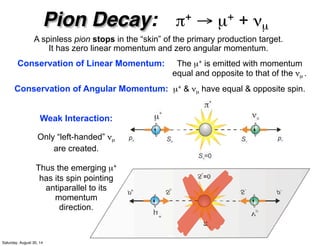
Pion Decay: π+ → µ+ + νµ
Conservation of Linear Momentum: The µ+ is emitted with momentum
equal and opposite to that of the νµ .
Conservation of Angular Momentum: µ+ & νµ have equal & opposite spin.
A spinless pion stops in the “skin” of the primary production target.
It has zero linear momentum and zero angular momentum.
Weak Interaction:
Only “left-handed” νµ
are created.
Thus the emerging µ+
has its spin pointing
antiparallel to its
momentum
direction.
✘Saturday, August 30, 14
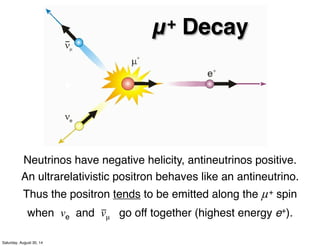
Neutrinos have negative helicity, antineutrinos positive.
An ultrarelativistic positron behaves like an antineutrino.
Thus the positron tends to be emitted along the µ+ spin
when νe and νµ go off together (highest energy e+).
μ+ Decay
–
Saturday, August 30, 14
2014 Sep 21-26 International Conference on Hyperfine Interactions & Nuclear Quadrupole Interactions
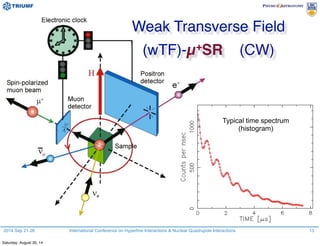
Weak Transverse Field
(wTF)-µ+SR (CW)
Typical time spectrum
(histogram)
13
Saturday, August 30, 14
2014 Sep 21-26 International Conference on Hyperfine Interactions & Nuclear Quadrupole Interactions
1958-1973: Science Fiction
1960s: Fundamental Physics Fun! — Tours de Force
Michel Parameters = Weak Interaction Laboratory
Heroic QED tests: AHF(Mu), µµ, gµ − 2
All lead to refined µSR techniques.
Applications: Muonium Chemistry, Semiconductors, Magnetism
1972: Bowen & Pifer build first Arizona/surface muon beam
to search for for µ+e− → µ−e+ conversion
mid-1970s: Meson Factories — Intensity Enables!
USA: LAMPF (now defunct) Switzerland: SIN (now PSI)
Canada: TRIUMF UK: RAL/ISIS
Japan: KEK/BOOM ( → J-PARC)
14
Saturday, August 30, 14
2014 Sep 21-26 International Conference on Hyperfine Interactions & Nuclear Quadrupole Interactions 15
μSR today: Routine Science?
J-PARC
Saturday, August 30, 14
2014 Sep 21-26 International Conference on Hyperfine Interactions & Nuclear Quadrupole Interactions 16
μSR today: Routine Science?
J-PARC
RAON ★
CSNS ★
★ BNL
ESS
★
Saturday, August 30, 14
2014 Sep 21-26 International Conference on Hyperfine Interactions & Nuclear Quadrupole Interactions
. Brewer, UBC & TRIUMF — Colloquium at Ohio Univ. — 5 May 2006 OUTLINE 18
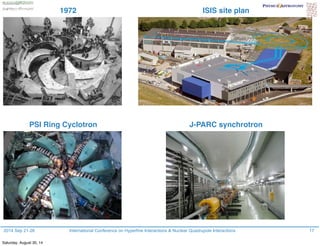
1972
17
PSI Ring Cyclotron
ISIS site plan
J-PARC synchrotron
Saturday, August 30, 14
2014 Sep 21-26 International Conference on Hyperfine Interactions & Nuclear Quadrupole Interactions
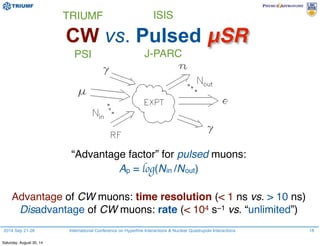
CW vs. Pulsed µSR
18
“Advantage factor” for pulsed muons:
Ap = log(Nin /Nout)
Advantage of CW muons: time resolution (< 1 ns vs. > 10 ns)
Disadvantage of CW muons: rate (< 104 s−1 vs. “unlimited”)
TRIUMF
PSI
ISIS
J-PARC
Saturday, August 30, 14
2014 Sep 21-26 International Conference on Hyperfine Interactions & Nuclear Quadrupole Interactions
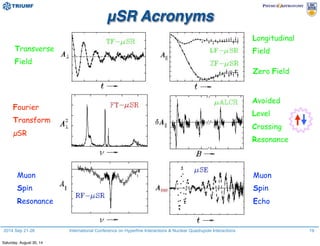
μSR Acronyms
Transverse
Field
Zero Field
Longitudinal
Field
Avoided
Level
Crossing
Resonance
Muon
Spin
Echo
Muon
Spin
Resonance
Fourier
Transform
µSR
19
Saturday, August 30, 14
2014 Sep 21-26 International Conference on Hyperfine Interactions & Nuclear Quadrupole Interactions
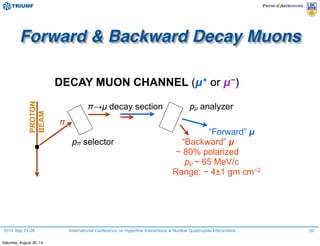
Forward & Backward Decay Muons
DECAY MUON CHANNEL (µ+ or µ−)
π→µ decay section pµ analyzer
π
“Forward” µ
pπ selector “Backward” µ .
~ 80% polarized .
pµ ~ 65 MeV/c .
Range: ~ 4±1 gm cm−2 .
PROTON
BEAM
20
Saturday, August 30, 14
2014 Sep 21-26 International Conference on Hyperfine Interactions & Nuclear Quadrupole Interactions
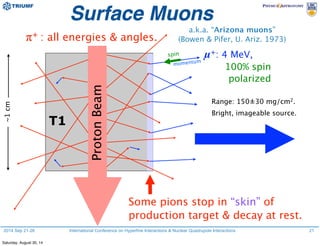
Surface Muons
ProtonBeam
π+
: all energies & angles.
µ+
: 4 MeV,
100% spin
polarized
Some pions stop in “skin” of
production target & decay at rest.
Range: 150±30 mg/cm2.
Bright, imageable source.
T1
21
spin
momentum
~1cm
a.k.a. “Arizona muons”
(Bowen & Pifer, U. Ariz. 1973)
Saturday, August 30, 14
2014 Sep 21-26 International Conference on Hyperfine Interactions & Nuclear Quadrupole Interactions
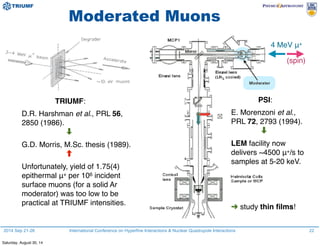
Moderated Muons
22
TRIUMF:
D.R. Harshman et al., PRL 56,
2850 (1986).
➡︎
G.D. Morris, M.Sc. thesis (1989).
︎
Unfortunately, yield of 1.75(4)
epithermal μ+ per 106 incident
surface muons (for a solid Ar
moderator) was too low to be
practical at TRIUMF intensities.
PSI:
E. Morenzoni et al.,
PRL 72, 2793 (1994).
➡︎
LEM facility now
delivers ~4500 μ+/s to
samples at 5-20 keV.
➜ study thin films!
4 MeV μ+
(spin)
Saturday, August 30, 14
2014 Sep 21-26 International Conference on Hyperfine Interactions & Nuclear Quadrupole Interactions
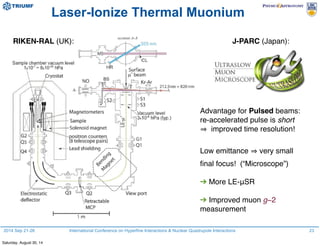
Laser-Ionize Thermal Muonium
23
RIKEN-RAL (UK): J-PARC (Japan):
Advantage for Pulsed beams:
re-accelerated pulse is short
improved time resolution!
Low emittance very small
final focus! (“Microscope”)
➔ More LE-μSR
➔ Improved muon g−2
measurement
Saturday, August 30, 14
2014 Sep 21-26 International Conference on Hyperfine Interactions & Nuclear Quadrupole Interactions 24
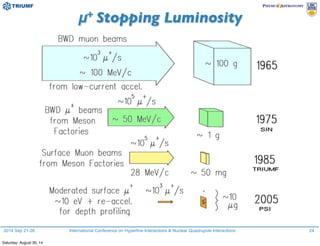
μ+ Stopping Luminosity
Saturday, August 30, 14
2014 Sep 21-26 International Conference on Hyperfine Interactions & Nuclear Quadrupole Interactions
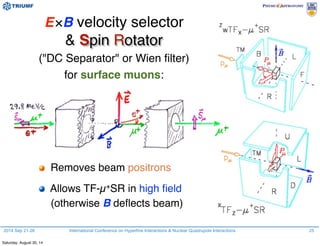
E×B velocity selector
& Spin Rotator
("DC Separator" or Wien filter)
for surface muons:
Removes beam positrons
Allows TF-µ+SR in high field
(otherwise B deflects beam)
25
Saturday, August 30, 14
2014 Sep 21-26 International Conference on Hyperfine Interactions & Nuclear Quadrupole Interactions
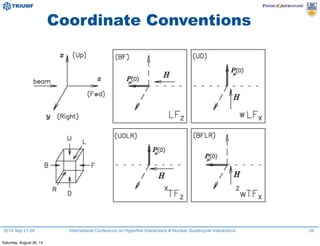
Coordinate Conventions
26
Saturday, August 30, 14
2014 Sep 21-26 International Conference on Hyperfine Interactions & Nuclear Quadrupole Interactions
High Field µSR
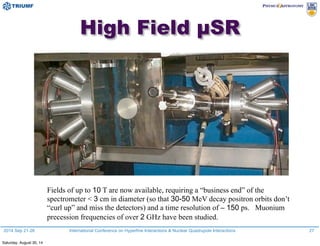
Fields of up to 10 T are now available, requiring a “business end” of the
spectrometer < 3 cm in diameter (so that 30-50 MeV decay positron orbits don’t
“curl up” and miss the detectors) and a time resolution of ∼ 150 ps. Muonium
precession frequencies of over 2 GHz have been studied.
27
Saturday, August 30, 14
2014 Sep 21-26 International Conference on Hyperfine Interactions & Nuclear Quadrupole Interactions
Rotating Reference Frame
28
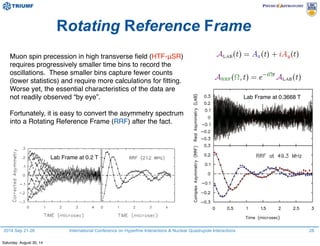
Muon spin precession in high transverse field (HTF-μSR)
requires progressively smaller time bins to record the
oscillations. These smaller bins capture fewer counts
(lower statistics) and require more calculations for fitting.
Worse yet, the essential characteristics of the data are
not readily observed “by eye”.
Fortunately, it is easy to convert the asymmetry spectrum
into a Rotating Reference Frame (RRF) after the fact.
Lab Frame at 0.3668 T
Lab Frame at 0.2 T
Saturday, August 30, 14
2014 Sep 21-26 International Conference on Hyperfine Interactions & Nuclear Quadrupole Interactions
Type-II Superconductors
29
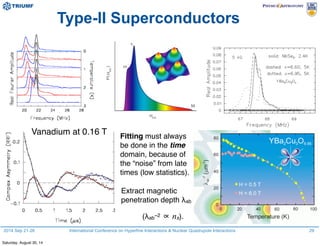
Vanadium at 0.16 T Fitting must always
be done in the time
domain, because of
the “noise” from late
times (low statistics).
Extract magnetic
penetration depth λab
(λab
−2 ∝ns).
Saturday, August 30, 14
2014 Sep 21-26 International Conference on Hyperfine Interactions & Nuclear Quadrupole Interactions
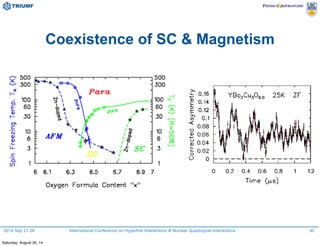
Coexistence of SC & Magnetism
30
Saturday, August 30, 14
Motion of Muon Spins
in Static Local Fields
= Expectation value of a
muon's spin directionSµ
(a) All muons "see" same field B: for B || Sµ nothing happens
for B ⊥ Sµ Larmor precession:
ωµ
ωµ = 2π γµ |B|
γµ = 135.5 MHz/T
(b) All muons "see" same |B| but random direction :
2/3 of Sµ precesses at ωµ
1/3 of Sµ stays constant
(c) Local field B random in both magnitude and direction:
All do not return to the same orientation at the same time
(dephasing) ⇒ Sµ "relaxes" as Gzz (t ) [Kubo & Toyabe, 1960's]
Saturday, August 30, 14
2014 Sep 21-26 International Conference on Hyperfine Interactions & Nuclear Quadrupole Interactions
ZF/LF-µSR & Local Magnetic Fields
32
5 K
MnSi below 29 K: helimagnetic MnSi at 285 K: relaxation by
static nuclear dipolar fields
(PM moments flip too fast)
Hayano et al.
TRIUMF - 1987
Decoupling
by LF
Static Gaussian
Kubo-Toyabe:
gG
zz(t)
gG
zz(t) = [1 + 2(1 - Δ2t2)・exp(-Δ2t2/2)] / 3
Inbetween,thingsgetveryinteresting...
Saturday, August 30, 14
2014 Sep 21-26 International Conference on Hyperfine Interactions & Nuclear Quadrupole Interactions
Motion of μ+ Spins in
Fluctuating Local Fields
33
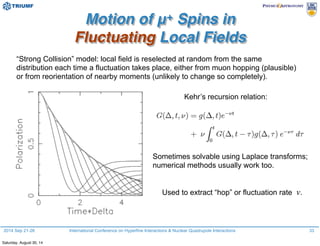
“Strong Collision” model: local field is reselected at random from the same
distribution each time a fluctuation takes place, either from muon hopping (plausible)
or from reorientation of nearby moments (unlikely to change so completely).
Kehr’s recursion relation:
Sometimes solvable using Laplace transforms;
numerical methods usually work too.
Used to extract “hop” or fluctuation rate ν.
Saturday, August 30, 14
2014 Sep 21-26 International Conference on Hyperfine Interactions & Nuclear Quadrupole Interactions 34
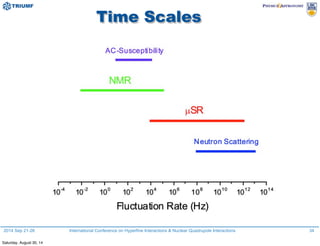
Time Scales
Saturday, August 30, 14
2014 Sep 21-26 International Conference on Hyperfine Interactions & Nuclear Quadrupole Interactions
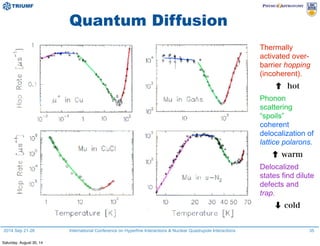
Quantum Diffusion
35
Thermally
activated over-
barrier hopping
(incoherent).
︎ hot
Phonon
scattering
“spoils”
coherent
delocalization of
lattice polarons.
︎warm
Delocalized
states find dilute
defects and
trap.
➡︎ cold
Saturday, August 30, 14
2014 Sep 21-26 International Conference on Hyperfine Interactions & Nuclear Quadrupole Interactions 36
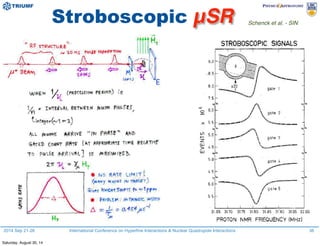
Stroboscopic µSR Schenck et al. - SIN
Saturday, August 30, 14
2014 Sep 21-26 International Conference on Hyperfine Interactions & Nuclear Quadrupole Interactions
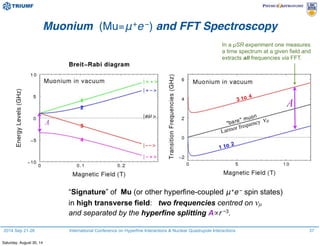
Muonium (Mu≡μ+e−) and FFT Spectroscopy
A
A
Larmor frequency νµ
“Signature” of Mu (or other hyperfine-coupled μ+
e−
spin states)
in high transverse field: two frequencies centred on νµ
and separated by the hyperfine splitting A∝r −3.
μ
In a µSR experiment one measures
a time spectrum at a given field and
extracts all frequencies via FFT.
37
Saturday, August 30, 14
2014 Sep 21-26 International Conference on Hyperfine Interactions & Nuclear Quadrupole Interactions
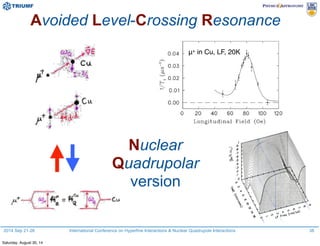
Avoided Level-Crossing Resonance
38
Nuclear
Quadrupolar
version
μ+ in Cu, LF, 20K
Saturday, August 30, 14
2014 Sep 21-26 International Conference on Hyperfine Interactions & Nuclear Quadrupole Interactions
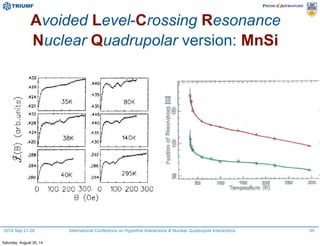
Avoided Level-Crossing Resonance
39
Nuclear Quadrupolar version: MnSi
Saturday, August 30, 14
2014 Sep 21-26 International Conference on Hyperfine Interactions & Nuclear Quadrupole Interactions
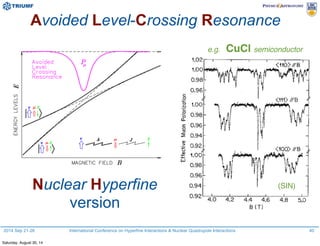
Avoided Level-Crossing Resonance
40
Nuclear Hyperfine
version
e.g. CuCl semiconductor
(SIN)
Saturday, August 30, 14
2014 Sep 21-26 International Conference on Hyperfine Interactions & Nuclear Quadrupole Interactions
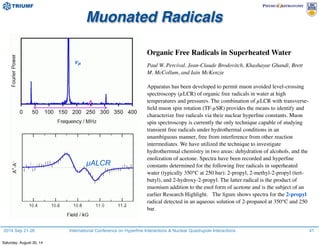
Organic Free Radicals in Superheated Water
Paul W. Percival, Jean-Claude Brodovitch, Khashayar Ghandi, Brett
M. McCollum, and Iain McKenzie
Apparatus has been developed to permit muon avoided level-crossing
spectroscopy (µLCR) of organic free radicals in water at high
temperatures and pressures. The combination of µLCR with transverse-
field muon spin rotation (TF-µSR) provides the means to identify and
characterize free radicals via their nuclear hyperfine constants. Muon
spin spectroscopy is currently the only technique capable of studying
transient free radicals under hydrothermal conditions in an
unambiguous manner, free from interference from other reaction
intermediates. We have utilized the technique to investigate
hydrothermnal chemistry in two areas: dehydration of alcohols, and the
enolization of acetone. Spectra have been recorded and hyperfine
constants determined for the following free radicals in superheated
water (typically 350°C at 250 bar): 2-propyl, 2-methyl-2-propyl (tert-
butyl), and 2-hydroxy-2-propyl. The latter radical is the product of
muonium addition to the enol form of acetone and is the subject of an
earlier Research Highlight. The figure shows spectra for the 2-propyl
radical detected in an aqueous solution of 2-propanol at 350°C and 250
bar.
Muonated Radicals
A
νµ
µALCR
41
Saturday, August 30, 14
2014 Sep 21-26 International Conference on Hyperfine Interactions & Nuclear Quadrupole Interactions
RF-µSR: muon Spin Resonance
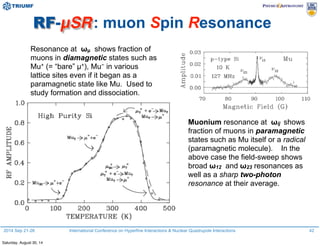
42
Resonance at ωµ shows fraction of
muons in diamagnetic states such as
Mu+ (= “bare” µ+), Mu− in various
lattice sites even if it began as a
paramagnetic state like Mu. Used to
study formation and dissociation.
Muonium resonance at ωij shows
fraction of muons in paramagnetic
states such as Mu itself or a radical
(paramagnetic molecule). In the
above case the field-sweep shows
broad ω12 and ω23 resonances as
well as a sharp two-photon
resonance at their average.
Saturday, August 30, 14
2014 Sep 21-26 International Conference on Hyperfine Interactions & Nuclear Quadrupole Interactions
RF-µSE: muon Spin Echo
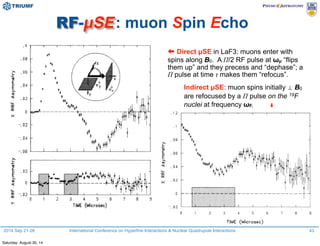
43
︎Direct µSE in LaF3: muons enter with
spins along B0. A Π/2 RF pulse at ωµ “flips
them up” and they precess and “dephase”; a
Π pulse at time τ makes them “refocus”.
Indirect µSE: muon spins initially ⊥ B0
are refocused by a Π pulse on the 19F
nuclei at frequency ωF. ➡︎
Saturday, August 30, 14
2014 Sep 21-26 International Conference on Hyperfine Interactions & Nuclear Quadrupole Interactions
µSE : Muon Spin Imaging
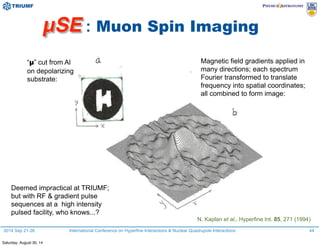
44
Magnetic field gradients applied in
many directions; each spectrum
Fourier transformed to translate
frequency into spatial coordinates;
all combined to form image:
“µ” cut from Al
on depolarizing
substrate:
N. Kaplan et al., Hyperfine Int. 85, 271 (1994)
Deemed impractical at TRIUMF;
but with RF & gradient pulse
sequences at a high intensity
pulsed facility, who knows...?
Saturday, August 30, 14
2014 Sep 21-26 International Conference on Hyperfine Interactions & Nuclear Quadrupole Interactions
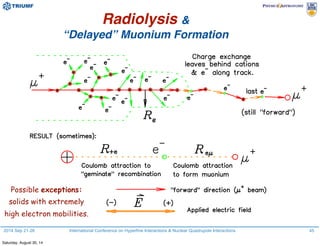
Radiolysis &
“Delayed” Muonium Formation
45
Possible exceptions:
solids with extremely
high electron mobilities.
Saturday, August 30, 14
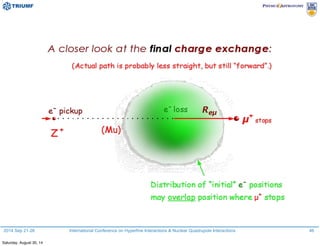
2014 Sep 21-26 International Conference on Hyperfine Interactions & Nuclear Quadrupole Interactions 46
Saturday, August 30, 14
2014 Sep 21-26 International Conference on Hyperfine Interactions & Nuclear Quadrupole Interactions
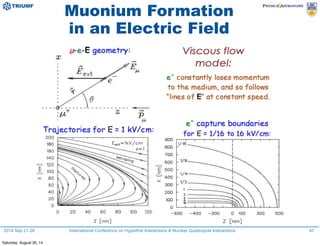
Muonium Formation
in an Electric Field
47
Saturday, August 30, 14
2014 Sep 21-26 International Conference on Hyperfine Interactions & Nuclear Quadrupole Interactions
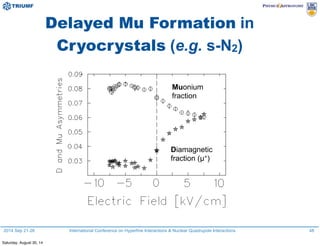
Delayed Mu Formation in
Cryocrystals (e.g. s-N2)
48
Diamagnetic
fraction (µ+)
Muonium
fraction
Saturday, August 30, 14
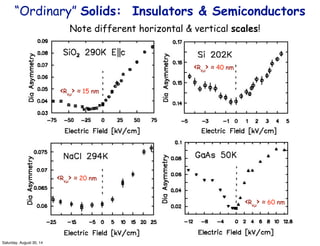
Note different horizontal & vertical scales!
‹Reµ
› ≈ 15 nm
‹Reµ
› ≈ 40 nm
‹Reµ
› ≈ 20 nm
‹Reµ
› ≈ 60 nm
“Ordinary” Solids: Insulators & Semiconductors
Saturday, August 30, 14
2014 Sep 21-26 International Conference on Hyperfine Interactions & Nuclear Quadrupole Interactions
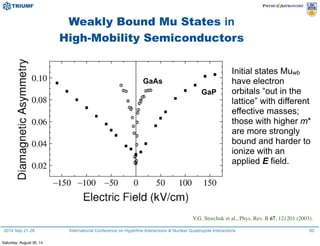
Weakly Bound Mu States in
High-Mobility Semiconductors
50
GaP
GaAs
Initial states Muwb
have electron
orbitals “out in the
lattice” with different
effective masses;
those with higher m*
are more strongly
bound and harder to
ionize with an
applied E field.
V.G. Storchak et al., Phys. Rev. B 67, 121201 (2003).
Saturday, August 30, 14
2014 Sep 21-26 International Conference on Hyperfine Interactions & Nuclear Quadrupole Interactions
 
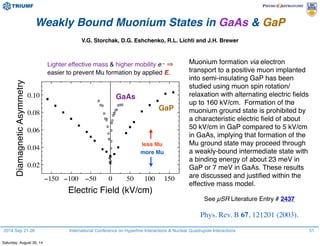
Muonium formation via electron
transport to a positive muon implanted
into semi-insulating GaP has been
studied using muon spin rotation/
relaxation with alternating electric fields
up to 160 kV/cm. Formation of the
muonium ground state is prohibited by
a characteristic electric field of about
50 kV/cm in GaP compared to 5 kV/cm
in GaAs, implying that formation of the
Mu ground state may proceed through
a weakly-bound intermediate state with
a binding energy of about 23 meV in
GaP or 7 meV in GaAs. These results
are discussed and justified within the
effective mass model.
See µSR Literature Entry # 2437
Phys. Rev. B 67, 121201 (2003).
150 100 50 0 50 100 150
0.02
0.04
0.06
0.08
0.10
DiamagneticAsymmetry
Electric Field (kV/cm)
Weakly Bound Muonium States in GaAs & GaP
V.G. Storchak, D.G. Eshchenko, R.L. Lichti and J.H. Brewer
GaAs
GaP
more Mu
less Mu
Lighter effective mass & higher mobility e −
easier to prevent Mu formation by applied E.
51
Saturday, August 30, 14
Finis
Saturday, August 30, 14

muSR at TRIUMF

  • 1.
    HFI - Uppsala- June 1974: My First Big International Conference! → Mu in SiO2, Si, Ge;Mu* in Si → μ+ quantum diffusion → μ+ in Ni, Fe Saturday, August 30, 14
  • 2.
    HOWTO of µSRmethods developed at 2014 Sep 21-26 International Conference on Hyperfine Interactions & Nuclear Quadrupole Interactions Owned and operated as a joint venture by a consortium of Canadian universities via a contribution through the National Research Council Canada 1 A science fiction adventure story by Jess H. Brewer Saturday, August 30, 14
  • 3.
    2014 Sep 21-26International Conference on Hyperfine Interactions & Nuclear Quadrupole Interactions Our Motto: 3 Saturday, August 30, 14
  • 4.
    OUTLINE 2014 Sep 21-26International Conference on Hyperfine Interactions & Nuclear Quadrupole Interactions 1 Research “Themes” in µSR History of µSR (“science fiction”?) Development of Advanced Muon Beams “Workhorse” µSR techniques: wTF, ZF, LF, Strobo, FFT “Exotic” µSR techniques: SR, HTF, RRF, ALCR, RF, μSI, E-field (µSR applications interleaved among techniques...) Saturday, August 30, 14
  • 5.
    2014 Sep 21-26International Conference on Hyperfine Interactions & Nuclear Quadrupole Interactions Muonium as light Hydrogen (Mu = µ+ e− ) (H = p+ e− ) ! Mu vs. H atom Chemistry: - gases, liquids & solids - Best test of reaction rate theories. - Study “unobservable” H atom rxns. - Discover new radical species. ! Mu vs. H in Semiconductors: - Until recently, µ + SR → only data on metastable H states in semiconductors! The Muon as a Probe ! Quantum Diffusion: µ + in metals (compare H+ ); Mu in nonmetals (compare H). ! Probing Magnetism: unequalled sensitivity - Local fields: electronic structure; ordering - Dynamics: electronic, nuclear spins ! Probing Superconductivity: (esp. HTcSC) - Coexistence of SC & Magnetism - Magnetic Penetration Depth λ - Coherence Length ξ Research “Themes” in µ+SR 5 Saturday, August 30, 14
  • 6.
    2014 Sep 21-26International Conference on Hyperfine Interactions & Nuclear Quadrupole Interactions And then there’s µ−SR ... 6 ... but there’s not enough time. :-( Saturday, August 30, 14
  • 7.
    2014 Sep 21-26International Conference on Hyperfine Interactions & Nuclear Quadrupole Interactions 7 Fantasy: violates the “known laws of physics” Science Fiction: possible in principle, but impractical with existing technology. (Clarke’s Law: “Any sufficiently advanced technology is indistinguishable from magic.” ) Routine Physics: “We can do that . . .” Applied Science: “ . . . and so can you!” Evolution of μSR: Fantasy ➜ Fiction ➜ Physics Saturday, August 30, 14
  • 8.
    2014 Sep 21-26International Conference on Hyperfine Interactions & Nuclear Quadrupole Interactions 8 Before 1956: μSR = Fantasy (violates “known laws of physics”) 1930s: Mistaken Identity Yukawa’s “nuclear glue” mesons ≠ cosmic rays 1937 Rabi: Nuclear Magnetic Resonance 1940s: “Who Ordered That?” 1940 Phys. Rev. Analytical Subject Index: “mesotron” 1944 Rasetti: 1st application of muons to condensed matter physics 1946 Bloch: Nuclear Induction (modern NMR with FID etc.) 1946 Various: “two-meson” π-µ hypothesis 1947 Richardson: produced π & µ at Berkeley 184 in. Cyclotron 1949 Kuhn: “The Structure of Scientific Revolutions” 1950s: “Particle Paradise” culminating in weird results with strange particles: 1956 Cronin, Fitch, . . . : “τ -θ puzzle” (neutral kaons) → Revolution! Brewer: born Saturday, August 30, 14
  • 9.
    2014 Sep 21-26International Conference on Hyperfine Interactions & Nuclear Quadrupole Interactions 1956-7: Revolution 1950s: “Particle Paradise” culminating in weird results with strange particles: 1956 Cronin, Fitch, . . . : “τ -θ puzzle” (neutral kaons) 1956: Lee & Yang postulate P-violation in weak interactions 1957: Wu confirms P-violation in β decay; Friedman & Telegdi confirm P-violation in π-µ-e decay; so do Garwin, Lederman & Weinrich, using a prototype μSR technique. 9 Saturday, August 30, 14
  • 10.
    2014 Sep 21-26International Conference on Hyperfine Interactions & Nuclear Quadrupole Interactions For newcomers . . . How does it work? . . . a brief introduction to P 10 Saturday, August 30, 14
  • 11.
    Pion Decay: π+→ µ+ + νµ Conservation of Linear Momentum: The µ+ is emitted with momentum equal and opposite to that of the νµ . Conservation of Angular Momentum: µ+ & νµ have equal & opposite spin. A spinless pion stops in the “skin” of the primary production target. It has zero linear momentum and zero angular momentum. Weak Interaction: Only “left-handed” νµ are created. Thus the emerging µ+ has its spin pointing antiparallel to its momentum direction. ✘Saturday, August 30, 14
  • 12.
    Neutrinos have negativehelicity, antineutrinos positive. An ultrarelativistic positron behaves like an antineutrino. Thus the positron tends to be emitted along the µ+ spin when νe and νµ go off together (highest energy e+). μ+ Decay – Saturday, August 30, 14
  • 13.
    2014 Sep 21-26International Conference on Hyperfine Interactions & Nuclear Quadrupole Interactions Weak Transverse Field (wTF)-µ+SR (CW) Typical time spectrum (histogram) 13 Saturday, August 30, 14
  • 14.
    2014 Sep 21-26International Conference on Hyperfine Interactions & Nuclear Quadrupole Interactions 1958-1973: Science Fiction 1960s: Fundamental Physics Fun! — Tours de Force Michel Parameters = Weak Interaction Laboratory Heroic QED tests: AHF(Mu), µµ, gµ − 2 All lead to refined µSR techniques. Applications: Muonium Chemistry, Semiconductors, Magnetism 1972: Bowen & Pifer build first Arizona/surface muon beam to search for for µ+e− → µ−e+ conversion mid-1970s: Meson Factories — Intensity Enables! USA: LAMPF (now defunct) Switzerland: SIN (now PSI) Canada: TRIUMF UK: RAL/ISIS Japan: KEK/BOOM ( → J-PARC) 14 Saturday, August 30, 14
  • 15.
    2014 Sep 21-26International Conference on Hyperfine Interactions & Nuclear Quadrupole Interactions 15 μSR today: Routine Science? J-PARC Saturday, August 30, 14
  • 16.
    2014 Sep 21-26International Conference on Hyperfine Interactions & Nuclear Quadrupole Interactions 16 μSR today: Routine Science? J-PARC RAON ★ CSNS ★ ★ BNL ESS ★ Saturday, August 30, 14
  • 17.
    2014 Sep 21-26International Conference on Hyperfine Interactions & Nuclear Quadrupole Interactions . Brewer, UBC & TRIUMF — Colloquium at Ohio Univ. — 5 May 2006 OUTLINE 18 1972 17 PSI Ring Cyclotron ISIS site plan J-PARC synchrotron Saturday, August 30, 14
  • 18.
    2014 Sep 21-26International Conference on Hyperfine Interactions & Nuclear Quadrupole Interactions CW vs. Pulsed µSR 18 “Advantage factor” for pulsed muons: Ap = log(Nin /Nout) Advantage of CW muons: time resolution (< 1 ns vs. > 10 ns) Disadvantage of CW muons: rate (< 104 s−1 vs. “unlimited”) TRIUMF PSI ISIS J-PARC Saturday, August 30, 14
  • 19.
    2014 Sep 21-26International Conference on Hyperfine Interactions & Nuclear Quadrupole Interactions μSR Acronyms Transverse Field Zero Field Longitudinal Field Avoided Level Crossing Resonance Muon Spin Echo Muon Spin Resonance Fourier Transform µSR 19 Saturday, August 30, 14
  • 20.
    2014 Sep 21-26International Conference on Hyperfine Interactions & Nuclear Quadrupole Interactions Forward & Backward Decay Muons DECAY MUON CHANNEL (µ+ or µ−) π→µ decay section pµ analyzer π “Forward” µ pπ selector “Backward” µ . ~ 80% polarized . pµ ~ 65 MeV/c . Range: ~ 4±1 gm cm−2 . PROTON BEAM 20 Saturday, August 30, 14
  • 21.
    2014 Sep 21-26International Conference on Hyperfine Interactions & Nuclear Quadrupole Interactions Surface Muons ProtonBeam π+ : all energies & angles. µ+ : 4 MeV, 100% spin polarized Some pions stop in “skin” of production target & decay at rest. Range: 150±30 mg/cm2. Bright, imageable source. T1 21 spin momentum ~1cm a.k.a. “Arizona muons” (Bowen & Pifer, U. Ariz. 1973) Saturday, August 30, 14
  • 22.
    2014 Sep 21-26International Conference on Hyperfine Interactions & Nuclear Quadrupole Interactions Moderated Muons 22 TRIUMF: D.R. Harshman et al., PRL 56, 2850 (1986). ➡︎ G.D. Morris, M.Sc. thesis (1989). ︎ Unfortunately, yield of 1.75(4) epithermal μ+ per 106 incident surface muons (for a solid Ar moderator) was too low to be practical at TRIUMF intensities. PSI: E. Morenzoni et al., PRL 72, 2793 (1994). ➡︎ LEM facility now delivers ~4500 μ+/s to samples at 5-20 keV. ➜ study thin films! 4 MeV μ+ (spin) Saturday, August 30, 14
  • 23.
    2014 Sep 21-26International Conference on Hyperfine Interactions & Nuclear Quadrupole Interactions Laser-Ionize Thermal Muonium 23 RIKEN-RAL (UK): J-PARC (Japan): Advantage for Pulsed beams: re-accelerated pulse is short improved time resolution! Low emittance very small final focus! (“Microscope”) ➔ More LE-μSR ➔ Improved muon g−2 measurement Saturday, August 30, 14
  • 24.
    2014 Sep 21-26International Conference on Hyperfine Interactions & Nuclear Quadrupole Interactions 24 μ+ Stopping Luminosity Saturday, August 30, 14
  • 25.
    2014 Sep 21-26International Conference on Hyperfine Interactions & Nuclear Quadrupole Interactions E×B velocity selector & Spin Rotator ("DC Separator" or Wien filter) for surface muons: Removes beam positrons Allows TF-µ+SR in high field (otherwise B deflects beam) 25 Saturday, August 30, 14
  • 26.
    2014 Sep 21-26International Conference on Hyperfine Interactions & Nuclear Quadrupole Interactions Coordinate Conventions 26 Saturday, August 30, 14
  • 27.
    2014 Sep 21-26International Conference on Hyperfine Interactions & Nuclear Quadrupole Interactions High Field µSR Fields of up to 10 T are now available, requiring a “business end” of the spectrometer < 3 cm in diameter (so that 30-50 MeV decay positron orbits don’t “curl up” and miss the detectors) and a time resolution of ∼ 150 ps. Muonium precession frequencies of over 2 GHz have been studied. 27 Saturday, August 30, 14
  • 28.
    2014 Sep 21-26International Conference on Hyperfine Interactions & Nuclear Quadrupole Interactions Rotating Reference Frame 28 Muon spin precession in high transverse field (HTF-μSR) requires progressively smaller time bins to record the oscillations. These smaller bins capture fewer counts (lower statistics) and require more calculations for fitting. Worse yet, the essential characteristics of the data are not readily observed “by eye”. Fortunately, it is easy to convert the asymmetry spectrum into a Rotating Reference Frame (RRF) after the fact. Lab Frame at 0.3668 T Lab Frame at 0.2 T Saturday, August 30, 14
  • 29.
    2014 Sep 21-26International Conference on Hyperfine Interactions & Nuclear Quadrupole Interactions Type-II Superconductors 29 Vanadium at 0.16 T Fitting must always be done in the time domain, because of the “noise” from late times (low statistics). Extract magnetic penetration depth λab (λab −2 ∝ns). Saturday, August 30, 14
  • 30.
    2014 Sep 21-26International Conference on Hyperfine Interactions & Nuclear Quadrupole Interactions Coexistence of SC & Magnetism 30 Saturday, August 30, 14
  • 31.
    Motion of MuonSpins in Static Local Fields = Expectation value of a muon's spin directionSµ (a) All muons "see" same field B: for B || Sµ nothing happens for B ⊥ Sµ Larmor precession: ωµ ωµ = 2π γµ |B| γµ = 135.5 MHz/T (b) All muons "see" same |B| but random direction : 2/3 of Sµ precesses at ωµ 1/3 of Sµ stays constant (c) Local field B random in both magnitude and direction: All do not return to the same orientation at the same time (dephasing) ⇒ Sµ "relaxes" as Gzz (t ) [Kubo & Toyabe, 1960's] Saturday, August 30, 14
  • 32.
    2014 Sep 21-26International Conference on Hyperfine Interactions & Nuclear Quadrupole Interactions ZF/LF-µSR & Local Magnetic Fields 32 5 K MnSi below 29 K: helimagnetic MnSi at 285 K: relaxation by static nuclear dipolar fields (PM moments flip too fast) Hayano et al. TRIUMF - 1987 Decoupling by LF Static Gaussian Kubo-Toyabe: gG zz(t) gG zz(t) = [1 + 2(1 - Δ2t2)・exp(-Δ2t2/2)] / 3 Inbetween,thingsgetveryinteresting... Saturday, August 30, 14
  • 33.
    2014 Sep 21-26International Conference on Hyperfine Interactions & Nuclear Quadrupole Interactions Motion of μ+ Spins in Fluctuating Local Fields 33 “Strong Collision” model: local field is reselected at random from the same distribution each time a fluctuation takes place, either from muon hopping (plausible) or from reorientation of nearby moments (unlikely to change so completely). Kehr’s recursion relation: Sometimes solvable using Laplace transforms; numerical methods usually work too. Used to extract “hop” or fluctuation rate ν. Saturday, August 30, 14
  • 34.
    2014 Sep 21-26International Conference on Hyperfine Interactions & Nuclear Quadrupole Interactions 34 Time Scales Saturday, August 30, 14
  • 35.
    2014 Sep 21-26International Conference on Hyperfine Interactions & Nuclear Quadrupole Interactions Quantum Diffusion 35 Thermally activated over- barrier hopping (incoherent). ︎ hot Phonon scattering “spoils” coherent delocalization of lattice polarons. ︎warm Delocalized states find dilute defects and trap. ➡︎ cold Saturday, August 30, 14
  • 36.
    2014 Sep 21-26International Conference on Hyperfine Interactions & Nuclear Quadrupole Interactions 36 Stroboscopic µSR Schenck et al. - SIN Saturday, August 30, 14
  • 37.
    2014 Sep 21-26International Conference on Hyperfine Interactions & Nuclear Quadrupole Interactions Muonium (Mu≡μ+e−) and FFT Spectroscopy A A Larmor frequency νµ “Signature” of Mu (or other hyperfine-coupled μ+ e− spin states) in high transverse field: two frequencies centred on νµ and separated by the hyperfine splitting A∝r −3. μ In a µSR experiment one measures a time spectrum at a given field and extracts all frequencies via FFT. 37 Saturday, August 30, 14
  • 38.
    2014 Sep 21-26International Conference on Hyperfine Interactions & Nuclear Quadrupole Interactions Avoided Level-Crossing Resonance 38 Nuclear Quadrupolar version μ+ in Cu, LF, 20K Saturday, August 30, 14
  • 39.
    2014 Sep 21-26International Conference on Hyperfine Interactions & Nuclear Quadrupole Interactions Avoided Level-Crossing Resonance 39 Nuclear Quadrupolar version: MnSi Saturday, August 30, 14
  • 40.
    2014 Sep 21-26International Conference on Hyperfine Interactions & Nuclear Quadrupole Interactions Avoided Level-Crossing Resonance 40 Nuclear Hyperfine version e.g. CuCl semiconductor (SIN) Saturday, August 30, 14
  • 41.
    2014 Sep 21-26International Conference on Hyperfine Interactions & Nuclear Quadrupole Interactions Organic Free Radicals in Superheated Water Paul W. Percival, Jean-Claude Brodovitch, Khashayar Ghandi, Brett M. McCollum, and Iain McKenzie Apparatus has been developed to permit muon avoided level-crossing spectroscopy (µLCR) of organic free radicals in water at high temperatures and pressures. The combination of µLCR with transverse- field muon spin rotation (TF-µSR) provides the means to identify and characterize free radicals via their nuclear hyperfine constants. Muon spin spectroscopy is currently the only technique capable of studying transient free radicals under hydrothermal conditions in an unambiguous manner, free from interference from other reaction intermediates. We have utilized the technique to investigate hydrothermnal chemistry in two areas: dehydration of alcohols, and the enolization of acetone. Spectra have been recorded and hyperfine constants determined for the following free radicals in superheated water (typically 350°C at 250 bar): 2-propyl, 2-methyl-2-propyl (tert- butyl), and 2-hydroxy-2-propyl. The latter radical is the product of muonium addition to the enol form of acetone and is the subject of an earlier Research Highlight. The figure shows spectra for the 2-propyl radical detected in an aqueous solution of 2-propanol at 350°C and 250 bar. Muonated Radicals A νµ µALCR 41 Saturday, August 30, 14
  • 42.
    2014 Sep 21-26International Conference on Hyperfine Interactions & Nuclear Quadrupole Interactions RF-µSR: muon Spin Resonance 42 Resonance at ωµ shows fraction of muons in diamagnetic states such as Mu+ (= “bare” µ+), Mu− in various lattice sites even if it began as a paramagnetic state like Mu. Used to study formation and dissociation. Muonium resonance at ωij shows fraction of muons in paramagnetic states such as Mu itself or a radical (paramagnetic molecule). In the above case the field-sweep shows broad ω12 and ω23 resonances as well as a sharp two-photon resonance at their average. Saturday, August 30, 14
  • 43.
    2014 Sep 21-26International Conference on Hyperfine Interactions & Nuclear Quadrupole Interactions RF-µSE: muon Spin Echo 43 ︎Direct µSE in LaF3: muons enter with spins along B0. A Π/2 RF pulse at ωµ “flips them up” and they precess and “dephase”; a Π pulse at time τ makes them “refocus”. Indirect µSE: muon spins initially ⊥ B0 are refocused by a Π pulse on the 19F nuclei at frequency ωF. ➡︎ Saturday, August 30, 14
  • 44.
    2014 Sep 21-26International Conference on Hyperfine Interactions & Nuclear Quadrupole Interactions µSE : Muon Spin Imaging 44 Magnetic field gradients applied in many directions; each spectrum Fourier transformed to translate frequency into spatial coordinates; all combined to form image: “µ” cut from Al on depolarizing substrate: N. Kaplan et al., Hyperfine Int. 85, 271 (1994) Deemed impractical at TRIUMF; but with RF & gradient pulse sequences at a high intensity pulsed facility, who knows...? Saturday, August 30, 14
  • 45.
    2014 Sep 21-26International Conference on Hyperfine Interactions & Nuclear Quadrupole Interactions Radiolysis & “Delayed” Muonium Formation 45 Possible exceptions: solids with extremely high electron mobilities. Saturday, August 30, 14
  • 46.
    2014 Sep 21-26International Conference on Hyperfine Interactions & Nuclear Quadrupole Interactions 46 Saturday, August 30, 14
  • 47.
    2014 Sep 21-26International Conference on Hyperfine Interactions & Nuclear Quadrupole Interactions Muonium Formation in an Electric Field 47 Saturday, August 30, 14
  • 48.
    2014 Sep 21-26International Conference on Hyperfine Interactions & Nuclear Quadrupole Interactions Delayed Mu Formation in Cryocrystals (e.g. s-N2) 48 Diamagnetic fraction (µ+) Muonium fraction Saturday, August 30, 14
  • 49.
    Note different horizontal& vertical scales! ‹Reµ › ≈ 15 nm ‹Reµ › ≈ 40 nm ‹Reµ › ≈ 20 nm ‹Reµ › ≈ 60 nm “Ordinary” Solids: Insulators & Semiconductors Saturday, August 30, 14
  • 50.
    2014 Sep 21-26International Conference on Hyperfine Interactions & Nuclear Quadrupole Interactions Weakly Bound Mu States in High-Mobility Semiconductors 50 GaP GaAs Initial states Muwb have electron orbitals “out in the lattice” with different effective masses; those with higher m* are more strongly bound and harder to ionize with an applied E field. V.G. Storchak et al., Phys. Rev. B 67, 121201 (2003). Saturday, August 30, 14
  • 51.
    2014 Sep 21-26International Conference on Hyperfine Interactions & Nuclear Quadrupole Interactions   Muonium formation via electron transport to a positive muon implanted into semi-insulating GaP has been studied using muon spin rotation/ relaxation with alternating electric fields up to 160 kV/cm. Formation of the muonium ground state is prohibited by a characteristic electric field of about 50 kV/cm in GaP compared to 5 kV/cm in GaAs, implying that formation of the Mu ground state may proceed through a weakly-bound intermediate state with a binding energy of about 23 meV in GaP or 7 meV in GaAs. These results are discussed and justified within the effective mass model. See µSR Literature Entry # 2437 Phys. Rev. B 67, 121201 (2003). 150 100 50 0 50 100 150 0.02 0.04 0.06 0.08 0.10 DiamagneticAsymmetry Electric Field (kV/cm) Weakly Bound Muonium States in GaAs & GaP V.G. Storchak, D.G. Eshchenko, R.L. Lichti and J.H. Brewer GaAs GaP more Mu less Mu Lighter effective mass & higher mobility e − easier to prevent Mu formation by applied E. 51 Saturday, August 30, 14
  • 52.