

Anil Kumar Shrestha
Ankeet Rajbhandari
         Diveej Shah
       Jush Shrestha
 Shashank Pradhan
-Found in 1865 as a
wood-pulp mill by
Finland-Swede Knut
Fredrik Idestam.

-Finnish Rubber Works
acquired Nokia wood
mills as well as Finnish
Cable Works, a
producer of telephone
and telegraph cables.

- All three companies
merged as Nokia
Corporation in 1967.
 Today Nokia is the most prolific maker of cellular phones.
 World's largest telecommunications equipment
  manufacturer.
 Nokia provides mobile communication equipment for
  every major market and protocol, including GSM, CDMA
  and WCDMA.
 Its global market share was 23% in the second quarter of
  2011.
The Mobile Gaming era
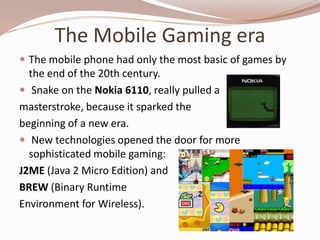
 The mobile phone had only the most basic of games by
  the end of the 20th century.
 Snake on the Nokia 6110, really pulled a
masterstroke, because it sparked the
beginning of a new era.
 New technologies opened the door for more
  sophisticated mobile gaming:
J2ME (Java 2 Micro Edition) and
BREW (Binary Runtime
Environment for Wireless).
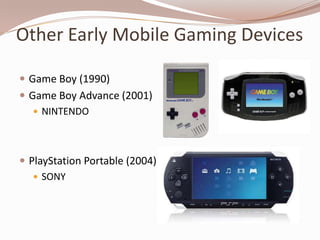
Other Early Mobile Gaming Devices

 Game Boy (1990)
 Game Boy Advance (2001)
    NINTENDO


 PlayStation Portable (2004)
    SONY
Gaming craze and Nokia’s Vision
 In the late 1990s, gamers increasingly carried both mobile
  phones and handheld game consoles.
 Nokia spotted an opportunity to combine these devices
  into one unit.
 So on October 2003, they launched a product, a device
  that integrated the wireless cell-phone and the handheld
  gaming console.
 It was……………
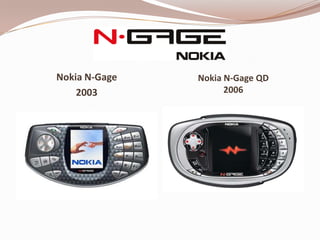
Nokia N-Gage   Nokia N-Gage QD
    2003             2006
 It was a game deck, an MP3 player, a wireless browser, and a
    phone in one.
   Based on the Symbian OS 6.1 and Series 60 user interface like
    the 7650 and 3650.
   Two useful additions: MP3 player and FM radio.
   Able to run all Series 60 software and Java MIDP applications.
   Main CPU was an ARM Integrated (ARMI) compatible chip
    (ARM4Tarchitecture) running at 104 MHz.
   Online and multimedia games via GPRS or Bluetooth.
   N-Gage was the first device of its kind.
The Hype and the Reality
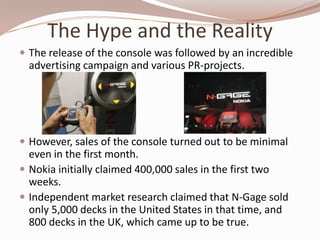
 The release of the console was followed by an incredible
  advertising campaign and various PR-projects.


 However, sales of the console turned out to be minimal
  even in the first month.
 Nokia initially claimed 400,000 sales in the first two
  weeks.
 Independent market research claimed that N-Gage sold
  only 5,000 decks in the United States in that time, and
  800 decks in the UK, which came up to be true.
What went wrong??
 The Design:
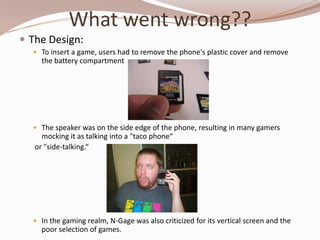
   To insert a game, users had to remove the phone's plastic cover and remove
     the battery compartment


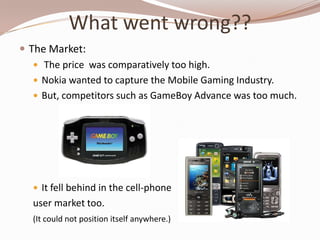
   The speaker was on the side edge of the phone, resulting in many gamers
     mocking it as talking into a "taco phone“
   or "side-talking.“


   In the gaming realm, N-Gage was also criticized for its vertical screen and the
     poor selection of games.
What went wrong??
 The Market:
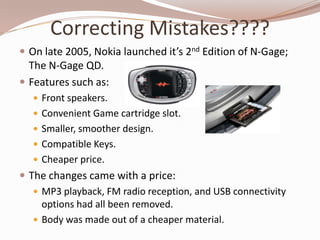
    The price was comparatively too high.
    Nokia wanted to capture the Mobile Gaming Industry.
    But, competitors such as GameBoy Advance was too much.


   It fell behind in the cell-phone
  user market too.
  (It could not position itself anywhere.)
Correcting Mistakes????
 On late 2005, Nokia launched it’s 2nd Edition of N-Gage;
  The N-Gage QD.
 Features such as:
    Front speakers.
    Convenient Game cartridge slot.
    Smaller, smoother design.
    Compatible Keys.
    Cheaper price.
 The changes came with a price:
    MP3 playback, FM radio reception, and USB connectivity
     options had all been removed.
    Body was made out of a cheaper material.
Same Results!
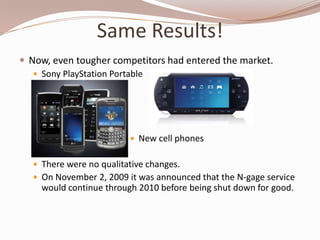
 Now, even tougher competitors had entered the market.
    Sony PlayStation Portable


                          New cell phones


   There were no qualitative changes.
   On November 2, 2009 it was announced that the N-gage service
    would continue through 2010 before being shut down for good.
.
Recommendation

         Design

      Convenience

       Consumers

    Market placement

         Price

Mtc n gage, group 8

  • 1.
    Anil Kumar Shrestha AnkeetRajbhandari Diveej Shah Jush Shrestha Shashank Pradhan
  • 2.
    -Found in 1865as a wood-pulp mill by Finland-Swede Knut Fredrik Idestam. -Finnish Rubber Works acquired Nokia wood mills as well as Finnish Cable Works, a producer of telephone and telegraph cables. - All three companies merged as Nokia Corporation in 1967.
  • 3.
     Today Nokiais the most prolific maker of cellular phones.  World's largest telecommunications equipment manufacturer.  Nokia provides mobile communication equipment for every major market and protocol, including GSM, CDMA and WCDMA.  Its global market share was 23% in the second quarter of 2011.
  • 4.
    The Mobile Gamingera  The mobile phone had only the most basic of games by the end of the 20th century.  Snake on the Nokia 6110, really pulled a masterstroke, because it sparked the beginning of a new era.  New technologies opened the door for more sophisticated mobile gaming: J2ME (Java 2 Micro Edition) and BREW (Binary Runtime Environment for Wireless).
  • 5.
    Other Early MobileGaming Devices  Game Boy (1990)  Game Boy Advance (2001)  NINTENDO  PlayStation Portable (2004)  SONY
  • 6.
    Gaming craze andNokia’s Vision  In the late 1990s, gamers increasingly carried both mobile phones and handheld game consoles.  Nokia spotted an opportunity to combine these devices into one unit.  So on October 2003, they launched a product, a device that integrated the wireless cell-phone and the handheld gaming console.  It was……………
  • 7.
    Nokia N-Gage Nokia N-Gage QD 2003 2006
  • 8.
     It wasa game deck, an MP3 player, a wireless browser, and a phone in one.  Based on the Symbian OS 6.1 and Series 60 user interface like the 7650 and 3650.  Two useful additions: MP3 player and FM radio.  Able to run all Series 60 software and Java MIDP applications.  Main CPU was an ARM Integrated (ARMI) compatible chip (ARM4Tarchitecture) running at 104 MHz.  Online and multimedia games via GPRS or Bluetooth.  N-Gage was the first device of its kind.
  • 9.
    The Hype andthe Reality  The release of the console was followed by an incredible advertising campaign and various PR-projects.  However, sales of the console turned out to be minimal even in the first month.  Nokia initially claimed 400,000 sales in the first two weeks.  Independent market research claimed that N-Gage sold only 5,000 decks in the United States in that time, and 800 decks in the UK, which came up to be true.
  • 10.
    What went wrong?? The Design:  To insert a game, users had to remove the phone's plastic cover and remove the battery compartment  The speaker was on the side edge of the phone, resulting in many gamers mocking it as talking into a "taco phone“ or "side-talking.“  In the gaming realm, N-Gage was also criticized for its vertical screen and the poor selection of games.
  • 11.
    What went wrong?? The Market:  The price was comparatively too high.  Nokia wanted to capture the Mobile Gaming Industry.  But, competitors such as GameBoy Advance was too much.  It fell behind in the cell-phone user market too. (It could not position itself anywhere.)
  • 12.
    Correcting Mistakes????  Onlate 2005, Nokia launched it’s 2nd Edition of N-Gage; The N-Gage QD.  Features such as:  Front speakers.  Convenient Game cartridge slot.  Smaller, smoother design.  Compatible Keys.  Cheaper price.  The changes came with a price:  MP3 playback, FM radio reception, and USB connectivity options had all been removed.  Body was made out of a cheaper material.
  • 13.
    Same Results!  Now,even tougher competitors had entered the market.  Sony PlayStation Portable  New cell phones  There were no qualitative changes.  On November 2, 2009 it was announced that the N-gage service would continue through 2010 before being shut down for good.
  • 14.
  • 15.
    Recommendation  Design  Convenience  Consumers  Market placement  Price