


A Revolutionary New Approach –
Using the ISI EnvisionTM
Rating System
for Water Infrastructure Sustainability
SUSTAINABILITY
the capacity to endure
It is no longer enough that infrastructure
work, that it be constructed on time and
within budget… or even that it lasts…
it now must be SUSTAINABLE.
A New Fact of Life…
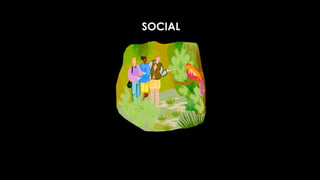
SOCIAL
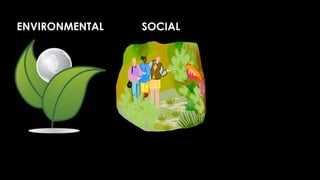
ENVIRONMENTAL SOCIAL
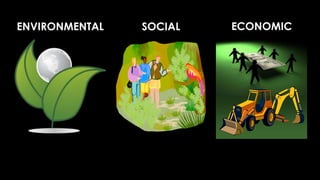
ENVIRONMENTAL SOCIAL ECONOMIC
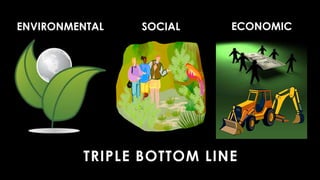
TRIPLE BOTTOM LINE
ENVIRONMENTAL SOCIAL ECONOMIC
SUSTAINABILITY
RATING SYSTEMS
Some cover buildings (single sector)
SUSTAINABILITY
RATING SYSTEMS
Others for infrastructure are sector specific
SUSTAINABILITY
RATING SYSTEMS
None cover all aspects of civil infrastructure
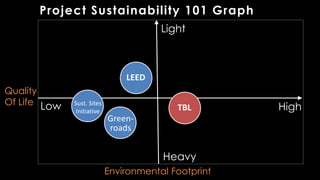
SUSTAINABILITY
RATING SYSTEMS
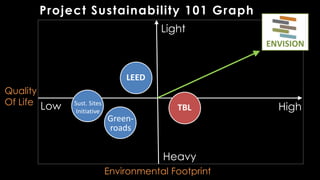
Triple Bottom Line
Don’t truly address Quality Of Life
Environmental Footprint
Quality
Of Life
Heavy
Low High
Light
Project Sustainability 101 Graph
Environmental Footprint
Quality
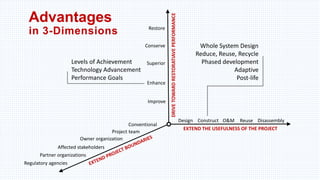
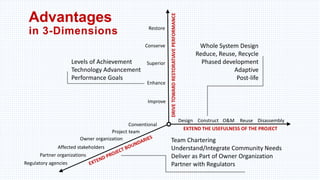
Of Life
Heavy
Low High
Light
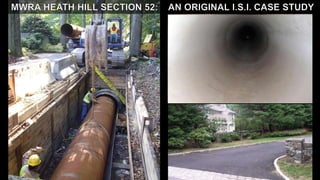
Project Sustainability 101 Graph
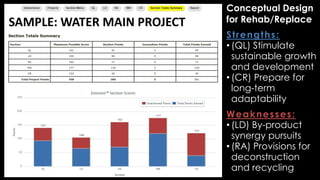
LEED
Sust. Sites
Initiative
Green-
roads
Environmental Footprint
Quality
Of Life
Heavy
Low High
Light
Project Sustainability 101 Graph
LEED
Sust. Sites
Initiative
Green-
roads
TBL
Environmental Footprint
Quality
Of Life
Heavy
Low High
Light
Project Sustainability 101 Graph
LEED
Sust. Sites
Initiative
Green-
roads
TBL
ENVISION
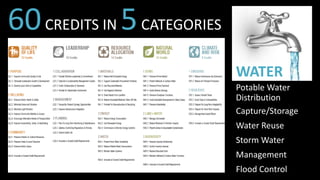
60CREDITS IN 5CATEGORIES
WATER
Potable Water
Distribution
Capture/Storage
Water Reuse
Storm Water
Management
Flood Control
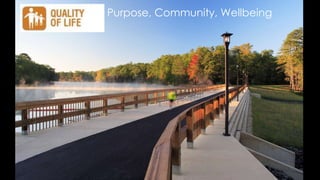
Purpose, Community, Wellbeing
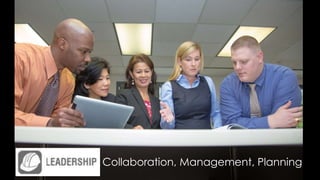
Collaboration, Management, Planning
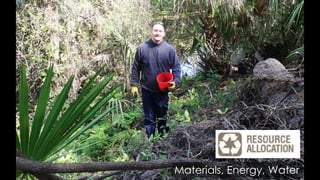
Materials, Energy, Water
Siting, Land & Water, Biodiversity
Emission, Resilience
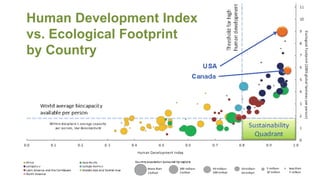
Human Development Index
vs. Ecological Footprint
by Country
Restore
Conventional
Superior
Improve
DisassemblyDesign Construct O&M Reuse
Project team
Owner organization
Affected stakeholders
Regulatory agencies
Partner organizations
EXTEND THE USEFULNESS OF THE PROJECT
DRIVETOWARDRESTORATIAVEPERFORMANCE
Advantages
in 3-Dimensions
Enhance
Conserve
Restore
Conventional
Superior
Improve
DisassemblyDesign Construct O&M Reuse
Project team
Owner organization
Affected stakeholders
Regulatory agencies
Partner organizations
EXTEND THE USEFULNESS OF THE PROJECT
DRIVETOWARDRESTORATIAVEPERFORMANCE
Whole System Design
Reduce, Reuse, Recycle
Phased development
Adaptive
Post-life
Advantages
in 3-Dimensions
Enhance
Conserve
Restore
Conventional
Superior
Improve
DisassemblyDesign Construct O&M Reuse
Project team
Owner organization
Affected stakeholders
Regulatory agencies
Partner organizations
EXTEND THE USEFULNESS OF THE PROJECT
DRIVETOWARDRESTORATIAVEPERFORMANCE
Whole System Design
Reduce, Reuse, Recycle
Phased development
Adaptive
Post-life
Levels of Achievement
Technology Advancement
Performance Goals
Advantages
in 3-Dimensions
Enhance
Conserve
Restore
Conventional
Superior
Improve
DisassemblyDesign Construct O&M Reuse
Project team
Owner organization
Affected stakeholders
Regulatory agencies
Partner organizations
EXTEND THE USEFULNESS OF THE PROJECT
DRIVETOWARDRESTORATIAVEPERFORMANCE
Team Chartering
Understand/Integrate Community Needs
Deliver as Part of Owner Organization
Partner with Regulators
Whole System Design
Reduce, Reuse, Recycle
Phased development
Adaptive
Post-life
Levels of Achievement
Technology Advancement
Performance Goals
Advantages
in 3-Dimensions
Enhance
Conserve
SAMPLE: WATER MAIN PROJECT
Conceptual Design
for Rehab/Replace
Strengths:
• (QL) Stimulate
sustainable growth
and development
• (CR) Prepare for
long-term
adaptability
Weaknesses:
• (LD) By-product
synergy pursuits
• (RA) Provisions for
deconstruction
and recycling
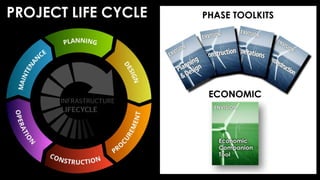
PROJECT LIFE CYCLE PHASE TOOLKITS
ECONOMIC
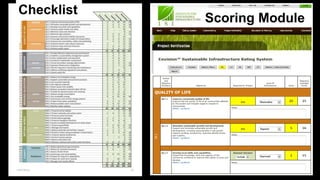
Checklist
Scoring Module
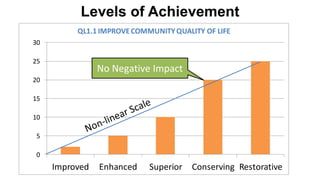
Levels of Achievement
0
5
10
15
20
25
30
Improved Enhanced Superior Conserving Restorative
Points QL1.1 IMPROVECOMMUNITYQUALITY OF LIFE
Levels of Achievement
0
5
10
15
20
25
30
Improved Enhanced Superior Conserving Restorative
Points QL1.1 IMPROVECOMMUNITYQUALITY OF LIFE
No Negative Impact
Levels of Achievement
0
5
10
15
20
25
30
Improved Enhanced Superior Conserving Restorative
Points QL1.1 IMPROVECOMMUNITYQUALITY OF LIFE
No Negative Impact
Award Levels
30%
40%
50%
20%
No minimum percentage
required for each category
Recognition
Level
Minimum
Applicable
Points
Bronze
Silver Award
Gold Award
Platinum Award
Project Size ($) Non-Member Price ISI Member Price
Up to 2M $3000 $2400
2-5M $8500 $7000
5-25M $17,000 $14,000
25-100M $25,000 $21,000
100-250M $33,000 $28,000
Over 250M
$5000 per 100M above base price of
$20,000
Registration Fee: $1000
Verification Fee:
Fee Schedule
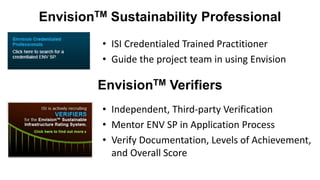
EnvisionTM Sustainability Professional
• ISI Credentialed Trained Practitioner
• Guide the project team in using Envision
EnvisionTM Verifiers
• Independent, Third-party Verification
• Mentor ENV SP in Application Process
• Verify Documentation, Levels of Achievement,
and Overall Score
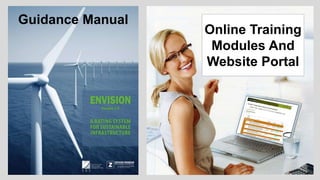
Guidance Manual
Online Training
Modules And
Website Portal
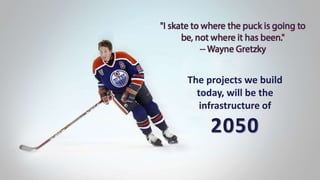
The projects we build
today, will be the
infrastructure of
2050
ENVISION YOUR FUTURE TODAY
LEARN, ADOPT and
PROMOTE Envision for
waterworks projects
EMPOWER by adding
training for ISI Envision
Rating System
SELECT and FUND projects
incorporating ISI Envision
Rating System
IMPROVE perceived
performance with
sustainable/resilient
Envision projects
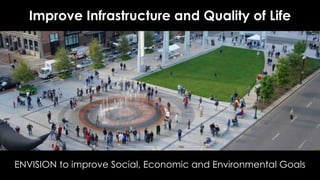
Improve Infrastructure and Quality of Life
ENVISION to improve Social, Economic and Environmental Goals
Associate / Project Manager
Michael Pelletier, PE, ENV SP
mpelletier@dewberry.com
(617) 531 - 0803
www.linkedin.com/in/michaelpel
Institute for Sustainable Infrastructure
www.sustainableinfrastructure.org

A Revolutionary New Approach – Using ISI Envision for Water Infrastructure Sustainability

Editor's Notes

  • #2 Welcome everyone! Thank You for coming to our symposium. It looks like I’ve come to the right place. We have a great and diverse audience here today from all walks of life in our profession representing city and town water system owners, to regulators, to consultants and vendors. But even more importantly, you’re here because you’re not satisfied with the Status Quo. You are also innovators and early adopters. You believe that together we can make a difference and Change Our World for the better. And that’s just Awesome. So, first I will tell you about WHY this new approach is important, Second, HOW it will improve your projects and your community’s confidence, And Third, WHAT is included in this system.
  • #3 So let’s make this fun and interactive… I have a Question for you. Today, when you hear the word “Sustainability”, what types of equipment or projects do you think of? Solar panels, wind turbines, hydroturbines, BMP’s or LID, etc. What else do you think of when it comes to “materials or products”? Recycling/Recycled materials, reducing quantities or wastefulness, using “green” products or low flow water fixtures in our buildings. Well our future life on Earth will depend on more than these things alone. We’re going to need to change the way we do everything. Why? Because we’re all well aware of the negative effects of climate change, resource depletion, CO2 emissions and energy wasting.
  • #4 Sustainability In it’s most basic terms it means: “The capacity to endure.” Or, according to the World Commission on Environment and Development: “Meeting the needs of the present without compromising our future needs, or the needs of future generations.” The infrastructure improvements we make to our water systems will also need to make less of an impact on the Earth’s natural resources and ecological systems, through the full Life Cycle of our infrastructure. We must now set a new course towards infrastructure sustainability to help maintain the future Quality of Life.
  • #5 Today, there is now A New Fact of Life… It is no longer enough that Infrastructure works or functions as designed, that it be constructed on time and within budget, or even that it lasts as long as possible… it now must be considered SUSTAINABLE. This is our purpose and what we must now achieve. To do it effectively, we must learn how to do this better than ever before. Well, This is the day I’ve been looking forward to for several years. Every once in a while, a Revolutionary approach comes along that changes everything… Today, we’re introducing a revolutionary new process for our water system projects! But first, let’s take a look at where we are today….
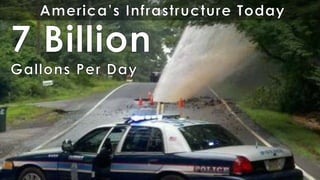
  • #6 (America’s Infrastructure Today) Currently, leaking water pipes lose 7 Billion gallons per day, and cause disruptions to traffic and roadways.
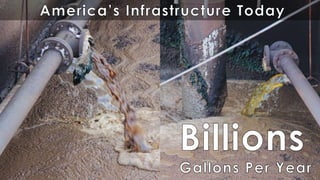
  • #7 There are Billions of gallons of untreated Wastewater discharged each year from aging systems, polluting our ecosystems.
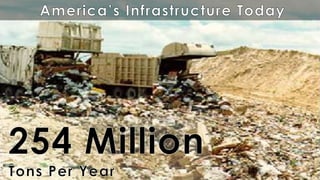
  • #8 And, the U.S. produces 254 Million tons of Solid Waste per year, unnecessarily. There are also 188 cities with Brownfield sites still in need of cleanup and redevelopment. All of this shows that we can do better!
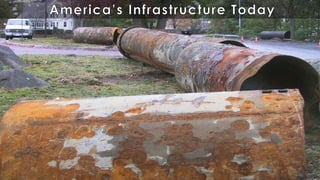
  • #9 One of the major challenges facing the water and wastewater industry is the aging condition of its infrastructure, and obtaining needed funding for improvements. Example photo, from my Quincy/Blue Hills 48” dia. water main project, of our typical water mains corroding and aging faster than we can maintain or replace them.
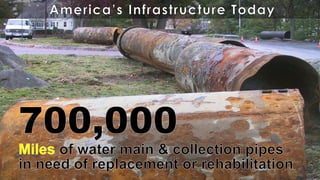
  • #10 According to the U.S. EPA nearly 700,000 miles of water main and wastewater collection pipe are in need of replacement or repair. This length is like laying pipe from the Earth to the Moon 3 times.
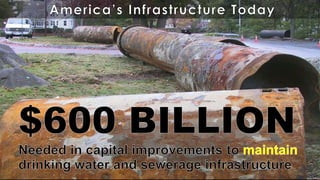
  • #11 The EPA estimates that over $600 billion is needed over the next two decades for capital improvements to drinking water and sewage infrastructure to maintain current levels of service. In addition, it may cost that amount again to address climate change issues through 2050.
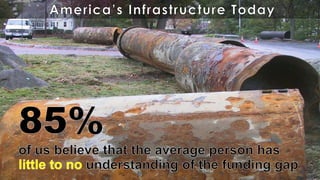
  • #12 85% of water industry professionals believe that the general public has little or no understanding of the funding gap that exists in order to repair our distribution systems. This is a problem to get the rate payers, public officials and other stakeholders to appreciate and support our water improvements. We need a good, reliable way to generate support.
  • #13 Skipping ahead to the Infrastructure for Tomorrow A new initiative is born... It’s called the Institute for Sustainable Infrastructure. It was based on the need for improving America’s infrastructure while becoming fully sustainable in our projects. I think all of us in this room take great pride in knowing that our water supplies are the source for bringing life and good health to our communities and sustaining them. So we should also be the leaders that help sustain life for generations to come. The ISI can help us succeed in our mission.
  • #14 ISI’s slogan is: “We’re here to initiate a systemic change… to transform the way infrastructure is designed, built and operated.” Since “Water Is Life”, as they say… this is also the “Future Of Water”.
  • #15 So I have a secret for only you folks in this room. There are actually 3 different ways you can create a world-class, award-winning infrastructure project. The first way, is to improve Social connectivity through your new infrastructure.
  • #16 The second way, is to improve the Environmental benefits from your project.
  • #17 And the third way, is to improve the Economic viability for your communities. So, 3 ways: Social connectivity, Environmental benefits and Economic viability. Are you getting this? These are not 3 separate approaches. This is 1 integrated approach.
  • #18 And the concept is called the Triple Bottom Line. Has anyone heard of this? It’s also been used as judging criteria for selecting award winning projects by some of our peer associations. I’ve been fortunate enough to see it work for several of my projects. Now ISI is using this TBL concept as their foundation, and created a Breakthrough new approach to projects. And it’s being called…
  • #19 And it’s being called… “ENVISION” Today, the Institute for Sustainable Infrastructure is reinventing the project approach. A revolution is coming in the way our projects will be selected, developed and implemented. The Envision method will increase the probability that the project will be accepted and completed within a community. Plus, we can improve our water system projects to have a Higher Level of Performance for the long-term. Now, are you ready to See it?! Well here it is…
  • #20 Envision, the all new Toilet Paper… [Holding up the roll of toilet paper for the audience to see.] So you can Reduce, Reuse and Recycle all your waste products until your heart’s content! No, no! JUST KIDDING!! That’s not it. That’s a joke. [Putting the roll of toilet paper down.] Actually the Envision system is in this manual that I have right here with me, which I’ll talk more in-depth about soon. [Holding up Envision Rating System manual for the audience to see.]
  • #21 Some cover buildings only (single sector) – LEED by USGBC.
  • #22 Others for infrastructure are sector specific – Greenroads.
  • #23 None cover all aspects of civil infrastructure – Sustainable Sites Initiatives.
  • #24 They may strive to, but they Don’t truly address the Quality Of Life issue completely – Triple Bottom Line.
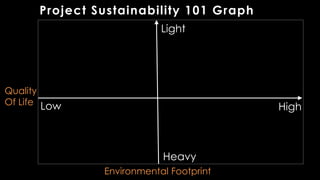
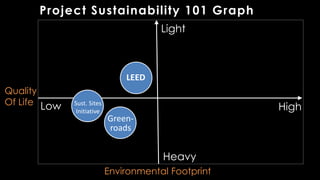
  • #25 So imagine that we’re sitting in Business School right now… and we’re drawing a Sustainability 101 Graph. With the Quality of Life on the Horizontal Axis (from low on the left to high on the right), and With the Environmental Footprint on the Vertical Axis (from worse on the bottom to better on the top)
  • #26 Some other rating systems do an OK job reducing some environmental impacts and try to improve our lifestyle.
  • #27 While others, like the Triple Bottom Line, are getting warmer, covering a wider range of the project outcomes. But no current system covered all aspects of civil infrastructure, or true quality of life.
  • #28 What we needed was a curve jumping system that goes Way beyond anything else before, with a Way higher Quality of Life for our community and Way less Environmental Impacts. So the EnvisionTM Rating System was designed to leapfrog ahead, as a holistic approach, to cover all aspects of Sustainable Infrastructure. This, out here, is where we want to be!
  • #29 Welcome to “Envision” the new Rating System by the Institute for Sustainable Infrastructure (ISI) Envision is uniquely qualified to address America’s infrastructure. ISI Envision represents the only comprehensive assessment system that strives to improve a project’s social and environmental performance, while also accounting for economic benefits and creating a better long-term value for the community.
  • #30 Developed by ASCE, ACEC and APWA as an alternative to LEED. As well as Harvard University’s Zofnass Program. - Envision applies to all civil infrastructure projects including water/wastewater. It incorporates the framework of some award-winning design processes serving the greater good. Envision will improve the performance of your project, and the public’s confidence in the owner’s performance.
  • #31 60 Credits (or evaluation criteria) in 5 major Categories that we’ll look at more closely next. EnvisionTM covers all types of Infrastructure. Like water and wastewater systems, roads, bridges, pipelines, railways, airports, dams, levees, landfills, and other civil infrastructure that make up the built environment. It can be adapted to many types of water projects like distribution, treatment systems, pumping stations and stormwater management. ISI did an awesome job compiling these criteria, based in part on past successful Triple Bottom Line and other award-winning projects. These criteria will help guide you to create Way Better Performing projects on your own. The 5 Categories, are great because they’re easy to understand for various town departments, community leaders, regulatory agencies and other stakeholders. And the 60 Credits incorporate the best parts of green infrastructure and sustainability issues.
  • #32 Now a look at the 5 Categories. First: Quality of Life specifically addresses a project’s impact on Communities from the health and wellbeing of individuals, to the Wellbeing of the larger social fabric as a whole. Envision also helps us evaluate the Purpose of the project. It not only asks “Will we do the project right?”, but also “Will we do the right project?” In other words: “Is this the right project here for our needs?” Which is a great question to ask during planning and selecting new projects.
  • #33 Leadership is comprised of the tasks including Collaboration efforts, Management and Planning processes that demonstrate effective leadership and commitment by all parties involved in a project. This generates meaningful commitment from the owner, team leaders, stakeholders & constructors.
  • #34 Resource Allocation measures the use of renewable and non-renewable resources for the project such as Materials, Energy and Water. The benefits of managing the resources that we need will allow for a longer life as we know it.
  • #35 Natural World allows project teams to assesses the effect of the project on the preservation and renewal of ecosystem functions. This includes considerations for project Site location, preserving Land and Water Resources, and incorporating Biodiversity. This section addresses how to understand and minimize negative impacts, while considering ways in which the infrastructure can interact with natural systems in a synergistic and positive way.
  • #36 Climate Change And Risk looks at two main concepts: minimizing Emissions that may contribute to increased short- and long-term risks, and Ensuring that infrastructure projects are Resilient to short-term hazards or altered long-term future conditions.
  • #37 Human Development Index vs. Ecological Footprint by Country Did you know that the U.S. has the highest Ecological Footprint of all developed countries? And the construction of our infrastructure projects is also having an impact on our world. This Graph shows how some countries, shown in yellow, that are not very advanced or developed, have lower environmental impacts on the Earth, However, when countries become more Developed over time, shown in orange and blue, they also tend to increase their Ecological Footprint, which isn’t good. We need to be able to reduce our impact while still developing further. So I hold in my hand planet Earth. [Holding up an inflatable Earth globe ball.] Ok, now it’s your turn… In terms of Ecological Footprint, how many planet Earth’s do you think the U.S. is using in it’s current rate of consumption of natural resources? (Maybe one-half, or a whole, or 2?) Let’s Count Them! [Throwing several Earth globe balls into the audience.] 1… 2… 3… 4… 5 ! 5 Planet Earths – The U.S. is operating as if it had 5 planets to work with instead of 1. The current world average usage is using 1.5 planets. So we’re in trouble. If allowed to continue, this overuse of natural resources and reduction of ecosystems will have devastating consequences. Not only for this country but also for the rest of society. We must show people a better way of doing things.
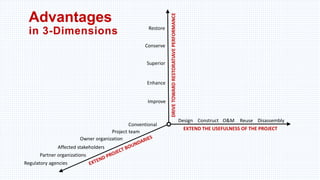
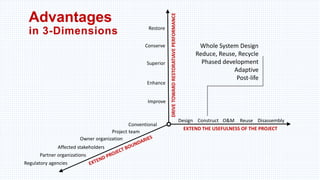
  • #38 Advantages of the Envision System in 3-Dimensions We have the opportunity to plan, design and build infrastructure that extends project boundaries, extends the usefulness of the project, and drives toward restorative performance.
  • #39 Explanation of the axes: X - Extend the useful life of the project (from planning & design thru reuse & disassembly).
  • #40 Y – Levels of Achievement: drive towards conserving and restorative conditions.
  • #41 Z - Extend the project boundaries with more stakeholder collaboration.
  • #42 Example my Heath Hill Section 52 Water Main Rehabilitation Project Won ACEC/MA Engineering Excellence Gold Award in 2009. Selected as an original ISI Envision Case Study in 2011, which was 1 of 5 nationally. 3 types of rehabilitation and replacement methods, with some innovations, that minimized overall surface disruptions. (Non-, Semi- and Fully-Structural linings and new pipe) Benefit – followed Triple Bottom Line approach of improving Social, Environmental and Economic benefits for community. I can provide you with a copy of the NEWWA Journal article and Envision summary if you’d like to read more about it.
  • #43 For example, a sample Water Main project conceptual design we were evaluating: At any time, the user can select the “Section Totals Summary” to see a table and graph of the points earned. The table lists: Each of the five categories and highlights the Strengths and Weaknesses. The maximum possible score (which may vary from project to project based on the credits included or excluded) The points earned (regular, innovation, and the sum of both) Potential improvements to achieve more points Strengths: QL: Stimulate sustainable growth and development. CR: Prepare for long-term adaptability. Weaknesses: LD: By product synergy pursuits RA: Provisions for deconstruction and recycling.
  • #44 Envision can currently be applied at any point in an infrastructure Project's Life Cycle including planning, design, construction, operation/maintenance, and decommissioning/deconstruction. In the future ISI will release additional Toolkits to more specifically address the later Phases of the project cycle, for continued use of the system. There is also a new Economic Companion Tool that was developed to help make informed decisions on your sustainability choices.
  • #45 Checklist: The EnvisionTM Checklist, which is a yes/no sustainability checklist, can be used on small projects or the preliminary design stage of a larger project. No training is necessary to use the Checklist. It’s a good first step for guidance. Scoring Module / Online Workbook: The ENV SP on the project and the team work through this spreadsheet questionnaire for all 60 credits. The objectives for each Credit are considered and based on (1) actions taken and (2) record keeping, the appropriate Level of Achievement can be selected. The rating system is intended to be a tool used throughout the project design phase, so it can be revisited and updated as many times as needed.
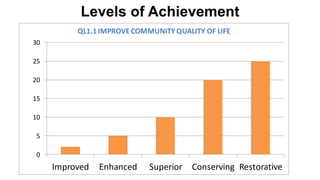
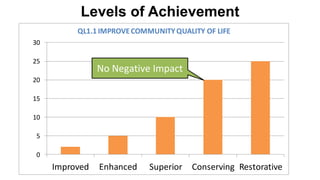
  • #46 The amount of points earned in each Credit depends on the Level of Achievement obtained. Starting low at “Improved” condition and moving up all the way to “Conserving” and “Restorative”. The Levels of Achievement are defined as: Improved: Performance that is above conventional. Enhanced: Sustainable performance that is on the right track. Indications that superior performance is within reach. Superior: Sustainable performance that is noteworthy. Conserving: Performance that has achieved essentially zero impact. Restorative: Performance that restores natural or social systems.
  • #47  For each Credit, the Guidance Manual gives a specific definition for each Level Not all levels of achievement are available for credits.
  • #48 Notice that the allocation of points is non-linear across the levels. This gives acknowledgement of initial efforts, but encourages higher levels of sustainability achievement.
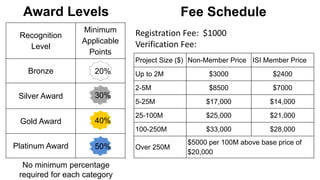
  • #49 Award Levels: It’s almost impossible to get all the points = 845. The Rating System allows for many possible ways to obtain points to be considered sustainable, but no project could incorporate them all. Do not expect your project to achieve a score of 90% to 100% that is typically considered an “A” in academia. Many projects designed with environmental and social considerations in mind will be able to achieve 40 to 45% of the applicable points in EnvisionTM. So it’s very likely your project will be recognized for some Award of merit by using this process. When the project team and ENV SP have complete the project and evaluation, they can submit the project to ISI for verification, but it is not a requirement. Fee Schedule: For official Verification, there is a Fee that varies based on the size of each project. The Verifier will also give input on the actions for achievement as needed.
  • #50 Envision Sustainability Professional: An ISI credentialed project guide is called an EnvisionTM Sustainability Professionals, or ENV SPs. At least one person on the project team must be trained and credentialed to use the online EnvisionTM website Scoring Module. That person guides the project team in applying the EnvisionTM rating system to their project. (A searchable list of ENV SPs is also available on the ISI website.) Envision Verifiers: ISI Verifiers provide independent, third-party verification of an EnvisionTM assessment. Professionals trained by ISI in the verification process will work under direct contract with ISI to assure an absence of a conflict of interest, overall uniformity, and quality in the conduct of evaluations and verifications. Verifiers work with ENV SPs during the rating process to verify the record documentation, levels of achievement for individual credits, and the overall rating score of the final project assessment submitted to ISI. They also help mentor the ENV SP in the application process.
  • #51 You can find resources, such as The EnvisionTM Guidance Manual Online Training Videos – 6 total for the rating system and process, with 1 extra for use of the online workbook Online Test for obtaining ENV SP credential To qualify for awards, at least one person on the project team must be credentialed to use the EnvisionTM rating system. This credentialed individual will act as a guide to helping the project team apply EnvisionTM to the project. Using Envision™ requires that the credentialed ENV SP logs in to the EnvisionTM Website Portal to register a project. Once there, they will see the interface for each of the 5 credit categories with the questions to be reviewed.
  • #52 To summarize this topic, this all reminds me of an old Wayne Gretzky quote that I love. Any hockey fans in the audience today? Gretzky said: “I skate to where the puck is going to be, Not to where it has been.”
  • #53 And that’s what we should all be trying to do now. The projects we build today, with 25 to 100 year design life’s, will be the existing infrastructure of 2050, When sustainability needs will be most crucial.
  • #54 Some Take-Away Action Items… LEARN, ADOPT and PROMOTE Envision for waterworks projects SELECT and FUND projects incorporating ISI Envision Rating System EMPOWER by adding training for ISI Envision Rating System IMPROVE perceived performance with sustainable/resilient Envision projects
  • #55 Finally, Welcome to Our Future, where we Improve Infrastructure and Quality of Life. Example: The Rose Kennedy Greenway and Central Artery Tunnel in Boston, MA with realigned underground utilities, open green space, and a large water fountain/splash area. Where people can be seen celebrating life and our great water supply! Now, use Envision to improve your Social, Economic and Environmental goals on your next water projects, and help Change Our World for the better!
  • #56 Dewberry Michael Pelletier, PE, ENV SP Associate / Project Manager mpelletier@dewberry.com (617) 531 – 0803 www.linkedin.com/in/michaelpel Institute for Sustainable Infrastructure (ISI) www.sustainableinfrastructure.org