“The transition from Primary to
Post-Primary has been recognised as
a crucial stage in young people’s
schooling career.”
(Moving Up- Smyth, McCoy and Darmody)
PUT SIMPLY
Students are required to: Move from one education

system to another, adjust their behaviour, develop
new ways of thinking and enter into new social
relationships (INTO 2008)

Broadly

speaking: Students experience better
transition if they are prepared well and view the
transition as an on-going process
WHICH SCHOOL TO CHOOSE???
Siblings attended !!!
You attended !!!!
Co-Ed V Single sex
Its been there forever !!!
Results, results and league tables !!!
Extra-curricular achievements !!!
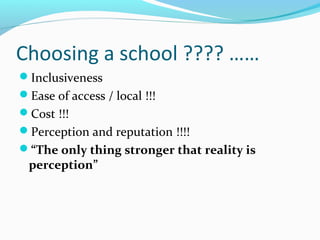
Choosing a school ???? ……
Inclusiveness
Ease of access / local !!!
Cost !!!
Perception and reputation !!!!
“The only thing stronger that reality is

perception”
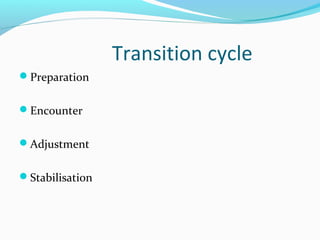
Transition cycle
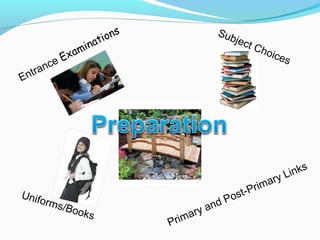
Preparation
Encounter
Adjustment
Stabilisation
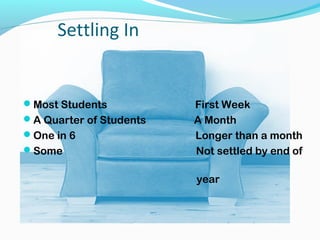
Settling In

Most Students
A Quarter of Students
One in 6
Some

First Week
A Month
Longer than a month
Not settled by end of
year
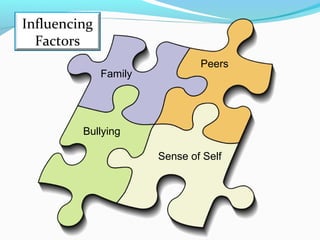
Influencing
Factors
Family

Peers

Bullying
Sense of Self
Coping mechanisms
Enabling students to deal with problems they

encounter, including managing time and negotiating
conflict

THERE IS A STRONG RELATIONSHIP BETWEEN

COPING MECHANISNS AND SUPPORT
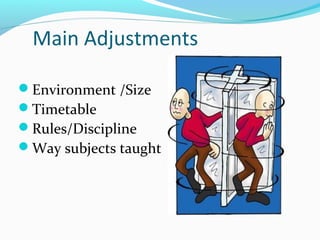
Main Adjustments
Environment /Size
Timetable
Rules/Discipline
Way subjects taught
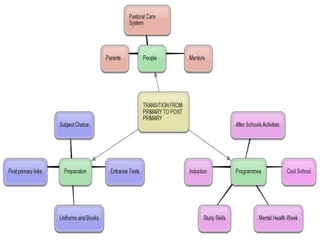
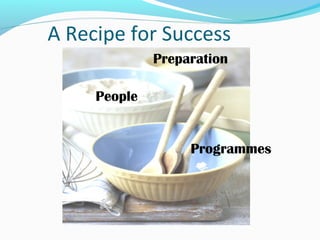
A Recipe for Success
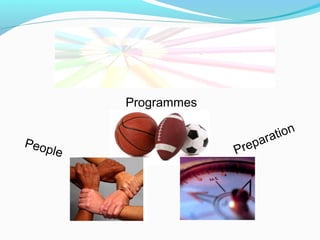
Preparation
People

Programmes
c
r an
t
En

Unif
or

ons
ati
min
a
Ex
e

m s/ B
o o ks

Sub
j

Prim

a

and
ry

ect
Cho
ices

ost
P

inks
ry L
a
rim
P
SUBJECT CHOICE ?????
Look at your strengths:
~{ Are you good with your hands?
~{ Are you musical?
~{ Do you like drawing/painting?
~{ Are you neat and careful?
~{ Are you logical and methodical?
~{ Do you have a flair for language – reading, talking

and writing?
Seven deadly sins of subject
selection ………..
1. “Only nerds do that Subject.”
2. “That’s just a subject for girls/boys.”
3. “None of my friends are doing that subject.”
4. “I’ll do that subject because it looks easy/like a

doss.”
5. “Even though I really hate it, I’ll do that subject
because I’ll need it to get into a particular course
in college.”
6. “I’ll be made fun of if I choose that subject.”
7. “It will be too hard and I’m not good enough.”
Links
Primary

Post Primary

Pastoral Care Team meet Primary Teachers
Tutors/Year Heads meet 6th class Students
Academic scores
Open day / Induction day
People
Pastoral Care System/Team
Mentoring
Parents
Student Mentors
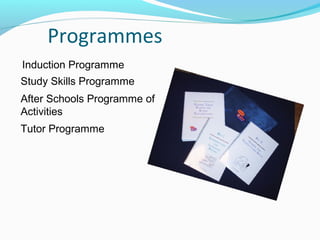
Programmes
Induction Programme
Study Skills Programme
After Schools Programme of
Activities
Tutor Programme
Induction Programme
Handover
Meet The Team
Rules
Tour
Class Groups

- Hopes and Fears
- Find a Friend
Subject Sample
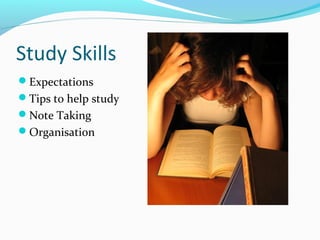
Study Skills
Expectations
Tips to help study
Note Taking
Organisation
Tips for Parents
Programmes
Peop
l

e

r ep
P

t ion
ar a
Personal Experience ….. Worries
New subjects…….
Having all their stuff …….
Timetables …….
Rules ……
Making friends …….
Bullying …….
Top of the school to bottom of the pile ….
Looking cool !!!!!
And all this at a time of big change ……….
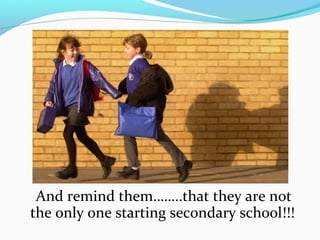
And remind them……..that they are not
the only one starting secondary school!!!
IF YOUR CHILD DOES EXPERIENCE
DIFFICULTIES, CONTACT THE SCHOOL

Moving On Up - Primary to Secondary

Editor's Notes

  • #2 This Presentation is largely based on the research in a book called Moving Up! It is referred to in my reference at the end of the presentation. In it research was done in Irish post primary schools on how was the experience of moving from primary to post primary for the schools involved in the research, the students and the parents. An excellent resource. The images in the presentation were all sourced from google images.
  • #6 This slide gives an overview of the content of the presentation. It is based on the 3Ps – Preparation, People and Programmes. It shows the various topic links to each of these key ingredients.
  • #8 “Most students reported settling into post-primary school within the first week but for a quarter of the students it takes about a month. One in 6 students …take longer than a month to settle in and a few of them still do not feel settled by the end of the first year.” (Moving up- Smyth, Mc Coy and Darmody)
  • #9 According to Smyth, McCoy and Darmody in their research the key factors in influencing how successful or not the transition from primary to post-primary will be for a student are :- Family Background Sense of Self Adolescent Development Interaction with Peers Interaction with Parents Bullying
  • #11 Main adjustments “changes in the physical environment and school size, the number of teachers and subjects, the longer school day, the structured timetable, the way in which subjects are taught and the nature of rules and discipline.” (Moving Up- Smyth, McCoy and Darmody)
  • #12 “There is a need for a planned, multi-faceted and long-term effort which involves parents, children and school staff.” (Moving Up- Smyth, McCoy and Darmody)
  • #13 Entrance Examinations Aptitude Tests 1st Saturday in February Verbal and Numerical Ability Reading Test Allows us identify students with specific learning difficulties Put necessary support structures in place School Tour- Leadership Committee Subject Choice Base Subjects (Exam) -Irish -English -Maths -French/German -History -Geography -Religion (exam subject) -CSPE Base Subjects (Non Exam) -Choir -Drama -P.E. -SPHE -Computers Option Subjects (Choose 3) -Technical Graphics -Home Economics -Science -Music -Spanish -Art -Business Sampling- Visits from Teachers to Primary Schools e.g. German Classes formed on basis of Music, German or Business. Uniforms and Books Book Lists Contact names and costs- uniforms
  • #16 This provides a great opportunity for the 6th class students to meet with some of the personnel in the secondary school before their first day. It also gives them a flavour of some of the subjects they may take in post primary.
  • #17 The Pastoral Care System/Team Principal Deputy Principal Chaplain Guidance Counsellor Year Head(s) Tutors Learning Support Teacher Mentors/Big Sister Representatives on the Student Council (some schools may have a Home-School Liasion Officer)
  • #19 Programmes Induction Programme: helping students settle in on their first day. Study Skills Programme : Needs to take place soon after arrival- preferably in the first month. After Schools Programme of Activities Basketball Drama Justice/Peace Group Gaelic Football Morning Prayer Group Athletics Hockey Volley Ball Soccer Badminton Badminton Table Tennis Keep Fit Cool School Week : Anti- Bullying Programme which runs for a week. Also called Friendship Week. Mental Health Week : Positive Psychology
  • #20 Induction Programme Handover- Primary Teachers to Secondary School- Speeches Meet Pastoral Care Team Rules Outlined Meet Mentors/Big Sister Tour- Orientation Game Tutors/Class Groups - Hopes and Fears - Find a Friend Subject Sample - 2 Subjects (x30 mins)
  • #21 Study Skills Programme Meet each class in 1st month Expectations around homework and study Location Tips to help study Note Taking Organisation- Filing, Lockers,Study Timetable
  • #22 People: Make new friends Seek advice/help if needed Contact your Big Sister Don’t pass on your fears Talk about your own experiences Preparation: Help choose subjects Be prepared the night before Eat and sleep well Get to know your timetable Encourage them to be aware Talk about how they plan to cope Programmes: Encourage participation in after schools activities Show an interest in her school life