Learning Goal
• to internalize and develop a clear
understanding on PNP Spiritual
and Values Formation Program,
and
• to provide moral and ethical
guidance which are powerful in
attaining the organization’s goal to
serve and protect lives and
properties.
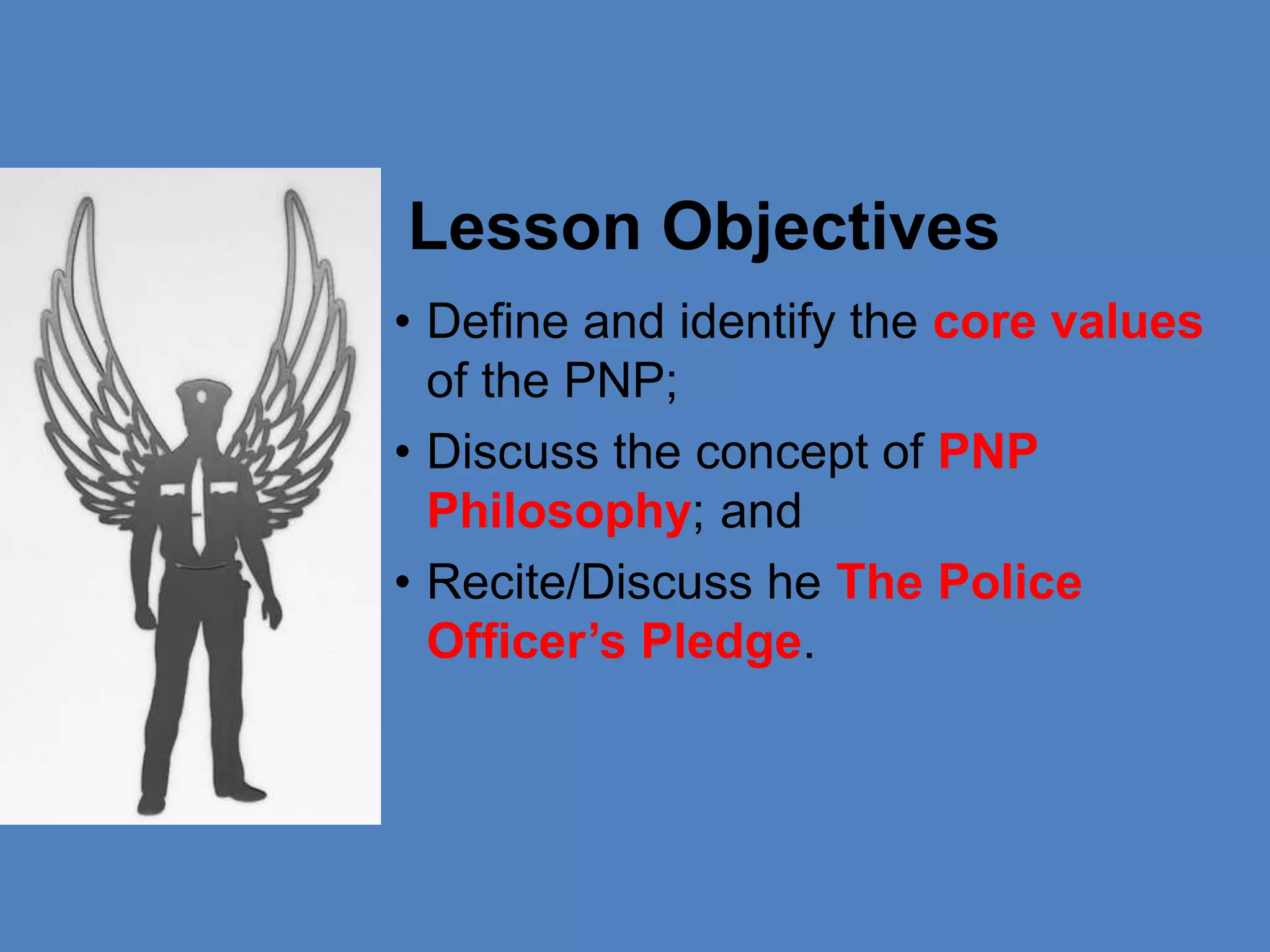
Lesson Objectives
• Define and identify the core values
of the PNP;
• Discuss the concept of PNP
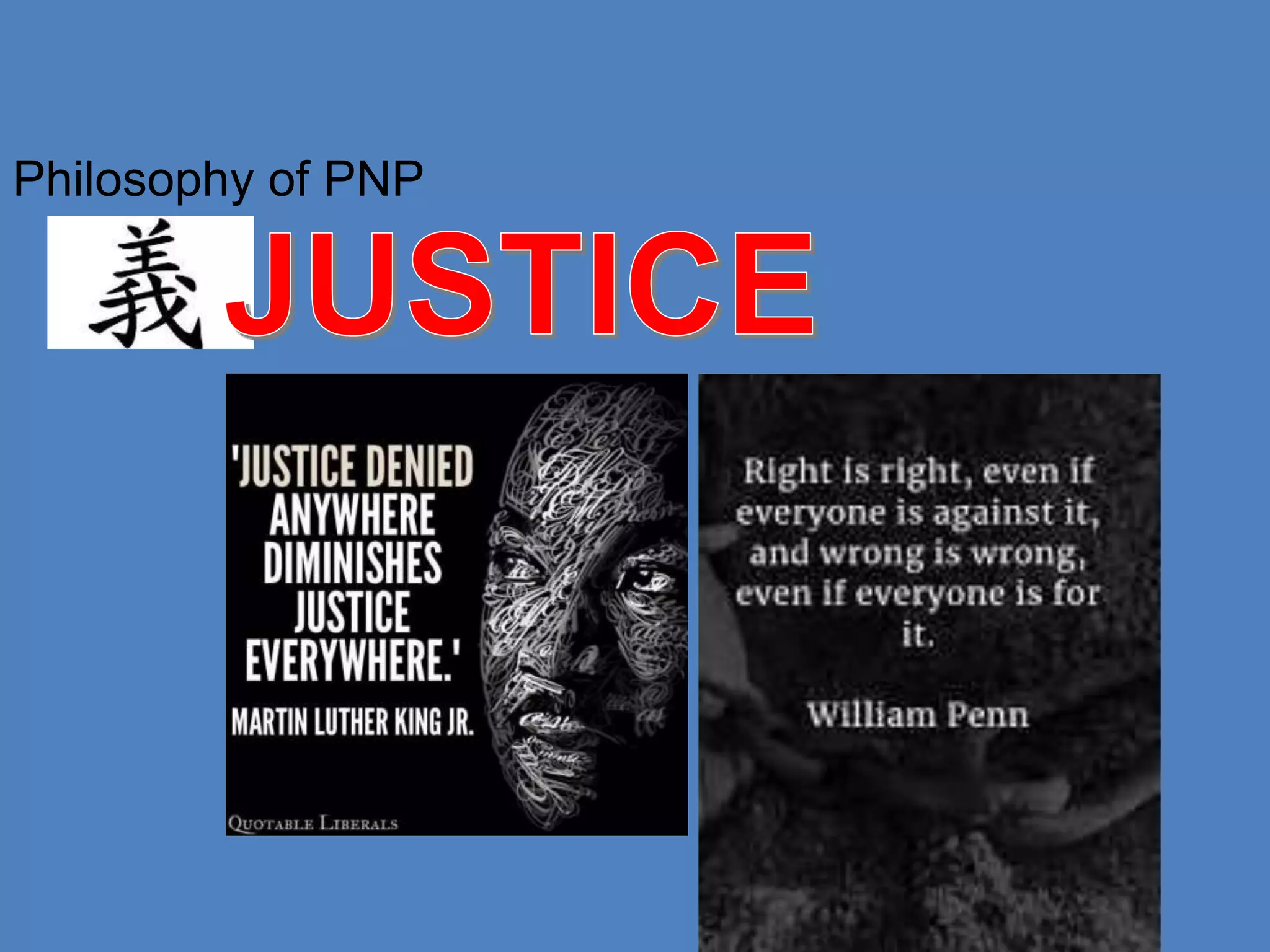
Philosophy; and
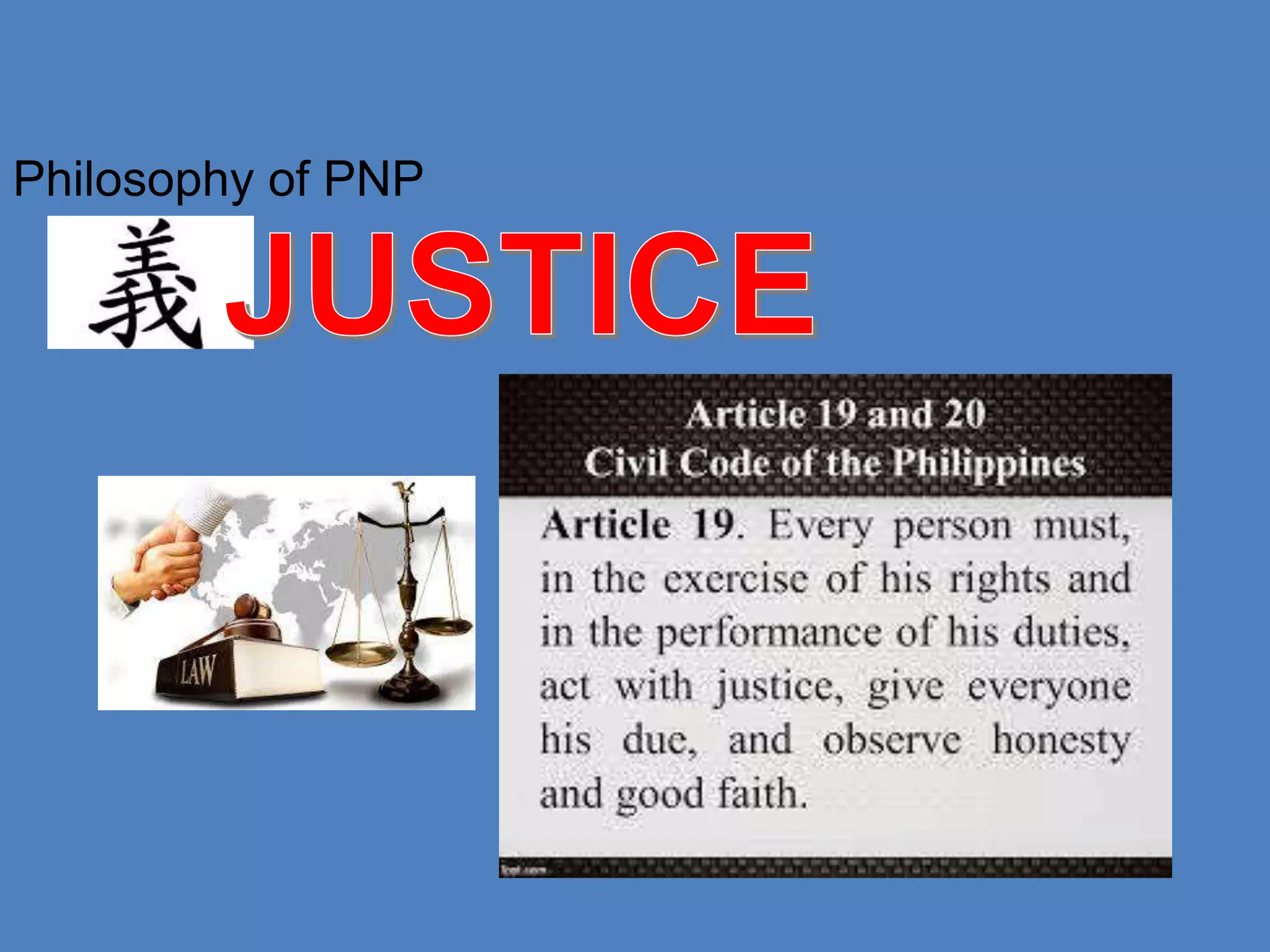
• Recite/Discuss he The Police
Officer’s Pledge.
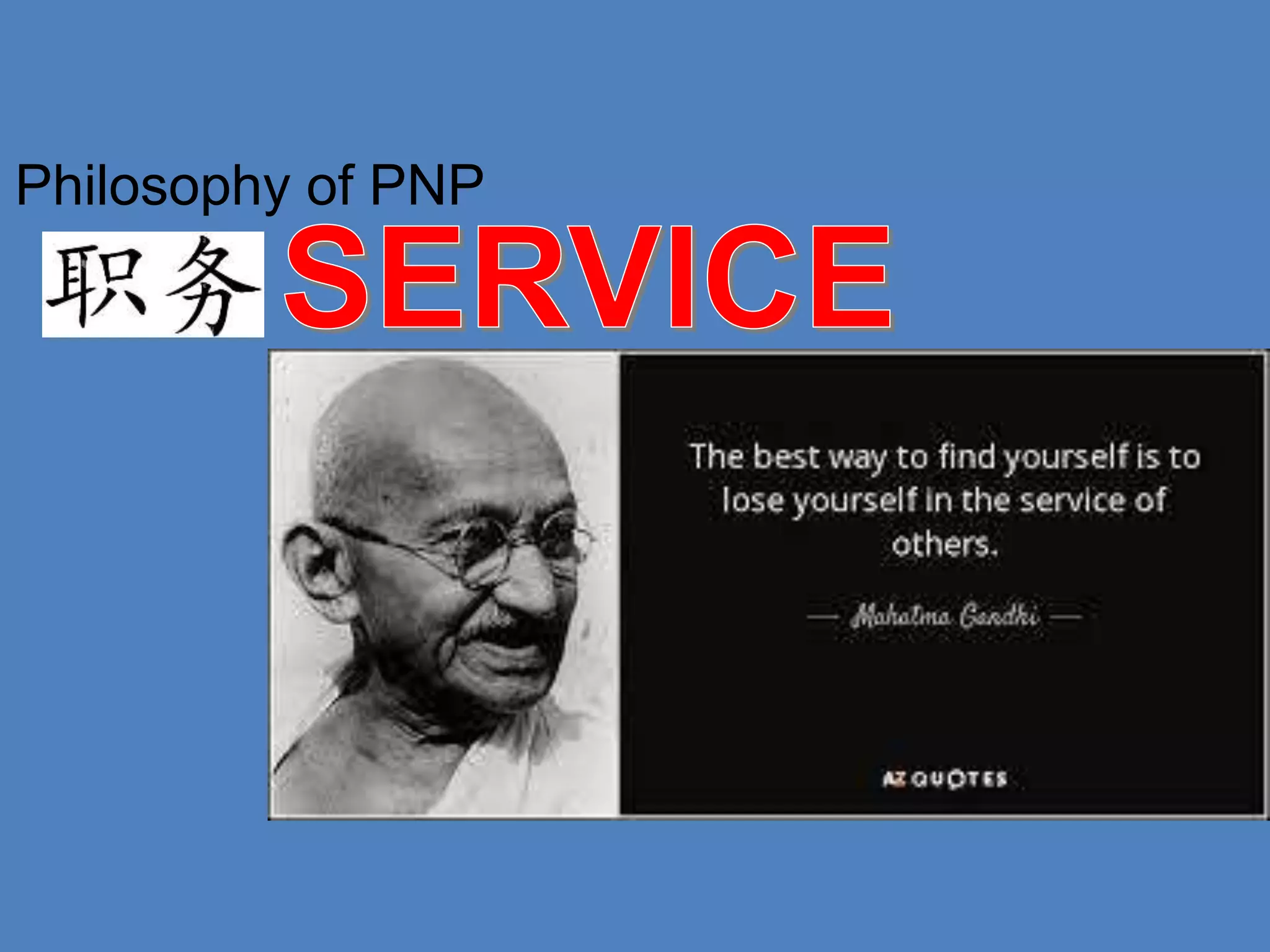
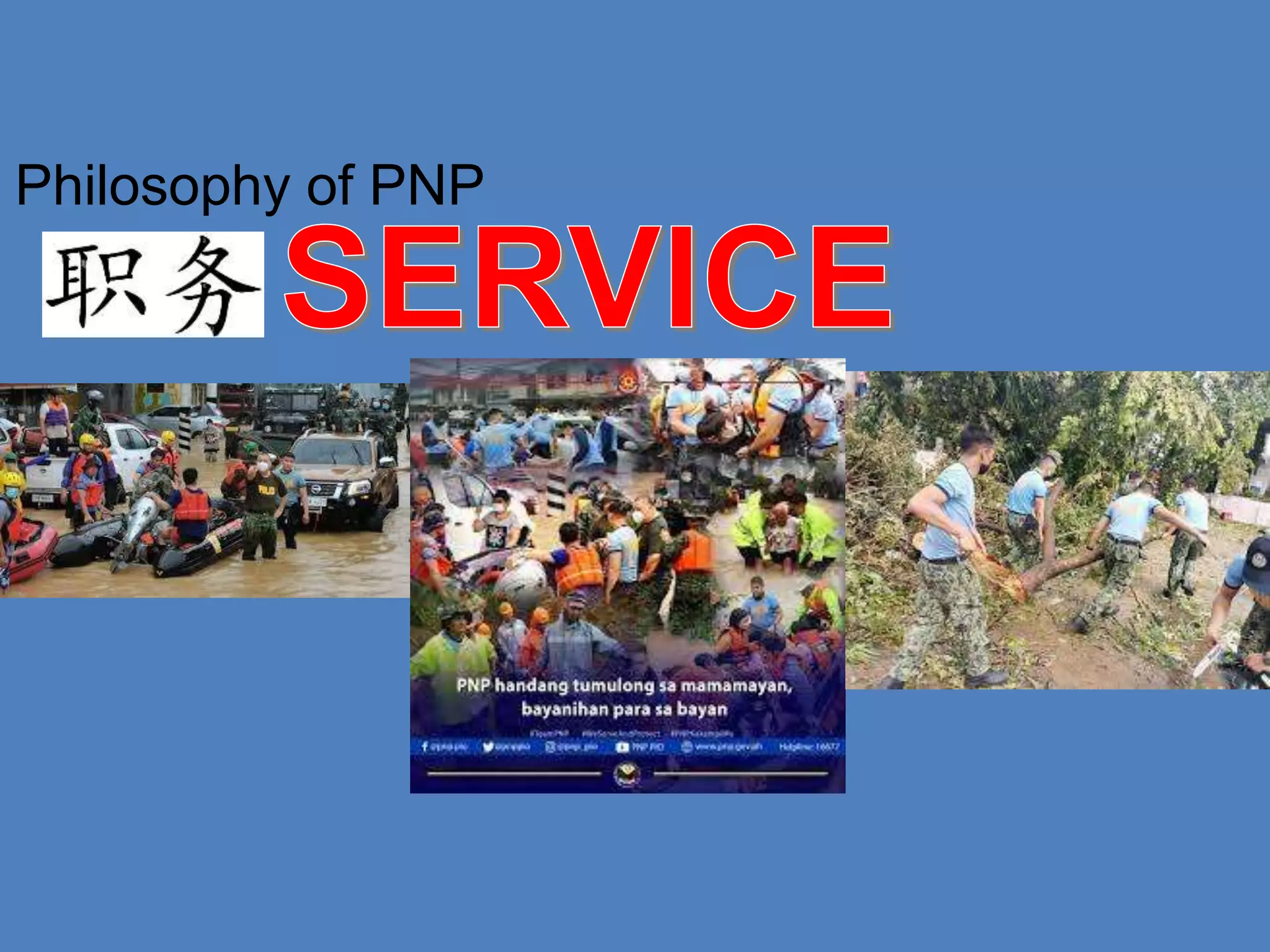
Philosophy of PNP
To Service
with Honor
and Justice
Philosophy of PNP
Philosophy of PNP
Philosophy of PNP
Philosophy of PNP
Philosophy of PNP
Philosophy of PNP
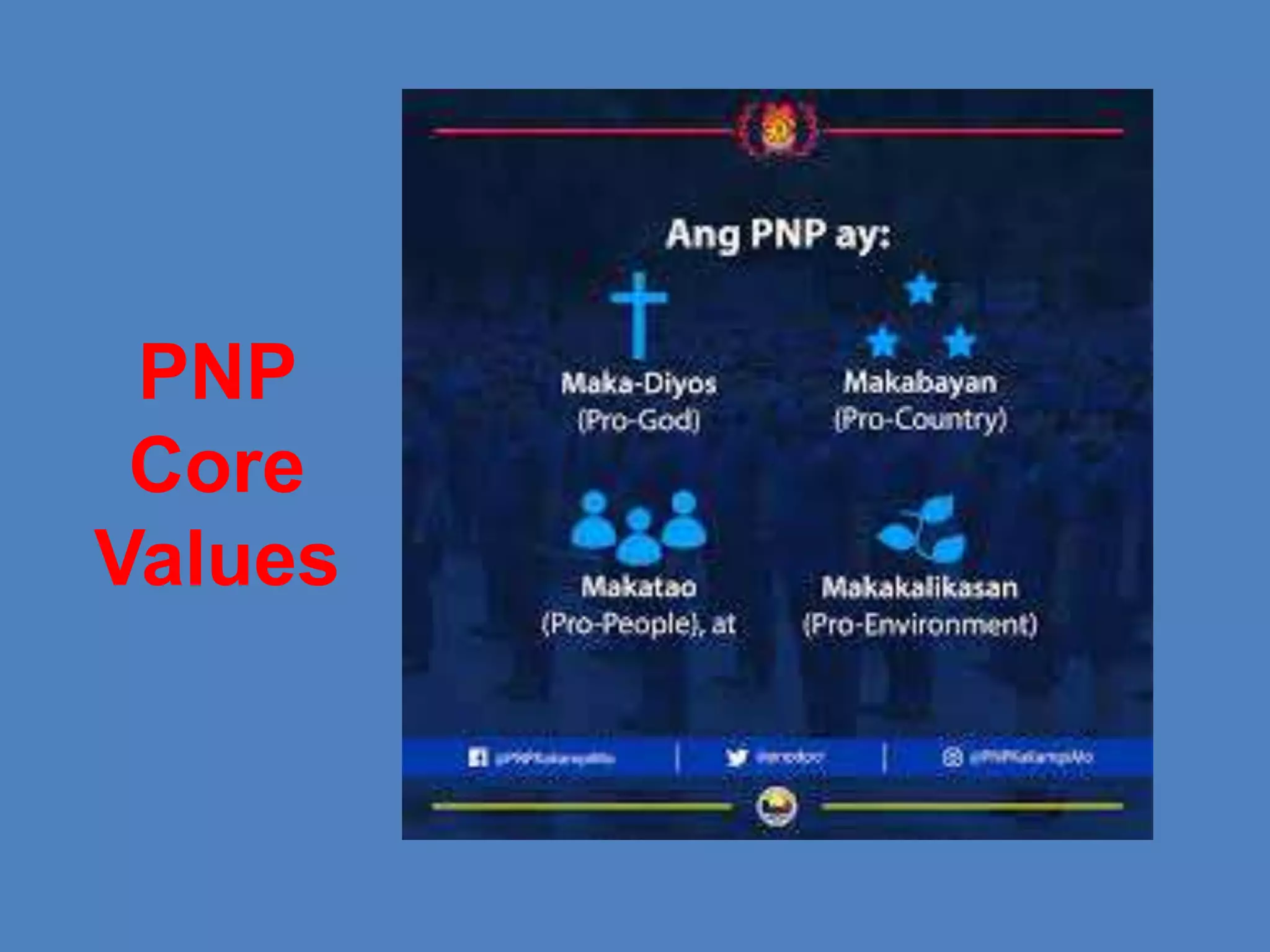
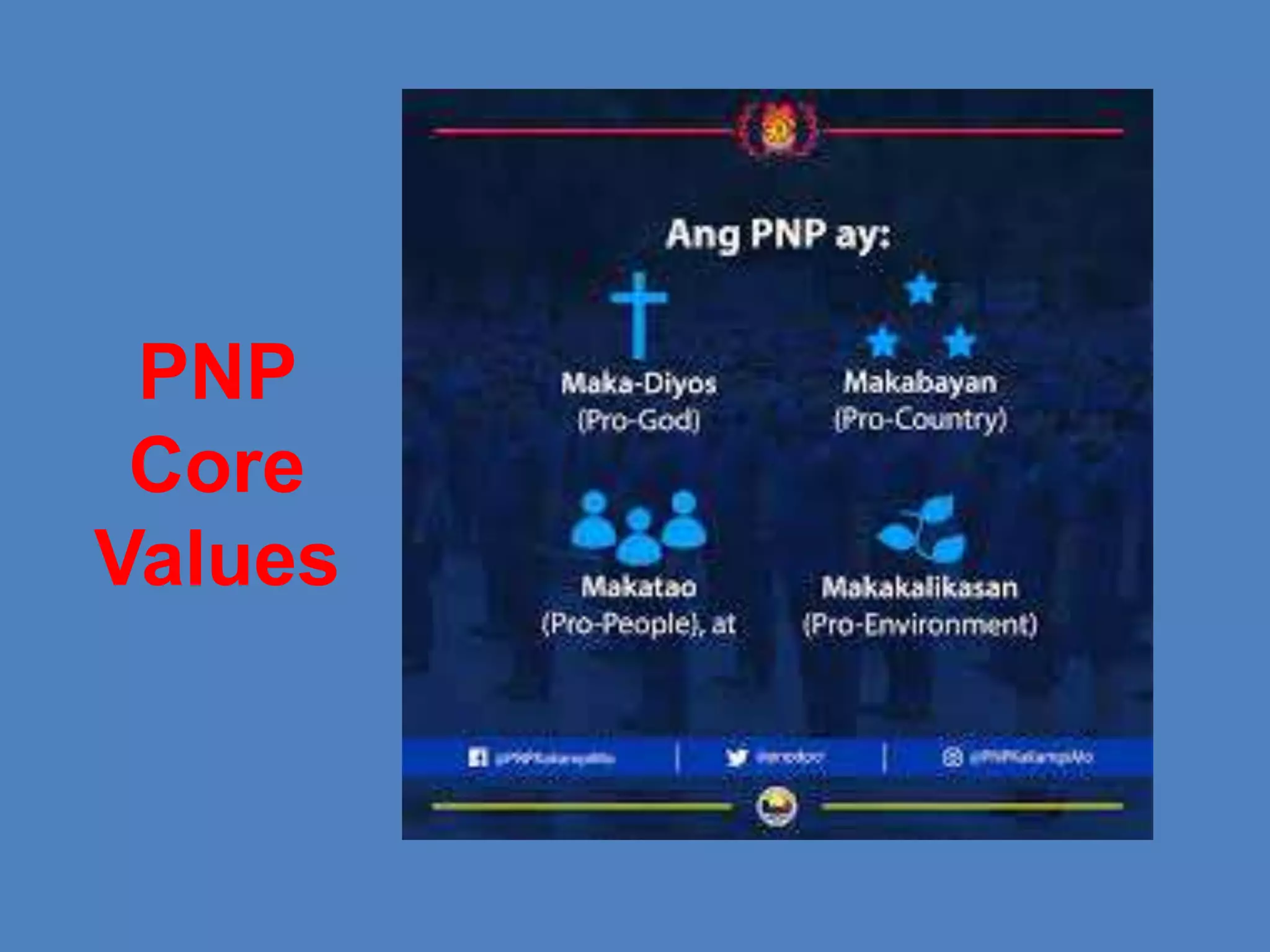
PNP
Core
Values
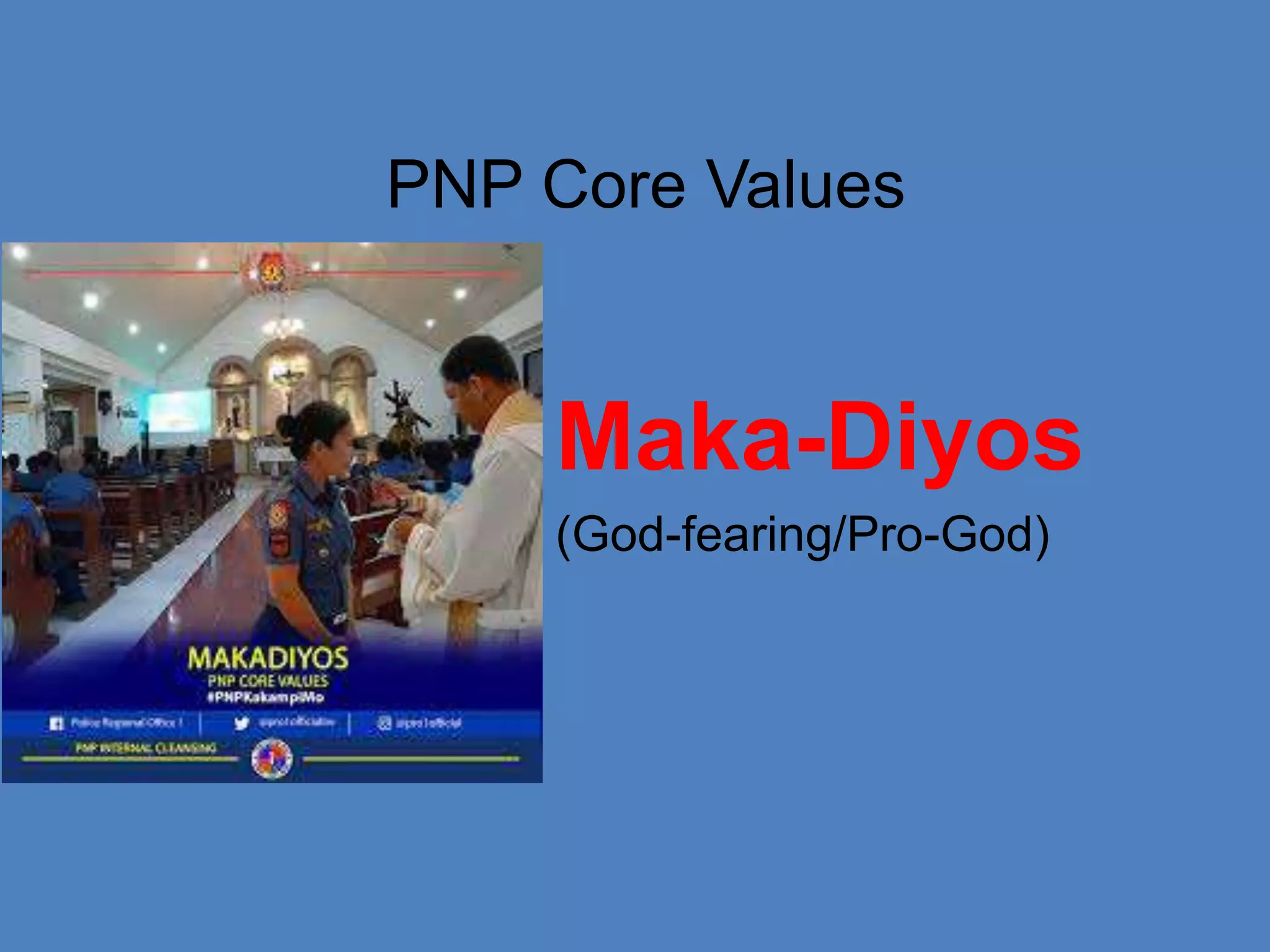
PNP Core Values
Maka-Diyos
(God-fearing/Pro-God)
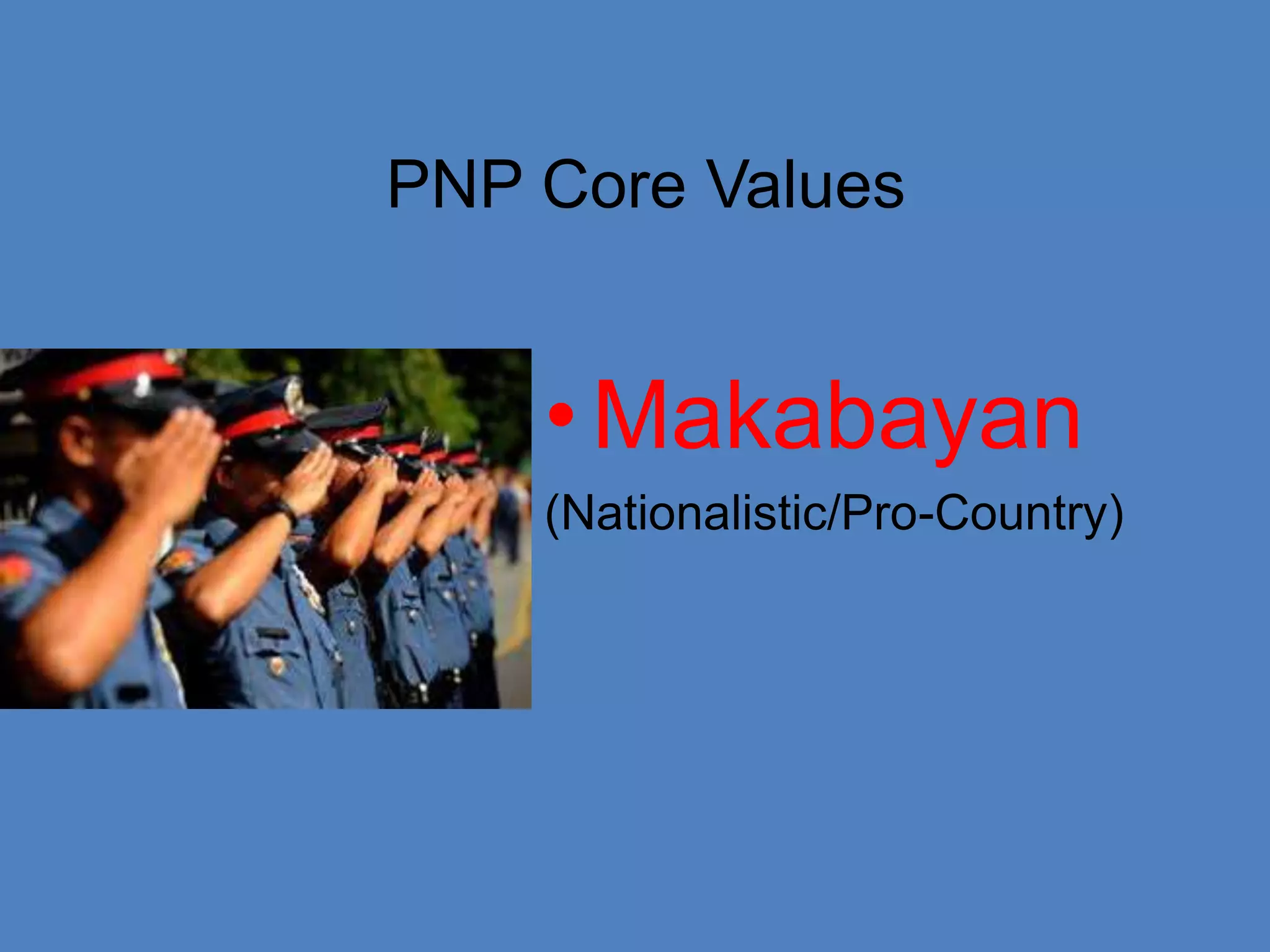
PNP Core Values
•Makabayan
(Nationalistic/Pro-Country)
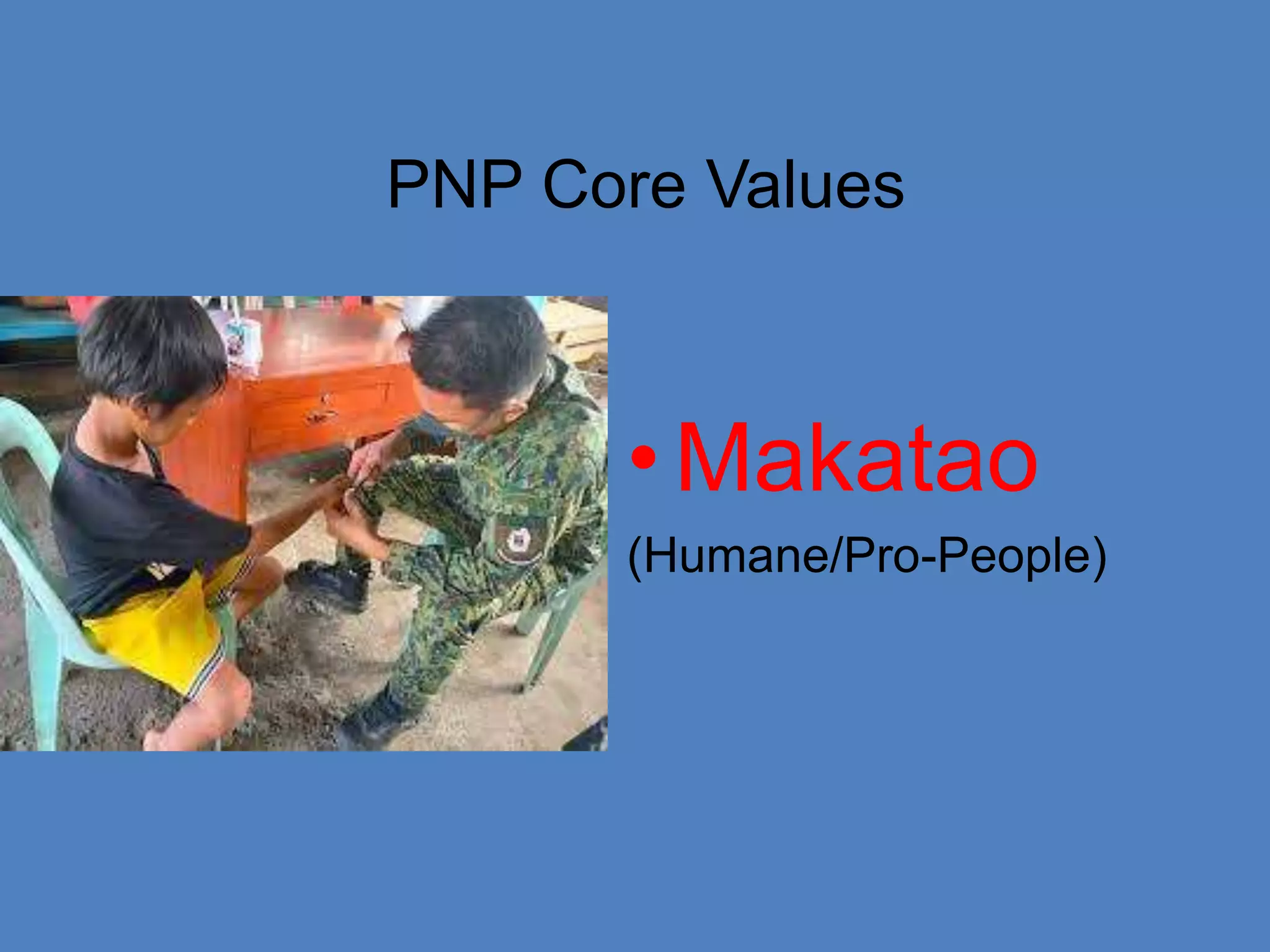
PNP Core Values
•Makatao
(Humane/Pro-People)
PNP Core Values
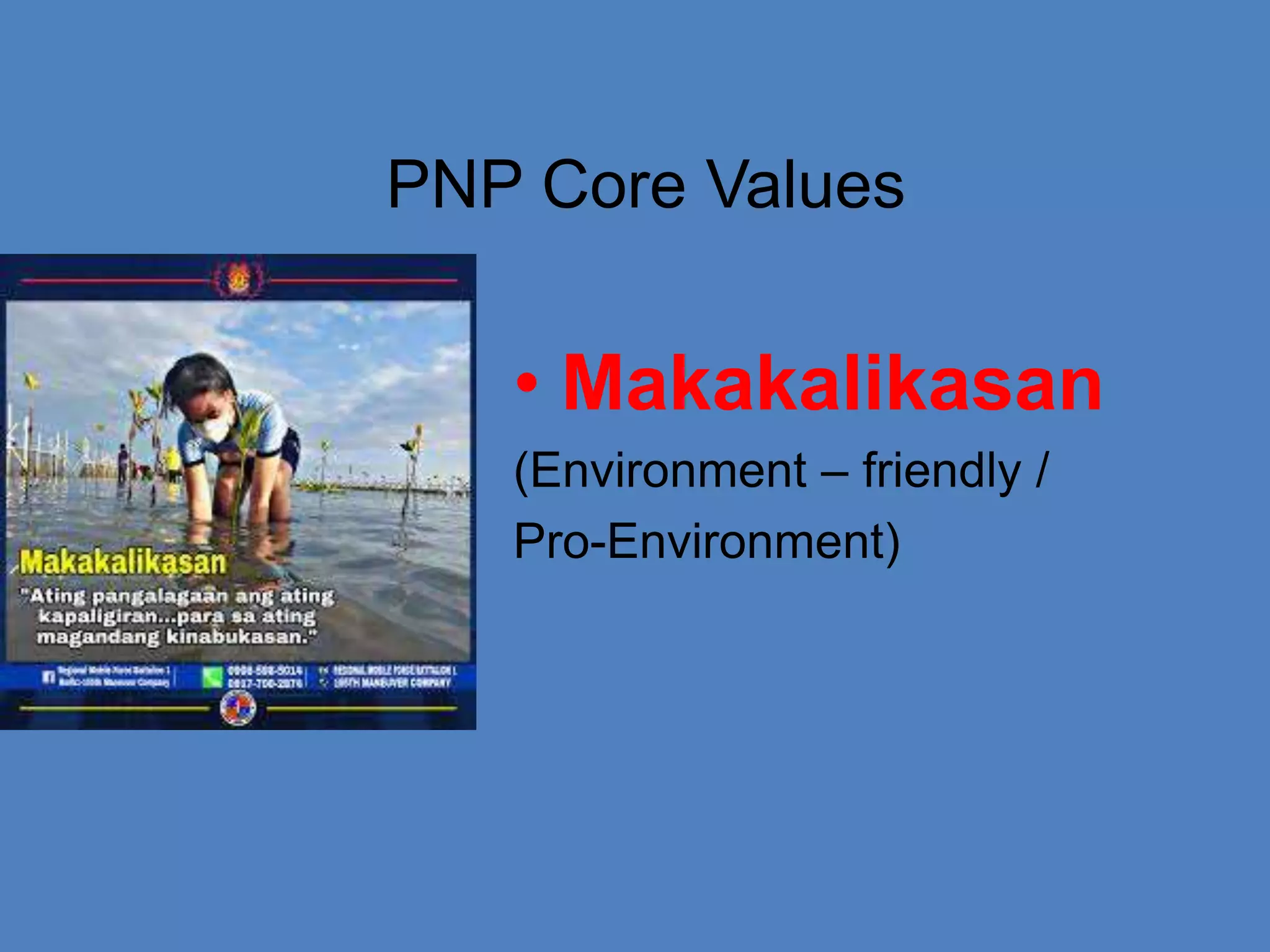
• Makakalikasan
(Environment – friendly /
Pro-Environment)
PNP
Core
Values
The Police Officer’s Creed
• I believe in God, the Supreme Being, the
Great Provider, and the creator of all men
and everything dear to me.
The Police Officer’s Creed
• I believe that respect for authority is a duty.
I respect and uphold the Constitution, the
laws of the land and the applicable rules
and regulations.
The Police Officer’s Creed
• I believe in selfless love and service to
people.
The Police Officer’s Creed
• I believe in the sanctity of marriage and
family life.
The Police Officer’s Creed
• I believe in the responsible dominion and
stewardship over material things.
The Police Officer’s Creed
• I believe in the wisdom of truthfulness.
The PNP is not the place
of angels with sterling
purity but of human
striving to become holy.”
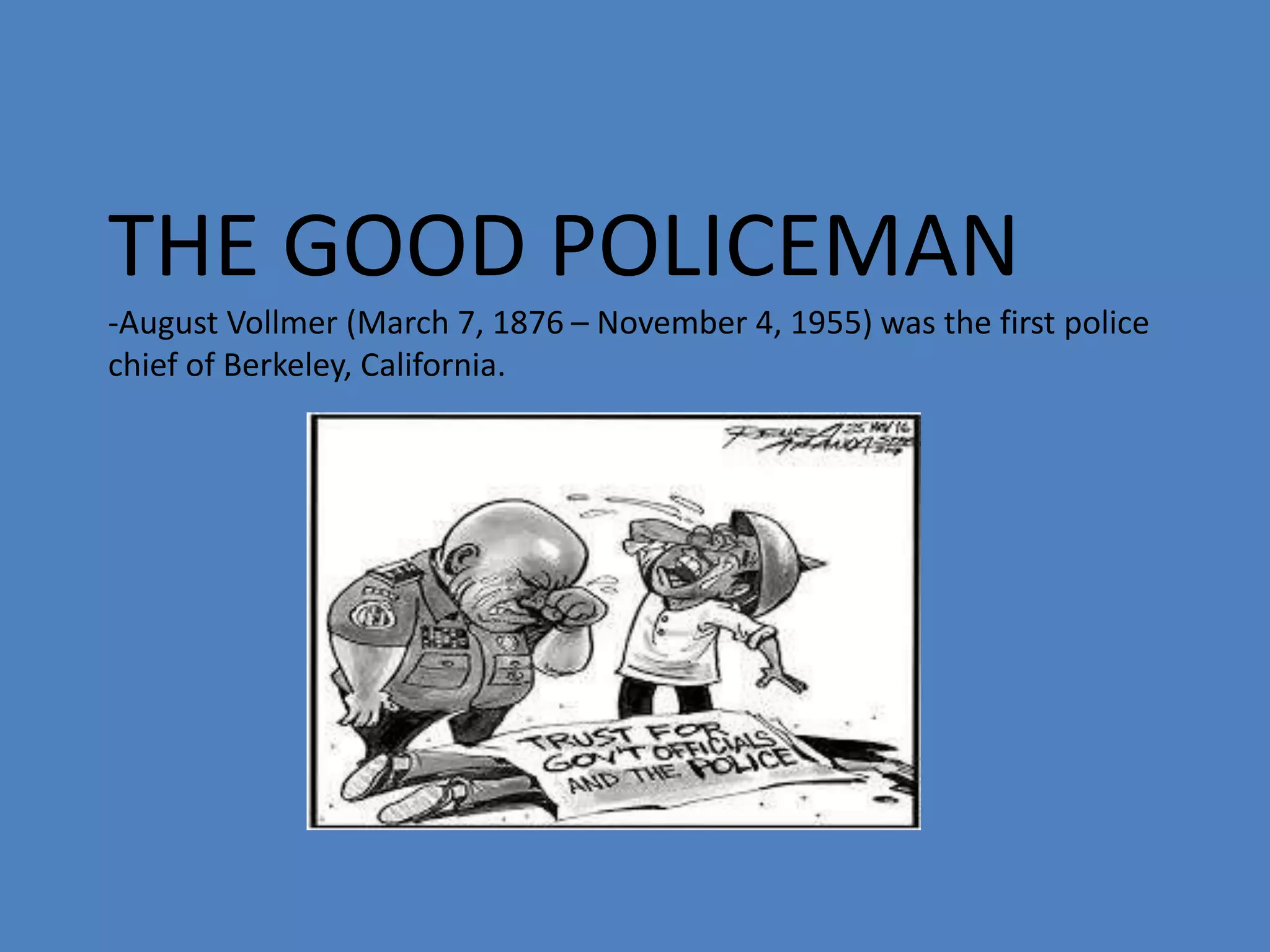
THE GOOD POLICEMAN
-August Vollmer (March 7, 1876 – November 4, 1955) was the first police
chief of Berkeley, California.
THE GOOD POLICEMAN
The citizen expects police officers to have
the wisdom of Solomon,
the courage of David,
the strength of Samson, t
the patience of Job,
the leadership of Moses,
the kindness of the Good Samaritan,
the faith of Daniel,
the tolerance of the Carpenter of Nazareth,
and, finally, an intimate knowledge of every branch of the
natural, biological, and social sciences. If he had all of these,
he might be a good policeman.
-August Vollmer, The Police in Modern Society, 1936
Thank you!

Moral Recovery Program.pptx

Editor's Notes

  • #2 Good afternoon, dear fellow police officers.
  • #3 Yesterday, I received an call first from PMSg Canja of the PIDMU and later from PCpl April May Ciasico of RIDMD inviting me to deliver this topic to you as students of Fingerprint Seminar. And you may wonder, why does this subject or topic become part of this seminar/training? It appears unrelated or off-tangent, right? But no, this topic is essential and timely because until now it remains a big challenge for the PNP is to restore the citizen’s trust and confidence because of the eroding image of the organization. The mission to restore citizen’s trust and confidence lies not only on the shoulders of our leaders but on each of us.
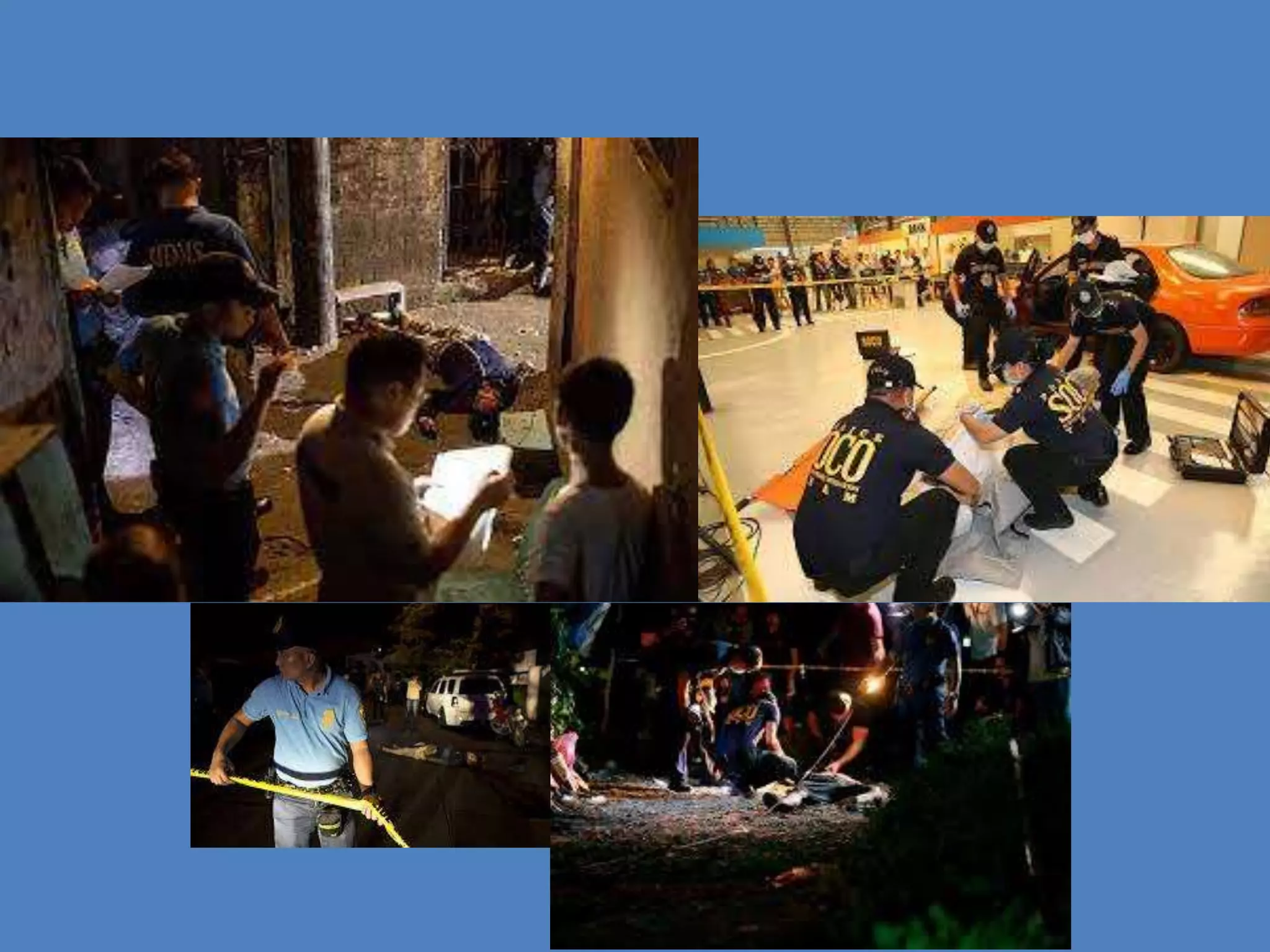
  • #4 ‘While, it appears that we are good at our respective unit, it is sad that when we check the internet we will find litany of blunders, scandals and anomalies involving top officials of the PNP.
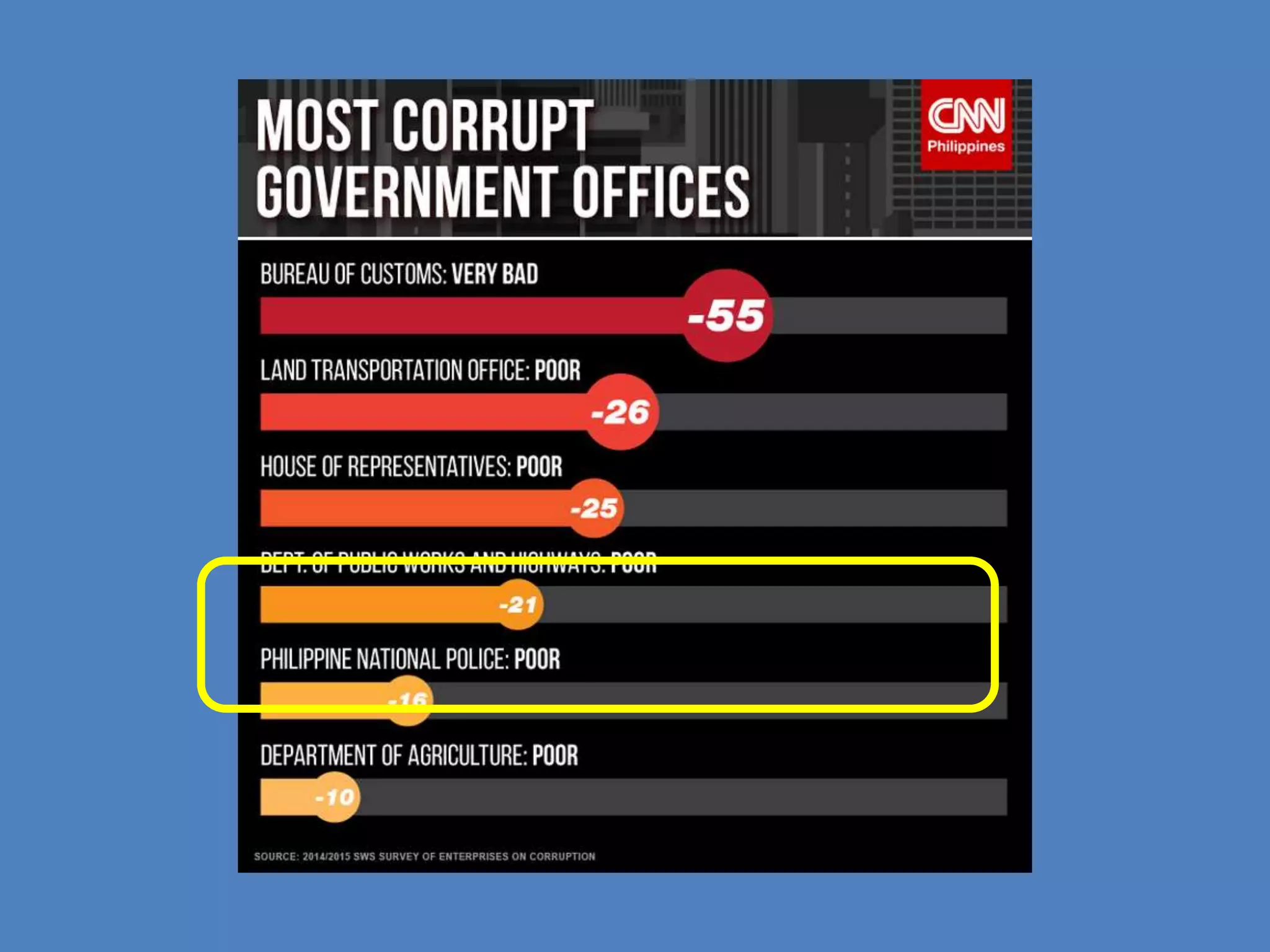
  • #5 In a survey by the Social Weather Station from November 14, 2014 until May 12, 2015, the PNP ranked 4th in the most corrupt agencies in the country. (http://integrityhasnoborders.com/news/news/79-customs-tops-list-of-most-corrupt-ph-agencies-again-sws)
  • #6 Aside from being tagged as corrupt, the PNP is among with the low sincerity in fighting corruption. (https://www.facebook.com/photo/?fbid=3894718837216075&set=pcb.3894718867216072)
  • #7 Sadly, however, not only our top officials are involved in anomalies and illegal activities. Even the lowest ranking members, in many occasions, are making headlines because of irregularity in the performance of their duty and conduct unbecoming of a police officer.
  • #8 It is paramount, therefore, that we need to have a clear understanding of the basic tenets of the PNP Values Formation Program as a powerful tool towards the attainment of our goal to serve and protect.
  • #9 So, it is hoped that that the end of this lecture, you will be able to define and identify the CORE VALUES of the PNP, discuss the concept of PNP Philosophy, and recite/discuss our PNP Pledge.
  • #10 INTRODUCTION: It is important that we know and understand that police investigators determine the success of investigation, but not solely with our knowledge, skills and abilities. The productivity and performance in solving crimes and eventually give justice to both victims and suspects is shaped by our CHARACTER.
  • #11 INTRODUCTION (cont…) Character is the reflection of one’s self and the application of the core values of “Maka-Diyos”, “Maka-Bayan”, “Maka-Tao” and “Maka-Kalikasan” in adherence to the PNP’s philosophy of HONOR, JUSTICE and SERVICE. These values and philosophies are powerful determinants of human accomplishment, progress, fulfillment and evolution. It is the very essence of human character.
  • #12 Other than the many symbols in the PNP Logo, Service • Honor • Justice added distinct ideals for the officers, men and women of the PNP to insure efficiency, integrity, cohesiveness, camaraderie and equanimity (mental calmness, composure) to enhance community acceptance and support to attain its mission of peace keeping and law enforcement.
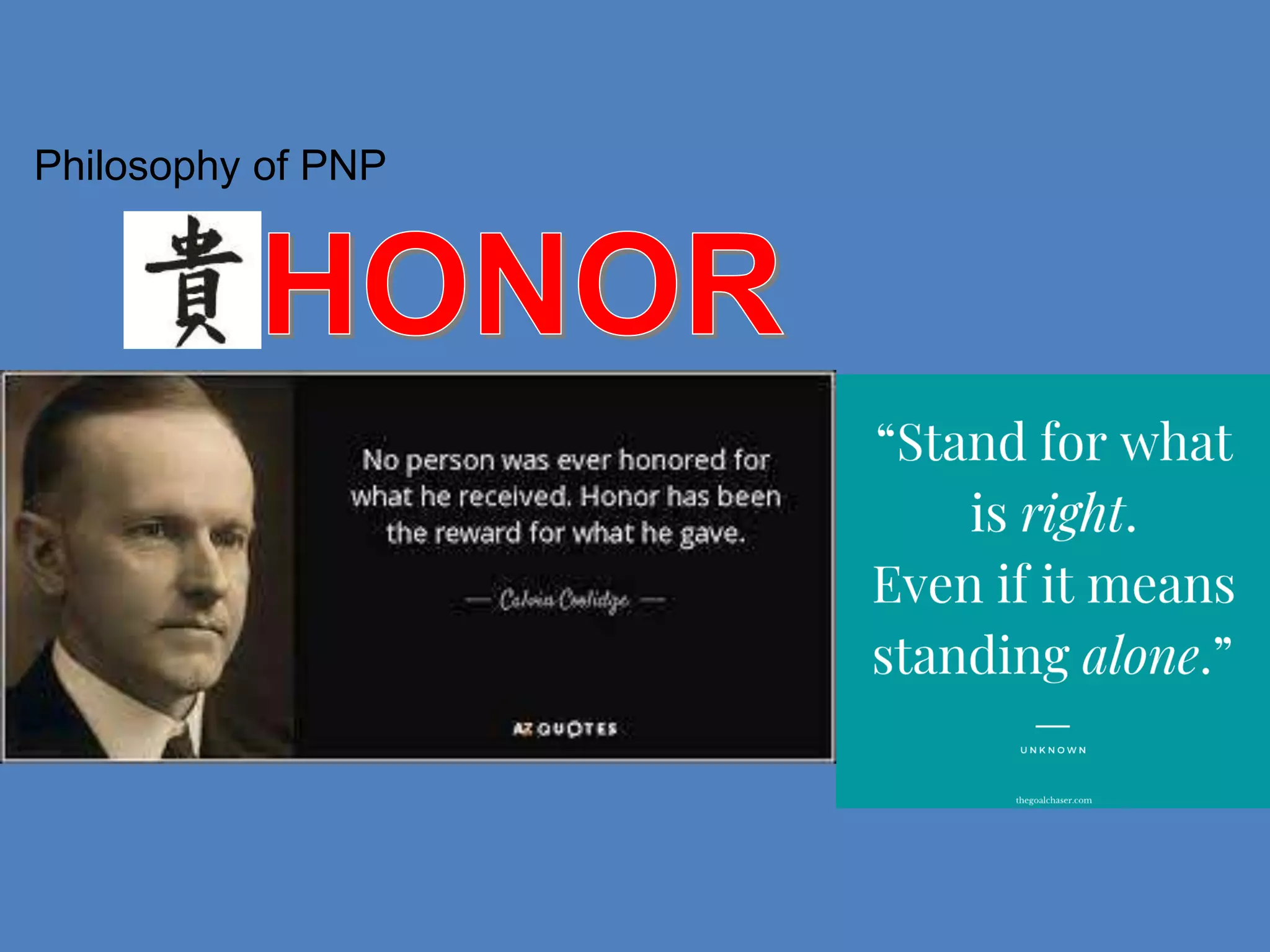
  • #13 Honor refers to the fairness or integrity in ones’ belief and actions allegiance to moral principles. Honor rrefers to orientation of our attitudes as first to honor God (maka-Diyos) and secondly, how we honor one another (maka-tao). According to American journalist and literary critic Henry Louis Mencken, “Honor is simply the morality of the superior men.” This conviction is echoed by ancient playwright of Athens [Greece] Sophocles reminding us to “Rather fail with honor than succeed by fraud.” (Cite Japanese Harakiri; or America’s leaders’ resignation.)
  • #14 Justice is generally understood to mean what is right, fair, appropriate, deserved. It is a virtue by means which man gives to others what is their due, whether to God, family or neighbors and environment.
  • #15 Thus, Article 19 of the Civil Code marks the beginning of the Chapter Human Relations, for indeed the chapter deals with so called norms of conduct in dealing with each other in respect to rights and duties. This provision has also been touted as a limitation on the exercise of one’s right. Always remember “our right ends where the right of others begins.”
  • #16 Justice, therefore, is based on the moral law and duty: to render everyone his due. We value justice and support the fair and just treatment of suspects and victims. Justice refers to the respect of rights of others and this includes the environment where we live.
  • #17 The concept service is simple. The organization and the individuals in it, from the Chief, PNP to the lowest level, Patrolman/woman, see themselves as helping others to achieve the organizational goal. (Cite TEAM PNP) (TEAM means: Together Everyone Achieves More)
  • #18 Motivational speaker Jim Rohn says “Whoever renders service to many puts himself in life for greatness, great wealth, great return, great satisfaction, great reputation, and great joy. USA’s 28th President Woodrow Wilson agrees to this when he says “There is no higher religion than human service. To work for the Common Good is the greatest creed.”
  • #20 God-fearing (Maka-Diyos) refers to what man truly needs, man’s greatest need is for God. When we look to God first and do things His way, the outcome will meet the deepest needs of men. (Matt. 6:33) Human worth is established by being God-centered. That is, when we focus on God who alone has worth in Himself, and we understand that we are created in His image, this brings us great worth. (II Samuel 22)
  • #21 Makabayan refers to loyalty and devotion to one's nation or country, especially as above loyalty to other groups or to individual interests. It also includes the devotion to the interests or culture of one's nation, the belief that nations will benefit from acting independently rather than collectively, emphasizing national rather than international goals and aspirations for national independence in a country under foreign domination.
  • #22 Humane (Makatao) refers to the attitude of caring about people and treating them with dignity at the same time valuing ourselves and others by speaking and acting with courtesy, treating others as we want to be treated and honoring the rules of our family or office, which make life more orderly and peaceful.
  • #23 Environment - friendly (Makakalikasan) – Caring for You and the Environment too, is affected by man Being free and a master of his environment, man's conduct and his reactions to environmental conditions are often different from that of an animal. Man's basic characteristic which, in fact, is the criterion of his humanity is his ability to control his passions and base desires. This ability which is a very bright aspect of the human life has been totally ignored by the materialists.
  • #24 It is important to note that Ethics and Values are interrelated. While ethics is defined as the capacity to determine right conduct and the knowledge of what is right from wrong, values are the applications of ethics. And with the PNP Core values, we must realize how noble is our profession. Yes, the police is service is a noble profession which demands from its members specialized knowledge and skills, as well as high standards of ethics and morality. It is why we, as PNP members, must adhere to and internalize not only those four core values of love of God, but also those as articulated in our Police Officer’s Pledge which underscore respect for authority, self-less love and service for people, sanctity of marriage and family life, responsible dominion and stewardship over material things and truthfulness.
  • #25 In return, we can do no less than love Him above all obeying His word, seek His guidance in the performance of our sworn duties and honor Him at all times.
  • #26 It means that we have to recognize the legitimacy and authority of the leadership, and obey legal orders of our superior officers.
  • #27 This reminds us to commit ourselves to the service of our fellowmen over and above our personal interest.
  • #28 It means that we shall set the example of decency and morality, shall have the high regard for family life and value of marital fidelity.
  • #29 This calls us to inhibit ourselves from extravagance and ostentatious display of material things. And we have also to help protect the environment and conserve nature to maintain ecological balance.
  • #30 Ladies and gentlemen, we have to be trustworthy and shall uphold the truth at all times.