Journey with MOOCs
Dr. Samson R. Victor
samsonrvictor@gmail.com
samson.victor@igntu.ac.in
Self Assessment
https://docs.google.com/forms/d/e/1FAIpQLScnw0ML9AsE8WGE0mWNDzxXtR_3
HeZxZ7QfCjC8u5ZZjvyhiQ/viewform?usp=sf_link
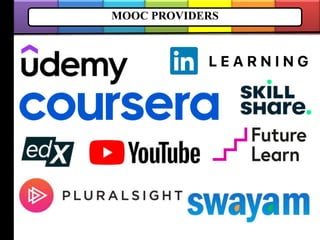
MOOC PROVIDERS
TIME
Study Webs of Active Learning for Young Aspiring
Minds (SWAYAM)
1. One-stop web and mobile based interactive e-content for all
courses from High School to University level.
2. High quality learning experience using multimedia on
anytime, anywhere basis.
3. State of the art system that allows easy access, monitoring
and certification.
4. Peer group interaction and discussion forum to clarify
doubts.
5. Hybrid model of delivery that adds to the quality of
classroom teaching.
NATIONAL COORDINATORS
AICTE (All India Council for Technical Education) for self-paced and international
courses
NPTEL (National Programme on Technology Enhanced Learning) for Engineering
UGC (University Grants Commission) for non technical post-graduation
education
CEC (Consortium for Educational Communication) for under-graduate
education
NCERT (National Council of Educational Research and Training) for school
education
NIOS (National Institute of Open Schooling) for school education
IGNOU (Indira Gandhi National Open University) for out-of-school students
IIMB (Indian Institute of Management, Bangalore) for management studies
NITTTR (National Institute of Technical Teachers Training and Research) for
Teacher Training programme
TERMS
National Coordinators (NCs): National Coordinators are the
Institutions that have been so designated by the Ministry and
assigned with a specific sector to cater to MOOCs.
Principal Investigator (PI): The PI shall be a Subject Matter
Expert (SME) belonging to a reputed educational institution,
identified and entrusted with the task of developing MOOCs in
a given area by the NC.
TERMS
Sector: mean a particular level of learning such as high school,
engineering/non-engineering diploma/degree/post-graduation.
Subject: shall mean a discipline taught in an educational
institution consisting of specific programme/courses, resulting in
the award of a certificate/diploma/degree.
Course: shall mean a paper, which is taught for at least one
semester as a part of a subject/programme.
FOUR QUADRANT APPROACH
Quadrant-I e-Tutorial: which shall contain: Video and Audio
Content in an organised form, Animation, Simulations, video
demonstrations, Virtual Labs, etc.
Quadrant-II e-Content: which shall contain: PDF, Text, e-
Books, illustrations, video demonstrations, documents and
Interactive simulations wherever required.
FOUR QUADRANT APPROACH
Quadrant-III Web Resources: which shall contain: Related Links,
Wikipedia Development of Course, Open source Content on Internet, Case
Studies, books including e-books, research papers & journals, Anecdotal
information, Historical development of the subject, Articles, etc.
Quadrant-IV Self-Assessment: which shall contain: Problems and
Solutions, which could be in the form of Multiple Choice Questions, Fill
in the blanks, Matching Questions, Short Answer Questions, Long Answer
Questions, Quizzes, Assignments and solutions, Discussion forum topics
and setting up the FAQs, Clarifications on general misconceptions.
QUADRANT-I E-TUTORIAL
Quadrant-I e-Tutorial: which shall contain: Video and Audio Content in
an organised form, Animation, Simulations, video demonstrations, Virtual
Labs, etc.
Video and Audio Content Development
1. Selecting of Content
2. Script writing
3. Script Evaluation
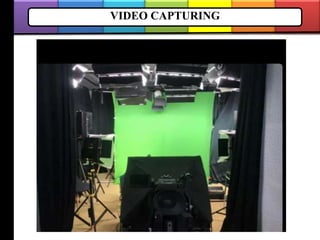
4. Video capturing
5. Video editing software
6. Reviewing
Script writing
Script Sample
VIDEO CAPTURING
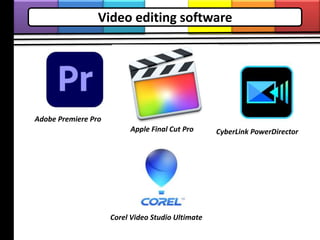
Video editing software
Adobe Premiere Pro
Apple Final Cut Pro CyberLink PowerDirector
Corel Video Studio Ultimate
VIDEO SAMPLE
Video Sample
Sample Quadrant 1
Sample Quadrant 1
Quadrant-II e-Content
Quadrant-II e-Content: which shall contain: PDF, Text, e-
Books, illustrations, video demonstrations, documents and
Interactive simulations wherever required.
Sample
Quadrant-III Web Resources
Quadrant-III Web Resources: which shall contain: Related Links,
Wikipedia Development of Course, Open source Content on Internet, Case
Studies, books including e-books, research papers & journals, Anecdotal
information, Historical development of the subject, Articles, etc.
Sample
Quadrant-IV Self-Assessment
Quadrant-IV Self-Assessment: which shall contain: Problems and
Solutions, which could be in the form of Multiple Choice Questions, Fill
in the blanks, Matching Questions, Short Answer Questions, Long Answer
Questions, Quizzes, Assignments and solutions, Discussion forum topics
and setting up the FAQs, Clarifications on general misconceptions.
Sample
SWAYAM PROPOSAL
Link
Self Assessment
https://docs.google.com/forms/d/e/1FAIpQLScnw0ML9AsE8WGE0mWNDzxXtR_3
HeZxZ7QfCjC8u5ZZjvyhiQ/viewform?usp=sf_link

MOOC.pptx

  • 1.
    Journey with MOOCs Dr.Samson R. Victor samsonrvictor@gmail.com samson.victor@igntu.ac.in
  • 2.
  • 3.
  • 4.
    Study Webs ofActive Learning for Young Aspiring Minds (SWAYAM) 1. One-stop web and mobile based interactive e-content for all courses from High School to University level. 2. High quality learning experience using multimedia on anytime, anywhere basis. 3. State of the art system that allows easy access, monitoring and certification. 4. Peer group interaction and discussion forum to clarify doubts. 5. Hybrid model of delivery that adds to the quality of classroom teaching.
  • 5.
    NATIONAL COORDINATORS AICTE (AllIndia Council for Technical Education) for self-paced and international courses NPTEL (National Programme on Technology Enhanced Learning) for Engineering UGC (University Grants Commission) for non technical post-graduation education CEC (Consortium for Educational Communication) for under-graduate education NCERT (National Council of Educational Research and Training) for school education NIOS (National Institute of Open Schooling) for school education IGNOU (Indira Gandhi National Open University) for out-of-school students IIMB (Indian Institute of Management, Bangalore) for management studies NITTTR (National Institute of Technical Teachers Training and Research) for Teacher Training programme
  • 6.
    TERMS National Coordinators (NCs):National Coordinators are the Institutions that have been so designated by the Ministry and assigned with a specific sector to cater to MOOCs. Principal Investigator (PI): The PI shall be a Subject Matter Expert (SME) belonging to a reputed educational institution, identified and entrusted with the task of developing MOOCs in a given area by the NC.
  • 7.
    TERMS Sector: mean aparticular level of learning such as high school, engineering/non-engineering diploma/degree/post-graduation. Subject: shall mean a discipline taught in an educational institution consisting of specific programme/courses, resulting in the award of a certificate/diploma/degree. Course: shall mean a paper, which is taught for at least one semester as a part of a subject/programme.
  • 8.
    FOUR QUADRANT APPROACH Quadrant-Ie-Tutorial: which shall contain: Video and Audio Content in an organised form, Animation, Simulations, video demonstrations, Virtual Labs, etc. Quadrant-II e-Content: which shall contain: PDF, Text, e- Books, illustrations, video demonstrations, documents and Interactive simulations wherever required.
  • 9.
    FOUR QUADRANT APPROACH Quadrant-IIIWeb Resources: which shall contain: Related Links, Wikipedia Development of Course, Open source Content on Internet, Case Studies, books including e-books, research papers & journals, Anecdotal information, Historical development of the subject, Articles, etc. Quadrant-IV Self-Assessment: which shall contain: Problems and Solutions, which could be in the form of Multiple Choice Questions, Fill in the blanks, Matching Questions, Short Answer Questions, Long Answer Questions, Quizzes, Assignments and solutions, Discussion forum topics and setting up the FAQs, Clarifications on general misconceptions.
  • 10.
    QUADRANT-I E-TUTORIAL Quadrant-I e-Tutorial:which shall contain: Video and Audio Content in an organised form, Animation, Simulations, video demonstrations, Virtual Labs, etc.
  • 11.
    Video and AudioContent Development 1. Selecting of Content 2. Script writing 3. Script Evaluation 4. Video capturing 5. Video editing software 6. Reviewing
  • 12.
  • 13.
  • 14.
    Video editing software AdobePremiere Pro Apple Final Cut Pro CyberLink PowerDirector Corel Video Studio Ultimate
  • 15.
  • 16.
  • 17.
    Quadrant-II e-Content Quadrant-II e-Content:which shall contain: PDF, Text, e- Books, illustrations, video demonstrations, documents and Interactive simulations wherever required. Sample
  • 18.
    Quadrant-III Web Resources Quadrant-IIIWeb Resources: which shall contain: Related Links, Wikipedia Development of Course, Open source Content on Internet, Case Studies, books including e-books, research papers & journals, Anecdotal information, Historical development of the subject, Articles, etc. Sample
  • 19.
    Quadrant-IV Self-Assessment Quadrant-IV Self-Assessment:which shall contain: Problems and Solutions, which could be in the form of Multiple Choice Questions, Fill in the blanks, Matching Questions, Short Answer Questions, Long Answer Questions, Quizzes, Assignments and solutions, Discussion forum topics and setting up the FAQs, Clarifications on general misconceptions. Sample
  • 20.
  • 21.