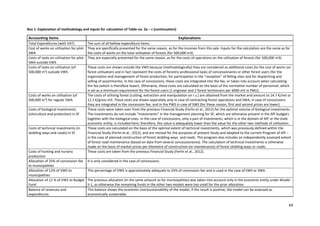
MONTENEGRO
Ministry of agriculture and rural development
Directorate for forestry, hunting and wood industry
Montenegro Institutional Development and Agricultural Strengthening Project
STUDY OF THE REFORM OF THE ORGANISATION AND THE CONCEPT OF
FOREST MANAGEMENT IN MONTENEGRO
(Author’s translation of the original local version)
Franc Ferlin,
Consultant
Podgorica, July 2017
1
CONTENTS
ACRONYMS 2
KEY DEFINITIONS 3
EXECUTIVE SUMMARY 4
1. INTRODUCTION 14
2. METHODOLOGICAL APPROACH 14
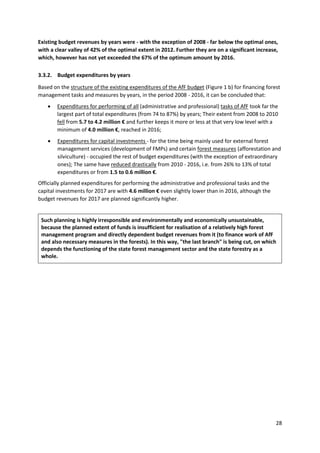
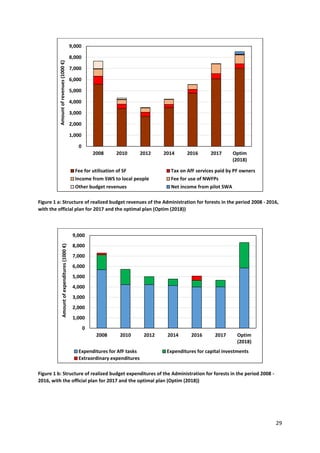
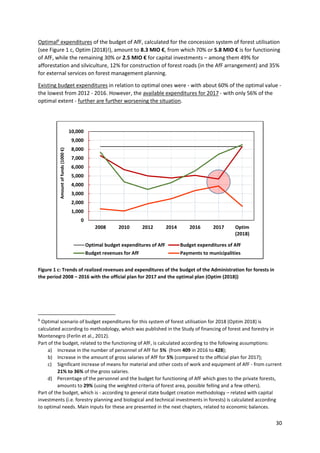
3. ANALYSIS OF THE EXISTING ORGANISATION AND THE CONCEPT OF FOREST
MANAGEMENT WITH PROPOSALS FOR IMPROVEMENT
15
3.1. EXISTING LEGAL, ORGANISATIONAL AND HUMAN RESOURCE STRUCTURE OF
INSTITUTIONS AND/OR SERVICES AND THEIR FUNCTIONING
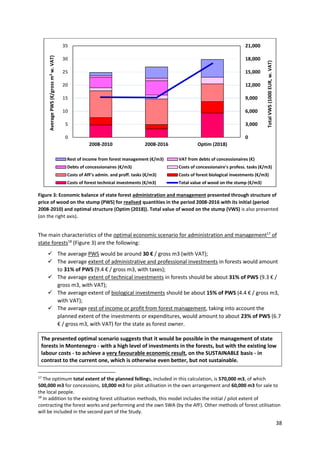
15
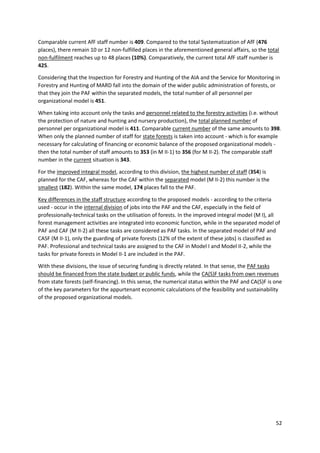
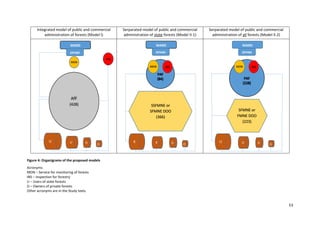
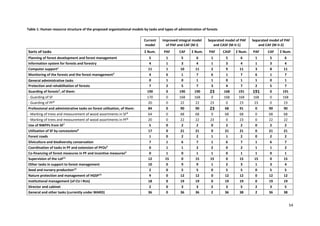
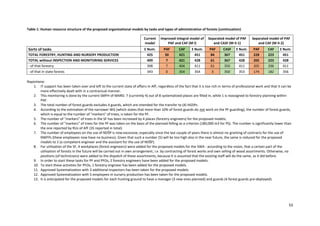
3.1.1. Administration for Forests of MARD 15
3.1.2. Service for Monitoring in Forestry and Hunting of MARD 23
3.1.3. Inspection for Forestry and Hunting of AIF 23
3.1.4. Forestry-professional Services within concession holders 24
3.2. EXISTING FUNCTIONING OF THE CONCESSION SYSTEM 24
3.3. EXISTING FINANCING OF THE TASKS AND THE MEASURES RELATED TO FOREST
MANAGEMENT
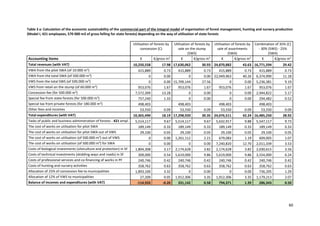
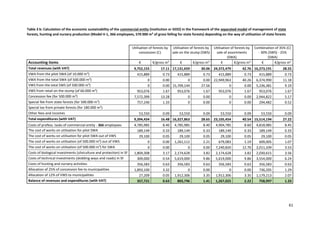
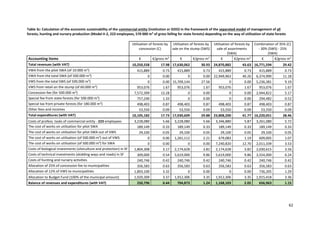
27
3.3.1. Budget revenues from forests by their sorts and years 27
3.3.2. Budget expenditures by years 28
3.4. EXISTING BALANCE OF THE BUDGET REVENUES AND EXPENDITURES 31
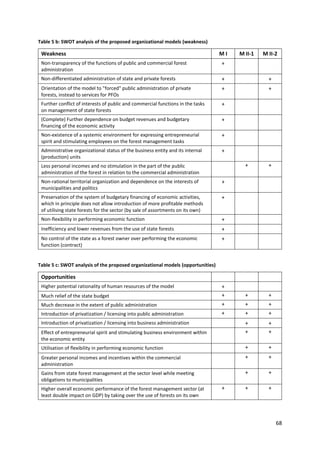
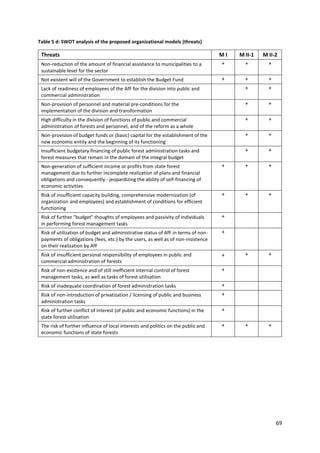
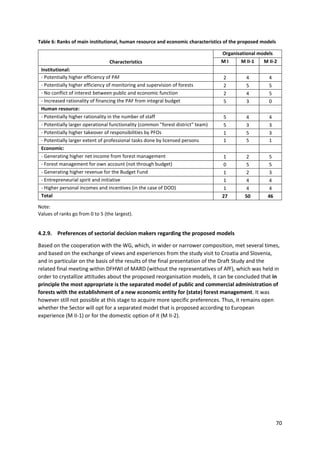
3.5. EXISTING SUPPORT TO DEVELOPMENT OF LOCAL GOVERNMENTS FROM STATE FOREST
UTILISATION INCOME
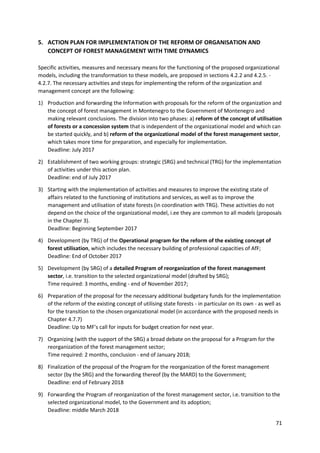
31
3.6. EXISTING ECONOMIC BALANCE IN STATE FOREST UTILISATION BY CONCESSIONS AT THE
LEVEL OF CONCESSION HOLDERS
32
3.7. EXISTING ECONOMIC BALANCE IN STATE FOREST MANAGEMENT AT THE SECTOR LEVEL 37
4. PROPOSALS FOR THE REFORM OF THE ORGANISATION AND THE CONCEPT OF
FOREST MANAGEMENT
39
4.1. OVERVIEW OF FOREST MANAGEMENT ORGANISATION MODELS IN EUROPE AND IN
NEIGHBOURHOOD
39
4.2. POSSIBLE SOLUTIONS FOR THE REFORM OF THE EXISTING ORGANISATION AND THE
CONCEPT OF FOREST MANAGEMENT
41
4.2.1. Possible re-organisational models 41
4.2.2. Scenarios of activities for establishing, development and functioning of the proposed
organisational models, including legislation changes needs
44
4.2.3. Possible institutional framework structure and total human resources' numbers of the
proposed models (organigrams)
50
4.2.4. Possible human resources structure of the proposed organisation models by tasks and
types of forest administration
51
4.2.5. Scenarios of revenues and expenditures and of economic sustainability of the proposed
organisation models depending on the methods of state forest utilisation
56
4.2.6. Necessary funds for financing the tasks of public administration of forests depending on
the organisational model
65
4.2.7. Necessary additional funds for financing the proposed concept of state forest
management and for the transition to the future system
65
4.2.8. SWOT analysis and evaluation of the overall adequacy of the proposed models 66
4.2.9. The preferences of the decision maker in the sector regarding the proposed models 70
5. ACTION PLAN FOR IMPLEMENTATION OF THE REFORM OF ORGANISATION AND
CONCEPT OF FOREST MANAGEMENT WITH TIME DYNAMICS
71
2
ACRONYMS
AfF - Administration for Forests of MARD
AIA - Administration of Inspection Affairs
CAF - commercial administration of forests
CASF - commercial administration of state forests
CFU - Costs of forest utilisation
CU of AfF - Central Unit of the AfF
DFHWI of MARD - Directorate for Forestry, Hunting and Wood Industry of MARD
FMNE DOO - Forests of Montenegro DOO
FMP - forest management plan
FMS of AfF - Forest Management Sector of AfF
FMU - forest management unit
FODEMO - Forestry development in Montenegro (project)
FSMNE - Forest Service of Montenegro
FTE - Full time equivalent
HGSP - hunting grounds of special purpose
IFH of AIA - Inspection for Forestry and Hunting of AIA
LoC - Law on Concessions
LoF - Law on Forests
LoSP - Law on State Property
MARD - Ministry of Agriculture and Rural Development
MIDAS - Montenegro Institutional Development and Agricultural Strengthening (project)
NWFP - non-wood forest products
OP – operational project (for execution of forest works)
PAF - Public Administration of Forests
PF - private forest
PFO - private forest owner
PWS - price of wood on the stump or stock
PWA - price of wood assortments on (forest) road side
RU of AfF - Regional Unit of AfF
SF - state forest
SFMNE DOO (DŠCG DOO) - State Forests of Montenegro DOO
SFSMNE - State Forest Service of Montenegro
SMFH of MARD – Service for monitoring in forestry and hunting of MARD
SWA - selling of wood assortments (on forest road side)
SWG - strategic working group
SWS - selling wood on the stump or stock
ToR - Terms of reference
TWG - technical working group
VWA - value of wood assortments on (forest) road side
VWS - value of wood on the stump or stock
WG - working group
3
KEY DEFINITIONS
Administration of (state) forests - According to LoF, Article 6, this administration includes the
preparation and decision-making regarding forest management and forest land (in state ownership),
as well as monitoring and control of forest management. The LoF's definition in the first part (before
making decisions) is not complete, so for the purposes of this Study (and otherwise), the term
"preparation" should be understood as planning.
Management of forests - According to LoF, Article 6, forest management includes afforestation
and/or raising new forests, silviculture (tending, restoration and conversion of forests), protection,
conservation and rehabilitation of forests, utilisation of forests (cutting, extracting of wood
assortments, skidding and other sorts of hauling or transport of wood assortments from the cutting
site to the track road), use of non-wood forest products, construction and maintenance of forest
infrastructure, road transport and sale of forest products, as well as maintenance and enhancement
of forest functions. So it is about all forestry operations and/or activities.
Concept of Forest Management - in this Study, the concept of forest management is understood as a
system, that is, the way of utilisation of forests and/or granting rights for (state) forests utilisation,
namely through: (a) concession, (b) sale of wood on the stump, and (c) sub-contracting of forest
operations and sale of wood assortments on its own, i.e. by the state entity responsible for forest
management. The performing of forest operations on its own (with own workers and
mechanization), as the fourth method of forest utilisation, is not included in this Study, because it
does not come into consideration for the current conditions in Montenegro.
Concession for utilisation of forests - according to LoF and LoC, this concession represents a long-
term right (from 5 to 30 years) to the utilisation of the contracted quantity and structure of the
timber mass on the stump, which includes the obligation of the concessionaire for the construction
and maintenance of forest infrastructure (tractor ways and truck roads) and is incorporated in the
concession fee and/or recognized through the same (and therefore the concession fee is
correspondingly lower than the PWS). The concession fee is essentially the expected profit (=
difference between revenues and expenditures) from the forest utilisation for the concession holder.
Concession in the case of one of the concessionaires includes the obligation to perform works on
forest protection and silviculture and, accordingly, it can be considered as forest management
concession.
Sale of wood on the stump (SWS) - or sale of standing wood - according to LoF, Article 77, is sale that
is carried out in accordance with the law governing state property. This method of utilising forests, in
the framework of this Study, implies the sale of trees (marked for felling) on the stump at the market
prices which (in the situation of non-existence of the SWS market) is obtained in such a way that the
costs of cutting, skidding and manipulation with wood assortments are deduced from the cost of
wood assortments on the forest road side. The costs of constructing and maintaining forest
infrastructure and of biological investments in forests are not included in the PWS, which means that
PWS is correspondingly higher than the price of standing wood within the concession.
Sale of wood assortments (SWA) - according to LoF, Article 77, this is the sale that is made at the
market prices on the forest truck road, in accordance with the methods defined by the law on state
property, while the previous sub-contracting of works on cutting and skidding of wood assortments is
carried out in accordance with the law governing public procurement.
4
EXECUTIVE SUMMARY
This Study was developed within the framework of the ToR for the "Individual Consultant for the
preparation of a proposal for the reform of the existing forest management concept in Montenegro",
funded by the MIDAS project of the Ministry of Agriculture and Rural Development (MARD). The
objective of this task is to provide the MARD with an analysis of the existing organization of forest
management, forest management and revenue generation activities, adequate solutions for the
reform of the existing forest management concept and to present the advantages and
disadvantages of these solutions, with recommendation for the best options in terms of
sustainability of forest management in Montenegro. The Study was developed in close cooperation
with sectoral Institutions and Services and in consultation with the Working Group (WG) for the
reform, which was established for this purpose. The project task, which particularly refers to the
reform of the forest management concept, was in the course of drafting of the Study, extended to
the reform of the existing organization of the sector as a roof for the reform of the forest
management concept. The reform of the organization of the forest management sector, within which
concept of state forest management is addressed, is therefore the main focus of the Study.
The key issues and recommendations regarding the organizational and human resource structure
and the functioning of the Institutions and Services related to forest management are as follows:
1) The statutory and functional integration of the Administration for Forests (AfF) in the Ministry of
Agriculture and Rural Development (MARD) and its Directorate for Forestry, Hunting and Wood
Industry (DFHWI), is too high for an effective functioning of the AfF and performing of its mission,
especially when the management of state forests (as an economic function) is in question.
Therefore, the statutory improvement of the AfF in the direction of an independent body
within the MARD and/or the allocation of the commercial function out from the public
administration, is necessary.
2) Functional organization (of tasks) of AfF at the operational level is not appropriate because the
"district forester" system does not exist, which is a prerequisite for sustainable and efficient
forest management. In connection with this, there is no personal territorial accountability at this
level. It is thus necessary to introduce the "district forest" system, regardless of the future
model of organization.
3) Compared to the current Systematization of 476 employees, of which 428 in organizational units
of AfF, the fulfilment of AfF jobs is 86%. The total forest areal coverage with AfF employees is for
13% more rational than in Slovenia, while the total number of them is - when the possible annual
cut is considered - even 4.8 times higher than in Slovenia. The total effect of this number of
personnel on cubic metre of felled timber is therefore extremely small and contains large
reserves which could be taken into account for the anticipated reorganisation.
4) Territorial coverage of personnel of the Regional Units (RU) of the AfF is very uneven and,
consequently, very uneven is also the business workload of employees, which jeopardizes the
quality and effectiveness of functioning of AfF. Bearing in mind the strong linkage of the AfF's
organization to local governments, and/or the inability to change the current status of the AfF,
appropriate staff re-allocation (between RU) would be required.
5) The educational structure of the AfF staff is very unfavourable: there is only 71 (17%) of forestry
engineers, 251 (61%) forestry technicians, and a total of 322 (78%) forestry professionals.
Slovenia, for instance, has no forestry technicians on comparable jobs, while Serbia has 36% of
forestry engineers. In Montenegro, there are especially university forestry engineers lacking, and
5
among them the engineers for marking of trees for felling (there are only 29), on which the
extent and quality and/or sustainability of forest utilisation depends. It is necessary, therefore,
to employ directly all the available forest engineers from the market (where only few of them
could be found). On the other hand, the number of forest guards is 194 (3750 ha per forest guard
"district"), which is far above the comparable standard (Serbia - 5000 ha for state and 7500 ha
for private forests, Slovenia does not have forest guards). It can be noted that Montenegrin
forestry is based on forest guards, instead of forestry engineers and technicians, who perform
professional tasks. If this structure does not improve soon, for which the realistic opportunities
are very small, a better and more sustainable development of forestry is further limited.
6) There are also very few forestry students in Montenegro, who, in addition, usually do not return
home after completing their studies (outside). It will be necessary in this respect to provide
scholarships for these students. Inadequate is a secondary forestry school program, as well as
there is a lack of interest in its attendance. It will be necessary to support the content-wise
improvement and promotion of this program.
7) The age structure of the AfF’s staff is very unfavourable, since the average age is 52 years. This
situation is even more critical, given the fact that there are almost no new forestry personnel,
especially forestry engineers, to be found on the Montenegrin labour market. It will be
necessary to "import" forestry personnel from the neighbourhood, after appropriate
adaptation of the LoF, enabling privatization and licensing of the forest administration tasks.
8) The Section for the use of forests and non-wood forest products with its Services for forest
utilisation within the RUs, on which the utilisation of state forests depends, is the most critical
among the key Services of AfF. The Section now has no chief engineer for the utilisation of
forests and concessions. The Section is not able to substantially coordinate the RUs in their
granting of forests utilisation rights, nor monitor and supervise the implementation of contracts
for utilisation of forests or concessions through the forestry engineers within the RUs. In
addition, there are no uniform and reliable databases on contracted and realized timber fellings
and appurtenant concession fees in the Section. The data could still only be found in the
concession contracts, their annexes and attachments. Consequently, the necessary data is always
collected on a new basis, and incomplete or very different data for the same or similar purpose
or year could be obtained, while the source of these differences could not be clarified. Until this
situation is improved, or in other words, until it is not known precisely, how much of wood
assortments has passed through the "treasury" of the Section, there can be no proper
overview, no control over the utilisation of state forests, regardless of their utilisation system
in use.
9) There is a critical situation in the level of informatisation of the AfF, the use of ICT means, the
existence of digital databases, and above all the forestry information system. The existing
Section for forest information system, with the support of the specialists for informatics through
the RUs, is otherwise well equipped and trained for these tasks. However, the Forestry
Information System - a platform for it was created within the FODEMO project and is available on
installation CDs - is not yet used in the AfF. The Rulebook on the information system has not
been adopted (by the MARD), with the internal obligation of AfF for its use. The current situation
regarding data and information related to forest management can be described briefly in the
following way: all key data and information on the use of forests at AfF are still only found in
books or papers; efficient monitoring of forest management and timber trade is not possible due
to non-digitization of these data; there are no standardized and transparent ways of presenting
6
information on the utilisation of forests; and the annual programs and reports on the work of the
AfF are therefore very incomplete and of bad quality.
10) A part of the AfF Service for marking of trees for felling in high forests, in which only forestry
engineers are allowed to perform the marking in accordance with the LoF, is also critical because
of too small number (29) of the engineers. Consequently, even about 13,000 ha of state forests
or 21,000 m3
of their possible felling falls on an average forestry engineer. The average workload
of the same in relation to the possible extent of felling is even (by 17%) higher than in Slovenia. It
can be concluded that the workload of forest engineers by the marking of trees for felling is
extremely high for Montenegrin conditions. Additional employment of the forestry engineers is
needed, and especially the activation and re-deployment of other forestry engineers
(especially from the Silviculture) within the AfF. The general problems of the Service are as
follows: (a) the structure or quality of the marked trees for felling, as a key instrument of
Silviculture, are often inadequate, as the ecological and economic functions of the forest are not
optimized within the task; (b) there is a lack of the CU's content-wise coordination of the
"markers" per RUs; (c) there is no internal AfF's checking and verification of the executed
marking of trees; and (d) there is no personal accountability for the quality of the marking of
trees for felling. The necessary changes in these directions would significantly contribute to the
improvement of the ecological and economic sustainability of the utilisation of state forests.
11) The tasks of forest guarding services deserve great attention especially due to the high number
of forest guards. When it came to employing them, it is obvious that the AfF has indirectly tried
to solve or resolve the social aspects, as according to the above-mentioned standard, the
number of forest guards could be significantly lower (for example, by a third).
12) Nurseries are organisationally integrated in RUs of AfF so they do not have the status of special
organizational units, as is usually the case in other countries. They do not get the necessary
attention and the necessary financial means for production are not assured. The level of nursery
production is therefore very low - only up to 250,000 seedlings a year. According to the optimal
plan, up to 1.5 Mio pieces of seedlings could be produced annually. There is also a problem in
coordination between the need for procurement (or already purchased seedlings) on the market
and the use of (already so small) amount of the AfF's seedlings. It happens that – with the
procurement of seedlings - the own seedlings remain even unused. A particular problem within
the current organization of AfF is that the use of own seedlings, or in the case of granting the
same to private forest owners (PFOs), cannot be reflected in the monetary value or income of
nurseries. In this way, nurseries remain only consumer units, instead of units that generate
revenue. Nurseries should therefore be activated for the qualitative and efficient production of
seedlings, which generates adequate income and operate economically positively. The future
organization of nurseries will depend on the selected framework forest management
organisation model. Within the existing organizational model of AfF, which does not provide
the necessary entrepreneurial spirit and motives, it is obviously not enough interest for the
functioning of the nurseries, nor for their possible separation from the AfF or privatization.
13) The status of forestry personnel at the concessionaires is quite unknown because the AfF’s
Service for forest utilisation does not dispose of this information and does not monitor the
fulfilment of the employment terms which concessionaires have to meet. According to the
prescribed norm under the Rulebook on minimum conditions to be met by the concessionaires (1
engineer plus 2 forestry technicians at 6000 m3
within the FMU), the total number of necessary
personnel of the concessionaires should thus be around 195 (of which 65 forestry engineers) for
the contracted or even 250 (of which 83 forestry engineers) for the planned amount of felling
7
(within the Study). It is obvious, however, that Montenegro does not have as much additional
forestry professionals (apart of the AfF personnel), especially not the forestry engineers, so the
concessionaires can neither theoretically fulfil this condition. The maximum possible extent for
meeting this requirement could be up to 60%. This also entails the question of the
appropriateness of the Rulebook and/or the required norm, which is too low. The Slovenian
staffing norm for carrying out these tasks amounts to about 8,000 m3
per forest professional,
which is 4 times more. The Montenegrin staffing norm should be risen accordingly.
The key issues and recommendations regarding the functioning of the concession system from legal,
forestry-professional and economic aspects are the following:
14) Incomplete implementation or non-implementation of the Law on Forests (LoF), the Law on
Concessions (LoC) and the Concession contracts, and in particular: a) non-drafting and non-
adoption of the methodology for calculating and adjusting the concession fee; consequently, b)
non-adjustment of the amount of the concession fee; c) non-reduction of the extent of
concessions in case of successive (after 2 years) non-realization of the contracted felling and d)
transfer of the implementation of the concession to third parties, without the consent of AfF
and/or the awardee, and most importantly; e) non-termination of some concession contracts
also in case of drastic violations (such as non-implementation of a concession in accordance with
the agreed scope and dynamics, non-payment of concession fee and initiation of bankruptcy or
liquidation procedures of the concessionaire).
15) Non-provision or incomplete provision of forestry-professional conditions or aspects of the
implementation of concessions by AfF, such as: a) non-appropriate content and quality of
operational projects (OP); b) insufficient extent of planned biological investments in forests in
relation to the needs and the amount of concession fee; c) non-planning sufficient amount of
technical investments in forests; (d) planning, or enabling (further) utilisation of forests to users
who have not realised the previously agreed extent or contract; e) the use of significant
overweight (60%) at tenders for evaluating the personnel, professional, technological and
financial qualifications of the bidders-concessionaires, which allows an unacceptably high state
subsidy; and f) insufficient monitoring and tolerance of the non-implementation of concession
contracts.
16) In addition to the general recommendation for adequate conversion of the mentioned
concessions' problems into solutions, i.e. overcoming and improving such a situation, it would be
necessary additionally, in particular: a) to reduce the extent of forests for which the concessions
would be granted, while simultaneously increasing the way of forest utilisation by selling wood
on the stump (SWS) and switching to construction and maintenance of forest infrastructure on
its own, based on the previously provided funds for this purpose, and b) to reduce the weight
for forestry-professional, technical and technological capacity (to only 10% - 30%) of forest
users on tenders for granting forest utilisation rights, as well as for SWS, and to use the weight
in selective manner – depending on the volume and quality of (to be felled) timber and the
way of forest utilisation.
The key features of the existing financing of tasks and measures related to forest management are
the following:
17) Existing budget revenues of AfF by years, among which the concession fee far prevails, were -
with the exception of 2008 - far below the optimal ones, with a clear valley in 2012. From 2012
8
they are on a significant increase, which, however, has not yet reached the 67% optimum until
2016. Expenditures for performing administrative and professional tasks of the AfF dropped
heavily from 2008 to 2010 and remain further at a very low level. Expenses for capital
investments into forests (for afforestation, silviculture and forest management planning) have
also drastically decreased. Now (in 2017), the planned extent of funds is insufficient even for a
minimum implementation of a relatively high forest management program (of the AfF) from
which the budget revenues (to finance AfF operations and necessary measures in the forests)
directly depend, which is ecologically and economically unsustainable.
18) Existing balance sheet of realized revenues and expenditures of the AfF's budget was negative in
the period from 2010 to 2014, with the valley in 2012, while in 2016 the same becomes positive.
For 2017, a further, more pronounced positive balance is expected. However, the available
budget expenditures for 2017 are lower. The first is a very good sign, while the second is a hint
for the continued, unsustainable functioning of the AfF and the financing of investments in the
forests. It is thus necessary to break with the current, irresponsible way of planning of the AfF
budget - within the Budget Law - which should follow before the adoption of the AfF's annual
forest management program, based on the needs expressed in the last year program. It is
necessary to introduce a proportionate and pro-active budget, which provides for the
generation of higher revenues from forests.
Analysis of financial support to local governments from the concession fees in the period 2008-2016
indicates:
19) A large increase in these payments from 2010 (30% of the fee) to 2016 (70% of the fee), i.e. from
1.0 to 3.3 million €, with a planned additional growth to 3.9 million € in 2017. Due to the
complete unsustainability of such a large outflow of funds (revenues) from the utilisation of
state forests, out of the forestry sector, and/or the need for as much as possible balanced
budget revenues and expenditures for forest management, it would also be necessary within
the state budget financing to reduce the extent of financial support to local governments from
this title. It would be necessary, by changing the law on the financing of local governments, to
define the purposed use of these funds, for example, for the construction and maintenance of
rural road infrastructure.
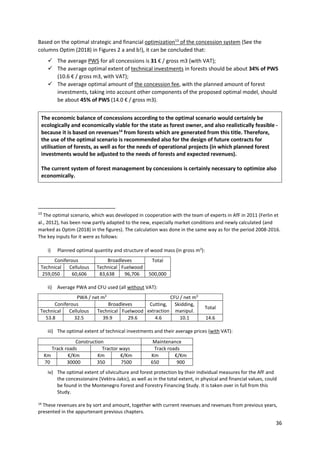
The existing economic balance of the utilisation of state forests by concessions in the period 2008-
2016 shows especially the following weaknesses:
20) Technical investments (tractor ways and truck roads) in forests amounted to only 9% of PWS (2.8
€ / gross m3
, with VAT); the averagely realized concession fee amounted to 10.0 € / gross m3
(excluding VAT) of the contracted harvest or 68% of the agreed amount of fee; the average debts
of concessionaires for the contracted quantities of timber were 16% of PWS (4.8 € / gross m3
,
excluding VAT) and the average income, which in this period was granted to the concessionaires
by AfF, amounted to 27.5% of PWS (8.4 € / gross m3
, with VAT). Such an economic balance is
very favourable for concessionaires, especially for the largest one among them. However, due
to the far too low extent of investment in forests, the same is ecologically unsustainable. Due
to the unjustified subsidy of the concessionaires and too low financial realization of concession
contracts, such a balance is for the state also economically unsustainable. The system of
concessions is therefore necessary to optimize also economically.
The optimal economic balance of the utilisation of state forests by concessions for the next short-
term period shows that:
9
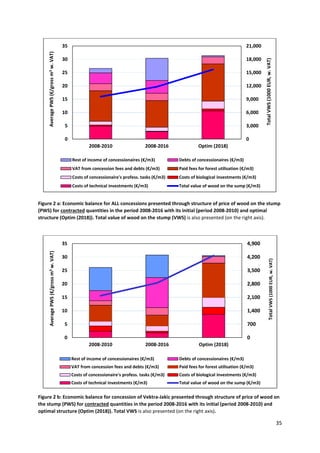
21) The optimal extent of technical investments in forests should be about 34% of PWS (10.6 € /
gross m3, with VAT) and about 45% of PWS (14.0 € / gross m3, without VAT) for the concession
fee. The economic balance of concessions according to the optimal scenario would certainly be
ecologically and economically viable for the state as forest owner, and also realistically
feasible. Therefore, the use of that scenario is recommended also for the design of future
contracts for utilisation of forests, as well as for the needs of appurtenant OPs.
The optimal economic balance in the administration and management of state forests for the next
short-term period shows that:
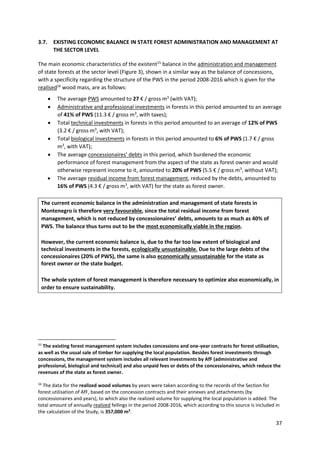
22) The extent of administrative and professional investments in forests would amount to 31% of
PWS (9.4 € / gross m3, with taxes); the extent of technical investments in forests should amount
to 31% of PWS (9.3 € / gross m3, with VAT); the extent of biological investments to 15% of PWS
(4.4 € / gross m3, with VAT) and the net income from forest management to 23% of PWS (6.7 € /
gross m3, with VAT) for the state as forest owner. The presented scenario suggests that it would
be possible in the administration and management of state forests in Montenegro - with a high
level of investments in forests, but with the existing low labour costs - to achieve a very
favourable economic result on the SUSTAINABLE basis - in contrast to the current one, which is
otherwise even better, but not sustainable.
Within the Study - on the basis of the analysis of the situation and problems, recommendations for
improvement and assessment of the needs and possibilities of forestry of Montenegro, using the
experiences in the development of forestry organization in the countries of Central Europe and the
neighbourhood - the following three possible models of organization of the forest management
sector are proposed:
23) Improved integral model of public and commercial administration of forests (Model I),
organized as a body within the MARD. This model is based on the improved status of the AfF.
This model includes existing forest management Institutions and / or Services and does not
provide for institutional, but only functional changes. In this way, the AfF remains responsible for
all functions: public administration of forests, state forest management, and directing the
management of private forests. The AfF as an organization that, in addition to the activities of
forestry, includes the activity of hunting and nursery production, therefore, remains integral.
According to the optimal model of this Study, the AfF would have 428 employees in total, of
which 12 for nature protection and hunting and 5 for nursery production. Hunting grounds with
special purpose (HGSP) and nurseries become independent organizational units within the RUs of
the AfF. Nurseries can also be semi-privatized, preferably through a form of public-private
partnership (if there would be private interest on that).
The SMFH of MARD, as well as the IFH within the AIA, remain in the current status and
responsibilities, according to which also the AfF is indirectly monitored and supervised (when it
comes to the implementation of the commercial forest management function of state forests).
24) Separated model of public administration of all forests and commercial administration of state
forests (Model II-1), the first being organized as a body within the ministry, and the second as an
independent, economic entity for managing state forests. This economic entity can be
established in the status of a public economic institution or a state limited liability company. This
model of public and commercial administration of forests is in line with the most common
European practice or trend of development of organizational models, and it exists in the
surrounding countries (Croatia and Slovenia - when it comes to the state commercial company).
10
This model envisages the separation of the current AfF to the Public Administration of Forests
(PAF) and the Commercial Administration of State Forests (CASF). In addition, the model
envisages the statutory reorganization of the SMFH of MARD, as well as the IFH of the AIA,
which, as special services, are associated with a functionally reduced AfF or future PAF, in order
to provide synergy for the full and efficient performance of all PAF functions. According to this
model, PAF also retains the authority to direct private forest management. To this end, a special
Service for private forests is established within the PAF. PAF also takes over the guarding tasks
for private forests and associated forest guards.
In order to carry out the function of CASF, which includes management of state forests and
activities of nursery production and hunting, an independent, economic entity is established in
the above described status. The HGSPs and the nurseries become independent organizational
units within the CASF. Nurseries become also internal profit centres. CASF also includes the
guarding of state forests (by forest guards), as a public authorisation. CASF does not perform
forestry-professional tasks for private forests, but can perform them as services, which should be
financed by the PAF.
According to the optimal model of this Study, the PAF would have 84 employees in total, of
which 15 would fall on the Inspection Service, 8 on the Monitoring Service, 23 on the Service for
private forests, and 23 on the guarding of private forests. According to this model, CASF would
have 367 employees, 12 of them in nature protection and hunting, and 5 in nursery production.
25) Separated model of public and commercial administration of all forests (Model II-2), where the
statutory forms of public and commercial administration of forests are the same as for Model II-
1. This model is based on the classical separation of the forest protection and the forest
utilisation functions, regardless of forest ownership. A similar model exists in rare countries with
forestry police (e.g. Italy).
Although this model envisages the same institutional structure as Model II-1, the functional
division of the forest administration tasks brings a significant difference in the scope of work and
numbers of employees in the PAF. The key difference is that PAF takes over the tasks of guarding
of all (state and private) forests and the associated forest guards, for which a special Service for
forest guarding is established within the PAF.
Within the framework of this model, the Commercial Forest Administration (CAF) carries out all
tasks related to state forest management, hunting and nursery production, as in the Model II-1.
The HGSPs and nurseries become independent organizational units within the CASF. Nurseries
become also internal profit centres. In addition, the CAF in the case of its public institution
status, also carries out forestry-professionally tasks for private forests according to the legal
authorisation, while in the case of DOO it can perform such services on the market. The PAF
within the function of public administration according to this model does not retain the
competencies for directing management of private forests.
According to the optimal model of this Study, the PAF would have 223 employees in total, of
which 15 employees would fall to the Inspection Service, 8 to the Monitoring Service and 191 to
the Guarding Service. According to this model, CAF would employ 227 employees, of which 12
would in nature protection and hunting, and 5 in nursery production.
26) The differences in the total number of personnel by the proposed models are small. Key
differences in the structure of personnel by models occur with the internal division of tasks
into public and commercial administration of forests, especially when it comes to the forest
11
guarding and the professional tasks on the utilisation of forests. Within the improved integral
model (Model I), all forest guarding tasks are integrated into the commercial function, while
within the separated model of PAF and CAF (Model II-2) all these tasks are considered as public
administration tasks. With the separated model PAF and CASF (Model II-1), only guarding of
private forests (12% of the scope of these task) is classified as PAF. Professional tasks on the
utilisation of forests are assigned to the CAF in the Model I and the Model II-2, while the tasks for
private forests in the Model II-1 are included in the PAF.
27) Common key activities and steps for the establishment, development and functioning of
proposed organizational models, including the necessary legislative changes, are as follows:
a) Reducing the percentage of support to the development of local governments to a
sustainable level, i.e. from 70% to 25% of the concession fees or (currently comparable) 12%
of the stumpage value of the marked / harvested timber for regular felling. In that sense, it is
necessary to amend the Law on financing local governments. It is necessary also to define by
this law the obligation to local governments for the purposed use of these funds (for
example, for the construction of rural road infrastructure);
b) Establishment of the Budget fund for forests based on amendments to the LoF;
c) Reducing the extent of forest utilisation through concessions (in case of violation of
concession contracts, successive non-reaching of the contracted volume and lack of local
professional capacities of the AfF for proper planning and monitoring of these contracts),
ending with conclusion of annual agreements on the utilisation of forests in a concession way
and inclusion of other ways of utilisation of forests - within the feasible optimal plan for
felling in state forests (of 570,000 gross m3
per year) - so that for the next short-term period
35% of the extent of the utilisation is achieved through concessions, 30% through the SWS
and 25% through sub-contracting of forest operations, with a standard 10% of sale of
fuelwood on the stump to supply the local population.
d) Establishment of a "district forest” administration and management system;
e) Creating of HGSPs and nurseries as independent organizational units within the entities for
management of state forests;
f) Introduction of privatization and licensing of tasks on (public) administration of forests also in
case of state forests.
28) The key activities and steps for the establishment, development and functioning of the improved
integrated model are the following:
a) Modification of the MARD's Systematization in order that AfF, as a body within the MARD,
obtains a corresponding, higher degree of autonomy;
b) Providing additional - start-up - budget funds for the commencement of utilisation of state
forests in own arrangement of the AfF (for financing the sub-contracted operations and
technical investments in forests);
c) Providing financing from the state's integral budget for typical public forest administration
tasks, which implies this model, irrespective of revenues from state forests;
d) Solving the efficiency of nursery production in the manner of public-private partnership.
29) The key activities and steps for the establishment, development and functioning of the separate
models of public and commercial administration of forests (regardless of its sub-option) are as
follows:
a) Division of the functions of the public and commercial administration of forests (as defined
by the sub-models);
12
b) Establishment of a public institution (zavod) or limited liability company (DOO) in 100%
state ownership, for performing the economic function in state forest management, hunting
and nursery production, based on the previous provisions of the law;
c) Transfer of employees, who have so far performed economic taks / activities, to the
institution / company;
d) Transfer of public authorisation for the administration of concessions, as well as right to
receive income from them, to the institution / company;
e) Taking over the obligation to finance the development of municipalities by the institution /
company (at the same reduced amount);
f) Establishment of the reduced functioning of the AfF in the form of new PAF;
g) Transfer of the Monitoring Service of the MARD and the Forestry Inspection Service of the
AIA to the PAF;
h) Concluding the agreement on the management of state forests between the institution /
company and the DFHWI of MARD.
30) Calculation of the economic sustainability of the sector of forest management, hunting and
nursery production, based on the optimal scenario of revenues and expenditures, depending
on the way of state forest utilisation and regardless of the chosen organizational model,
indicates that:
a) The expected revenues from the use of state forests are significantly dependent on the way
of forest utilisation, i.e. by concessions, sale of wood at stump (SWS) and sale of wood
assortments (SWA). For the concession system, the annual revenues would amount to 10.2
million €, for the SWS up to 17.6 million €, 24.9 million € for the SWA and up to 16.8 million €
for the planned combination of the forest utilisation ways. The planned revenues now (in
2017) amount to only 5.6 million €. The contribution of forestry to GDP would thus increase
significantly (for few times).
b) The expenditures are in close correlation with the revenues;
c) The expected total balance of revenues and expenditures is also - but not so strongly -
dependent on the way of utilisation of state forests: it is the worst in the case of concessions
and the best in the case of own SWA.
d) After the allocation of planned funds to municipalities (25% of the concession fee or 12% of
the PWS), a small negative balance in the concession system (minus 2% of revenues) can be
expected, while the same for the other two systems is already slightly positive (from 1 to 3%
of revenue). On average, however, a slight positive economic balance (of 1% of revenue) can
be expected for the proposed combination of the forest utilisation ways.
31) The necessary funds for financing the tasks of the public administration of forests are very
dependent on the organizational model. They amount to 1 % only in case of the improved
integral model (Model I), 15% in case of the separate model of the public and commercial
administration of state forests (Model II-1), and 42% in case of the separate model of public and
commercial administration of all forests (Model II-2). However, a very significant reduction in
the extent of current budgetary financing in forestry, in which the AfF tasks are (or should be)
entirely financed from the state budget, is contributed also by the Model II-2, with a highly (58%)
reduced extent of the necessary funds for the forest administration tasks.
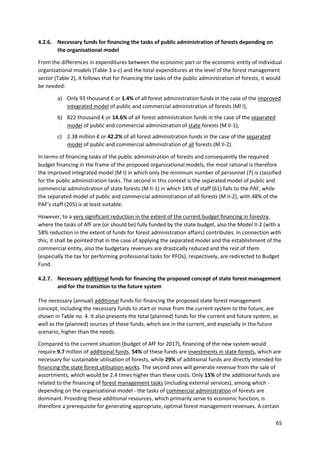
32) In relation to the current situation, financing of the new system would require 9.7 million € of
additional funds. 54% of these funds are investments in state forests, which are necessary for
sustainable use of forests, while 29% of them are directly intended for financing works on the
13
utilisation of state forests. They will generate revenue from the own selling of wood assortments,
which would be 2.4 times higher than these costs. Only 15% of the additional funds are related to
the financing of forest administration tasks (including external services), among which -
depending on the organizational model - the tasks of commercial forest administration prevail.
Providing these additional financial resources, which primarily support the economic function,
is therefore a prerequisite for generating appropriate, optimal revenues from forest
management. A certain portion of these funds, especially for forest works and investments
that are directly in the function of generating income, can also be provided through credit
arrangements. The rest of the funds should certainly be provided through the state's integral
budget.
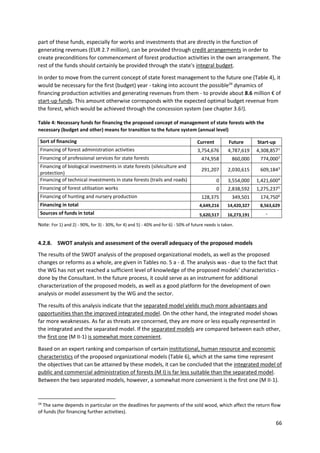
33) In order to move from the current concept of the state forest management to the future one, it
would be necessary - taking into account the possible dynamics of financing the production
activities and generating revenues from them - to assure about 8.6 million € of start-up funds
for the first (budget) year.
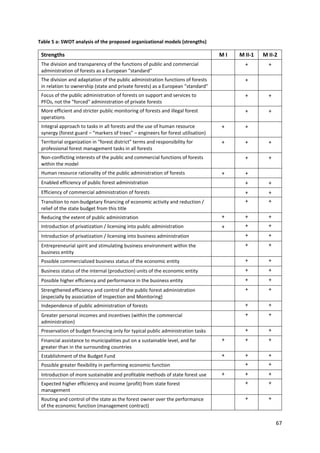
34) SWOT analysis results indicate that the separated model brings much more advantages and
opportunities than the improved integrated model. On the other hand, the integrated model
shows far more weaknesses. Based on the assessments of the overall adequacy of the proposed
models, it can be concluded that the integrated model of public and commercial administration
of forests (M II) is far less suitable than the separated one (M I). However, among the two
separated sub-models, there is a somewhat more favourable the model of public and
commercial administration of the state forests (M II-1).
35) Based on the final considerations within the DFHWI of MARD, but in absence of the AfF’s
management, it can be noted that the separated model of public and commercial
administration of forests (M II), with the establishment of a new economic entity for
management of (state) forests, is principally acceptable.
36) The action plan for implementation of the reform, with framework dynamics, envisages two
phases: a) a reform of the concept of forest utilisation and/or concession system that is
independent of the organizational model and can be started quickly, and b) a reform of the
organizational model of forest management sector, which needs more time for preparations,
and especially for implementation. After adopting appurtenant decisions regarding the points a)
and b) by the Government and nominating corresponding WGs, an Operative program of the
reform of the current concessional way of utilisation of state forests, as well as a detailed
Program of reorganisation of the forest management sector, should be prepared (by the WGs).
The first one could be implemented with the beginning of 2018, if the necessary additional
funds would be assured for financing the forest operations (which would be carried out in the
own arrangement). The second one should be widely discussed among stakeholders before its
adoption by the Government (e.g. by March 2018). After that, all needed activities on
implementation of that program could gradually start, including, among others, the necessary
changes in the legislation and the systematization, or development the new ones, the separation
of the public and the commercial forest administration functions and appurtenant employees,
and establishing the new entities for the administration and the management of forests (if the
separated model is selected). Start-up in the functioning of the new organisation model could
be expected by the beginning of 2019.
37) For efficient implementation of the action plan it would be necessary to assure further
international expert support, optimally during the entire duration of the activities.
14
1. INTRODUCTION
This Study was developed within the framework of the ToR for the "Individual Consultant for the
preparation of a proposal for the reform of the existing forest management concept in Montenegro",
funded by the Montenegro Institutional Development and Agricultural Strengthening (MIDAS)
project of the Ministry of Agriculture and Rural Development (MARD). MIDAS is coming to an end on
June 30 this year. By that time also this project task, which began on March 27 this year, formally
completes.
The objective of this task is to provide the MARD with an analysis of the existing organization of
forest management, forest management and revenue generation activities, adequate solutions for
the reform of the existing forest management concept and to present the advantages and
disadvantages of these solutions, with recommendation for the best options in terms of
sustainability of forest management in Montenegro. According to the objective also the framework
content of the Study was defined.
2. METHODOLOGICAL APPROACH
The methodological approach in the realization of this task and/or the development of the Study is
based on:
- Excellent knowledge and experience of the Consultant in the establishing of regulatory and other
frameworks, in particular the framework for sustainable forest management and related
capacities of the forest sector in Montenegro, as well as his knowledge of forests, forest
management and related key problems (all this since 2008 onwards);
- Using the existing sectoral analyses and studies related to the subject of this ToR, in particular
those developed by the Consultant in the past years (e.g. Forest and Forestry Financing Study of
Montenegro, 2012) and the studies to which he contributed (e.g. EBRD Study on Montenegro
Forestry, Wood Industry and Wood Energy, 2016);
- Cooperation with Institutions and their Services related to the tasks, data and information on
forest management;
- Cooperation and consultation with the Working Group (WG) for the reform of the organization
and the concept of forest management, which was established for this purpose by the MARD;
- Initial, intermediate and final presentations of the situation and possible solutions, as well as the
very Draft Study.
The project task, which particularly refers to the reform of the forest management concept, was in
the course of drafting of the Study, extended to the reform of the existing organization of the sector
as a roof for the reform of the forest management concept. The reform of the organization of the
forest management sector, within which the concept of state forest management is addressed, is
therefore the main focus of the Study.
15
3. ANALYSIS OF THE EXISTING ORGANISATION AND THE CONCEPT OF FOREST
MANAGEMENT WITH PROPOSALS FOR IMPROVEMENT
3.1. EXISTING LEGAL, ORGANISATIONAL AND HUMAN RESOURCE STRUCTURE OF INSTITUTIONS
AND/OR SERVICES AND THEIR FUNCTIONING
3.1.1. Administration for Forests of MARD
3.1.1.1. Administration for Forests as a whole
Legal status and institutional organisation
The Administration for Forests (AfF) is in accordance with the Law on Forests (LoF) and the
Regulation on the organization and mode of operation of the state administration, the administrative
authority responsible for administration and management of forests, while respecting the right of
PFOs to own management of their forests. In addition to its competence for public administration
tasks for forests, AfF has the authority to manage state forests, as well as the competence for
directing management of private forests. AfF is responsible also for assuring the Forest Guarding
Service. AfF also performs hunting activities in hunting grounds of special purpose (HGSP) and seed
and nursery production.
In accordance with the Rulebook on Internal Organization and Systematization of the Ministry of
Agriculture and Rural Development (MARD), AfF has the status of a body within the Ministry.
However, as organizational units of AfF only the Forest Management Sector (FMS) and the Regional
Units (RUs) are recognized. Systematization does not mention the Central Unit (CU) of AfF, which is
now together with the Department of General Affairs an integral part of the MARD. The degree of
autonomy of AfF in relation to its previous status (as a body within the Government) is now
significantly lower, because the functional integration of AfF in the Ministry is too high.
AfF as a body within a ministry or state administration is usually a traditional (European) form of
organization of forest administration. It is important that AfF has the authority to (administrational
and professional) control of all forests, regardless of ownership. It is also good that the functions of
forest administration ("hammer") and the utilisation ("axe") of state forests are separated in the
present system (of concessions).
However, the status of AfF as a state administration body is not suitable for the efficient
performance of the economic function, i.e. management of state forests and other economic
activities. Namely, the state administration, by its definition, cannot efficiently carry out an economic
function, and it is often in conflict with the public administration function. Therefore, the statutory
improvement of the AfF in the direction of an independent body within the MARD and/or the
allocation of the economic function out from the public administration, is necessary.
Among the weaknesses regarding the organization of the AfF, one can count the uneven territorial
organization of the RUs, which are linked to the territory of the municipalities, with extremely large
differences in the area and the extent of harvesting, and thus the scope of work, which is not good
for the rational and efficient functioning of such an institution.
However, the key problem in terms of rationality and efficiency of AfF's functioning at the local level
is the absence of a "forest district" system and the so called PDCA cycle (planning-doing-checking-
adjustment) at that level, and consequently the non-existence of personal territorial accountability
by the forestry engineers or technicians. There is only the territorial accountability of forest guards.
16
Functional organization
The Forest Management Sector (FMS) of the AfF is horizontally divided into five Sections: Forest
Management planning Section, Information System Section, Silviculture and Forest Protection
Section, Section for Forest Utilisation and Non-Wood Forest Products and Section for Nature
Conservation and Management of Hunting Grounds of Special Purpose. Their work is coordinated by
the heads, who are graduated faculty forestry engineers, except for the Information Systems Section
(with diploma engineers of informatics). The Sections are responsible for directing the work of the
RUs and the affairs and (informal) Services in their domain, respectively. However, content-wise co-
ordination by the Sections, with the exception of the sections for Forest management Planning and
the Information System, is often relatively weak in practice, which is a limiting factor in the
functioning of the AfF.
The number of RUs is now 17 and one of them (Kotor) also has local units (4). RUs perform all
operational administrative and professional tasks, especially on protection, silviculture and utilisation
of forests. In addition, the RUs also perform the Forest Guarding Service, which does not have the
status of a special (formal) Service within AfF, although the forest guards have special powers
according to LoF. Work of RUs is coordinated by chiefs of the RUs, who, according to the
Systematization, can also be of a non-forestry academic profile. Therefore, in practice, only 10 chiefs
of the RUs (out of 17) have a diploma of forestry engineer, while the others are of other (e.g. law or
economic) academic backgrounds. Considering that the work of RUs is highly forestry-professional,
this is one of the key problems in achieving better quality of forestry-professional functioning of RUs.
RUs are in terms of their functioning also too autonomous in relation to the CU and/or its Sections.
On the other hand, the aforementioned forestry-professional guidance and control by the CU is not
strong enough, which additionally contributes to the weaknesses in the functioning of AfF as a whole.
Hunting Grounds of Special Purpose (HGSPs) (4 plus 1 usual HG), as well as nurseries (2) are
organisationally set inside the RUs, but do not have status of organizational (sub) units.
Human Resources and Forest Coverage by them
AfF now (data for March 2017) has 409 employees, including employees in General Affairs within the
MARD, as well as those who are employed on "indefinite time" on a contract basis (particularly forest
guards). Of this number, 373 are employed in organizational units of AfF. Compared to the current
Systematization of 476 employees, of which 428 in the organizational units of AfF, the fulfilment of
AfF's jobs amounts to 86%.
In relation to the total forest area1
, the existing coverage with AfF personnel is 0.56 FTE / 1000 ha (or
1780 ha / FTE) on average. For comparison: The total coverage of forests with AfF personnel is
somewhat smaller (13%) than on comparable jobs in Slovenia (situation before the establishment of
a state company), which has one of the smallest staffing density among Central European countries.
In Serbia and Croatia, coverage with (forestry) personnel is significantly higher. In this regard, it can
be concluded that the total surface coverage of the forest with the AfF personnel is very rational.
In relation to the possible felling2
, the coverage of AfF is 0.52 FTE / 1000 m3 (or 1937 m3 / FTE). This,
however, is 4.8 times more than on comparable jobs in Slovenia. In that sense, it can be said that the
1
State forests - 372.500 ha (according to FMPs), private forests - 355.600 ha (according to NFI), 728.100 ha in
total.
2
State forests - 615.000 m3
(according to FMPs), private forests - 177.000 m3
(according to the AfF's plan for
2017), 792.000 m3
in total.
17
total number of AfF personnel - per the possible extent of felling - is even extraordinarily high and
that there are large reserves for intensifying management of (state) forests within the existing staff
number.
Territorial coverage of the RUs of AfF by personnel is very uneven. The differences between RUs from
Northern Montenegro amount to 1: 6.3 when it comes to the area of the forest and 1: 5.5 when the
possible felling is in question. The HR's richest coverage on the surface of the forest has RU Rožaje
with 1.3 FTE / 1000 ha (760 ha / FTE), and the poorest RU Pljevlja with 0.2 FTE / 1000 ha (4800 ha /
FTE). In relation to the possible felling, the personnel representation with about 0.2 FTE / 1000 m3 is
the smallest in RU Kolašin (4500 m3 / FTE), and immediately after that in RU Pljevlja (4100 m3 / FTE),
while the largest is in RU Plav with 1.35 FTE / 1000 m3 and RU Berane with 0.7 FTE / 1000 m3 (1400
m3 / FTE). According to these two indicators, there is a markedly uneven workload3
on employees:
there is a huge workload on one side and there are large reserves on the other.
Educational and functional staff structure
When it comes to the existing educational structure of AfF staff, the situation is as follows: 71 (17%)
are forestry engineers and 251 (61%) forest technicians - in total 322 (78%) are forestry
professionals. In comparison: Slovenia does not have any forestry technicians on comparable jobs at
all, and the lowest educational structure on these jobs is a high-school forestry engineer. Serbia
(example of public enterprise “Serbiaforests”) employs 36% of forestry engineers in forest
management.
Similarly to the overall territorial distribution of staff in AfF, the deployment of professional staff by
RUs is very uneven. In this sense it is necessary to achieve more balanced staffing and workload,
both by additional employment and by the re-deployment of staff between the RUs.
Critical for AfF is apparently a too small share, and too small number of forestry engineers in total.
The lack of the same (37 in relation to the Systematization) is extremely worrying, with the fact that
young engineers in Montenegro are almost not existent on the market: according to the information,
only 3 of them are currently available. Firstly, it would be necessary to employ directly the available
forest engineers from the market. The further problem is that there are very few forestry students,
who, in addition, usually do not return to Montenegro after completing their studies (abroad). It will
be necessary to provide scholarships for forestry students. There is also a very inadequate
secondary school education program for forestry, as well as a lack of interest in its attendance. It
would be necessary to provide support from the Forestry Sector for improvement and promotion
of this educational program.
Among the AfF forestry engineers, 29 are working on marking of trees for felling, 28 in planning,
silviculture, protection and utilisation of forests, 10 on posts of RU chiefs and 4 in CU. Extreme
shortage is present especially on forestry engineers – “markers” (of trees for felling), without whom
the realization of forest utilisation plans is not possible in a sustainable way.
Among the forestry technicians, 55 of them are performing the marking of trees for felling (in low
forests), of them 35 fall on private forests (according to flat estimates of RUs).
The number of forest guards is 194, which is 47% of employees or 60% of AfF's forestry professionals.
For comparison, there are no forest guards in Slovenia at all.
3
This is later also more selectively analysed, particularly within the task on marking of trees for felling.
18
Regarding the personnel structure, it can be concluded that Montenegrin forestry is based on forest
guards, instead of forestry engineers and technicians who perform professional tasks. This situation
in the forest management sector is very critical. If this structure does not improve soon, and there
are very few realistic opportunities, a better and more sustainable development of forestry is
further limited.
Age structure of staff
According to the updated staff records of AfF, the average age of employees is 52 years, with a range
from 47 (RU Petnica) to 57 years (RU Rozaje). The same has improved over the last couple of years (it
amounted to 56 years), due to retirement and recruitment of some new, younger staff. However,
this situation is still extremely critical, primarily because of the lack of new forestry personnel,
especially forestry engineers on the Montenegrin labour market. It will be necessary to "import"
forestry staff from the neighbourhood. In that sense, additional adaptation of the LoF will be
necessary, especially in terms of the possibility of carrying out forestry-professional tasks through
licensed (private) persons also in the case of state forests.
3.1.1.2. Section for Forest Management Planning
In the decentralized Forest Management Planning Section, a total of 5 FTE of forestry experts were
engaged (of which 3 FTE employees are in the RUs). The Section is - based on the methodologies and
skills developed or acquired under the FODEMO project - adequately skilled to coordinate these
tasks. It possesses and regularly uses GIS software. It also has the necessary knowledge to provide
education and training of employees.
The elaboration of the forest management plans (FMPs) is still carried out by qualified external
contractors for the Section. Forest development plans, except for one pilot, have not yet been
developed, and they are not even in a more recent program to be drafted. However, with regard to
the contractual elaboration of the FMPs, one key issue could be raised, namely whether foreign
contractors can set appropriate goals, guidelines and measures for the Montenegrin forests and
forestry, and if can such plans could be strategically and substantially appropriate? Based on the
experience of Central European countries, where forestry planning (for state forests) is carried out by
domestic experts, this answer would not be positive. Therefore, it would be necessary for the
experts of AfF to take on the elaboration, or at least cooperate in the elaboration of the essential
parts of the FMPs. With the current number of forest management planning staff, this would be
possible only for some FMUs per year. If the development of the FMPs would include engineers for
the silviculture, protection and utilisation of forests in the RUs (which is quite natural and necessary),
this essential part of the work could be even greater on own behalf of AfF. Otherwise, the question
arises, what will currently available staff (other than the central one, which prepares tender
documentation) do in this Service?
For further development in the proposed direction, i.e. with the elaboration of the FMPs on its
own, increasing of the forest planning staff would be needed. In the organizational sense, it would
be rational if some centres for forestry planning, including the information system, say 4 - 6 of
them, with appropriate professional capacity and equipment, are established at the state level.
3.1.1.3. Section for forestry information system
The Section for Forestry Information System has employs 4 IT engineers, while in the framework of
the RUs - according to the AfF personnel records - another 11 IT engineers are employed. Their total
number is thus great. The Central Service' is well-trained and has, together with the IT staff in RUs,
19
and of adequate capacity. The CU with two RUs has the necessary equipment for performing this
function, as well as for providing quality services to users. Regardless of the number of IT staff, only
the email and MS Office are used by AfF until now. Numerous employees, some of them even on jobs
where extensive data are being collected, still do not use a computer. Given this situation, it seems
that the concept with the IT staff, employed in certain RUs, is not efficient and that these IT
engineers are passive, respectively. More rational and more efficient IT support or service to
employees in AfF could otherwise be provided in a contractual manner at all RUs.
The forestry information system, created within the FODEMO project and available on installation
CDs, is not yet used in AfF. The Rulebook on the information system has not yet been adopted, with
the internal obligation of AfF for its use. Now, a new project for the implementation of the
information system has been completed and it is to hope that the results will contribute to the
development of the said Rulebook and its implementation. As far as further procurement of
equipment is concerned, funds for the procurement of hardware and software are still missing or are
not planned.
The current situation regarding data and information related to forest management can be
summarized in the following way: All key data and information on forest management (i.e. on
marked tree volume for felling, volume of produced wood assortments, wood shipments and trade
and concessions) at AfF are still only in "books" and papers; Efficient monitoring of forest
management and timber trade is not possible due to non-digitization of these data; There are also no
standardized forms of displaying information on the utilisation or management of forests; This
information is not sufficiently transparent; Even very different data or results related to the same
purpose (e.g. the volume of regular felling according to the RUs' records and the volume of
concession felling according to the records of the Section for forest utilisation) come up; Annual
programs and reports on the work of AfF are very incomplete, non-transparent and of poor quality.
3.1.1.4. Section for nature protection and management of hunting grounds with special purpose
In addition to carrying out professional activities related to nature protection in forests, the Section
for nature protection and management of HGSP, according to the Systematization (2 employees),
professionally directs the management of HGSP. However, it seems that this guidance in practice
does not yet come to light.
The three HGSPs do not have the hunting ground managers yet, and only two have the hunting
guards. The hunting guarding function in the HGSP is now performed by forest guards within their
areas that coincide with the HGSP, which is a rational solution. Otherwise, with the Systematization,
special hunting guards are foreseen for the HGSPs, in accordance with the Law on game and hunting.
This is however not rational solution, as it would double the coverage of these areas by the forest
and the hunting guards.
3.1.1.5. Section for silviculture and protection of forests
In the Section for silviculture and protection of forests and on related jobs within RUs, a total of 14
FTE of employees are engaged (5 of them work also on other fields in the RUs). The place of engineer
for protection in the Section is not fulfilled. According to the Systematisation, the Section
professionally directs the work of the RUs in the fields of silviculture and protection, reproductive
material and nursery production planning, as well as the monitoring of illegal harvesting.
Systematization does not include the responsibility for expert guidance of the marking of trees for
felling, which is, in fact, the essential "instrument" of silviculture. The Section also has the
20
responsibility for coordinating and preparing professional exams for forest guards. According to the
Systematisation, the Section does not have the responsibility for expert directing of forest guarding
(which is a failure), while the forest protection engineer has the authority to control the work of
forest guards. The Section has, according to the Systematization, also no responsibility for expert
guidance of seed and nursery production, which lies within RUs. These responsibilities should
certainly be added to the Section. It should confidently professionally direct all these tasks within
the AfF. For the time being, it seems that the expert directing of RUs by the Section still remains at
the level of planning and reporting only.
3.1.1.6. Tasks on marking of trees for felling
The tasks on marking of trees for felling and the appurtenant "Service" are performed by 29 forestry
engineers and 55 forestry technicians. According to the RUs reports, 35 of the technicians work in
private forests. According to WG's opinion, this is too large number in relation to the real portion of
work for private forests. The 3150 hectares of forest area or 9450 m3 of possible felling falls on an
average "marker". The average workload on the "marker" is around 50% of the Slovenia’s - if possible
felling is considered. This is not much, but significantly higher than the comparable workload of all
AfF employees (which is only about 20% of Slovenia's).
However, about 13,000 ha of state forests or 21,000 m3 of their possible felling fall on an average
engineer - "marker". The average workload of the same - in relation to the possible extent of
harvesting - is even (by 17%) higher than in Slovenia. Therefore, it can be concluded that the
workload on forest engineers - "markers" - is extremely high for the Montenegrin conditions.
According to the realized, and especially the possible extent of felling (and appurtenant marking of
trees), these engineers can, as the only Service of AfF, be compared equally with the Slovenian ones.
There is an urgent need for additional employment of at least few engineers, and in particular, for
the activation and re-deployment of other engineers (especially from silviculture) for making of
trees for felling (in high forests).
Another major problem is the uneven distribution of the "markers" by RUs in relation to the surface
of the forest, and above all the possible extent of felling. In addition, 4 RUs do not have forest
engineers - "markers", which makes it impossible for RUs to carry out the task in high forests. An
additional problem in this context is the existing legal barrier, which does not allow the forest
technicians to mark the trees in high forests. This barrier should definitely be removed, and the
capacities of the forest technicians (with a certain experience) should be built for qualitative and
sustainable performance of the task.
Other problems related to the performance of the marking of trees and recommendations related to
them are the following:
 The structure or quality of the marking, as a key instrument of silviculture, is often
inadequate, because the ecological and economic functions are not optimized in the process
of selection of trees for felling (in terms of positive selection as a tending principle). The
mentioned weakness can be quite quickly resolved by introducing appropriate internal
educations4
and/or trainings, and in particular using examples of good practice that exist in
AfF;
4
Such education and trainings, based on the demonstration stands and plots and jointly performed
experimental marking of trees for felling, have already begun within the AfF in 2010 - 2011 by the then SNV,
under the guidance of the writer of this Study.
21
 There is a lack of content-wise coordination of the RUs' "markers" by the CU, as well as
internal control of the "marked" forest stands. It is necessary to be introduced as a
permanent activity;
 There is no personal accountability of the "markers" for the quality of their marking of trees,
because there is no "forest district" system, that is, the "marker" does not return to the
forest, in which he has performed the marking. With the introduction of the "forest district"
system, this problem is automatically solved.
 Data on marked trees for felling are still available only in "books", so it is not possible (quickly
and efficiently) to check and compare the records on the realised felling with them. That is
why, as fast as possible informatization of the AfF, the establishment of digital databases of
these data, the appurtenant trainings of employees and the direct input of the data on
trees marked for felling and on measured wood assortments (via PDAs), are necessary.
3.1.1.7. Forest guarding tasks
Forest guarding tasks, in which 194 forest guards are engaged, are performed within RUs. According
to the Systematization, their work is coordinated by the RUs' engineers for silviculture and protection
of forests, and controlled by the forest protection engineer of the CU. With the Systematization, the
forest guard is also involved in the measurement of wood assortments and retail of wood on the
stump. In practice, forest guards do not perform these forestry-professional tasks in the RUs that are
rich in forestry personnel (example of RU Rozaje), while they do not perform them in the RUs with
too little personnel (example of RU Pljevlja).
The average forest area per one guard amounts to 3750 ha. Compared to the average normative
forest area per a guard, which has Serbia (5000 ha for state and 7500 ha for private forests), the
coverage of forests by the guards in Montenegro is more than adequate. In addition, the guard's
area sizes are pretty homogenous in the North of Montenegro. They range from 2000 (!) to 3700 ha,
which is very low. In the South of Montenegro, the average areas are expectedly much higher and
range from 6500 ha (RU Kotor) to 14 000 ha (RU Podgorica).
Based on these indicators, it can be concluded that AfF in the employment of so many forest guards
indirectly solved or still solves their social aspects, because according to the mentioned "standard"
the number of forest guards could be significantly lower (for example, by a third). A similar
statement could also be made for some other, non-forestry posts in the AfF.
3.1.1.8. Seed and nursery production activities
Within the AfF there are two nurseries (Kolasin and Rozaje) with production of seedlings. One has a
forest engineer, the other is uncovered (because of retirement). There is no seed processing in
Montenegro. It is done in cooperation with Serbia (the Pozega Seed Center). The level of production
in the two nurseries is now very low - only up to 250,000 seedlings a year. According to the optimal
plan, with the provided funds for material and labour, it would be possible to produce up to 1.5
million pieces of seedlings annually.
In organizational terms, nurseries are integrated into the RUs, i.e. are not specific organizational
units, as is usually the case in other countries. In this sense, the nursery management
responsibilities are with the RU chief, but should be given to the nursery production engineer.
Consequently, too little resources are available for nursery production activities (i.e. material and
occasional labour force), which results in the minimal production of seedlings.
22
There is also a problem of coordination between the needs for procurement, i.e. the purchased
seedlings on the market and use of (already so small quantities) of the seedlings from own nurseries.
It even happens that the own seedlings - with the procurement of seedlings - remain unused.
A particular problem related to nurseries within the existing organization of AfF is that the use of
seedlings for own needs, or in the case of giving the same to PFOs, cannot be reflected in the
monetary value or the income of nurseries. In this way, nurseries remain only as consumer units, and
not units generating revenue.
Nurseries should therefore be activated for the qualitative and efficient production of seedlings,
which generates adequate income and yields positive economic result. The future organization of
nurseries will depend on the selected framework model of forest management. Within the existing
organizational model of AfF, which does not provide the necessary entrepreneurial spirit and
motives, it is obviously not enough interest neither for the functioning of the nurseries, nor for
their possible separation or privatization.
3.1.1.9. Section for utilisation of forests and use of non-wood forest products
The Section for the utilisation of forests and use of non-wood forest products is responsible for the
professional directing of the work of RUs in the utilisation of state forests, including concessions, as
well as in the use of non-wood forest products (NWFP). In the Section and appurtenant "Service"
within the RUs, 18 FTE of forestry professionals are engaged in forest utilisation. However, 6 RUs do
not have forestry engineers to perform this task, so it is taken over by the chiefs of RUs. The key
problem of the Section is also in the fact that the post of the main engineer for the utilisation of
forests and concessions is emptied.
The use of NWFP employs 5 persons, regardless of the fact that AfF has almost no longer concluded
the contracts on allocation of the rights to use (collect) NWFP in the past few years. In addition, also
the post of the main engineer for NWFP was emptied. The remaining (3 - 4) employees within the
NWFP "Service", which are of non-forestry educational profile, are therefore maintained for the
social purpose only.
For the utilisation of forests, according to the Systematization, additional 3 FTE of forestry engineers
would be required within the RUs. In the first place, however, the position of the main engineer for
forest utilisation and concessions should be fulfilled, without which this Section cannot perform its
main function: content-wise direction of tasks on the utilisation of forests, and especially
concessions. The Section for forest utilisation should be the key pillar of the Forest management
sector of the AfF. However, the Section - without the main engineer's position - is actually the
weakest one among the Services in this Sector. Therefore, the Section in practice cannot substantially
direct the appurtenant work of the RUs. Consequently, for example, it comes to extremely non-
harmonized RUs' proposals for granting of forest utilisation rights, which can, as such, go beyond the
control of the Section. Another major weakness of the Section, of which a key role is also the keeping
of records and data on the utilisation of forests, is a backwardness in use of computers and other
information and communication means. Namely, the employees in the Section still perform all these
tasks "on hand" and "on foot", which is, for example, comparable to the situation in Slovenia since
more than 30 years ago.
A key problem in the context of the data records is that there are no single and reliable databases on
contracted and realized fellings available in the Section for forest utilisation, as well as not on
contracted concession fees. The data is still only found in the concession contracts, their annexes and
attachments. Consequently, the necessary data is always collected on new, and the results are
23
incomplete or very different for the same or similar purpose. Example: For the purposes of this
Study, data on contracted and realized fellings, as well as concession fees, were requested for all
concessionaires from 2007/2008 to 2016. For comparison, the data on regular fellings, which,
independently of the Section, are collected by the RUs (these are used by MONSTAT for the official
statistics on the fellings), was available. Result: The sum of the realized regular fellings from 2008 –
2016 by the concessionaires, based on the records of the Section, amounts to 2.66 million m3
, while
the sum of the realized regular fellings, based on the records of the RUs or MONSTAT, amounts to
3.13 million m3
. The difference is therefore 0.47 million m3
. For the concessionaire Vektra-Jakic
and/or RU Pljevlja, this difference in the same period reaches 88 thousand m3
. AfF therefore has two
sources of data on realized fellings, and the differences between them are large and unexplained.
A specific problem is also the lack of connection between the data on the contracted concession fees
(at the Section for forest utilisation) and the data on the collected fees (at the Section for finance).
Without this, it is not possible to monitor the implementation of concession contracts.
3.1.2. Service for monitoring in forestry and hunting of MARD
The Service for monitoring in forestry and hunting (SMFH) of MARD is responsible for independent
monitoring of forests and forest management in accordance with the LoF. Its competence is also
related to the monitoring of the implementation of stand inventories and elaboration of FMPs.
SMFH has - based on the results of the FODEMO project and previous work within the MARD
Monitoring Centre - built a good system framework and work program. It also has the appropriate
human resources (currently 4, according to Systematisation 8 employees) and excellent professional
capacity (built during the FODEMO project), including the potential for conducting education and
training. The equipment of this Service with hardware and software, including the GIS and the
Forestry Information System Platform (developed within the FODEMO project), is adequate as well.
SMFH also has also access to the state real estate database (cadastral parcels).
So far, the field activity of SMFH has been limited due to the lack of budgetary funds and field
vehicle. The second mentioned problem is now solved.
SMFH is therefore one of the most modern (in European context) and of the highest quality Services
related to forest management in Montenegro. However, a higher degree of utilization of the
capacity and potential of this Service would be beneficial, as well as its better communication and
cooperation with the other Services.
3.1.3. Inspection for Forestry and Hunting within AIA
The Inspection for Forestry and Hunting (IFH), which operates within the independent Administration
of Inspection Affairs (AIA), is responsible for supervising the forests and the forest management in
accordance with the LoF, as well as for hunting surveillance in accordance with the Law on Wildlife
and Hunting.
IFH is small but staffed (11 + 1 employed inspectors). Its extension was currently approved (for 3
inspectors). However, the concession forest management would require more inspections, since
the concessionaires or their contractors do not have the appropriate forestry-professional and
other capacities.
One of the problems for the more efficient operation of the Inspection would be that it does not
have proper cooperation with AfF when it comes to the supervision of concessions. It seems that
the Inspection in some cases also misses the proper understanding of the MARD, for example
24
regarding the possibilities and efficiency of the supervision that the inspection has within the
applicable legislative system.
3.1.4. Forestry-professional Services at the concessionaires
The status of forestry personnel at the concessionaires is quite unknown because the AfF Section for
forest utilisation does not dispose of this information and does not monitor the fulfilment of the
personnel’s requirements by the concessionaires. According to a partial response to the
corresponding Questionnaire for the needs of this Study (by 5 RUs), which was signed by the
competent persons of the concessionaires, it can be concluded that most concessionaires still fulfil
the prescribed tender requirements regarding forestry personnel. However, the prevailing opinion of
the AfF is that the concessionaires do not meet these conditions, especially when the forestry
engineers are concerned.
In addition, most concessions are carried out through subcontractors (and sub-subcontractors), and
in this chain, also the responsibility for fulfilling the conditions is lost. In this way, there is almost
impossible to find a forestry professional among the sub-contractors in the field.
According to some previous estimates, based on a survey of 22 enterprises with forestry and wood
industry activities (within the EBRD Report of the Forestry, Wood and Bioenergy Sector of
Montenegro, February 2016), only 49 forest engineers and 85 forestry technicians were employed in
the private forestry sector in 2014. Most of them were most likely employees of the concessionaires.
In order to come to the number of forestry personnel, which is formally required for realization of
the contracted amount of felling, the number is calculated for the purposes of this Study on the basis
of the Rulebook on minimum conditions to be met by the concessionaires. Based on the prescribed
norm (1 engineer plus 2 forest technicians at 6000 m3
within the FMU) and the contracted or
planned volume of felling, the number of required forestry personnel of the concessionaires is:
 195 (out of which 65 forestry engineers) for timber that is contracted for cutting in the period
2008-2016 or even
 250 (out of which 83 forestry engineers) for timber, which is planned for felling in the framework
of this Study (optimal plan).
This is very high in relation to the number of personnel which is employed by the concessionaires (if
we take the total number based on the EBRD study as a benchmark). Obviously, Montenegro does
not have as much additional forestry personnel, especially not the engineers, so the concessionaires
can also (theoretically) not fulfil such a standard. The maximum possible extent to meet this
requirement could be up to 60%. This also entails the question of the appropriateness of the
Rulebook and its norm, which is too low. The Slovenian staffing norm for carrying out these tasks
amounts to about 8,000 m3
per a forestry professional, which is 4 times more. The Montenegrin
norm should be risen accordingly.
3.2. EXISTING FUNCTIONING OF THE CONCESSION SYSTEM
Based on the analysis of the concession system, the following key weaknesses can be identified in
terms of the legal aspects of the implementation of concessions:
 Incomplete implementation or non-implementation of the LoF, the Law on Concessions (LoC)
and concession contracts as a general problem;
 Concluding of 1-year contracts on the SWS, using LoC - especially regarding the tender
methodology, including an unacceptable weight between the offered price (50%) and the
25
fulfilment of professionally-professional-technological requirements (50%), instead of the
use of the Law on state property;
 Non-preparation (by MARD) and non-adoption of the methodology (by the Government) for
calculating and adjusting the concession fee (Article 75/5 LoF), and consequently also non-
adjustment of the amount of the concession fees (in accordance with the LoF and the
concession contract), as well as tolerating of such a situation - to the detriment of budget
revenues and, consequently, the own functioning of AfF;
 Non-reduction of the extent of concessions (by AfF) in the case of 2 consecutive years of non-
realization of the felling (Article 73/3 LoF);
 Transfer of the implementation of the concession to third parties, without the approval of
the AfF or the awardee (Articles 52 and 53 LoC);
 Non-termination of concession contracts also in case of drastic violation by the
concessionaires, especially in case of non-implementation of the concession in accordance
with the contracted extent and dynamics, non-payment of the concession fee, as well as in
case of initiating the bankruptcy or liquidation procedures of the concessionaire (Article 53
LoC).
The key weaknesses in terms of forestry-professional aspects of the implementation of concessions
are the following:
 Non-appropriate content and quality of the operational projects (OP) for the needs of
sustainable forest management;
 Insufficient extent of planned investments in forests (in relation to the needs and amount of
the fee for the utilisation of forests or the PWS), which are a prerequisite for sustainable
forest management;
 Non-planning of technical investments (skidding ways) in the case of 1-year contracts for the
SWS - along with the planning of a lower initial level of the utilisation fees, which include the
costs of these investments - which could result in a too low agreed price on the sump, and
consequently, the potential subsidy of that price for the users too high;
 Planning or enabling (further) utilisation of forests to all users (through OP and annex /
attachment to the contract) that did not realize the previously agreed extent or contract,
thus allowing for unsustainable selectivity by the users (i.e. selecting only economically
interesting forest compartments) and indirectly stimulating the non-realization of the forest
utilisation contracts;
 Non-adjustment of the level of concession fee (in the case of long-term contracts) by years,
which - in conditions of growth of the market price of wood and stagnation of labour costs -
caused a significant drop in budget revenues;
 Significantly too high weight (60%), which was applied at the tenders for evaluation of the
personnel, professional, technological and financial (PTTF) qualifications of the bidders-
concessionaires, which now amounts to 50% in the SWS and allows an inadmissible high
state subsidy.
Example: A bidder who receives 100 KTTF points and offers 12.5 € / m3
, is on the tender -
with 60% of the weight for fulfilling the KTTF requirements - more competitive than the
bidder with 60 KTTF points, who offers 29.5 € / m3. If this weight is reduced to 30%, the first
bidder must offer 25 € / m3
in order to be more competitive than the second one. This means
that in the case of using the 60% weight, it could come to the situation that extremely low
financial offer wins the extremely high one (the difference in the example shown is 17 € /
m3
).
26
 Insufficient monitoring, tolerance of non-implementation and insufficient implementation of
a significant number of concession contracts or contracts of utilisation.
Suggestions for advancing legal aspects are as follows:
 Reducing the extent of forests for which concessions for utilisation would be granted,
while simultaneously increasing the use of wood sale on the stump and transiting to the
construction and maintenance of forest infrastructure in the own arrangement, based on
the previously provided funds for this purpose (in order to make the own arrangement
possible at all);
 Emerging drafting, adoption and implementation of the methodology for calculation and
annual adjustment of concession fee (professional basis are already prepared);
 Urgent reduction of the contracted extent of concessions in the case of two consecutive
years of their non-realization and granting it to others or utilising the same extent in the
own arrangement;
 Application of all available measures and procedures, including the ones at courts, in order
to eliminate irregularities and to correctly implement laws and concession contracts.
Suggestions for the advancing forestry-professional aspects are as follows:
 Improving the methodology, quality and functionality of OP (based on foreign experience);
 Planning balanced amounts of felling and forest investment under the OP for concessions
and other contracts for utilisation of forests; Planning of these investments also and for 1-
year contracts or the recognition of these investments (along with a reduction in the
obligation to pay) only after execution;
 Termination with the practice of planning and granting of forests for utilisation and/or
enabling (further) utilisation of forests to all the users (through OPs and annexes /
attachments to contracts) that did not realize the previously agreed extent or contract;
 Until adoption of the methodology for calculation of concession fee, calculation of the fees
in the standard way, based on the theory of forest rent, which implies calculation of net
income from the use of forests in the manner that the costs of cutting, extraction of wood
assortments and skidding, including manipulation at the forest road, as well as costs of all
investments to forests (in silviculture and protection, if they are part of the contract, and
construction and maintenance of forest infrastructure) and the recognised costs of the
forestry-professional tasks of the concessionaire are deducted from the market value of the
wood assortments on the truck road;
 Due to the extraordinary large differences between the existing and the real fees for the
utilisation of forests, the urgent adjustment of the amount of the concession fee - after the
previous modification of the concession contracts (in accordance with the law), in order,
inter alia, to prevent unjustified further subsidization of the concession fee; In doing this, it
is necessary to take into account also the amount of so called special fee for forest
utilisation;
 In the absence of professional capacity for proper calculation of the concession fee, the
forests should be used only through the sale on the sump (for which a minimum price list
would be needed), and the construction and maintenance of forest infrastructure should be
taken into own arrangement or be recognized to the users only after their execution (and
receipt);
 Reduction of the weighting for professional, professional and technological capacities of
forest users at tenders for granting the forest for utilisation or the SWS (to only 10% - 30%),
27
and using the weight selectively - in relation to the extent, quality and way of forest
utilisation;
 Investing all efforts to achieve planned and contracted felling and income from concessions
or utilisation contracts. These revenues have already been planned by the AfF Management
Program for 2017 (See Figure 1b!) quite high (on 7.3 million €) in relation to the optimal
extent (8.3 million €) under the concession system. In this way, a significant surplus of
revenues would be generated (of 2.8 million €) in relation to the available expenditures of
the AfF's budget (of 4.6 million € only).
3.3. EXISTING FINANCING OF THE TASKS AND THE MEASURES RELATED TO FOREST
MANAGEMENT
3.3.1. Budget incomes from forests by their sorts and years
Based on the structure of the existing budget sources of financing (Figure 1 a) the tasks, services and
measures for forest management, by type of sources and years in the period from 2008 to 2016, it
can be concluded that:
 The sources of financing, which are almost entirely comprised of different fees, were the
largest in 2008 - in the total extent, as well as by sorts of fees;
 The total funding has dropped drastically until 2012, and since then it is increasing;
 The fee for forest utilisation5
dominated among sources (from 73% in 2008 to 86% in 2016);
 The fee paid by PFOs (for marking of trees for felling and measuring of wood assortments
after) from 2014 to 2016 was at an absolute and relative lowest level (6% - 7% of total
budget revenue), although the extent of felling in private forests was increasing;
 The amount of compensation for fuelwood for the supply of local population, which after
2010 was about 11%, fell to 6% of total revenue in 2016;
 The fee for the use of non-wood forest products, which otherwise in the best years reached
1% of the total budget revenues, has drastically decreased (now it is even not collected any
more);
 Other budget revenues of AfF, which in 2008 were significant (about 9% of total revenue),
are now also not existent any more.
The planned budget revenues from forests for 2017, in the total amount of 7.4 million €, are now
already close to those of 2008. It will only need to be realized at the planned amount.
The optimal budget revenues, calculated for the concession system for 2018 (see Figure 1a, Optim
(2018)!), amount to 8.5 million €, of which 82% (7.0 million €) should be fees for utilisation of state
forests (for 500.000 m3
), 3% the revenues from pilot sale (10,000 m3
) of wood assortments in own
arrangement of the AfF (which is introduced on new), 9% the compensation for supplying local
population with wood from state forests (60,000 m3
) and other fees (especially from the use of non-
wood forest products) or revenues, which do not reach 1% of the total revenue. The remaining 5% of
the total planned budget revenue (about 420 thousand €) is expected from the fee for administrative
and professional services of AfF, which according to the respective Rulebook is paid by the PFOs.
5
Contains the concession fee and a special fee for forest utilisation. The special fee presents a compensation
for the services of the AfF on marking of trees for felling and measurement of wood assortments after felling,
including issuing of a proof of origin of wood. It now amounts to 10% of the concession fee in the case of state
forests and from 1.5 – 4.5 € / m3
of wood assortments in the case pf private forests.
28
Existing budget revenues by years were - with the exception of 2008 - far below the optimal ones,
with a clear valley of 42% of the optimal extent in 2012. Further they are on a significant increase,
which, however has not yet exceeded the 67% of the optimum amount by 2016.
3.3.2. Budget expenditures by years
Based on the structure of the existing expenditures of the AfF budget (Figure 1 b) for financing forest
management tasks and measures by years, in the period 2008 - 2016, it can be concluded that:
 Expenditures for performing of all (administrative and professional) tasks of AfF took far the
largest part of total expenditures (from 74 to 87%) by years; Their extent from 2008 to 2010
fell from 5.7 to 4.2 million € and further keeps it more or less at that very low level with a
minimum of 4.0 million €, reached in 2016;
 Expenditures for capital investments - for the time being mainly used for external forest
management services (development of FMPs) and certain forest measures (afforestation and
silviculture) - occupied the rest of budget expenditures (with the exception of extraordinary
ones); The same have reduced drastically from 2010 - 2016, i.e. from 26% to 13% of total
expenditures or from 1.5 to 0.6 million €.
Officially planned expenditures for performing the administrative and professional tasks and the
capital investments for 2017 are with 4.6 million € even slightly lower than in 2016, although the
budget revenues for 2017 are planned significantly higher.
Such planning is highly irresponsible and environmentally and economically unsustainable,
because the planned extent of funds is insufficient for realisation of a relatively high forest
management program and directly dependent budget revenues from it (to finance work of AfF
and also necessary measures in the forests). In this way, "the last branch" is being cut, on which
depends the functioning of the state forest management sector and the state forestry as a
whole.
29
Figure 1 a: Structure of realized budget revenues of the Administration for forests in the period 2008 - 2016,
with the official plan for 2017 and the optimal plan (Optim (2018))
Figure 1 b: Structure of realized budget expenditures of the Administration for forests in the period 2008 -
2016, with the official plan for 2017 and the optimal plan (Optim (2018))
0
1,000
2,000
3,000
4,000
5,000
6,000
7,000
8,000
9,000
2008 2010 2012 2014 2016 2017 Optim
(2018)
Amount
of
revenues
(1000
€)
Fee for utilisation of SF Tax on AfF services paid by PF owners
Income from SWS to local people Fee for use of NWFPs
Other budget revenues Net income from pilot SWA
0
1,000
2,000
3,000
4,000
5,000
6,000
7,000
8,000
9,000
2008 2010 2012 2014 2016 2017 Optim
(2018)
Amount
of
expenditures
(1000
€)
Expenditures for AfF tasks Expenditures for capital investments
Extraordinary expenditures
30
Optimal6
expenditures of the budget of AfF, calculated for the concession system of forest utilisation
(see Figure 1 c, Optim (2018)!), amount to 8.3 MIO €, from which 70% or 5.8 MIO € is for functioning
of AfF, while the remaining 30% or 2.5 MIO € for capital investments – among them 49% for
afforestation and silviculture, 12% for construction of forest roads (in the AfF arrangement) and 35%
for external services on forest management planning.
Existing budget expenditures in relation to optimal ones were - with about 60% of the optimal value -
the lowest from 2012 - 2016. However, the available expenditures for 2017 - with only 56% of the
optimal extent - further are further worsening the situation.
Figure 1 c: Trends of realized revenues and expenditures of the budget of the Administration for forests in
the period 2008 – 2016 with the official plan for 2017 and the optimal plan (Optim (2018))
6
Optimal scenario of budget expenditures for this system of forest utilisation for 2018 (Optim 2018) is
calculated according to methodology, which was published in the Study of financing of forest and forestry in
Montenegro (Ferlin et al., 2012).
Part of the budget, related to the functioning of AfF, is calculated according to the following assumptions:
a) Increase in the number of personnel of AfF for 5% (from 409 in 2016 to 428);
b) Increase in the amount of gross salaries of AfF for 5% (compared to the official plan for 2017);
c) Significant increase of means for material and other costs of work and equipment of AfF - from current
21% to 36% of the gross salaries.
d) Percentage of the personnel and the budget for functioning of AfF which goes to the private forests,
amounts to 29% (using the weighted criteria of forest area, possible felling and a few others).
Part of the budget, which is - according to general state budget creation methodology – related with capital
investments (i.e. forestry planning and biological and technical investments in forests) is calculated according
to optimal needs. Main inputs for these are presented in the next chapters, related to economic balances.
0
1,000
2,000
3,000
4,000
5,000
6,000
7,000
8,000
9,000
10,000
2008 2010 2012 2014 2016 2017 Optim
(2018)
Amount
of
funds
(1000
€)
Optimal budget expenditures of AfF Budget expenditures of AfF
Budget revenues for AfF Payments to municipalities
31
3.4. EXISTING BALANCE OF BUDGET REVENUES AND EXPENDITURES
Existing balance of realized revenues and expenditures of the AfF budget was negative from 2010 to
2014, with the valley in 2012. In 2016, the same becomes positive (revenues higher than
expenditures). For 2017, a further and more pronounced, positive balance is expected (for 2.8 million
€) - with even less planned budget expenditures. The first is a very good sign, while the other is
unsustainable for the functioning of AfF and for the financing of forest measures.
The optimal balance of budget expenditures according to the proposed scenario (Figure 1 c) is almost
completely aligned with revenues (with a small residual income).
In order to achieve an optimal balance of budgetary financing of tasks and measures for forest
management, it is necessary:
 Urgent termination of the concession contracts in cases where legal conditions for
termination have been met;
 Termination with the current, irresponsible way of planning of the AfF budget - within
the Budget Law (as responsibility of the AfF, the leadership of the MARD, the Ministry of
Finance and the Government) - which should follow before adoption of the annual
Program of Forest Management of AfF and be prepared on the basis of needs, which are
expressed in the last year Program;
 Introducing a proportional (in relation to budget revenues) and pro-active budget of AfF,
which is providing for generation of higher revenues from forests, and especially
enabling the utilisation of forests in own arrangement of AfF (i.e. for financing the
operation services on forest utilisation).
3.5. EXISTING SUPPORT TO DEVELOPMENT OF LOCAL GOVERNMENTS FROM THE STATE FOREST
UTILISATION INCOME
Analysis of the support from the state forests utilisation to local governments from the concession
fees in the period 2008-2016 indicates a large increase in these payments from 2010 (30% of the fee)
to 2016 (70% of the fee), i.e. from 1.0 to 3.3 million €, with planned additional growth to 3.9 million €
in 2017.
Due to the complete unsustainability of such a large outflow of funds (revenues) from utilisation
of state forests from the forestry sector, i.e. the need for as much as possible balanced budget
revenues and expenditures for forest management (and current AfF budget), an urgent
reduction in the support to local governments from this title would be needed within the
budgetary financing system. As the financial sustainability of the forest management sector
would not be (further) endangered, the scope of this support should not exceed 25% of the
amount of the concession fee.
It would be necessary, by changing the Law on the financing of local governments also to define
the purposed use of these funds, for example, for the construction and maintenance of rural
road infrastructure.
32
Accordingly, the support to local governments in the optimal scenario for utilisation of state forests
by concessions would amount to 1.6 million € (excluding VAT). For direct financing of tasks, works
and measures for forest management according to the optimal scenario, it would thus remain up to
6.9 million € (excluding VAT).
The resulting negative difference of 2.9 million € (up to 70% of the amount of the concession fees or
the planned 4.4 million €) should in that case be covered to local governments from other sources
by the integral state budget.
3.6. EXISTING ECONOMIC BALANCE IN STATE FOREST UTILISATION BY CONCESSIONS AT THE
LEVEL OF CONCESSION HOLDERS
Key economic characteristics of the existent balance7
in utilisation of state forests by concessions – at
the level of concession holders – presented through the structure of price of wood on stump (PWS),
in the period 2008 - 2016 (see Figures 2 a and b!), which are related to the contracted8
quantities of
timber and contracted fees for utilisation of forests, are as follows:
7
Calculation of the balance, which is done according to the slightly supplemented methodology of the Study of
financing of forests and forestry in Montenegro (Ferlin et al., 2012), includes:
a) VWS (with VAT), which is obtained as a product between the contracted quantity of timber and the
PWS, taking into account the tree species groups (coniferous, broadleves) and framework quality
classes of timber (technical and cellulous wood or fuelwood). The PWS is calculated in the way that
from the average market price of wood assortments on the forest road (PWA), the average market
costs of forest utilisation (CFU) (cutting of trees, extraction of wood assortments and skidding,
including manipulation at forest road), along with corresponding recalculation of wood quantities
from net to gross values (using reciprocal values of 0.80 - 0.82 for coniferous and 0.85 for
broadleaves).
b) Planned technical investments in forests (tractor ways and track roads), as well as biological
investments (silviculture and protection of forests), the second in the case of the largest concession
holder only;
c) (Recognized) costs of forestry-professional tasks of concession holders;
d) Paid fees for forest utilisation by concession holders;
e) Remaining payments obligations (debts) of concession holders.
Economic balance or result is obtained in the way that from VWS, the cost items under b) to d) are deduced,
taking correspondingly into consideration also the remaining payment obligations.
8
Contracted quantity and anticipated structure of the timber volume, according to the records of the Section
for utilisation of forests of AfF, is the following:
Coniferous Broadleves Total
Year Technical Cellulous Technical Fuelwood
2008-2016 241,529 57,170 30,161 59,750 388,611
33
 Average PWS9
for all concessions amounted to 30.4 € / gross m3
(with VAT);
 The average contracted fee for the utilization10
of forests in this period, for all concessions,
amounted to 14.8 € / gross m3
(without VAT) of the contracted wood mass on the stump:
15.2 € / gross m3 in the case of Vektra-Jakic and 14.7 € / gross m3
in case of other
concessionaires;
 The averagely realized fee for the utilisation of forests in this period amounted to 10.0 € /
gross m3
(without VAT) of the contracted felling or 68% of the contracted amount of the fee:
26% (4.0 € / gross m3
) in the case of Vektra-Jakic and 81% (11.9 € / gross m3
) in the case of
other concessionaires;
 The average share of the realized fee was 33% of PWS in this period: 13% of PWS in case of
Vektra-Jakic and 39% of PWS in case of other concessionaires; According to the contracted
obligations, the realized fee should averagely amount to 49% of PWS;
 Technical11
investments in the forests (construction and maintenance of forest tractor ways
and track roads) in this period amounted averagely to 9% of PWS (2.8 € / gross m3
, with
VAT);
 Biological investments (according to the model of concessions included only in the case of
Vektra-Jakic) in this period amounted to only 0.5% of PWS (0.1 € / gross m3
, with VAT);
9
Average PWA and CFU (all without VAT) by years, which are taken into calculation, are the following:
PWA / net m3
(without VAT) CFU / net m3
(without VAT)
Coniferous Broadleves Cutting,
extracting
Skidding,
manipulat.
Total
Year Technical Cellulous Technical Fuelwood
2008-2010 50.0 25.0 40.0 25.0 4.5 9.5 14.0
2014 52.5 25.0 42.5 27.0 4.0 9.5 13.5
2016 56.7 34.2 42.0 31.2 4.4 9.6 14.0
In the calculation for the period 2008 - 2016, the PWA and the CFU values for 2014 and 2016 are taken as
weighted average for the end of the period. Based on the same and the values for 2008 - 2010, average value
for the whole period is obtained and applied to average quantity of the woody mass for that period.
10
It contains the concession and a special fee, the second one only for the years for which the same was
assigned according to the decisions of Government and the legislation. In the case of Vektra-Jakic also
additional amount of the concession fee for previously contracted felling, for the years from 2013 to 2016, is
added to the calculation. The additional fee was recently invoiced by AfF in backward according to newest
Decision of Government (in 2017).
11
Amounts of technical investments and average prices of them (with VAT) are the following:
Construction Maintenance
Track roads Tractor ways Track roads
Year KM €/Km KM €/Km KM €/Km
2008-2010 54 20000 119 4000 344 600
2014 4 25000 59 5000 344 750
2016 9 25000 51 5000 400 750
The extent of these investments of concessionaires was taken according to the realization (for 2008-2010) or
the AfF plan (2014, 2016). Based on the assessment of the Section for utilisation, an adequate part of the costs
for maintaining the forest roads that the concessionaires are implementing, had been added. The values for
2014 and 2016 are taken as the average for the end of the period 2008-2016. Based on the same values and
the values for 2008-2010, average values for the whole period were obtained.
34
 The cost of the concessionaire's12
professional tasks, which is displayed through the PWS,
was 4% of PWS (1.3 € / gross m3
, with taxes);
 The average debt of the concessionaires for the contracted amount of wood mass in this
period totalled 16% of PWS (4.8 €/gross m3
, without VAT);
 The average income left as subsidy to concessionaires by the AfF, without obligation for
return, amounted to 27.5% of PWS (8.4 €/gross m3
, with VAT).
On the basis of the above indicators, as well as the comparison with the optimal balance of
concessions, the following weaknesses – taking into account the fact that the height of the
concession fees was quite appropriate in relation to the height of the investment in forests in
the initial period (2008 - 2010) – can be stated:
 The extent of the required investment in forests was planned already at the beginning
(2008 - 2010) significantly too low, and the implementation of the same further halved
this extent until 2016 (as they reached only 15% of the optimal extent);
 Due to non-adjustment and/or non-increasing of the forest utilisation fees in correlation
with the growth of the PWS by years, it came to an additional, higher rest of the income
which the AfF left to concession holders;
Due to non-payment of the fees for the contracted amount of timber, it came to large debts of
the concession holders and consequently, to a high loss of revenues for the State budget, and
consequently for the functioning of the AfF.
Such an economic balance of concessions was certainly very suitable for the concession holders,
especially for the largest of them. However, due to the far too low extent of investments in
forests, the same was ecologically unsustainable. Due to the unjustified subsidy which is granted
to the concession holders, and too low financial realization of the concession contracts, such a
balance was also economically unsustainable for the state as forest owner and for the state
budget.
12
The remaining part of the concessionaire's professional investments (about 3.0 € / gross m3) is
incorporated into the forest utilisation costs and is not reflected through PWS. The calculation of the total costs
of the concessionaire's professional activities (together with the cost of the concession management) - in the
absence of data on the number of forestry professionals at the concessionaire - was made on the basis of the
minimum required number of forestry staff at the concessionaires (according to the respective Rulebook),
using the actual labour costs and a factor of 1.5 on gross wages. The average cost of one FTE of forestry staff,
which is obtained in this way, is (because of better educational structure and assumed better earnings at the
concessionaire) by 53% higher than the corresponding average of the AfF. This calculation included a significant
number of forestry personnel (195 in the period 2008-2016, and 250 for the optimal plan). However, due to the
high likelihood of incomplete fulfilment of this criterion by the concessionaires (which AfF should quantitatively
determine), this number was arbitrarily reduced for the purposes of this calculation, but only by 20%. This
means that the calculation still contains a significant reserve (for example, 40 - 50% of the normative extent).
The total cost of personnel according to such a model is 4.0 € / gross m3 for the period 2008-2010, 4.3 € / gross
m3 for the period 2008-2016 and 5.0 € / gross m3 for the optimal plan. For comparison: average normative
cost for the organization and leading the forest production and the measurement of wood assortments on road
side in the state forests of Slovenia now stands at 3.9 € / gross m3. It must however be taken into account that
the wages are 2.5 to 3 times higher than in Montenegro. If the Slovenian staffing norm for the performance of
these tasks would be used for Montenegro (it amounts to about 8,000 m3 per a forestry professional, which is
4 times higher), this cost would amount only to 1.8 € / gross m3 (in the case of 500,000 m3 felling), which is
more than 3 times less than the value included into this economic balance sheet. The above calculation of the
professional investments of concessionaires (4 - 5 € / gross m3) can be considered very convenient for the
concessionaires.
35
Figure 2 a: Economic balance for ALL concessions presented through structure of price of wood on the stump
(PWS) for contracted quantities in the period 2008-2016 with its initial (period 2008-2010) and optimal
structure (Optim (2018)). Total value of wood on the stump (VWS) is also presented (on the right axis).
Figure 2 b: Economic balance for concession of Vektra-Jakic presented through structure of price of wood on
the stump (PWS) for contracted quantities in the period 2008-2016 with its initial (period 2008-2010) and
optimal structure (Optim (2018)). Total VWS is also presented (on the right axis).
0
3,000
6,000
9,000
12,000
15,000
18,000
21,000
0
5
10
15
20
25
30
35
2008-2010 2008-2016 Optim (2018)
Total
VWS
(1000
EUR,
w.
VAT)
Average
PWS
(€/gross
m
3
w.
VAT)
Rest of income of concessionaires (€/m3) Debts of concessionaires (€/m3)
VAT from concession fees and debts (€/m3) Paid fees for forest utilisation (€/m3)
Costs of concessionaire's profess. tasks (€/m3) Costs of biological investments (€/m3)
Costs of technical investments (€/m3) Total value of wood on the sump (€/m3)
0
700
1,400
2,100
2,800
3,500
4,200
4,900
0
5
10
15
20
25
30
35
2008-2010 2008-2016 Optim (2018)
Total
VWS
(1000
EUR,
w.
VAT)
Average
PWS
(€/gross
m
3
w.
VAT)
Rest of income of concessionaires (€/m3) Debts of concessionaires (€/m3)
VAT from concession fees and debts (€/m3) Paid fees for forest utilisation (€/m3)
Costs of concessionaire's profess. tasks (€/m3) Costs of biological investments (€/m3)
Costs of technical investments (€/m3) Total value of wood on the sump (€/m3)
36
Based on the optimal strategic and financial optimization13
of the concession system (See the
columns Optim (2018) in Figures 2 a and b!), it can be concluded that:
 The average PWS for all concessions is 31 € / gross m3 (with VAT);
 The average optimal extent of technical investments in forests should be about 34% of PWS
(10.6 € / gross m3, with VAT);
 The average optimal amount of the concession fee, with the planned amount of forest
investments, taking into account other components of the proposed optimal model, should
be about 45% of PWS (14.0 € / gross m3).
The economic balance of concessions according to the optimal scenario would certainly be
ecologically and economically viable for the state as forest owner, and also realistically feasible -
because it is based on revenues14
from forests which are generated from this title. Therefore,
the use of the optimal scenario is recommended also for the design of future contracts for
utilisation of forests, as well as for the needs of operational projects (in which planned forest
investments would be adjusted to the needs of forests and expected revenues).
The current system of forest management by concessions is certainly necessary to optimize also
economically.
13
The optimal scenario, which was developed in cooperation with the team of experts in AfF in 2011 (Ferlin et
al., 2012), has been now partly adapted to the new, especially market conditions and newly calculated (and
marked as Optim (2018) in the figures). The calculation was done in the same way as for the period 2008-2016.
The key inputs for it were as follows:
i) Planned optimal quantity and structure of wood mass (in gross m3
):
Coniferous Broadleves Total
Technical Cellulous Technical Fuelwood
259,050 60,606 83,638 96,706 500,000
ii) Average PWA and CFU used (all without VAT):
PWA / net m3
CFU / net m3
Coniferous Broadleves Cutting,
extraction
Skidding,
manipul.
Total
Technical Cellulous Technical Fuelwood
53.8 32.5 39.9 29.6 4.6 10.1 14.6
iii) The optimal extent of technical investments and their average prices (with VAT):
Construction Maintenance
Track roads Tractor ways Track roads
Km €/Km Km €/Km Km €/Km
70 30000 350 7500 650 900
iv) The optimal extent of silviculture and forest protection by their individual measures for the AfF and
the concessionaire (Vektra-Jakic), as well as in the total extent, in physical and financial values, could
be found in the Montenegro Forest and Forestry Financing Study. It is taken over in full from this
Study.
14
These revenues are by sort and amount, together with current revenues and revenues from previous years,
presented in the appurtenant previous chapters.
37
3.7. EXISTING ECONOMIC BALANCE IN STATE FOREST ADMINISTRATION AND MANAGEMENT AT
THE SECTOR LEVEL
The main economic characteristics of the existent15
balance in the administration and management
of state forests at the sector level (Figure 3), shown in a similar way as the balance of concessions,
with a specificity regarding the structure of the PWS in the period 2008-2016 which is given for the
realised16
wood mass, are as follows:
 The average PWS amounted to 27 € / gross m3
(with VAT);
 Administrative and professional investments in forests in this period amounted to an average
of 41% of PWS (11.3 € / gross m3
, with taxes);
 Total technical investments in forests in this period amounted to an average of 12% of PWS
(3.2 € / gross m3
, with VAT);
 Total biological investments in forests in this period amounted to 6% of PWS (1.7 € / gross
m3
, with VAT);
 The average concessionaires' debts in this period, which burdened the economic
performance of forest management from the aspect of the state as forest owner and would
otherwise represent income to it, amounted to 20% of PWS (5.5 € / gross m3
, without VAT);
 The average residual income from forest management, reduced by the debts, amounted to
16% of PWS (4.3 € / gross m3
, with VAT) for the state as forest owner.
The current economic balance in the administration and management of state forests in
Montenegro is therefore very favourable, since the total residual income from forest
management, which is not reduced by concessionaires’ debts, amounts to as much as 40% of
PWS. The balance thus turns out to be the most economically viable in the region.
However, the current economic balance is, due to the far too low extent of biological and
technical investments in the forests, ecologically unsustainable. Due to the large debts of the
concessionaires (20% of PWS), the same is also economically unsustainable for the state as
forest owner or the state budget.
The whole system of forest management is therefore necessary to optimize also economically, in
order to ensure sustainability.
15
The existing forest management system includes concessions and one-year contracts for forest utilisation,
as well as the usual sale of timber for supplying the local population. Besides forest investments through
concessions, the management system includes all relevant investments by AfF (administrative and
professional, biological and technical) and also unpaid fees or debts of the concessionaires, which reduce the
revenues of the state as forest owner.
16
The data for the realized wood volumes by years were taken according to the records of the Section for
forest utilisation of AfF, based on the concession contracts and their annexes and attachments (by
concessionaires and years), to which also the realized volume for supplying the local population is added. The
total amount of annually realized fellings in the period 2008-2016, which according to this source is included in
the calculation of the Study, is 357,000 m3
.
38
Figure 3: Economic balance of state forest administration and management presented through structure of
price of wood on the stump (PWS) for realised quantities in the period 2008-2016 with its initial (period
2008-2010) and optimal structure (Optim (2018)). Total value of wood on the stump (VWS) is also presented
(on the right axis).
The main characteristics of the optimal economic scenario for administration and management17
of
state forests18
(Figure 3) are the following:
 The average PWS would be around 30 € / gross m3 (with VAT);
 The average extent of administrative and professional investments in forests would amount
to 31% of PWS (9.4 € / gross m3, with taxes);
 The average extent of technical investments in forests should be about 31% of PWS (9.3 € /
gross m3, with VAT);
 The average extent of biological investments should be about 15% of PWS (4.4 € / gross m3,
with VAT);
 The average rest of income or profit from forest management, taking into account the
planned extent of the investments or expenditures, would amount to about 23% of PWS (6.7
€ / gross m3, with VAT) for the state as forest owner.
The presented optimal scenario suggests that it would be possible in the management of state
forests in Montenegro - with a high level of investments in the forests, but with the existing low
labour costs - to achieve a very favourable economic result, on the SUSTAINABLE basis - in
contrast to the current one, which is otherwise even better, but not sustainable.
17
The optimum total extent of the planned fellings, included in this calculation, is 570,000 m3, of which
500,000 m3 for concessions, 10,000 m3 for pilot utilisation in the own arrangement and 60,000 m3 for sale to
the local people.
18
In addition to the existing forest utilisation methods, this model includes the initial / pilot extent of
contracting the forest works and performing and the own SWA (by the AfF). Other methods of forest utilisation
will be included in the second part of the Study.
0
3,000
6,000
9,000
12,000
15,000
18,000
21,000
0
5
10
15
20
25
30
35
2008-2010 2008-2016 Optim (2018)
Total
VWS
(1000
EUR,
w.
VAT)
Average
PWS
(€/gross
m
3
w.
VAT)
Rest of income from forest management (€/m3) VAT from debts of concessionaires (€)
Debts of concessionaires (€/m3) Costs of concessionaire's profess. tasks (€/m3)
Costs of AfF's admin. and proff. tasks (€/m3) Costs of forest biological investments (€/m3)
Costs of forest technical investments (€/m3) Total value of wood on the stump (€/m3)
39
4. PROPOSALS FOR THE REFORM OF THE ORGANISATION AND THE CONCEPT OF FOREST
MANAGEMENT
4.1. OVERVIEW OF FOREST MANAGEMENT ORGANISATION MODELS IN EUROPE AND IN
NEIGHBOURHOOD
According to the basic, essential criterion for distinguishing the models of the organization of forestry
in Europe, which is functional (differentiation according to the main functions or tasks), existing
organizational models in Europe and in the neighbourhood can be roughly grouped into two groups,
with two sub-groups:
I) Model in which the functions of public and commercial administration (=management) of
forests are integrated in the same state institution / organization that:
1) Manages the STATE forests as:
a) A body within the ministry: Classical examples of German states until 2004 (with Forest
Administrations), and later only a few of these countries, which did not separate the
state forest management function from the state forest administration (e.g. Baden-
Württemberg); Examples of Poland (with Polish state forests as an economic department
within the ministry), Romania (with Romanian state forests as an economic department
of the forest administration) and Bulgaria (of Forest Agency as a body within the
ministry); Or the example of big states in the world (USA, Canada, Russia, Japan ...) with
their State Forest Services as bodies within the ministries.
b) A state-owned public company established under public law: Examples of the Czech
Republic (with the Czech State Forests) and France (with the French National Forests).
2) Manages the STATE forests and is responsible for providing the management of PRIVATE
forests as:
a) A body within the ministry: Examples of Montenegro (with the Administration for
Forests) and partly Kosovo (with the Agency for Forests and municipalities) or
b) A public enterprise: Examples of former YU republics (with forest management
enterprises), former forestry PEs of BiH, Montenegro and Macedonia and current
forestry PEs of Serbia).
II) Model in which the functions of public and commercial administration (=management) of
forests are separated into two state institutions / organizations, the first being in the status of
a body within the ministry, and the other as an independent economic entity that:
1. Manages the STATE forests as:
a) An independent public-economic institution or state enterprise, established on the basis
of a (special) law on state forest management and law, which regulates the status of
state-owned enterprises according to public law. Examples: Slovenia until 2016 (with the
Fund for Agricultural Land and Forests as a public economic institution) and most of the
current, restructured German state forest enterprises, which are also in the status of a
public economic institution (e.g. Bavarian State Forests);
b) Commercialized state enterprise, established on the basis of the law on state forest
management and the company law. These are limited liability companies (LLC) and joint
stock companies (JSC). Examples: cantonal companies for the use of state forests of BiH,
"Croatian Forests” LLC, "State Forests of Slovenia" LLC, "Austrian State Forests" JSC,
Hungarian state forest companies, "Latvian State Forests" JSC and others.
40
2. Manages the STATE forests and is responsible for directing forest management of PRIVATE
forests: This is now example of PE "Forests of Republic of Srpska JSC" and PE "Macedonian
forests" JSC, which are legally responsible for carrying out forestry-professional tasks in
private forests and perform also guarding service as public authorities. Similar was the
previous Croatian model, in which the Croatian Forests LLC had legal competence for private
forests, which has been separated now from it and given to the Advisory Service within the
ministry. Models in which such a state economic entity would have the direct responsibility
of providing management also with private forests (as a specificity of the former YU system)
in other European countries does not exist. This competence is otherwise with the public
administration of forests and / or institutions of the private forestry sector.
Based on the presented forestry organizational models in the European countries and the knowledge
of the history of their organizational development, the following general directions, as well as phases
of the organizational development of the European forestries can be identified:
 From an integral administration of all forests to an independent management of state forest
within a public enterprise. Examples: France, Czech Republic, Slovakia; not an example of the
former YU republics (because they already previously had independent forest management
enterprises);
 From an integral administration of all forests to an independent public economic entity for
the management of state forests: Examples if most German states with state-owned
enterprises in the status of a public institution (e.g. Bavarian State Forests) or towards an
independent and commercialized state owned entity for management of state forests:
Examples: Austria, Hungary, Latvia;
 From an independent public entity for the management of all forests to an independent
public entity for the management of state forests: Example of Slovenia until 2016;
 From an independent public entity for the management of state forests to an independent,
commercialized entity for management of state forests: Examples of Croatia, the Republic of
Srpska, cantonal companies in BiH and now Slovenia.
When it comes to organization of the state forest management function in European countries, there
is of course also a practice of long-term persistence in the existing, most often in an integrated
model. Examples: the rest of the German states, which kept the management of state forests within
the forest administration (e.g. Baden-Württemberg) and Poland, which (since 1929) persists in the
status of "Polish state forests" as a directorate within the ministry.
The reversed direction of organizational development (compared to the presented ones) does not
exist in the present European countries, nor would such a development process be natural. The
exception are Montenegro and Kosovo. In these two cases, there has been a reversed development
from independent public enterprise for forest management to an integral forest administration. In
both cases, the integral forest administration was established after the collapse of the economic
entities for forest management. In Montenegro, such a process was, according to the opinion of
some senior forestry professionals, a consequence of an inadequate privatization policy in forestry
(at the end of the 1990s), which destroyed the former, good (socially owned) forestry enterprises, at
the account of many new, unskilled private contractors of forest operations, which later became
concessionaires.
An eventual organizational step backward - to an independent, but enhanced economic entity - in
Montenegro, therefore, would in fact mean a correction of the former strategic mistake, that is,
one step ahead, in line with the "European" trends.
41
4.2. POSSIBLE SOLUTIONS FOR THE REFORM OF THE EXISTING ORGANISATION AND THE
CONCEPT OF FOREST MANAGEMENT
4.2.1. Possible re-organisational models
Based on previous analyses of forestry organization, functioning of Institutions and Services, situation
and potential of personnel, revenues from forests, budgetary and other sources of financing, as well
as real forestry needs and possibilities, and taking into account the experiences in the forestry
organizational development of European countries and countries in the neighbourhood, the
following models of organizational development - based on the organization of the forest
administration and management functions - can be proposed as the most appropriate:
I) The improved integrated model of public and commercial administration of forests (Model
I), where the Administration is organized as a body within the MARD. This model is based on
the improved status of AfF.
II) The separated model of public administration of all forests and commercial administration
of state forests (M II-1), where the first function is organized as a body within the ministry,
and the second one as an independent, economic entity for the management of state
forests. This economic entity may be established in the status of a public economic
institution or a state-owned limited liability company. This model of public and commercial
administration of forests is in line with the most common European practice or trend of
development of organizational models, and it exists also in the surrounding countries
(Croatia, Slovenia).
III) The separated model of public and commercial administration of all forests (M II-2), where
the status forms of the public and the commercial administrations of forests are the same as
for M II-1. This model is based on classical separation of the protection function and the
forest utilisation function, regardless of ownership. A similar model exists in rare countries
with forestry police (e.g. Italy).
In accordance with the current status of public enterprises in Montenegro (the Public Enterprises Act
no longer exists) and the Government's guidelines for restructuring public enterprises (similarly in
Serbia), as well as the presented European practice, the public economic institution19
(especially
within M II-1) could be considered as a classical public company, while the state-owned limited
liability company as a restructured public company. In this way, this proposal also meets the
requirements of the ToR of the Study, which includes also a model with a public company.
4.2.2. Scenarios of activities for establishing, development and functioning of the proposed
organisational models, including legislation changes needs
4.2.2.1. Improved integral model of administration of forests (Model I)
For improvement of the current functioning and further development of the integrated forest
administration model, it would be necessary to ensure that:
1. The Administration for Forests as a body within the MARD systemically obtains a
correspondingly higher degree of autonomy within the MARD. The Director of AfF, unlike the
19
Similar is the praxis, for instance, in Germany and Slovenia.
42
current situation, should be responsible for the overall functioning of the AfF or for the
implementation of the so-called executive functions of the same, in accordance with the LoF,
the Regulation on organization and manner of work of the state administration and the
Systematization of the MARD. For this purpose, this Regulation and the Systematization
should be adapted accordingly.
2. The Directorate for forestry, hunting and wood industry (DFHWI) of MARD performs
administrative supervision over the AfF in accordance with the LoF. In this context, and in
accordance with its basic function, DFHWI represents the highest authority, which creates
forestry policy, while the AfF executes it. When it comes to administrative procedures or
complaints within it, AfF is the first and DFHWI the second degree (and the third is the
Administrative Court).
3. Within the AfF's regional units, an integral "district foresters" system for administration of
state and private forests is established, and that the "districts" (for which it is possible and
rational), became local units of AfF, in which the "district" teams are located: forestry
engineer(s), technician(s) and forest guards. This level is purely operational because it
approaches the organization of AfF to users and PFOs (with indirect benefits for them, as well
as for forest protection), and the forests to employees in AfF. Higher costs (for official
premises or rents) due to this localization are expected to be compensated with lower
logistical costs.
4. Forest nurseries and hunting grounds with special purpose become special organizational
units within the regional units of AfF. Within these units, active management of HGSP and
efficient seed and nursery production is established, which should soon generate more than
the production “consumes”.
Alternatively, the forest nurseries are semi-privatized in the form of a public-private
partnership (= a modern form of concession) within which the public and economic function
of seed and nursery production is carried out according to the long-term contract. The
private partner (concessionaire) in this way, and on a commercial basis, establishes the
contracted production of seedlings by tree species and quantities (with guaranteed
purchase), including the amount of seedlings of rare tree species, as well as seed orchards of
these species.
5. For the typical tasks of the public administration of forests, which is implied within this
model, financing from the state's integral budget is provided, irrespective of the revenues
from state forests.
Tasks of the public administration of forests under this model are related in particular to:
 Strategic forestry planning, including forest development plans;
 National forest inventory and monitoring (operations outside DFHWI of MARD which
are not integrated into the forest management function);
 Database or information system for forests and forestry (operations outside DFHWI
of MARD, which are not integrated into the forest management function);
 Preventive forest protection function and extraordinary measures (operations that
are not integrated into the forest management function);
 Forest rehabilitation (tasks that are not integrated into the forest management
function);
 Advisory and financial support to PFOs (without professional services for forest
management);
43
 Administrative tasks related to forests and forest management (i.e. decisions and
permissions), as well as to the transport of wood assortments (certificate of origin).
6. The forestry-professional tasks for PFs / PFOs are performed not only in the own
arrangement of AfF, but also through the licensed private contractors, in accordance with
the LoF. In that sense, an appropriate amendment to the Law is needed, which will provide
for the possibility of financing the tasks of licensed contractors from the budget of AfF or
public funds, based on the collected revenues from the corresponding tax20
.
7. Privatization and licensing of tasks of the public administration of forests are introduced also
for state forests;
8. The existing budget revenues from PFOs' taxes for performing forestry-professional services
continue to be used for the provision of these services.
9. The ways or methods of utilisation of state forests are extended, irrespective of the
organizational status, and include:
a. Prospective concessions;
b. Selling of wood on the stump along with providing for the construction and
maintenance of forest infrastructure in the own arrangement or by recognizing these
costs to the users - after the execution and receipt of these investments;
c. Contracting of forest operations and own SWA (on the truck road or timberyard);
d. The existing SWS (fuelwood and other) for supplying the local population.
10. The extent of utilisation of forests through concessions is reduced (in case of violation of
concession contracts, successive non-reaching of the planned extent and lack of local
professional capacities of AfF for proper planning and monitoring of these contracts), and
that no further one-year contracts for utilisation of forests are concluded in the current
(concessions) manner.
11. For the next short-term period - taking into account the feasible optimal plan of timber
felling in state forests (with 570,000 m3 per year) and the remaining long-term concessions
(4 of them, with about 200,000 m3 per year, if all are left) with a 35% of the extent of
optimal plan – around 30% of the forest utilisation is achieved through the SWS (170,000 m3)
and 25% (140,000 m3) through the contracting of forest operations, along with a standard
10% (60,000 m3) sales of fuel wood on the stump for supplying the local population.
12. Additional - start-up - budget funds for the beginning of the implementation of the utilisation
of state forests in own arrangement of AfF (i.e. for financing the contracted operations and
the technical investments in forests), which will significantly increase budget revenues from
forests, are ensured.
13. A Budget Fund for Forests is established and managed (by the AfF), in which - instead of
integral budget - all future budget revenues from forests are being collected and used to
finance the tasks of AfF, including services for private forests, as well as financing of
contracted operations in state forests and all forest investments within the jurisdiction of
20
Based on the collected tax in 2016 (345,000 €), a 32 FTE of forestry technicians could be financed (with a
gross salary of 600 € / month and 50% of this amount for the material and other costs), while based on the
planned compensation for 2017 (455,500 €), these would be even 46 FTE. On these tasks in private forests
now, according to (a wide-ranging) estimate of RUs of AfF, a 35 forest technicians are engaged. The collected
funds from the tax would therefore be sufficient to finance all the forestry-technical services in private forests.
44
AfF. The funds from own sales of wood assortments are also to be transferred to this Fund. In
that sense, a change of the LoF is needed.
14. Co-financing of measures for private forests is ensured from the integral state budget,
similarly to the existing rural development subsidies (Agrobudget and IPARD II).
15. The current share of support to the development of municipalities is necessarily reduced
from 70% to 25% of the concession fee (in the case of concessions) or 12%21
of the value of
wood on the stump which is marked or felled in the regular felling. For that, it is necessary to
amend the Law on Financing Local Self-Governments. It is also necessary in this Law to define
an obligation to local governments for the purposed use of these funds (for example, for the
construction of rural road infrastructure).
4.2.2.2. Separated model of public administration of all forests and commercial administration of
state forests (Model II-1)
For the establishment and functioning of the separated model of public administration of all forests
and commercial administration of state forests, it would be necessary to ensure that:
1. The functions of forest administration are divided into the public administration of forests,
which includes private forests, and commercial administration of state forests and
management of state forests, respectively.
The tasks of the public administration of forests under this model are related in particular to:
 Strategic forestry planning, including forest development plans;
 National forest inventory and monitoring (operations outside DFHWI of MARD which
are not integrated into the state forest management function);
 Database or information system for forests and forestry (operations outside DFHWI
of MARD, which are not integrated into the state forest management function);
 Preventive forest protection function and extraordinary measures (operations that
are not integrated into the forest management function);
 Forest rehabilitation (tasks that are not integrated into the forest management
function);
 Guarding of private forests;
 Professional tasks on marking of trees for felling, elaboration of OPs and “reception”
of felling sites and wood assortments in private forests;
 Advisory and financial support to PFOs;
 Administrative tasks related to forests and forest management (i.e. decisions and
permissions), as well as to transport of timber assortments (certificate of origin).
The tasks of commercial administration of the state forests and management of the state
forests, respectively, according to this model are related, in particular to:
 Economic forest management planning, including forest management programs /
plans;
21
In Croatia, this percentage is only 3.5% and 5% of the value of wood on stump (around 1 - 1.5 € / gross m3),
respectively. Local governments in Serbia receive 30% of the forest utilisation fee (which accounts for 3% of
the total annual income of state forest users or about 1.5 € / net m3 for state forests only), while for private
forests it accounts 5% of the value of timber assortments at the place of cutting or about 1.5 € / net m3).
Comparable value in Montenegro with 70% of the concession fee (or of 13 € / gross m3) is at least 6 times
higher!
45
 Stand inventories and monitoring of the state forest management (a part which is
not in the domain of DFHWI of MARD and in the function of public administration of
forests, respectively);
 Maintenance of databases, records and registers in support of the state forest
management function;
 Granting the rights to use the state forests, forest land and forest products
(concessions and other forms, land lease, the right to use non-timber forest
products);
 Operational planning, organization and monitoring of the utilisation of state forests,
including works on protection of forests and silviculture;
 Guarding of state forests;
 Marking of trees for felling, elaboration of OPs and "reception" of felling sites and
wood assortments in state forests;
 Dispatching and selling of wood assortments from state forests (to the extent that
they exist).
2. For the management of state forests, the Government establishes an independent public
economic institution - “Service for State Forests of Montenegro (SSFMNE)” or a
commercialised public company - “State Forests of Montenegro (SFMNE DOO)”, based on
the previous provisions of the Law which regulates the establishing.
3. The Law on establishment of the legal entity, in the case of SFMNE DOO, defines the status of
the same as a public company in 100% ownership of the state aimed at acquisition of profit
from management of state forests, nursery activities and hunting, from performing certain
professional services (especially for private forests), as well as certain tasks based on the
legal authorisation (in particular the forest guarding), along with a general obligation for the
company to ensure certain ecological and social objectives or functions of forests (which
usually require additional expenditures or a reduction in profit).
4. The function of state forest management according to the above-defined tasks is separated
from the integral model and transferred to SSFMNE or SFMNE DOO.
5. The Law on the establishment of SSFMNE or SFMNE DOO transfers also the public
authorization for the management of concessions and their revenues to that entity.
6. The nurseries, as well as HGSPs, join the SSFMNE or the SFMNE DOO and get the status of its
special organizational units, within which an active management of HGSP is established and
effective performance of the seed and nursery production, which generates profit, is ensured
in the public and commercial interests.
7. The employees, who currently work in the management of state forests, nursery production
and management of special purpose hunting areas, are transferred to the SSFMNE or the
SFMNE DOO.
8. The employees, who currently work on the above-defined tasks of the public administration
of forests, continue to work in the framework of the Public Administration Forests (PAF); it
continues to operate as a functionally adapted body of the current AfF within the MARD.
9. Within the PAF, an internal Service for private forests, is established: It integrates the
provision of forestry-professional tasks (in particular: the development of management plans
and annual management plans, the felling approvals, marking of trees for felling and
46
"reception" of felling sites, individual counselling - along with the marking of trees, the
charging of tax for marking of trees and "reception" of the felling sites, and issuance of
certificates of origin), advisory services (training and expert assistance) and financial support
(especially for the preparation of projects for the use of budget funds) for PFOs.
10. Privatization and licensing of tasks of the public administration of forests are introduced also
for state forests.
11. Once the forest guards (who fall into private forests) move to the PAF, an internal Guarding
Service for private forests is established and functioned together with the Inspection Service.
Forestry inspectors get the role of the coordinators of the Service.
12. The current Monitoring Service of the DFHWI is transferred to the PAF and continues to
perform the current function within it.
13. The current Inspection for Forestry and Hunting of AIA transfers to the PAF and continues to
perform the current function within it (as IFH of PAF).
14. The territorial organization of the PAF, based on the current organization of the AfF, adapts
to its reduced functions and the reduced number of personnel, which at this level includes
only the forest inspection (15 employees), professional tasks for private forests (23
employees) and the guarding of private forest (23 employees).
15. The territorial organization of SSFMNE or SFMNE DOO, based on the current organization of
the AfF, adapts to the spatial distribution of state forests (with a focus in the northern,
eastern and central part of Montenegro) and rationalizes. This includes optimizing the
number of future operational production units of SSFMNE or SFMNE DOO. Within them, the
"forest district" system is established for the management of state forests.
16. Financing of the typical tasks of PAF is provided from the state budget, irrespective of the
budget revenues from forests and forestry, while the guarding of private forests is financed
(also) from the Budget Fund at DFHWI of MARD (after establishing it, and before that from
the integral budget).
17. Financing of professional tasks for private forests, which according to this model transfer to
the PAF, is provided from the Budget Fund at DFHWI of MARD - after prior definition of them
by the Law.
18. Financing of tasks, works and activities of SSFMNE or SFMNE DOO, related to the commercial
administration of forests or the economic activities, is provided from own revenues
(including financing of nursery production and hunting activities).
19. SSFMNE or SFMNE DOO uses a similar combination of the methods of utilization of state
forests as proposed for the first model, with the aim of reaching a higher extent of forest
utilisation by own SWA (which generates the highest profit) and own securing the
construction and maintenance of forest infrastructure (apart from other investments, which
it must provide).
20. SSFMNE or SFMNE DOO assumes the obligation to provide financial support to the
development of municipalities in the amount of 25% of the concession fee (in the case of
concessions) or 12% of the value of the market or felled timber in regular felling (in the case
of other ways of utilisation).
47
21. The Budget Fund for Forests is established and managed (by DFHWI of MARD). Its purpose
is to collect all budget revenues (fees and taxes) from forests, as well as the rest of income
(profit) from state forest management. These funds are to be used (in accordance with their
source and purpose) to finance forest management tasks, including forest guarding and
professional tasks in private forests, for financing the hunting activities and the seed and
nursery production, as well as for the implementation of planned investments in state and
private forests - all in accordance with the special program of disbursement of these funds,
which DFHWI of MARD adopts annually. In that sense, a change in the LoF is also needed.
22. SSFMNE or SFMNE DOO transfers the residual income from state forest management to the
Budget Fund at DFHWI of MARD, after22
settling23
the needs in accordance with the Law and
the Statute.
23. The DFHWI of MARD concludes with the SSFMNE or the SFMNE DOO - on behalf of the state
as forest owner - a Contract for management of state forests and execution of the
aforementioned public authorities. By this contract, all obligations to, and relationships with
the state as forest owner, including financial ones, are to be defined annually. For this issues
also a change of the LoF is necessary.
24. The Contract on management state forests contains also an obligation of the SSFMNE or the
SFMNE DOO to supply the domestic wood processing industry with wood assortments (with
which it possesses) as priority, in accordance with the appropriate objective of the Law
(which is defined with the establishment of this economic entity) and the market
movements.
4.2.2.3. Separated model of public and commercial administration of all forests (Model II-2)
For the establishment and functioning of the separated model of public administration of all forests,
it would be necessary to ensure that:
1. The functions of forest administration are divided into the public and commercial
administration of all forests.
The tasks of the public administration of forests under this model are related in particular to:
 Strategic forestry planning, including forest development plans;
 National forest inventory and monitoring (operations outside DFHWI of MARD which
are not integrated into the state forest management function);
 Database or information system for forests and forestry (operations outside DFHWI
of MARD, which are not integrated into the state forest management function);
 Preventive forest protection function and extraordinary measures (operations that
are not integrated into the state forest management function);
 Forest rehabilitation (tasks that are not integrated into the state forest management
function);
 Guarding of state and private forests;
 Advisory and financial support to PFOs;
22
Due to the expectation that this economic entity - because of the potentially large amount of staff (which fall
on state forests) and with the prior allocation of proposed funds to local communities - will not be able to
generate a significant portion of revenues for their prior allocation to the Budget Fund.
23
In the case of DOO, it is about granting of a part of the profit (to employees) in accordance with the Statute.
48
 Administrative tasks related to forests and forest management (i.e. decisions and
permissions), as well as to transport of timber assortments (certificate of origin).
The tasks of commercial administration, according to this model are related in particular to:
 Economic forest management planning, including forest management programs /
plans;
 Stand inventories and monitoring of forest management (a part which is not in the
domain of DFHWI of MARD and in the function of public administration of forests,
respectively);
 Maintenance of databases, records and registers in support of the forest
management function;
 Granting the rights to use the state forests, forest land and forest products
(concessions and other forms, land lease, the right to use non-timber forest
products);
 Operational planning, organization and monitoring of the utilisation of state forests,
including works on protection of forests and silviculture;
 Marking of trees for felling in all forests, elaboration of OPs for state forests and
"reception" of felling sites and wood assortments in all forests;
 Dispatching and selling of wood assortments from state forests (to the extent that
they exist).
2. For the management of state forests, the Government establishes an independent public
economic institution - “Service for Forests of Montenegro (SFMNE)” or a commercialised
public company - “Forests of Montenegro (FMNE DOO)”, based on the previous provisions
of the Law.
3. The Law on establishment of the legal entity, in the case of FMNE DOO, defines the status of
the same as a public company in 100% ownership of the state aimed at acquisition of profit
from management of state forests, nursery activities and hunting, from performing certain
professional services (especially for private forests), as well as certain tasks based on the
legal authorisation (in particular the forest guarding), along with a general obligation for the
company to ensure certain ecological and social objectives or functions of forests (which
usually require additional expenditures or a reduction in profit).
4. The function of state forest management according to the above-defined tasks is separated
from the integral model and transferred to SFMNE or FMNE DOO.
5. The Law on the establishment of SFMNE or FMNE DOO transfers also the public authorization
for the management of concessions and their revenues to that entity.
6. The nurseries and HGSPs join the SFMNE or the FMNE DOO and obtain the status of its
special organizational units, within which an active management of HGSP is established and
effective performance of the seed and nursery production, which generates profit, is ensured
in the public and commercial interests.
7. The employees, who currently work in the management of state forests, nursery production
and management of special purpose hunting areas, are transferred to the SFMNE or the
FMNE DOO.
8. The employees, who currently work on the tasks of the public administration of forests,
continue to work in the framework of new PAF within the MARD.
49
9. The current Monitoring Service of the DFHWI is transferred to the PAF and continues to
perform the current function within it.
10. The current Inspection for Forestry and Hunting of AIA transfers to the PAF and continues to
perform the current function within it (as IFH of PAF).
11. After transition of the forest guards (without hunting guards who remain with the HGSP
managers) to PAF, the internal Guarding Service of the PAF is established and functions
together with the Inspection Service. Forestry inspectors are getting the role of its
coordinators.
12. The territorial organization of SFMNE or FMNE DOO adapts to its commercial function and
rationalizes. This includes also optimization of the number of future operational production
units of SFMNE or FMNE DOO. Within them, the "forest district" system is established for the
administration and management of state and private forests - regardless that FMNE DOO is
not having direct authorisation for performing professional tasks in private forests (but it
could perform these as services obtained at the tenders).
13. The territorial organization of the PAF, based on the current organization of the AfF, adapts
to its reduced functions, which at operational level include forestry inspection and guarding
of the state and private forests. According to this, a two-level of organizations of PAF would
be (also further) optimal.
14. The Budget Fund for Forests is established and managed (by DFHWI of MARD). Its purpose
is to collect all budget revenues (fees and taxes) from forests, as well as the rest of income
(profit) from state forest management. These funds are to be used (in accordance with their
source and purpose) to finance forest management tasks, including guarding of all forests
and professional tasks for private forests, for financing the hunting activities and the seed
and nursery production, as well as for the implementation of planned investments in state
and private forests - all in accordance with the special program of disbursement of these
funds. In that sense, a change in the LoF is also needed.
15. Financing of the typical tasks of PAF is provided from the state budget, irrespective of the
budget revenues from forests and forestry, while the guarding of private forests (also) from
the Budget Fund at DFHWI of MARD (after establishing it, and before that from the integral
budget).
16. Financing of professional tasks for private forests, which are according to this model not
transferred to the PAF, is provided from the Budget Fund to the SFMNE directly, and to the
FMNE DOO indirectly (through tenders), after prior definition of them by the Law.
17. Financing of tasks, works and activities of SFMNE or FMNE DOO, related to the commercial
administration of forests or the economic activities, is provided from own revenues.
18. SFMNE or FMNE DOO uses a similar combination of the methods of utilization of state
forests as proposed for the first two models, with the aim of reaching a higher extent of
forest utilisation by selling of wood on the stump and own securing the construction and
maintenance of forest infrastructure.
19. SFMNE or FMNE DOO assumes the same level of obligation for the financial support to the
development of municipalities as SSFMNE or SFMNE DOO.
50
20. SFMNE or FMNE DOO executes pre-payments of funds to the Budget Fund in the amount of
the planned support to local governments.
21. SFMNE pays also all the residual income from the state forest management to the Budget
Fund, while FMNE DOO at least two-thirds of it, which is defined by the LoF and the Contract
(with DFHWI of MARD).
22. The DFHWI of MARD concludes with the SFMNE or the FMNE DOO the Contract for
management of state forests.
25. The Contract on management state forests contains also an obligation of the SFMNE or the
FMNE DOO to supply the domestic wood processing industry as priority, in accordance with
the appropriate objective of the Law (which is defined with the establishment of this
economic entity) and the market movements.
4.2.3. Possible institutional framework structure and total human resources' numbers of the
proposed models (organigrams)
The framework institutional structure of the proposed organizational models, with the total number
of staff, is shown in the organigrams in Figure 4.
4.2.3.1. Improved integral model of public and commercial administration of forests (Model I)
This model includes existing Institutions and/or Services related to forest management and does not
anticipate institutional, but only functional changes. In this way, the AfF remains responsible for all
functions, i.e. public forest administration, state forest management and directing management of
private forests. In this way, the AfF - as an organization that, in addition to the activities of forestry,
includes the activity of hunting and nursery production, therefore - remains integral.
According to the optimal model of this Study, the AfF would have 428 employees in total, of which 12
for nature protection and hunting, and 5 for nursery production. The MARD's Service for monitoring
of forests and of forest management, as well as the Inspection for Forestry and Hunting of the AIA,
remain in the same status and competencies, according to which also the AfF is indirectly monitored
and supervised (when it comes to the implementation of the commercial forest management
function of state forests).
4.2.3.2. Separated model of public administration of all forests and commercial administration of
state forests (Model II-1)
This model envisages the separation of the current AfF to the Public Administration of Forest (PAF)
and the Commercial Administration of State Forests (CASF). In addition, the model envisages the
statuary reorganization of SMFH of MARD, as well as of IFH-AIA, which, as special Services, are
associated with a functionally reduced AfF or PAF, in order to provide synergy for the full and
efficient performance of all PAF's functions. According to this model, the PAF also retains authority
for directing management of private forests. To this end, a special Service for private forest is
established within the PAF. PAF also takes over the tasks of guarding private forests and associated
forest guards, coordinated by the Inspection Service.
For execution of CASF, which includes management of state forests (with all accompanying tasks,
including forest management planning for forest management units, marking of trees for felling,
measurement and dispatching of assortments), nursery production and hunting activities, a new,
independent, economic entity is established according to this model in the status of a public
51
institution or a state-owned company. CASF also includes the guarding of state forests - as a public
authority - but especially in the function of guarding of forests as property of the state. Professional
tasks for private forests are not part of the CASF, but can be performed as services, which are
(financially) ensured by PAF.
According to the optimal model of this Study, the PAF would have 84 employees together, of which
15 would fall to the Inspection Service, 8 to the Monitoring Service, 23 to the Service for Private
Forests, and 23 to the guarding of private forests. According to this model, CASF would, however,
have 367 employees, 12 of them on nature conservation and hunting, and 5 on nursery production.
4.2.3.3. Separated model of public and commercial administration of all forests (Model II-2)
This model envisages the same institutional structure as Model II-1. However, the functional division
of forest administration on forest protection and utilisation of forests (regardless of ownership)
brings a big difference in the scope of work and number of employees in the PAF. The key difference
is that the PAF takes over all the tasks of guarding (state and private) forests and the associated
forest guards, for which a special Guarding Service is established within the PAF. The same is
associated with the Inspection Service, which coordinates it. In that sense, a kind of the Forest Police
would actually be obtained (similar to that in Italy).
Within the framework of this model, the Commercial Forest Administration (CAF) carries out all tasks
related to the management of state forests and other economic activities, as in Model II-1. In
addition, the CAF in the case of the institution also contains professional tasks for private forests
according to the legal authorisation, while in the case of DOO these could be in the form of market
services, ensured (financed) by the PAF.
Within the function of public administration, the PAF therefore does not retain the authority for
directing management of private forests according to this model. This competence is assumed by the
management institution, while the company can only perform professional services in private forests
(which are obtained on the tender).
According to the optimal model of this Study, the PAF would have 223 employees together, of which
15 employees would fall into the Inspection Service, 8 to the Monitoring Service and 191 to the
Guarding Service. According to this model, CAF would have 227 employees, of which 12 would be on
nature protection and hunting, and 5 in plantation production.
4.2.4. Possible human resources structure of the proposed organisation models by tasks and
types of forest administration
The detailed staff structure of the proposed organizational models by groups of tasks and types of
forest administration (public and commercial), which is the basis for the framework Systematization
of personnel, is presented in Table no. 1.
Considering that the basis for the total number of staff planned for the forest management tasks,
hunting and nursery production was the endorsed Systematisation of AfF with 428 employees and
that with this number of staff also preliminary calculations of the economic balance of concessions
and management of state forests were made, 428 is the total number of personnel by individual
organizational models. This number also includes general support staff (36 in M 1 and M II-1 and 38
in M II-2). This means that the Systematisation with 428 places still remains non-fulfilled for this
difference.
52
Comparable current AfF staff number is 409. Compared to the total Systematization of AfF (476
places), there remain 10 or 12 non-fulfilled places in the aforementioned general affairs, so the total
non-fulfilment reaches up to 48 places (10%). Comparatively, the current total AfF staff number is
425.
Considering that the Inspection for Forestry and Hunting of the AIA and the Service for Monitoring in
Forestry and Hunting of MARD fall into the domain of the wider public administration of forests, or
that they join the PAF within the separated models, the total number of all personnel per
organizational model is 451.
When taking into account only the tasks and personnel related to the forestry activities (i.e. without
the protection of nature and hunting and nursery production), the total planned number of
personnel per organizational model is 411. Comparable current number of the same amounts to 398.
When only the planned number of staff for state forests is taken into account - which is for example
necessary for calculating of financing or economic balance of the proposed organizational models -
then the total number of staff amounts to 353 (in M II-1) to 356 (for M II-2). The comparable staff
number in the current situation is 343.
For the improved integral model, according to this division, the highest number of staff (354) is
planned for the CAF, whereas for the CAF within the separated model (M II-2) this number is the
smallest (182). Within the same model, 174 places fall to the PAF.
Key differences in the staff structure according to the proposed models - according to the criteria
used - occur in the internal division of jobs into the PAF and the CAF, especially in the field of
professionally-technical tasks on the utilisation of forests. In the improved integral model (M I), all
forest management activities are integrated into economic function, while in the separated model of
PAF and CAF (M II-2) all these tasks are considered as PAF tasks. In the separated model of PAF and
CASF (M II-1), only the guarding of private forests (12% of the extent of these jobs) is classified as
PAF. Professional and technical tasks are assigned to the CAF in Model I and Model II-2, while the
tasks for private forests in Model II-1 are included in the PAF.
With these divisions, the issue of securing funding is directly related. In that sense, the PAF tasks
should be financed from the state budget or public funds, while the CA(S)F tasks from own revenues
from state forests (self-financing). In this sense, the numerical status within the PAF and CA(S)F is one
of the key parameters for the appurtenant economic calculations of the feasibility and sustainability
of the proposed organizational models.
53
Integrated model of public and commercial
administration of forests (Model I)
Serparated model of public and commercial
administration of state forests (Model II-1)
Serparated model of public and commercial
administration of all forests (Model II-2)
Figure 4: Organigrams of the proposed models
Acronyms:
MON – Service for monitoring of forests
INS – Inspection for forestry
U – Users of state forests
O – Owners of private forests
Other acronyms are in the Study texts.
AfF
(428)
U U O O
MARD
DFHWI
MON
INS
K K O O
MARD
DFHWI
MON INS
SSFMNE or
SFMNE DOO
(366)
U U O O
MARD
DFHWI
MON INS
SFMNE or
FMNE DOO
(223)
54
Table 1: Human resource structure of the proposed organizational models by tasks and types of administration of forests
Current
model
Improved integral model
of PAF and CAF (M I)
Separated model of PAF
and CASF (M II-1)
Separated model of PAF
and CAF (M II-2)
Sorts of tasks Ʃ Num. PAF CAF Ʃ Num. PAF CASF Ʃ Num. PAF CAF Ʃ Num.
Planning of forest development and forest management 5 1 5 6 1 5 6 1 5 6
Information system for forests and forestry 4 1 3 4 1 3 4 1 3 4
Computer support1
11 1 10 11 2 9 11 3 8 11
Monitoring of the forests and the forest management2
4 6 1 7 6 1 7 6 1 7
General administrative tasks 0 1 0 1 1 0 1 1 0 1
Protection and rehabilitation of forests 7 2 5 7 3 4 7 2 5 7
Guarding of forests3
, of them: 190 0 190 190 23 168 191 191 0 191
- Guarding of SF 170 0 168 168 0 168 168 168 0 168
- Guarding of PF4
20 0 22 22 23 0 23 23 0 23
Professional and administrative tasks on forest utilisation, of them: 84 0 90 90 23 68 91 0 90 90
- Marking of trees and measurement of wood assortments in SF5
64 0 68 68 0 68 68 0 68 68
- Marking of trees and measurement of wood assortments in PF6
20 0 22 22 23 0 23 0 22 22
Use of NWFPs from SF7
5 0 2 2 0 2 2 0 2 2
Utilisation of SF by concessions8
17 0 21 21 0 21 21 0 21 21
Forest roads 1 0 2 2 1 1 2 0 2 2
Silviculture and biodiversity conservation 7 1 6 7 1 6 7 1 6 7
Coordination of tasks in PF and extension of PFOs9
0 1 1 2 2 0 2 1 1 2
Co-financing of forest measures in PF and incentive measures0
0 1 0 1 1 0 1 1 0 1
Supervision of the LoF11
12 15 0 15 15 0 15 15 0 15
Other tasks in support to forest management 10 0 9 9 1 2 3 1 3 4
Seed and nursery production12
2 0 5 5 0 5 5 0 5 5
Nature protection and management of HGSP13
9 0 12 12 0 12 12 0 12 12
Institutional management (of CU i RUs) 18 0 19 19 0 19 19 0 19 19
Director and cabinet 2 0 3 3 2 3 5 2 3 5
General and other tasks (currently under MARD) 36 0 36 36 2 36 38 2 36 38
55
Table 1: Human resource structure of the proposed organizational models by tasks and types of administration of forests (continuation)
Current
model
Improved integral model of
PAF and CAF (M I)
Separated model of PAF
and CASF (M II-1)
Separated model of PAF
and CAF (M II-2)
Sorts of tasks Ʃ Num. PAF CAF Ʃ Num. PAF CASF Ʃ Num. PAF CAF Ʃ Num.
TOTAL FORESTRY, HUNTING AND NURSERY PRODUCTION 425 30 421 451 84 367 451 228 223 451
TOTAL without INSPECTION AND MONITORING SERVICES 409 7 421 428 61 367 428 205 223 428
- of that forestry 398 7 404 411 61 350 411 205 206 411
- of that in state forests 343 0 354 354 3 350 353 174 182 356
Napomene:
1. IT support has been taken over and left to the current state of affairs in AfF, regardless of the fact that it is too rich in terms of professional work and that it can be
more effectively dealt with in a contractual manner.
2. This monitoring is done by the current SMFH of MARD. 7 (currently 4) out of 8 systematized places are filled in, while 1 is reassigned to forestry planning within
PAF.
3. The total number of forest guards excludes 4 guards, which are intended for the transfer to (4) HGSPs.
4. According to the estimation of the narrower WG (which states that more than 10% of forest guards do not work on the PF guarding), the number of forest guards,
which is equal to the number of "markers" of trees, is taken for the PF.
5. The number of "markers" of trees in the SF has been increased by 4 places (forestry engineers) for the proposed models.
6. The number of "markers" of trees for the PF was taken on the basis of the planned felling as a criterion (180,000 m3 for PS). The number is significantly lower than
the one reported by RUs of AfF (35 reported in total).
7. The number of employees on the use of NDŠP is now excessive, especially since the last couple of years there is almost no granting of contracts for the use of
NWFPs (these employees now have no business). Given that such a number (5) will be too high also in the near future, the same is reduced for the proposed
models to 2 (a competent engineer and the assistant for the use of NDŠP).
8. For utilisation of the SF, 4 workplaces (forest engineers) were added for the proposed models for the SWA - according to the vision, that a certain part of the
utilisation of forests in the future will be carried out in own arrangement, i.e. by contracting of forest works and own selling of wood assortments. Otherwise, no
positions (of technicians) were added to the dispatch of these assortments, because it is assumed that the existing staff will do the same, as it did before.
9. In order to start these tasks for PF and PFOs, 2 forestry engineers have been added for the proposed models.
10. To start these activities for PFOs, 1 forestry engineer has been added for the proposed models.
11. Approved Systematization with 3 additional inspectors has been taken for the proposed models.
12. Approved Systematization with 5 employees in nursery production has been taken for the proposed models.
13. It is anticipated for the proposed models for each hunting ground to have a manager (3 new ones planned) and guards (4 forest guards pre-deployed).
56
4.2.5. Scenarios of revenues and expenditures and of economic sustainability of the proposed
organisation models depending on the methods of state forest utilisation
Calculations of revenues and expenditures and of economic sustainability of the proposed
organizational models and their parts, depending on the methods of utilisation of state forests -
based on the corresponding elements and assumptions of the organisational models (given in
Chapters 4.2.2 to 4.2.4), on the optimal scenario of financing the tasks and measures of forest
management (in chapter 3.3), as well as on the optimal economic balance of utilisation and
management of state forests (in chapters 3.6 and 3.7) - are shown in Tables no. 2 and 3 a - c.
Methodological explanations of these calculations are given in Box no. 1. The results are explained in
the following sub-chapters.
4.2.5.1. Sector of forest management regardless the organizational model
Calculation of the economic sustainability of the forestry, hunting and nursery management sector
(Table 2, 428 employees, 570,000 m3 of gross felling in state forests), based on the optimal scenario
of revenues and expenditures from these activities, depending on the utilisation of state forests,
independently of the selected organizational model, indicates that:
- The expected revenues from the utilisation of state forests, as well as the expenditures from the
same, significantly depend on the way of utilisation of forests.
- The expected expenditures for forest management tasks and for implementation of state forest
utilisation (including contracting of forest works), for the activities of hunting and nursery
production, as well as for all planned investments in forests, are generally in correlation with the
income levels and also strongly depend on the system of use state forests.
- The expected total balance of revenues and expenditures is also - but not so strongly -
dependent on the way of utilisation of state forests; it is the worst in the case of concessions and
the best in the case of own sales of assortments.
With the allocation of planned funds to municipalities (25% of the concession fee or 12% of the
PWS), a small negative balance in the concession system (minus 2% of revenues) can be expected,
while the other two systems are slightly positive (from 1 to 3% of revenue). However, for a proposed
combination of forest utilisation systems, a slightly positive economic balance (of 1% of revenue) can
be expected on average.
Based on this overall balance of revenues and expenditures, it can be concluded that the balance is
sustainable, as it can settle all the needs of the forest management sector - of course, under a
condition that the expected revenues are realized in full. If this would not be the case, a negative
balance or economic unsustainability of the forest management sector could quickly be reached. This
means, inter alia, that:
- Financing the development of municipalities in the future should NOT exceed the proposed
(reduced) level. Or otherwise: Without reducing the contribution to local communities, the
forestry sector remains - regardless of the proposed changes and improvements to the forest
utilisation system - in a deep minus. Namely, with the present obligation to allocate 70% of the
concession fee (or a comparable value of 33.5% of the wood on the stump), this minus (excluding
the costs for co-financing works in the PF) would reach around 3.0 million €.
- NO longer has to happen, that the concessions are not fully paid. Non-payment of concessions
to the present extent (33% in relation to the contracted obligations) would throw the sector into
57
a negative balance of 35% in the case of a concession system, or minus 5% in the case of the
proposed combined system of forest utilisation.
4.2.5.2. Commercial part of the integrated model for forest management (within Model I)
Calculation of revenues and expenditures and economic sustainability of the commercial part of the
integrated forest management model (M I), which includes hunting and nursery production (Table
3a, 421 employees, 570,000 m3 of gross felling in state forests), based on the optimal scenario of
revenues and expenditures from these activities, indicates - depending on the methods of utilisation
of state forests - that:
- The expected revenues from the utilisation of state forests and other sources, at the annual
level, amount to 10.3 million € for the concession system, 17.6 million € for the SWS and 24.9
million € for the sale of assortments. For the proposed combined system of forest utilisation (i.e.
35% of concessions - 30% of sale on the stump - 25% of sale of assortments), these revenues are
expected in the amount of 16.8 million € per year.
- The expected expenditures for forest management tasks and implementation of state forest
utilisation (including contracted execution of works), for performing hunting and nursery
production activities, as well as for all planned investments in state forests, including co-financing
for private forests, and for planned allocation of funds to municipalities, but without previous
allocation to the Budget Fund, amount to 10.4 million € for the system of concessions, 17.3
million for the sale on the stump and 24.1 million € for the own sale of assortments. With the
combined system, the same would amount to 16.5 million €.
- The expected total balance of revenues and expenditures would still be negative for the
concession system (minus 1.1%), while for the sale on the stump and the sale of assortments
already positive (1.9% and 3.2% respectively). With the combined system this balance would be
positive with plus 1.7%.
Based on this balance, it can be concluded that the same - with the planned (previously reduced)
allocation of funds for municipalities - is sustainable under the condition that the revenues are
realized in full, but is leaving only a symbolic residual income for the Budgetary Fund at the end.
4.2.5.3. Commercial entity for management of state forests (within Model II-1)
Calculation of revenues and expenditures and economic sustainability of the commercial entity
(SSFMNE ili SFMNE DOO, M II-1) for management of state forests, which includes hunting and
nursery production (Table 3b, 366 employees, 570,000 m3 of gross felling in state forests), based on
the optimal scenario of revenues and expenditures from these activities, indicates - depending on
the methods of utilisation of state forests - that:
- The expected revenues from the utilisation of state forests and other sources, at the annual
level, amount to 9.8 million € for the concession system, 17.1 million € for the SWS and 24.3
million € for the sale of assortments. For the proposed combined system of forest utilisation,
these revenues are expected in the amount of 16.3 million € per year.
- The expected expenditures for forest management tasks and implementation of state forest
utilisation (including contracted execution of works), for performing hunting and nursery
production activities, as well as for all planned investments in state forests, for planned
allocation of funds to municipalities, but without previous allocation to the Budget Fund, amount
to 9.4 million € fir the system of concessions, 16.3 million for the sale on the stump and 23.1
58
million € for the own sale of assortments. With the combined system, the same would amount to
15.5 million €.
- The expected total balance of revenues and expenditures would be positive, but with a small
residual revenue: 4.4% of all revenues in case of the combined system of forest utilisation (from
3.7% in case of concessions to 5.2% in case of own sales of wood assortments).
Based on this balance, it can be concluded that the same - with the planned (previously reduced)
allocation of funds for municipalities, but without previous allocations to the Budget Fund - is
sustainable, but leaving only a small residual income for the Budgetary Fund at the end.
4.2.5.4. Commercial entity for management of all forests (within Model II-2)
Calculation of revenues and expenditures and economic sustainability of the commercial entity
(SFMNE ili FMNE DOO, M II-2) for management of all forests, which includes hunting and nursery
production (Table 3c, 223 employees, 570,000 m3 of gross felling in state forests), based on the
optimal scenario of revenues and expenditures from these activities, indicates - depending on the
methods of utilisation of state forests - that:
- The expected revenues from the utilisation of state forests and other sources, at the annual
level, amount to 10.3 million € for the concession system, 17.6 million € for the SWS and 24.9
million € for the sale of assortments. For the proposed combined system of forest utilisation,
these revenues are expected in the amount of 16.8 million € per year.
- The expected expenditures for forest management tasks and implementation of state forest
utilisation (including contracted execution of works), for performing hunting and nursery
production activities, as well as for all planned investments in state forests, with planned
allocation of funds to municipalities and with previous allocation to the Budget Fund, amount
to 10.1 million € for the system of concessions, 17.0 million for the sale on the stump and
23.8 million € for the own sale of assortments. With the combined system, the same would
amount to 16.2 million € annually.
- The expected total balance of revenues and expenditures – after previous allocations of
funds to municipalities and to the Budget Fund - would be positive, with a residual revenue
of 3.9% in case of the combined system of forest utilisation (from 2.4% in case of concessions
to 4.7% in case of own sales of wood assortments).
Based on this balance, it can be concluded that the same – after previous allocations of funds to
municipalities and to the Budget Fund - is sustainable.
It is clear, however, that, in the absence of state budget funds, the Budget Fund resources, as well as
almost all of the remaining revenues, will have to be used for financing the tasks of public
administration of forests, especially the Guarding Service.
59
Table 2: Calculation of the economic sustainability of the forest management, hunting and nursery production sector (428 employees, 570 000 m3
of gross felling for
state forests) depending on the way of utilisation of state forests
Utilisation of forests by
concession (C)
Utilisation of forests by
sale on the stump
(SWS)
Utilisation of forests by
sale of assortments
(SWA)
Combination of 35% (C)
- 30% (SWS) - 25%
(SWA)
Accounting items € €/gross m3
€ €/gross m3
€ €/gross m3
€ €/gross m3
Total revenues (with VAT) 10,250,558 17.98 17,630,062 30.93 24,870,882 43.63 16,771,594 29.42
VWA from the pilot SWA (of 10.000 m3
) 415,889 0.73 415,889 0.73 415,889 0.73 415,889 0.73
VWA from the total SWA (of 500.000 m3
) 0 0.00 0 0.00 22,949,963 40.26 6,374,990 11.18
VWS from the total SWS (of 500.000 m3
) 0 0.00 15,709,144 27.56 0 0.00 5,236,381 9.19
VWS from retail on the stump (of 60.000 m3
) 953,076 1.67 953,076 1.67 953,076 1.67 953,076 1.67
Concession fee (for 500.000 m3
) 7,572,399 13.28 0 0.00 0 0.00 2,944,822 5.17
Special tax from state forests (for 500.000 m3
) 757,240 1.33 0 0.00 0 0.00 294,482 0.52
Special fee from private forests (for 180.000 m3
) 498,403 498,403 498,403 498,403
Other fees and incomes 53,550 0.09 53,550 0.09 53,550 0.09 53,550 0.09
Total expenditures (with VAT) 10,215,237 17.92 17,148,666 30.09 23,926,257 41.98 16,334,997 28.66
Tasks of public and business administration of forests - 428 empl. 5,606,788 9.84 5,606,788 9.84 5,725,588 10.04 5,639,788 9.89
The cost of works on utilisation for pilot SWA 189,149 0.33 189,149 0.33 189,149 0.33 189,149 0.33
The cost of works on utilisation for pilot SWA out of VWS 29,100 0.05 29,100 0.05 29,100 0.05 29,100 0.05
The cost of works on utilisation (of 500.000 m3
) out of VWS 0 0.00 1,261,112 2.21 679,083 1.19 609,005 1.07
The cost of works on utilisation (of 500.000 m3
) for SWA 0 0.00 0 0.00 7,240,820 12.70 2,011,339 3.53
Costs of biological investments (silviculture and protection) in SF 1,804,308 3.17 2,174,628 3.82 2,174,628 3.82 2,030,615 3.56
Costs of technical investments (skidding ways and roads) in SF 309,000 0.54 5,619,000 9.86 5,619,000 9.86 3,554,000 6.24
Costs of professional services and co-financing of works in PF 240,746 0.42 240,746 0.42 240,746 0.42 240,746 0.42
Costs of hunting and nursery activities 356,583 0.63 356,583 0.63 356,583 0.63 356,583 0.63
Allocation of 25% of concession fee to municipalities 1,893,100 3.32 0 0.00 0 0.00 736,205 1.29
Allocation of 12% of VWS to municipalities 27,209 0.05 1,912,306 3.35 1,912,306 3.35 1,179,213 2.07
Balance of revenues and expenditures (with VAT) -205,424 -0.36 240,650 0.42 703,880 1.23 195,852 0.34
60
Table 3 a: Calculation of the economic sustainability of the commercial part of the integral model of organisation of forest management, hunting and nursery production
(Model I, 421 employees, 570 000 m3 of gross felling for state forests) depending on the way of utilisation of state forests
Utilisation of forests by
concession (C)
Utilisation of forests by
sale on the stump
(SWS)
Utilisation of forests by
sale of assortments
(SWA)
Combination of 35% (C)
- 30% (SWS) - 25%
(SWA)
Accounting items € €/gross m3
€ €/gross m3
€ €/gross m3
€ €/gross m3
Total revenues (with VAT) 10,250,558 17.98 17,630,062 30.93 24,870,882 43.63 16,771,594 29.42
VWA from the pilot SWA (of 10.000 m3
) 415,889 0.73 415,889 0.73 415,889 0.73 415,889 0.73
VWA from the total SWA (of 500.000 m3
) 0 0.00 0 0.00 22,949,963 40.26 6,374,990 11.18
VWS from the total SWS (of 500.000 m3
) 0 0.00 15,709,144 27.56 0 0.00 5,236,381 9.19
VWS from retail on the stump (of 60.000 m3
) 953,076 1.67 953,076 1.67 953,076 1.67 953,076 1.67
Concession fee (for 500.000 m3
) 7,572,399 13.28 0 0.00 0 0.00 2,944,822 5.17
Special fee from state forests (for 500.000 m3
) 757,240 1.33 0 0.00 0 0.00 294,482 0.52
Special tax from private forests (for 180.000 m3
) 498,403 498,403 498,403 498,403
Other fees and incomes 53,550 0.09 53,550 0.09 53,550 0.09 53,550 0.09
Total expenditures (with VAT) 10,365,490 18.19 17,298,920 30.35 24,076,511 42.24 16,485,250 28.92
Tasks of public and business administration of forests - 421 empl. 5,514,117 9.67 5,514,117 9.67 5,632,917 9.88 5,547,117 9.73
The cost of works on utilisation for pilot SWA 189,149 0.33 189,149 0.33 189,149 0.33 189,149 0.33
The cost of works on utilisation for pilot SWA out of VWS 29,100 0.05 29,100 0.05 29,100 0.05 29,100 0.05
The cost of works on utilisation (of 500.000 m3
) out of VWS 0 0.00 1,261,112 2.21 679,083 1.19 609,005 1.07
The cost of works on utilisation (of 500.000 m3
) for SWA 0 0.00 0 0.00 7,240,820 12.70 2,011,339 3.53
Costs of biological investments (silviculture and protection) in SF 1,804,308 3.17 2,174,628 3.82 2,174,628 3.82 2,030,615 3.56
Costs of technical investments (skidding ways and roads) in SF 309,000 0.54 5,619,000 9.86 5,619,000 9.86 3,554,000 6.24
Costs of professional services and co-financing of works in PF 240,746 0.42 240,746 0.42 240,746 0.42 240,746 0.42
Costs of hunting and nursery activities 358,762 0.63 358,762 0.63 358,762 0.63 358,762 0.63
Allocation of 25% of concession fee to municipalities 1,893,100 3.32 0 0.00 0 0.00 736,205 1.29
Allocation of 12% of VWS to municipalities 27,209 0.05 1,912,306 3.35 1,912,306 3.35 1,179,213 2.07
Balance of incomes and expenditures (with VAT) -114,933 -0.20 331,142 0.58 794,371 1.39 286,343 0.50
61
Table 3 b: Calculation of the economic sustainability of the commercial entity (institution or DOO) in the framework of the separated model of management of state
forests, hunting and nursery production (Model II-1, 366 employees, 570 000 m3
of gross felling for state forests) depending on the way of utilisation of state forests
Utilisation of forests by
concession (C)
Utilisation of forests by
sale on the stump (SWS)
Utilisation of forests by
sale of assortments
(SWA)
Combination of 35% (C)
- 30% (SWS) - 25%
(SWA)
Accounting items € €/gross m3
€ €/gross m3
€ €/gross m3
€ €/gross m3
Total revenues (with VAT) 9,752,155 17.11 17,131,659 30.06 24,372,479 42.76 16,273,191 28.55
VWA from the pilot SWA (of 10.000 m3
) 415,889 0.73 415,889 0.73 415,889 0.73 415,889 0.73
VWA from the total SWA (of 500.000 m3
) 0 0.00 0 0.00 22,949,963 40.26 6,374,990 11.18
VWS from the total SWS (of 500.000 m3
) 0 0.00 15,709,144 27.56 0 0.00 5,236,381 9.19
VWS from retail on the stump (of 60.000 m3
) 953,076 1.67 953,076 1.67 953,076 1.67 953,076 1.67
Concession fee (for 500.000 m3
) 7,572,399 13.28 0 0.00 0 0.00 2,944,822 5.17
Special fee from state forests (for 500.000 m3
) 757,240 1.33 0 0.00 0 0.00 294,482 0.52
Special tax from private forests (for 180.000 m3
)
Other fees and incomes 53,550 0.09 53,550 0.09 53,550 0.09 53,550 0.09
Total expenditures (with VAT) 9,394,434 16.48 16,327,863 28.65 23,105,454 40.54 15,514,194 27.22
Costs of profess. tasks of commercial entity - 366 employees 4,785,985 8.40 4,785,985 8.40 4,904,785 8.60 4,818,985 8.45
The cost of works on utilisation for pilot SWA 189,149 0.33 189,149 0.33 189,149 0.33 189,149 0.33
The cost of works on utilisation for pilot SWA out of VWS 29,100 0.05 29,100 0.05 29,100 0.05 29,100 0.05
The cost of works on utilisation (of 500.000 m3
) out of VWS 0 0.00 1,261,112 2.21 679,083 1.19 609,005 1.07
The cost of works on utilisation (of 500.000 m3
) for SWA 0 0.00 0 0.00 7,240,820 12.70 2,011,339 3.53
Costs of biological investments (silviculture and protection) in SF 1,804,308 3.17 2,174,628 3.82 2,174,628 3.82 2,030,615 3.56
Costs of technical investments (skidding ways and roads) in SF 309,000 0.54 5,619,000 9.86 5,619,000 9.86 3,554,000 6.24
Costs of hunting and nursery activities 356,583 0.63 356,583 0.63 356,583 0.63 356,583 0.63
Allocation of 25% of concession fee to municipalities 1,893,100 3.32 0 0.00 0 0.00 736,205 1.29
Allocation of 12% of VWS to municipalities 27,209 0.05 1,912,306 3.35 1,912,306 3.35 1,179,213 2.07
Balance of revenues and expenditures (with VAT) 357,721 0.63 803,796 1.41 1,267,025 2.22 758,997 1.33
62
Table 3c: Calculation of the economic sustainability of the commercial entity (institution or DOO) in the framework of the separated model of management of all
forests, hunting and nursery production (Model II-2, 223 employees, 570 000 m3
of gross felling for state forests) depending on the way of utilisation of state forests
Utilisation of forests by
concession (C)
Utilisation of forests by
sale on the stump (SWS)
Utilisation of forests by
sale of assortments
(SWA)
Combination of 35% (C)
- 30% (SWS) - 25%
(SWA)
Accounting items € €/gross m3
€ €/gross m3
€ €/gross m3
€ €/gross m3
Total revenues (with VAT) 10,250,558 17.98 17,630,062 30.93 24,870,882 43.63 16,771,594 29.42
VWA from the pilot SWA (of 10.000 m3
) 415,889 0.73 415,889 0.73 415,889 0.73 415,889 0.73
VWA from the total SWA (of 500.000 m3
) 0 0.00 0 0.00 22,949,963 40.26 6,374,990 11.18
VWS from the total SWS (of 500.000 m3
) 0 0.00 15,709,144 27.56 0 0.00 5,236,381 9.19
VWS from retail on the stump (of 60.000 m3
) 953,076 1.67 953,076 1.67 953,076 1.67 953,076 1.67
Concession fee (for 500.000 m3
) 7,572,399 13.28 0 0.00 0 0.00 2,944,822 5.17
Special fee from state forests (for 500.000 m3
) 757,240 1.33 0 0.00 0 0.00 294,482 0.52
Special tax from private forests (for 180.000 m3
) 498,403 0.87 498,403 0.87 498,403 0.87 498,403 0.87
Other fees and incomes 53,550 0.09 53,550 0.09 53,550 0.09 53,550 0.09
Total expenditures (with VAT) 10,105,182 17.73 17,030,609 29.88 23,808,200 41.77 16,220,051 28.46
Costs of profess. tasks of commercial entity - 223 employees 3,228,080 5.66 3,228,080 5.66 3,346,880 5.87 3,261,080 5.72
The cost of works on utilisation for pilot SWA 189,149 0.33 189,149 0.33 189,149 0.33 189,149 0.33
The cost of works on utilisation for pilot SWA out of VWS 29,100 0.05 29,100 0.05 29,100 0.05 29,100 0.05
The cost of works on utilisation (of 500.000 m3
) out of VWS 0 0.00 1,261,112 2.21 679,083 1.19 609,005 1.07
The cost of works on utilisation (of 500.000 m3
) for SWA 0 0.00 0 0.00 7,240,820 12.70 2,011,339 3.53
Costs of biological investments (silviculture and protection) in SF 1,804,308 3.17 2,174,628 3.82 2,174,628 3.82 2,030,615 3.56
Costs of technical investments (skidding ways and roads) in SF 309,000 0.54 5,619,000 9.86 5,619,000 9.86 3,554,000 6.24
Costs of hunting and nursery activities 240,746 0.42 240,746 0.42 240,746 0.42 240,746 0.42
Allocation of 25% of concession fee to municipalities 356,583 0.63 356,583 0.63 356,583 0.63 356,583 0.63
Allocation of 12% of VWS to municipalities 1,893,100 3.32 0 0.00 0 0.00 736,205 1.29
Allocation to Budget Fund (100% of the municipal amount) 1,920,309 3.37 1,912,306 3.35 1,912,306 3.35 1,915,418 3.36
Balance of revenues and expenditures (with VAT) 250,796 0.44 704,873 1.24 1,168,103 2.05 656,963 1.15
63
Box 1: Explanation of methodology and inputs for calculation of Table no. 2a - c
Accounting items Explanations
Total expenditures (with VAT) Sum of all the lower income items.
VWA from pilot SWA (of
10,000 m3
)
This item is called the pilot SWA, which would first start within the concession system. Only for calculating-technical (non-essential)
reasons, it is also particularly shown in SWS and SWA (in which the pilot SWA falls).
VWA of regular SWA (of
500,000 m3
)
This item is considered as a way of forest utilisation by SWA as a whole, or in combination with other modes. VWA is calculated based on
the planned extent and structure of wood assortments, at the average (estimated) market prices in Montenegro. The average price of
this wood on the truck road according to this calculation is 45.9 € / gross m3 (with VAT).
VWS of regular SWS (of
500,000 m3
)
This item is only considered as a method of forest utilisation by SWS as a whole, or in combination with other modes. VWS is calculated
backward from the forest road (by deducting the utilisation costs), based on the same planned extent and structure of wood assortments
and average market prices, as is the case by SWA.
VWS from retail of wood on
the stump (of 60,000 m3
)
This item is taken into account in addition to every method of forest utilisation and is calculated on the basis of the current retail plan
and the average price reached in the last year at AfF. The average price of these wood on the stump is 15.9 € / gross m3 (with VAT).
Concession fee (for 500,000
m3
)
Optimal amount of the concession fee was taken, which is for the planned amount and structure of the harvest, the existing (market)
costs of utilisation, the (recognized) costs of the professional work of the concessionaires and the planned, optimal (biological and
technical) investments in the forests, calculated on the basis (of somewhat adapted) methodology published in the Forestry and Forestry
Study of Montenegro (Ferlin et al., 2012). This methodology is based on the theory of forest rent. The calculated concession fee was
previously shown within the structure of the PWS or the financial balance of concessions in the first part of present Study. The average
amount of optimal concession fee according to this calculation is 12.6 €/gross m3 (without VAT).
Special fee from state forests
(for 500,000 m3
)
Calculated in accordance with the Rulebook, as 10% of the amount of the concession fee. This fee is not specifically presented within the
structure of PWS (Chapter 3.6 of this Study), but as an integral part of the total fee for concession or utilisation of forests.
Special tax from private forests
(for 180,000 m3
)
Calculated in accordance with the Rulebook, for the planned felling - for private forests. The average rate of this tax on gross m3
is about
80% higher than for state forests. The average amount of this fee is 2.8 €/gross m3
with VAT, i.e. 2.35 €/gross m3
without VAT.
Other fees and revenues from
forests
Calculation taken from the optimal plan of the Financing Study (Ferlin et al., 2012) and adapted to the current conditions and
possibilities. It is a collection of revenues from the planned fee for the use of NWFPs, planned sale of hunting services and the sale of
forest seeds and seedlings. Production of seedlings from nurseries of AfF for own use and for distribution to PFO is not valued as income.
Costs of public and / or
commercial administration of
forests
Depending on the organizational model, the costs of public and commercial administration of forests (for an integral model) or only the
costs of business entities (for the corresponding separated models) are included. The corresponding number of employees for this
calculation is given with the model. Costs of work include: gross personal income of employees, material and other costs for performing
the tasks, costs of external services, as well as investments in equipment, premises and others. The costs of these activities include also
external services for the optimum amount of forest management planning (860,000 €). As a result, the average total cost per employee
in the integral model (approximately the current AfF) is 13,200 € per year, and 14,700 € per year for the economic entity within the
separated model (M II-2). For the entity in the framework of Model II-1, the average cost remains the same, because also the structure of
employees remains the same (only the number is smaller). The share of total financial means – according to the total employees, which
according to these models fall on state forests - is 86%.
64
Box 1: Explanation of methodology and inputs for calculation of Table no. 2a – c (continuation)
Accounting items Explanations
Total Expenditures (with VAT) The sum of all bellow expenditure items.
Cost of works on utilisation for pilot
SWA
They are specifically presented for the same reason, as for the incomes from this sale. Inputs for the calculation are the same as for
the costs of works on the total utilisation of forests (for 500,000 m3).
Costs of tasks on utilisation for pilot
SWA outside VWS
They are especially presented for the same reason, as for the costs of operations on the utilisation of forests (for 500,000 m3).
Costs of tasks on utilisation (of
500,000 m3
) outside VWS
These costs are shown outside the VWS because (methodologically) they are considered as additional costs (to the cost of works on
forest utilisation) and in fact represent the costs of forestry-professional tasks of concessionaires or other forest users (for the
organization and management of forest production, for participation in the "reception" of felling sites and for dispatching and
selling of assortments). In the case of concessions, these costs are integrated into the fee, or taken into account when calculating
the fee (which is therefore lower). Otherwise, these costs are calculated on the basis of the normative number of personnel, which
is set as a minimum requirement for the forest users (1 engineer and 2 forest technicians per 6000 m3 in FMU).
Costs of works on utilisation (of
500,000 m3
) for regular SWA
The costs of utilising forest (cutting, extraction and manipulation on r.s.) are obtained from the market and amount to 14.7 €/net or
12.2 €/gross m3. These costs are shown separately only in case of contracting forest operations and SWA; in case of concessions
they are integrated in the concession fee, and in the PWS in case of SWS (for these reason, first and second prices are lower).
Costs of biological investments
(silviculture and protection) in SF
These costs were taken over from the previous Financial Study (Ferlin et al., 2012) for the optimal volume of biological investments.
The investments do not include "investments" in the management planning for SF, which are otherwise present in the AfF budgets
together with the biological ones. In the case of concessions, only a part of investments, which is in the domain of AfF or the state
economic entity, is included here; therefore, this value is adequately lower than the value for the other two methods of utilisation.
Costs of technical investments (in
skidding ways and roads) in SF
These costs are calculated on the basis of the optimal extent of technical investments, which was previously defined within the
Financial Study (Ferlin et al., 2012), and are revised for the purposes of present Study and adapted to the current Program of AfF –
in the case of planned construction of forest skidding ways and roads. This program also includes an independently assessed extent
of forest road maintenance (based on data from several concessionaires). The calculation of technical investments is otherwise
made on the basis of market prices per kilometre of construction (or maintenance) of forest skidding ways or roads.
Costs of hunting and nursery
production
These costs are taken from the previous Financial Study (Ferlin et al., 2012).
Allocation of 25% of concession fee
to municipalities
It is only considered in the case of concessions.
Allocation of 12% of VWS to
municipalities
This percentage of VWS is approximately adequate to 25% of concession fee and is used in the case of SWS or SWA.
Allocation of 12 % of VWS to Budget
Fund
The previous allocation (in the same amount as for municipalities) was taken into account only in the economic entity under Model
II-1, as otherwise the remaining funds in the other two models were too small for the prior allocation.
Balance of revenues and
expenditures
This balance shows the economic (non)sustainability of the model; if the result is positive, the model can be assessed as
economically sustainable.
65
4.2.6. Necessary funds for financing the tasks of public administration of forests depending on
the organisational model
From the differences in expenditures between the economic part or the economic entity of individual
organizational models (Table 3 a-c) and the total expenditures at the level of the forest management
sector (Table 2), it follows that for financing the tasks of the public administration of forests, it would
be needed:
a) Only 93 thousand € or 1.4% of all forest administration funds in the case of the improved
integrated model of public and commercial administration of forests (Ml I);
b) 822 thousand € or 14.6% of all forest administration funds in the case of the separated
model of public and commercial administration of state forests (M II-1);
c) 2.38 million € or 42.2% of all forest administration funds in the case of the separated
model of public and commercial administration of all forests (M II-2).
In terms of financing tasks of the public administration of forests and consequently the required
budget financing in the frame of the proposed organizational models, the most rational is therefore
the improved integrated model (M I) in which only the minimum number of personnel (7) is classified
for the public administration tasks. The second in this context is the separated model of public and
commercial administration of state forests (M II-1) in which 14% of staff (61) falls to the PAF, while
the separated model of public and commercial administration of all forests (M II-2), with 48% of the
PAF's staff (205) is at least suitable.
However, to a very significant reduction in the extent of the current budget financing in forestry,
where the tasks of AfF are (or should be) fully funded by the state budget, also the Model II-2 (with a
58% reduction in the extent of funds for forest administration affairs) contributes. In connection with
this, it shall be pointed that in the case of applying the separated model and the establishment of the
commercial entity, also the budgetary revenues are drastically reduced and the rest of them
(especially the tax for performing professional tasks for PFOs), respectively, are redirected to Budget
Fund.
4.2.7. Necessary additional funds for financing the proposed concept of state forest management
and for the transition to the future system
The necessary (annual) additional funds for financing the proposed state forest management
concept, including the necessary funds to start or move from the current system to the future, are
shown in Table no. 4. It also presents the total (planned) funds for the current and future system, as
well as the (planned) sources of these funds, which are in the current, and especially in the future
scenario, higher than the needs.
Compared to the current situation (budget of AfF for 2017), financing of the new system would
require 9.7 million of additional funds. 54% of these funds are investments in state forests, which are
necessary for sustainable utilisation of forests, while 29% of additional funds are directly intended for
financing the state forest utilisation works. The second ones will generate revenue from the sale of
assortments, which would be 2.4 times higher than these costs. Only 15% of the additional funds are
related to the financing of forest management tasks (including external services), among which -
depending on the organizational model - the tasks of commercial administration of forests are
dominant. Providing these additional resources, which primarily serve to economic function, is
therefore a prerequisite for generating appropriate, optimal forest management revenues. A certain
66
part of these funds, especially for works and investments that are directly in the function of
generating revenues (EUR 2.7 million), can be provided through credit arrangements in order to
create preconditions for commencement of forest production activities in the own arrangement. The
rest of the funds should certainly be provided through the state's integral budget.
In order to move from the current concept of state forest management to the future one (Table 4), it
would be necessary for the first (budget) year - taking into account the possible24
dynamics of
financing production activities and generating revenues from them - to provide about 8.6 million € of
start-up funds. This amount otherwise corresponds with the expected optimal budget revenue from
the forest, which would be achieved through the concession system (see chapter 3.6!).
Table 4: Necessary funds for financing the proposed concept of management of state forests with the
necessary (budget and other) means for transition to the future system (annual level)
Sort of financing Current Future Start-up
Financing of forest administration activities 3,754,676 4,787,619 4,308,8571
Financing of professional services for state forests 474,958 860,000 774,0002
Financing of biological investments in state forests (silviculture and
protection)
291,207 2,030,615 609,1843
Financing of technical investments in state forests (trails and roads) 0 3,554,000 1,421,6004
Financing of forest utilisation works 0 2,838,592 1,275,2375
Financing of hunting and nursery production 128,375 349,501 174,7506
Financing in total 4,649,216 14,420,327 8,563,629
Sources of funds in total 5,620,517 16,273,191 -
Note: For 1) and 2) - 90%, for 3) - 30%, for 4) and 5) - 40% and for 6) - 50% of future needs is taken.
4.2.8. SWOT analysis and assessment of the overall adequacy of the proposed models
The results of the SWOT analysis of the proposed organizational models, as well as the proposed
changes or reforms as a whole, are given in Tables no. 5 a - d. The analysis was - due to the fact that
the WG has not yet reached a sufficient level of knowledge of the proposed models' characteristics -
done by the Consultant. In the future process, it could serve as an instrument for additional
characterization of the proposed models, as well as a good platform for the development of own
analysis or model assessment by the WG and the sector.
The results of this analysis indicate that the separated model yields much more advantages and
opportunities than the improved integrated model. On the other hand, the integrated model shows
far more weaknesses. As far as threats are concerned, they are more or less equally represented in
the integrated and the separated model. If the separated models are compared between each other,
the first one (M II-1) is somewhat more convenient.
Based on an expert ranking and comparison of certain institutional, human resource and economic
characteristics of the proposed organizational models (Table 6), which at the same time represent
the objectives that can be attained by these models, it can be concluded that the integrated model of
public and commercial administration of forests (M I) is far less suitable than the separated model.
Between the two separated models, however, a somewhat more convenient is the first one (M II-1).
24
The same depends in particular on the deadlines for payments of the sold wood, which affect the return flow
of funds (for financing further activities).
67
Table 5 a: SWOT analysis of the proposed organizational models (strengths)
Strengths M I M II-1 M II-2
The division and transparency of the functions of public and commercial
administration of forests as a European "standard"
+ +
The division and adaptation of the public administration functions of forests
in relation to ownership (state and private forests) as a European "standard"
+
Focus of the public administration of forests on support and services to
PFOs, not the "forced" administration of private forests
+ +
More efficient and stricter public monitoring of forests and illegal forest
operations
+ +
Integral approach to tasks in all forests and the use of human resource
synergy (forest guard – “markers of trees” – engineers for forest utilisation)
+ +
Territorial organization in "forest district" terms and responsibility for
professional forest management tasks in all forests
+ + +
Non-conflicting interests of the public and commercial functions of forests
within the model
+ +
Human resource rationality of the public administration of forests + +
Enabled efficiency of public forest administration + +
Efficiency of commercial administration of forests + +
Transition to non-budgetary financing of economic activity and reduction /
relief of the state budget from this title
+ +
Reducing the extent of public administration + + +
Introduction of privatization / licensing into public administration + + +
Introduction of privatization / licensing into business administration + +
Entrepreneurial spirit and stimulating business environment within the
business entity
+ +
Possible commercialized business status of the economic entity + +
Business status of the internal (production) units of the economic entity + +
Possible higher efficiency and performance in the business entity + +
Strengthened efficiency and control of the public forest administration
(especially by association of Inspection and Monitoring)
+ +
Independence of public administration of forests + +
Greater personal incomes and incentives (within the commercial
administration)
+ +
Preservation of budget financing only for typical public administration tasks + +
Financial assistance to municipalities put on a sustainable level, and far
greater than in the surrounding countries
+ + +
Establishment of the Budget Fund + + +
Possible greater flexibility in performing economic function + +
Introduction of more sustainable and profitable methods of state forest use + + +
Expected higher efficiency and income (profit) from state forest
management
+ +
Routing and control of the state as the forest owner over the performance
of the economic function (management contract)
+ +
68
Table 5 b: SWOT analysis of the proposed organizational models (weakness)
Weakness M I M II-1 M II-2
Non-transparency of the functions of public and commercial forest
administration
+
Non-differentiated administration of state and private forests + +
Orientation of the model to "forced" public administration of private
forests, instead to services for PFOs
+ +
Further conflict of interests of public and commercial functions in the tasks
on management of state forests
+
(Complete) Further dependence on budget revenues and budgetary
financing of the economic activity
+
Non-existence of a systemic environment for expressing entrepreneurial
spirit and stimulating employees on the forest management tasks
+
Administrative organizational status of the business entity and its internal
(production) units
+
Less personal incomes and no stimulation in the part of the public
administration of the forest in relation to the commercial administration
+ +
Non-rational territorial organization and dependence on the interests of
municipalities and politics
+
Preservation of the system of budgetary financing of economic activities,
which in principle does not allow introduction of more profitable methods
of utilising state forests for the sector (by sale of assortments on its own)
+
Non-flexibility in performing economic function +
Inefficiency and lower revenues from the use of state forests +
No control of the state as a forest owner over performing the economic
function (contract)
+
Table 5 c: SWOT analysis of the proposed organizational models (opportunities)
Opportunities
Higher potential rationality of human resources of the model +
Much relief of the state budget + + +
Much decrease in the extent of public administration + + +
Introduction of privatization / licensing into public administration + + +
Introduction of privatization / licensing into business administration + +
Effect of entrepreneurial spirit and stimulating business environment within
the economic entity
+ +
Utilisation of flexibility in performing economic function + +
Greater personal incomes and incentives within the commercial
administration
+ +
Gains from state forest management at the sector level while meeting
obligations to municipalities
+ +
Higher overall economic performance of the forest management sector (at
least double impact on GDP) by taking over the use of forests on its own
+ + +
69
Table 5 d: SWOT analysis of the proposed organizational models (threats)
Threats M I M II-1 M II-2
Non-reduction of the amount of financial assistance to municipalities to a
sustainable level for the sector
+ + +
Not existent will of the Government to establish the Budget Fund + + +
Lack of readiness of employees of the AfF for the division into public and
commercial administration
+ +
Non-provision of personnel and material pre-conditions for the
implementation of the division and transformation
+ +
High difficulty in the division of functions of public and commercial
administration of forests and personnel, and of the reform as a whole
+ +
Non-provision of budget funds or (basic) capital for the establishment of the
new economic entity and the beginning of its functioning
+ +
Insufficient budgetary financing of public forest administration tasks and
forest measures that remain in the domain of the integral budget
+ +
Non-generation of sufficient income or profits from state forest
management due to further incomplete realization of plans and financial
obligations and consequently - jeopardizing the ability of self-financing of
economic activities
+ + +
Risk of insufficient capacity building, comprehensive modernization (of
organization and employees) and establishment of conditions for efficient
functioning
+ + +
Risk of further "budget" thoughts of employees and passivity of individuals
in performing forest management tasks
+
Risk of utilization of budget and administrative status of AfF in terms of non-
payments of obligations (fees, etc.) by the users, as well as of non-insistence
on their realization by AfF
+
Risk of insufficient personal responsibility of employees in public and
commercial administration of forests
+ + +
Risk of non-existence and of still inefficient internal control of forest
management tasks, as well as tasks of forest utilisation
+
Risk of inadequate coordination of forest administration tasks +
Risk of non-introduction of privatization / licensing of public and business
administration tasks
+
Risk of further conflict of interest (of public and economic functions) in the
state forest utilisation
+
The risk of further influence of local interests and politics on the public and
economic functions of state forests
+ + +
70
Table 6: Ranks of main institutional, human resource and economic characteristics of the proposed models
Organisational models
Characteristics M I M II-1 M II-2
Institutional:
- Potentially higher efficiency of PAF 2 4 4
- Potentially higher efficiency of monitoring and supervision of forests 2 5 5
- No conflict of interest between public and economic function 2 4 5
- Increased rationality of financing the PAF from integral budget 5 3 0
Human resource:
- Potentially higher rationality in the number of staff 5 4 4
- Potentially larger operational functionality (common "forest district" team) 5 3 3
- Potentially higher takeover of responsibilities by PFOs 1 5 3
- Potentially larger extent of professional tasks done by licensed persons 1 5 1
Economic:
- Generating higher net income from forest management 1 2 5
- Forest management for own account (not through budget) 0 5 5
- Generating higher revenue for the Budget Fund 1 2 3
- Entrepreneurial spirit and initiative 1 4 4
- Higher personal incomes and incentives (in the case of DOO) 1 4 4
Total 27 50 46
Note:
Values of ranks go from 0 to 5 (the largest).
4.2.9. Preferences of sectorial decision makers regarding the proposed models
Based on the cooperation with the WG, which, in wider or narrower composition, met several times,
and based on the exchange of views and experiences from the study visit to Croatia and Slovenia,
and in particular on the basis of the results of the final presentation of the Draft Study and the
related final meeting within DFHWI of MARD (without the representatives of AfF), which was held in
order to crystallize attitudes about the proposed reorganisation models, it can be concluded that in
principle the most appropriate is the separated model of public and commercial administration of
forests with the establishment of a new economic entity for (state) forest management. It was
however still not possible at this stage to acquire more specific preferences. Thus, it remains open
whether the Sector will opt for a separated model that is proposed according to European
experience (M II-1) or for the domestic option of it (M II-2).
71
5. ACTION PLAN FOR IMPLEMENTATION OF THE REFORM OF ORGANISATION AND
CONCEPT OF FOREST MANAGEMENT WITH TIME DYNAMICS
Specific activities, measures and necessary means for the functioning of the proposed organizational
models, including the transformation to these models, are proposed in sections 4.2.2 and 4.2.5. -
4.2.7. The necessary activities and steps for implementing the reform of the organization and
management concept are the following:
1) Production and forwarding the Information with proposals for the reform of the organization and
the concept of forest management in Montenegro to the Government of Montenegro and
making relevant conclusions. The division into two phases: a) reform of the concept of utilisation
of forests or a concession system that is independent of the organizational model and which can
be started quickly, and b) reform of the organizational model of the forest management sector,
which takes more time for preparation, and especially for implementation.
Deadline: July 2017
2) Establishment of two working groups: strategic (SRG) and technical (TRG) for the implementation
of activities under this action plan.
Deadline: end of July 2017
3) Starting with the implementation of activities and measures to improve the existing state of
affairs related to the functioning of institutions and services, as well as to improve the
management and utilisation of state forests (in coordination with TRG). These activities do not
depend on the choice of the organizational model, i.ee they are common to all models (proposals
in the Chapter 3).
Deadline: Beginning September 2017
4) Development (by TRG) of the Operational program for the reform of the existing concept of
forest utilisation, which includes the necessary building of professional capacities of AfF;
Deadline: End of October 2017
5) Development (by SRG) of a detailed Program of reorganization of the forest management
sector, i.e. transition to the selected organizational model (drafted by SRG);
Time required: 3 months, ending - end of November 2017;
6) Preparation of the proposal for the necessary additional budgetary funds for the implementation
of the reform of the existing concept of utilising state forests - in particular on its own - as well as
for the transition to the chosen organizational model (in accordance with the proposed needs in
Chapter 4.7.7)
Deadline: Up to MF's call for inputs for budget creation for next year.
7) Organizing (with the support of the SRG) a broad debate on the proposal for a Program for the
reorganization of the forest management sector;
Time required: 2 months, conclusion - end of January 2018;
8) Finalization of the proposal of the Program for the reorganization of the forest management
sector (by the SRG) and the forwarding thereof (by the MARD) to the Government;
Deadline: end of February 2018
9) Forwarding the Program of reorganization of the forest management sector, i.e. transition to the
selected organizational model, to the Government and its adoption;
Deadline: middle March 2018
72
10) Commencement of activities (in coordination or SRG) on the implementation of the Program of
reorganization of the forest management sector, i.e. transition to a new organizational model, as
follows:
a) Implementation of preparatory activities and/or changes within the existing organizational
model (in coordination with SRG and TRG), which are necessary for the new model and which
can be implemented even before the new model is created (proposals in Chapter 4.2.2);
Deadline: end March 2017 and permanently until transformation (in the case of Model II)
b) Appointment (by DFHWI of MARD) of a WG to amend legislation and WG for systematization
Deadline: end of March 2017
c) Preparation (by WG for legislation) of amendments to the LoF, the Law on Financing of Local
Self-Government and the Regulation on the Organization of the State Administration (in line
with the proposals in Chapter 4.2.2);
Time required for Model I: 1 month, end of April 2018
Time required for Model II: 3 months, end of June 2018
d) Development (by WG for systematization) of an adapted systematization for AfF or new
systematisation for the public and economic entities;
Time required for Model I: 1 month, end of May 2018
Time required for Model II: 2 months, end of August 2018
e) Introduction of the adapted systematization in AfF and the establishment of its functioning in
an improved way;
Deadline: after the adoption of the systematization, and first of June 2017
f) "Registration" and establishment of the functioning of the new PAF;
Deadline: after adoption of amendments to the Law and the Systematization
g) Registration and establishment of a new business entity for the management of (state)
forests;
Deadline: after amendments and supplements to the Law enter into force
h) Transfer of employees which in AfF work on business administration of forests from AfF to a
new commercial entity for management of (state) forests;
Deadline: after registration and established basic functioning
i) Transfer of the SMFH of MARD and IFH of AIA to PAF in the case of Model II;
Deadline: Immediately after the establishment of the PAF functioning
11) Begin of functioning of new (M II) organizational model.
Deadline: Dependent on previous steps, but not before end December 2018.
*****
For effective implementation of this action plan it would be necessary to provide international
expert support, optimally for the overall duration of these activities.

Montenegro forest management reform study

  • 1.
    MONTENEGRO Ministry of agricultureand rural development Directorate for forestry, hunting and wood industry Montenegro Institutional Development and Agricultural Strengthening Project STUDY OF THE REFORM OF THE ORGANISATION AND THE CONCEPT OF FOREST MANAGEMENT IN MONTENEGRO (Author’s translation of the original local version) Franc Ferlin, Consultant Podgorica, July 2017
  • 2.
    1 CONTENTS ACRONYMS 2 KEY DEFINITIONS3 EXECUTIVE SUMMARY 4 1. INTRODUCTION 14 2. METHODOLOGICAL APPROACH 14 3. ANALYSIS OF THE EXISTING ORGANISATION AND THE CONCEPT OF FOREST MANAGEMENT WITH PROPOSALS FOR IMPROVEMENT 15 3.1. EXISTING LEGAL, ORGANISATIONAL AND HUMAN RESOURCE STRUCTURE OF INSTITUTIONS AND/OR SERVICES AND THEIR FUNCTIONING 15 3.1.1. Administration for Forests of MARD 15 3.1.2. Service for Monitoring in Forestry and Hunting of MARD 23 3.1.3. Inspection for Forestry and Hunting of AIF 23 3.1.4. Forestry-professional Services within concession holders 24 3.2. EXISTING FUNCTIONING OF THE CONCESSION SYSTEM 24 3.3. EXISTING FINANCING OF THE TASKS AND THE MEASURES RELATED TO FOREST MANAGEMENT 27 3.3.1. Budget revenues from forests by their sorts and years 27 3.3.2. Budget expenditures by years 28 3.4. EXISTING BALANCE OF THE BUDGET REVENUES AND EXPENDITURES 31 3.5. EXISTING SUPPORT TO DEVELOPMENT OF LOCAL GOVERNMENTS FROM STATE FOREST UTILISATION INCOME 31 3.6. EXISTING ECONOMIC BALANCE IN STATE FOREST UTILISATION BY CONCESSIONS AT THE LEVEL OF CONCESSION HOLDERS 32 3.7. EXISTING ECONOMIC BALANCE IN STATE FOREST MANAGEMENT AT THE SECTOR LEVEL 37 4. PROPOSALS FOR THE REFORM OF THE ORGANISATION AND THE CONCEPT OF FOREST MANAGEMENT 39 4.1. OVERVIEW OF FOREST MANAGEMENT ORGANISATION MODELS IN EUROPE AND IN NEIGHBOURHOOD 39 4.2. POSSIBLE SOLUTIONS FOR THE REFORM OF THE EXISTING ORGANISATION AND THE CONCEPT OF FOREST MANAGEMENT 41 4.2.1. Possible re-organisational models 41 4.2.2. Scenarios of activities for establishing, development and functioning of the proposed organisational models, including legislation changes needs 44 4.2.3. Possible institutional framework structure and total human resources' numbers of the proposed models (organigrams) 50 4.2.4. Possible human resources structure of the proposed organisation models by tasks and types of forest administration 51 4.2.5. Scenarios of revenues and expenditures and of economic sustainability of the proposed organisation models depending on the methods of state forest utilisation 56 4.2.6. Necessary funds for financing the tasks of public administration of forests depending on the organisational model 65 4.2.7. Necessary additional funds for financing the proposed concept of state forest management and for the transition to the future system 65 4.2.8. SWOT analysis and evaluation of the overall adequacy of the proposed models 66 4.2.9. The preferences of the decision maker in the sector regarding the proposed models 70 5. ACTION PLAN FOR IMPLEMENTATION OF THE REFORM OF ORGANISATION AND CONCEPT OF FOREST MANAGEMENT WITH TIME DYNAMICS 71
  • 3.
    2 ACRONYMS AfF - Administrationfor Forests of MARD AIA - Administration of Inspection Affairs CAF - commercial administration of forests CASF - commercial administration of state forests CFU - Costs of forest utilisation CU of AfF - Central Unit of the AfF DFHWI of MARD - Directorate for Forestry, Hunting and Wood Industry of MARD FMNE DOO - Forests of Montenegro DOO FMP - forest management plan FMS of AfF - Forest Management Sector of AfF FMU - forest management unit FODEMO - Forestry development in Montenegro (project) FSMNE - Forest Service of Montenegro FTE - Full time equivalent HGSP - hunting grounds of special purpose IFH of AIA - Inspection for Forestry and Hunting of AIA LoC - Law on Concessions LoF - Law on Forests LoSP - Law on State Property MARD - Ministry of Agriculture and Rural Development MIDAS - Montenegro Institutional Development and Agricultural Strengthening (project) NWFP - non-wood forest products OP – operational project (for execution of forest works) PAF - Public Administration of Forests PF - private forest PFO - private forest owner PWS - price of wood on the stump or stock PWA - price of wood assortments on (forest) road side RU of AfF - Regional Unit of AfF SF - state forest SFMNE DOO (DŠCG DOO) - State Forests of Montenegro DOO SFSMNE - State Forest Service of Montenegro SMFH of MARD – Service for monitoring in forestry and hunting of MARD SWA - selling of wood assortments (on forest road side) SWG - strategic working group SWS - selling wood on the stump or stock ToR - Terms of reference TWG - technical working group VWA - value of wood assortments on (forest) road side VWS - value of wood on the stump or stock WG - working group
  • 4.
    3 KEY DEFINITIONS Administration of(state) forests - According to LoF, Article 6, this administration includes the preparation and decision-making regarding forest management and forest land (in state ownership), as well as monitoring and control of forest management. The LoF's definition in the first part (before making decisions) is not complete, so for the purposes of this Study (and otherwise), the term "preparation" should be understood as planning. Management of forests - According to LoF, Article 6, forest management includes afforestation and/or raising new forests, silviculture (tending, restoration and conversion of forests), protection, conservation and rehabilitation of forests, utilisation of forests (cutting, extracting of wood assortments, skidding and other sorts of hauling or transport of wood assortments from the cutting site to the track road), use of non-wood forest products, construction and maintenance of forest infrastructure, road transport and sale of forest products, as well as maintenance and enhancement of forest functions. So it is about all forestry operations and/or activities. Concept of Forest Management - in this Study, the concept of forest management is understood as a system, that is, the way of utilisation of forests and/or granting rights for (state) forests utilisation, namely through: (a) concession, (b) sale of wood on the stump, and (c) sub-contracting of forest operations and sale of wood assortments on its own, i.e. by the state entity responsible for forest management. The performing of forest operations on its own (with own workers and mechanization), as the fourth method of forest utilisation, is not included in this Study, because it does not come into consideration for the current conditions in Montenegro. Concession for utilisation of forests - according to LoF and LoC, this concession represents a long- term right (from 5 to 30 years) to the utilisation of the contracted quantity and structure of the timber mass on the stump, which includes the obligation of the concessionaire for the construction and maintenance of forest infrastructure (tractor ways and truck roads) and is incorporated in the concession fee and/or recognized through the same (and therefore the concession fee is correspondingly lower than the PWS). The concession fee is essentially the expected profit (= difference between revenues and expenditures) from the forest utilisation for the concession holder. Concession in the case of one of the concessionaires includes the obligation to perform works on forest protection and silviculture and, accordingly, it can be considered as forest management concession. Sale of wood on the stump (SWS) - or sale of standing wood - according to LoF, Article 77, is sale that is carried out in accordance with the law governing state property. This method of utilising forests, in the framework of this Study, implies the sale of trees (marked for felling) on the stump at the market prices which (in the situation of non-existence of the SWS market) is obtained in such a way that the costs of cutting, skidding and manipulation with wood assortments are deduced from the cost of wood assortments on the forest road side. The costs of constructing and maintaining forest infrastructure and of biological investments in forests are not included in the PWS, which means that PWS is correspondingly higher than the price of standing wood within the concession. Sale of wood assortments (SWA) - according to LoF, Article 77, this is the sale that is made at the market prices on the forest truck road, in accordance with the methods defined by the law on state property, while the previous sub-contracting of works on cutting and skidding of wood assortments is carried out in accordance with the law governing public procurement.
  • 5.
    4 EXECUTIVE SUMMARY This Studywas developed within the framework of the ToR for the "Individual Consultant for the preparation of a proposal for the reform of the existing forest management concept in Montenegro", funded by the MIDAS project of the Ministry of Agriculture and Rural Development (MARD). The objective of this task is to provide the MARD with an analysis of the existing organization of forest management, forest management and revenue generation activities, adequate solutions for the reform of the existing forest management concept and to present the advantages and disadvantages of these solutions, with recommendation for the best options in terms of sustainability of forest management in Montenegro. The Study was developed in close cooperation with sectoral Institutions and Services and in consultation with the Working Group (WG) for the reform, which was established for this purpose. The project task, which particularly refers to the reform of the forest management concept, was in the course of drafting of the Study, extended to the reform of the existing organization of the sector as a roof for the reform of the forest management concept. The reform of the organization of the forest management sector, within which concept of state forest management is addressed, is therefore the main focus of the Study. The key issues and recommendations regarding the organizational and human resource structure and the functioning of the Institutions and Services related to forest management are as follows: 1) The statutory and functional integration of the Administration for Forests (AfF) in the Ministry of Agriculture and Rural Development (MARD) and its Directorate for Forestry, Hunting and Wood Industry (DFHWI), is too high for an effective functioning of the AfF and performing of its mission, especially when the management of state forests (as an economic function) is in question. Therefore, the statutory improvement of the AfF in the direction of an independent body within the MARD and/or the allocation of the commercial function out from the public administration, is necessary. 2) Functional organization (of tasks) of AfF at the operational level is not appropriate because the "district forester" system does not exist, which is a prerequisite for sustainable and efficient forest management. In connection with this, there is no personal territorial accountability at this level. It is thus necessary to introduce the "district forest" system, regardless of the future model of organization. 3) Compared to the current Systematization of 476 employees, of which 428 in organizational units of AfF, the fulfilment of AfF jobs is 86%. The total forest areal coverage with AfF employees is for 13% more rational than in Slovenia, while the total number of them is - when the possible annual cut is considered - even 4.8 times higher than in Slovenia. The total effect of this number of personnel on cubic metre of felled timber is therefore extremely small and contains large reserves which could be taken into account for the anticipated reorganisation. 4) Territorial coverage of personnel of the Regional Units (RU) of the AfF is very uneven and, consequently, very uneven is also the business workload of employees, which jeopardizes the quality and effectiveness of functioning of AfF. Bearing in mind the strong linkage of the AfF's organization to local governments, and/or the inability to change the current status of the AfF, appropriate staff re-allocation (between RU) would be required. 5) The educational structure of the AfF staff is very unfavourable: there is only 71 (17%) of forestry engineers, 251 (61%) forestry technicians, and a total of 322 (78%) forestry professionals. Slovenia, for instance, has no forestry technicians on comparable jobs, while Serbia has 36% of forestry engineers. In Montenegro, there are especially university forestry engineers lacking, and
  • 6.
    5 among them theengineers for marking of trees for felling (there are only 29), on which the extent and quality and/or sustainability of forest utilisation depends. It is necessary, therefore, to employ directly all the available forest engineers from the market (where only few of them could be found). On the other hand, the number of forest guards is 194 (3750 ha per forest guard "district"), which is far above the comparable standard (Serbia - 5000 ha for state and 7500 ha for private forests, Slovenia does not have forest guards). It can be noted that Montenegrin forestry is based on forest guards, instead of forestry engineers and technicians, who perform professional tasks. If this structure does not improve soon, for which the realistic opportunities are very small, a better and more sustainable development of forestry is further limited. 6) There are also very few forestry students in Montenegro, who, in addition, usually do not return home after completing their studies (outside). It will be necessary in this respect to provide scholarships for these students. Inadequate is a secondary forestry school program, as well as there is a lack of interest in its attendance. It will be necessary to support the content-wise improvement and promotion of this program. 7) The age structure of the AfF’s staff is very unfavourable, since the average age is 52 years. This situation is even more critical, given the fact that there are almost no new forestry personnel, especially forestry engineers, to be found on the Montenegrin labour market. It will be necessary to "import" forestry personnel from the neighbourhood, after appropriate adaptation of the LoF, enabling privatization and licensing of the forest administration tasks. 8) The Section for the use of forests and non-wood forest products with its Services for forest utilisation within the RUs, on which the utilisation of state forests depends, is the most critical among the key Services of AfF. The Section now has no chief engineer for the utilisation of forests and concessions. The Section is not able to substantially coordinate the RUs in their granting of forests utilisation rights, nor monitor and supervise the implementation of contracts for utilisation of forests or concessions through the forestry engineers within the RUs. In addition, there are no uniform and reliable databases on contracted and realized timber fellings and appurtenant concession fees in the Section. The data could still only be found in the concession contracts, their annexes and attachments. Consequently, the necessary data is always collected on a new basis, and incomplete or very different data for the same or similar purpose or year could be obtained, while the source of these differences could not be clarified. Until this situation is improved, or in other words, until it is not known precisely, how much of wood assortments has passed through the "treasury" of the Section, there can be no proper overview, no control over the utilisation of state forests, regardless of their utilisation system in use. 9) There is a critical situation in the level of informatisation of the AfF, the use of ICT means, the existence of digital databases, and above all the forestry information system. The existing Section for forest information system, with the support of the specialists for informatics through the RUs, is otherwise well equipped and trained for these tasks. However, the Forestry Information System - a platform for it was created within the FODEMO project and is available on installation CDs - is not yet used in the AfF. The Rulebook on the information system has not been adopted (by the MARD), with the internal obligation of AfF for its use. The current situation regarding data and information related to forest management can be described briefly in the following way: all key data and information on the use of forests at AfF are still only found in books or papers; efficient monitoring of forest management and timber trade is not possible due to non-digitization of these data; there are no standardized and transparent ways of presenting
  • 7.
    6 information on theutilisation of forests; and the annual programs and reports on the work of the AfF are therefore very incomplete and of bad quality. 10) A part of the AfF Service for marking of trees for felling in high forests, in which only forestry engineers are allowed to perform the marking in accordance with the LoF, is also critical because of too small number (29) of the engineers. Consequently, even about 13,000 ha of state forests or 21,000 m3 of their possible felling falls on an average forestry engineer. The average workload of the same in relation to the possible extent of felling is even (by 17%) higher than in Slovenia. It can be concluded that the workload of forest engineers by the marking of trees for felling is extremely high for Montenegrin conditions. Additional employment of the forestry engineers is needed, and especially the activation and re-deployment of other forestry engineers (especially from the Silviculture) within the AfF. The general problems of the Service are as follows: (a) the structure or quality of the marked trees for felling, as a key instrument of Silviculture, are often inadequate, as the ecological and economic functions of the forest are not optimized within the task; (b) there is a lack of the CU's content-wise coordination of the "markers" per RUs; (c) there is no internal AfF's checking and verification of the executed marking of trees; and (d) there is no personal accountability for the quality of the marking of trees for felling. The necessary changes in these directions would significantly contribute to the improvement of the ecological and economic sustainability of the utilisation of state forests. 11) The tasks of forest guarding services deserve great attention especially due to the high number of forest guards. When it came to employing them, it is obvious that the AfF has indirectly tried to solve or resolve the social aspects, as according to the above-mentioned standard, the number of forest guards could be significantly lower (for example, by a third). 12) Nurseries are organisationally integrated in RUs of AfF so they do not have the status of special organizational units, as is usually the case in other countries. They do not get the necessary attention and the necessary financial means for production are not assured. The level of nursery production is therefore very low - only up to 250,000 seedlings a year. According to the optimal plan, up to 1.5 Mio pieces of seedlings could be produced annually. There is also a problem in coordination between the need for procurement (or already purchased seedlings) on the market and the use of (already so small) amount of the AfF's seedlings. It happens that – with the procurement of seedlings - the own seedlings remain even unused. A particular problem within the current organization of AfF is that the use of own seedlings, or in the case of granting the same to private forest owners (PFOs), cannot be reflected in the monetary value or income of nurseries. In this way, nurseries remain only consumer units, instead of units that generate revenue. Nurseries should therefore be activated for the qualitative and efficient production of seedlings, which generates adequate income and operate economically positively. The future organization of nurseries will depend on the selected framework forest management organisation model. Within the existing organizational model of AfF, which does not provide the necessary entrepreneurial spirit and motives, it is obviously not enough interest for the functioning of the nurseries, nor for their possible separation from the AfF or privatization. 13) The status of forestry personnel at the concessionaires is quite unknown because the AfF’s Service for forest utilisation does not dispose of this information and does not monitor the fulfilment of the employment terms which concessionaires have to meet. According to the prescribed norm under the Rulebook on minimum conditions to be met by the concessionaires (1 engineer plus 2 forestry technicians at 6000 m3 within the FMU), the total number of necessary personnel of the concessionaires should thus be around 195 (of which 65 forestry engineers) for the contracted or even 250 (of which 83 forestry engineers) for the planned amount of felling
  • 8.
    7 (within the Study).It is obvious, however, that Montenegro does not have as much additional forestry professionals (apart of the AfF personnel), especially not the forestry engineers, so the concessionaires can neither theoretically fulfil this condition. The maximum possible extent for meeting this requirement could be up to 60%. This also entails the question of the appropriateness of the Rulebook and/or the required norm, which is too low. The Slovenian staffing norm for carrying out these tasks amounts to about 8,000 m3 per forest professional, which is 4 times more. The Montenegrin staffing norm should be risen accordingly. The key issues and recommendations regarding the functioning of the concession system from legal, forestry-professional and economic aspects are the following: 14) Incomplete implementation or non-implementation of the Law on Forests (LoF), the Law on Concessions (LoC) and the Concession contracts, and in particular: a) non-drafting and non- adoption of the methodology for calculating and adjusting the concession fee; consequently, b) non-adjustment of the amount of the concession fee; c) non-reduction of the extent of concessions in case of successive (after 2 years) non-realization of the contracted felling and d) transfer of the implementation of the concession to third parties, without the consent of AfF and/or the awardee, and most importantly; e) non-termination of some concession contracts also in case of drastic violations (such as non-implementation of a concession in accordance with the agreed scope and dynamics, non-payment of concession fee and initiation of bankruptcy or liquidation procedures of the concessionaire). 15) Non-provision or incomplete provision of forestry-professional conditions or aspects of the implementation of concessions by AfF, such as: a) non-appropriate content and quality of operational projects (OP); b) insufficient extent of planned biological investments in forests in relation to the needs and the amount of concession fee; c) non-planning sufficient amount of technical investments in forests; (d) planning, or enabling (further) utilisation of forests to users who have not realised the previously agreed extent or contract; e) the use of significant overweight (60%) at tenders for evaluating the personnel, professional, technological and financial qualifications of the bidders-concessionaires, which allows an unacceptably high state subsidy; and f) insufficient monitoring and tolerance of the non-implementation of concession contracts. 16) In addition to the general recommendation for adequate conversion of the mentioned concessions' problems into solutions, i.e. overcoming and improving such a situation, it would be necessary additionally, in particular: a) to reduce the extent of forests for which the concessions would be granted, while simultaneously increasing the way of forest utilisation by selling wood on the stump (SWS) and switching to construction and maintenance of forest infrastructure on its own, based on the previously provided funds for this purpose, and b) to reduce the weight for forestry-professional, technical and technological capacity (to only 10% - 30%) of forest users on tenders for granting forest utilisation rights, as well as for SWS, and to use the weight in selective manner – depending on the volume and quality of (to be felled) timber and the way of forest utilisation. The key features of the existing financing of tasks and measures related to forest management are the following: 17) Existing budget revenues of AfF by years, among which the concession fee far prevails, were - with the exception of 2008 - far below the optimal ones, with a clear valley in 2012. From 2012
  • 9.
    8 they are ona significant increase, which, however, has not yet reached the 67% optimum until 2016. Expenditures for performing administrative and professional tasks of the AfF dropped heavily from 2008 to 2010 and remain further at a very low level. Expenses for capital investments into forests (for afforestation, silviculture and forest management planning) have also drastically decreased. Now (in 2017), the planned extent of funds is insufficient even for a minimum implementation of a relatively high forest management program (of the AfF) from which the budget revenues (to finance AfF operations and necessary measures in the forests) directly depend, which is ecologically and economically unsustainable. 18) Existing balance sheet of realized revenues and expenditures of the AfF's budget was negative in the period from 2010 to 2014, with the valley in 2012, while in 2016 the same becomes positive. For 2017, a further, more pronounced positive balance is expected. However, the available budget expenditures for 2017 are lower. The first is a very good sign, while the second is a hint for the continued, unsustainable functioning of the AfF and the financing of investments in the forests. It is thus necessary to break with the current, irresponsible way of planning of the AfF budget - within the Budget Law - which should follow before the adoption of the AfF's annual forest management program, based on the needs expressed in the last year program. It is necessary to introduce a proportionate and pro-active budget, which provides for the generation of higher revenues from forests. Analysis of financial support to local governments from the concession fees in the period 2008-2016 indicates: 19) A large increase in these payments from 2010 (30% of the fee) to 2016 (70% of the fee), i.e. from 1.0 to 3.3 million €, with a planned additional growth to 3.9 million € in 2017. Due to the complete unsustainability of such a large outflow of funds (revenues) from the utilisation of state forests, out of the forestry sector, and/or the need for as much as possible balanced budget revenues and expenditures for forest management, it would also be necessary within the state budget financing to reduce the extent of financial support to local governments from this title. It would be necessary, by changing the law on the financing of local governments, to define the purposed use of these funds, for example, for the construction and maintenance of rural road infrastructure. The existing economic balance of the utilisation of state forests by concessions in the period 2008- 2016 shows especially the following weaknesses: 20) Technical investments (tractor ways and truck roads) in forests amounted to only 9% of PWS (2.8 € / gross m3 , with VAT); the averagely realized concession fee amounted to 10.0 € / gross m3 (excluding VAT) of the contracted harvest or 68% of the agreed amount of fee; the average debts of concessionaires for the contracted quantities of timber were 16% of PWS (4.8 € / gross m3 , excluding VAT) and the average income, which in this period was granted to the concessionaires by AfF, amounted to 27.5% of PWS (8.4 € / gross m3 , with VAT). Such an economic balance is very favourable for concessionaires, especially for the largest one among them. However, due to the far too low extent of investment in forests, the same is ecologically unsustainable. Due to the unjustified subsidy of the concessionaires and too low financial realization of concession contracts, such a balance is for the state also economically unsustainable. The system of concessions is therefore necessary to optimize also economically. The optimal economic balance of the utilisation of state forests by concessions for the next short- term period shows that:
  • 10.
    9 21) The optimalextent of technical investments in forests should be about 34% of PWS (10.6 € / gross m3, with VAT) and about 45% of PWS (14.0 € / gross m3, without VAT) for the concession fee. The economic balance of concessions according to the optimal scenario would certainly be ecologically and economically viable for the state as forest owner, and also realistically feasible. Therefore, the use of that scenario is recommended also for the design of future contracts for utilisation of forests, as well as for the needs of appurtenant OPs. The optimal economic balance in the administration and management of state forests for the next short-term period shows that: 22) The extent of administrative and professional investments in forests would amount to 31% of PWS (9.4 € / gross m3, with taxes); the extent of technical investments in forests should amount to 31% of PWS (9.3 € / gross m3, with VAT); the extent of biological investments to 15% of PWS (4.4 € / gross m3, with VAT) and the net income from forest management to 23% of PWS (6.7 € / gross m3, with VAT) for the state as forest owner. The presented scenario suggests that it would be possible in the administration and management of state forests in Montenegro - with a high level of investments in forests, but with the existing low labour costs - to achieve a very favourable economic result on the SUSTAINABLE basis - in contrast to the current one, which is otherwise even better, but not sustainable. Within the Study - on the basis of the analysis of the situation and problems, recommendations for improvement and assessment of the needs and possibilities of forestry of Montenegro, using the experiences in the development of forestry organization in the countries of Central Europe and the neighbourhood - the following three possible models of organization of the forest management sector are proposed: 23) Improved integral model of public and commercial administration of forests (Model I), organized as a body within the MARD. This model is based on the improved status of the AfF. This model includes existing forest management Institutions and / or Services and does not provide for institutional, but only functional changes. In this way, the AfF remains responsible for all functions: public administration of forests, state forest management, and directing the management of private forests. The AfF as an organization that, in addition to the activities of forestry, includes the activity of hunting and nursery production, therefore, remains integral. According to the optimal model of this Study, the AfF would have 428 employees in total, of which 12 for nature protection and hunting and 5 for nursery production. Hunting grounds with special purpose (HGSP) and nurseries become independent organizational units within the RUs of the AfF. Nurseries can also be semi-privatized, preferably through a form of public-private partnership (if there would be private interest on that). The SMFH of MARD, as well as the IFH within the AIA, remain in the current status and responsibilities, according to which also the AfF is indirectly monitored and supervised (when it comes to the implementation of the commercial forest management function of state forests). 24) Separated model of public administration of all forests and commercial administration of state forests (Model II-1), the first being organized as a body within the ministry, and the second as an independent, economic entity for managing state forests. This economic entity can be established in the status of a public economic institution or a state limited liability company. This model of public and commercial administration of forests is in line with the most common European practice or trend of development of organizational models, and it exists in the surrounding countries (Croatia and Slovenia - when it comes to the state commercial company).
  • 11.
    10 This model envisagesthe separation of the current AfF to the Public Administration of Forests (PAF) and the Commercial Administration of State Forests (CASF). In addition, the model envisages the statutory reorganization of the SMFH of MARD, as well as the IFH of the AIA, which, as special services, are associated with a functionally reduced AfF or future PAF, in order to provide synergy for the full and efficient performance of all PAF functions. According to this model, PAF also retains the authority to direct private forest management. To this end, a special Service for private forests is established within the PAF. PAF also takes over the guarding tasks for private forests and associated forest guards. In order to carry out the function of CASF, which includes management of state forests and activities of nursery production and hunting, an independent, economic entity is established in the above described status. The HGSPs and the nurseries become independent organizational units within the CASF. Nurseries become also internal profit centres. CASF also includes the guarding of state forests (by forest guards), as a public authorisation. CASF does not perform forestry-professional tasks for private forests, but can perform them as services, which should be financed by the PAF. According to the optimal model of this Study, the PAF would have 84 employees in total, of which 15 would fall on the Inspection Service, 8 on the Monitoring Service, 23 on the Service for private forests, and 23 on the guarding of private forests. According to this model, CASF would have 367 employees, 12 of them in nature protection and hunting, and 5 in nursery production. 25) Separated model of public and commercial administration of all forests (Model II-2), where the statutory forms of public and commercial administration of forests are the same as for Model II- 1. This model is based on the classical separation of the forest protection and the forest utilisation functions, regardless of forest ownership. A similar model exists in rare countries with forestry police (e.g. Italy). Although this model envisages the same institutional structure as Model II-1, the functional division of the forest administration tasks brings a significant difference in the scope of work and numbers of employees in the PAF. The key difference is that PAF takes over the tasks of guarding of all (state and private) forests and the associated forest guards, for which a special Service for forest guarding is established within the PAF. Within the framework of this model, the Commercial Forest Administration (CAF) carries out all tasks related to state forest management, hunting and nursery production, as in the Model II-1. The HGSPs and nurseries become independent organizational units within the CASF. Nurseries become also internal profit centres. In addition, the CAF in the case of its public institution status, also carries out forestry-professionally tasks for private forests according to the legal authorisation, while in the case of DOO it can perform such services on the market. The PAF within the function of public administration according to this model does not retain the competencies for directing management of private forests. According to the optimal model of this Study, the PAF would have 223 employees in total, of which 15 employees would fall to the Inspection Service, 8 to the Monitoring Service and 191 to the Guarding Service. According to this model, CAF would employ 227 employees, of which 12 would in nature protection and hunting, and 5 in nursery production. 26) The differences in the total number of personnel by the proposed models are small. Key differences in the structure of personnel by models occur with the internal division of tasks into public and commercial administration of forests, especially when it comes to the forest
  • 12.
    11 guarding and theprofessional tasks on the utilisation of forests. Within the improved integral model (Model I), all forest guarding tasks are integrated into the commercial function, while within the separated model of PAF and CAF (Model II-2) all these tasks are considered as public administration tasks. With the separated model PAF and CASF (Model II-1), only guarding of private forests (12% of the scope of these task) is classified as PAF. Professional tasks on the utilisation of forests are assigned to the CAF in the Model I and the Model II-2, while the tasks for private forests in the Model II-1 are included in the PAF. 27) Common key activities and steps for the establishment, development and functioning of proposed organizational models, including the necessary legislative changes, are as follows: a) Reducing the percentage of support to the development of local governments to a sustainable level, i.e. from 70% to 25% of the concession fees or (currently comparable) 12% of the stumpage value of the marked / harvested timber for regular felling. In that sense, it is necessary to amend the Law on financing local governments. It is necessary also to define by this law the obligation to local governments for the purposed use of these funds (for example, for the construction of rural road infrastructure); b) Establishment of the Budget fund for forests based on amendments to the LoF; c) Reducing the extent of forest utilisation through concessions (in case of violation of concession contracts, successive non-reaching of the contracted volume and lack of local professional capacities of the AfF for proper planning and monitoring of these contracts), ending with conclusion of annual agreements on the utilisation of forests in a concession way and inclusion of other ways of utilisation of forests - within the feasible optimal plan for felling in state forests (of 570,000 gross m3 per year) - so that for the next short-term period 35% of the extent of the utilisation is achieved through concessions, 30% through the SWS and 25% through sub-contracting of forest operations, with a standard 10% of sale of fuelwood on the stump to supply the local population. d) Establishment of a "district forest” administration and management system; e) Creating of HGSPs and nurseries as independent organizational units within the entities for management of state forests; f) Introduction of privatization and licensing of tasks on (public) administration of forests also in case of state forests. 28) The key activities and steps for the establishment, development and functioning of the improved integrated model are the following: a) Modification of the MARD's Systematization in order that AfF, as a body within the MARD, obtains a corresponding, higher degree of autonomy; b) Providing additional - start-up - budget funds for the commencement of utilisation of state forests in own arrangement of the AfF (for financing the sub-contracted operations and technical investments in forests); c) Providing financing from the state's integral budget for typical public forest administration tasks, which implies this model, irrespective of revenues from state forests; d) Solving the efficiency of nursery production in the manner of public-private partnership. 29) The key activities and steps for the establishment, development and functioning of the separate models of public and commercial administration of forests (regardless of its sub-option) are as follows: a) Division of the functions of the public and commercial administration of forests (as defined by the sub-models);
  • 13.
    12 b) Establishment ofa public institution (zavod) or limited liability company (DOO) in 100% state ownership, for performing the economic function in state forest management, hunting and nursery production, based on the previous provisions of the law; c) Transfer of employees, who have so far performed economic taks / activities, to the institution / company; d) Transfer of public authorisation for the administration of concessions, as well as right to receive income from them, to the institution / company; e) Taking over the obligation to finance the development of municipalities by the institution / company (at the same reduced amount); f) Establishment of the reduced functioning of the AfF in the form of new PAF; g) Transfer of the Monitoring Service of the MARD and the Forestry Inspection Service of the AIA to the PAF; h) Concluding the agreement on the management of state forests between the institution / company and the DFHWI of MARD. 30) Calculation of the economic sustainability of the sector of forest management, hunting and nursery production, based on the optimal scenario of revenues and expenditures, depending on the way of state forest utilisation and regardless of the chosen organizational model, indicates that: a) The expected revenues from the use of state forests are significantly dependent on the way of forest utilisation, i.e. by concessions, sale of wood at stump (SWS) and sale of wood assortments (SWA). For the concession system, the annual revenues would amount to 10.2 million €, for the SWS up to 17.6 million €, 24.9 million € for the SWA and up to 16.8 million € for the planned combination of the forest utilisation ways. The planned revenues now (in 2017) amount to only 5.6 million €. The contribution of forestry to GDP would thus increase significantly (for few times). b) The expenditures are in close correlation with the revenues; c) The expected total balance of revenues and expenditures is also - but not so strongly - dependent on the way of utilisation of state forests: it is the worst in the case of concessions and the best in the case of own SWA. d) After the allocation of planned funds to municipalities (25% of the concession fee or 12% of the PWS), a small negative balance in the concession system (minus 2% of revenues) can be expected, while the same for the other two systems is already slightly positive (from 1 to 3% of revenue). On average, however, a slight positive economic balance (of 1% of revenue) can be expected for the proposed combination of the forest utilisation ways. 31) The necessary funds for financing the tasks of the public administration of forests are very dependent on the organizational model. They amount to 1 % only in case of the improved integral model (Model I), 15% in case of the separate model of the public and commercial administration of state forests (Model II-1), and 42% in case of the separate model of public and commercial administration of all forests (Model II-2). However, a very significant reduction in the extent of current budgetary financing in forestry, in which the AfF tasks are (or should be) entirely financed from the state budget, is contributed also by the Model II-2, with a highly (58%) reduced extent of the necessary funds for the forest administration tasks. 32) In relation to the current situation, financing of the new system would require 9.7 million € of additional funds. 54% of these funds are investments in state forests, which are necessary for sustainable use of forests, while 29% of them are directly intended for financing works on the
  • 14.
    13 utilisation of stateforests. They will generate revenue from the own selling of wood assortments, which would be 2.4 times higher than these costs. Only 15% of the additional funds are related to the financing of forest administration tasks (including external services), among which - depending on the organizational model - the tasks of commercial forest administration prevail. Providing these additional financial resources, which primarily support the economic function, is therefore a prerequisite for generating appropriate, optimal revenues from forest management. A certain portion of these funds, especially for forest works and investments that are directly in the function of generating income, can also be provided through credit arrangements. The rest of the funds should certainly be provided through the state's integral budget. 33) In order to move from the current concept of the state forest management to the future one, it would be necessary - taking into account the possible dynamics of financing the production activities and generating revenues from them - to assure about 8.6 million € of start-up funds for the first (budget) year. 34) SWOT analysis results indicate that the separated model brings much more advantages and opportunities than the improved integrated model. On the other hand, the integrated model shows far more weaknesses. Based on the assessments of the overall adequacy of the proposed models, it can be concluded that the integrated model of public and commercial administration of forests (M II) is far less suitable than the separated one (M I). However, among the two separated sub-models, there is a somewhat more favourable the model of public and commercial administration of the state forests (M II-1). 35) Based on the final considerations within the DFHWI of MARD, but in absence of the AfF’s management, it can be noted that the separated model of public and commercial administration of forests (M II), with the establishment of a new economic entity for management of (state) forests, is principally acceptable. 36) The action plan for implementation of the reform, with framework dynamics, envisages two phases: a) a reform of the concept of forest utilisation and/or concession system that is independent of the organizational model and can be started quickly, and b) a reform of the organizational model of forest management sector, which needs more time for preparations, and especially for implementation. After adopting appurtenant decisions regarding the points a) and b) by the Government and nominating corresponding WGs, an Operative program of the reform of the current concessional way of utilisation of state forests, as well as a detailed Program of reorganisation of the forest management sector, should be prepared (by the WGs). The first one could be implemented with the beginning of 2018, if the necessary additional funds would be assured for financing the forest operations (which would be carried out in the own arrangement). The second one should be widely discussed among stakeholders before its adoption by the Government (e.g. by March 2018). After that, all needed activities on implementation of that program could gradually start, including, among others, the necessary changes in the legislation and the systematization, or development the new ones, the separation of the public and the commercial forest administration functions and appurtenant employees, and establishing the new entities for the administration and the management of forests (if the separated model is selected). Start-up in the functioning of the new organisation model could be expected by the beginning of 2019. 37) For efficient implementation of the action plan it would be necessary to assure further international expert support, optimally during the entire duration of the activities.
  • 15.
    14 1. INTRODUCTION This Studywas developed within the framework of the ToR for the "Individual Consultant for the preparation of a proposal for the reform of the existing forest management concept in Montenegro", funded by the Montenegro Institutional Development and Agricultural Strengthening (MIDAS) project of the Ministry of Agriculture and Rural Development (MARD). MIDAS is coming to an end on June 30 this year. By that time also this project task, which began on March 27 this year, formally completes. The objective of this task is to provide the MARD with an analysis of the existing organization of forest management, forest management and revenue generation activities, adequate solutions for the reform of the existing forest management concept and to present the advantages and disadvantages of these solutions, with recommendation for the best options in terms of sustainability of forest management in Montenegro. According to the objective also the framework content of the Study was defined. 2. METHODOLOGICAL APPROACH The methodological approach in the realization of this task and/or the development of the Study is based on: - Excellent knowledge and experience of the Consultant in the establishing of regulatory and other frameworks, in particular the framework for sustainable forest management and related capacities of the forest sector in Montenegro, as well as his knowledge of forests, forest management and related key problems (all this since 2008 onwards); - Using the existing sectoral analyses and studies related to the subject of this ToR, in particular those developed by the Consultant in the past years (e.g. Forest and Forestry Financing Study of Montenegro, 2012) and the studies to which he contributed (e.g. EBRD Study on Montenegro Forestry, Wood Industry and Wood Energy, 2016); - Cooperation with Institutions and their Services related to the tasks, data and information on forest management; - Cooperation and consultation with the Working Group (WG) for the reform of the organization and the concept of forest management, which was established for this purpose by the MARD; - Initial, intermediate and final presentations of the situation and possible solutions, as well as the very Draft Study. The project task, which particularly refers to the reform of the forest management concept, was in the course of drafting of the Study, extended to the reform of the existing organization of the sector as a roof for the reform of the forest management concept. The reform of the organization of the forest management sector, within which the concept of state forest management is addressed, is therefore the main focus of the Study.
  • 16.
    15 3. ANALYSIS OFTHE EXISTING ORGANISATION AND THE CONCEPT OF FOREST MANAGEMENT WITH PROPOSALS FOR IMPROVEMENT 3.1. EXISTING LEGAL, ORGANISATIONAL AND HUMAN RESOURCE STRUCTURE OF INSTITUTIONS AND/OR SERVICES AND THEIR FUNCTIONING 3.1.1. Administration for Forests of MARD 3.1.1.1. Administration for Forests as a whole Legal status and institutional organisation The Administration for Forests (AfF) is in accordance with the Law on Forests (LoF) and the Regulation on the organization and mode of operation of the state administration, the administrative authority responsible for administration and management of forests, while respecting the right of PFOs to own management of their forests. In addition to its competence for public administration tasks for forests, AfF has the authority to manage state forests, as well as the competence for directing management of private forests. AfF is responsible also for assuring the Forest Guarding Service. AfF also performs hunting activities in hunting grounds of special purpose (HGSP) and seed and nursery production. In accordance with the Rulebook on Internal Organization and Systematization of the Ministry of Agriculture and Rural Development (MARD), AfF has the status of a body within the Ministry. However, as organizational units of AfF only the Forest Management Sector (FMS) and the Regional Units (RUs) are recognized. Systematization does not mention the Central Unit (CU) of AfF, which is now together with the Department of General Affairs an integral part of the MARD. The degree of autonomy of AfF in relation to its previous status (as a body within the Government) is now significantly lower, because the functional integration of AfF in the Ministry is too high. AfF as a body within a ministry or state administration is usually a traditional (European) form of organization of forest administration. It is important that AfF has the authority to (administrational and professional) control of all forests, regardless of ownership. It is also good that the functions of forest administration ("hammer") and the utilisation ("axe") of state forests are separated in the present system (of concessions). However, the status of AfF as a state administration body is not suitable for the efficient performance of the economic function, i.e. management of state forests and other economic activities. Namely, the state administration, by its definition, cannot efficiently carry out an economic function, and it is often in conflict with the public administration function. Therefore, the statutory improvement of the AfF in the direction of an independent body within the MARD and/or the allocation of the economic function out from the public administration, is necessary. Among the weaknesses regarding the organization of the AfF, one can count the uneven territorial organization of the RUs, which are linked to the territory of the municipalities, with extremely large differences in the area and the extent of harvesting, and thus the scope of work, which is not good for the rational and efficient functioning of such an institution. However, the key problem in terms of rationality and efficiency of AfF's functioning at the local level is the absence of a "forest district" system and the so called PDCA cycle (planning-doing-checking- adjustment) at that level, and consequently the non-existence of personal territorial accountability by the forestry engineers or technicians. There is only the territorial accountability of forest guards.
  • 17.
    16 Functional organization The ForestManagement Sector (FMS) of the AfF is horizontally divided into five Sections: Forest Management planning Section, Information System Section, Silviculture and Forest Protection Section, Section for Forest Utilisation and Non-Wood Forest Products and Section for Nature Conservation and Management of Hunting Grounds of Special Purpose. Their work is coordinated by the heads, who are graduated faculty forestry engineers, except for the Information Systems Section (with diploma engineers of informatics). The Sections are responsible for directing the work of the RUs and the affairs and (informal) Services in their domain, respectively. However, content-wise co- ordination by the Sections, with the exception of the sections for Forest management Planning and the Information System, is often relatively weak in practice, which is a limiting factor in the functioning of the AfF. The number of RUs is now 17 and one of them (Kotor) also has local units (4). RUs perform all operational administrative and professional tasks, especially on protection, silviculture and utilisation of forests. In addition, the RUs also perform the Forest Guarding Service, which does not have the status of a special (formal) Service within AfF, although the forest guards have special powers according to LoF. Work of RUs is coordinated by chiefs of the RUs, who, according to the Systematization, can also be of a non-forestry academic profile. Therefore, in practice, only 10 chiefs of the RUs (out of 17) have a diploma of forestry engineer, while the others are of other (e.g. law or economic) academic backgrounds. Considering that the work of RUs is highly forestry-professional, this is one of the key problems in achieving better quality of forestry-professional functioning of RUs. RUs are in terms of their functioning also too autonomous in relation to the CU and/or its Sections. On the other hand, the aforementioned forestry-professional guidance and control by the CU is not strong enough, which additionally contributes to the weaknesses in the functioning of AfF as a whole. Hunting Grounds of Special Purpose (HGSPs) (4 plus 1 usual HG), as well as nurseries (2) are organisationally set inside the RUs, but do not have status of organizational (sub) units. Human Resources and Forest Coverage by them AfF now (data for March 2017) has 409 employees, including employees in General Affairs within the MARD, as well as those who are employed on "indefinite time" on a contract basis (particularly forest guards). Of this number, 373 are employed in organizational units of AfF. Compared to the current Systematization of 476 employees, of which 428 in the organizational units of AfF, the fulfilment of AfF's jobs amounts to 86%. In relation to the total forest area1 , the existing coverage with AfF personnel is 0.56 FTE / 1000 ha (or 1780 ha / FTE) on average. For comparison: The total coverage of forests with AfF personnel is somewhat smaller (13%) than on comparable jobs in Slovenia (situation before the establishment of a state company), which has one of the smallest staffing density among Central European countries. In Serbia and Croatia, coverage with (forestry) personnel is significantly higher. In this regard, it can be concluded that the total surface coverage of the forest with the AfF personnel is very rational. In relation to the possible felling2 , the coverage of AfF is 0.52 FTE / 1000 m3 (or 1937 m3 / FTE). This, however, is 4.8 times more than on comparable jobs in Slovenia. In that sense, it can be said that the 1 State forests - 372.500 ha (according to FMPs), private forests - 355.600 ha (according to NFI), 728.100 ha in total. 2 State forests - 615.000 m3 (according to FMPs), private forests - 177.000 m3 (according to the AfF's plan for 2017), 792.000 m3 in total.
  • 18.
    17 total number ofAfF personnel - per the possible extent of felling - is even extraordinarily high and that there are large reserves for intensifying management of (state) forests within the existing staff number. Territorial coverage of the RUs of AfF by personnel is very uneven. The differences between RUs from Northern Montenegro amount to 1: 6.3 when it comes to the area of the forest and 1: 5.5 when the possible felling is in question. The HR's richest coverage on the surface of the forest has RU Rožaje with 1.3 FTE / 1000 ha (760 ha / FTE), and the poorest RU Pljevlja with 0.2 FTE / 1000 ha (4800 ha / FTE). In relation to the possible felling, the personnel representation with about 0.2 FTE / 1000 m3 is the smallest in RU Kolašin (4500 m3 / FTE), and immediately after that in RU Pljevlja (4100 m3 / FTE), while the largest is in RU Plav with 1.35 FTE / 1000 m3 and RU Berane with 0.7 FTE / 1000 m3 (1400 m3 / FTE). According to these two indicators, there is a markedly uneven workload3 on employees: there is a huge workload on one side and there are large reserves on the other. Educational and functional staff structure When it comes to the existing educational structure of AfF staff, the situation is as follows: 71 (17%) are forestry engineers and 251 (61%) forest technicians - in total 322 (78%) are forestry professionals. In comparison: Slovenia does not have any forestry technicians on comparable jobs at all, and the lowest educational structure on these jobs is a high-school forestry engineer. Serbia (example of public enterprise “Serbiaforests”) employs 36% of forestry engineers in forest management. Similarly to the overall territorial distribution of staff in AfF, the deployment of professional staff by RUs is very uneven. In this sense it is necessary to achieve more balanced staffing and workload, both by additional employment and by the re-deployment of staff between the RUs. Critical for AfF is apparently a too small share, and too small number of forestry engineers in total. The lack of the same (37 in relation to the Systematization) is extremely worrying, with the fact that young engineers in Montenegro are almost not existent on the market: according to the information, only 3 of them are currently available. Firstly, it would be necessary to employ directly the available forest engineers from the market. The further problem is that there are very few forestry students, who, in addition, usually do not return to Montenegro after completing their studies (abroad). It will be necessary to provide scholarships for forestry students. There is also a very inadequate secondary school education program for forestry, as well as a lack of interest in its attendance. It would be necessary to provide support from the Forestry Sector for improvement and promotion of this educational program. Among the AfF forestry engineers, 29 are working on marking of trees for felling, 28 in planning, silviculture, protection and utilisation of forests, 10 on posts of RU chiefs and 4 in CU. Extreme shortage is present especially on forestry engineers – “markers” (of trees for felling), without whom the realization of forest utilisation plans is not possible in a sustainable way. Among the forestry technicians, 55 of them are performing the marking of trees for felling (in low forests), of them 35 fall on private forests (according to flat estimates of RUs). The number of forest guards is 194, which is 47% of employees or 60% of AfF's forestry professionals. For comparison, there are no forest guards in Slovenia at all. 3 This is later also more selectively analysed, particularly within the task on marking of trees for felling.
  • 19.
    18 Regarding the personnelstructure, it can be concluded that Montenegrin forestry is based on forest guards, instead of forestry engineers and technicians who perform professional tasks. This situation in the forest management sector is very critical. If this structure does not improve soon, and there are very few realistic opportunities, a better and more sustainable development of forestry is further limited. Age structure of staff According to the updated staff records of AfF, the average age of employees is 52 years, with a range from 47 (RU Petnica) to 57 years (RU Rozaje). The same has improved over the last couple of years (it amounted to 56 years), due to retirement and recruitment of some new, younger staff. However, this situation is still extremely critical, primarily because of the lack of new forestry personnel, especially forestry engineers on the Montenegrin labour market. It will be necessary to "import" forestry staff from the neighbourhood. In that sense, additional adaptation of the LoF will be necessary, especially in terms of the possibility of carrying out forestry-professional tasks through licensed (private) persons also in the case of state forests. 3.1.1.2. Section for Forest Management Planning In the decentralized Forest Management Planning Section, a total of 5 FTE of forestry experts were engaged (of which 3 FTE employees are in the RUs). The Section is - based on the methodologies and skills developed or acquired under the FODEMO project - adequately skilled to coordinate these tasks. It possesses and regularly uses GIS software. It also has the necessary knowledge to provide education and training of employees. The elaboration of the forest management plans (FMPs) is still carried out by qualified external contractors for the Section. Forest development plans, except for one pilot, have not yet been developed, and they are not even in a more recent program to be drafted. However, with regard to the contractual elaboration of the FMPs, one key issue could be raised, namely whether foreign contractors can set appropriate goals, guidelines and measures for the Montenegrin forests and forestry, and if can such plans could be strategically and substantially appropriate? Based on the experience of Central European countries, where forestry planning (for state forests) is carried out by domestic experts, this answer would not be positive. Therefore, it would be necessary for the experts of AfF to take on the elaboration, or at least cooperate in the elaboration of the essential parts of the FMPs. With the current number of forest management planning staff, this would be possible only for some FMUs per year. If the development of the FMPs would include engineers for the silviculture, protection and utilisation of forests in the RUs (which is quite natural and necessary), this essential part of the work could be even greater on own behalf of AfF. Otherwise, the question arises, what will currently available staff (other than the central one, which prepares tender documentation) do in this Service? For further development in the proposed direction, i.e. with the elaboration of the FMPs on its own, increasing of the forest planning staff would be needed. In the organizational sense, it would be rational if some centres for forestry planning, including the information system, say 4 - 6 of them, with appropriate professional capacity and equipment, are established at the state level. 3.1.1.3. Section for forestry information system The Section for Forestry Information System has employs 4 IT engineers, while in the framework of the RUs - according to the AfF personnel records - another 11 IT engineers are employed. Their total number is thus great. The Central Service' is well-trained and has, together with the IT staff in RUs,
  • 20.
    19 and of adequatecapacity. The CU with two RUs has the necessary equipment for performing this function, as well as for providing quality services to users. Regardless of the number of IT staff, only the email and MS Office are used by AfF until now. Numerous employees, some of them even on jobs where extensive data are being collected, still do not use a computer. Given this situation, it seems that the concept with the IT staff, employed in certain RUs, is not efficient and that these IT engineers are passive, respectively. More rational and more efficient IT support or service to employees in AfF could otherwise be provided in a contractual manner at all RUs. The forestry information system, created within the FODEMO project and available on installation CDs, is not yet used in AfF. The Rulebook on the information system has not yet been adopted, with the internal obligation of AfF for its use. Now, a new project for the implementation of the information system has been completed and it is to hope that the results will contribute to the development of the said Rulebook and its implementation. As far as further procurement of equipment is concerned, funds for the procurement of hardware and software are still missing or are not planned. The current situation regarding data and information related to forest management can be summarized in the following way: All key data and information on forest management (i.e. on marked tree volume for felling, volume of produced wood assortments, wood shipments and trade and concessions) at AfF are still only in "books" and papers; Efficient monitoring of forest management and timber trade is not possible due to non-digitization of these data; There are also no standardized forms of displaying information on the utilisation or management of forests; This information is not sufficiently transparent; Even very different data or results related to the same purpose (e.g. the volume of regular felling according to the RUs' records and the volume of concession felling according to the records of the Section for forest utilisation) come up; Annual programs and reports on the work of AfF are very incomplete, non-transparent and of poor quality. 3.1.1.4. Section for nature protection and management of hunting grounds with special purpose In addition to carrying out professional activities related to nature protection in forests, the Section for nature protection and management of HGSP, according to the Systematization (2 employees), professionally directs the management of HGSP. However, it seems that this guidance in practice does not yet come to light. The three HGSPs do not have the hunting ground managers yet, and only two have the hunting guards. The hunting guarding function in the HGSP is now performed by forest guards within their areas that coincide with the HGSP, which is a rational solution. Otherwise, with the Systematization, special hunting guards are foreseen for the HGSPs, in accordance with the Law on game and hunting. This is however not rational solution, as it would double the coverage of these areas by the forest and the hunting guards. 3.1.1.5. Section for silviculture and protection of forests In the Section for silviculture and protection of forests and on related jobs within RUs, a total of 14 FTE of employees are engaged (5 of them work also on other fields in the RUs). The place of engineer for protection in the Section is not fulfilled. According to the Systematisation, the Section professionally directs the work of the RUs in the fields of silviculture and protection, reproductive material and nursery production planning, as well as the monitoring of illegal harvesting. Systematization does not include the responsibility for expert guidance of the marking of trees for felling, which is, in fact, the essential "instrument" of silviculture. The Section also has the
  • 21.
    20 responsibility for coordinatingand preparing professional exams for forest guards. According to the Systematisation, the Section does not have the responsibility for expert directing of forest guarding (which is a failure), while the forest protection engineer has the authority to control the work of forest guards. The Section has, according to the Systematization, also no responsibility for expert guidance of seed and nursery production, which lies within RUs. These responsibilities should certainly be added to the Section. It should confidently professionally direct all these tasks within the AfF. For the time being, it seems that the expert directing of RUs by the Section still remains at the level of planning and reporting only. 3.1.1.6. Tasks on marking of trees for felling The tasks on marking of trees for felling and the appurtenant "Service" are performed by 29 forestry engineers and 55 forestry technicians. According to the RUs reports, 35 of the technicians work in private forests. According to WG's opinion, this is too large number in relation to the real portion of work for private forests. The 3150 hectares of forest area or 9450 m3 of possible felling falls on an average "marker". The average workload on the "marker" is around 50% of the Slovenia’s - if possible felling is considered. This is not much, but significantly higher than the comparable workload of all AfF employees (which is only about 20% of Slovenia's). However, about 13,000 ha of state forests or 21,000 m3 of their possible felling fall on an average engineer - "marker". The average workload of the same - in relation to the possible extent of harvesting - is even (by 17%) higher than in Slovenia. Therefore, it can be concluded that the workload on forest engineers - "markers" - is extremely high for the Montenegrin conditions. According to the realized, and especially the possible extent of felling (and appurtenant marking of trees), these engineers can, as the only Service of AfF, be compared equally with the Slovenian ones. There is an urgent need for additional employment of at least few engineers, and in particular, for the activation and re-deployment of other engineers (especially from silviculture) for making of trees for felling (in high forests). Another major problem is the uneven distribution of the "markers" by RUs in relation to the surface of the forest, and above all the possible extent of felling. In addition, 4 RUs do not have forest engineers - "markers", which makes it impossible for RUs to carry out the task in high forests. An additional problem in this context is the existing legal barrier, which does not allow the forest technicians to mark the trees in high forests. This barrier should definitely be removed, and the capacities of the forest technicians (with a certain experience) should be built for qualitative and sustainable performance of the task. Other problems related to the performance of the marking of trees and recommendations related to them are the following:  The structure or quality of the marking, as a key instrument of silviculture, is often inadequate, because the ecological and economic functions are not optimized in the process of selection of trees for felling (in terms of positive selection as a tending principle). The mentioned weakness can be quite quickly resolved by introducing appropriate internal educations4 and/or trainings, and in particular using examples of good practice that exist in AfF; 4 Such education and trainings, based on the demonstration stands and plots and jointly performed experimental marking of trees for felling, have already begun within the AfF in 2010 - 2011 by the then SNV, under the guidance of the writer of this Study.
  • 22.
    21  There isa lack of content-wise coordination of the RUs' "markers" by the CU, as well as internal control of the "marked" forest stands. It is necessary to be introduced as a permanent activity;  There is no personal accountability of the "markers" for the quality of their marking of trees, because there is no "forest district" system, that is, the "marker" does not return to the forest, in which he has performed the marking. With the introduction of the "forest district" system, this problem is automatically solved.  Data on marked trees for felling are still available only in "books", so it is not possible (quickly and efficiently) to check and compare the records on the realised felling with them. That is why, as fast as possible informatization of the AfF, the establishment of digital databases of these data, the appurtenant trainings of employees and the direct input of the data on trees marked for felling and on measured wood assortments (via PDAs), are necessary. 3.1.1.7. Forest guarding tasks Forest guarding tasks, in which 194 forest guards are engaged, are performed within RUs. According to the Systematization, their work is coordinated by the RUs' engineers for silviculture and protection of forests, and controlled by the forest protection engineer of the CU. With the Systematization, the forest guard is also involved in the measurement of wood assortments and retail of wood on the stump. In practice, forest guards do not perform these forestry-professional tasks in the RUs that are rich in forestry personnel (example of RU Rozaje), while they do not perform them in the RUs with too little personnel (example of RU Pljevlja). The average forest area per one guard amounts to 3750 ha. Compared to the average normative forest area per a guard, which has Serbia (5000 ha for state and 7500 ha for private forests), the coverage of forests by the guards in Montenegro is more than adequate. In addition, the guard's area sizes are pretty homogenous in the North of Montenegro. They range from 2000 (!) to 3700 ha, which is very low. In the South of Montenegro, the average areas are expectedly much higher and range from 6500 ha (RU Kotor) to 14 000 ha (RU Podgorica). Based on these indicators, it can be concluded that AfF in the employment of so many forest guards indirectly solved or still solves their social aspects, because according to the mentioned "standard" the number of forest guards could be significantly lower (for example, by a third). A similar statement could also be made for some other, non-forestry posts in the AfF. 3.1.1.8. Seed and nursery production activities Within the AfF there are two nurseries (Kolasin and Rozaje) with production of seedlings. One has a forest engineer, the other is uncovered (because of retirement). There is no seed processing in Montenegro. It is done in cooperation with Serbia (the Pozega Seed Center). The level of production in the two nurseries is now very low - only up to 250,000 seedlings a year. According to the optimal plan, with the provided funds for material and labour, it would be possible to produce up to 1.5 million pieces of seedlings annually. In organizational terms, nurseries are integrated into the RUs, i.e. are not specific organizational units, as is usually the case in other countries. In this sense, the nursery management responsibilities are with the RU chief, but should be given to the nursery production engineer. Consequently, too little resources are available for nursery production activities (i.e. material and occasional labour force), which results in the minimal production of seedlings.
  • 23.
    22 There is alsoa problem of coordination between the needs for procurement, i.e. the purchased seedlings on the market and use of (already so small quantities) of the seedlings from own nurseries. It even happens that the own seedlings - with the procurement of seedlings - remain unused. A particular problem related to nurseries within the existing organization of AfF is that the use of seedlings for own needs, or in the case of giving the same to PFOs, cannot be reflected in the monetary value or the income of nurseries. In this way, nurseries remain only as consumer units, and not units generating revenue. Nurseries should therefore be activated for the qualitative and efficient production of seedlings, which generates adequate income and yields positive economic result. The future organization of nurseries will depend on the selected framework model of forest management. Within the existing organizational model of AfF, which does not provide the necessary entrepreneurial spirit and motives, it is obviously not enough interest neither for the functioning of the nurseries, nor for their possible separation or privatization. 3.1.1.9. Section for utilisation of forests and use of non-wood forest products The Section for the utilisation of forests and use of non-wood forest products is responsible for the professional directing of the work of RUs in the utilisation of state forests, including concessions, as well as in the use of non-wood forest products (NWFP). In the Section and appurtenant "Service" within the RUs, 18 FTE of forestry professionals are engaged in forest utilisation. However, 6 RUs do not have forestry engineers to perform this task, so it is taken over by the chiefs of RUs. The key problem of the Section is also in the fact that the post of the main engineer for the utilisation of forests and concessions is emptied. The use of NWFP employs 5 persons, regardless of the fact that AfF has almost no longer concluded the contracts on allocation of the rights to use (collect) NWFP in the past few years. In addition, also the post of the main engineer for NWFP was emptied. The remaining (3 - 4) employees within the NWFP "Service", which are of non-forestry educational profile, are therefore maintained for the social purpose only. For the utilisation of forests, according to the Systematization, additional 3 FTE of forestry engineers would be required within the RUs. In the first place, however, the position of the main engineer for forest utilisation and concessions should be fulfilled, without which this Section cannot perform its main function: content-wise direction of tasks on the utilisation of forests, and especially concessions. The Section for forest utilisation should be the key pillar of the Forest management sector of the AfF. However, the Section - without the main engineer's position - is actually the weakest one among the Services in this Sector. Therefore, the Section in practice cannot substantially direct the appurtenant work of the RUs. Consequently, for example, it comes to extremely non- harmonized RUs' proposals for granting of forest utilisation rights, which can, as such, go beyond the control of the Section. Another major weakness of the Section, of which a key role is also the keeping of records and data on the utilisation of forests, is a backwardness in use of computers and other information and communication means. Namely, the employees in the Section still perform all these tasks "on hand" and "on foot", which is, for example, comparable to the situation in Slovenia since more than 30 years ago. A key problem in the context of the data records is that there are no single and reliable databases on contracted and realized fellings available in the Section for forest utilisation, as well as not on contracted concession fees. The data is still only found in the concession contracts, their annexes and attachments. Consequently, the necessary data is always collected on new, and the results are
  • 24.
    23 incomplete or verydifferent for the same or similar purpose. Example: For the purposes of this Study, data on contracted and realized fellings, as well as concession fees, were requested for all concessionaires from 2007/2008 to 2016. For comparison, the data on regular fellings, which, independently of the Section, are collected by the RUs (these are used by MONSTAT for the official statistics on the fellings), was available. Result: The sum of the realized regular fellings from 2008 – 2016 by the concessionaires, based on the records of the Section, amounts to 2.66 million m3 , while the sum of the realized regular fellings, based on the records of the RUs or MONSTAT, amounts to 3.13 million m3 . The difference is therefore 0.47 million m3 . For the concessionaire Vektra-Jakic and/or RU Pljevlja, this difference in the same period reaches 88 thousand m3 . AfF therefore has two sources of data on realized fellings, and the differences between them are large and unexplained. A specific problem is also the lack of connection between the data on the contracted concession fees (at the Section for forest utilisation) and the data on the collected fees (at the Section for finance). Without this, it is not possible to monitor the implementation of concession contracts. 3.1.2. Service for monitoring in forestry and hunting of MARD The Service for monitoring in forestry and hunting (SMFH) of MARD is responsible for independent monitoring of forests and forest management in accordance with the LoF. Its competence is also related to the monitoring of the implementation of stand inventories and elaboration of FMPs. SMFH has - based on the results of the FODEMO project and previous work within the MARD Monitoring Centre - built a good system framework and work program. It also has the appropriate human resources (currently 4, according to Systematisation 8 employees) and excellent professional capacity (built during the FODEMO project), including the potential for conducting education and training. The equipment of this Service with hardware and software, including the GIS and the Forestry Information System Platform (developed within the FODEMO project), is adequate as well. SMFH also has also access to the state real estate database (cadastral parcels). So far, the field activity of SMFH has been limited due to the lack of budgetary funds and field vehicle. The second mentioned problem is now solved. SMFH is therefore one of the most modern (in European context) and of the highest quality Services related to forest management in Montenegro. However, a higher degree of utilization of the capacity and potential of this Service would be beneficial, as well as its better communication and cooperation with the other Services. 3.1.3. Inspection for Forestry and Hunting within AIA The Inspection for Forestry and Hunting (IFH), which operates within the independent Administration of Inspection Affairs (AIA), is responsible for supervising the forests and the forest management in accordance with the LoF, as well as for hunting surveillance in accordance with the Law on Wildlife and Hunting. IFH is small but staffed (11 + 1 employed inspectors). Its extension was currently approved (for 3 inspectors). However, the concession forest management would require more inspections, since the concessionaires or their contractors do not have the appropriate forestry-professional and other capacities. One of the problems for the more efficient operation of the Inspection would be that it does not have proper cooperation with AfF when it comes to the supervision of concessions. It seems that the Inspection in some cases also misses the proper understanding of the MARD, for example
  • 25.
    24 regarding the possibilitiesand efficiency of the supervision that the inspection has within the applicable legislative system. 3.1.4. Forestry-professional Services at the concessionaires The status of forestry personnel at the concessionaires is quite unknown because the AfF Section for forest utilisation does not dispose of this information and does not monitor the fulfilment of the personnel’s requirements by the concessionaires. According to a partial response to the corresponding Questionnaire for the needs of this Study (by 5 RUs), which was signed by the competent persons of the concessionaires, it can be concluded that most concessionaires still fulfil the prescribed tender requirements regarding forestry personnel. However, the prevailing opinion of the AfF is that the concessionaires do not meet these conditions, especially when the forestry engineers are concerned. In addition, most concessions are carried out through subcontractors (and sub-subcontractors), and in this chain, also the responsibility for fulfilling the conditions is lost. In this way, there is almost impossible to find a forestry professional among the sub-contractors in the field. According to some previous estimates, based on a survey of 22 enterprises with forestry and wood industry activities (within the EBRD Report of the Forestry, Wood and Bioenergy Sector of Montenegro, February 2016), only 49 forest engineers and 85 forestry technicians were employed in the private forestry sector in 2014. Most of them were most likely employees of the concessionaires. In order to come to the number of forestry personnel, which is formally required for realization of the contracted amount of felling, the number is calculated for the purposes of this Study on the basis of the Rulebook on minimum conditions to be met by the concessionaires. Based on the prescribed norm (1 engineer plus 2 forest technicians at 6000 m3 within the FMU) and the contracted or planned volume of felling, the number of required forestry personnel of the concessionaires is:  195 (out of which 65 forestry engineers) for timber that is contracted for cutting in the period 2008-2016 or even  250 (out of which 83 forestry engineers) for timber, which is planned for felling in the framework of this Study (optimal plan). This is very high in relation to the number of personnel which is employed by the concessionaires (if we take the total number based on the EBRD study as a benchmark). Obviously, Montenegro does not have as much additional forestry personnel, especially not the engineers, so the concessionaires can also (theoretically) not fulfil such a standard. The maximum possible extent to meet this requirement could be up to 60%. This also entails the question of the appropriateness of the Rulebook and its norm, which is too low. The Slovenian staffing norm for carrying out these tasks amounts to about 8,000 m3 per a forestry professional, which is 4 times more. The Montenegrin norm should be risen accordingly. 3.2. EXISTING FUNCTIONING OF THE CONCESSION SYSTEM Based on the analysis of the concession system, the following key weaknesses can be identified in terms of the legal aspects of the implementation of concessions:  Incomplete implementation or non-implementation of the LoF, the Law on Concessions (LoC) and concession contracts as a general problem;  Concluding of 1-year contracts on the SWS, using LoC - especially regarding the tender methodology, including an unacceptable weight between the offered price (50%) and the
  • 26.
    25 fulfilment of professionally-professional-technologicalrequirements (50%), instead of the use of the Law on state property;  Non-preparation (by MARD) and non-adoption of the methodology (by the Government) for calculating and adjusting the concession fee (Article 75/5 LoF), and consequently also non- adjustment of the amount of the concession fees (in accordance with the LoF and the concession contract), as well as tolerating of such a situation - to the detriment of budget revenues and, consequently, the own functioning of AfF;  Non-reduction of the extent of concessions (by AfF) in the case of 2 consecutive years of non- realization of the felling (Article 73/3 LoF);  Transfer of the implementation of the concession to third parties, without the approval of the AfF or the awardee (Articles 52 and 53 LoC);  Non-termination of concession contracts also in case of drastic violation by the concessionaires, especially in case of non-implementation of the concession in accordance with the contracted extent and dynamics, non-payment of the concession fee, as well as in case of initiating the bankruptcy or liquidation procedures of the concessionaire (Article 53 LoC). The key weaknesses in terms of forestry-professional aspects of the implementation of concessions are the following:  Non-appropriate content and quality of the operational projects (OP) for the needs of sustainable forest management;  Insufficient extent of planned investments in forests (in relation to the needs and amount of the fee for the utilisation of forests or the PWS), which are a prerequisite for sustainable forest management;  Non-planning of technical investments (skidding ways) in the case of 1-year contracts for the SWS - along with the planning of a lower initial level of the utilisation fees, which include the costs of these investments - which could result in a too low agreed price on the sump, and consequently, the potential subsidy of that price for the users too high;  Planning or enabling (further) utilisation of forests to all users (through OP and annex / attachment to the contract) that did not realize the previously agreed extent or contract, thus allowing for unsustainable selectivity by the users (i.e. selecting only economically interesting forest compartments) and indirectly stimulating the non-realization of the forest utilisation contracts;  Non-adjustment of the level of concession fee (in the case of long-term contracts) by years, which - in conditions of growth of the market price of wood and stagnation of labour costs - caused a significant drop in budget revenues;  Significantly too high weight (60%), which was applied at the tenders for evaluation of the personnel, professional, technological and financial (PTTF) qualifications of the bidders- concessionaires, which now amounts to 50% in the SWS and allows an inadmissible high state subsidy. Example: A bidder who receives 100 KTTF points and offers 12.5 € / m3 , is on the tender - with 60% of the weight for fulfilling the KTTF requirements - more competitive than the bidder with 60 KTTF points, who offers 29.5 € / m3. If this weight is reduced to 30%, the first bidder must offer 25 € / m3 in order to be more competitive than the second one. This means that in the case of using the 60% weight, it could come to the situation that extremely low financial offer wins the extremely high one (the difference in the example shown is 17 € / m3 ).
  • 27.
    26  Insufficient monitoring,tolerance of non-implementation and insufficient implementation of a significant number of concession contracts or contracts of utilisation. Suggestions for advancing legal aspects are as follows:  Reducing the extent of forests for which concessions for utilisation would be granted, while simultaneously increasing the use of wood sale on the stump and transiting to the construction and maintenance of forest infrastructure in the own arrangement, based on the previously provided funds for this purpose (in order to make the own arrangement possible at all);  Emerging drafting, adoption and implementation of the methodology for calculation and annual adjustment of concession fee (professional basis are already prepared);  Urgent reduction of the contracted extent of concessions in the case of two consecutive years of their non-realization and granting it to others or utilising the same extent in the own arrangement;  Application of all available measures and procedures, including the ones at courts, in order to eliminate irregularities and to correctly implement laws and concession contracts. Suggestions for the advancing forestry-professional aspects are as follows:  Improving the methodology, quality and functionality of OP (based on foreign experience);  Planning balanced amounts of felling and forest investment under the OP for concessions and other contracts for utilisation of forests; Planning of these investments also and for 1- year contracts or the recognition of these investments (along with a reduction in the obligation to pay) only after execution;  Termination with the practice of planning and granting of forests for utilisation and/or enabling (further) utilisation of forests to all the users (through OPs and annexes / attachments to contracts) that did not realize the previously agreed extent or contract;  Until adoption of the methodology for calculation of concession fee, calculation of the fees in the standard way, based on the theory of forest rent, which implies calculation of net income from the use of forests in the manner that the costs of cutting, extraction of wood assortments and skidding, including manipulation at the forest road, as well as costs of all investments to forests (in silviculture and protection, if they are part of the contract, and construction and maintenance of forest infrastructure) and the recognised costs of the forestry-professional tasks of the concessionaire are deducted from the market value of the wood assortments on the truck road;  Due to the extraordinary large differences between the existing and the real fees for the utilisation of forests, the urgent adjustment of the amount of the concession fee - after the previous modification of the concession contracts (in accordance with the law), in order, inter alia, to prevent unjustified further subsidization of the concession fee; In doing this, it is necessary to take into account also the amount of so called special fee for forest utilisation;  In the absence of professional capacity for proper calculation of the concession fee, the forests should be used only through the sale on the sump (for which a minimum price list would be needed), and the construction and maintenance of forest infrastructure should be taken into own arrangement or be recognized to the users only after their execution (and receipt);  Reduction of the weighting for professional, professional and technological capacities of forest users at tenders for granting the forest for utilisation or the SWS (to only 10% - 30%),
  • 28.
    27 and using theweight selectively - in relation to the extent, quality and way of forest utilisation;  Investing all efforts to achieve planned and contracted felling and income from concessions or utilisation contracts. These revenues have already been planned by the AfF Management Program for 2017 (See Figure 1b!) quite high (on 7.3 million €) in relation to the optimal extent (8.3 million €) under the concession system. In this way, a significant surplus of revenues would be generated (of 2.8 million €) in relation to the available expenditures of the AfF's budget (of 4.6 million € only). 3.3. EXISTING FINANCING OF THE TASKS AND THE MEASURES RELATED TO FOREST MANAGEMENT 3.3.1. Budget incomes from forests by their sorts and years Based on the structure of the existing budget sources of financing (Figure 1 a) the tasks, services and measures for forest management, by type of sources and years in the period from 2008 to 2016, it can be concluded that:  The sources of financing, which are almost entirely comprised of different fees, were the largest in 2008 - in the total extent, as well as by sorts of fees;  The total funding has dropped drastically until 2012, and since then it is increasing;  The fee for forest utilisation5 dominated among sources (from 73% in 2008 to 86% in 2016);  The fee paid by PFOs (for marking of trees for felling and measuring of wood assortments after) from 2014 to 2016 was at an absolute and relative lowest level (6% - 7% of total budget revenue), although the extent of felling in private forests was increasing;  The amount of compensation for fuelwood for the supply of local population, which after 2010 was about 11%, fell to 6% of total revenue in 2016;  The fee for the use of non-wood forest products, which otherwise in the best years reached 1% of the total budget revenues, has drastically decreased (now it is even not collected any more);  Other budget revenues of AfF, which in 2008 were significant (about 9% of total revenue), are now also not existent any more. The planned budget revenues from forests for 2017, in the total amount of 7.4 million €, are now already close to those of 2008. It will only need to be realized at the planned amount. The optimal budget revenues, calculated for the concession system for 2018 (see Figure 1a, Optim (2018)!), amount to 8.5 million €, of which 82% (7.0 million €) should be fees for utilisation of state forests (for 500.000 m3 ), 3% the revenues from pilot sale (10,000 m3 ) of wood assortments in own arrangement of the AfF (which is introduced on new), 9% the compensation for supplying local population with wood from state forests (60,000 m3 ) and other fees (especially from the use of non- wood forest products) or revenues, which do not reach 1% of the total revenue. The remaining 5% of the total planned budget revenue (about 420 thousand €) is expected from the fee for administrative and professional services of AfF, which according to the respective Rulebook is paid by the PFOs. 5 Contains the concession fee and a special fee for forest utilisation. The special fee presents a compensation for the services of the AfF on marking of trees for felling and measurement of wood assortments after felling, including issuing of a proof of origin of wood. It now amounts to 10% of the concession fee in the case of state forests and from 1.5 – 4.5 € / m3 of wood assortments in the case pf private forests.
  • 29.
    28 Existing budget revenuesby years were - with the exception of 2008 - far below the optimal ones, with a clear valley of 42% of the optimal extent in 2012. Further they are on a significant increase, which, however has not yet exceeded the 67% of the optimum amount by 2016. 3.3.2. Budget expenditures by years Based on the structure of the existing expenditures of the AfF budget (Figure 1 b) for financing forest management tasks and measures by years, in the period 2008 - 2016, it can be concluded that:  Expenditures for performing of all (administrative and professional) tasks of AfF took far the largest part of total expenditures (from 74 to 87%) by years; Their extent from 2008 to 2010 fell from 5.7 to 4.2 million € and further keeps it more or less at that very low level with a minimum of 4.0 million €, reached in 2016;  Expenditures for capital investments - for the time being mainly used for external forest management services (development of FMPs) and certain forest measures (afforestation and silviculture) - occupied the rest of budget expenditures (with the exception of extraordinary ones); The same have reduced drastically from 2010 - 2016, i.e. from 26% to 13% of total expenditures or from 1.5 to 0.6 million €. Officially planned expenditures for performing the administrative and professional tasks and the capital investments for 2017 are with 4.6 million € even slightly lower than in 2016, although the budget revenues for 2017 are planned significantly higher. Such planning is highly irresponsible and environmentally and economically unsustainable, because the planned extent of funds is insufficient for realisation of a relatively high forest management program and directly dependent budget revenues from it (to finance work of AfF and also necessary measures in the forests). In this way, "the last branch" is being cut, on which depends the functioning of the state forest management sector and the state forestry as a whole.
  • 30.
    29 Figure 1 a:Structure of realized budget revenues of the Administration for forests in the period 2008 - 2016, with the official plan for 2017 and the optimal plan (Optim (2018)) Figure 1 b: Structure of realized budget expenditures of the Administration for forests in the period 2008 - 2016, with the official plan for 2017 and the optimal plan (Optim (2018)) 0 1,000 2,000 3,000 4,000 5,000 6,000 7,000 8,000 9,000 2008 2010 2012 2014 2016 2017 Optim (2018) Amount of revenues (1000 €) Fee for utilisation of SF Tax on AfF services paid by PF owners Income from SWS to local people Fee for use of NWFPs Other budget revenues Net income from pilot SWA 0 1,000 2,000 3,000 4,000 5,000 6,000 7,000 8,000 9,000 2008 2010 2012 2014 2016 2017 Optim (2018) Amount of expenditures (1000 €) Expenditures for AfF tasks Expenditures for capital investments Extraordinary expenditures
  • 31.
    30 Optimal6 expenditures of thebudget of AfF, calculated for the concession system of forest utilisation (see Figure 1 c, Optim (2018)!), amount to 8.3 MIO €, from which 70% or 5.8 MIO € is for functioning of AfF, while the remaining 30% or 2.5 MIO € for capital investments – among them 49% for afforestation and silviculture, 12% for construction of forest roads (in the AfF arrangement) and 35% for external services on forest management planning. Existing budget expenditures in relation to optimal ones were - with about 60% of the optimal value - the lowest from 2012 - 2016. However, the available expenditures for 2017 - with only 56% of the optimal extent - further are further worsening the situation. Figure 1 c: Trends of realized revenues and expenditures of the budget of the Administration for forests in the period 2008 – 2016 with the official plan for 2017 and the optimal plan (Optim (2018)) 6 Optimal scenario of budget expenditures for this system of forest utilisation for 2018 (Optim 2018) is calculated according to methodology, which was published in the Study of financing of forest and forestry in Montenegro (Ferlin et al., 2012). Part of the budget, related to the functioning of AfF, is calculated according to the following assumptions: a) Increase in the number of personnel of AfF for 5% (from 409 in 2016 to 428); b) Increase in the amount of gross salaries of AfF for 5% (compared to the official plan for 2017); c) Significant increase of means for material and other costs of work and equipment of AfF - from current 21% to 36% of the gross salaries. d) Percentage of the personnel and the budget for functioning of AfF which goes to the private forests, amounts to 29% (using the weighted criteria of forest area, possible felling and a few others). Part of the budget, which is - according to general state budget creation methodology – related with capital investments (i.e. forestry planning and biological and technical investments in forests) is calculated according to optimal needs. Main inputs for these are presented in the next chapters, related to economic balances. 0 1,000 2,000 3,000 4,000 5,000 6,000 7,000 8,000 9,000 10,000 2008 2010 2012 2014 2016 2017 Optim (2018) Amount of funds (1000 €) Optimal budget expenditures of AfF Budget expenditures of AfF Budget revenues for AfF Payments to municipalities
  • 32.
    31 3.4. EXISTING BALANCEOF BUDGET REVENUES AND EXPENDITURES Existing balance of realized revenues and expenditures of the AfF budget was negative from 2010 to 2014, with the valley in 2012. In 2016, the same becomes positive (revenues higher than expenditures). For 2017, a further and more pronounced, positive balance is expected (for 2.8 million €) - with even less planned budget expenditures. The first is a very good sign, while the other is unsustainable for the functioning of AfF and for the financing of forest measures. The optimal balance of budget expenditures according to the proposed scenario (Figure 1 c) is almost completely aligned with revenues (with a small residual income). In order to achieve an optimal balance of budgetary financing of tasks and measures for forest management, it is necessary:  Urgent termination of the concession contracts in cases where legal conditions for termination have been met;  Termination with the current, irresponsible way of planning of the AfF budget - within the Budget Law (as responsibility of the AfF, the leadership of the MARD, the Ministry of Finance and the Government) - which should follow before adoption of the annual Program of Forest Management of AfF and be prepared on the basis of needs, which are expressed in the last year Program;  Introducing a proportional (in relation to budget revenues) and pro-active budget of AfF, which is providing for generation of higher revenues from forests, and especially enabling the utilisation of forests in own arrangement of AfF (i.e. for financing the operation services on forest utilisation). 3.5. EXISTING SUPPORT TO DEVELOPMENT OF LOCAL GOVERNMENTS FROM THE STATE FOREST UTILISATION INCOME Analysis of the support from the state forests utilisation to local governments from the concession fees in the period 2008-2016 indicates a large increase in these payments from 2010 (30% of the fee) to 2016 (70% of the fee), i.e. from 1.0 to 3.3 million €, with planned additional growth to 3.9 million € in 2017. Due to the complete unsustainability of such a large outflow of funds (revenues) from utilisation of state forests from the forestry sector, i.e. the need for as much as possible balanced budget revenues and expenditures for forest management (and current AfF budget), an urgent reduction in the support to local governments from this title would be needed within the budgetary financing system. As the financial sustainability of the forest management sector would not be (further) endangered, the scope of this support should not exceed 25% of the amount of the concession fee. It would be necessary, by changing the Law on the financing of local governments also to define the purposed use of these funds, for example, for the construction and maintenance of rural road infrastructure.
  • 33.
    32 Accordingly, the supportto local governments in the optimal scenario for utilisation of state forests by concessions would amount to 1.6 million € (excluding VAT). For direct financing of tasks, works and measures for forest management according to the optimal scenario, it would thus remain up to 6.9 million € (excluding VAT). The resulting negative difference of 2.9 million € (up to 70% of the amount of the concession fees or the planned 4.4 million €) should in that case be covered to local governments from other sources by the integral state budget. 3.6. EXISTING ECONOMIC BALANCE IN STATE FOREST UTILISATION BY CONCESSIONS AT THE LEVEL OF CONCESSION HOLDERS Key economic characteristics of the existent balance7 in utilisation of state forests by concessions – at the level of concession holders – presented through the structure of price of wood on stump (PWS), in the period 2008 - 2016 (see Figures 2 a and b!), which are related to the contracted8 quantities of timber and contracted fees for utilisation of forests, are as follows: 7 Calculation of the balance, which is done according to the slightly supplemented methodology of the Study of financing of forests and forestry in Montenegro (Ferlin et al., 2012), includes: a) VWS (with VAT), which is obtained as a product between the contracted quantity of timber and the PWS, taking into account the tree species groups (coniferous, broadleves) and framework quality classes of timber (technical and cellulous wood or fuelwood). The PWS is calculated in the way that from the average market price of wood assortments on the forest road (PWA), the average market costs of forest utilisation (CFU) (cutting of trees, extraction of wood assortments and skidding, including manipulation at forest road), along with corresponding recalculation of wood quantities from net to gross values (using reciprocal values of 0.80 - 0.82 for coniferous and 0.85 for broadleaves). b) Planned technical investments in forests (tractor ways and track roads), as well as biological investments (silviculture and protection of forests), the second in the case of the largest concession holder only; c) (Recognized) costs of forestry-professional tasks of concession holders; d) Paid fees for forest utilisation by concession holders; e) Remaining payments obligations (debts) of concession holders. Economic balance or result is obtained in the way that from VWS, the cost items under b) to d) are deduced, taking correspondingly into consideration also the remaining payment obligations. 8 Contracted quantity and anticipated structure of the timber volume, according to the records of the Section for utilisation of forests of AfF, is the following: Coniferous Broadleves Total Year Technical Cellulous Technical Fuelwood 2008-2016 241,529 57,170 30,161 59,750 388,611
  • 34.
    33  Average PWS9 forall concessions amounted to 30.4 € / gross m3 (with VAT);  The average contracted fee for the utilization10 of forests in this period, for all concessions, amounted to 14.8 € / gross m3 (without VAT) of the contracted wood mass on the stump: 15.2 € / gross m3 in the case of Vektra-Jakic and 14.7 € / gross m3 in case of other concessionaires;  The averagely realized fee for the utilisation of forests in this period amounted to 10.0 € / gross m3 (without VAT) of the contracted felling or 68% of the contracted amount of the fee: 26% (4.0 € / gross m3 ) in the case of Vektra-Jakic and 81% (11.9 € / gross m3 ) in the case of other concessionaires;  The average share of the realized fee was 33% of PWS in this period: 13% of PWS in case of Vektra-Jakic and 39% of PWS in case of other concessionaires; According to the contracted obligations, the realized fee should averagely amount to 49% of PWS;  Technical11 investments in the forests (construction and maintenance of forest tractor ways and track roads) in this period amounted averagely to 9% of PWS (2.8 € / gross m3 , with VAT);  Biological investments (according to the model of concessions included only in the case of Vektra-Jakic) in this period amounted to only 0.5% of PWS (0.1 € / gross m3 , with VAT); 9 Average PWA and CFU (all without VAT) by years, which are taken into calculation, are the following: PWA / net m3 (without VAT) CFU / net m3 (without VAT) Coniferous Broadleves Cutting, extracting Skidding, manipulat. Total Year Technical Cellulous Technical Fuelwood 2008-2010 50.0 25.0 40.0 25.0 4.5 9.5 14.0 2014 52.5 25.0 42.5 27.0 4.0 9.5 13.5 2016 56.7 34.2 42.0 31.2 4.4 9.6 14.0 In the calculation for the period 2008 - 2016, the PWA and the CFU values for 2014 and 2016 are taken as weighted average for the end of the period. Based on the same and the values for 2008 - 2010, average value for the whole period is obtained and applied to average quantity of the woody mass for that period. 10 It contains the concession and a special fee, the second one only for the years for which the same was assigned according to the decisions of Government and the legislation. In the case of Vektra-Jakic also additional amount of the concession fee for previously contracted felling, for the years from 2013 to 2016, is added to the calculation. The additional fee was recently invoiced by AfF in backward according to newest Decision of Government (in 2017). 11 Amounts of technical investments and average prices of them (with VAT) are the following: Construction Maintenance Track roads Tractor ways Track roads Year KM €/Km KM €/Km KM €/Km 2008-2010 54 20000 119 4000 344 600 2014 4 25000 59 5000 344 750 2016 9 25000 51 5000 400 750 The extent of these investments of concessionaires was taken according to the realization (for 2008-2010) or the AfF plan (2014, 2016). Based on the assessment of the Section for utilisation, an adequate part of the costs for maintaining the forest roads that the concessionaires are implementing, had been added. The values for 2014 and 2016 are taken as the average for the end of the period 2008-2016. Based on the same values and the values for 2008-2010, average values for the whole period were obtained.
  • 35.
    34  The costof the concessionaire's12 professional tasks, which is displayed through the PWS, was 4% of PWS (1.3 € / gross m3 , with taxes);  The average debt of the concessionaires for the contracted amount of wood mass in this period totalled 16% of PWS (4.8 €/gross m3 , without VAT);  The average income left as subsidy to concessionaires by the AfF, without obligation for return, amounted to 27.5% of PWS (8.4 €/gross m3 , with VAT). On the basis of the above indicators, as well as the comparison with the optimal balance of concessions, the following weaknesses – taking into account the fact that the height of the concession fees was quite appropriate in relation to the height of the investment in forests in the initial period (2008 - 2010) – can be stated:  The extent of the required investment in forests was planned already at the beginning (2008 - 2010) significantly too low, and the implementation of the same further halved this extent until 2016 (as they reached only 15% of the optimal extent);  Due to non-adjustment and/or non-increasing of the forest utilisation fees in correlation with the growth of the PWS by years, it came to an additional, higher rest of the income which the AfF left to concession holders; Due to non-payment of the fees for the contracted amount of timber, it came to large debts of the concession holders and consequently, to a high loss of revenues for the State budget, and consequently for the functioning of the AfF. Such an economic balance of concessions was certainly very suitable for the concession holders, especially for the largest of them. However, due to the far too low extent of investments in forests, the same was ecologically unsustainable. Due to the unjustified subsidy which is granted to the concession holders, and too low financial realization of the concession contracts, such a balance was also economically unsustainable for the state as forest owner and for the state budget. 12 The remaining part of the concessionaire's professional investments (about 3.0 € / gross m3) is incorporated into the forest utilisation costs and is not reflected through PWS. The calculation of the total costs of the concessionaire's professional activities (together with the cost of the concession management) - in the absence of data on the number of forestry professionals at the concessionaire - was made on the basis of the minimum required number of forestry staff at the concessionaires (according to the respective Rulebook), using the actual labour costs and a factor of 1.5 on gross wages. The average cost of one FTE of forestry staff, which is obtained in this way, is (because of better educational structure and assumed better earnings at the concessionaire) by 53% higher than the corresponding average of the AfF. This calculation included a significant number of forestry personnel (195 in the period 2008-2016, and 250 for the optimal plan). However, due to the high likelihood of incomplete fulfilment of this criterion by the concessionaires (which AfF should quantitatively determine), this number was arbitrarily reduced for the purposes of this calculation, but only by 20%. This means that the calculation still contains a significant reserve (for example, 40 - 50% of the normative extent). The total cost of personnel according to such a model is 4.0 € / gross m3 for the period 2008-2010, 4.3 € / gross m3 for the period 2008-2016 and 5.0 € / gross m3 for the optimal plan. For comparison: average normative cost for the organization and leading the forest production and the measurement of wood assortments on road side in the state forests of Slovenia now stands at 3.9 € / gross m3. It must however be taken into account that the wages are 2.5 to 3 times higher than in Montenegro. If the Slovenian staffing norm for the performance of these tasks would be used for Montenegro (it amounts to about 8,000 m3 per a forestry professional, which is 4 times higher), this cost would amount only to 1.8 € / gross m3 (in the case of 500,000 m3 felling), which is more than 3 times less than the value included into this economic balance sheet. The above calculation of the professional investments of concessionaires (4 - 5 € / gross m3) can be considered very convenient for the concessionaires.
  • 36.
    35 Figure 2 a:Economic balance for ALL concessions presented through structure of price of wood on the stump (PWS) for contracted quantities in the period 2008-2016 with its initial (period 2008-2010) and optimal structure (Optim (2018)). Total value of wood on the stump (VWS) is also presented (on the right axis). Figure 2 b: Economic balance for concession of Vektra-Jakic presented through structure of price of wood on the stump (PWS) for contracted quantities in the period 2008-2016 with its initial (period 2008-2010) and optimal structure (Optim (2018)). Total VWS is also presented (on the right axis). 0 3,000 6,000 9,000 12,000 15,000 18,000 21,000 0 5 10 15 20 25 30 35 2008-2010 2008-2016 Optim (2018) Total VWS (1000 EUR, w. VAT) Average PWS (€/gross m 3 w. VAT) Rest of income of concessionaires (€/m3) Debts of concessionaires (€/m3) VAT from concession fees and debts (€/m3) Paid fees for forest utilisation (€/m3) Costs of concessionaire's profess. tasks (€/m3) Costs of biological investments (€/m3) Costs of technical investments (€/m3) Total value of wood on the sump (€/m3) 0 700 1,400 2,100 2,800 3,500 4,200 4,900 0 5 10 15 20 25 30 35 2008-2010 2008-2016 Optim (2018) Total VWS (1000 EUR, w. VAT) Average PWS (€/gross m 3 w. VAT) Rest of income of concessionaires (€/m3) Debts of concessionaires (€/m3) VAT from concession fees and debts (€/m3) Paid fees for forest utilisation (€/m3) Costs of concessionaire's profess. tasks (€/m3) Costs of biological investments (€/m3) Costs of technical investments (€/m3) Total value of wood on the sump (€/m3)
  • 37.
    36 Based on theoptimal strategic and financial optimization13 of the concession system (See the columns Optim (2018) in Figures 2 a and b!), it can be concluded that:  The average PWS for all concessions is 31 € / gross m3 (with VAT);  The average optimal extent of technical investments in forests should be about 34% of PWS (10.6 € / gross m3, with VAT);  The average optimal amount of the concession fee, with the planned amount of forest investments, taking into account other components of the proposed optimal model, should be about 45% of PWS (14.0 € / gross m3). The economic balance of concessions according to the optimal scenario would certainly be ecologically and economically viable for the state as forest owner, and also realistically feasible - because it is based on revenues14 from forests which are generated from this title. Therefore, the use of the optimal scenario is recommended also for the design of future contracts for utilisation of forests, as well as for the needs of operational projects (in which planned forest investments would be adjusted to the needs of forests and expected revenues). The current system of forest management by concessions is certainly necessary to optimize also economically. 13 The optimal scenario, which was developed in cooperation with the team of experts in AfF in 2011 (Ferlin et al., 2012), has been now partly adapted to the new, especially market conditions and newly calculated (and marked as Optim (2018) in the figures). The calculation was done in the same way as for the period 2008-2016. The key inputs for it were as follows: i) Planned optimal quantity and structure of wood mass (in gross m3 ): Coniferous Broadleves Total Technical Cellulous Technical Fuelwood 259,050 60,606 83,638 96,706 500,000 ii) Average PWA and CFU used (all without VAT): PWA / net m3 CFU / net m3 Coniferous Broadleves Cutting, extraction Skidding, manipul. Total Technical Cellulous Technical Fuelwood 53.8 32.5 39.9 29.6 4.6 10.1 14.6 iii) The optimal extent of technical investments and their average prices (with VAT): Construction Maintenance Track roads Tractor ways Track roads Km €/Km Km €/Km Km €/Km 70 30000 350 7500 650 900 iv) The optimal extent of silviculture and forest protection by their individual measures for the AfF and the concessionaire (Vektra-Jakic), as well as in the total extent, in physical and financial values, could be found in the Montenegro Forest and Forestry Financing Study. It is taken over in full from this Study. 14 These revenues are by sort and amount, together with current revenues and revenues from previous years, presented in the appurtenant previous chapters.
  • 38.
    37 3.7. EXISTING ECONOMICBALANCE IN STATE FOREST ADMINISTRATION AND MANAGEMENT AT THE SECTOR LEVEL The main economic characteristics of the existent15 balance in the administration and management of state forests at the sector level (Figure 3), shown in a similar way as the balance of concessions, with a specificity regarding the structure of the PWS in the period 2008-2016 which is given for the realised16 wood mass, are as follows:  The average PWS amounted to 27 € / gross m3 (with VAT);  Administrative and professional investments in forests in this period amounted to an average of 41% of PWS (11.3 € / gross m3 , with taxes);  Total technical investments in forests in this period amounted to an average of 12% of PWS (3.2 € / gross m3 , with VAT);  Total biological investments in forests in this period amounted to 6% of PWS (1.7 € / gross m3 , with VAT);  The average concessionaires' debts in this period, which burdened the economic performance of forest management from the aspect of the state as forest owner and would otherwise represent income to it, amounted to 20% of PWS (5.5 € / gross m3 , without VAT);  The average residual income from forest management, reduced by the debts, amounted to 16% of PWS (4.3 € / gross m3 , with VAT) for the state as forest owner. The current economic balance in the administration and management of state forests in Montenegro is therefore very favourable, since the total residual income from forest management, which is not reduced by concessionaires’ debts, amounts to as much as 40% of PWS. The balance thus turns out to be the most economically viable in the region. However, the current economic balance is, due to the far too low extent of biological and technical investments in the forests, ecologically unsustainable. Due to the large debts of the concessionaires (20% of PWS), the same is also economically unsustainable for the state as forest owner or the state budget. The whole system of forest management is therefore necessary to optimize also economically, in order to ensure sustainability. 15 The existing forest management system includes concessions and one-year contracts for forest utilisation, as well as the usual sale of timber for supplying the local population. Besides forest investments through concessions, the management system includes all relevant investments by AfF (administrative and professional, biological and technical) and also unpaid fees or debts of the concessionaires, which reduce the revenues of the state as forest owner. 16 The data for the realized wood volumes by years were taken according to the records of the Section for forest utilisation of AfF, based on the concession contracts and their annexes and attachments (by concessionaires and years), to which also the realized volume for supplying the local population is added. The total amount of annually realized fellings in the period 2008-2016, which according to this source is included in the calculation of the Study, is 357,000 m3 .
  • 39.
    38 Figure 3: Economicbalance of state forest administration and management presented through structure of price of wood on the stump (PWS) for realised quantities in the period 2008-2016 with its initial (period 2008-2010) and optimal structure (Optim (2018)). Total value of wood on the stump (VWS) is also presented (on the right axis). The main characteristics of the optimal economic scenario for administration and management17 of state forests18 (Figure 3) are the following:  The average PWS would be around 30 € / gross m3 (with VAT);  The average extent of administrative and professional investments in forests would amount to 31% of PWS (9.4 € / gross m3, with taxes);  The average extent of technical investments in forests should be about 31% of PWS (9.3 € / gross m3, with VAT);  The average extent of biological investments should be about 15% of PWS (4.4 € / gross m3, with VAT);  The average rest of income or profit from forest management, taking into account the planned extent of the investments or expenditures, would amount to about 23% of PWS (6.7 € / gross m3, with VAT) for the state as forest owner. The presented optimal scenario suggests that it would be possible in the management of state forests in Montenegro - with a high level of investments in the forests, but with the existing low labour costs - to achieve a very favourable economic result, on the SUSTAINABLE basis - in contrast to the current one, which is otherwise even better, but not sustainable. 17 The optimum total extent of the planned fellings, included in this calculation, is 570,000 m3, of which 500,000 m3 for concessions, 10,000 m3 for pilot utilisation in the own arrangement and 60,000 m3 for sale to the local people. 18 In addition to the existing forest utilisation methods, this model includes the initial / pilot extent of contracting the forest works and performing and the own SWA (by the AfF). Other methods of forest utilisation will be included in the second part of the Study. 0 3,000 6,000 9,000 12,000 15,000 18,000 21,000 0 5 10 15 20 25 30 35 2008-2010 2008-2016 Optim (2018) Total VWS (1000 EUR, w. VAT) Average PWS (€/gross m 3 w. VAT) Rest of income from forest management (€/m3) VAT from debts of concessionaires (€) Debts of concessionaires (€/m3) Costs of concessionaire's profess. tasks (€/m3) Costs of AfF's admin. and proff. tasks (€/m3) Costs of forest biological investments (€/m3) Costs of forest technical investments (€/m3) Total value of wood on the stump (€/m3)
  • 40.
    39 4. PROPOSALS FORTHE REFORM OF THE ORGANISATION AND THE CONCEPT OF FOREST MANAGEMENT 4.1. OVERVIEW OF FOREST MANAGEMENT ORGANISATION MODELS IN EUROPE AND IN NEIGHBOURHOOD According to the basic, essential criterion for distinguishing the models of the organization of forestry in Europe, which is functional (differentiation according to the main functions or tasks), existing organizational models in Europe and in the neighbourhood can be roughly grouped into two groups, with two sub-groups: I) Model in which the functions of public and commercial administration (=management) of forests are integrated in the same state institution / organization that: 1) Manages the STATE forests as: a) A body within the ministry: Classical examples of German states until 2004 (with Forest Administrations), and later only a few of these countries, which did not separate the state forest management function from the state forest administration (e.g. Baden- Württemberg); Examples of Poland (with Polish state forests as an economic department within the ministry), Romania (with Romanian state forests as an economic department of the forest administration) and Bulgaria (of Forest Agency as a body within the ministry); Or the example of big states in the world (USA, Canada, Russia, Japan ...) with their State Forest Services as bodies within the ministries. b) A state-owned public company established under public law: Examples of the Czech Republic (with the Czech State Forests) and France (with the French National Forests). 2) Manages the STATE forests and is responsible for providing the management of PRIVATE forests as: a) A body within the ministry: Examples of Montenegro (with the Administration for Forests) and partly Kosovo (with the Agency for Forests and municipalities) or b) A public enterprise: Examples of former YU republics (with forest management enterprises), former forestry PEs of BiH, Montenegro and Macedonia and current forestry PEs of Serbia). II) Model in which the functions of public and commercial administration (=management) of forests are separated into two state institutions / organizations, the first being in the status of a body within the ministry, and the other as an independent economic entity that: 1. Manages the STATE forests as: a) An independent public-economic institution or state enterprise, established on the basis of a (special) law on state forest management and law, which regulates the status of state-owned enterprises according to public law. Examples: Slovenia until 2016 (with the Fund for Agricultural Land and Forests as a public economic institution) and most of the current, restructured German state forest enterprises, which are also in the status of a public economic institution (e.g. Bavarian State Forests); b) Commercialized state enterprise, established on the basis of the law on state forest management and the company law. These are limited liability companies (LLC) and joint stock companies (JSC). Examples: cantonal companies for the use of state forests of BiH, "Croatian Forests” LLC, "State Forests of Slovenia" LLC, "Austrian State Forests" JSC, Hungarian state forest companies, "Latvian State Forests" JSC and others.
  • 41.
    40 2. Manages theSTATE forests and is responsible for directing forest management of PRIVATE forests: This is now example of PE "Forests of Republic of Srpska JSC" and PE "Macedonian forests" JSC, which are legally responsible for carrying out forestry-professional tasks in private forests and perform also guarding service as public authorities. Similar was the previous Croatian model, in which the Croatian Forests LLC had legal competence for private forests, which has been separated now from it and given to the Advisory Service within the ministry. Models in which such a state economic entity would have the direct responsibility of providing management also with private forests (as a specificity of the former YU system) in other European countries does not exist. This competence is otherwise with the public administration of forests and / or institutions of the private forestry sector. Based on the presented forestry organizational models in the European countries and the knowledge of the history of their organizational development, the following general directions, as well as phases of the organizational development of the European forestries can be identified:  From an integral administration of all forests to an independent management of state forest within a public enterprise. Examples: France, Czech Republic, Slovakia; not an example of the former YU republics (because they already previously had independent forest management enterprises);  From an integral administration of all forests to an independent public economic entity for the management of state forests: Examples if most German states with state-owned enterprises in the status of a public institution (e.g. Bavarian State Forests) or towards an independent and commercialized state owned entity for management of state forests: Examples: Austria, Hungary, Latvia;  From an independent public entity for the management of all forests to an independent public entity for the management of state forests: Example of Slovenia until 2016;  From an independent public entity for the management of state forests to an independent, commercialized entity for management of state forests: Examples of Croatia, the Republic of Srpska, cantonal companies in BiH and now Slovenia. When it comes to organization of the state forest management function in European countries, there is of course also a practice of long-term persistence in the existing, most often in an integrated model. Examples: the rest of the German states, which kept the management of state forests within the forest administration (e.g. Baden-Württemberg) and Poland, which (since 1929) persists in the status of "Polish state forests" as a directorate within the ministry. The reversed direction of organizational development (compared to the presented ones) does not exist in the present European countries, nor would such a development process be natural. The exception are Montenegro and Kosovo. In these two cases, there has been a reversed development from independent public enterprise for forest management to an integral forest administration. In both cases, the integral forest administration was established after the collapse of the economic entities for forest management. In Montenegro, such a process was, according to the opinion of some senior forestry professionals, a consequence of an inadequate privatization policy in forestry (at the end of the 1990s), which destroyed the former, good (socially owned) forestry enterprises, at the account of many new, unskilled private contractors of forest operations, which later became concessionaires. An eventual organizational step backward - to an independent, but enhanced economic entity - in Montenegro, therefore, would in fact mean a correction of the former strategic mistake, that is, one step ahead, in line with the "European" trends.
  • 42.
    41 4.2. POSSIBLE SOLUTIONSFOR THE REFORM OF THE EXISTING ORGANISATION AND THE CONCEPT OF FOREST MANAGEMENT 4.2.1. Possible re-organisational models Based on previous analyses of forestry organization, functioning of Institutions and Services, situation and potential of personnel, revenues from forests, budgetary and other sources of financing, as well as real forestry needs and possibilities, and taking into account the experiences in the forestry organizational development of European countries and countries in the neighbourhood, the following models of organizational development - based on the organization of the forest administration and management functions - can be proposed as the most appropriate: I) The improved integrated model of public and commercial administration of forests (Model I), where the Administration is organized as a body within the MARD. This model is based on the improved status of AfF. II) The separated model of public administration of all forests and commercial administration of state forests (M II-1), where the first function is organized as a body within the ministry, and the second one as an independent, economic entity for the management of state forests. This economic entity may be established in the status of a public economic institution or a state-owned limited liability company. This model of public and commercial administration of forests is in line with the most common European practice or trend of development of organizational models, and it exists also in the surrounding countries (Croatia, Slovenia). III) The separated model of public and commercial administration of all forests (M II-2), where the status forms of the public and the commercial administrations of forests are the same as for M II-1. This model is based on classical separation of the protection function and the forest utilisation function, regardless of ownership. A similar model exists in rare countries with forestry police (e.g. Italy). In accordance with the current status of public enterprises in Montenegro (the Public Enterprises Act no longer exists) and the Government's guidelines for restructuring public enterprises (similarly in Serbia), as well as the presented European practice, the public economic institution19 (especially within M II-1) could be considered as a classical public company, while the state-owned limited liability company as a restructured public company. In this way, this proposal also meets the requirements of the ToR of the Study, which includes also a model with a public company. 4.2.2. Scenarios of activities for establishing, development and functioning of the proposed organisational models, including legislation changes needs 4.2.2.1. Improved integral model of administration of forests (Model I) For improvement of the current functioning and further development of the integrated forest administration model, it would be necessary to ensure that: 1. The Administration for Forests as a body within the MARD systemically obtains a correspondingly higher degree of autonomy within the MARD. The Director of AfF, unlike the 19 Similar is the praxis, for instance, in Germany and Slovenia.
  • 43.
    42 current situation, shouldbe responsible for the overall functioning of the AfF or for the implementation of the so-called executive functions of the same, in accordance with the LoF, the Regulation on organization and manner of work of the state administration and the Systematization of the MARD. For this purpose, this Regulation and the Systematization should be adapted accordingly. 2. The Directorate for forestry, hunting and wood industry (DFHWI) of MARD performs administrative supervision over the AfF in accordance with the LoF. In this context, and in accordance with its basic function, DFHWI represents the highest authority, which creates forestry policy, while the AfF executes it. When it comes to administrative procedures or complaints within it, AfF is the first and DFHWI the second degree (and the third is the Administrative Court). 3. Within the AfF's regional units, an integral "district foresters" system for administration of state and private forests is established, and that the "districts" (for which it is possible and rational), became local units of AfF, in which the "district" teams are located: forestry engineer(s), technician(s) and forest guards. This level is purely operational because it approaches the organization of AfF to users and PFOs (with indirect benefits for them, as well as for forest protection), and the forests to employees in AfF. Higher costs (for official premises or rents) due to this localization are expected to be compensated with lower logistical costs. 4. Forest nurseries and hunting grounds with special purpose become special organizational units within the regional units of AfF. Within these units, active management of HGSP and efficient seed and nursery production is established, which should soon generate more than the production “consumes”. Alternatively, the forest nurseries are semi-privatized in the form of a public-private partnership (= a modern form of concession) within which the public and economic function of seed and nursery production is carried out according to the long-term contract. The private partner (concessionaire) in this way, and on a commercial basis, establishes the contracted production of seedlings by tree species and quantities (with guaranteed purchase), including the amount of seedlings of rare tree species, as well as seed orchards of these species. 5. For the typical tasks of the public administration of forests, which is implied within this model, financing from the state's integral budget is provided, irrespective of the revenues from state forests. Tasks of the public administration of forests under this model are related in particular to:  Strategic forestry planning, including forest development plans;  National forest inventory and monitoring (operations outside DFHWI of MARD which are not integrated into the forest management function);  Database or information system for forests and forestry (operations outside DFHWI of MARD, which are not integrated into the forest management function);  Preventive forest protection function and extraordinary measures (operations that are not integrated into the forest management function);  Forest rehabilitation (tasks that are not integrated into the forest management function);  Advisory and financial support to PFOs (without professional services for forest management);
  • 44.
    43  Administrative tasksrelated to forests and forest management (i.e. decisions and permissions), as well as to the transport of wood assortments (certificate of origin). 6. The forestry-professional tasks for PFs / PFOs are performed not only in the own arrangement of AfF, but also through the licensed private contractors, in accordance with the LoF. In that sense, an appropriate amendment to the Law is needed, which will provide for the possibility of financing the tasks of licensed contractors from the budget of AfF or public funds, based on the collected revenues from the corresponding tax20 . 7. Privatization and licensing of tasks of the public administration of forests are introduced also for state forests; 8. The existing budget revenues from PFOs' taxes for performing forestry-professional services continue to be used for the provision of these services. 9. The ways or methods of utilisation of state forests are extended, irrespective of the organizational status, and include: a. Prospective concessions; b. Selling of wood on the stump along with providing for the construction and maintenance of forest infrastructure in the own arrangement or by recognizing these costs to the users - after the execution and receipt of these investments; c. Contracting of forest operations and own SWA (on the truck road or timberyard); d. The existing SWS (fuelwood and other) for supplying the local population. 10. The extent of utilisation of forests through concessions is reduced (in case of violation of concession contracts, successive non-reaching of the planned extent and lack of local professional capacities of AfF for proper planning and monitoring of these contracts), and that no further one-year contracts for utilisation of forests are concluded in the current (concessions) manner. 11. For the next short-term period - taking into account the feasible optimal plan of timber felling in state forests (with 570,000 m3 per year) and the remaining long-term concessions (4 of them, with about 200,000 m3 per year, if all are left) with a 35% of the extent of optimal plan – around 30% of the forest utilisation is achieved through the SWS (170,000 m3) and 25% (140,000 m3) through the contracting of forest operations, along with a standard 10% (60,000 m3) sales of fuel wood on the stump for supplying the local population. 12. Additional - start-up - budget funds for the beginning of the implementation of the utilisation of state forests in own arrangement of AfF (i.e. for financing the contracted operations and the technical investments in forests), which will significantly increase budget revenues from forests, are ensured. 13. A Budget Fund for Forests is established and managed (by the AfF), in which - instead of integral budget - all future budget revenues from forests are being collected and used to finance the tasks of AfF, including services for private forests, as well as financing of contracted operations in state forests and all forest investments within the jurisdiction of 20 Based on the collected tax in 2016 (345,000 €), a 32 FTE of forestry technicians could be financed (with a gross salary of 600 € / month and 50% of this amount for the material and other costs), while based on the planned compensation for 2017 (455,500 €), these would be even 46 FTE. On these tasks in private forests now, according to (a wide-ranging) estimate of RUs of AfF, a 35 forest technicians are engaged. The collected funds from the tax would therefore be sufficient to finance all the forestry-technical services in private forests.
  • 45.
    44 AfF. The fundsfrom own sales of wood assortments are also to be transferred to this Fund. In that sense, a change of the LoF is needed. 14. Co-financing of measures for private forests is ensured from the integral state budget, similarly to the existing rural development subsidies (Agrobudget and IPARD II). 15. The current share of support to the development of municipalities is necessarily reduced from 70% to 25% of the concession fee (in the case of concessions) or 12%21 of the value of wood on the stump which is marked or felled in the regular felling. For that, it is necessary to amend the Law on Financing Local Self-Governments. It is also necessary in this Law to define an obligation to local governments for the purposed use of these funds (for example, for the construction of rural road infrastructure). 4.2.2.2. Separated model of public administration of all forests and commercial administration of state forests (Model II-1) For the establishment and functioning of the separated model of public administration of all forests and commercial administration of state forests, it would be necessary to ensure that: 1. The functions of forest administration are divided into the public administration of forests, which includes private forests, and commercial administration of state forests and management of state forests, respectively. The tasks of the public administration of forests under this model are related in particular to:  Strategic forestry planning, including forest development plans;  National forest inventory and monitoring (operations outside DFHWI of MARD which are not integrated into the state forest management function);  Database or information system for forests and forestry (operations outside DFHWI of MARD, which are not integrated into the state forest management function);  Preventive forest protection function and extraordinary measures (operations that are not integrated into the forest management function);  Forest rehabilitation (tasks that are not integrated into the forest management function);  Guarding of private forests;  Professional tasks on marking of trees for felling, elaboration of OPs and “reception” of felling sites and wood assortments in private forests;  Advisory and financial support to PFOs;  Administrative tasks related to forests and forest management (i.e. decisions and permissions), as well as to transport of timber assortments (certificate of origin). The tasks of commercial administration of the state forests and management of the state forests, respectively, according to this model are related, in particular to:  Economic forest management planning, including forest management programs / plans; 21 In Croatia, this percentage is only 3.5% and 5% of the value of wood on stump (around 1 - 1.5 € / gross m3), respectively. Local governments in Serbia receive 30% of the forest utilisation fee (which accounts for 3% of the total annual income of state forest users or about 1.5 € / net m3 for state forests only), while for private forests it accounts 5% of the value of timber assortments at the place of cutting or about 1.5 € / net m3). Comparable value in Montenegro with 70% of the concession fee (or of 13 € / gross m3) is at least 6 times higher!
  • 46.
    45  Stand inventoriesand monitoring of the state forest management (a part which is not in the domain of DFHWI of MARD and in the function of public administration of forests, respectively);  Maintenance of databases, records and registers in support of the state forest management function;  Granting the rights to use the state forests, forest land and forest products (concessions and other forms, land lease, the right to use non-timber forest products);  Operational planning, organization and monitoring of the utilisation of state forests, including works on protection of forests and silviculture;  Guarding of state forests;  Marking of trees for felling, elaboration of OPs and "reception" of felling sites and wood assortments in state forests;  Dispatching and selling of wood assortments from state forests (to the extent that they exist). 2. For the management of state forests, the Government establishes an independent public economic institution - “Service for State Forests of Montenegro (SSFMNE)” or a commercialised public company - “State Forests of Montenegro (SFMNE DOO)”, based on the previous provisions of the Law which regulates the establishing. 3. The Law on establishment of the legal entity, in the case of SFMNE DOO, defines the status of the same as a public company in 100% ownership of the state aimed at acquisition of profit from management of state forests, nursery activities and hunting, from performing certain professional services (especially for private forests), as well as certain tasks based on the legal authorisation (in particular the forest guarding), along with a general obligation for the company to ensure certain ecological and social objectives or functions of forests (which usually require additional expenditures or a reduction in profit). 4. The function of state forest management according to the above-defined tasks is separated from the integral model and transferred to SSFMNE or SFMNE DOO. 5. The Law on the establishment of SSFMNE or SFMNE DOO transfers also the public authorization for the management of concessions and their revenues to that entity. 6. The nurseries, as well as HGSPs, join the SSFMNE or the SFMNE DOO and get the status of its special organizational units, within which an active management of HGSP is established and effective performance of the seed and nursery production, which generates profit, is ensured in the public and commercial interests. 7. The employees, who currently work in the management of state forests, nursery production and management of special purpose hunting areas, are transferred to the SSFMNE or the SFMNE DOO. 8. The employees, who currently work on the above-defined tasks of the public administration of forests, continue to work in the framework of the Public Administration Forests (PAF); it continues to operate as a functionally adapted body of the current AfF within the MARD. 9. Within the PAF, an internal Service for private forests, is established: It integrates the provision of forestry-professional tasks (in particular: the development of management plans and annual management plans, the felling approvals, marking of trees for felling and
  • 47.
    46 "reception" of fellingsites, individual counselling - along with the marking of trees, the charging of tax for marking of trees and "reception" of the felling sites, and issuance of certificates of origin), advisory services (training and expert assistance) and financial support (especially for the preparation of projects for the use of budget funds) for PFOs. 10. Privatization and licensing of tasks of the public administration of forests are introduced also for state forests. 11. Once the forest guards (who fall into private forests) move to the PAF, an internal Guarding Service for private forests is established and functioned together with the Inspection Service. Forestry inspectors get the role of the coordinators of the Service. 12. The current Monitoring Service of the DFHWI is transferred to the PAF and continues to perform the current function within it. 13. The current Inspection for Forestry and Hunting of AIA transfers to the PAF and continues to perform the current function within it (as IFH of PAF). 14. The territorial organization of the PAF, based on the current organization of the AfF, adapts to its reduced functions and the reduced number of personnel, which at this level includes only the forest inspection (15 employees), professional tasks for private forests (23 employees) and the guarding of private forest (23 employees). 15. The territorial organization of SSFMNE or SFMNE DOO, based on the current organization of the AfF, adapts to the spatial distribution of state forests (with a focus in the northern, eastern and central part of Montenegro) and rationalizes. This includes optimizing the number of future operational production units of SSFMNE or SFMNE DOO. Within them, the "forest district" system is established for the management of state forests. 16. Financing of the typical tasks of PAF is provided from the state budget, irrespective of the budget revenues from forests and forestry, while the guarding of private forests is financed (also) from the Budget Fund at DFHWI of MARD (after establishing it, and before that from the integral budget). 17. Financing of professional tasks for private forests, which according to this model transfer to the PAF, is provided from the Budget Fund at DFHWI of MARD - after prior definition of them by the Law. 18. Financing of tasks, works and activities of SSFMNE or SFMNE DOO, related to the commercial administration of forests or the economic activities, is provided from own revenues (including financing of nursery production and hunting activities). 19. SSFMNE or SFMNE DOO uses a similar combination of the methods of utilization of state forests as proposed for the first model, with the aim of reaching a higher extent of forest utilisation by own SWA (which generates the highest profit) and own securing the construction and maintenance of forest infrastructure (apart from other investments, which it must provide). 20. SSFMNE or SFMNE DOO assumes the obligation to provide financial support to the development of municipalities in the amount of 25% of the concession fee (in the case of concessions) or 12% of the value of the market or felled timber in regular felling (in the case of other ways of utilisation).
  • 48.
    47 21. The BudgetFund for Forests is established and managed (by DFHWI of MARD). Its purpose is to collect all budget revenues (fees and taxes) from forests, as well as the rest of income (profit) from state forest management. These funds are to be used (in accordance with their source and purpose) to finance forest management tasks, including forest guarding and professional tasks in private forests, for financing the hunting activities and the seed and nursery production, as well as for the implementation of planned investments in state and private forests - all in accordance with the special program of disbursement of these funds, which DFHWI of MARD adopts annually. In that sense, a change in the LoF is also needed. 22. SSFMNE or SFMNE DOO transfers the residual income from state forest management to the Budget Fund at DFHWI of MARD, after22 settling23 the needs in accordance with the Law and the Statute. 23. The DFHWI of MARD concludes with the SSFMNE or the SFMNE DOO - on behalf of the state as forest owner - a Contract for management of state forests and execution of the aforementioned public authorities. By this contract, all obligations to, and relationships with the state as forest owner, including financial ones, are to be defined annually. For this issues also a change of the LoF is necessary. 24. The Contract on management state forests contains also an obligation of the SSFMNE or the SFMNE DOO to supply the domestic wood processing industry with wood assortments (with which it possesses) as priority, in accordance with the appropriate objective of the Law (which is defined with the establishment of this economic entity) and the market movements. 4.2.2.3. Separated model of public and commercial administration of all forests (Model II-2) For the establishment and functioning of the separated model of public administration of all forests, it would be necessary to ensure that: 1. The functions of forest administration are divided into the public and commercial administration of all forests. The tasks of the public administration of forests under this model are related in particular to:  Strategic forestry planning, including forest development plans;  National forest inventory and monitoring (operations outside DFHWI of MARD which are not integrated into the state forest management function);  Database or information system for forests and forestry (operations outside DFHWI of MARD, which are not integrated into the state forest management function);  Preventive forest protection function and extraordinary measures (operations that are not integrated into the state forest management function);  Forest rehabilitation (tasks that are not integrated into the state forest management function);  Guarding of state and private forests;  Advisory and financial support to PFOs; 22 Due to the expectation that this economic entity - because of the potentially large amount of staff (which fall on state forests) and with the prior allocation of proposed funds to local communities - will not be able to generate a significant portion of revenues for their prior allocation to the Budget Fund. 23 In the case of DOO, it is about granting of a part of the profit (to employees) in accordance with the Statute.
  • 49.
    48  Administrative tasksrelated to forests and forest management (i.e. decisions and permissions), as well as to transport of timber assortments (certificate of origin). The tasks of commercial administration, according to this model are related in particular to:  Economic forest management planning, including forest management programs / plans;  Stand inventories and monitoring of forest management (a part which is not in the domain of DFHWI of MARD and in the function of public administration of forests, respectively);  Maintenance of databases, records and registers in support of the forest management function;  Granting the rights to use the state forests, forest land and forest products (concessions and other forms, land lease, the right to use non-timber forest products);  Operational planning, organization and monitoring of the utilisation of state forests, including works on protection of forests and silviculture;  Marking of trees for felling in all forests, elaboration of OPs for state forests and "reception" of felling sites and wood assortments in all forests;  Dispatching and selling of wood assortments from state forests (to the extent that they exist). 2. For the management of state forests, the Government establishes an independent public economic institution - “Service for Forests of Montenegro (SFMNE)” or a commercialised public company - “Forests of Montenegro (FMNE DOO)”, based on the previous provisions of the Law. 3. The Law on establishment of the legal entity, in the case of FMNE DOO, defines the status of the same as a public company in 100% ownership of the state aimed at acquisition of profit from management of state forests, nursery activities and hunting, from performing certain professional services (especially for private forests), as well as certain tasks based on the legal authorisation (in particular the forest guarding), along with a general obligation for the company to ensure certain ecological and social objectives or functions of forests (which usually require additional expenditures or a reduction in profit). 4. The function of state forest management according to the above-defined tasks is separated from the integral model and transferred to SFMNE or FMNE DOO. 5. The Law on the establishment of SFMNE or FMNE DOO transfers also the public authorization for the management of concessions and their revenues to that entity. 6. The nurseries and HGSPs join the SFMNE or the FMNE DOO and obtain the status of its special organizational units, within which an active management of HGSP is established and effective performance of the seed and nursery production, which generates profit, is ensured in the public and commercial interests. 7. The employees, who currently work in the management of state forests, nursery production and management of special purpose hunting areas, are transferred to the SFMNE or the FMNE DOO. 8. The employees, who currently work on the tasks of the public administration of forests, continue to work in the framework of new PAF within the MARD.
  • 50.
    49 9. The currentMonitoring Service of the DFHWI is transferred to the PAF and continues to perform the current function within it. 10. The current Inspection for Forestry and Hunting of AIA transfers to the PAF and continues to perform the current function within it (as IFH of PAF). 11. After transition of the forest guards (without hunting guards who remain with the HGSP managers) to PAF, the internal Guarding Service of the PAF is established and functions together with the Inspection Service. Forestry inspectors are getting the role of its coordinators. 12. The territorial organization of SFMNE or FMNE DOO adapts to its commercial function and rationalizes. This includes also optimization of the number of future operational production units of SFMNE or FMNE DOO. Within them, the "forest district" system is established for the administration and management of state and private forests - regardless that FMNE DOO is not having direct authorisation for performing professional tasks in private forests (but it could perform these as services obtained at the tenders). 13. The territorial organization of the PAF, based on the current organization of the AfF, adapts to its reduced functions, which at operational level include forestry inspection and guarding of the state and private forests. According to this, a two-level of organizations of PAF would be (also further) optimal. 14. The Budget Fund for Forests is established and managed (by DFHWI of MARD). Its purpose is to collect all budget revenues (fees and taxes) from forests, as well as the rest of income (profit) from state forest management. These funds are to be used (in accordance with their source and purpose) to finance forest management tasks, including guarding of all forests and professional tasks for private forests, for financing the hunting activities and the seed and nursery production, as well as for the implementation of planned investments in state and private forests - all in accordance with the special program of disbursement of these funds. In that sense, a change in the LoF is also needed. 15. Financing of the typical tasks of PAF is provided from the state budget, irrespective of the budget revenues from forests and forestry, while the guarding of private forests (also) from the Budget Fund at DFHWI of MARD (after establishing it, and before that from the integral budget). 16. Financing of professional tasks for private forests, which are according to this model not transferred to the PAF, is provided from the Budget Fund to the SFMNE directly, and to the FMNE DOO indirectly (through tenders), after prior definition of them by the Law. 17. Financing of tasks, works and activities of SFMNE or FMNE DOO, related to the commercial administration of forests or the economic activities, is provided from own revenues. 18. SFMNE or FMNE DOO uses a similar combination of the methods of utilization of state forests as proposed for the first two models, with the aim of reaching a higher extent of forest utilisation by selling of wood on the stump and own securing the construction and maintenance of forest infrastructure. 19. SFMNE or FMNE DOO assumes the same level of obligation for the financial support to the development of municipalities as SSFMNE or SFMNE DOO.
  • 51.
    50 20. SFMNE orFMNE DOO executes pre-payments of funds to the Budget Fund in the amount of the planned support to local governments. 21. SFMNE pays also all the residual income from the state forest management to the Budget Fund, while FMNE DOO at least two-thirds of it, which is defined by the LoF and the Contract (with DFHWI of MARD). 22. The DFHWI of MARD concludes with the SFMNE or the FMNE DOO the Contract for management of state forests. 25. The Contract on management state forests contains also an obligation of the SFMNE or the FMNE DOO to supply the domestic wood processing industry as priority, in accordance with the appropriate objective of the Law (which is defined with the establishment of this economic entity) and the market movements. 4.2.3. Possible institutional framework structure and total human resources' numbers of the proposed models (organigrams) The framework institutional structure of the proposed organizational models, with the total number of staff, is shown in the organigrams in Figure 4. 4.2.3.1. Improved integral model of public and commercial administration of forests (Model I) This model includes existing Institutions and/or Services related to forest management and does not anticipate institutional, but only functional changes. In this way, the AfF remains responsible for all functions, i.e. public forest administration, state forest management and directing management of private forests. In this way, the AfF - as an organization that, in addition to the activities of forestry, includes the activity of hunting and nursery production, therefore - remains integral. According to the optimal model of this Study, the AfF would have 428 employees in total, of which 12 for nature protection and hunting, and 5 for nursery production. The MARD's Service for monitoring of forests and of forest management, as well as the Inspection for Forestry and Hunting of the AIA, remain in the same status and competencies, according to which also the AfF is indirectly monitored and supervised (when it comes to the implementation of the commercial forest management function of state forests). 4.2.3.2. Separated model of public administration of all forests and commercial administration of state forests (Model II-1) This model envisages the separation of the current AfF to the Public Administration of Forest (PAF) and the Commercial Administration of State Forests (CASF). In addition, the model envisages the statuary reorganization of SMFH of MARD, as well as of IFH-AIA, which, as special Services, are associated with a functionally reduced AfF or PAF, in order to provide synergy for the full and efficient performance of all PAF's functions. According to this model, the PAF also retains authority for directing management of private forests. To this end, a special Service for private forest is established within the PAF. PAF also takes over the tasks of guarding private forests and associated forest guards, coordinated by the Inspection Service. For execution of CASF, which includes management of state forests (with all accompanying tasks, including forest management planning for forest management units, marking of trees for felling, measurement and dispatching of assortments), nursery production and hunting activities, a new, independent, economic entity is established according to this model in the status of a public
  • 52.
    51 institution or astate-owned company. CASF also includes the guarding of state forests - as a public authority - but especially in the function of guarding of forests as property of the state. Professional tasks for private forests are not part of the CASF, but can be performed as services, which are (financially) ensured by PAF. According to the optimal model of this Study, the PAF would have 84 employees together, of which 15 would fall to the Inspection Service, 8 to the Monitoring Service, 23 to the Service for Private Forests, and 23 to the guarding of private forests. According to this model, CASF would, however, have 367 employees, 12 of them on nature conservation and hunting, and 5 on nursery production. 4.2.3.3. Separated model of public and commercial administration of all forests (Model II-2) This model envisages the same institutional structure as Model II-1. However, the functional division of forest administration on forest protection and utilisation of forests (regardless of ownership) brings a big difference in the scope of work and number of employees in the PAF. The key difference is that the PAF takes over all the tasks of guarding (state and private) forests and the associated forest guards, for which a special Guarding Service is established within the PAF. The same is associated with the Inspection Service, which coordinates it. In that sense, a kind of the Forest Police would actually be obtained (similar to that in Italy). Within the framework of this model, the Commercial Forest Administration (CAF) carries out all tasks related to the management of state forests and other economic activities, as in Model II-1. In addition, the CAF in the case of the institution also contains professional tasks for private forests according to the legal authorisation, while in the case of DOO these could be in the form of market services, ensured (financed) by the PAF. Within the function of public administration, the PAF therefore does not retain the authority for directing management of private forests according to this model. This competence is assumed by the management institution, while the company can only perform professional services in private forests (which are obtained on the tender). According to the optimal model of this Study, the PAF would have 223 employees together, of which 15 employees would fall into the Inspection Service, 8 to the Monitoring Service and 191 to the Guarding Service. According to this model, CAF would have 227 employees, of which 12 would be on nature protection and hunting, and 5 in plantation production. 4.2.4. Possible human resources structure of the proposed organisation models by tasks and types of forest administration The detailed staff structure of the proposed organizational models by groups of tasks and types of forest administration (public and commercial), which is the basis for the framework Systematization of personnel, is presented in Table no. 1. Considering that the basis for the total number of staff planned for the forest management tasks, hunting and nursery production was the endorsed Systematisation of AfF with 428 employees and that with this number of staff also preliminary calculations of the economic balance of concessions and management of state forests were made, 428 is the total number of personnel by individual organizational models. This number also includes general support staff (36 in M 1 and M II-1 and 38 in M II-2). This means that the Systematisation with 428 places still remains non-fulfilled for this difference.
  • 53.
    52 Comparable current AfFstaff number is 409. Compared to the total Systematization of AfF (476 places), there remain 10 or 12 non-fulfilled places in the aforementioned general affairs, so the total non-fulfilment reaches up to 48 places (10%). Comparatively, the current total AfF staff number is 425. Considering that the Inspection for Forestry and Hunting of the AIA and the Service for Monitoring in Forestry and Hunting of MARD fall into the domain of the wider public administration of forests, or that they join the PAF within the separated models, the total number of all personnel per organizational model is 451. When taking into account only the tasks and personnel related to the forestry activities (i.e. without the protection of nature and hunting and nursery production), the total planned number of personnel per organizational model is 411. Comparable current number of the same amounts to 398. When only the planned number of staff for state forests is taken into account - which is for example necessary for calculating of financing or economic balance of the proposed organizational models - then the total number of staff amounts to 353 (in M II-1) to 356 (for M II-2). The comparable staff number in the current situation is 343. For the improved integral model, according to this division, the highest number of staff (354) is planned for the CAF, whereas for the CAF within the separated model (M II-2) this number is the smallest (182). Within the same model, 174 places fall to the PAF. Key differences in the staff structure according to the proposed models - according to the criteria used - occur in the internal division of jobs into the PAF and the CAF, especially in the field of professionally-technical tasks on the utilisation of forests. In the improved integral model (M I), all forest management activities are integrated into economic function, while in the separated model of PAF and CAF (M II-2) all these tasks are considered as PAF tasks. In the separated model of PAF and CASF (M II-1), only the guarding of private forests (12% of the extent of these jobs) is classified as PAF. Professional and technical tasks are assigned to the CAF in Model I and Model II-2, while the tasks for private forests in Model II-1 are included in the PAF. With these divisions, the issue of securing funding is directly related. In that sense, the PAF tasks should be financed from the state budget or public funds, while the CA(S)F tasks from own revenues from state forests (self-financing). In this sense, the numerical status within the PAF and CA(S)F is one of the key parameters for the appurtenant economic calculations of the feasibility and sustainability of the proposed organizational models.
  • 54.
    53 Integrated model ofpublic and commercial administration of forests (Model I) Serparated model of public and commercial administration of state forests (Model II-1) Serparated model of public and commercial administration of all forests (Model II-2) Figure 4: Organigrams of the proposed models Acronyms: MON – Service for monitoring of forests INS – Inspection for forestry U – Users of state forests O – Owners of private forests Other acronyms are in the Study texts. AfF (428) U U O O MARD DFHWI MON INS K K O O MARD DFHWI MON INS SSFMNE or SFMNE DOO (366) U U O O MARD DFHWI MON INS SFMNE or FMNE DOO (223)
  • 55.
    54 Table 1: Humanresource structure of the proposed organizational models by tasks and types of administration of forests Current model Improved integral model of PAF and CAF (M I) Separated model of PAF and CASF (M II-1) Separated model of PAF and CAF (M II-2) Sorts of tasks Ʃ Num. PAF CAF Ʃ Num. PAF CASF Ʃ Num. PAF CAF Ʃ Num. Planning of forest development and forest management 5 1 5 6 1 5 6 1 5 6 Information system for forests and forestry 4 1 3 4 1 3 4 1 3 4 Computer support1 11 1 10 11 2 9 11 3 8 11 Monitoring of the forests and the forest management2 4 6 1 7 6 1 7 6 1 7 General administrative tasks 0 1 0 1 1 0 1 1 0 1 Protection and rehabilitation of forests 7 2 5 7 3 4 7 2 5 7 Guarding of forests3 , of them: 190 0 190 190 23 168 191 191 0 191 - Guarding of SF 170 0 168 168 0 168 168 168 0 168 - Guarding of PF4 20 0 22 22 23 0 23 23 0 23 Professional and administrative tasks on forest utilisation, of them: 84 0 90 90 23 68 91 0 90 90 - Marking of trees and measurement of wood assortments in SF5 64 0 68 68 0 68 68 0 68 68 - Marking of trees and measurement of wood assortments in PF6 20 0 22 22 23 0 23 0 22 22 Use of NWFPs from SF7 5 0 2 2 0 2 2 0 2 2 Utilisation of SF by concessions8 17 0 21 21 0 21 21 0 21 21 Forest roads 1 0 2 2 1 1 2 0 2 2 Silviculture and biodiversity conservation 7 1 6 7 1 6 7 1 6 7 Coordination of tasks in PF and extension of PFOs9 0 1 1 2 2 0 2 1 1 2 Co-financing of forest measures in PF and incentive measures0 0 1 0 1 1 0 1 1 0 1 Supervision of the LoF11 12 15 0 15 15 0 15 15 0 15 Other tasks in support to forest management 10 0 9 9 1 2 3 1 3 4 Seed and nursery production12 2 0 5 5 0 5 5 0 5 5 Nature protection and management of HGSP13 9 0 12 12 0 12 12 0 12 12 Institutional management (of CU i RUs) 18 0 19 19 0 19 19 0 19 19 Director and cabinet 2 0 3 3 2 3 5 2 3 5 General and other tasks (currently under MARD) 36 0 36 36 2 36 38 2 36 38
  • 56.
    55 Table 1: Humanresource structure of the proposed organizational models by tasks and types of administration of forests (continuation) Current model Improved integral model of PAF and CAF (M I) Separated model of PAF and CASF (M II-1) Separated model of PAF and CAF (M II-2) Sorts of tasks Ʃ Num. PAF CAF Ʃ Num. PAF CASF Ʃ Num. PAF CAF Ʃ Num. TOTAL FORESTRY, HUNTING AND NURSERY PRODUCTION 425 30 421 451 84 367 451 228 223 451 TOTAL without INSPECTION AND MONITORING SERVICES 409 7 421 428 61 367 428 205 223 428 - of that forestry 398 7 404 411 61 350 411 205 206 411 - of that in state forests 343 0 354 354 3 350 353 174 182 356 Napomene: 1. IT support has been taken over and left to the current state of affairs in AfF, regardless of the fact that it is too rich in terms of professional work and that it can be more effectively dealt with in a contractual manner. 2. This monitoring is done by the current SMFH of MARD. 7 (currently 4) out of 8 systematized places are filled in, while 1 is reassigned to forestry planning within PAF. 3. The total number of forest guards excludes 4 guards, which are intended for the transfer to (4) HGSPs. 4. According to the estimation of the narrower WG (which states that more than 10% of forest guards do not work on the PF guarding), the number of forest guards, which is equal to the number of "markers" of trees, is taken for the PF. 5. The number of "markers" of trees in the SF has been increased by 4 places (forestry engineers) for the proposed models. 6. The number of "markers" of trees for the PF was taken on the basis of the planned felling as a criterion (180,000 m3 for PS). The number is significantly lower than the one reported by RUs of AfF (35 reported in total). 7. The number of employees on the use of NDŠP is now excessive, especially since the last couple of years there is almost no granting of contracts for the use of NWFPs (these employees now have no business). Given that such a number (5) will be too high also in the near future, the same is reduced for the proposed models to 2 (a competent engineer and the assistant for the use of NDŠP). 8. For utilisation of the SF, 4 workplaces (forest engineers) were added for the proposed models for the SWA - according to the vision, that a certain part of the utilisation of forests in the future will be carried out in own arrangement, i.e. by contracting of forest works and own selling of wood assortments. Otherwise, no positions (of technicians) were added to the dispatch of these assortments, because it is assumed that the existing staff will do the same, as it did before. 9. In order to start these tasks for PF and PFOs, 2 forestry engineers have been added for the proposed models. 10. To start these activities for PFOs, 1 forestry engineer has been added for the proposed models. 11. Approved Systematization with 3 additional inspectors has been taken for the proposed models. 12. Approved Systematization with 5 employees in nursery production has been taken for the proposed models. 13. It is anticipated for the proposed models for each hunting ground to have a manager (3 new ones planned) and guards (4 forest guards pre-deployed).
  • 57.
    56 4.2.5. Scenarios ofrevenues and expenditures and of economic sustainability of the proposed organisation models depending on the methods of state forest utilisation Calculations of revenues and expenditures and of economic sustainability of the proposed organizational models and their parts, depending on the methods of utilisation of state forests - based on the corresponding elements and assumptions of the organisational models (given in Chapters 4.2.2 to 4.2.4), on the optimal scenario of financing the tasks and measures of forest management (in chapter 3.3), as well as on the optimal economic balance of utilisation and management of state forests (in chapters 3.6 and 3.7) - are shown in Tables no. 2 and 3 a - c. Methodological explanations of these calculations are given in Box no. 1. The results are explained in the following sub-chapters. 4.2.5.1. Sector of forest management regardless the organizational model Calculation of the economic sustainability of the forestry, hunting and nursery management sector (Table 2, 428 employees, 570,000 m3 of gross felling in state forests), based on the optimal scenario of revenues and expenditures from these activities, depending on the utilisation of state forests, independently of the selected organizational model, indicates that: - The expected revenues from the utilisation of state forests, as well as the expenditures from the same, significantly depend on the way of utilisation of forests. - The expected expenditures for forest management tasks and for implementation of state forest utilisation (including contracting of forest works), for the activities of hunting and nursery production, as well as for all planned investments in forests, are generally in correlation with the income levels and also strongly depend on the system of use state forests. - The expected total balance of revenues and expenditures is also - but not so strongly - dependent on the way of utilisation of state forests; it is the worst in the case of concessions and the best in the case of own sales of assortments. With the allocation of planned funds to municipalities (25% of the concession fee or 12% of the PWS), a small negative balance in the concession system (minus 2% of revenues) can be expected, while the other two systems are slightly positive (from 1 to 3% of revenue). However, for a proposed combination of forest utilisation systems, a slightly positive economic balance (of 1% of revenue) can be expected on average. Based on this overall balance of revenues and expenditures, it can be concluded that the balance is sustainable, as it can settle all the needs of the forest management sector - of course, under a condition that the expected revenues are realized in full. If this would not be the case, a negative balance or economic unsustainability of the forest management sector could quickly be reached. This means, inter alia, that: - Financing the development of municipalities in the future should NOT exceed the proposed (reduced) level. Or otherwise: Without reducing the contribution to local communities, the forestry sector remains - regardless of the proposed changes and improvements to the forest utilisation system - in a deep minus. Namely, with the present obligation to allocate 70% of the concession fee (or a comparable value of 33.5% of the wood on the stump), this minus (excluding the costs for co-financing works in the PF) would reach around 3.0 million €. - NO longer has to happen, that the concessions are not fully paid. Non-payment of concessions to the present extent (33% in relation to the contracted obligations) would throw the sector into
  • 58.
    57 a negative balanceof 35% in the case of a concession system, or minus 5% in the case of the proposed combined system of forest utilisation. 4.2.5.2. Commercial part of the integrated model for forest management (within Model I) Calculation of revenues and expenditures and economic sustainability of the commercial part of the integrated forest management model (M I), which includes hunting and nursery production (Table 3a, 421 employees, 570,000 m3 of gross felling in state forests), based on the optimal scenario of revenues and expenditures from these activities, indicates - depending on the methods of utilisation of state forests - that: - The expected revenues from the utilisation of state forests and other sources, at the annual level, amount to 10.3 million € for the concession system, 17.6 million € for the SWS and 24.9 million € for the sale of assortments. For the proposed combined system of forest utilisation (i.e. 35% of concessions - 30% of sale on the stump - 25% of sale of assortments), these revenues are expected in the amount of 16.8 million € per year. - The expected expenditures for forest management tasks and implementation of state forest utilisation (including contracted execution of works), for performing hunting and nursery production activities, as well as for all planned investments in state forests, including co-financing for private forests, and for planned allocation of funds to municipalities, but without previous allocation to the Budget Fund, amount to 10.4 million € for the system of concessions, 17.3 million for the sale on the stump and 24.1 million € for the own sale of assortments. With the combined system, the same would amount to 16.5 million €. - The expected total balance of revenues and expenditures would still be negative for the concession system (minus 1.1%), while for the sale on the stump and the sale of assortments already positive (1.9% and 3.2% respectively). With the combined system this balance would be positive with plus 1.7%. Based on this balance, it can be concluded that the same - with the planned (previously reduced) allocation of funds for municipalities - is sustainable under the condition that the revenues are realized in full, but is leaving only a symbolic residual income for the Budgetary Fund at the end. 4.2.5.3. Commercial entity for management of state forests (within Model II-1) Calculation of revenues and expenditures and economic sustainability of the commercial entity (SSFMNE ili SFMNE DOO, M II-1) for management of state forests, which includes hunting and nursery production (Table 3b, 366 employees, 570,000 m3 of gross felling in state forests), based on the optimal scenario of revenues and expenditures from these activities, indicates - depending on the methods of utilisation of state forests - that: - The expected revenues from the utilisation of state forests and other sources, at the annual level, amount to 9.8 million € for the concession system, 17.1 million € for the SWS and 24.3 million € for the sale of assortments. For the proposed combined system of forest utilisation, these revenues are expected in the amount of 16.3 million € per year. - The expected expenditures for forest management tasks and implementation of state forest utilisation (including contracted execution of works), for performing hunting and nursery production activities, as well as for all planned investments in state forests, for planned allocation of funds to municipalities, but without previous allocation to the Budget Fund, amount to 9.4 million € fir the system of concessions, 16.3 million for the sale on the stump and 23.1
  • 59.
    58 million € forthe own sale of assortments. With the combined system, the same would amount to 15.5 million €. - The expected total balance of revenues and expenditures would be positive, but with a small residual revenue: 4.4% of all revenues in case of the combined system of forest utilisation (from 3.7% in case of concessions to 5.2% in case of own sales of wood assortments). Based on this balance, it can be concluded that the same - with the planned (previously reduced) allocation of funds for municipalities, but without previous allocations to the Budget Fund - is sustainable, but leaving only a small residual income for the Budgetary Fund at the end. 4.2.5.4. Commercial entity for management of all forests (within Model II-2) Calculation of revenues and expenditures and economic sustainability of the commercial entity (SFMNE ili FMNE DOO, M II-2) for management of all forests, which includes hunting and nursery production (Table 3c, 223 employees, 570,000 m3 of gross felling in state forests), based on the optimal scenario of revenues and expenditures from these activities, indicates - depending on the methods of utilisation of state forests - that: - The expected revenues from the utilisation of state forests and other sources, at the annual level, amount to 10.3 million € for the concession system, 17.6 million € for the SWS and 24.9 million € for the sale of assortments. For the proposed combined system of forest utilisation, these revenues are expected in the amount of 16.8 million € per year. - The expected expenditures for forest management tasks and implementation of state forest utilisation (including contracted execution of works), for performing hunting and nursery production activities, as well as for all planned investments in state forests, with planned allocation of funds to municipalities and with previous allocation to the Budget Fund, amount to 10.1 million € for the system of concessions, 17.0 million for the sale on the stump and 23.8 million € for the own sale of assortments. With the combined system, the same would amount to 16.2 million € annually. - The expected total balance of revenues and expenditures – after previous allocations of funds to municipalities and to the Budget Fund - would be positive, with a residual revenue of 3.9% in case of the combined system of forest utilisation (from 2.4% in case of concessions to 4.7% in case of own sales of wood assortments). Based on this balance, it can be concluded that the same – after previous allocations of funds to municipalities and to the Budget Fund - is sustainable. It is clear, however, that, in the absence of state budget funds, the Budget Fund resources, as well as almost all of the remaining revenues, will have to be used for financing the tasks of public administration of forests, especially the Guarding Service.
  • 60.
    59 Table 2: Calculationof the economic sustainability of the forest management, hunting and nursery production sector (428 employees, 570 000 m3 of gross felling for state forests) depending on the way of utilisation of state forests Utilisation of forests by concession (C) Utilisation of forests by sale on the stump (SWS) Utilisation of forests by sale of assortments (SWA) Combination of 35% (C) - 30% (SWS) - 25% (SWA) Accounting items € €/gross m3 € €/gross m3 € €/gross m3 € €/gross m3 Total revenues (with VAT) 10,250,558 17.98 17,630,062 30.93 24,870,882 43.63 16,771,594 29.42 VWA from the pilot SWA (of 10.000 m3 ) 415,889 0.73 415,889 0.73 415,889 0.73 415,889 0.73 VWA from the total SWA (of 500.000 m3 ) 0 0.00 0 0.00 22,949,963 40.26 6,374,990 11.18 VWS from the total SWS (of 500.000 m3 ) 0 0.00 15,709,144 27.56 0 0.00 5,236,381 9.19 VWS from retail on the stump (of 60.000 m3 ) 953,076 1.67 953,076 1.67 953,076 1.67 953,076 1.67 Concession fee (for 500.000 m3 ) 7,572,399 13.28 0 0.00 0 0.00 2,944,822 5.17 Special tax from state forests (for 500.000 m3 ) 757,240 1.33 0 0.00 0 0.00 294,482 0.52 Special fee from private forests (for 180.000 m3 ) 498,403 498,403 498,403 498,403 Other fees and incomes 53,550 0.09 53,550 0.09 53,550 0.09 53,550 0.09 Total expenditures (with VAT) 10,215,237 17.92 17,148,666 30.09 23,926,257 41.98 16,334,997 28.66 Tasks of public and business administration of forests - 428 empl. 5,606,788 9.84 5,606,788 9.84 5,725,588 10.04 5,639,788 9.89 The cost of works on utilisation for pilot SWA 189,149 0.33 189,149 0.33 189,149 0.33 189,149 0.33 The cost of works on utilisation for pilot SWA out of VWS 29,100 0.05 29,100 0.05 29,100 0.05 29,100 0.05 The cost of works on utilisation (of 500.000 m3 ) out of VWS 0 0.00 1,261,112 2.21 679,083 1.19 609,005 1.07 The cost of works on utilisation (of 500.000 m3 ) for SWA 0 0.00 0 0.00 7,240,820 12.70 2,011,339 3.53 Costs of biological investments (silviculture and protection) in SF 1,804,308 3.17 2,174,628 3.82 2,174,628 3.82 2,030,615 3.56 Costs of technical investments (skidding ways and roads) in SF 309,000 0.54 5,619,000 9.86 5,619,000 9.86 3,554,000 6.24 Costs of professional services and co-financing of works in PF 240,746 0.42 240,746 0.42 240,746 0.42 240,746 0.42 Costs of hunting and nursery activities 356,583 0.63 356,583 0.63 356,583 0.63 356,583 0.63 Allocation of 25% of concession fee to municipalities 1,893,100 3.32 0 0.00 0 0.00 736,205 1.29 Allocation of 12% of VWS to municipalities 27,209 0.05 1,912,306 3.35 1,912,306 3.35 1,179,213 2.07 Balance of revenues and expenditures (with VAT) -205,424 -0.36 240,650 0.42 703,880 1.23 195,852 0.34
  • 61.
    60 Table 3 a:Calculation of the economic sustainability of the commercial part of the integral model of organisation of forest management, hunting and nursery production (Model I, 421 employees, 570 000 m3 of gross felling for state forests) depending on the way of utilisation of state forests Utilisation of forests by concession (C) Utilisation of forests by sale on the stump (SWS) Utilisation of forests by sale of assortments (SWA) Combination of 35% (C) - 30% (SWS) - 25% (SWA) Accounting items € €/gross m3 € €/gross m3 € €/gross m3 € €/gross m3 Total revenues (with VAT) 10,250,558 17.98 17,630,062 30.93 24,870,882 43.63 16,771,594 29.42 VWA from the pilot SWA (of 10.000 m3 ) 415,889 0.73 415,889 0.73 415,889 0.73 415,889 0.73 VWA from the total SWA (of 500.000 m3 ) 0 0.00 0 0.00 22,949,963 40.26 6,374,990 11.18 VWS from the total SWS (of 500.000 m3 ) 0 0.00 15,709,144 27.56 0 0.00 5,236,381 9.19 VWS from retail on the stump (of 60.000 m3 ) 953,076 1.67 953,076 1.67 953,076 1.67 953,076 1.67 Concession fee (for 500.000 m3 ) 7,572,399 13.28 0 0.00 0 0.00 2,944,822 5.17 Special fee from state forests (for 500.000 m3 ) 757,240 1.33 0 0.00 0 0.00 294,482 0.52 Special tax from private forests (for 180.000 m3 ) 498,403 498,403 498,403 498,403 Other fees and incomes 53,550 0.09 53,550 0.09 53,550 0.09 53,550 0.09 Total expenditures (with VAT) 10,365,490 18.19 17,298,920 30.35 24,076,511 42.24 16,485,250 28.92 Tasks of public and business administration of forests - 421 empl. 5,514,117 9.67 5,514,117 9.67 5,632,917 9.88 5,547,117 9.73 The cost of works on utilisation for pilot SWA 189,149 0.33 189,149 0.33 189,149 0.33 189,149 0.33 The cost of works on utilisation for pilot SWA out of VWS 29,100 0.05 29,100 0.05 29,100 0.05 29,100 0.05 The cost of works on utilisation (of 500.000 m3 ) out of VWS 0 0.00 1,261,112 2.21 679,083 1.19 609,005 1.07 The cost of works on utilisation (of 500.000 m3 ) for SWA 0 0.00 0 0.00 7,240,820 12.70 2,011,339 3.53 Costs of biological investments (silviculture and protection) in SF 1,804,308 3.17 2,174,628 3.82 2,174,628 3.82 2,030,615 3.56 Costs of technical investments (skidding ways and roads) in SF 309,000 0.54 5,619,000 9.86 5,619,000 9.86 3,554,000 6.24 Costs of professional services and co-financing of works in PF 240,746 0.42 240,746 0.42 240,746 0.42 240,746 0.42 Costs of hunting and nursery activities 358,762 0.63 358,762 0.63 358,762 0.63 358,762 0.63 Allocation of 25% of concession fee to municipalities 1,893,100 3.32 0 0.00 0 0.00 736,205 1.29 Allocation of 12% of VWS to municipalities 27,209 0.05 1,912,306 3.35 1,912,306 3.35 1,179,213 2.07 Balance of incomes and expenditures (with VAT) -114,933 -0.20 331,142 0.58 794,371 1.39 286,343 0.50
  • 62.
    61 Table 3 b:Calculation of the economic sustainability of the commercial entity (institution or DOO) in the framework of the separated model of management of state forests, hunting and nursery production (Model II-1, 366 employees, 570 000 m3 of gross felling for state forests) depending on the way of utilisation of state forests Utilisation of forests by concession (C) Utilisation of forests by sale on the stump (SWS) Utilisation of forests by sale of assortments (SWA) Combination of 35% (C) - 30% (SWS) - 25% (SWA) Accounting items € €/gross m3 € €/gross m3 € €/gross m3 € €/gross m3 Total revenues (with VAT) 9,752,155 17.11 17,131,659 30.06 24,372,479 42.76 16,273,191 28.55 VWA from the pilot SWA (of 10.000 m3 ) 415,889 0.73 415,889 0.73 415,889 0.73 415,889 0.73 VWA from the total SWA (of 500.000 m3 ) 0 0.00 0 0.00 22,949,963 40.26 6,374,990 11.18 VWS from the total SWS (of 500.000 m3 ) 0 0.00 15,709,144 27.56 0 0.00 5,236,381 9.19 VWS from retail on the stump (of 60.000 m3 ) 953,076 1.67 953,076 1.67 953,076 1.67 953,076 1.67 Concession fee (for 500.000 m3 ) 7,572,399 13.28 0 0.00 0 0.00 2,944,822 5.17 Special fee from state forests (for 500.000 m3 ) 757,240 1.33 0 0.00 0 0.00 294,482 0.52 Special tax from private forests (for 180.000 m3 ) Other fees and incomes 53,550 0.09 53,550 0.09 53,550 0.09 53,550 0.09 Total expenditures (with VAT) 9,394,434 16.48 16,327,863 28.65 23,105,454 40.54 15,514,194 27.22 Costs of profess. tasks of commercial entity - 366 employees 4,785,985 8.40 4,785,985 8.40 4,904,785 8.60 4,818,985 8.45 The cost of works on utilisation for pilot SWA 189,149 0.33 189,149 0.33 189,149 0.33 189,149 0.33 The cost of works on utilisation for pilot SWA out of VWS 29,100 0.05 29,100 0.05 29,100 0.05 29,100 0.05 The cost of works on utilisation (of 500.000 m3 ) out of VWS 0 0.00 1,261,112 2.21 679,083 1.19 609,005 1.07 The cost of works on utilisation (of 500.000 m3 ) for SWA 0 0.00 0 0.00 7,240,820 12.70 2,011,339 3.53 Costs of biological investments (silviculture and protection) in SF 1,804,308 3.17 2,174,628 3.82 2,174,628 3.82 2,030,615 3.56 Costs of technical investments (skidding ways and roads) in SF 309,000 0.54 5,619,000 9.86 5,619,000 9.86 3,554,000 6.24 Costs of hunting and nursery activities 356,583 0.63 356,583 0.63 356,583 0.63 356,583 0.63 Allocation of 25% of concession fee to municipalities 1,893,100 3.32 0 0.00 0 0.00 736,205 1.29 Allocation of 12% of VWS to municipalities 27,209 0.05 1,912,306 3.35 1,912,306 3.35 1,179,213 2.07 Balance of revenues and expenditures (with VAT) 357,721 0.63 803,796 1.41 1,267,025 2.22 758,997 1.33
  • 63.
    62 Table 3c: Calculationof the economic sustainability of the commercial entity (institution or DOO) in the framework of the separated model of management of all forests, hunting and nursery production (Model II-2, 223 employees, 570 000 m3 of gross felling for state forests) depending on the way of utilisation of state forests Utilisation of forests by concession (C) Utilisation of forests by sale on the stump (SWS) Utilisation of forests by sale of assortments (SWA) Combination of 35% (C) - 30% (SWS) - 25% (SWA) Accounting items € €/gross m3 € €/gross m3 € €/gross m3 € €/gross m3 Total revenues (with VAT) 10,250,558 17.98 17,630,062 30.93 24,870,882 43.63 16,771,594 29.42 VWA from the pilot SWA (of 10.000 m3 ) 415,889 0.73 415,889 0.73 415,889 0.73 415,889 0.73 VWA from the total SWA (of 500.000 m3 ) 0 0.00 0 0.00 22,949,963 40.26 6,374,990 11.18 VWS from the total SWS (of 500.000 m3 ) 0 0.00 15,709,144 27.56 0 0.00 5,236,381 9.19 VWS from retail on the stump (of 60.000 m3 ) 953,076 1.67 953,076 1.67 953,076 1.67 953,076 1.67 Concession fee (for 500.000 m3 ) 7,572,399 13.28 0 0.00 0 0.00 2,944,822 5.17 Special fee from state forests (for 500.000 m3 ) 757,240 1.33 0 0.00 0 0.00 294,482 0.52 Special tax from private forests (for 180.000 m3 ) 498,403 0.87 498,403 0.87 498,403 0.87 498,403 0.87 Other fees and incomes 53,550 0.09 53,550 0.09 53,550 0.09 53,550 0.09 Total expenditures (with VAT) 10,105,182 17.73 17,030,609 29.88 23,808,200 41.77 16,220,051 28.46 Costs of profess. tasks of commercial entity - 223 employees 3,228,080 5.66 3,228,080 5.66 3,346,880 5.87 3,261,080 5.72 The cost of works on utilisation for pilot SWA 189,149 0.33 189,149 0.33 189,149 0.33 189,149 0.33 The cost of works on utilisation for pilot SWA out of VWS 29,100 0.05 29,100 0.05 29,100 0.05 29,100 0.05 The cost of works on utilisation (of 500.000 m3 ) out of VWS 0 0.00 1,261,112 2.21 679,083 1.19 609,005 1.07 The cost of works on utilisation (of 500.000 m3 ) for SWA 0 0.00 0 0.00 7,240,820 12.70 2,011,339 3.53 Costs of biological investments (silviculture and protection) in SF 1,804,308 3.17 2,174,628 3.82 2,174,628 3.82 2,030,615 3.56 Costs of technical investments (skidding ways and roads) in SF 309,000 0.54 5,619,000 9.86 5,619,000 9.86 3,554,000 6.24 Costs of hunting and nursery activities 240,746 0.42 240,746 0.42 240,746 0.42 240,746 0.42 Allocation of 25% of concession fee to municipalities 356,583 0.63 356,583 0.63 356,583 0.63 356,583 0.63 Allocation of 12% of VWS to municipalities 1,893,100 3.32 0 0.00 0 0.00 736,205 1.29 Allocation to Budget Fund (100% of the municipal amount) 1,920,309 3.37 1,912,306 3.35 1,912,306 3.35 1,915,418 3.36 Balance of revenues and expenditures (with VAT) 250,796 0.44 704,873 1.24 1,168,103 2.05 656,963 1.15
  • 64.
    63 Box 1: Explanationof methodology and inputs for calculation of Table no. 2a - c Accounting items Explanations Total expenditures (with VAT) Sum of all the lower income items. VWA from pilot SWA (of 10,000 m3 ) This item is called the pilot SWA, which would first start within the concession system. Only for calculating-technical (non-essential) reasons, it is also particularly shown in SWS and SWA (in which the pilot SWA falls). VWA of regular SWA (of 500,000 m3 ) This item is considered as a way of forest utilisation by SWA as a whole, or in combination with other modes. VWA is calculated based on the planned extent and structure of wood assortments, at the average (estimated) market prices in Montenegro. The average price of this wood on the truck road according to this calculation is 45.9 € / gross m3 (with VAT). VWS of regular SWS (of 500,000 m3 ) This item is only considered as a method of forest utilisation by SWS as a whole, or in combination with other modes. VWS is calculated backward from the forest road (by deducting the utilisation costs), based on the same planned extent and structure of wood assortments and average market prices, as is the case by SWA. VWS from retail of wood on the stump (of 60,000 m3 ) This item is taken into account in addition to every method of forest utilisation and is calculated on the basis of the current retail plan and the average price reached in the last year at AfF. The average price of these wood on the stump is 15.9 € / gross m3 (with VAT). Concession fee (for 500,000 m3 ) Optimal amount of the concession fee was taken, which is for the planned amount and structure of the harvest, the existing (market) costs of utilisation, the (recognized) costs of the professional work of the concessionaires and the planned, optimal (biological and technical) investments in the forests, calculated on the basis (of somewhat adapted) methodology published in the Forestry and Forestry Study of Montenegro (Ferlin et al., 2012). This methodology is based on the theory of forest rent. The calculated concession fee was previously shown within the structure of the PWS or the financial balance of concessions in the first part of present Study. The average amount of optimal concession fee according to this calculation is 12.6 €/gross m3 (without VAT). Special fee from state forests (for 500,000 m3 ) Calculated in accordance with the Rulebook, as 10% of the amount of the concession fee. This fee is not specifically presented within the structure of PWS (Chapter 3.6 of this Study), but as an integral part of the total fee for concession or utilisation of forests. Special tax from private forests (for 180,000 m3 ) Calculated in accordance with the Rulebook, for the planned felling - for private forests. The average rate of this tax on gross m3 is about 80% higher than for state forests. The average amount of this fee is 2.8 €/gross m3 with VAT, i.e. 2.35 €/gross m3 without VAT. Other fees and revenues from forests Calculation taken from the optimal plan of the Financing Study (Ferlin et al., 2012) and adapted to the current conditions and possibilities. It is a collection of revenues from the planned fee for the use of NWFPs, planned sale of hunting services and the sale of forest seeds and seedlings. Production of seedlings from nurseries of AfF for own use and for distribution to PFO is not valued as income. Costs of public and / or commercial administration of forests Depending on the organizational model, the costs of public and commercial administration of forests (for an integral model) or only the costs of business entities (for the corresponding separated models) are included. The corresponding number of employees for this calculation is given with the model. Costs of work include: gross personal income of employees, material and other costs for performing the tasks, costs of external services, as well as investments in equipment, premises and others. The costs of these activities include also external services for the optimum amount of forest management planning (860,000 €). As a result, the average total cost per employee in the integral model (approximately the current AfF) is 13,200 € per year, and 14,700 € per year for the economic entity within the separated model (M II-2). For the entity in the framework of Model II-1, the average cost remains the same, because also the structure of employees remains the same (only the number is smaller). The share of total financial means – according to the total employees, which according to these models fall on state forests - is 86%.
  • 65.
    64 Box 1: Explanationof methodology and inputs for calculation of Table no. 2a – c (continuation) Accounting items Explanations Total Expenditures (with VAT) The sum of all bellow expenditure items. Cost of works on utilisation for pilot SWA They are specifically presented for the same reason, as for the incomes from this sale. Inputs for the calculation are the same as for the costs of works on the total utilisation of forests (for 500,000 m3). Costs of tasks on utilisation for pilot SWA outside VWS They are especially presented for the same reason, as for the costs of operations on the utilisation of forests (for 500,000 m3). Costs of tasks on utilisation (of 500,000 m3 ) outside VWS These costs are shown outside the VWS because (methodologically) they are considered as additional costs (to the cost of works on forest utilisation) and in fact represent the costs of forestry-professional tasks of concessionaires or other forest users (for the organization and management of forest production, for participation in the "reception" of felling sites and for dispatching and selling of assortments). In the case of concessions, these costs are integrated into the fee, or taken into account when calculating the fee (which is therefore lower). Otherwise, these costs are calculated on the basis of the normative number of personnel, which is set as a minimum requirement for the forest users (1 engineer and 2 forest technicians per 6000 m3 in FMU). Costs of works on utilisation (of 500,000 m3 ) for regular SWA The costs of utilising forest (cutting, extraction and manipulation on r.s.) are obtained from the market and amount to 14.7 €/net or 12.2 €/gross m3. These costs are shown separately only in case of contracting forest operations and SWA; in case of concessions they are integrated in the concession fee, and in the PWS in case of SWS (for these reason, first and second prices are lower). Costs of biological investments (silviculture and protection) in SF These costs were taken over from the previous Financial Study (Ferlin et al., 2012) for the optimal volume of biological investments. The investments do not include "investments" in the management planning for SF, which are otherwise present in the AfF budgets together with the biological ones. In the case of concessions, only a part of investments, which is in the domain of AfF or the state economic entity, is included here; therefore, this value is adequately lower than the value for the other two methods of utilisation. Costs of technical investments (in skidding ways and roads) in SF These costs are calculated on the basis of the optimal extent of technical investments, which was previously defined within the Financial Study (Ferlin et al., 2012), and are revised for the purposes of present Study and adapted to the current Program of AfF – in the case of planned construction of forest skidding ways and roads. This program also includes an independently assessed extent of forest road maintenance (based on data from several concessionaires). The calculation of technical investments is otherwise made on the basis of market prices per kilometre of construction (or maintenance) of forest skidding ways or roads. Costs of hunting and nursery production These costs are taken from the previous Financial Study (Ferlin et al., 2012). Allocation of 25% of concession fee to municipalities It is only considered in the case of concessions. Allocation of 12% of VWS to municipalities This percentage of VWS is approximately adequate to 25% of concession fee and is used in the case of SWS or SWA. Allocation of 12 % of VWS to Budget Fund The previous allocation (in the same amount as for municipalities) was taken into account only in the economic entity under Model II-1, as otherwise the remaining funds in the other two models were too small for the prior allocation. Balance of revenues and expenditures This balance shows the economic (non)sustainability of the model; if the result is positive, the model can be assessed as economically sustainable.
  • 66.
    65 4.2.6. Necessary fundsfor financing the tasks of public administration of forests depending on the organisational model From the differences in expenditures between the economic part or the economic entity of individual organizational models (Table 3 a-c) and the total expenditures at the level of the forest management sector (Table 2), it follows that for financing the tasks of the public administration of forests, it would be needed: a) Only 93 thousand € or 1.4% of all forest administration funds in the case of the improved integrated model of public and commercial administration of forests (Ml I); b) 822 thousand € or 14.6% of all forest administration funds in the case of the separated model of public and commercial administration of state forests (M II-1); c) 2.38 million € or 42.2% of all forest administration funds in the case of the separated model of public and commercial administration of all forests (M II-2). In terms of financing tasks of the public administration of forests and consequently the required budget financing in the frame of the proposed organizational models, the most rational is therefore the improved integrated model (M I) in which only the minimum number of personnel (7) is classified for the public administration tasks. The second in this context is the separated model of public and commercial administration of state forests (M II-1) in which 14% of staff (61) falls to the PAF, while the separated model of public and commercial administration of all forests (M II-2), with 48% of the PAF's staff (205) is at least suitable. However, to a very significant reduction in the extent of the current budget financing in forestry, where the tasks of AfF are (or should be) fully funded by the state budget, also the Model II-2 (with a 58% reduction in the extent of funds for forest administration affairs) contributes. In connection with this, it shall be pointed that in the case of applying the separated model and the establishment of the commercial entity, also the budgetary revenues are drastically reduced and the rest of them (especially the tax for performing professional tasks for PFOs), respectively, are redirected to Budget Fund. 4.2.7. Necessary additional funds for financing the proposed concept of state forest management and for the transition to the future system The necessary (annual) additional funds for financing the proposed state forest management concept, including the necessary funds to start or move from the current system to the future, are shown in Table no. 4. It also presents the total (planned) funds for the current and future system, as well as the (planned) sources of these funds, which are in the current, and especially in the future scenario, higher than the needs. Compared to the current situation (budget of AfF for 2017), financing of the new system would require 9.7 million of additional funds. 54% of these funds are investments in state forests, which are necessary for sustainable utilisation of forests, while 29% of additional funds are directly intended for financing the state forest utilisation works. The second ones will generate revenue from the sale of assortments, which would be 2.4 times higher than these costs. Only 15% of the additional funds are related to the financing of forest management tasks (including external services), among which - depending on the organizational model - the tasks of commercial administration of forests are dominant. Providing these additional resources, which primarily serve to economic function, is therefore a prerequisite for generating appropriate, optimal forest management revenues. A certain
  • 67.
    66 part of thesefunds, especially for works and investments that are directly in the function of generating revenues (EUR 2.7 million), can be provided through credit arrangements in order to create preconditions for commencement of forest production activities in the own arrangement. The rest of the funds should certainly be provided through the state's integral budget. In order to move from the current concept of state forest management to the future one (Table 4), it would be necessary for the first (budget) year - taking into account the possible24 dynamics of financing production activities and generating revenues from them - to provide about 8.6 million € of start-up funds. This amount otherwise corresponds with the expected optimal budget revenue from the forest, which would be achieved through the concession system (see chapter 3.6!). Table 4: Necessary funds for financing the proposed concept of management of state forests with the necessary (budget and other) means for transition to the future system (annual level) Sort of financing Current Future Start-up Financing of forest administration activities 3,754,676 4,787,619 4,308,8571 Financing of professional services for state forests 474,958 860,000 774,0002 Financing of biological investments in state forests (silviculture and protection) 291,207 2,030,615 609,1843 Financing of technical investments in state forests (trails and roads) 0 3,554,000 1,421,6004 Financing of forest utilisation works 0 2,838,592 1,275,2375 Financing of hunting and nursery production 128,375 349,501 174,7506 Financing in total 4,649,216 14,420,327 8,563,629 Sources of funds in total 5,620,517 16,273,191 - Note: For 1) and 2) - 90%, for 3) - 30%, for 4) and 5) - 40% and for 6) - 50% of future needs is taken. 4.2.8. SWOT analysis and assessment of the overall adequacy of the proposed models The results of the SWOT analysis of the proposed organizational models, as well as the proposed changes or reforms as a whole, are given in Tables no. 5 a - d. The analysis was - due to the fact that the WG has not yet reached a sufficient level of knowledge of the proposed models' characteristics - done by the Consultant. In the future process, it could serve as an instrument for additional characterization of the proposed models, as well as a good platform for the development of own analysis or model assessment by the WG and the sector. The results of this analysis indicate that the separated model yields much more advantages and opportunities than the improved integrated model. On the other hand, the integrated model shows far more weaknesses. As far as threats are concerned, they are more or less equally represented in the integrated and the separated model. If the separated models are compared between each other, the first one (M II-1) is somewhat more convenient. Based on an expert ranking and comparison of certain institutional, human resource and economic characteristics of the proposed organizational models (Table 6), which at the same time represent the objectives that can be attained by these models, it can be concluded that the integrated model of public and commercial administration of forests (M I) is far less suitable than the separated model. Between the two separated models, however, a somewhat more convenient is the first one (M II-1). 24 The same depends in particular on the deadlines for payments of the sold wood, which affect the return flow of funds (for financing further activities).
  • 68.
    67 Table 5 a:SWOT analysis of the proposed organizational models (strengths) Strengths M I M II-1 M II-2 The division and transparency of the functions of public and commercial administration of forests as a European "standard" + + The division and adaptation of the public administration functions of forests in relation to ownership (state and private forests) as a European "standard" + Focus of the public administration of forests on support and services to PFOs, not the "forced" administration of private forests + + More efficient and stricter public monitoring of forests and illegal forest operations + + Integral approach to tasks in all forests and the use of human resource synergy (forest guard – “markers of trees” – engineers for forest utilisation) + + Territorial organization in "forest district" terms and responsibility for professional forest management tasks in all forests + + + Non-conflicting interests of the public and commercial functions of forests within the model + + Human resource rationality of the public administration of forests + + Enabled efficiency of public forest administration + + Efficiency of commercial administration of forests + + Transition to non-budgetary financing of economic activity and reduction / relief of the state budget from this title + + Reducing the extent of public administration + + + Introduction of privatization / licensing into public administration + + + Introduction of privatization / licensing into business administration + + Entrepreneurial spirit and stimulating business environment within the business entity + + Possible commercialized business status of the economic entity + + Business status of the internal (production) units of the economic entity + + Possible higher efficiency and performance in the business entity + + Strengthened efficiency and control of the public forest administration (especially by association of Inspection and Monitoring) + + Independence of public administration of forests + + Greater personal incomes and incentives (within the commercial administration) + + Preservation of budget financing only for typical public administration tasks + + Financial assistance to municipalities put on a sustainable level, and far greater than in the surrounding countries + + + Establishment of the Budget Fund + + + Possible greater flexibility in performing economic function + + Introduction of more sustainable and profitable methods of state forest use + + + Expected higher efficiency and income (profit) from state forest management + + Routing and control of the state as the forest owner over the performance of the economic function (management contract) + +
  • 69.
    68 Table 5 b:SWOT analysis of the proposed organizational models (weakness) Weakness M I M II-1 M II-2 Non-transparency of the functions of public and commercial forest administration + Non-differentiated administration of state and private forests + + Orientation of the model to "forced" public administration of private forests, instead to services for PFOs + + Further conflict of interests of public and commercial functions in the tasks on management of state forests + (Complete) Further dependence on budget revenues and budgetary financing of the economic activity + Non-existence of a systemic environment for expressing entrepreneurial spirit and stimulating employees on the forest management tasks + Administrative organizational status of the business entity and its internal (production) units + Less personal incomes and no stimulation in the part of the public administration of the forest in relation to the commercial administration + + Non-rational territorial organization and dependence on the interests of municipalities and politics + Preservation of the system of budgetary financing of economic activities, which in principle does not allow introduction of more profitable methods of utilising state forests for the sector (by sale of assortments on its own) + Non-flexibility in performing economic function + Inefficiency and lower revenues from the use of state forests + No control of the state as a forest owner over performing the economic function (contract) + Table 5 c: SWOT analysis of the proposed organizational models (opportunities) Opportunities Higher potential rationality of human resources of the model + Much relief of the state budget + + + Much decrease in the extent of public administration + + + Introduction of privatization / licensing into public administration + + + Introduction of privatization / licensing into business administration + + Effect of entrepreneurial spirit and stimulating business environment within the economic entity + + Utilisation of flexibility in performing economic function + + Greater personal incomes and incentives within the commercial administration + + Gains from state forest management at the sector level while meeting obligations to municipalities + + Higher overall economic performance of the forest management sector (at least double impact on GDP) by taking over the use of forests on its own + + +
  • 70.
    69 Table 5 d:SWOT analysis of the proposed organizational models (threats) Threats M I M II-1 M II-2 Non-reduction of the amount of financial assistance to municipalities to a sustainable level for the sector + + + Not existent will of the Government to establish the Budget Fund + + + Lack of readiness of employees of the AfF for the division into public and commercial administration + + Non-provision of personnel and material pre-conditions for the implementation of the division and transformation + + High difficulty in the division of functions of public and commercial administration of forests and personnel, and of the reform as a whole + + Non-provision of budget funds or (basic) capital for the establishment of the new economic entity and the beginning of its functioning + + Insufficient budgetary financing of public forest administration tasks and forest measures that remain in the domain of the integral budget + + Non-generation of sufficient income or profits from state forest management due to further incomplete realization of plans and financial obligations and consequently - jeopardizing the ability of self-financing of economic activities + + + Risk of insufficient capacity building, comprehensive modernization (of organization and employees) and establishment of conditions for efficient functioning + + + Risk of further "budget" thoughts of employees and passivity of individuals in performing forest management tasks + Risk of utilization of budget and administrative status of AfF in terms of non- payments of obligations (fees, etc.) by the users, as well as of non-insistence on their realization by AfF + Risk of insufficient personal responsibility of employees in public and commercial administration of forests + + + Risk of non-existence and of still inefficient internal control of forest management tasks, as well as tasks of forest utilisation + Risk of inadequate coordination of forest administration tasks + Risk of non-introduction of privatization / licensing of public and business administration tasks + Risk of further conflict of interest (of public and economic functions) in the state forest utilisation + The risk of further influence of local interests and politics on the public and economic functions of state forests + + +
  • 71.
    70 Table 6: Ranksof main institutional, human resource and economic characteristics of the proposed models Organisational models Characteristics M I M II-1 M II-2 Institutional: - Potentially higher efficiency of PAF 2 4 4 - Potentially higher efficiency of monitoring and supervision of forests 2 5 5 - No conflict of interest between public and economic function 2 4 5 - Increased rationality of financing the PAF from integral budget 5 3 0 Human resource: - Potentially higher rationality in the number of staff 5 4 4 - Potentially larger operational functionality (common "forest district" team) 5 3 3 - Potentially higher takeover of responsibilities by PFOs 1 5 3 - Potentially larger extent of professional tasks done by licensed persons 1 5 1 Economic: - Generating higher net income from forest management 1 2 5 - Forest management for own account (not through budget) 0 5 5 - Generating higher revenue for the Budget Fund 1 2 3 - Entrepreneurial spirit and initiative 1 4 4 - Higher personal incomes and incentives (in the case of DOO) 1 4 4 Total 27 50 46 Note: Values of ranks go from 0 to 5 (the largest). 4.2.9. Preferences of sectorial decision makers regarding the proposed models Based on the cooperation with the WG, which, in wider or narrower composition, met several times, and based on the exchange of views and experiences from the study visit to Croatia and Slovenia, and in particular on the basis of the results of the final presentation of the Draft Study and the related final meeting within DFHWI of MARD (without the representatives of AfF), which was held in order to crystallize attitudes about the proposed reorganisation models, it can be concluded that in principle the most appropriate is the separated model of public and commercial administration of forests with the establishment of a new economic entity for (state) forest management. It was however still not possible at this stage to acquire more specific preferences. Thus, it remains open whether the Sector will opt for a separated model that is proposed according to European experience (M II-1) or for the domestic option of it (M II-2).
  • 72.
    71 5. ACTION PLANFOR IMPLEMENTATION OF THE REFORM OF ORGANISATION AND CONCEPT OF FOREST MANAGEMENT WITH TIME DYNAMICS Specific activities, measures and necessary means for the functioning of the proposed organizational models, including the transformation to these models, are proposed in sections 4.2.2 and 4.2.5. - 4.2.7. The necessary activities and steps for implementing the reform of the organization and management concept are the following: 1) Production and forwarding the Information with proposals for the reform of the organization and the concept of forest management in Montenegro to the Government of Montenegro and making relevant conclusions. The division into two phases: a) reform of the concept of utilisation of forests or a concession system that is independent of the organizational model and which can be started quickly, and b) reform of the organizational model of the forest management sector, which takes more time for preparation, and especially for implementation. Deadline: July 2017 2) Establishment of two working groups: strategic (SRG) and technical (TRG) for the implementation of activities under this action plan. Deadline: end of July 2017 3) Starting with the implementation of activities and measures to improve the existing state of affairs related to the functioning of institutions and services, as well as to improve the management and utilisation of state forests (in coordination with TRG). These activities do not depend on the choice of the organizational model, i.ee they are common to all models (proposals in the Chapter 3). Deadline: Beginning September 2017 4) Development (by TRG) of the Operational program for the reform of the existing concept of forest utilisation, which includes the necessary building of professional capacities of AfF; Deadline: End of October 2017 5) Development (by SRG) of a detailed Program of reorganization of the forest management sector, i.e. transition to the selected organizational model (drafted by SRG); Time required: 3 months, ending - end of November 2017; 6) Preparation of the proposal for the necessary additional budgetary funds for the implementation of the reform of the existing concept of utilising state forests - in particular on its own - as well as for the transition to the chosen organizational model (in accordance with the proposed needs in Chapter 4.7.7) Deadline: Up to MF's call for inputs for budget creation for next year. 7) Organizing (with the support of the SRG) a broad debate on the proposal for a Program for the reorganization of the forest management sector; Time required: 2 months, conclusion - end of January 2018; 8) Finalization of the proposal of the Program for the reorganization of the forest management sector (by the SRG) and the forwarding thereof (by the MARD) to the Government; Deadline: end of February 2018 9) Forwarding the Program of reorganization of the forest management sector, i.e. transition to the selected organizational model, to the Government and its adoption; Deadline: middle March 2018
  • 73.
    72 10) Commencement ofactivities (in coordination or SRG) on the implementation of the Program of reorganization of the forest management sector, i.e. transition to a new organizational model, as follows: a) Implementation of preparatory activities and/or changes within the existing organizational model (in coordination with SRG and TRG), which are necessary for the new model and which can be implemented even before the new model is created (proposals in Chapter 4.2.2); Deadline: end March 2017 and permanently until transformation (in the case of Model II) b) Appointment (by DFHWI of MARD) of a WG to amend legislation and WG for systematization Deadline: end of March 2017 c) Preparation (by WG for legislation) of amendments to the LoF, the Law on Financing of Local Self-Government and the Regulation on the Organization of the State Administration (in line with the proposals in Chapter 4.2.2); Time required for Model I: 1 month, end of April 2018 Time required for Model II: 3 months, end of June 2018 d) Development (by WG for systematization) of an adapted systematization for AfF or new systematisation for the public and economic entities; Time required for Model I: 1 month, end of May 2018 Time required for Model II: 2 months, end of August 2018 e) Introduction of the adapted systematization in AfF and the establishment of its functioning in an improved way; Deadline: after the adoption of the systematization, and first of June 2017 f) "Registration" and establishment of the functioning of the new PAF; Deadline: after adoption of amendments to the Law and the Systematization g) Registration and establishment of a new business entity for the management of (state) forests; Deadline: after amendments and supplements to the Law enter into force h) Transfer of employees which in AfF work on business administration of forests from AfF to a new commercial entity for management of (state) forests; Deadline: after registration and established basic functioning i) Transfer of the SMFH of MARD and IFH of AIA to PAF in the case of Model II; Deadline: Immediately after the establishment of the PAF functioning 11) Begin of functioning of new (M II) organizational model. Deadline: Dependent on previous steps, but not before end December 2018. ***** For effective implementation of this action plan it would be necessary to provide international expert support, optimally for the overall duration of these activities.