Protecting Your Intellectual Property:
Practical Strategies for Managing
Patent Rights
Jennifer Spaith, Partner
Marcus Simon, Partner
Patent Prosecution Group
OVERVIEW
• Patent Basics
• Post-Grant Review of Patents
• Patent Eligible Subject Matter
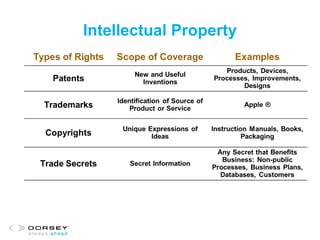
Intellectual Property
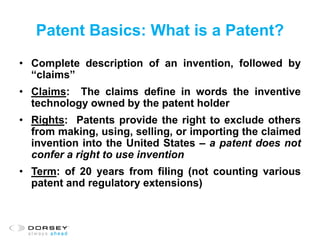
Patent Basics: What is a Patent?
• Complete description of an invention, followed by
“claims”
• Claims: The claims define in words the inventive
technology owned by the patent holder
• Rights: Patents provide the right to exclude others
from making, using, selling, or importing the claimed
invention into the United States – a patent does not
confer a right to use invention
• Term: of 20 years from filing (not counting various
patent and regulatory extensions)
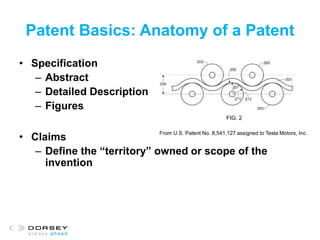
Patent Basics: Anatomy of a Patent
• Specification
– Abstract
– Detailed Description
– Figures
• Claims
– Define the “territory” owned or scope of the
invention
From U.S. Patent No. 8,541,127 assigned to Tesla Motors, Inc.
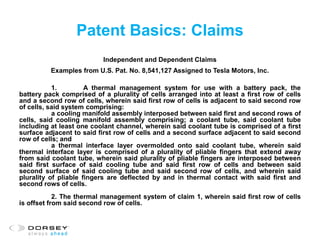
Patent Basics: Claims
Independent and Dependent Claims
Examples from U.S. Pat. No. 8,541,127 Assigned to Tesla Motors, Inc.
1. A thermal management system for use with a battery pack, the
battery pack comprised of a plurality of cells arranged into at least a first row of cells
and a second row of cells, wherein said first row of cells is adjacent to said second row
of cells, said system comprising:
a cooling manifold assembly interposed between said first and second rows of
cells, said cooling manifold assembly comprising; a coolant tube, said coolant tube
including at least one coolant channel, wherein said coolant tube is comprised of a first
surface adjacent to said first row of cells and a second surface adjacent to said second
row of cells; and
a thermal interface layer overmolded onto said coolant tube, wherein said
thermal interface layer is comprised of a plurality of pliable fingers that extend away
from said coolant tube, wherein said plurality of pliable fingers are interposed between
said first surface of said cooling tube and said first row of cells and between said
second surface of said cooling tube and said second row of cells, and wherein said
plurality of pliable fingers are deflected by and in thermal contact with said first and
second rows of cells.
2. The thermal management system of claim 1, wherein said first row of cells
is offset from said second row of cells.
Types of Patents: Technologies
Patent Eligible Subject Matter: Any “new and useful
process, machine, manufacture, or composition of
matter”
• Mechanical Inventions – turbines, wind power,
hydropower, electric vehicles, fueling stations, modular
housing
• Electrical Inventions (hardware, software) – solar cells,
fuel cells, batteries, power distribution control, network
architecture for power management, LEDs
• Chemistry-Related Inventions and Biotechnology –
biodegradable materials, polymers made from recycled
pollutants, light-weight composites, high-temperature
materials for more efficient combustion technologies,
cement alternatives, insulation materials
• Methods or processes for any of the above – methods of
use, methods of making, etc.
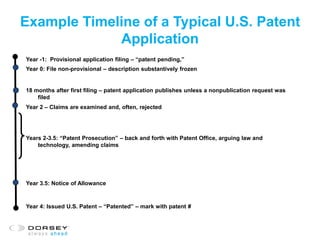
Example Timeline of a Typical U.S. Patent
Application
Year -1: Provisional application filing – “patent pending,”
Year 0: File non-provisional – description substantively frozen
18 months after first filing – patent application publishes unless a nonpublication request was
filed
Year 2 – Claims are examined and, often, rejected
Years 2-3.5: “Patent Prosecution” – back and forth with Patent Office, arguing law and
technology, amending claims
Year 3.5: Notice of Allowance
Year 4: Issued U.S. Patent – “Patented” – mark with patent #
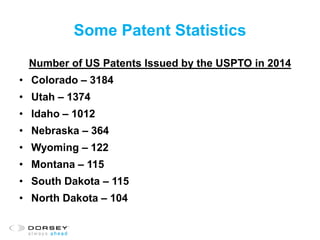
Some Patent Statistics
Number of US Patents Issued by the USPTO in 2014
• Colorado – 3184
• Utah – 1374
• Idaho – 1012
• Nebraska – 364
• Wyoming – 122
• Montana – 115
• South Dakota – 115
• North Dakota – 104
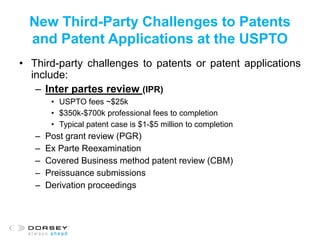
New Third-Party Challenges to Patents
and Patent Applications at the USPTO
• Third-party challenges to patents or patent applications
include:
– Inter partes review (IPR)
• USPTO fees ~$25k
• $350k-$700k professional fees to completion
• Typical patent case is $1-$5 million to completion
– Post grant review (PGR)
– Ex Parte Reexamination
– Covered Business method patent review (CBM)
– Preissuance submissions
– Derivation proceedings
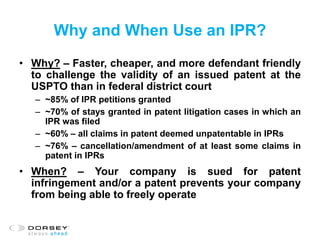
Why and When Use an IPR?
• Why? – Faster, cheaper, and more defendant friendly
to challenge the validity of an issued patent at the
USPTO than in federal district court
– ~85% of IPR petitions granted
– ~70% of stays granted in patent litigation cases in which an
IPR was filed
– ~60% – all claims in patent deemed unpatentable in IPRs
– ~76% – cancellation/amendment of at least some claims in
patent in IPRs
• When? – Your company is sued for patent
infringement and/or a patent prevents your company
from being able to freely operate
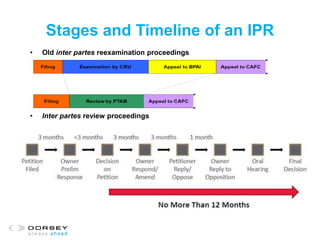
Stages and Timeline of an IPR
• Old inter partes reexamination proceedings
• Inter partes review proceedings
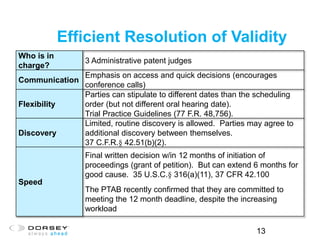
Efficient Resolution of Validity
13
Who is in
charge?
3 Administrative patent judges
Communication
Emphasis on access and quick decisions (encourages
conference calls)
Flexibility
Parties can stipulate to different dates than the scheduling
order (but not different oral hearing date).
Trial Practice Guidelines (77 F.R. 48,756).
Discovery
Limited, routine discovery is allowed. Parties may agree to
additional discovery between themselves.
37 C.F.R.§ 42.51(b)(2).
Speed
Final written decision w/in 12 months of initiation of
proceedings (grant of petition). But can extend 6 months for
good cause. 35 U.S.C.§ 316(a)(11), 37 CFR 42.100
The PTAB recently confirmed that they are committed to
meeting the 12 month deadline, despite the increasing
workload
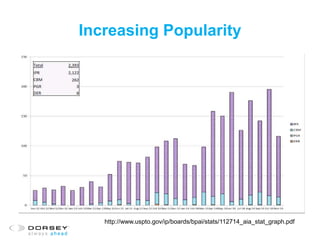
Increasing Popularity
http://www.uspto.gov/ip/boards/bpai/stats/112714_aia_stat_graph.pdf
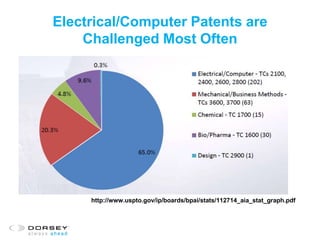
Electrical/Computer Patents are
Challenged Most Often
http://www.uspto.gov/ip/boards/bpai/stats/112714_aia_stat_graph.pdf
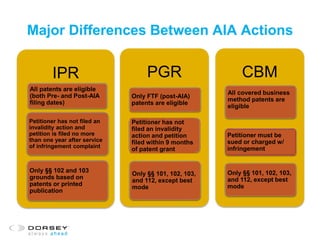
Major Differences Between AIA Actions
IPR PGR CBM
All patents are eligible
(both Pre- and Post-AIA
filing dates)
Petitioner has not filed an
invalidity action and
petition is filed no more
than one year after service
of infringement complaint
Only §§ 102 and 103
grounds based on
patents or printed
publication
Only FTF (post-AIA)
patents are eligible
Petitioner has not
filed an invalidity
action and petition
filed within 9 months
of patent grant
Only §§ 101, 102, 103,
and 112, except best
mode
All covered business
method patents are
eligible
Petitioner must be
sued or charged w/
infringement
Only §§ 101, 102, 103,
and 112, except best
mode
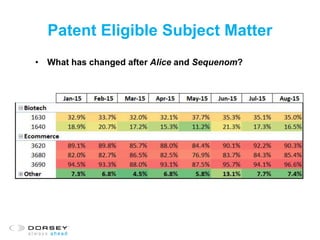
Patent Eligible Subject Matter
• What has changed after Alice and Sequenom?
Alice – “Abstract Idea” problem for
computer-implemented innovation
• Patent concerned system for intermediated settlement of a
transaction
• US Supreme Court invalidates patent, setting out process
for invalidation when directed toward “abstract idea”
• Identify the “abstract idea” (intermediated settlement)
• Then, look for “something more”
• NOT OK = routine steps, generic computer implementation,
obtain data, etc.
• COULD BE OK = improve function of computer itself, improve
another technology or field
Mayo/Sequenom – “Law of nature”
problem for therapeutic innovation
• Mayo patent concerned system for correcting drug dosage
based on measured quantity of blood metabolites
• US Supreme Court invalidates patent, setting out process
for invalidation when directed toward “law of nature”
• Identify the “law of nature” (metabolism of drug in
bloodstream)
• Then, look for “something more”
• NOT OK = routine steps, administer drug, measure metabolite
levels
• COULD BE OK = action to be taken, how to administer drug,
mechanism to measure metabolite levels
Mayo/Sequenom – “Law of nature”
problem for therapeutic innovation
• Sequenom patent concerned MaterniT-21 test for fetal
anomalies (e.g., Downs)
• Federal Circuit invalidates patent as ineligible “law of
nature”
• Identify the “law of nature” (presence of fetal DNA in maternal
blood stream)
• Then, look for “something more”
• NOT OK = routine methods and techniques for isolating,
amplifying, sequencing DNA
Even technology that “revolutionized patient care” can
be patent ineligible
What to do?
• Greater care in assessing inventions in these areas
• Fields like digital health / “big data” for medicine can face a
double-whammy
– Computer-implemented inventions
• Focus on how computer operation is improved
• Where possible, include portions of a physical system that go
beyond an everyday computer
– Medical inventions
• Consider claiming actions taken based on diagnostic
information
• Where possible, include specific actions or systems for
sample acquisition or analysis
– Consider alternatives
Alternatives
• Design Patents
• Trade Secrets
Thanks for your attention! Questions?
Marcus Simon
Patent
simon.marcus@Dorsey.com
(801) 933-7360
Jennifer Spaith
Patent
spaith.jennifer@Dorsey.com
(206) 903-8836

Montana IP Roadshow

  • 1.
    Protecting Your IntellectualProperty: Practical Strategies for Managing Patent Rights Jennifer Spaith, Partner Marcus Simon, Partner Patent Prosecution Group
  • 2.
    OVERVIEW • Patent Basics •Post-Grant Review of Patents • Patent Eligible Subject Matter
  • 3.
  • 4.
    Patent Basics: Whatis a Patent? • Complete description of an invention, followed by “claims” • Claims: The claims define in words the inventive technology owned by the patent holder • Rights: Patents provide the right to exclude others from making, using, selling, or importing the claimed invention into the United States – a patent does not confer a right to use invention • Term: of 20 years from filing (not counting various patent and regulatory extensions)
  • 5.
    Patent Basics: Anatomyof a Patent • Specification – Abstract – Detailed Description – Figures • Claims – Define the “territory” owned or scope of the invention From U.S. Patent No. 8,541,127 assigned to Tesla Motors, Inc.
  • 6.
    Patent Basics: Claims Independentand Dependent Claims Examples from U.S. Pat. No. 8,541,127 Assigned to Tesla Motors, Inc. 1. A thermal management system for use with a battery pack, the battery pack comprised of a plurality of cells arranged into at least a first row of cells and a second row of cells, wherein said first row of cells is adjacent to said second row of cells, said system comprising: a cooling manifold assembly interposed between said first and second rows of cells, said cooling manifold assembly comprising; a coolant tube, said coolant tube including at least one coolant channel, wherein said coolant tube is comprised of a first surface adjacent to said first row of cells and a second surface adjacent to said second row of cells; and a thermal interface layer overmolded onto said coolant tube, wherein said thermal interface layer is comprised of a plurality of pliable fingers that extend away from said coolant tube, wherein said plurality of pliable fingers are interposed between said first surface of said cooling tube and said first row of cells and between said second surface of said cooling tube and said second row of cells, and wherein said plurality of pliable fingers are deflected by and in thermal contact with said first and second rows of cells. 2. The thermal management system of claim 1, wherein said first row of cells is offset from said second row of cells.
  • 7.
    Types of Patents:Technologies Patent Eligible Subject Matter: Any “new and useful process, machine, manufacture, or composition of matter” • Mechanical Inventions – turbines, wind power, hydropower, electric vehicles, fueling stations, modular housing • Electrical Inventions (hardware, software) – solar cells, fuel cells, batteries, power distribution control, network architecture for power management, LEDs • Chemistry-Related Inventions and Biotechnology – biodegradable materials, polymers made from recycled pollutants, light-weight composites, high-temperature materials for more efficient combustion technologies, cement alternatives, insulation materials • Methods or processes for any of the above – methods of use, methods of making, etc.
  • 8.
    Example Timeline ofa Typical U.S. Patent Application Year -1: Provisional application filing – “patent pending,” Year 0: File non-provisional – description substantively frozen 18 months after first filing – patent application publishes unless a nonpublication request was filed Year 2 – Claims are examined and, often, rejected Years 2-3.5: “Patent Prosecution” – back and forth with Patent Office, arguing law and technology, amending claims Year 3.5: Notice of Allowance Year 4: Issued U.S. Patent – “Patented” – mark with patent #
  • 9.
    Some Patent Statistics Numberof US Patents Issued by the USPTO in 2014 • Colorado – 3184 • Utah – 1374 • Idaho – 1012 • Nebraska – 364 • Wyoming – 122 • Montana – 115 • South Dakota – 115 • North Dakota – 104
  • 10.
    New Third-Party Challengesto Patents and Patent Applications at the USPTO • Third-party challenges to patents or patent applications include: – Inter partes review (IPR) • USPTO fees ~$25k • $350k-$700k professional fees to completion • Typical patent case is $1-$5 million to completion – Post grant review (PGR) – Ex Parte Reexamination – Covered Business method patent review (CBM) – Preissuance submissions – Derivation proceedings
  • 11.
    Why and WhenUse an IPR? • Why? – Faster, cheaper, and more defendant friendly to challenge the validity of an issued patent at the USPTO than in federal district court – ~85% of IPR petitions granted – ~70% of stays granted in patent litigation cases in which an IPR was filed – ~60% – all claims in patent deemed unpatentable in IPRs – ~76% – cancellation/amendment of at least some claims in patent in IPRs • When? – Your company is sued for patent infringement and/or a patent prevents your company from being able to freely operate
  • 12.
    Stages and Timelineof an IPR • Old inter partes reexamination proceedings • Inter partes review proceedings
  • 13.
    Efficient Resolution ofValidity 13 Who is in charge? 3 Administrative patent judges Communication Emphasis on access and quick decisions (encourages conference calls) Flexibility Parties can stipulate to different dates than the scheduling order (but not different oral hearing date). Trial Practice Guidelines (77 F.R. 48,756). Discovery Limited, routine discovery is allowed. Parties may agree to additional discovery between themselves. 37 C.F.R.§ 42.51(b)(2). Speed Final written decision w/in 12 months of initiation of proceedings (grant of petition). But can extend 6 months for good cause. 35 U.S.C.§ 316(a)(11), 37 CFR 42.100 The PTAB recently confirmed that they are committed to meeting the 12 month deadline, despite the increasing workload
  • 14.
  • 15.
    Electrical/Computer Patents are ChallengedMost Often http://www.uspto.gov/ip/boards/bpai/stats/112714_aia_stat_graph.pdf
  • 16.
    Major Differences BetweenAIA Actions IPR PGR CBM All patents are eligible (both Pre- and Post-AIA filing dates) Petitioner has not filed an invalidity action and petition is filed no more than one year after service of infringement complaint Only §§ 102 and 103 grounds based on patents or printed publication Only FTF (post-AIA) patents are eligible Petitioner has not filed an invalidity action and petition filed within 9 months of patent grant Only §§ 101, 102, 103, and 112, except best mode All covered business method patents are eligible Petitioner must be sued or charged w/ infringement Only §§ 101, 102, 103, and 112, except best mode
  • 17.
    Patent Eligible SubjectMatter • What has changed after Alice and Sequenom?
  • 18.
    Alice – “AbstractIdea” problem for computer-implemented innovation • Patent concerned system for intermediated settlement of a transaction • US Supreme Court invalidates patent, setting out process for invalidation when directed toward “abstract idea” • Identify the “abstract idea” (intermediated settlement) • Then, look for “something more” • NOT OK = routine steps, generic computer implementation, obtain data, etc. • COULD BE OK = improve function of computer itself, improve another technology or field
  • 19.
    Mayo/Sequenom – “Lawof nature” problem for therapeutic innovation • Mayo patent concerned system for correcting drug dosage based on measured quantity of blood metabolites • US Supreme Court invalidates patent, setting out process for invalidation when directed toward “law of nature” • Identify the “law of nature” (metabolism of drug in bloodstream) • Then, look for “something more” • NOT OK = routine steps, administer drug, measure metabolite levels • COULD BE OK = action to be taken, how to administer drug, mechanism to measure metabolite levels
  • 20.
    Mayo/Sequenom – “Lawof nature” problem for therapeutic innovation • Sequenom patent concerned MaterniT-21 test for fetal anomalies (e.g., Downs) • Federal Circuit invalidates patent as ineligible “law of nature” • Identify the “law of nature” (presence of fetal DNA in maternal blood stream) • Then, look for “something more” • NOT OK = routine methods and techniques for isolating, amplifying, sequencing DNA Even technology that “revolutionized patient care” can be patent ineligible
  • 21.
    What to do? •Greater care in assessing inventions in these areas • Fields like digital health / “big data” for medicine can face a double-whammy – Computer-implemented inventions • Focus on how computer operation is improved • Where possible, include portions of a physical system that go beyond an everyday computer – Medical inventions • Consider claiming actions taken based on diagnostic information • Where possible, include specific actions or systems for sample acquisition or analysis – Consider alternatives
  • 22.
  • 23.
    Thanks for yourattention! Questions? Marcus Simon Patent simon.marcus@Dorsey.com (801) 933-7360 Jennifer Spaith Patent spaith.jennifer@Dorsey.com (206) 903-8836