Microeconomics

   Monopoly
      and
Anti-Trust Policy
Perfect
                                 Monopoly
                  Competition
Number of Firms      Many          One
Type of Product     Identical     Unique

 Ease of Entry        Easy        Blocked

   Demand           D = MR        D > MR

                  Commodities
                                  Utilities
   Examples          Rice
                                Government
                    Apples
Perfect
                                 Monopoly
                  Competition
Number of Firms      Many          One
Type of Product     Identical     Unique

 Ease of Entry        Easy        Blocked

   Demand           D = MR        D > MR

                  Commodities
                                  Utilities
   Examples          Rice
                                Government
                    Apples
Perfect
                                 Monopoly
                  Competition
Number of Firms      Many          One
Type of Product     Identical     Unique

 Ease of Entry        Easy        Blocked

   Demand           D = MR        D > MR

                  Commodities
                                  Utilities
   Examples          Rice
                                Government
                    Apples
Monopoly
Monopoly

    Only Seller
No Close Substitutes
Barriers to Entry
Barriers to Entry

Government Protection
    Key Resource
Network Externalities
 Economies of Scale
Patents


Copyrights
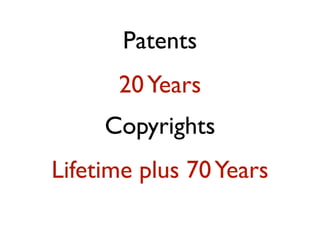
Patents
      20 Years
     Copyrights
Lifetime plus 70 Years
Franchise
Franchise

Exclusive Legal Provider
New Drugs
New Drugs

 10 Years of Testing
  before Approval

10 Years of Monopoly
Network Externalities

The more who use it

The more valuable it
     becomes
Natural Monopoly
Natural Monopoly

  One firm can supply
entire market at a lower
average cost than two or
       more firms
Natural Monopoly
Natural Monopoly

 The more I make
the lower my costs

Large Fixed Costs
Is competition
 always good?
Is competition
      always good?

Sometimes it can lead to
    higher prices
Monopoly
Output and Price
Monopoly
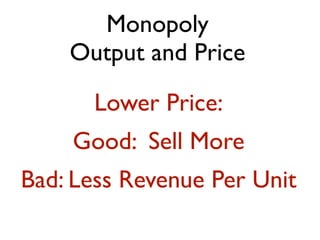
    Output and Price

      Lower Price:
    Good: Sell More
Bad: Less Revenue Per Unit
Perfect Competition
Perfect Competition
$


    Quantity
Perfect Competition
$


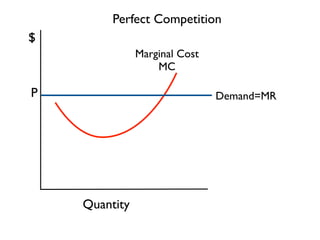
P                         Demand=MR


    Quantity
Perfect Competition
$
               Marginal Cost
                   MC

P                              Demand=MR


    Quantity
Perfect Competition
$
               Marginal Cost
                   MC

P                              Demand=MR


    Quantity
Perfect Competition
$
               Marginal Cost
                   MC

P                              Demand=MR


    Quantity       Q
Perfect Competition
$
                    Marginal Cost
                        MC

P                                   Demand=MR


    Total Revenue


       Quantity         Q
Perfect Competition
$
                    Marginal Cost
                        MC       Average Cost
                                     ATC
P                                   Demand=MR


    Total Revenue


       Quantity         Q
Perfect Competition
$
                    Marginal Cost
                        MC       Average Cost
                                     ATC
P                                   Demand=MR


    Total Revenue


       Quantity         Q
Perfect Competition
$
                 Marginal Cost
                     MC       Average Cost
                                  ATC
P                                Demand=MR


    Total Cost


     Quantity        Q
Perfect Competition
$
                 Marginal Cost
                     MC       Average Cost
                                  ATC
P                                Demand=MR
      Profit


    Total Cost


     Quantity        Q
Perfect Competition
Perfect Competition
                      Demand
Perfect Competition
                      Demand
                               MR
Perfect Competition
                      Demand = MR
Monopoly
           Demand   MR
Monopoly
                    MR


           Demand
Monopoly


           Demand


      MR
Perfect Competition   Monopoly

Q      D      TR      MR     D      TR      MR
1
2
3
4
5

Monopoly: To get more Quantity must lower price
Perfect Competition   Monopoly

Q      D      TR      MR     D      TR      MR
1
2
3
4
5

Monopoly: To get more Quantity must lower price
Perfect Competition   Monopoly

Q      D      TR      MR     D      TR      MR
1      $3     $3      $3     $5     $5      $5
2      $3     $6      $3     $4     $8      $3
3      $3     $9      $3     $3     $9      $1
4      $3    $12      $3     $2     $8     -$1
5      $3    $15      $3     $1     $5     -$3

Monopoly: To get more Quantity must lower price
Perfect Competition   Monopoly

Q      D      TR      MR     D      TR      MR
1      $3     $3      $3     $5     $5      $5
2      $3     $6      $3     $4     $8      $3
3      $3     $9      $3     $3     $9      $1
4      $3    $12      $3     $2     $8     -$1
5      $3    $15      $3     $1     $5     -$3

Monopoly: To get more Quantity must lower price
Perfect Competition   Monopoly

Q      D      TR      MR     D      TR      MR
1      $3     $3      $3     $5     $5      $5
2      $3     $6      $3     $4     $8      $3
3      $3     $9      $3     $3     $9      $1
4      $3    $12      $3     $2     $8     -$1
5      $3    $15      $3     $1     $5     -$3

Monopoly: To get more Quantity must lower price
Perfect Competition   Monopoly

Q      D      TR      MR     D      TR      MR
1      $3     $3      $3     $5     $5      $5
2      $3     $6      $3     $4     $8      $3
3      $3     $9      $3     $3     $9      $1
4      $3    $12      $3     $2     $8     -$1
5      $3    $15      $3     $1     $5     -$3

Monopoly: To get more Quantity must lower price
Perfect Competition   Monopoly

Q      D      TR      MR     D      TR      MR
1      $3     $3      $3     $5     $5      $5
2      $3     $6      $3     $4     $8      $3
3      $3     $9      $3     $3     $9      $1
4      $3    $12      $3     $2     $8     -$1
5      $3    $15      $3     $1     $5     -$3

Monopoly: To get more Quantity must lower price
Perfect Competition   Monopoly

Q      D      TR      MR     D      TR      MR
1      $3     $3      $3     $5     $5      $5
2      $3     $6      $3     $4     $8      $3
3      $3     $9      $3     $3     $9      $1
4      $3    $12      $3     $2     $8     -$1
5      $3    $15      $3     $1     $5     -$3

Monopoly: To get more Quantity must lower price
Perfect Competition
                      Demand
Perfect Competition
                      Demand = MR
Monopoly


           Demand


      MR
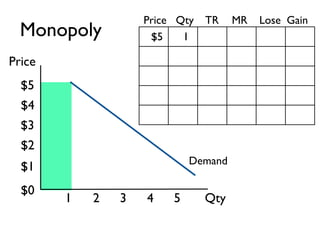
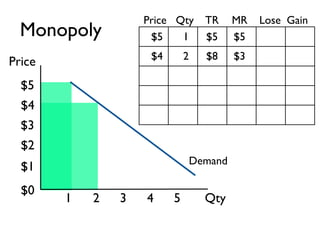
Price Qty   TR    MR   Lose Gain
  Monopoly
Price
  $5
  $4
  $3
  $2
                             Demand
  $1
  $0
        1   2   3   4    5      Qty
Price Qty   TR    MR   Lose Gain
  Monopoly           $5    1

Price
  $5
  $4
  $3
  $2
                             Demand
  $1
  $0
        1   2   3   4    5      Qty
Price Qty   TR    MR   Lose Gain
  Monopoly           $5    1    $5

Price
  $5
  $4
  $3
  $2
                             Demand
  $1
  $0
        1   2   3   4    5      Qty
Price Qty   TR    MR   Lose Gain
  Monopoly           $5    1    $5    $5

Price
  $5
  $4
  $3
  $2
                             Demand
  $1
  $0
        1   2   3   4    5      Qty
Price Qty       TR     MR   Lose Gain
  Monopoly           $5    1        $5     $5
                     $4       2
Price
  $5
  $4
  $3
  $2
                                  Demand
  $1
  $0
        1   2   3   4     5         Qty
Price Qty       TR     MR   Lose Gain
  Monopoly           $5    1        $5     $5
                     $4       2     $8
Price
  $5
  $4
  $3
  $2
                                  Demand
  $1
  $0
        1   2   3   4     5         Qty
Price Qty       TR     MR   Lose Gain
  Monopoly           $5    1        $5     $5
                     $4       2     $8     $3
Price
  $5
  $4
  $3
  $2
                                  Demand
  $1
  $0
        1   2   3   4     5         Qty
Price Qty       TR     MR   Lose Gain
  Monopoly           $5    1        $5     $5
                     $4       2     $8     $3
Price
  $5
  $4
  $3
  $2
                                  Demand
  $1
  $0
        1   2   3   4     5         Qty
Price Qty       TR     MR   Lose Gain
  Monopoly           $5    1        $5     $5
                     $4       2     $8     $3
Price
  $5
  $4
  $3
  $2
                                  Demand
  $1
  $0
        1   2   3   4     5         Qty
Price Qty       TR     MR   Lose Gain
  Monopoly              $5    1        $5     $5
                        $4       2     $8     $3   -$1
Price
  $5
        Lose
  $4
  $3
  $2
                                     Demand
  $1
  $0
           1   2   3   4     5         Qty
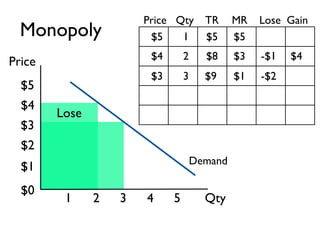
Price Qty       TR     MR   Lose Gain
  Monopoly                     $5    1        $5     $5
                               $4       2     $8     $3   -$1   $4
Price
  $5
        Lose
  $4
  $3
               Gain


  $2
                                            Demand
  $1
  $0
           1          2   3   4     5         Qty
Price Qty       TR     MR   Lose Gain
  Monopoly                     $5    1        $5     $5
                               $4       2     $8     $3   -$1   $4
Price
  $5
        Lose
  $4
  $3
               Gain


  $2
                                            Demand
  $1
  $0
           1          2   3   4     5         Qty
Price Qty       TR     MR   Lose Gain
  Monopoly                     $5    1        $5     $5
                               $4       2     $8     $3   -$1   $4
Price
  $5
        Lose
  $4
  $3
               Gain


  $2
                                            Demand
  $1
  $0
           1          2   3   4     5         Qty
Price Qty       TR     MR   Lose Gain
  Monopoly           $5    1        $5     $5
                     $4       2     $8     $3   -$1   $4
Price
  $5
  $4
  $3
  $2
                                  Demand
  $1
  $0
        1   2   3   4     5         Qty
Price Qty       TR     MR   Lose Gain
  Monopoly           $5    1        $5     $5
                     $4       2     $8     $3   -$1   $4
Price
                     $3       3
  $5
  $4
  $3
  $2
                                  Demand
  $1
  $0
        1   2   3   4     5         Qty
Price Qty       TR     MR   Lose Gain
  Monopoly           $5    1        $5     $5
                     $4       2     $8     $3   -$1   $4
Price
                     $3       3     $9
  $5
  $4
  $3
  $2
                                  Demand
  $1
  $0
        1   2   3   4     5         Qty
Price Qty       TR     MR   Lose Gain
  Monopoly           $5    1        $5     $5
                     $4       2     $8     $3   -$1   $4
Price
                     $3       3     $9     $1
  $5
  $4
  $3
  $2
                                  Demand
  $1
  $0
        1   2   3   4     5         Qty
Price Qty       TR     MR   Lose Gain
  Monopoly              $5    1        $5     $5
                        $4       2     $8     $3   -$1   $4
Price
                        $3       3     $9     $1   -$2
  $5
  $4
        Lose
  $3
  $2
                                     Demand
  $1
  $0
         1     2   3   4     5         Qty
Price Qty       TR     MR   Lose Gain
  Monopoly                     $5    1        $5     $5
                               $4       2     $8     $3   -$1   $4
Price
                               $3       3     $9     $1   -$2   $3
  $5
  $4
        Lose
  $3
  $2
                   Gain


                                            Demand
  $1
  $0
         1     2          3   4     5         Qty
Price Qty       TR     MR   Lose Gain
  Monopoly           $5    1        $5     $5
                     $4       2     $8     $3   -$1   $4
Price
                     $3       3     $9     $1   -$2   $3
  $5
  $4
  $3
  $2
                                  Demand
  $1
  $0
        1   2   3   4     5         Qty
Price Qty       TR     MR   Lose Gain
  Monopoly           $5    1        $5     $5
                     $4       2     $8     $3   -$1   $4
Price
                     $3       3     $9     $1   -$2   $3
  $5
                     $2       4
  $4
  $3
  $2
                                  Demand
  $1
  $0
        1   2   3   4     5         Qty
Price Qty       TR     MR   Lose Gain
  Monopoly           $5    1        $5     $5
                     $4       2     $8     $3   -$1   $4
Price
                     $3       3     $9     $1   -$2   $3
  $5
                     $2       4     $8
  $4
  $3
  $2
                                  Demand
  $1
  $0
        1   2   3   4     5         Qty
Price Qty       TR     MR    Lose Gain
  Monopoly           $5    1        $5     $5
                     $4       2     $8     $3    -$1   $4
Price
                     $3       3     $9     $1    -$2   $3
  $5
                     $2       4     $8     -$1
  $4
  $3
  $2
                                  Demand
  $1
  $0
        1   2   3   4     5         Qty
Price Qty       TR     MR    Lose Gain
  Monopoly           $5    1        $5     $5
                     $4       2     $8     $3    -$1   $4
Price
                     $3       3     $9     $1    -$2   $3
  $5
                     $2       4     $8     -$1   -$3
  $4
  $3
        Lose
  $2
                                  Demand
  $1
  $0
        1   2   3   4     5         Qty
Price Qty          TR     MR    Lose Gain
  Monopoly              $5    1           $5     $5
                           $4       2     $8     $3    -$1   $4
Price
                           $3       3     $9     $1    -$2   $3
  $5
                           $2       4     $8     -$1   -$3   $2
  $4
  $3
        Lose
  $2
                                        Demand
                    Gain

  $1
  $0
        1   2   3          4    5         Qty
Price Qty       TR     MR    Lose Gain
  Monopoly           $5    1        $5     $5
                     $4       2     $8     $3    -$1   $4
Price
                     $3       3     $9     $1    -$2   $3
  $5
                     $2       4     $8     -$1   -$3   $2
  $4
  $3
  $2
                                  Demand
  $1
  $0
        1   2   3   4     5         Qty
Price Qty       TR     MR    Lose Gain
  Monopoly           $5    1        $5     $5
                     $4       2     $8     $3    -$1   $4
Price
                     $3       3     $9     $1    -$2   $3
  $5
                     $2       4     $8     -$1   -$3   $2
  $4
                     $1       5
  $3
  $2
                                  Demand
  $1
  $0
        1   2   3   4     5         Qty
Price Qty       TR     MR    Lose Gain
  Monopoly           $5    1        $5     $5
                     $4       2     $8     $3    -$1   $4
Price
                     $3       3     $9     $1    -$2   $3
  $5
                     $2       4     $8     -$1   -$3   $2
  $4
                     $1       5     $5
  $3
  $2
                                  Demand
  $1
  $0
        1   2   3   4     5         Qty
Price Qty       TR     MR    Lose Gain
  Monopoly           $5    1        $5     $5
                     $4       2     $8     $3    -$1   $4
Price
                     $3       3     $9     $1    -$2   $3
  $5
                     $2       4     $8     -$1   -$3   $2
  $4
                     $1       5     $5     -$3
  $3
  $2
                                  Demand
  $1
  $0
        1   2   3   4     5         Qty
Price Qty       TR     MR    Lose Gain
  Monopoly              $5    1        $5     $5
                        $4       2     $8     $3    -$1   $4
Price
                        $3       3     $9     $1    -$2   $3
  $5
                        $2       4     $8     -$1   -$3   $2
  $4
                        $1       5     $5     -$3   -$4
  $3
  $2
            Lose                     Demand
  $1
  $0
        1    2     3   4     5         Qty
Price Qty            TR     MR    Lose Gain
  Monopoly              $5    1             $5     $5
                        $4            2     $8     $3    -$1   $4
Price
                        $3            3     $9     $1    -$2   $3
  $5
                        $2            4     $8     -$1   -$3   $2
  $4
                        $1            5     $5     -$3   -$4   $1
  $3
  $2
            Lose                          Demand
  $1                       Gain
  $0
        1    2     3   4          5         Qty
Price Qty       TR     MR    Lose Gain
  Monopoly           $5    1        $5     $5
                     $4       2     $8     $3    -$1   $4
Price
                     $3       3     $9     $1    -$2   $3
  $5
                     $2       4     $8     -$1   -$3   $2
  $4
                     $1       5     $5     -$3   -$4   $1
  $3
  $2
                                  Demand
  $1
  $0
        1   2   3   4     5         Qty
Price Qty       TR     MR    Lose Gain
  Monopoly           $5    1        $5     $5
                     $4       2     $8     $3    -$1   $4
Price
                     $3       3     $9     $1    -$2   $3
  $5
                     $2       4     $8     -$1   -$3   $2
  $4
                     $1       5     $5     -$3   -$4   $1
  $3
  $2
                                  Demand
  $1
  $0
        1   2   3   4     5         Qty
Price Qty       TR     MR    Lose Gain
  Monopoly           $5    1        $5     $5
                     $4       2     $8     $3    -$1   $4
Price
                     $3       3     $9     $1    -$2   $3
  $5
                     $2       4     $8     -$1   -$3   $2
  $4
                     $1       5     $5     -$3   -$4   $1
  $3
  $2
                                  Demand
  $1
  $0
        1   2   3   4     5         Qty
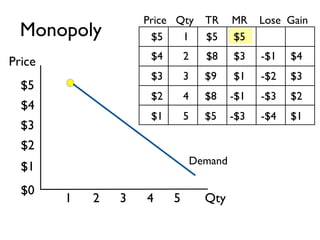
Price Qty       TR     MR    Lose Gain
  Monopoly           $5    1        $5     $5
                     $4       2     $8     $3    -$1   $4
Price
                     $3       3     $9     $1    -$2   $3
  $5
                     $2       4     $8     -$1   -$3   $2
  $4
                     $1       5     $5     -$3   -$4   $1
  $3
  $2
                                  Demand
  $1
  $0
        1   2   3   4     5         Qty
Price Qty       TR     MR    Lose Gain
  Monopoly           $5    1        $5     $5
                     $4       2     $8     $3    -$1   $4
Price
                     $3       3     $9     $1    -$2   $3
  $5
                     $2       4     $8     -$1   -$3   $2
  $4
                     $1       5     $5     -$3   -$4   $1
  $3
  $2
                                  Demand
  $1
  $0
        1   2   3   4     5         Qty
Price Qty       TR     MR    Lose Gain
  Monopoly           $5    1        $5     $5
                     $4       2     $8     $3    -$1   $4
Price
                     $3       3     $9     $1    -$2   $3
  $5
                     $2       4     $8     -$1   -$3   $2
  $4
                     $1       5     $5     -$3   -$4   $1
  $3
  $2
                                  Demand
  $1
  $0
        1   2   3   4     5         Qty
                        Marginal Revenue MR
Monopoly
$


               Q
Monopoly
$


               Demand


               Q
Monopoly
$


                    Demand
        Marginal Revenue MR
                   Q
Monopoly
$
        Marginal Cost
            MC


                        Demand
        Marginal Revenue MR
                    Q
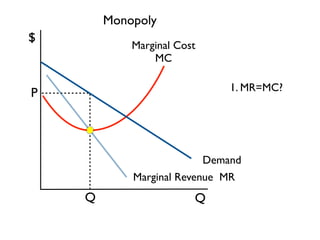
Monopoly
$
        Marginal Cost
            MC

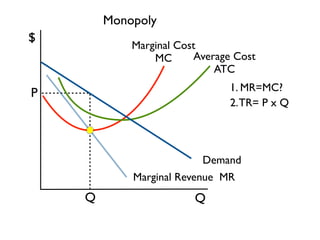
                            1. MR=MC?


                        Demand
        Marginal Revenue MR
                    Q
Monopoly
$
        Marginal Cost
            MC

                            1. MR=MC?


                        Demand
        Marginal Revenue MR
                    Q
Monopoly
$
            Marginal Cost
                MC

                                1. MR=MC?


                            Demand
            Marginal Revenue MR
    Q                   Q
Monopoly
$
            Marginal Cost
                MC

                                1. MR=MC?
P


                            Demand
            Marginal Revenue MR
    Q                   Q
Monopoly
$
            Marginal Cost
                MC

                                1. MR=MC?
P
                                2. TR= P x Q


                            Demand
            Marginal Revenue MR
    Q                   Q
Monopoly
$
            Marginal Cost
                MC      Average Cost
                            ATC
                               1. MR=MC?
P
                               2. TR= P x Q


                         Demand
            Marginal Revenue MR
    Q                   Q
Monopoly
$
            Marginal Cost
                MC      Average Cost
                            ATC
                               1. MR=MC?
P
                               2. TR= P x Q
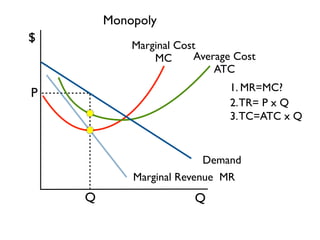
                               3. TC=ATC x Q


                         Demand
            Marginal Revenue MR
    Q                   Q
Monopoly
$
            Marginal Cost
                MC      Average Cost
                            ATC
                               1. MR=MC?
P
                               2. TR= P x Q
                               3. TC=ATC x Q


                         Demand
            Marginal Revenue MR
    Q                   Q
Monopoly
$
            Marginal Cost
                MC      Average Cost
                            ATC
                               1. MR=MC?
P
                               2. TR= P x Q
                               3. TC=ATC x Q


                         Demand
            Marginal Revenue MR
    Q                   Q
Monopoly
$
            Marginal Cost
                MC      Average Cost
                            ATC
                               1. MR=MC?
P
                               2. TR= P x Q
                               3. TC=ATC x Q


                         Demand
            Marginal Revenue MR
    Q                   Q
Monopoly
$
                   Marginal Cost
                       MC      Average Cost
                                   ATC
                                      1. MR=MC?
P
                                      2. TR= P x Q
                                      3. TC=ATC x Q


    Cost                        Demand
                   Marginal Revenue MR
           Q                   Q
Monopoly
$
                   Marginal Cost
                       MC      Average Cost
                                   ATC
                                     1. MR=MC?
P
                                     2. TR= P x Q
                                     3. TC=ATC x Q
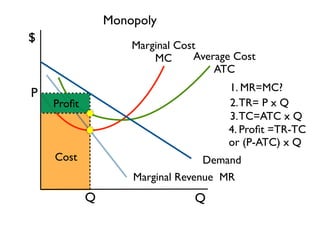
                                     4. Profit =TR-TC
                                     or (P-ATC) x Q
    Cost                        Demand
                   Marginal Revenue MR
           Q                   Q
Monopoly
$
                   Marginal Cost
                       MC      Average Cost
                                   ATC
                                     1. MR=MC?
P
                                     2. TR= P x Q
                                     3. TC=ATC x Q
                                     4. Profit =TR-TC
                                     or (P-ATC) x Q
    Cost                        Demand
                   Marginal Revenue MR
           Q                   Q
Monopoly
$
                    Marginal Cost
                        MC      Average Cost
                                    ATC
                                      1. MR=MC?
P
    Profit                             2. TR= P x Q
                                      3. TC=ATC x Q
                                      4. Profit =TR-TC
                                      or (P-ATC) x Q
    Cost                         Demand
                    Marginal Revenue MR
            Q                   Q
Monopoly
$
                    Marginal Cost
                        MC      Average Cost
                                    ATC
                                      1. MR=MC?
P
    Profit                             2. TR= P x Q
                                      3. TC=ATC x Q
                                      4. Profit =TR-TC
                                      or (P-ATC) x Q
    Cost                         Demand
                    Marginal Revenue MR
            Q                   Q
Monopoly
$
                    Marginal Cost
    Consumer
                        MC      Average Cost
     Surplus
                                    ATC
                                      1. MR=MC?
P
    Profit                             2. TR= P x Q
                                      3. TC=ATC x Q
                                      4. Profit =TR-TC
                                      or (P-ATC) x Q
    Cost                         Demand
                    Marginal Revenue MR
            Q                   Q
Monopoly
$
                    Marginal Cost
    Consumer
                        MC      Average Cost
     Surplus
                                    ATC
                                      1. MR=MC?
P
    Profit                             2. TR= P x Q
                                      3. TC=ATC x Q
                                      4. Profit =TR-TC
                                      or (P-ATC) x Q
    Cost                         Demand
                    Marginal Revenue MR
            Q                   Q
Monopoly
$
                        Marginal Cost
    Consumer
                            MC      Average Cost
     Surplus
                                        ATC
                Deadweight                1. MR=MC?
P                  Loss
    Profit                                 2. TR= P x Q
                                          3. TC=ATC x Q
                                          4. Profit =TR-TC
                                          or (P-ATC) x Q
    Cost                             Demand
                         Marginal Revenue MR
            Q                       Q
Antitrust
 Laws
Antitrust
 Laws

Collusion
 Felony

Monopoly

  • 1.
    Microeconomics Monopoly and Anti-Trust Policy
  • 4.
    Perfect Monopoly Competition Number of Firms Many One Type of Product Identical Unique Ease of Entry Easy Blocked Demand D = MR D > MR Commodities Utilities Examples Rice Government Apples
  • 5.
    Perfect Monopoly Competition Number of Firms Many One Type of Product Identical Unique Ease of Entry Easy Blocked Demand D = MR D > MR Commodities Utilities Examples Rice Government Apples
  • 6.
    Perfect Monopoly Competition Number of Firms Many One Type of Product Identical Unique Ease of Entry Easy Blocked Demand D = MR D > MR Commodities Utilities Examples Rice Government Apples
  • 7.
  • 8.
    Monopoly Only Seller No Close Substitutes
  • 9.
  • 10.
    Barriers to Entry GovernmentProtection Key Resource Network Externalities Economies of Scale
  • 11.
  • 12.
    Patents 20 Years Copyrights Lifetime plus 70 Years
  • 13.
  • 14.
  • 15.
  • 16.
    New Drugs 10Years of Testing before Approval 10 Years of Monopoly
  • 17.
  • 18.
    Network Externalities The morewho use it The more valuable it becomes
  • 19.
  • 20.
    Natural Monopoly One firm can supply entire market at a lower average cost than two or more firms
  • 21.
  • 22.
    Natural Monopoly Themore I make the lower my costs Large Fixed Costs
  • 23.
  • 24.
    Is competition always good? Sometimes it can lead to higher prices
  • 25.
  • 26.
    Monopoly Output and Price Lower Price: Good: Sell More Bad: Less Revenue Per Unit
  • 27.
  • 28.
  • 29.
    Perfect Competition $ P Demand=MR Quantity
  • 30.
    Perfect Competition $ Marginal Cost MC P Demand=MR Quantity
  • 31.
    Perfect Competition $ Marginal Cost MC P Demand=MR Quantity
  • 32.
    Perfect Competition $ Marginal Cost MC P Demand=MR Quantity Q
  • 33.
    Perfect Competition $ Marginal Cost MC P Demand=MR Total Revenue Quantity Q
  • 34.
    Perfect Competition $ Marginal Cost MC Average Cost ATC P Demand=MR Total Revenue Quantity Q
  • 35.
    Perfect Competition $ Marginal Cost MC Average Cost ATC P Demand=MR Total Revenue Quantity Q
  • 36.
    Perfect Competition $ Marginal Cost MC Average Cost ATC P Demand=MR Total Cost Quantity Q
  • 37.
    Perfect Competition $ Marginal Cost MC Average Cost ATC P Demand=MR Profit Total Cost Quantity Q
  • 38.
  • 39.
  • 40.
  • 41.
  • 42.
    Monopoly Demand MR
  • 43.
    Monopoly MR Demand
  • 44.
    Monopoly Demand MR
  • 45.
    Perfect Competition Monopoly Q D TR MR D TR MR 1 2 3 4 5 Monopoly: To get more Quantity must lower price
  • 46.
    Perfect Competition Monopoly Q D TR MR D TR MR 1 2 3 4 5 Monopoly: To get more Quantity must lower price
  • 47.
    Perfect Competition Monopoly Q D TR MR D TR MR 1 $3 $3 $3 $5 $5 $5 2 $3 $6 $3 $4 $8 $3 3 $3 $9 $3 $3 $9 $1 4 $3 $12 $3 $2 $8 -$1 5 $3 $15 $3 $1 $5 -$3 Monopoly: To get more Quantity must lower price
  • 48.
    Perfect Competition Monopoly Q D TR MR D TR MR 1 $3 $3 $3 $5 $5 $5 2 $3 $6 $3 $4 $8 $3 3 $3 $9 $3 $3 $9 $1 4 $3 $12 $3 $2 $8 -$1 5 $3 $15 $3 $1 $5 -$3 Monopoly: To get more Quantity must lower price
  • 49.
    Perfect Competition Monopoly Q D TR MR D TR MR 1 $3 $3 $3 $5 $5 $5 2 $3 $6 $3 $4 $8 $3 3 $3 $9 $3 $3 $9 $1 4 $3 $12 $3 $2 $8 -$1 5 $3 $15 $3 $1 $5 -$3 Monopoly: To get more Quantity must lower price
  • 50.
    Perfect Competition Monopoly Q D TR MR D TR MR 1 $3 $3 $3 $5 $5 $5 2 $3 $6 $3 $4 $8 $3 3 $3 $9 $3 $3 $9 $1 4 $3 $12 $3 $2 $8 -$1 5 $3 $15 $3 $1 $5 -$3 Monopoly: To get more Quantity must lower price
  • 51.
    Perfect Competition Monopoly Q D TR MR D TR MR 1 $3 $3 $3 $5 $5 $5 2 $3 $6 $3 $4 $8 $3 3 $3 $9 $3 $3 $9 $1 4 $3 $12 $3 $2 $8 -$1 5 $3 $15 $3 $1 $5 -$3 Monopoly: To get more Quantity must lower price
  • 52.
    Perfect Competition Monopoly Q D TR MR D TR MR 1 $3 $3 $3 $5 $5 $5 2 $3 $6 $3 $4 $8 $3 3 $3 $9 $3 $3 $9 $1 4 $3 $12 $3 $2 $8 -$1 5 $3 $15 $3 $1 $5 -$3 Monopoly: To get more Quantity must lower price
  • 53.
  • 54.
  • 55.
    Monopoly Demand MR
  • 56.
    Price Qty TR MR Lose Gain Monopoly Price $5 $4 $3 $2 Demand $1 $0 1 2 3 4 5 Qty
  • 57.
    Price Qty TR MR Lose Gain Monopoly $5 1 Price $5 $4 $3 $2 Demand $1 $0 1 2 3 4 5 Qty
  • 58.
    Price Qty TR MR Lose Gain Monopoly $5 1 $5 Price $5 $4 $3 $2 Demand $1 $0 1 2 3 4 5 Qty
  • 59.
    Price Qty TR MR Lose Gain Monopoly $5 1 $5 $5 Price $5 $4 $3 $2 Demand $1 $0 1 2 3 4 5 Qty
  • 60.
    Price Qty TR MR Lose Gain Monopoly $5 1 $5 $5 $4 2 Price $5 $4 $3 $2 Demand $1 $0 1 2 3 4 5 Qty
  • 61.
    Price Qty TR MR Lose Gain Monopoly $5 1 $5 $5 $4 2 $8 Price $5 $4 $3 $2 Demand $1 $0 1 2 3 4 5 Qty
  • 62.
    Price Qty TR MR Lose Gain Monopoly $5 1 $5 $5 $4 2 $8 $3 Price $5 $4 $3 $2 Demand $1 $0 1 2 3 4 5 Qty
  • 63.
    Price Qty TR MR Lose Gain Monopoly $5 1 $5 $5 $4 2 $8 $3 Price $5 $4 $3 $2 Demand $1 $0 1 2 3 4 5 Qty
  • 64.
    Price Qty TR MR Lose Gain Monopoly $5 1 $5 $5 $4 2 $8 $3 Price $5 $4 $3 $2 Demand $1 $0 1 2 3 4 5 Qty
  • 65.
    Price Qty TR MR Lose Gain Monopoly $5 1 $5 $5 $4 2 $8 $3 -$1 Price $5 Lose $4 $3 $2 Demand $1 $0 1 2 3 4 5 Qty
  • 66.
    Price Qty TR MR Lose Gain Monopoly $5 1 $5 $5 $4 2 $8 $3 -$1 $4 Price $5 Lose $4 $3 Gain $2 Demand $1 $0 1 2 3 4 5 Qty
  • 67.
    Price Qty TR MR Lose Gain Monopoly $5 1 $5 $5 $4 2 $8 $3 -$1 $4 Price $5 Lose $4 $3 Gain $2 Demand $1 $0 1 2 3 4 5 Qty
  • 68.
    Price Qty TR MR Lose Gain Monopoly $5 1 $5 $5 $4 2 $8 $3 -$1 $4 Price $5 Lose $4 $3 Gain $2 Demand $1 $0 1 2 3 4 5 Qty
  • 69.
    Price Qty TR MR Lose Gain Monopoly $5 1 $5 $5 $4 2 $8 $3 -$1 $4 Price $5 $4 $3 $2 Demand $1 $0 1 2 3 4 5 Qty
  • 70.
    Price Qty TR MR Lose Gain Monopoly $5 1 $5 $5 $4 2 $8 $3 -$1 $4 Price $3 3 $5 $4 $3 $2 Demand $1 $0 1 2 3 4 5 Qty
  • 71.
    Price Qty TR MR Lose Gain Monopoly $5 1 $5 $5 $4 2 $8 $3 -$1 $4 Price $3 3 $9 $5 $4 $3 $2 Demand $1 $0 1 2 3 4 5 Qty
  • 72.
    Price Qty TR MR Lose Gain Monopoly $5 1 $5 $5 $4 2 $8 $3 -$1 $4 Price $3 3 $9 $1 $5 $4 $3 $2 Demand $1 $0 1 2 3 4 5 Qty
  • 73.
    Price Qty TR MR Lose Gain Monopoly $5 1 $5 $5 $4 2 $8 $3 -$1 $4 Price $3 3 $9 $1 -$2 $5 $4 Lose $3 $2 Demand $1 $0 1 2 3 4 5 Qty
  • 74.
    Price Qty TR MR Lose Gain Monopoly $5 1 $5 $5 $4 2 $8 $3 -$1 $4 Price $3 3 $9 $1 -$2 $3 $5 $4 Lose $3 $2 Gain Demand $1 $0 1 2 3 4 5 Qty
  • 75.
    Price Qty TR MR Lose Gain Monopoly $5 1 $5 $5 $4 2 $8 $3 -$1 $4 Price $3 3 $9 $1 -$2 $3 $5 $4 $3 $2 Demand $1 $0 1 2 3 4 5 Qty
  • 76.
    Price Qty TR MR Lose Gain Monopoly $5 1 $5 $5 $4 2 $8 $3 -$1 $4 Price $3 3 $9 $1 -$2 $3 $5 $2 4 $4 $3 $2 Demand $1 $0 1 2 3 4 5 Qty
  • 77.
    Price Qty TR MR Lose Gain Monopoly $5 1 $5 $5 $4 2 $8 $3 -$1 $4 Price $3 3 $9 $1 -$2 $3 $5 $2 4 $8 $4 $3 $2 Demand $1 $0 1 2 3 4 5 Qty
  • 78.
    Price Qty TR MR Lose Gain Monopoly $5 1 $5 $5 $4 2 $8 $3 -$1 $4 Price $3 3 $9 $1 -$2 $3 $5 $2 4 $8 -$1 $4 $3 $2 Demand $1 $0 1 2 3 4 5 Qty
  • 79.
    Price Qty TR MR Lose Gain Monopoly $5 1 $5 $5 $4 2 $8 $3 -$1 $4 Price $3 3 $9 $1 -$2 $3 $5 $2 4 $8 -$1 -$3 $4 $3 Lose $2 Demand $1 $0 1 2 3 4 5 Qty
  • 80.
    Price Qty TR MR Lose Gain Monopoly $5 1 $5 $5 $4 2 $8 $3 -$1 $4 Price $3 3 $9 $1 -$2 $3 $5 $2 4 $8 -$1 -$3 $2 $4 $3 Lose $2 Demand Gain $1 $0 1 2 3 4 5 Qty
  • 81.
    Price Qty TR MR Lose Gain Monopoly $5 1 $5 $5 $4 2 $8 $3 -$1 $4 Price $3 3 $9 $1 -$2 $3 $5 $2 4 $8 -$1 -$3 $2 $4 $3 $2 Demand $1 $0 1 2 3 4 5 Qty
  • 82.
    Price Qty TR MR Lose Gain Monopoly $5 1 $5 $5 $4 2 $8 $3 -$1 $4 Price $3 3 $9 $1 -$2 $3 $5 $2 4 $8 -$1 -$3 $2 $4 $1 5 $3 $2 Demand $1 $0 1 2 3 4 5 Qty
  • 83.
    Price Qty TR MR Lose Gain Monopoly $5 1 $5 $5 $4 2 $8 $3 -$1 $4 Price $3 3 $9 $1 -$2 $3 $5 $2 4 $8 -$1 -$3 $2 $4 $1 5 $5 $3 $2 Demand $1 $0 1 2 3 4 5 Qty
  • 84.
    Price Qty TR MR Lose Gain Monopoly $5 1 $5 $5 $4 2 $8 $3 -$1 $4 Price $3 3 $9 $1 -$2 $3 $5 $2 4 $8 -$1 -$3 $2 $4 $1 5 $5 -$3 $3 $2 Demand $1 $0 1 2 3 4 5 Qty
  • 85.
    Price Qty TR MR Lose Gain Monopoly $5 1 $5 $5 $4 2 $8 $3 -$1 $4 Price $3 3 $9 $1 -$2 $3 $5 $2 4 $8 -$1 -$3 $2 $4 $1 5 $5 -$3 -$4 $3 $2 Lose Demand $1 $0 1 2 3 4 5 Qty
  • 86.
    Price Qty TR MR Lose Gain Monopoly $5 1 $5 $5 $4 2 $8 $3 -$1 $4 Price $3 3 $9 $1 -$2 $3 $5 $2 4 $8 -$1 -$3 $2 $4 $1 5 $5 -$3 -$4 $1 $3 $2 Lose Demand $1 Gain $0 1 2 3 4 5 Qty
  • 87.
    Price Qty TR MR Lose Gain Monopoly $5 1 $5 $5 $4 2 $8 $3 -$1 $4 Price $3 3 $9 $1 -$2 $3 $5 $2 4 $8 -$1 -$3 $2 $4 $1 5 $5 -$3 -$4 $1 $3 $2 Demand $1 $0 1 2 3 4 5 Qty
  • 88.
    Price Qty TR MR Lose Gain Monopoly $5 1 $5 $5 $4 2 $8 $3 -$1 $4 Price $3 3 $9 $1 -$2 $3 $5 $2 4 $8 -$1 -$3 $2 $4 $1 5 $5 -$3 -$4 $1 $3 $2 Demand $1 $0 1 2 3 4 5 Qty
  • 89.
    Price Qty TR MR Lose Gain Monopoly $5 1 $5 $5 $4 2 $8 $3 -$1 $4 Price $3 3 $9 $1 -$2 $3 $5 $2 4 $8 -$1 -$3 $2 $4 $1 5 $5 -$3 -$4 $1 $3 $2 Demand $1 $0 1 2 3 4 5 Qty
  • 90.
    Price Qty TR MR Lose Gain Monopoly $5 1 $5 $5 $4 2 $8 $3 -$1 $4 Price $3 3 $9 $1 -$2 $3 $5 $2 4 $8 -$1 -$3 $2 $4 $1 5 $5 -$3 -$4 $1 $3 $2 Demand $1 $0 1 2 3 4 5 Qty
  • 91.
    Price Qty TR MR Lose Gain Monopoly $5 1 $5 $5 $4 2 $8 $3 -$1 $4 Price $3 3 $9 $1 -$2 $3 $5 $2 4 $8 -$1 -$3 $2 $4 $1 5 $5 -$3 -$4 $1 $3 $2 Demand $1 $0 1 2 3 4 5 Qty
  • 92.
    Price Qty TR MR Lose Gain Monopoly $5 1 $5 $5 $4 2 $8 $3 -$1 $4 Price $3 3 $9 $1 -$2 $3 $5 $2 4 $8 -$1 -$3 $2 $4 $1 5 $5 -$3 -$4 $1 $3 $2 Demand $1 $0 1 2 3 4 5 Qty Marginal Revenue MR
  • 93.
  • 94.
    Monopoly $ Demand Q
  • 95.
    Monopoly $ Demand Marginal Revenue MR Q
  • 96.
    Monopoly $ Marginal Cost MC Demand Marginal Revenue MR Q
  • 97.
    Monopoly $ Marginal Cost MC 1. MR=MC? Demand Marginal Revenue MR Q
  • 98.
    Monopoly $ Marginal Cost MC 1. MR=MC? Demand Marginal Revenue MR Q
  • 99.
    Monopoly $ Marginal Cost MC 1. MR=MC? Demand Marginal Revenue MR Q Q
  • 100.
    Monopoly $ Marginal Cost MC 1. MR=MC? P Demand Marginal Revenue MR Q Q
  • 101.
    Monopoly $ Marginal Cost MC 1. MR=MC? P 2. TR= P x Q Demand Marginal Revenue MR Q Q
  • 102.
    Monopoly $ Marginal Cost MC Average Cost ATC 1. MR=MC? P 2. TR= P x Q Demand Marginal Revenue MR Q Q
  • 103.
    Monopoly $ Marginal Cost MC Average Cost ATC 1. MR=MC? P 2. TR= P x Q 3. TC=ATC x Q Demand Marginal Revenue MR Q Q
  • 104.
    Monopoly $ Marginal Cost MC Average Cost ATC 1. MR=MC? P 2. TR= P x Q 3. TC=ATC x Q Demand Marginal Revenue MR Q Q
  • 105.
    Monopoly $ Marginal Cost MC Average Cost ATC 1. MR=MC? P 2. TR= P x Q 3. TC=ATC x Q Demand Marginal Revenue MR Q Q
  • 106.
    Monopoly $ Marginal Cost MC Average Cost ATC 1. MR=MC? P 2. TR= P x Q 3. TC=ATC x Q Demand Marginal Revenue MR Q Q
  • 107.
    Monopoly $ Marginal Cost MC Average Cost ATC 1. MR=MC? P 2. TR= P x Q 3. TC=ATC x Q Cost Demand Marginal Revenue MR Q Q
  • 108.
    Monopoly $ Marginal Cost MC Average Cost ATC 1. MR=MC? P 2. TR= P x Q 3. TC=ATC x Q 4. Profit =TR-TC or (P-ATC) x Q Cost Demand Marginal Revenue MR Q Q
  • 109.
    Monopoly $ Marginal Cost MC Average Cost ATC 1. MR=MC? P 2. TR= P x Q 3. TC=ATC x Q 4. Profit =TR-TC or (P-ATC) x Q Cost Demand Marginal Revenue MR Q Q
  • 110.
    Monopoly $ Marginal Cost MC Average Cost ATC 1. MR=MC? P Profit 2. TR= P x Q 3. TC=ATC x Q 4. Profit =TR-TC or (P-ATC) x Q Cost Demand Marginal Revenue MR Q Q
  • 111.
    Monopoly $ Marginal Cost MC Average Cost ATC 1. MR=MC? P Profit 2. TR= P x Q 3. TC=ATC x Q 4. Profit =TR-TC or (P-ATC) x Q Cost Demand Marginal Revenue MR Q Q
  • 112.
    Monopoly $ Marginal Cost Consumer MC Average Cost Surplus ATC 1. MR=MC? P Profit 2. TR= P x Q 3. TC=ATC x Q 4. Profit =TR-TC or (P-ATC) x Q Cost Demand Marginal Revenue MR Q Q
  • 113.
    Monopoly $ Marginal Cost Consumer MC Average Cost Surplus ATC 1. MR=MC? P Profit 2. TR= P x Q 3. TC=ATC x Q 4. Profit =TR-TC or (P-ATC) x Q Cost Demand Marginal Revenue MR Q Q
  • 114.
    Monopoly $ Marginal Cost Consumer MC Average Cost Surplus ATC Deadweight 1. MR=MC? P Loss Profit 2. TR= P x Q 3. TC=ATC x Q 4. Profit =TR-TC or (P-ATC) x Q Cost Demand Marginal Revenue MR Q Q
  • 115.
  • 116.

Editor's Notes

  • #2 \n
  • #3 \n
  • #4 \n
  • #5 \n
  • #6 \n
  • #7 \n
  • #8 \n
  • #9 \n
  • #10 \n
  • #11 \n
  • #12 \n
  • #13 \n
  • #14 \n
  • #15 \n
  • #16 \n
  • #17 Perfect Competition\n\nIn this video we’re going to talk about Perfect Competition.\n\nFirst we’ll draw and label our price-quantity graph.\n\nThen we’ll draw the demand curve.\n\nRemember that under perfect competition there is one price level for all individual sellers. This means the demand curve is flat. This also means the marginal revenue curve is the same as the demand curve. So price and demand and marginal revenue are all on the same line.\n\nSo the first question we want to answer is “At what level should we produce to maximize profits?” We always answer this question with the equation MR=MC.\nSo we need to see a marginal cost curve. This curve is a “U-shape” to indicate that costs typically tend to decline and then increase. \n\nNow that we have a MR and a MC curve we can pin-point the intersection. \n\nThe next step is to draw a vertical line down to the Quantity axis. This line will point to the quantity we should produce to maximize profits. \n\nWe can then calculate Total Revenue. This is P times Q, or this area.\n\nThe next step is to calculate Total Costs. Total Costs are calculated as ATC x Q. We need the ATC curve to do this. Once we know the ATC then we pin-point the intersection of the ATC curve and the vertical line we drew. Then we daw a horizontal line from this point over to the price axis. The area below this line represents our total costs. \n\nNow we can calculate profits. The equation is TR -TC, or another way is (Price-ATC) x Q. \n\nLet’s quickly review. We start with a flat demand curve which is also our marginal revenue curve. We then add a marginal cost curve. Using MR=MR we pinpoint the profit maximizing location and draw a line down to quantity. This are is total revenue. We then look at the Average Total Cost curve and pinpoint where it crosses our line and then draw a horizontal line. The area below this line is Total Cost and the area above is profit. \n\nLets look at another example.\n\nWe start with a flat demand curve which is also our marginal revenue curve. We then add a marginal cost curve. Using MR=MR we pinpoint the profit maximizing location and draw a line down to quantity. This are is total revenue. In this case the ATC curve is above the price line. If this is the case we will be looking for the location that minimizes losses. We pinpoint where ATC crosses our line and then draw a horizontal line. The area is Total Cost. Since Total Costs are larger than Total Revenue, this area represents our losses. Remember that using MC=MR we can figure out where our losses are minimized. \n\nAlright, now you know how to analyze Perfect Competition. \n\nDon’t forget you can rewind this video to make sure you understand how the graph works.\n
  • #18 Perfect Competition\n\nIn this video we’re going to talk about Perfect Competition.\n\nFirst we’ll draw and label our price-quantity graph.\n\nThen we’ll draw the demand curve.\n\nRemember that under perfect competition there is one price level for all individual sellers. This means the demand curve is flat. This also means the marginal revenue curve is the same as the demand curve. So price and demand and marginal revenue are all on the same line.\n\nSo the first question we want to answer is “At what level should we produce to maximize profits?” We always answer this question with the equation MR=MC.\nSo we need to see a marginal cost curve. This curve is a “U-shape” to indicate that costs typically tend to decline and then increase. \n\nNow that we have a MR and a MC curve we can pin-point the intersection. \n\nThe next step is to draw a vertical line down to the Quantity axis. This line will point to the quantity we should produce to maximize profits. \n\nWe can then calculate Total Revenue. This is P times Q, or this area.\n\nThe next step is to calculate Total Costs. Total Costs are calculated as ATC x Q. We need the ATC curve to do this. Once we know the ATC then we pin-point the intersection of the ATC curve and the vertical line we drew. Then we daw a horizontal line from this point over to the price axis. The area below this line represents our total costs. \n\nNow we can calculate profits. The equation is TR -TC, or another way is (Price-ATC) x Q. \n\nLet’s quickly review. We start with a flat demand curve which is also our marginal revenue curve. We then add a marginal cost curve. Using MR=MR we pinpoint the profit maximizing location and draw a line down to quantity. This are is total revenue. We then look at the Average Total Cost curve and pinpoint where it crosses our line and then draw a horizontal line. The area below this line is Total Cost and the area above is profit. \n\nLets look at another example.\n\nWe start with a flat demand curve which is also our marginal revenue curve. We then add a marginal cost curve. Using MR=MR we pinpoint the profit maximizing location and draw a line down to quantity. This are is total revenue. In this case the ATC curve is above the price line. If this is the case we will be looking for the location that minimizes losses. We pinpoint where ATC crosses our line and then draw a horizontal line. The area is Total Cost. Since Total Costs are larger than Total Revenue, this area represents our losses. Remember that using MC=MR we can figure out where our losses are minimized. \n\nAlright, now you know how to analyze Perfect Competition. \n\nDon’t forget you can rewind this video to make sure you understand how the graph works.\n
  • #19 Perfect Competition\n\nIn this video we’re going to talk about Perfect Competition.\n\nFirst we’ll draw and label our price-quantity graph.\n\nThen we’ll draw the demand curve.\n\nRemember that under perfect competition there is one price level for all individual sellers. This means the demand curve is flat. This also means the marginal revenue curve is the same as the demand curve. So price and demand and marginal revenue are all on the same line.\n\nSo the first question we want to answer is “At what level should we produce to maximize profits?” We always answer this question with the equation MR=MC.\nSo we need to see a marginal cost curve. This curve is a “U-shape” to indicate that costs typically tend to decline and then increase. \n\nNow that we have a MR and a MC curve we can pin-point the intersection. \n\nThe next step is to draw a vertical line down to the Quantity axis. This line will point to the quantity we should produce to maximize profits. \n\nWe can then calculate Total Revenue. This is P times Q, or this area.\n\nThe next step is to calculate Total Costs. Total Costs are calculated as ATC x Q. We need the ATC curve to do this. Once we know the ATC then we pin-point the intersection of the ATC curve and the vertical line we drew. Then we daw a horizontal line from this point over to the price axis. The area below this line represents our total costs. \n\nNow we can calculate profits. The equation is TR -TC, or another way is (Price-ATC) x Q. \n\nLet’s quickly review. We start with a flat demand curve which is also our marginal revenue curve. We then add a marginal cost curve. Using MR=MR we pinpoint the profit maximizing location and draw a line down to quantity. This are is total revenue. We then look at the Average Total Cost curve and pinpoint where it crosses our line and then draw a horizontal line. The area below this line is Total Cost and the area above is profit. \n\nLets look at another example.\n\nWe start with a flat demand curve which is also our marginal revenue curve. We then add a marginal cost curve. Using MR=MR we pinpoint the profit maximizing location and draw a line down to quantity. This are is total revenue. In this case the ATC curve is above the price line. If this is the case we will be looking for the location that minimizes losses. We pinpoint where ATC crosses our line and then draw a horizontal line. The area is Total Cost. Since Total Costs are larger than Total Revenue, this area represents our losses. Remember that using MC=MR we can figure out where our losses are minimized. \n\nAlright, now you know how to analyze Perfect Competition. \n\nDon’t forget you can rewind this video to make sure you understand how the graph works.\n
  • #20 Perfect Competition\n\nIn this video we’re going to talk about Perfect Competition.\n\nFirst we’ll draw and label our price-quantity graph.\n\nThen we’ll draw the demand curve.\n\nRemember that under perfect competition there is one price level for all individual sellers. This means the demand curve is flat. This also means the marginal revenue curve is the same as the demand curve. So price and demand and marginal revenue are all on the same line.\n\nSo the first question we want to answer is “At what level should we produce to maximize profits?” We always answer this question with the equation MR=MC.\nSo we need to see a marginal cost curve. This curve is a “U-shape” to indicate that costs typically tend to decline and then increase. \n\nNow that we have a MR and a MC curve we can pin-point the intersection. \n\nThe next step is to draw a vertical line down to the Quantity axis. This line will point to the quantity we should produce to maximize profits. \n\nWe can then calculate Total Revenue. This is P times Q, or this area.\n\nThe next step is to calculate Total Costs. Total Costs are calculated as ATC x Q. We need the ATC curve to do this. Once we know the ATC then we pin-point the intersection of the ATC curve and the vertical line we drew. Then we daw a horizontal line from this point over to the price axis. The area below this line represents our total costs. \n\nNow we can calculate profits. The equation is TR -TC, or another way is (Price-ATC) x Q. \n\nLet’s quickly review. We start with a flat demand curve which is also our marginal revenue curve. We then add a marginal cost curve. Using MR=MR we pinpoint the profit maximizing location and draw a line down to quantity. This are is total revenue. We then look at the Average Total Cost curve and pinpoint where it crosses our line and then draw a horizontal line. The area below this line is Total Cost and the area above is profit. \n\nLets look at another example.\n\nWe start with a flat demand curve which is also our marginal revenue curve. We then add a marginal cost curve. Using MR=MR we pinpoint the profit maximizing location and draw a line down to quantity. This are is total revenue. In this case the ATC curve is above the price line. If this is the case we will be looking for the location that minimizes losses. We pinpoint where ATC crosses our line and then draw a horizontal line. The area is Total Cost. Since Total Costs are larger than Total Revenue, this area represents our losses. Remember that using MC=MR we can figure out where our losses are minimized. \n\nAlright, now you know how to analyze Perfect Competition. \n\nDon’t forget you can rewind this video to make sure you understand how the graph works.\n
  • #21 Perfect Competition\n\nIn this video we’re going to talk about Perfect Competition.\n\nFirst we’ll draw and label our price-quantity graph.\n\nThen we’ll draw the demand curve.\n\nRemember that under perfect competition there is one price level for all individual sellers. This means the demand curve is flat. This also means the marginal revenue curve is the same as the demand curve. So price and demand and marginal revenue are all on the same line.\n\nSo the first question we want to answer is “At what level should we produce to maximize profits?” We always answer this question with the equation MR=MC.\nSo we need to see a marginal cost curve. This curve is a “U-shape” to indicate that costs typically tend to decline and then increase. \n\nNow that we have a MR and a MC curve we can pin-point the intersection. \n\nThe next step is to draw a vertical line down to the Quantity axis. This line will point to the quantity we should produce to maximize profits. \n\nWe can then calculate Total Revenue. This is P times Q, or this area.\n\nThe next step is to calculate Total Costs. Total Costs are calculated as ATC x Q. We need the ATC curve to do this. Once we know the ATC then we pin-point the intersection of the ATC curve and the vertical line we drew. Then we daw a horizontal line from this point over to the price axis. The area below this line represents our total costs. \n\nNow we can calculate profits. The equation is TR -TC, or another way is (Price-ATC) x Q. \n\nLet’s quickly review. We start with a flat demand curve which is also our marginal revenue curve. We then add a marginal cost curve. Using MR=MR we pinpoint the profit maximizing location and draw a line down to quantity. This are is total revenue. We then look at the Average Total Cost curve and pinpoint where it crosses our line and then draw a horizontal line. The area below this line is Total Cost and the area above is profit. \n\nLets look at another example.\n\nWe start with a flat demand curve which is also our marginal revenue curve. We then add a marginal cost curve. Using MR=MR we pinpoint the profit maximizing location and draw a line down to quantity. This are is total revenue. In this case the ATC curve is above the price line. If this is the case we will be looking for the location that minimizes losses. We pinpoint where ATC crosses our line and then draw a horizontal line. The area is Total Cost. Since Total Costs are larger than Total Revenue, this area represents our losses. Remember that using MC=MR we can figure out where our losses are minimized. \n\nAlright, now you know how to analyze Perfect Competition. \n\nDon’t forget you can rewind this video to make sure you understand how the graph works.\n
  • #22 Perfect Competition\n\nIn this video we’re going to talk about Perfect Competition.\n\nFirst we’ll draw and label our price-quantity graph.\n\nThen we’ll draw the demand curve.\n\nRemember that under perfect competition there is one price level for all individual sellers. This means the demand curve is flat. This also means the marginal revenue curve is the same as the demand curve. So price and demand and marginal revenue are all on the same line.\n\nSo the first question we want to answer is “At what level should we produce to maximize profits?” We always answer this question with the equation MR=MC.\nSo we need to see a marginal cost curve. This curve is a “U-shape” to indicate that costs typically tend to decline and then increase. \n\nNow that we have a MR and a MC curve we can pin-point the intersection. \n\nThe next step is to draw a vertical line down to the Quantity axis. This line will point to the quantity we should produce to maximize profits. \n\nWe can then calculate Total Revenue. This is P times Q, or this area.\n\nThe next step is to calculate Total Costs. Total Costs are calculated as ATC x Q. We need the ATC curve to do this. Once we know the ATC then we pin-point the intersection of the ATC curve and the vertical line we drew. Then we daw a horizontal line from this point over to the price axis. The area below this line represents our total costs. \n\nNow we can calculate profits. The equation is TR -TC, or another way is (Price-ATC) x Q. \n\nLet’s quickly review. We start with a flat demand curve which is also our marginal revenue curve. We then add a marginal cost curve. Using MR=MR we pinpoint the profit maximizing location and draw a line down to quantity. This are is total revenue. We then look at the Average Total Cost curve and pinpoint where it crosses our line and then draw a horizontal line. The area below this line is Total Cost and the area above is profit. \n\nLets look at another example.\n\nWe start with a flat demand curve which is also our marginal revenue curve. We then add a marginal cost curve. Using MR=MR we pinpoint the profit maximizing location and draw a line down to quantity. This are is total revenue. In this case the ATC curve is above the price line. If this is the case we will be looking for the location that minimizes losses. We pinpoint where ATC crosses our line and then draw a horizontal line. The area is Total Cost. Since Total Costs are larger than Total Revenue, this area represents our losses. Remember that using MC=MR we can figure out where our losses are minimized. \n\nAlright, now you know how to analyze Perfect Competition. \n\nDon’t forget you can rewind this video to make sure you understand how the graph works.\n
  • #23 Perfect Competition\n\nIn this video we’re going to talk about Perfect Competition.\n\nFirst we’ll draw and label our price-quantity graph.\n\nThen we’ll draw the demand curve.\n\nRemember that under perfect competition there is one price level for all individual sellers. This means the demand curve is flat. This also means the marginal revenue curve is the same as the demand curve. So price and demand and marginal revenue are all on the same line.\n\nSo the first question we want to answer is “At what level should we produce to maximize profits?” We always answer this question with the equation MR=MC.\nSo we need to see a marginal cost curve. This curve is a “U-shape” to indicate that costs typically tend to decline and then increase. \n\nNow that we have a MR and a MC curve we can pin-point the intersection. \n\nThe next step is to draw a vertical line down to the Quantity axis. This line will point to the quantity we should produce to maximize profits. \n\nWe can then calculate Total Revenue. This is P times Q, or this area.\n\nThe next step is to calculate Total Costs. Total Costs are calculated as ATC x Q. We need the ATC curve to do this. Once we know the ATC then we pin-point the intersection of the ATC curve and the vertical line we drew. Then we daw a horizontal line from this point over to the price axis. The area below this line represents our total costs. \n\nNow we can calculate profits. The equation is TR -TC, or another way is (Price-ATC) x Q. \n\nLet’s quickly review. We start with a flat demand curve which is also our marginal revenue curve. We then add a marginal cost curve. Using MR=MR we pinpoint the profit maximizing location and draw a line down to quantity. This are is total revenue. We then look at the Average Total Cost curve and pinpoint where it crosses our line and then draw a horizontal line. The area below this line is Total Cost and the area above is profit. \n\nLets look at another example.\n\nWe start with a flat demand curve which is also our marginal revenue curve. We then add a marginal cost curve. Using MR=MR we pinpoint the profit maximizing location and draw a line down to quantity. This are is total revenue. In this case the ATC curve is above the price line. If this is the case we will be looking for the location that minimizes losses. We pinpoint where ATC crosses our line and then draw a horizontal line. The area is Total Cost. Since Total Costs are larger than Total Revenue, this area represents our losses. Remember that using MC=MR we can figure out where our losses are minimized. \n\nAlright, now you know how to analyze Perfect Competition. \n\nDon’t forget you can rewind this video to make sure you understand how the graph works.\n
  • #24 Perfect Competition\n\nIn this video we’re going to talk about Perfect Competition.\n\nFirst we’ll draw and label our price-quantity graph.\n\nThen we’ll draw the demand curve.\n\nRemember that under perfect competition there is one price level for all individual sellers. This means the demand curve is flat. This also means the marginal revenue curve is the same as the demand curve. So price and demand and marginal revenue are all on the same line.\n\nSo the first question we want to answer is “At what level should we produce to maximize profits?” We always answer this question with the equation MR=MC.\nSo we need to see a marginal cost curve. This curve is a “U-shape” to indicate that costs typically tend to decline and then increase. \n\nNow that we have a MR and a MC curve we can pin-point the intersection. \n\nThe next step is to draw a vertical line down to the Quantity axis. This line will point to the quantity we should produce to maximize profits. \n\nWe can then calculate Total Revenue. This is P times Q, or this area.\n\nThe next step is to calculate Total Costs. Total Costs are calculated as ATC x Q. We need the ATC curve to do this. Once we know the ATC then we pin-point the intersection of the ATC curve and the vertical line we drew. Then we daw a horizontal line from this point over to the price axis. The area below this line represents our total costs. \n\nNow we can calculate profits. The equation is TR -TC, or another way is (Price-ATC) x Q. \n\nLet’s quickly review. We start with a flat demand curve which is also our marginal revenue curve. We then add a marginal cost curve. Using MR=MR we pinpoint the profit maximizing location and draw a line down to quantity. This are is total revenue. We then look at the Average Total Cost curve and pinpoint where it crosses our line and then draw a horizontal line. The area below this line is Total Cost and the area above is profit. \n\nLets look at another example.\n\nWe start with a flat demand curve which is also our marginal revenue curve. We then add a marginal cost curve. Using MR=MR we pinpoint the profit maximizing location and draw a line down to quantity. This are is total revenue. In this case the ATC curve is above the price line. If this is the case we will be looking for the location that minimizes losses. We pinpoint where ATC crosses our line and then draw a horizontal line. The area is Total Cost. Since Total Costs are larger than Total Revenue, this area represents our losses. Remember that using MC=MR we can figure out where our losses are minimized. \n\nAlright, now you know how to analyze Perfect Competition. \n\nDon’t forget you can rewind this video to make sure you understand how the graph works.\n
  • #25 Perfect Competition\n\nIn this video we’re going to talk about Perfect Competition.\n\nFirst we’ll draw and label our price-quantity graph.\n\nThen we’ll draw the demand curve.\n\nRemember that under perfect competition there is one price level for all individual sellers. This means the demand curve is flat. This also means the marginal revenue curve is the same as the demand curve. So price and demand and marginal revenue are all on the same line.\n\nSo the first question we want to answer is “At what level should we produce to maximize profits?” We always answer this question with the equation MR=MC.\nSo we need to see a marginal cost curve. This curve is a “U-shape” to indicate that costs typically tend to decline and then increase. \n\nNow that we have a MR and a MC curve we can pin-point the intersection. \n\nThe next step is to draw a vertical line down to the Quantity axis. This line will point to the quantity we should produce to maximize profits. \n\nWe can then calculate Total Revenue. This is P times Q, or this area.\n\nThe next step is to calculate Total Costs. Total Costs are calculated as ATC x Q. We need the ATC curve to do this. Once we know the ATC then we pin-point the intersection of the ATC curve and the vertical line we drew. Then we daw a horizontal line from this point over to the price axis. The area below this line represents our total costs. \n\nNow we can calculate profits. The equation is TR -TC, or another way is (Price-ATC) x Q. \n\nLet’s quickly review. We start with a flat demand curve which is also our marginal revenue curve. We then add a marginal cost curve. Using MR=MR we pinpoint the profit maximizing location and draw a line down to quantity. This are is total revenue. We then look at the Average Total Cost curve and pinpoint where it crosses our line and then draw a horizontal line. The area below this line is Total Cost and the area above is profit. \n\nLets look at another example.\n\nWe start with a flat demand curve which is also our marginal revenue curve. We then add a marginal cost curve. Using MR=MR we pinpoint the profit maximizing location and draw a line down to quantity. This are is total revenue. In this case the ATC curve is above the price line. If this is the case we will be looking for the location that minimizes losses. We pinpoint where ATC crosses our line and then draw a horizontal line. The area is Total Cost. Since Total Costs are larger than Total Revenue, this area represents our losses. Remember that using MC=MR we can figure out where our losses are minimized. \n\nAlright, now you know how to analyze Perfect Competition. \n\nDon’t forget you can rewind this video to make sure you understand how the graph works.\n
  • #26 Perfect Competition\n\nIn this video we’re going to talk about Perfect Competition.\n\nFirst we’ll draw and label our price-quantity graph.\n\nThen we’ll draw the demand curve.\n\nRemember that under perfect competition there is one price level for all individual sellers. This means the demand curve is flat. This also means the marginal revenue curve is the same as the demand curve. So price and demand and marginal revenue are all on the same line.\n\nSo the first question we want to answer is “At what level should we produce to maximize profits?” We always answer this question with the equation MR=MC.\nSo we need to see a marginal cost curve. This curve is a “U-shape” to indicate that costs typically tend to decline and then increase. \n\nNow that we have a MR and a MC curve we can pin-point the intersection. \n\nThe next step is to draw a vertical line down to the Quantity axis. This line will point to the quantity we should produce to maximize profits. \n\nWe can then calculate Total Revenue. This is P times Q, or this area.\n\nThe next step is to calculate Total Costs. Total Costs are calculated as ATC x Q. We need the ATC curve to do this. Once we know the ATC then we pin-point the intersection of the ATC curve and the vertical line we drew. Then we daw a horizontal line from this point over to the price axis. The area below this line represents our total costs. \n\nNow we can calculate profits. The equation is TR -TC, or another way is (Price-ATC) x Q. \n\nLet’s quickly review. We start with a flat demand curve which is also our marginal revenue curve. We then add a marginal cost curve. Using MR=MR we pinpoint the profit maximizing location and draw a line down to quantity. This are is total revenue. We then look at the Average Total Cost curve and pinpoint where it crosses our line and then draw a horizontal line. The area below this line is Total Cost and the area above is profit. \n\nLets look at another example.\n\nWe start with a flat demand curve which is also our marginal revenue curve. We then add a marginal cost curve. Using MR=MR we pinpoint the profit maximizing location and draw a line down to quantity. This are is total revenue. In this case the ATC curve is above the price line. If this is the case we will be looking for the location that minimizes losses. We pinpoint where ATC crosses our line and then draw a horizontal line. The area is Total Cost. Since Total Costs are larger than Total Revenue, this area represents our losses. Remember that using MC=MR we can figure out where our losses are minimized. \n\nAlright, now you know how to analyze Perfect Competition. \n\nDon’t forget you can rewind this video to make sure you understand how the graph works.\n
  • #27 Perfect Competition\n\nIn this video we’re going to talk about Perfect Competition.\n\nFirst we’ll draw and label our price-quantity graph.\n\nThen we’ll draw the demand curve.\n\nRemember that under perfect competition there is one price level for all individual sellers. This means the demand curve is flat. This also means the marginal revenue curve is the same as the demand curve. So price and demand and marginal revenue are all on the same line.\n\nSo the first question we want to answer is “At what level should we produce to maximize profits?” We always answer this question with the equation MR=MC.\nSo we need to see a marginal cost curve. This curve is a “U-shape” to indicate that costs typically tend to decline and then increase. \n\nNow that we have a MR and a MC curve we can pin-point the intersection. \n\nThe next step is to draw a vertical line down to the Quantity axis. This line will point to the quantity we should produce to maximize profits. \n\nWe can then calculate Total Revenue. This is P times Q, or this area.\n\nThe next step is to calculate Total Costs. Total Costs are calculated as ATC x Q. We need the ATC curve to do this. Once we know the ATC then we pin-point the intersection of the ATC curve and the vertical line we drew. Then we daw a horizontal line from this point over to the price axis. The area below this line represents our total costs. \n\nNow we can calculate profits. The equation is TR -TC, or another way is (Price-ATC) x Q. \n\nLet’s quickly review. We start with a flat demand curve which is also our marginal revenue curve. We then add a marginal cost curve. Using MR=MR we pinpoint the profit maximizing location and draw a line down to quantity. This are is total revenue. We then look at the Average Total Cost curve and pinpoint where it crosses our line and then draw a horizontal line. The area below this line is Total Cost and the area above is profit. \n\nLets look at another example.\n\nWe start with a flat demand curve which is also our marginal revenue curve. We then add a marginal cost curve. Using MR=MR we pinpoint the profit maximizing location and draw a line down to quantity. This are is total revenue. In this case the ATC curve is above the price line. If this is the case we will be looking for the location that minimizes losses. We pinpoint where ATC crosses our line and then draw a horizontal line. The area is Total Cost. Since Total Costs are larger than Total Revenue, this area represents our losses. Remember that using MC=MR we can figure out where our losses are minimized. \n\nAlright, now you know how to analyze Perfect Competition. \n\nDon’t forget you can rewind this video to make sure you understand how the graph works.\n
  • #28 Perfect Competition\n\nIn this video we’re going to talk about Perfect Competition.\n\nFirst we’ll draw and label our price-quantity graph.\n\nThen we’ll draw the demand curve.\n\nRemember that under perfect competition there is one price level for all individual sellers. This means the demand curve is flat. This also means the marginal revenue curve is the same as the demand curve. So price and demand and marginal revenue are all on the same line.\n\nSo the first question we want to answer is “At what level should we produce to maximize profits?” We always answer this question with the equation MR=MC.\nSo we need to see a marginal cost curve. This curve is a “U-shape” to indicate that costs typically tend to decline and then increase. \n\nNow that we have a MR and a MC curve we can pin-point the intersection. \n\nThe next step is to draw a vertical line down to the Quantity axis. This line will point to the quantity we should produce to maximize profits. \n\nWe can then calculate Total Revenue. This is P times Q, or this area.\n\nThe next step is to calculate Total Costs. Total Costs are calculated as ATC x Q. We need the ATC curve to do this. Once we know the ATC then we pin-point the intersection of the ATC curve and the vertical line we drew. Then we daw a horizontal line from this point over to the price axis. The area below this line represents our total costs. \n\nNow we can calculate profits. The equation is TR -TC, or another way is (Price-ATC) x Q. \n\nLet’s quickly review. We start with a flat demand curve which is also our marginal revenue curve. We then add a marginal cost curve. Using MR=MR we pinpoint the profit maximizing location and draw a line down to quantity. This are is total revenue. We then look at the Average Total Cost curve and pinpoint where it crosses our line and then draw a horizontal line. The area below this line is Total Cost and the area above is profit. \n\nLets look at another example.\n\nWe start with a flat demand curve which is also our marginal revenue curve. We then add a marginal cost curve. Using MR=MR we pinpoint the profit maximizing location and draw a line down to quantity. This are is total revenue. In this case the ATC curve is above the price line. If this is the case we will be looking for the location that minimizes losses. We pinpoint where ATC crosses our line and then draw a horizontal line. The area is Total Cost. Since Total Costs are larger than Total Revenue, this area represents our losses. Remember that using MC=MR we can figure out where our losses are minimized. \n\nAlright, now you know how to analyze Perfect Competition. \n\nDon’t forget you can rewind this video to make sure you understand how the graph works.\n
  • #29 Perfect Competition\n\nIn this video we’re going to talk about Perfect Competition.\n\nFirst we’ll draw and label our price-quantity graph.\n\nThen we’ll draw the demand curve.\n\nRemember that under perfect competition there is one price level for all individual sellers. This means the demand curve is flat. This also means the marginal revenue curve is the same as the demand curve. So price and demand and marginal revenue are all on the same line.\n\nSo the first question we want to answer is “At what level should we produce to maximize profits?” We always answer this question with the equation MR=MC.\nSo we need to see a marginal cost curve. This curve is a “U-shape” to indicate that costs typically tend to decline and then increase. \n\nNow that we have a MR and a MC curve we can pin-point the intersection. \n\nThe next step is to draw a vertical line down to the Quantity axis. This line will point to the quantity we should produce to maximize profits. \n\nWe can then calculate Total Revenue. This is P times Q, or this area.\n\nThe next step is to calculate Total Costs. Total Costs are calculated as ATC x Q. We need the ATC curve to do this. Once we know the ATC then we pin-point the intersection of the ATC curve and the vertical line we drew. Then we daw a horizontal line from this point over to the price axis. The area below this line represents our total costs. \n\nNow we can calculate profits. The equation is TR -TC, or another way is (Price-ATC) x Q. \n\nLet’s quickly review. We start with a flat demand curve which is also our marginal revenue curve. We then add a marginal cost curve. Using MR=MR we pinpoint the profit maximizing location and draw a line down to quantity. This are is total revenue. We then look at the Average Total Cost curve and pinpoint where it crosses our line and then draw a horizontal line. The area below this line is Total Cost and the area above is profit. \n\nLets look at another example.\n\nWe start with a flat demand curve which is also our marginal revenue curve. We then add a marginal cost curve. Using MR=MR we pinpoint the profit maximizing location and draw a line down to quantity. This are is total revenue. In this case the ATC curve is above the price line. If this is the case we will be looking for the location that minimizes losses. We pinpoint where ATC crosses our line and then draw a horizontal line. The area is Total Cost. Since Total Costs are larger than Total Revenue, this area represents our losses. Remember that using MC=MR we can figure out where our losses are minimized. \n\nAlright, now you know how to analyze Perfect Competition. \n\nDon’t forget you can rewind this video to make sure you understand how the graph works.\n
  • #30 Perfect Competition\n\nIn this video we’re going to talk about Perfect Competition.\n\nFirst we’ll draw and label our price-quantity graph.\n\nThen we’ll draw the demand curve.\n\nRemember that under perfect competition there is one price level for all individual sellers. This means the demand curve is flat. This also means the marginal revenue curve is the same as the demand curve. So price and demand and marginal revenue are all on the same line.\n\nSo the first question we want to answer is “At what level should we produce to maximize profits?” We always answer this question with the equation MR=MC.\nSo we need to see a marginal cost curve. This curve is a “U-shape” to indicate that costs typically tend to decline and then increase. \n\nNow that we have a MR and a MC curve we can pin-point the intersection. \n\nThe next step is to draw a vertical line down to the Quantity axis. This line will point to the quantity we should produce to maximize profits. \n\nWe can then calculate Total Revenue. This is P times Q, or this area.\n\nThe next step is to calculate Total Costs. Total Costs are calculated as ATC x Q. We need the ATC curve to do this. Once we know the ATC then we pin-point the intersection of the ATC curve and the vertical line we drew. Then we daw a horizontal line from this point over to the price axis. The area below this line represents our total costs. \n\nNow we can calculate profits. The equation is TR -TC, or another way is (Price-ATC) x Q. \n\nLet’s quickly review. We start with a flat demand curve which is also our marginal revenue curve. We then add a marginal cost curve. Using MR=MR we pinpoint the profit maximizing location and draw a line down to quantity. This are is total revenue. We then look at the Average Total Cost curve and pinpoint where it crosses our line and then draw a horizontal line. The area below this line is Total Cost and the area above is profit. \n\nLets look at another example.\n\nWe start with a flat demand curve which is also our marginal revenue curve. We then add a marginal cost curve. Using MR=MR we pinpoint the profit maximizing location and draw a line down to quantity. This are is total revenue. In this case the ATC curve is above the price line. If this is the case we will be looking for the location that minimizes losses. We pinpoint where ATC crosses our line and then draw a horizontal line. The area is Total Cost. Since Total Costs are larger than Total Revenue, this area represents our losses. Remember that using MC=MR we can figure out where our losses are minimized. \n\nAlright, now you know how to analyze Perfect Competition. \n\nDon’t forget you can rewind this video to make sure you understand how the graph works.\n
  • #31 Perfect Competition\n\nIn this video we’re going to talk about Perfect Competition.\n\nFirst we’ll draw and label our price-quantity graph.\n\nThen we’ll draw the demand curve.\n\nRemember that under perfect competition there is one price level for all individual sellers. This means the demand curve is flat. This also means the marginal revenue curve is the same as the demand curve. So price and demand and marginal revenue are all on the same line.\n\nSo the first question we want to answer is “At what level should we produce to maximize profits?” We always answer this question with the equation MR=MC.\nSo we need to see a marginal cost curve. This curve is a “U-shape” to indicate that costs typically tend to decline and then increase. \n\nNow that we have a MR and a MC curve we can pin-point the intersection. \n\nThe next step is to draw a vertical line down to the Quantity axis. This line will point to the quantity we should produce to maximize profits. \n\nWe can then calculate Total Revenue. This is P times Q, or this area.\n\nThe next step is to calculate Total Costs. Total Costs are calculated as ATC x Q. We need the ATC curve to do this. Once we know the ATC then we pin-point the intersection of the ATC curve and the vertical line we drew. Then we daw a horizontal line from this point over to the price axis. The area below this line represents our total costs. \n\nNow we can calculate profits. The equation is TR -TC, or another way is (Price-ATC) x Q. \n\nLet’s quickly review. We start with a flat demand curve which is also our marginal revenue curve. We then add a marginal cost curve. Using MR=MR we pinpoint the profit maximizing location and draw a line down to quantity. This are is total revenue. We then look at the Average Total Cost curve and pinpoint where it crosses our line and then draw a horizontal line. The area below this line is Total Cost and the area above is profit. \n\nLets look at another example.\n\nWe start with a flat demand curve which is also our marginal revenue curve. We then add a marginal cost curve. Using MR=MR we pinpoint the profit maximizing location and draw a line down to quantity. This are is total revenue. In this case the ATC curve is above the price line. If this is the case we will be looking for the location that minimizes losses. We pinpoint where ATC crosses our line and then draw a horizontal line. The area is Total Cost. Since Total Costs are larger than Total Revenue, this area represents our losses. Remember that using MC=MR we can figure out where our losses are minimized. \n\nAlright, now you know how to analyze Perfect Competition. \n\nDon’t forget you can rewind this video to make sure you understand how the graph works.\n
  • #32 Perfect Competition\n\nIn this video we’re going to talk about Perfect Competition.\n\nFirst we’ll draw and label our price-quantity graph.\n\nThen we’ll draw the demand curve.\n\nRemember that under perfect competition there is one price level for all individual sellers. This means the demand curve is flat. This also means the marginal revenue curve is the same as the demand curve. So price and demand and marginal revenue are all on the same line.\n\nSo the first question we want to answer is “At what level should we produce to maximize profits?” We always answer this question with the equation MR=MC.\nSo we need to see a marginal cost curve. This curve is a “U-shape” to indicate that costs typically tend to decline and then increase. \n\nNow that we have a MR and a MC curve we can pin-point the intersection. \n\nThe next step is to draw a vertical line down to the Quantity axis. This line will point to the quantity we should produce to maximize profits. \n\nWe can then calculate Total Revenue. This is P times Q, or this area.\n\nThe next step is to calculate Total Costs. Total Costs are calculated as ATC x Q. We need the ATC curve to do this. Once we know the ATC then we pin-point the intersection of the ATC curve and the vertical line we drew. Then we daw a horizontal line from this point over to the price axis. The area below this line represents our total costs. \n\nNow we can calculate profits. The equation is TR -TC, or another way is (Price-ATC) x Q. \n\nLet’s quickly review. We start with a flat demand curve which is also our marginal revenue curve. We then add a marginal cost curve. Using MR=MR we pinpoint the profit maximizing location and draw a line down to quantity. This are is total revenue. We then look at the Average Total Cost curve and pinpoint where it crosses our line and then draw a horizontal line. The area below this line is Total Cost and the area above is profit. \n\nLets look at another example.\n\nWe start with a flat demand curve which is also our marginal revenue curve. We then add a marginal cost curve. Using MR=MR we pinpoint the profit maximizing location and draw a line down to quantity. This are is total revenue. In this case the ATC curve is above the price line. If this is the case we will be looking for the location that minimizes losses. We pinpoint where ATC crosses our line and then draw a horizontal line. The area is Total Cost. Since Total Costs are larger than Total Revenue, this area represents our losses. Remember that using MC=MR we can figure out where our losses are minimized. \n\nAlright, now you know how to analyze Perfect Competition. \n\nDon’t forget you can rewind this video to make sure you understand how the graph works.\n
  • #33 Perfect Competition\n\nIn this video we’re going to talk about Perfect Competition.\n\nFirst we’ll draw and label our price-quantity graph.\n\nThen we’ll draw the demand curve.\n\nRemember that under perfect competition there is one price level for all individual sellers. This means the demand curve is flat. This also means the marginal revenue curve is the same as the demand curve. So price and demand and marginal revenue are all on the same line.\n\nSo the first question we want to answer is “At what level should we produce to maximize profits?” We always answer this question with the equation MR=MC.\nSo we need to see a marginal cost curve. This curve is a “U-shape” to indicate that costs typically tend to decline and then increase. \n\nNow that we have a MR and a MC curve we can pin-point the intersection. \n\nThe next step is to draw a vertical line down to the Quantity axis. This line will point to the quantity we should produce to maximize profits. \n\nWe can then calculate Total Revenue. This is P times Q, or this area.\n\nThe next step is to calculate Total Costs. Total Costs are calculated as ATC x Q. We need the ATC curve to do this. Once we know the ATC then we pin-point the intersection of the ATC curve and the vertical line we drew. Then we daw a horizontal line from this point over to the price axis. The area below this line represents our total costs. \n\nNow we can calculate profits. The equation is TR -TC, or another way is (Price-ATC) x Q. \n\nLet’s quickly review. We start with a flat demand curve which is also our marginal revenue curve. We then add a marginal cost curve. Using MR=MR we pinpoint the profit maximizing location and draw a line down to quantity. This are is total revenue. We then look at the Average Total Cost curve and pinpoint where it crosses our line and then draw a horizontal line. The area below this line is Total Cost and the area above is profit. \n\nLets look at another example.\n\nWe start with a flat demand curve which is also our marginal revenue curve. We then add a marginal cost curve. Using MR=MR we pinpoint the profit maximizing location and draw a line down to quantity. This are is total revenue. In this case the ATC curve is above the price line. If this is the case we will be looking for the location that minimizes losses. We pinpoint where ATC crosses our line and then draw a horizontal line. The area is Total Cost. Since Total Costs are larger than Total Revenue, this area represents our losses. Remember that using MC=MR we can figure out where our losses are minimized. \n\nAlright, now you know how to analyze Perfect Competition. \n\nDon’t forget you can rewind this video to make sure you understand how the graph works.\n
  • #34 Perfect Competition\n\nIn this video we’re going to talk about Perfect Competition.\n\nFirst we’ll draw and label our price-quantity graph.\n\nThen we’ll draw the demand curve.\n\nRemember that under perfect competition there is one price level for all individual sellers. This means the demand curve is flat. This also means the marginal revenue curve is the same as the demand curve. So price and demand and marginal revenue are all on the same line.\n\nSo the first question we want to answer is “At what level should we produce to maximize profits?” We always answer this question with the equation MR=MC.\nSo we need to see a marginal cost curve. This curve is a “U-shape” to indicate that costs typically tend to decline and then increase. \n\nNow that we have a MR and a MC curve we can pin-point the intersection. \n\nThe next step is to draw a vertical line down to the Quantity axis. This line will point to the quantity we should produce to maximize profits. \n\nWe can then calculate Total Revenue. This is P times Q, or this area.\n\nThe next step is to calculate Total Costs. Total Costs are calculated as ATC x Q. We need the ATC curve to do this. Once we know the ATC then we pin-point the intersection of the ATC curve and the vertical line we drew. Then we daw a horizontal line from this point over to the price axis. The area below this line represents our total costs. \n\nNow we can calculate profits. The equation is TR -TC, or another way is (Price-ATC) x Q. \n\nLet’s quickly review. We start with a flat demand curve which is also our marginal revenue curve. We then add a marginal cost curve. Using MR=MR we pinpoint the profit maximizing location and draw a line down to quantity. This are is total revenue. We then look at the Average Total Cost curve and pinpoint where it crosses our line and then draw a horizontal line. The area below this line is Total Cost and the area above is profit. \n\nLets look at another example.\n\nWe start with a flat demand curve which is also our marginal revenue curve. We then add a marginal cost curve. Using MR=MR we pinpoint the profit maximizing location and draw a line down to quantity. This are is total revenue. In this case the ATC curve is above the price line. If this is the case we will be looking for the location that minimizes losses. We pinpoint where ATC crosses our line and then draw a horizontal line. The area is Total Cost. Since Total Costs are larger than Total Revenue, this area represents our losses. Remember that using MC=MR we can figure out where our losses are minimized. \n\nAlright, now you know how to analyze Perfect Competition. \n\nDon’t forget you can rewind this video to make sure you understand how the graph works.\n
  • #35 Perfect Competition\n\nIn this video we’re going to talk about Perfect Competition.\n\nFirst we’ll draw and label our price-quantity graph.\n\nThen we’ll draw the demand curve.\n\nRemember that under perfect competition there is one price level for all individual sellers. This means the demand curve is flat. This also means the marginal revenue curve is the same as the demand curve. So price and demand and marginal revenue are all on the same line.\n\nSo the first question we want to answer is “At what level should we produce to maximize profits?” We always answer this question with the equation MR=MC.\nSo we need to see a marginal cost curve. This curve is a “U-shape” to indicate that costs typically tend to decline and then increase. \n\nNow that we have a MR and a MC curve we can pin-point the intersection. \n\nThe next step is to draw a vertical line down to the Quantity axis. This line will point to the quantity we should produce to maximize profits. \n\nWe can then calculate Total Revenue. This is P times Q, or this area.\n\nThe next step is to calculate Total Costs. Total Costs are calculated as ATC x Q. We need the ATC curve to do this. Once we know the ATC then we pin-point the intersection of the ATC curve and the vertical line we drew. Then we daw a horizontal line from this point over to the price axis. The area below this line represents our total costs. \n\nNow we can calculate profits. The equation is TR -TC, or another way is (Price-ATC) x Q. \n\nLet’s quickly review. We start with a flat demand curve which is also our marginal revenue curve. We then add a marginal cost curve. Using MR=MR we pinpoint the profit maximizing location and draw a line down to quantity. This are is total revenue. We then look at the Average Total Cost curve and pinpoint where it crosses our line and then draw a horizontal line. The area below this line is Total Cost and the area above is profit. \n\nLets look at another example.\n\nWe start with a flat demand curve which is also our marginal revenue curve. We then add a marginal cost curve. Using MR=MR we pinpoint the profit maximizing location and draw a line down to quantity. This are is total revenue. In this case the ATC curve is above the price line. If this is the case we will be looking for the location that minimizes losses. We pinpoint where ATC crosses our line and then draw a horizontal line. The area is Total Cost. Since Total Costs are larger than Total Revenue, this area represents our losses. Remember that using MC=MR we can figure out where our losses are minimized. \n\nAlright, now you know how to analyze Perfect Competition. \n\nDon’t forget you can rewind this video to make sure you understand how the graph works.\n
  • #36 Perfect Competition\n\nIn this video we’re going to talk about Perfect Competition.\n\nFirst we’ll draw and label our price-quantity graph.\n\nThen we’ll draw the demand curve.\n\nRemember that under perfect competition there is one price level for all individual sellers. This means the demand curve is flat. This also means the marginal revenue curve is the same as the demand curve. So price and demand and marginal revenue are all on the same line.\n\nSo the first question we want to answer is “At what level should we produce to maximize profits?” We always answer this question with the equation MR=MC.\nSo we need to see a marginal cost curve. This curve is a “U-shape” to indicate that costs typically tend to decline and then increase. \n\nNow that we have a MR and a MC curve we can pin-point the intersection. \n\nThe next step is to draw a vertical line down to the Quantity axis. This line will point to the quantity we should produce to maximize profits. \n\nWe can then calculate Total Revenue. This is P times Q, or this area.\n\nThe next step is to calculate Total Costs. Total Costs are calculated as ATC x Q. We need the ATC curve to do this. Once we know the ATC then we pin-point the intersection of the ATC curve and the vertical line we drew. Then we daw a horizontal line from this point over to the price axis. The area below this line represents our total costs. \n\nNow we can calculate profits. The equation is TR -TC, or another way is (Price-ATC) x Q. \n\nLet’s quickly review. We start with a flat demand curve which is also our marginal revenue curve. We then add a marginal cost curve. Using MR=MR we pinpoint the profit maximizing location and draw a line down to quantity. This are is total revenue. We then look at the Average Total Cost curve and pinpoint where it crosses our line and then draw a horizontal line. The area below this line is Total Cost and the area above is profit. \n\nLets look at another example.\n\nWe start with a flat demand curve which is also our marginal revenue curve. We then add a marginal cost curve. Using MR=MR we pinpoint the profit maximizing location and draw a line down to quantity. This are is total revenue. In this case the ATC curve is above the price line. If this is the case we will be looking for the location that minimizes losses. We pinpoint where ATC crosses our line and then draw a horizontal line. The area is Total Cost. Since Total Costs are larger than Total Revenue, this area represents our losses. Remember that using MC=MR we can figure out where our losses are minimized. \n\nAlright, now you know how to analyze Perfect Competition. \n\nDon’t forget you can rewind this video to make sure you understand how the graph works.\n
  • #37 \n
  • #38 \n
  • #39 \n
  • #40 \n
  • #41 \n
  • #42 \n
  • #43 \n
  • #44 \n
  • #45 \n
  • #46 \n
  • #47 \n
  • #48 \n
  • #49 \n
  • #50 \n
  • #51 \n
  • #52 \n
  • #53 \n
  • #54 \n
  • #55 \n
  • #56 \n
  • #57 \n
  • #58 \n
  • #59 \n
  • #60 \n
  • #61 \n
  • #62 \n
  • #63 \n
  • #64 \n
  • #65 \n
  • #66 \n
  • #67 \n
  • #68 \n
  • #69 \n
  • #70 \n
  • #71 \n
  • #72 \n
  • #73 \n
  • #74 \n
  • #75 \n
  • #76 \n
  • #77 \n
  • #78 \n
  • #79 \n
  • #80 \n
  • #81 \n
  • #82 \n
  • #83 \n
  • #84 \n
  • #85 \n
  • #86 \n
  • #87 \n
  • #88 \n
  • #89 \n
  • #90 \n
  • #91 \n
  • #92 \n
  • #93 \n
  • #94 \n
  • #95 \n
  • #96 \n
  • #97 \n
  • #98 \n
  • #99 \n
  • #100 \n
  • #101 \n
  • #102 \n
  • #103 \n
  • #104 \n
  • #105 \n
  • #106 \n
  • #107 \n
  • #108 \n
  • #109 \n
  • #110 \n
  • #111 \n
  • #112 \n
  • #113 \n
  • #114 \n
  • #115 \n
  • #116 \n
  • #117 \n
  • #118 \n
  • #119 \n
  • #120 \n
  • #121 \n
  • #122 \n
  • #123 \n
  • #124 \n
  • #125 \n
  • #126 \n
  • #127 \n
  • #128 \n
  • #129 \n
  • #130 \n
  • #131 \n
  • #132 \n
  • #133 \n
  • #134 \n
  • #135 \n
  • #136 \n
  • #137 \n
  • #138 \n
  • #139 \n
  • #140 \n
  • #141 \n
  • #142 \n
  • #143 \n
  • #144 \n
  • #145 \n
  • #146 \n
  • #147 \n
  • #148 \n
  • #149 \n
  • #150 \n
  • #151 \n
  • #152 \n
  • #153 \n
  • #154 \n
  • #155 \n
  • #156 \n
  • #157 \n
  • #158 \n
  • #159 \n
  • #160 \n
  • #161 \n
  • #162 \n
  • #163 \n
  • #164 \n
  • #165 \n
  • #166 \n