MONITORING IN
ANESTHESIA
AIDYN ZHANBOLAT
OVERVIEW
o INTRODUCTION
o CARDIOVASCULAR
MONITORING
o RESPIRATORY
MONITORING
o TEMPERATURE
MONITORING
o NEUROMUSCULAR & CNS
MONITORING
INTRODUCTION
INTRODUCTION
o Monitoring is important to
prevent complications
o Not only about instrumetations
o Anesthesiologists-  essential
expertise and interpretations to
monitoring beyond
instrumentation
ASA STANDARDS FOR BASIC ANESTHETIC
MONITORING
o STANDARD I
Qualified anesthesia
personnel shall be present
in the room throughout
the conduct of all general
anesthetics, regional
anesthetics and monitored
anesthesia care.
o STANDARD II
o Oxygenation
o Ventilation
o Circulation
o Temperature
BASIC MONITORING
CLINICAL MONITORING
1. PULSE RATE
2. COLOR OF SKIN
3. BLOOD PRESSURE
4. INFLATION OF CHEST
5. PRECORDIAL AND ESOPHAGEAL
STETHOSCOPY
6. SIGNS OF SYMPATHETIC OVER ACTIVITY
7. URINE OUTPUT (>0.5ML/MIN)
ADVANCE MONITORING –
INSTRUMENTAL
Click icon to add picture
CARDIOVASCULAR
MONITORING
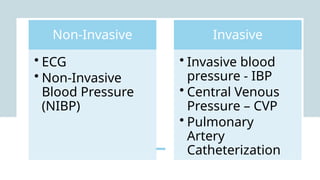
Non-Invasive
• ECG
• Non-Invasive
Blood Pressure
(NIBP)
Invasive
• Invasive blood
pressure - IBP
• Central Venous
Pressure – CVP
• Pulmonary
Artery
Catheterization
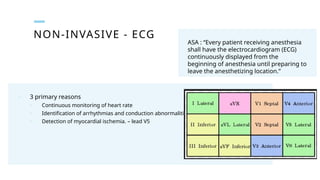
NON-INVASIVE - ECG
ASA : “Every patient receiving anesthesia
shall have the electrocardiogram (ECG)
continuously displayed from the
beginning of anesthesia until preparing to
leave the anesthetizing location.”
o 3 primary reasons
o Continuous monitoring of heart rate
o Identification of arrhythmias and conduction abnormalities – lead II
o Detection of myocardial ischemia. – lead V5
NON-INVASIVE
BLOOD PRESSURE
(NIBP)
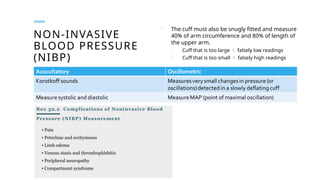
o The cuff must also be snugly fitted and measure
40% of arm circumference and 80% of length of
the upper arm.
o Cuff that is too large  falsely low readings
o Cuff that is too small  falsely high readings
INVASIVE BLOOD
PRESSURE
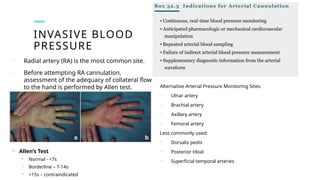
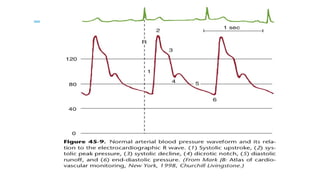
o Radial artery (RA) is the most common site.
o Before attempting RA cannulation,
assessment of the adequacy of collateral flow
to the hand is performed by Allen test. Alternative Arterial Pressure Monitoring Sites:
o Ulnar artery
o Brachial artery
o Axillary artery
o Femoral artery
Less commonly used:
 Dorsalis pedis
 Posterior tibial
 Superficial temporal arteries
 Allen’s Test
 Normal - <7s
 Borderline – 7-14s
 >15s – contraindicated
CENTRAL VENOUS
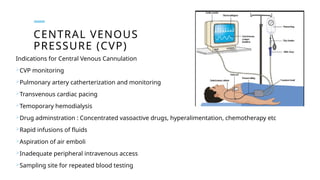
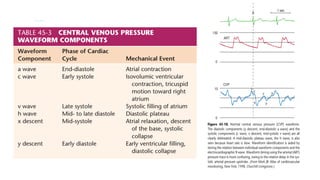
PRESSURE (CVP)
Indications for Central Venous Cannulation
CVP monitoring
Pulmonary artery catherterization and monitoring
Transvenous cardiac pacing
Temoporary hemodialysis
Drug adminstration : Concentrated vasoactive drugs, hyperalimentation, chemotherapy etc
Rapid infusions of fluids
Aspiration of air emboli
Inadequate peripheral intravenous access
Sampling site for repeated blood testing
PULMONARY ARTERY
CATHETERIZATION
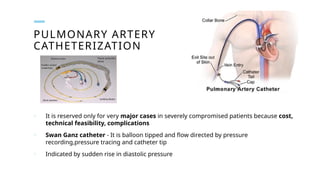
o It is reserved only for very major cases in severely compromised patients because cost,
technical feasibility, complications
o Swan Ganz catheter - It is balloon tipped and flow directed by pressure
recording,pressure tracing and catheter tip
o Indicated by sudden rise in diastolic pressure
RESPIRATORY MONITORING
Click icon to add picture
1. PULSE OXIMETRY
2. CAPNOGRAPHY
3. BLOOD GAS ANALYSIS
4. LUNG VOLUMES
5. OXYGEN ANALYSERS
6. AIRWAY PRESSURE MONITORING
7. APNEA MONITORING
PULSE OXIMETRY
Click icon to add picture
o OXYGEN SATURATION – SPO2
o NORMAL SPO2 - 97 – 98 %
o PROBE IS APPLIED AT :
o finger
o nail bed,
o toe nail bed ,
o ear lobule,
o tip of nose
o USES : DETECTION OF HYPOXIA
INTRA/POST OPERATIVE
Errors in :
• Carboxyhaemoglobinemia
• Methhemoglobinemia
• Anemia
• Hypovolemia and vasoconstriction
• Nail polish
• Shivering
• spO2 below 60%
• Skin pigmentation
• Dyes
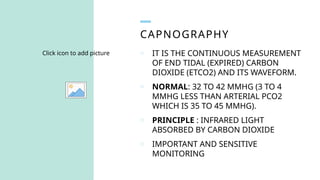
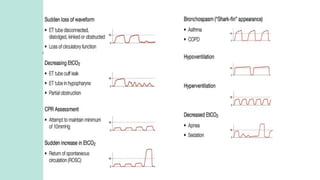
CAPNOGRAPHY
Click icon to add picture o IT IS THE CONTINUOUS MEASUREMENT
OF END TIDAL (EXPIRED) CARBON
DIOXIDE (ETCO2) AND ITS WAVEFORM.
o NORMAL: 32 TO 42 MMHG (3 TO 4
MMHG LESS THAN ARTERIAL PCO2
WHICH IS 35 TO 45 MMHG).
o PRINCIPLE : INFRARED LIGHT
ABSORBED BY CARBON DIOXIDE
o IMPORTANT AND SENSITIVE
MONITORING
Click icon to add picture
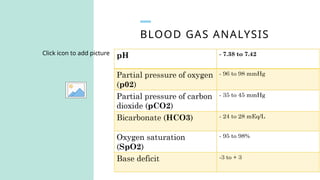
BLOOD GAS ANALYSIS
Click icon to add picture
OTHERS
Click icon to add picture
o LUNG VOLUMES – SPIROMETER
o OXYGEN ANALYSERS
o Monitor actual value oxygen delivered
o Fitted in inspiratory in limb of breathing
circuit
o Useful in closed circuit (use low flow oxygen)
o AIRWAY PRESSURE MONITORING
o It should less than 20 – 25cm H2O
o Low pressure – disconnection
o High pressure – obstruction in tube or
circuit and bronchospasm
APNEA MONITORING
(MONITORING OF RESPIRATION)
Click icon to add picture
o APNEA IS CESSATION OF RESPIRATION FOR MORE THAN 10S.
INTUBATED PATIENTS
o CAPNOGRAPHY - MOST SENSITIVE AND COST EFFECTIVE TO
DETECT APNEA
o AIRWAY PRESSURE MONITOR
NON INTUBATED PATIENTS
o MONITORING THE AIRFLOW AT NOSTRILS (ACOUSTIC PROBE)
o DETECTION OF CHEST MOVEMENTS
 Impedence plethysmography – chest is encircled by a coil
 Transthoracic impedence pulmonometery
FOR INTUBATED AND NON INTUBATED PATIENT
o PULSE OXIMETER
MONITORING BLOOD LOSS
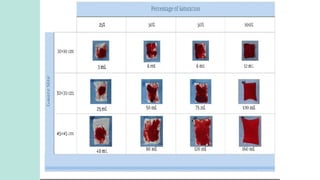
Click icon to add picture o ESTIMATION OF BLOOD LOSS IS DONE BY WEIGHING
BLOOD SOAKED SWABS, SPONGES (GRAVIMETRIC
METHOD) AND ESTIMATION OF BLOOD LOSS IN
SUCTION BOTTLE (VOLUMETRIC METHOD).
ON AN AVERAGE (A ROUGH GUIDE):
o FULLY SOAKED SWAB MEANS 20 ML OF LOSS.
o FULLY SOAKED SPONGE MEANS 100 TO 120 ML OF
LOSS.
o A FIST OF CLOTS MEANS 200 TO 300 ML OF LOSS.
Click icon to add picture
THANK YOU

Monitoring in anesthesia 1234567789.pptx

  • 1.
  • 2.
    OVERVIEW o INTRODUCTION o CARDIOVASCULAR MONITORING oRESPIRATORY MONITORING o TEMPERATURE MONITORING o NEUROMUSCULAR & CNS MONITORING
  • 3.
  • 4.
    INTRODUCTION o Monitoring isimportant to prevent complications o Not only about instrumetations o Anesthesiologists-  essential expertise and interpretations to monitoring beyond instrumentation
  • 5.
    ASA STANDARDS FORBASIC ANESTHETIC MONITORING o STANDARD I Qualified anesthesia personnel shall be present in the room throughout the conduct of all general anesthetics, regional anesthetics and monitored anesthesia care. o STANDARD II o Oxygenation o Ventilation o Circulation o Temperature
  • 6.
    BASIC MONITORING CLINICAL MONITORING 1.PULSE RATE 2. COLOR OF SKIN 3. BLOOD PRESSURE 4. INFLATION OF CHEST 5. PRECORDIAL AND ESOPHAGEAL STETHOSCOPY 6. SIGNS OF SYMPATHETIC OVER ACTIVITY 7. URINE OUTPUT (>0.5ML/MIN)
  • 7.
  • 8.
  • 9.
    Non-Invasive • ECG • Non-Invasive BloodPressure (NIBP) Invasive • Invasive blood pressure - IBP • Central Venous Pressure – CVP • Pulmonary Artery Catheterization
  • 10.
    NON-INVASIVE - ECG ASA: “Every patient receiving anesthesia shall have the electrocardiogram (ECG) continuously displayed from the beginning of anesthesia until preparing to leave the anesthetizing location.” o 3 primary reasons o Continuous monitoring of heart rate o Identification of arrhythmias and conduction abnormalities – lead II o Detection of myocardial ischemia. – lead V5
  • 11.
    NON-INVASIVE BLOOD PRESSURE (NIBP) o Thecuff must also be snugly fitted and measure 40% of arm circumference and 80% of length of the upper arm. o Cuff that is too large  falsely low readings o Cuff that is too small  falsely high readings
  • 12.
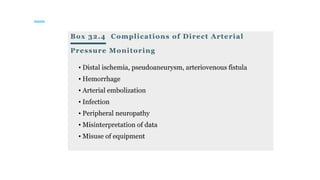
    INVASIVE BLOOD PRESSURE o Radialartery (RA) is the most common site. o Before attempting RA cannulation, assessment of the adequacy of collateral flow to the hand is performed by Allen test. Alternative Arterial Pressure Monitoring Sites: o Ulnar artery o Brachial artery o Axillary artery o Femoral artery Less commonly used:  Dorsalis pedis  Posterior tibial  Superficial temporal arteries  Allen’s Test  Normal - <7s  Borderline – 7-14s  >15s – contraindicated
  • 16.
    CENTRAL VENOUS PRESSURE (CVP) Indicationsfor Central Venous Cannulation CVP monitoring Pulmonary artery catherterization and monitoring Transvenous cardiac pacing Temoporary hemodialysis Drug adminstration : Concentrated vasoactive drugs, hyperalimentation, chemotherapy etc Rapid infusions of fluids Aspiration of air emboli Inadequate peripheral intravenous access Sampling site for repeated blood testing
  • 18.
    PULMONARY ARTERY CATHETERIZATION o Itis reserved only for very major cases in severely compromised patients because cost, technical feasibility, complications o Swan Ganz catheter - It is balloon tipped and flow directed by pressure recording,pressure tracing and catheter tip o Indicated by sudden rise in diastolic pressure
  • 19.
    RESPIRATORY MONITORING Click iconto add picture 1. PULSE OXIMETRY 2. CAPNOGRAPHY 3. BLOOD GAS ANALYSIS 4. LUNG VOLUMES 5. OXYGEN ANALYSERS 6. AIRWAY PRESSURE MONITORING 7. APNEA MONITORING
  • 20.
    PULSE OXIMETRY Click iconto add picture o OXYGEN SATURATION – SPO2 o NORMAL SPO2 - 97 – 98 % o PROBE IS APPLIED AT : o finger o nail bed, o toe nail bed , o ear lobule, o tip of nose o USES : DETECTION OF HYPOXIA INTRA/POST OPERATIVE Errors in : • Carboxyhaemoglobinemia • Methhemoglobinemia • Anemia • Hypovolemia and vasoconstriction • Nail polish • Shivering • spO2 below 60% • Skin pigmentation • Dyes
  • 21.
    CAPNOGRAPHY Click icon toadd picture o IT IS THE CONTINUOUS MEASUREMENT OF END TIDAL (EXPIRED) CARBON DIOXIDE (ETCO2) AND ITS WAVEFORM. o NORMAL: 32 TO 42 MMHG (3 TO 4 MMHG LESS THAN ARTERIAL PCO2 WHICH IS 35 TO 45 MMHG). o PRINCIPLE : INFRARED LIGHT ABSORBED BY CARBON DIOXIDE o IMPORTANT AND SENSITIVE MONITORING
  • 22.
    Click icon toadd picture
  • 23.
    BLOOD GAS ANALYSIS Clickicon to add picture
  • 24.
    OTHERS Click icon toadd picture o LUNG VOLUMES – SPIROMETER o OXYGEN ANALYSERS o Monitor actual value oxygen delivered o Fitted in inspiratory in limb of breathing circuit o Useful in closed circuit (use low flow oxygen) o AIRWAY PRESSURE MONITORING o It should less than 20 – 25cm H2O o Low pressure – disconnection o High pressure – obstruction in tube or circuit and bronchospasm
  • 25.
    APNEA MONITORING (MONITORING OFRESPIRATION) Click icon to add picture o APNEA IS CESSATION OF RESPIRATION FOR MORE THAN 10S. INTUBATED PATIENTS o CAPNOGRAPHY - MOST SENSITIVE AND COST EFFECTIVE TO DETECT APNEA o AIRWAY PRESSURE MONITOR NON INTUBATED PATIENTS o MONITORING THE AIRFLOW AT NOSTRILS (ACOUSTIC PROBE) o DETECTION OF CHEST MOVEMENTS  Impedence plethysmography – chest is encircled by a coil  Transthoracic impedence pulmonometery FOR INTUBATED AND NON INTUBATED PATIENT o PULSE OXIMETER
  • 26.
    MONITORING BLOOD LOSS Clickicon to add picture o ESTIMATION OF BLOOD LOSS IS DONE BY WEIGHING BLOOD SOAKED SWABS, SPONGES (GRAVIMETRIC METHOD) AND ESTIMATION OF BLOOD LOSS IN SUCTION BOTTLE (VOLUMETRIC METHOD). ON AN AVERAGE (A ROUGH GUIDE): o FULLY SOAKED SWAB MEANS 20 ML OF LOSS. o FULLY SOAKED SPONGE MEANS 100 TO 120 ML OF LOSS. o A FIST OF CLOTS MEANS 200 TO 300 ML OF LOSS.

  • 27.
    Click icon toadd picture
  • 28.
    Click icon toadd picture THANK YOU