A Tool Kit for Credit Union
  Leaders and Lenders
      Module Two

     DRAFT FOR REVIEW - PLEASE
         DO NOT CIRCULATE
Why do more women than men start
businesses in Canada but more men grow
them?
What barriers do women face in growing
their businesses?
How can credit union leaders and lenders
better support women to grow their
businesses?

            DRAFT FOR REVIEW - PLEASE
                DO NOT CIRCULATE
Vancity Community Foundation undertook
                   the
  Women Entrepreneurs: Financing
       Opportunities for Growth
project between 2011 – 2013 to address
             these questions.
    The project included extensive
research and a pilot project for women
           entrepreneurs.
           DRAFT FOR REVIEW - PLEASE
               DO NOT CIRCULATE
The content of this tool kit reflects what we
 learned from project participants, service
  providers and advisors about how credit
    unions in Canada can better support
 women to grow their businesses and, by
    extension, support greater economic
          activity and job creation.


             DRAFT FOR REVIEW - PLEASE
                 DO NOT CIRCULATE
Welcome to Module Two:

  Women and Reasons for
    Entrepreneurship


      DRAFT FOR REVIEW - PLEASE
          DO NOT CIRCULATE
In This Module We Will Explore
1. The three main profiles of entrepreneurs.
2. The reasons women give for becoming
   entrepreneurs.
3. How those reasons can be different from
   those stated by men.
4. How reasons for entrepreneurship are
   linked to business growth and success.

               DRAFT FOR REVIEW - PLEASE
                   DO NOT CIRCULATE
Introduction
• Why do women become entrepreneurs? Is
  there a difference between why women
  and men become entrepreneurs?
• In order to understand more about women
  entrepreneurs, it is important to know, in
  general, why men and women start
  businesses.

               DRAFT FOR REVIEW - PLEASE
                   DO NOT CIRCULATE
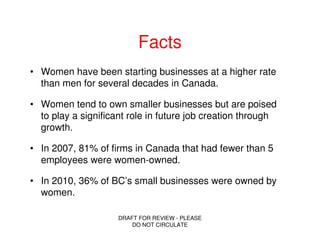
Facts
• Women have been starting businesses at a higher rate
  than men for several decades in Canada.

• Women tend to own smaller businesses but are poised
  to play a significant role in future job creation through
  growth.

• In 2007, 81% of firms in Canada that had fewer than 5
  employees were women-owned.

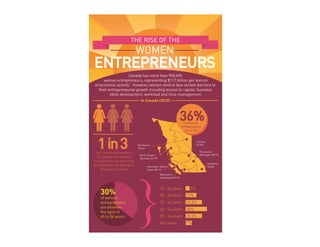
• In 2010, 36% of BC’s small businesses were owned by
  women.

                     DRAFT FOR REVIEW - PLEASE
                         DO NOT CIRCULATE
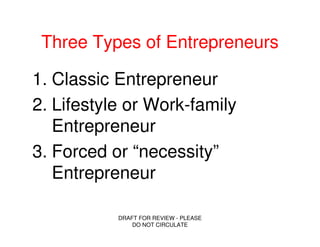
Three Types of Entrepreneurs

1. Classic Entrepreneur
2. Lifestyle or Work-family
   Entrepreneur
3. Forced or “necessity”
   Entrepreneur

           DRAFT FOR REVIEW - PLEASE
               DO NOT CIRCULATE
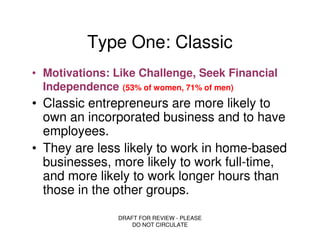
Type One: Classic
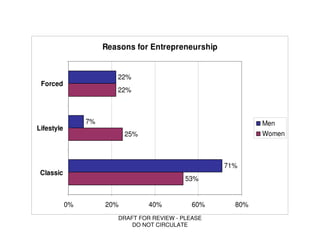
• Motivations: Like Challenge, Seek Financial
  Independence (53% of women, 71% of men)
• Classic entrepreneurs are more likely to
  own an incorporated business and to have
  employees.
• They are less likely to work in home-based
  businesses, more likely to work full-time,
  and more likely to work longer hours than
  those in the other groups.

               DRAFT FOR REVIEW - PLEASE
                   DO NOT CIRCULATE
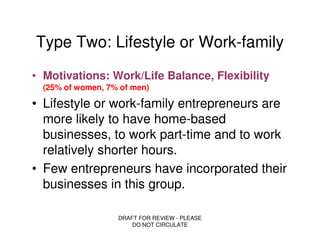
Type Two: Lifestyle or Work-family
• Motivations: Work/Life Balance, Flexibility
  (25% of women, 7% of men)

• Lifestyle or work-family entrepreneurs are
  more likely to have home-based
  businesses, to work part-time and to work
  relatively shorter hours.
• Few entrepreneurs have incorporated their
  businesses in this group.

                   DRAFT FOR REVIEW - PLEASE
                       DO NOT CIRCULATE
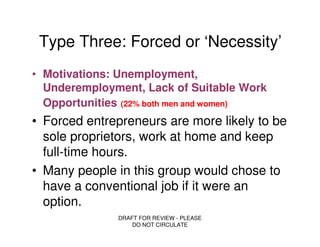
Type Three: Forced or ‘Necessity’
• Motivations: Unemployment,
  Underemployment, Lack of Suitable Work
  Opportunities (22% both men and women)
• Forced entrepreneurs are more likely to be
  sole proprietors, work at home and keep
  full-time hours.
• Many people in this group would chose to
  have a conventional job if it were an
  option.
              DRAFT FOR REVIEW - PLEASE
                  DO NOT CIRCULATE
Reasons for Entrepreneurship


                         22%
 Forced
                         22%


                 7%                                          Men
Lifestyle
                            25%                              Women


                                                     71%
 Classic
                                             53%


            0%        20%         40%          60%     80%
                         DRAFT FOR REVIEW - PLEASE
                             DO NOT CIRCULATE
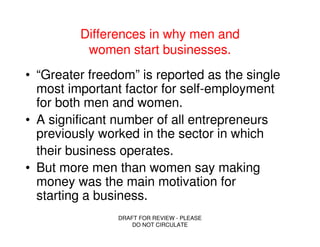
Differences in why men and
          women start businesses.
• “Greater freedom” is reported as the single
  most important factor for self-employment
  for both men and women.
• A significant number of all entrepreneurs
  previously worked in the sector in which
  their business operates.
• But more men than women say making
  money was the main motivation for
  starting a business.
                DRAFT FOR REVIEW - PLEASE
                    DO NOT CIRCULATE
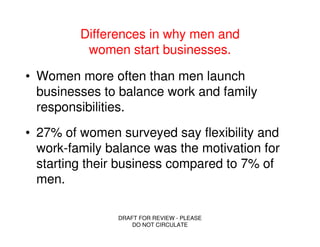
Differences in why men and
          women start businesses.

• Women more often than men launch
  businesses to balance work and family
  responsibilities.
• 27% of women surveyed say flexibility and
  work-family balance was the motivation for
  starting their business compared to 7% of
  men.

                DRAFT FOR REVIEW - PLEASE
                    DO NOT CIRCULATE
Differences in why men and
         women start businesses.
• According to a Women’s Enterprise Centre
  survey in BC in 2011, 69% of women
  surveyed mentioned “passion and self-
  fulfillment” as a primary motivation.
• Many women say they identified a need or
  niche that motivated them to start their
  business.

              DRAFT FOR REVIEW - PLEASE
                  DO NOT CIRCULATE
Different Reasons to Grow
              Business
• Motivations change over time and the top
  reason women cite to grow their business
  is to increase their income.
• According to Industry Canada, in 2007
  16% more women intended to grow their
  business than men (44% vs 38%).


              DRAFT FOR REVIEW - PLEASE
                  DO NOT CIRCULATE
In BC
• According to clients surveyed by the
  Women’s Enterprise Centre in 2011, these
  are the top three reasons given for
  business growth:
  – Higher income (66%)
  – Passion, self-fulfillment, challenge (63%)
  – Increased demand, business opportunity
    (61%)

                DRAFT FOR REVIEW - PLEASE
                    DO NOT CIRCULATE
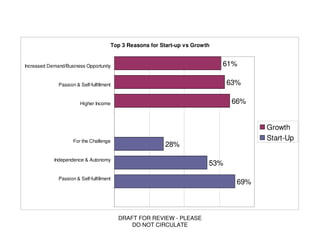
Top 3 Reasons for Start-up vs Growth


Increased Demand/Business Opportunity                                           61%

              Passion & Self-fulfillment                                          63%

                        Higher Income                                              66%


                                                                                          Growth
                     For the Challenge                                                    Start-Up
                                                            28%

            Independence & Autonomy
                                                                            53%

              Passion & Self-fulfillment
                                                                                    69%


                                           DRAFT FOR REVIEW - PLEASE
                                               DO NOT CIRCULATE
Video


DRAFT FOR REVIEW - PLEASE
    DO NOT CIRCULATE
Women entrepreneurs are more
    likely than men to:
 start out as lifestyle entrepreneurs motivated by a
 desire for independence, self-fulfillment and flexibility
 be relatively conservative when it comes to taking
 risks
 not require large amounts of start-up capital
 have smaller, more manageable businesses with
 fewer employees
 be interested in business growth but approach it
 differently than male entrepreneurs - preferring a
 ‘slow and steady’ rate of expansion

                DRAFT FOR REVIEW - PLEASE
                    DO NOT CIRCULATE
“My single piece of advice to women
 considering expanding their business
  is be sure to dream big enough, no
           dream is too big.”

 Joyce Groote, President and Chief Executive Officer of
                            Holey Soles Holdings Ltd.


                DRAFT FOR REVIEW - PLEASE
                    DO NOT CIRCULATE
Quiz
• Please click on this link to review the
  points covered in this module.
• Note to Reviewer:
  – Modules will include an optional, online quiz
    (5 to 6 questions) that will reinforce some of
    the key points made in the module.


                DRAFT FOR REVIEW - PLEASE
                    DO NOT CIRCULATE
NOTE TO REVIEWER
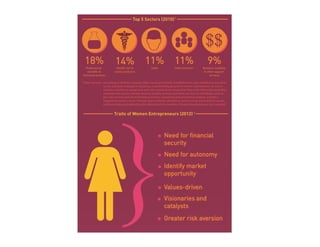
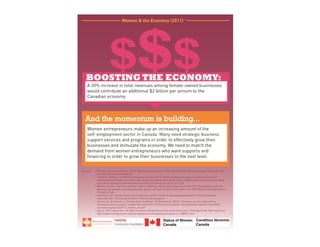
• The following three slides are an
  infographic delivering a few key facts.
• It is difficult to see in this format but will be
  readable in the final online presentation.


                 DRAFT FOR REVIEW - PLEASE
                     DO NOT CIRCULATE
DRAFT FOR REVIEW - PLEASE
    DO NOT CIRCULATE
DRAFT FOR REVIEW - PLEASE
    DO NOT CIRCULATE
DRAFT FOR REVIEW - PLEASE
    DO NOT CIRCULATE
Resources
• Websites
• Articles
• Studies


             DRAFT FOR REVIEW - PLEASE
                 DO NOT CIRCULATE
End Notes
Sources
• Hughes, Karen D. 2005. Female Enterprise in the New Economy . Toronto:
   University of Toronto Press.
• Hughes, Karen D. 2006. “Exploring motivation and success among
   Canadian women entrepreneurs.”
   Journal of Small Business and Entrepreneurship. Vol.19, Issue 2.
• Small Business Profile 2011
• Small Business BC, www.smallbusinesbc.ca
• BC Stats, wwwbcstats.gov.bc.ca
• KPMG. October 15, 2012. “Women changing the face of Canadian
   entrepreneurship”
• http://www.newswire.ca/en/story/1052491/women-changing-the-face-of-
   canadian-entrepreneurship
• CIBC World Markets, 2004. “Women Entrepreneurs: Leading the Charge”.
• Caranci, Beata and Leslie Preston, January 2012. “The Venus Vs. Mars
   Approach to Entrepreneurial Success in Canada.” TD Economics.


                        DRAFT FOR REVIEW - PLEASE
                            DO NOT CIRCULATE
Project Partners
Project partners:


This project was funded by


               DRAFT FOR REVIEW - PLEASE
                   DO NOT CIRCULATE

Module two for review (draft 8)

  • 1.
    A Tool Kitfor Credit Union Leaders and Lenders Module Two DRAFT FOR REVIEW - PLEASE DO NOT CIRCULATE
  • 2.
    Why do morewomen than men start businesses in Canada but more men grow them? What barriers do women face in growing their businesses? How can credit union leaders and lenders better support women to grow their businesses? DRAFT FOR REVIEW - PLEASE DO NOT CIRCULATE
  • 3.
    Vancity Community Foundationundertook the Women Entrepreneurs: Financing Opportunities for Growth project between 2011 – 2013 to address these questions. The project included extensive research and a pilot project for women entrepreneurs. DRAFT FOR REVIEW - PLEASE DO NOT CIRCULATE
  • 4.
    The content ofthis tool kit reflects what we learned from project participants, service providers and advisors about how credit unions in Canada can better support women to grow their businesses and, by extension, support greater economic activity and job creation. DRAFT FOR REVIEW - PLEASE DO NOT CIRCULATE
  • 5.
    Welcome to ModuleTwo: Women and Reasons for Entrepreneurship DRAFT FOR REVIEW - PLEASE DO NOT CIRCULATE
  • 6.
    In This ModuleWe Will Explore 1. The three main profiles of entrepreneurs. 2. The reasons women give for becoming entrepreneurs. 3. How those reasons can be different from those stated by men. 4. How reasons for entrepreneurship are linked to business growth and success. DRAFT FOR REVIEW - PLEASE DO NOT CIRCULATE
  • 7.
    Introduction • Why dowomen become entrepreneurs? Is there a difference between why women and men become entrepreneurs? • In order to understand more about women entrepreneurs, it is important to know, in general, why men and women start businesses. DRAFT FOR REVIEW - PLEASE DO NOT CIRCULATE
  • 8.
    Facts • Women havebeen starting businesses at a higher rate than men for several decades in Canada. • Women tend to own smaller businesses but are poised to play a significant role in future job creation through growth. • In 2007, 81% of firms in Canada that had fewer than 5 employees were women-owned. • In 2010, 36% of BC’s small businesses were owned by women. DRAFT FOR REVIEW - PLEASE DO NOT CIRCULATE
  • 9.
    Three Types ofEntrepreneurs 1. Classic Entrepreneur 2. Lifestyle or Work-family Entrepreneur 3. Forced or “necessity” Entrepreneur DRAFT FOR REVIEW - PLEASE DO NOT CIRCULATE
  • 10.
    Type One: Classic •Motivations: Like Challenge, Seek Financial Independence (53% of women, 71% of men) • Classic entrepreneurs are more likely to own an incorporated business and to have employees. • They are less likely to work in home-based businesses, more likely to work full-time, and more likely to work longer hours than those in the other groups. DRAFT FOR REVIEW - PLEASE DO NOT CIRCULATE
  • 11.
    Type Two: Lifestyleor Work-family • Motivations: Work/Life Balance, Flexibility (25% of women, 7% of men) • Lifestyle or work-family entrepreneurs are more likely to have home-based businesses, to work part-time and to work relatively shorter hours. • Few entrepreneurs have incorporated their businesses in this group. DRAFT FOR REVIEW - PLEASE DO NOT CIRCULATE
  • 12.
    Type Three: Forcedor ‘Necessity’ • Motivations: Unemployment, Underemployment, Lack of Suitable Work Opportunities (22% both men and women) • Forced entrepreneurs are more likely to be sole proprietors, work at home and keep full-time hours. • Many people in this group would chose to have a conventional job if it were an option. DRAFT FOR REVIEW - PLEASE DO NOT CIRCULATE
  • 13.
    Reasons for Entrepreneurship 22% Forced 22% 7% Men Lifestyle 25% Women 71% Classic 53% 0% 20% 40% 60% 80% DRAFT FOR REVIEW - PLEASE DO NOT CIRCULATE
  • 14.
    Differences in whymen and women start businesses. • “Greater freedom” is reported as the single most important factor for self-employment for both men and women. • A significant number of all entrepreneurs previously worked in the sector in which their business operates. • But more men than women say making money was the main motivation for starting a business. DRAFT FOR REVIEW - PLEASE DO NOT CIRCULATE
  • 15.
    Differences in whymen and women start businesses. • Women more often than men launch businesses to balance work and family responsibilities. • 27% of women surveyed say flexibility and work-family balance was the motivation for starting their business compared to 7% of men. DRAFT FOR REVIEW - PLEASE DO NOT CIRCULATE
  • 16.
    Differences in whymen and women start businesses. • According to a Women’s Enterprise Centre survey in BC in 2011, 69% of women surveyed mentioned “passion and self- fulfillment” as a primary motivation. • Many women say they identified a need or niche that motivated them to start their business. DRAFT FOR REVIEW - PLEASE DO NOT CIRCULATE
  • 17.
    Different Reasons toGrow Business • Motivations change over time and the top reason women cite to grow their business is to increase their income. • According to Industry Canada, in 2007 16% more women intended to grow their business than men (44% vs 38%). DRAFT FOR REVIEW - PLEASE DO NOT CIRCULATE
  • 18.
    In BC • Accordingto clients surveyed by the Women’s Enterprise Centre in 2011, these are the top three reasons given for business growth: – Higher income (66%) – Passion, self-fulfillment, challenge (63%) – Increased demand, business opportunity (61%) DRAFT FOR REVIEW - PLEASE DO NOT CIRCULATE
  • 19.
    Top 3 Reasonsfor Start-up vs Growth Increased Demand/Business Opportunity 61% Passion & Self-fulfillment 63% Higher Income 66% Growth For the Challenge Start-Up 28% Independence & Autonomy 53% Passion & Self-fulfillment 69% DRAFT FOR REVIEW - PLEASE DO NOT CIRCULATE
  • 20.
    Video DRAFT FOR REVIEW- PLEASE DO NOT CIRCULATE
  • 21.
    Women entrepreneurs aremore likely than men to: start out as lifestyle entrepreneurs motivated by a desire for independence, self-fulfillment and flexibility be relatively conservative when it comes to taking risks not require large amounts of start-up capital have smaller, more manageable businesses with fewer employees be interested in business growth but approach it differently than male entrepreneurs - preferring a ‘slow and steady’ rate of expansion DRAFT FOR REVIEW - PLEASE DO NOT CIRCULATE
  • 22.
    “My single pieceof advice to women considering expanding their business is be sure to dream big enough, no dream is too big.” Joyce Groote, President and Chief Executive Officer of Holey Soles Holdings Ltd. DRAFT FOR REVIEW - PLEASE DO NOT CIRCULATE
  • 23.
    Quiz • Please clickon this link to review the points covered in this module. • Note to Reviewer: – Modules will include an optional, online quiz (5 to 6 questions) that will reinforce some of the key points made in the module. DRAFT FOR REVIEW - PLEASE DO NOT CIRCULATE
  • 24.
    NOTE TO REVIEWER •The following three slides are an infographic delivering a few key facts. • It is difficult to see in this format but will be readable in the final online presentation. DRAFT FOR REVIEW - PLEASE DO NOT CIRCULATE
  • 25.
    DRAFT FOR REVIEW- PLEASE DO NOT CIRCULATE
  • 26.
    DRAFT FOR REVIEW- PLEASE DO NOT CIRCULATE
  • 27.
    DRAFT FOR REVIEW- PLEASE DO NOT CIRCULATE
  • 28.
    Resources • Websites • Articles •Studies DRAFT FOR REVIEW - PLEASE DO NOT CIRCULATE
  • 29.
    End Notes Sources • Hughes,Karen D. 2005. Female Enterprise in the New Economy . Toronto: University of Toronto Press. • Hughes, Karen D. 2006. “Exploring motivation and success among Canadian women entrepreneurs.” Journal of Small Business and Entrepreneurship. Vol.19, Issue 2. • Small Business Profile 2011 • Small Business BC, www.smallbusinesbc.ca • BC Stats, wwwbcstats.gov.bc.ca • KPMG. October 15, 2012. “Women changing the face of Canadian entrepreneurship” • http://www.newswire.ca/en/story/1052491/women-changing-the-face-of- canadian-entrepreneurship • CIBC World Markets, 2004. “Women Entrepreneurs: Leading the Charge”. • Caranci, Beata and Leslie Preston, January 2012. “The Venus Vs. Mars Approach to Entrepreneurial Success in Canada.” TD Economics. DRAFT FOR REVIEW - PLEASE DO NOT CIRCULATE
  • 30.
    Project Partners Project partners: Thisproject was funded by DRAFT FOR REVIEW - PLEASE DO NOT CIRCULATE