Climate
Climate means theusual condition
of the temperature, humidity,
atmospheric pressure, wind, rainfall,
and other meteorological elements
in an area of the Earth's surface for a
long time.
4.
What is ClimateChange?
Climate change refers to significant, long-
term changes in the global climate.
5.
Pollutants
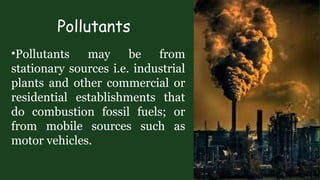
•Pollutants may befrom
stationary sources i.e. industrial
plants and other commercial or
residential establishments that
do combustion fossil fuels; or
from mobile sources such as
motor vehicles.
6.
•Primary pollutants arethose that are emitted directly into
the air from a source, such as smokestacks, vehicles, and
industrial facilities. Some examples of primary pollutants
include:
•Carbon monoxide: A colorless, odorless gas that is produced
by the incomplete combustion of fuels. It can cause health
problems such as headaches, dizziness, and nausea.
•Sulfur dioxide: A gas that is produced when sulfur-containing
fuels are burned. It can cause respiratory problems such as
asthma and bronchitis.
•Nitrogen oxides: A group of gases that are produced when
nitrogen and oxygen in the air react at high temperatures. They
can cause respiratory problems such as asthma and bronchitis,
and they can also contribute to acid rain.
•Particulate matter: A mixture of solid particles and liquid
droplets that are suspended in the air. They can be harmful to
health, and they can also reduce visibility.
7.
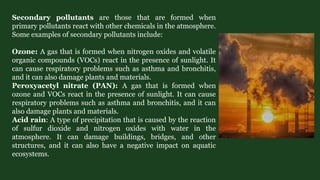
Secondary pollutants arethose that are formed when
primary pollutants react with other chemicals in the atmosphere.
Some examples of secondary pollutants include:
Ozone: A gas that is formed when nitrogen oxides and volatile
organic compounds (VOCs) react in the presence of sunlight. It
can cause respiratory problems such as asthma and bronchitis,
and it can also damage plants and materials.
Peroxyacetyl nitrate (PAN): A gas that is formed when
ozone and VOCs react in the presence of sunlight. It can cause
respiratory problems such as asthma and bronchitis, and it can
also damage plants and materials.
Acid rain: A type of precipitation that is caused by the reaction
of sulfur dioxide and nitrogen oxides with water in the
atmosphere. It can damage buildings, bridges, and other
structures, and it can also have a negative impact on aquatic
ecosystems.
Global Warming
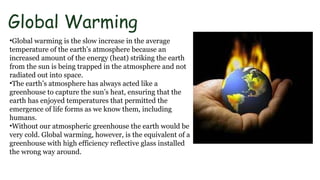
•Global warmingis the slow increase in the average
temperature of the earth’s atmosphere because an
increased amount of the energy (heat) striking the earth
from the sun is being trapped in the atmosphere and not
radiated out into space.
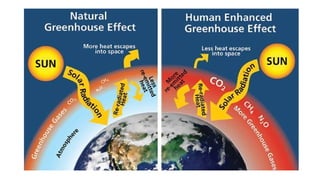
•The earth’s atmosphere has always acted like a
greenhouse to capture the sun’s heat, ensuring that the
earth has enjoyed temperatures that permitted the
emergence of life forms as we know them, including
humans.
•Without our atmospheric greenhouse the earth would be
very cold. Global warming, however, is the equivalent of a
greenhouse with high efficiency reflective glass installed
the wrong way around.
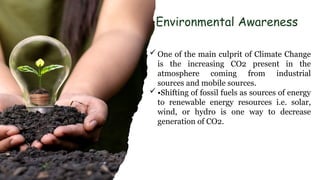
Environmental Awareness
Oneof the main culprit of Climate Change
is the increasing CO2 present in the
atmosphere coming from industrial
sources and mobile sources.
•Shifting of fossil fuels as sources of energy
to renewable energy resources i.e. solar,
wind, or hydro is one way to decrease
generation of CO2.
14.
Since theenvironment is contiguous, the
responsibilities should also be shared not only locally,
regionally and even globally.
•Countries come together to come up with different
protocols and agreements so as to help each other
solve Climate Change.
•Kyoto Protocol is an international agreement linked to
the United Nations Framework Convention on Climate
Change where the Philippines is one of the signatories.
•Commits each signatory or member by setting
internationally binding emission reduction targets
•Adopted in 1997 but the first commitment period
started in 2008 and ended in 2012
•Countries committed to cut by 2% their CO2
emissions until 2050 to help in solving the problem on
Climate Change
•Estimated that by 2050, the world will have an
approximate 80% reduction on CO2 emissions
#3 Greenhouse gases include carbon dioxide, methane, nitrous oxide and other gases that accumulate in the atmosphere and create the heat-reflective layer that keeps the Earth at a livable temperature. These gases form the insulation that keeps the planet warm enough to support life.
Some of the most common — and worrisome — greenhouse gases are:
Carbon dioxide, which is emitted whenever coal, oil, natural gas and other carbon-rich fossil fuels are burned. Although carbon dioxide is not the most powerful greenhouse gas, it is the largest contributor to climate change because it is so common. In order to reduce carbon dioxide emissions, we need to reduce the amount of fuel we use in our cars, homes, and lives.
Methane is caused by the decomposition of plant matter, and is released from landfills, swamps, rice paddies. Cattle also release methane. Although methane emissions are lower than carbon dioxide emissions, it is considered a major greenhouse gas because each methane molecule has 25 times the global warming potential of a carbon dioxide molecule.
Nitrous oxide is released from bacteria in soil. Modern agricultural practices — tilling and soil cultivation, livestock waste management, and the use of nitrogen-rich fertilizers — contribute significantly to nitrous oxide emissions. A single nitrous oxide molecule has 298 times the global warming potential of a carbon dioxide molecule.
Additional greenhouse gases include hydrofluorocarbons (1,430-14,800 time the global warming potential of carbon dioxide), sulfur hexafluoride (22,800 times the global warming potential of carbon dioxide), and water vapor.
#4 Climate change refers to long-term shifts in temperatures and weather patterns, mainly caused by human activities, especially the burning of fossil fuels, which emit heat-trapping greenhouse gases into the atmosphere. These gases include carbon dioxide (CO2), methane (CH4), and nitrous oxide (N2O).
#6 Particulate matter (PM): PM is a mixture of solid and liquid particles found in the air. It can be emitted from a variety of sources, including vehicles, power plants, and industrial facilities. PM can cause respiratory problems, heart disease, and cancer.
Nitrogen oxides (NOx): NOx is a group of gases that are formed when nitrogen and oxygen combine in the atmosphere. NOx can be emitted from a variety of sources, including vehicles, power plants, and industrial facilities. NOx can cause respiratory problems and contribute to acid rain.
Sulfur oxides (SOx): SOx is a group of gases that are formed when sulfur and oxygen combine in the atmosphere. SOx can be emitted from a variety of sources, including power plants, industrial facilities, and volcanoes. SOx can cause respiratory problems and contribute to acid rain.
Volatile organic compounds (VOCs): VOCs are a group of chemicals that are easily evaporated into the atmosphere. VOCs can be emitted from a variety of sources, including vehicles, industrial facilities, and paints and solvents. VOCs can contribute to smog formation and respiratory problems.
Carbon monoxide (CO): CO is a colorless, odorless, and tasteless gas that is formed when carbon in fuel is not burned completely. CO can be emitted from a variety of sources, including vehicles, power plants, and industrial facilities. CO can cause headache, dizziness, and nausea, and can be fatal in high concentrations.
#7 Primary and secondary pollutants can have a significant impact on the environment and human health. They can cause respiratory problems, damage ecosystems, and contribute to climate change.
#8 To understand the term global warming, you just have to look at the individual words. Global means it's happening around the globe, and warming means it's getting hotter. Put them together and global warming is the heating up of the Earth’s surface over time.
Reasons Behind Global Warming
Global warming is increasing at a rapid rate because of humans. They are adding CO2 to the atmosphere creating a shield that keeps heat in, called the greenhouse effect. As humans burn fossil fuels, like coal and petroleum, the CO2 and other greenhouse gases create a barrier making the sun's rays stay on Earth. With nowhere to go, the sun rays heat up the Earth.
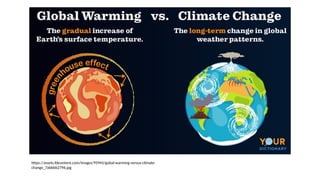
to understand what climate change means, you just need to dissect the phrase. Climate is the average weather a place has, while change is something outside the usual pattern. So, climate change means the usual weather patterns of a place are changing. Since climate change can include global warming, it’s easy to get them confused. But the major difference between global warming and climate change is climate change can be caused by two different factors: humans and nature.
#9 Global warming refers to the ongoing increase in Earth's average surface temperature. Since the pre-industrial period (between 1850 and 1900), human activities are estimated to have increased Earth's global average temperature by about 1 degree Celsius (1.8 degrees Fahrenheit), a number that is currently increasing by more than 0.2 degrees Celsius (0.36 degrees Fahrenheit) per decade.
#10 Global warming is primarily caused by human activities, especially the burning of fossil fuels, which release heat-trapping greenhouse gases into the atmosphere. These gases include carbon dioxide (CO2), methane (CH4), and nitrous oxide (N2O).
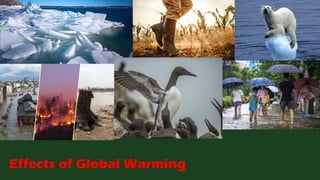
#11 The effects of global warming are already being felt around the world, and they are expected to become more severe in the future. These effects include:
Rising sea levels: As the Earth warms, glaciers and ice sheets are melting, causing sea levels to rise. This is threatening coastal communities around the world.
More extreme weather events: Global warming is making extreme weather events, such as heat waves, droughts, floods, and wildfires, more frequent and severe.
Changes in plant and animal life: Global warming is causing plants and animals to migrate to cooler climates. This is disrupting ecosystems and threatening biodiversity.
There is still time to take action to address global warming and mitigate its effects. This will require a global effort to reduce greenhouse gas emissions and transition to clean energy sources.
Individuals can also take action to reduce their own carbon footprint. This includes:
Driving less and walking, biking, or taking public transportation more often.
Conserving energy at home by using energy-efficient appliances and turning off lights when not in use.
Eating less meat and more plant-based foods.
Recycling and composting.
#12
Environmental awareness is the understanding that the environment is a fragile and interconnected system that is essential for human health and well-being. It is also the recognition that human activities have a significant impact on the environment and that we have a responsibility to protect it.
Why is environmental awareness important?
Environmental awareness is important because it helps us to understand the impact of our actions on the planet. When we are aware of the consequences of our choices, we are more likely to make decisions that are beneficial for the environment.
Environmental awareness can also help us to find solutions to environmental problems. By understanding the root causes of these problems, we can develop effective strategies to address them.
Environmental awareness is also important for our own health and well-being. The environment provides us with a number of essential resources, such as clean air and water, food, and shelter. When we damage the environment, we are also damaging our own health.
How can we increase environmental awareness?
There are many things we can do to increase environmental awareness. Some of the most important include:
Educating ourselves about environmental issues. There are a wealth of resources available to help us learn about the environment, including books, websites, and documentaries.
Making changes to our own lifestyles. There are many simple things we can do to reduce our impact on the environment, such as recycling, conserving energy, and using less water.
Supporting environmental organizations. There are many organizations working to protect the environment. We can support these organizations by donating money, volunteering our time, or simply spreading the word about their work.