Mid-Continent Research for
Education and Learning (McREL)
Teacher Evaluation Standards
ROSELLE M. BELTRAN, PhD
Subject Teacher
Mid-Continent Research for
Education and Learning (McREL)
Teacher Evaluation Standards
Standard 1 includes leadership in the
classroom, school and profession,
ethical standards and advocacy.
Standard 2 includes providing a
nurturing environment, embracing
diversity, individualizing and
adapting instruction and
communicating with families.
Mid-Continent Research for Education
and Learning (McREL) Teacher
Evaluation Standards
• Standard 3 includes content
knowledge, alignment of instruction
to standards, recognizing
interconnections, and making
instruction relevant to students.
• Standard 4 includes understanding
how children develop and learn,
planning appropriate instruction,
using a variety of learning materials,
integrating technology, and
developing critical thinking.
Mid-Continent Research for
Education and Learning (McREL)
Teacher Evaluation Standards
Standard 5 includes reflecting on
practice, analyzing learning,
professionalism and professional
development, and effective
institutional functioning.
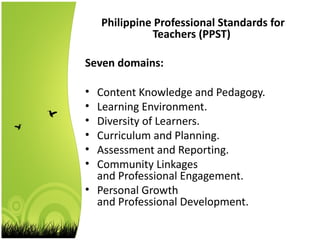
Philippine Professional Standards for
Teachers (PPST)
Seven domains:
• Content Knowledge and Pedagogy.
• Learning Environment.
• Diversity of Learners.
• Curriculum and Planning.
• Assessment and Reporting.
• Community Linkages
and Professional Engagement.
• Personal Growth
and Professional Development.
Philippine Professional Standards for
Teachers (PPST)
Domain 1 states that teachers must
recognize the importance of mastery of
content knowledge and its
interconnectedness within and across
curriculum areas, coupled with a sound
and critical understanding of the
application of theories and principles of
teaching and learning. They apply
developmentally appropriate and
meaningful pedagogy grounded on
content knowledge and current research.
Philippine Professional Standards for
Teachers (PPST)
Domain 2 indicates that teachers must
provide learning environments that are
safe, secure, fair and supportive in order
to promote learner responsibility and
achievement. They create an environment
that is learning- focused and they
efficiently manage learner behavior in a
physical and virtual space. They utilize a
range of resources and provide
intellectually challenging and stimulating
activities to encourage constructive
classroom interactions geared towards the
attainment of high standards of learning.
Philippine Professional Standards for
Teachers (PPST)
Domain 3 shows that teachers must be
able to establish learning environments
that are responsive to learner diversity.
They respect learner’s diverse
characteristics and experiences as inputs
to the planning and design of learning
opportunities. They encourage the
celebration of diversity in the classroom
and the need for teaching practices that
are differentiated to encourage all
learners to be successful citizens in a
changing local and global environment.
Philippine Professional Standards for Teachers
(PPST)
Domain 4 mentions that teachers must know
how to interact with the national and local
curriculum requirements. They translate
curriculum content into learning activities that
are relevant to learners and based on the
principles of effective teaching and learning.
They apply their professional knowledge to
plan and design, individually or in collaboration
with colleagues, well-structured and
sequenced lessons that are contextually
relevant, responsive to learners’ needs and
incorporate a range of teaching and learning
resources. They communicate learning goals to
support learner participation, understanding
and achievement.
Philippine Professional Standards for
Teachers (PPST)
Domain 5 specifies that teachers must
apply a variety of assessment tools and
strategies in monitoring, evaluating,
documenting and reporting learners’
needs, progress and achievement. They
use assessment data in a variety of ways
to inform and enhance the teaching and
learning process and programs. They
provide learners with the necessary
feedback about learning outcomes that
inform the reporting cycle and enables
teachers to select, organize, and use
sound assessment processes.
Philippine Professional Standards for
Teachers (PPST)
Domain 6 stresses that teacher must be
able to establish school-community
partnerships aimed at enriching the
learning environment, as well as the
community’s engagement in the
educative process. They identify and
respond to opportunities that link
teaching and learning in the classroom
to the experiences, interests and
aspirations of the wider school
community and other key stakeholders.
Philippine Professional Standards for
Teachers (PPST)
Domain 7 emphasizes that teachers must
value personal growth and professional
development and exhibit high personal
regard for the profession by maintaining
qualities that uphold the dignity of
teaching such as caring attitude, respect
and integrity. They value personal and
professional reflection and learning to
improve their practice. They assume
responsibility for personal growth and
professional development for lifelong
learning.
Thank You!!!
Thank You!!!

Module-2for_educationhahaujioowppmmkokmm

  • 1.
    Mid-Continent Research for Educationand Learning (McREL) Teacher Evaluation Standards ROSELLE M. BELTRAN, PhD Subject Teacher
  • 2.
    Mid-Continent Research for Educationand Learning (McREL) Teacher Evaluation Standards Standard 1 includes leadership in the classroom, school and profession, ethical standards and advocacy. Standard 2 includes providing a nurturing environment, embracing diversity, individualizing and adapting instruction and communicating with families.
  • 3.
    Mid-Continent Research forEducation and Learning (McREL) Teacher Evaluation Standards • Standard 3 includes content knowledge, alignment of instruction to standards, recognizing interconnections, and making instruction relevant to students. • Standard 4 includes understanding how children develop and learn, planning appropriate instruction, using a variety of learning materials, integrating technology, and developing critical thinking.
  • 4.
    Mid-Continent Research for Educationand Learning (McREL) Teacher Evaluation Standards Standard 5 includes reflecting on practice, analyzing learning, professionalism and professional development, and effective institutional functioning.
  • 5.
    Philippine Professional Standardsfor Teachers (PPST) Seven domains: • Content Knowledge and Pedagogy. • Learning Environment. • Diversity of Learners. • Curriculum and Planning. • Assessment and Reporting. • Community Linkages and Professional Engagement. • Personal Growth and Professional Development.
  • 6.
    Philippine Professional Standardsfor Teachers (PPST) Domain 1 states that teachers must recognize the importance of mastery of content knowledge and its interconnectedness within and across curriculum areas, coupled with a sound and critical understanding of the application of theories and principles of teaching and learning. They apply developmentally appropriate and meaningful pedagogy grounded on content knowledge and current research.
  • 7.
    Philippine Professional Standardsfor Teachers (PPST) Domain 2 indicates that teachers must provide learning environments that are safe, secure, fair and supportive in order to promote learner responsibility and achievement. They create an environment that is learning- focused and they efficiently manage learner behavior in a physical and virtual space. They utilize a range of resources and provide intellectually challenging and stimulating activities to encourage constructive classroom interactions geared towards the attainment of high standards of learning.
  • 8.
    Philippine Professional Standardsfor Teachers (PPST) Domain 3 shows that teachers must be able to establish learning environments that are responsive to learner diversity. They respect learner’s diverse characteristics and experiences as inputs to the planning and design of learning opportunities. They encourage the celebration of diversity in the classroom and the need for teaching practices that are differentiated to encourage all learners to be successful citizens in a changing local and global environment.
  • 9.
    Philippine Professional Standardsfor Teachers (PPST) Domain 4 mentions that teachers must know how to interact with the national and local curriculum requirements. They translate curriculum content into learning activities that are relevant to learners and based on the principles of effective teaching and learning. They apply their professional knowledge to plan and design, individually or in collaboration with colleagues, well-structured and sequenced lessons that are contextually relevant, responsive to learners’ needs and incorporate a range of teaching and learning resources. They communicate learning goals to support learner participation, understanding and achievement.
  • 10.
    Philippine Professional Standardsfor Teachers (PPST) Domain 5 specifies that teachers must apply a variety of assessment tools and strategies in monitoring, evaluating, documenting and reporting learners’ needs, progress and achievement. They use assessment data in a variety of ways to inform and enhance the teaching and learning process and programs. They provide learners with the necessary feedback about learning outcomes that inform the reporting cycle and enables teachers to select, organize, and use sound assessment processes.
  • 11.
    Philippine Professional Standardsfor Teachers (PPST) Domain 6 stresses that teacher must be able to establish school-community partnerships aimed at enriching the learning environment, as well as the community’s engagement in the educative process. They identify and respond to opportunities that link teaching and learning in the classroom to the experiences, interests and aspirations of the wider school community and other key stakeholders.
  • 12.
    Philippine Professional Standardsfor Teachers (PPST) Domain 7 emphasizes that teachers must value personal growth and professional development and exhibit high personal regard for the profession by maintaining qualities that uphold the dignity of teaching such as caring attitude, respect and integrity. They value personal and professional reflection and learning to improve their practice. They assume responsibility for personal growth and professional development for lifelong learning.
  • 13.