Eva M. Bajade
WHAT IS A PROGRAM CYCLE?
Module 2 : Project& ProgramCycle EvaM. Bajade
A program cycle is a series
of steps that your program
repeats until an end-of-file
condition is reached.
(www.ibm.com)
WHAT IS A PROGRAM CYCLE?
Module 2 : Project& ProgramCycle EvaM. Bajade
It provides a more strategic and evidence-
based approach to justifying resources and serves
as the basis for a more integrated budget cycle,
ensuring that resource decisions are built around
strategic plans and priorities and performance and
evaluation data.
( https://pdf.usaid.gov>PDACS774 )
WHAT IS A PROGRAM CYCLE?
Module 2 : Project& ProgramCycle EvaM. Bajade
It is an operational model for
planning, implementing, assessing
and adapting.
( USAID )
4 PHASES OF PROJECT LIFE CYCLE
Module 2 : Project& ProgramCycle EvaM. Bajade
1. The Project Initiation Stage
2. The Project Planning Stage
3. The Project Execution Stage
4. The Project Closure Stage
4 PHASES OF PROJECT LIFE CYCLE
Module 2 : Project& ProgramCycle EvaM. Bajade
The Project Initiation Stage:
understand the goals, priorities,
deadlines, and risks of the project
4 PHASES OF PROJECT LIFE CYCLE
Module 2 : Project& ProgramCycle EvaM. Bajade
The Project Planning Stage:
outline the tasks and timeline
required to execute on the project
4 PHASES OF PROJECT LIFE CYCLE
Module 2 : Project& ProgramCycle EvaM. Bajade
The Project Execution Stage:
turn your plan into action and
monitor project performance
4 PHASES OF PROJECT LIFE CYCLE
Module 2 : Project& ProgramCycle EvaM. Bajade
The Project Closure Stage:
analyze results, summarize key
learnings, and plan next steps
PROGRAMME CYCLE MANAGEMENT
Module 2 : Project& ProgramCycle EvaM. Bajade
The Program Life Cycle predominantly
resembles the project management lifecycle. The
fundamental difference is that while program
management aims at dealing with results and gains
and its value to the organization, project
management aims at delivering products on time
and obtaining customer satisfaction.
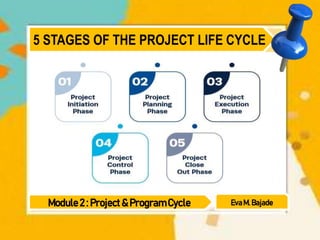
5 STAGES OF THE PROJECT LIFE CYCLE
Module 2 : Project& ProgramCycle EvaM. Bajade
5 STAGES OF THE PROJECT LIFE CYCLE
Module 2 : Project& ProgramCycle EvaM. Bajade
1. Project Initiation Phase
The first phase in the
project management life cycle is
the initiation phase. This phase
is the starting point for all
projects when we need to make a
positive decision about the
objectives we need to achieve.
5 STAGES OF THE PROJECT LIFE CYCLE
Module 2 : Project& ProgramCycle EvaM. Bajade
2. Project Planning Phase
This phase of the project is
essentially the plan that tells you where
you are supposed to be in the first place.
Without a plan, you have no idea if you
are doing okay or not. If you have no
plan, you have no control. You need to
know – How long will it take? – How
much will it cost? – What must be done?
5 STAGES OF THE PROJECT LIFE CYCLE
Module 2 : Project& ProgramCycle EvaM. Bajade
3. Project Execution Phase
In the execution phase, work
begins on implementing the project
plan. This means putting it into
action as soon as possible. The
famous quote “Procrastination is the
thief of time” holds very true for
project execution.
5 STAGES OF THE PROJECT LIFE CYCLE
Module 2 : Project& ProgramCycle EvaM. Bajade
4. Project Control Phase
In the previous, execution
phase, the process had started and
now in this project management life
cycle phase, the focus is on monitoring
the processes as the work is
performed. Typically, control is the day-
to-day effort of project managers to
keep project works on track.
5 STAGES OF THE PROJECT LIFE CYCLE
Module 2 : Project& ProgramCycle EvaM. Bajade
5. Project Close Out Phase
Project closure is defined as the
learning stage of a project. In this
phase of a project, we collect and store
data on our successes and
shortcomings. This ensures that we do
not continue to find ourselves following
the same predictable path to failure.
STAGES OF A PROJECT
Module 2 : Project& ProgramCycle EvaM. Bajade
1. Determine the Project Goals and Objectives
The first step in the project planning phase is to
define the goals and objectives of your project.
Project goals and objectives help you decide if the
project should be prioritized (or even undertaken—essentially
you need to use a proof of concept).
They also assist you in deciding what to deliver to the
client and in identifying problems early on, e.g., a short
deadline.
STAGES OF A PROJECT
Module 2 : Project& ProgramCycle EvaM. Bajade
2. Determine the Project Scope
Stakeholders often request extra tasks or
significant changes in direction (sometimes several of
them) during a project that could derail it.
Your project scope protects you from unrealistic
expectations, conflicting interests, and unattainable
demands as the project progresses.
STAGES OF A PROJECT
Module 2 : Project& ProgramCycle EvaM. Bajade
3. Build Your Work Breakdown Structure (WBS)
At this stage, start determining which tasks, subtasks,
and deliverables must be carried out to complete the project.
You can do this by referring to your scope and creating a work
breakdown structure—a structured decomposition of tasks
needed to complete a project.
In his book Project Management for Humans, Brett Harned
emphasizes the importance of work breakdown structure: "Creating a work
breakdown structure for any plan or set of tasks helps you get granular
about the work that needs to be done on any given project."
STAGES OF A PROJECT
Module 2 : Project& ProgramCycle EvaM. Bajade
4. Set Timelines
Now that you have individual tasks created,
you can set timelines for each activity.
Project timelines help you estimate the completion
date and keep things on track.
Timelines are usually plotted on a Gantt chart
or in a resource management tool like Float.
STAGES OF A PROJECT
Module 2 : Project& ProgramCycle EvaM. Bajade
5. Determine and Plan Resources
For a project to succeed, you need the right people
and resources.
The resource planning process in project
management involves a lot of project assumptions and
making estimates.
But from the past steps—especially your WBS,
scope, and goals—you should have a rough idea of what
resources you need.
STAGES OF A PROJECT
Module 2 : Project& ProgramCycle EvaM. Bajade
6. Estimate Costs
One of the challenges in the project planning
process is balancing your budget with your
stakeholders' desire to save money.
However, if you underestimate costs, you
might find yourself without funds in the middle of the
project.
STAGES OF A PROJECT
Module 2 : Project& ProgramCycle EvaM. Bajade
6. Estimate Costs
To approximate the cost of the project, you can use:
Ballpark estimation:
What do you think the entire project will cost based on
project objectives and client expectations? This is not an
exact figure. It could cost less or more, so let your clients
know. Use this method when you need to give a cost
estimate before determining things like your WBS or
resources.
STAGES OF A PROJECT
Module 2 : Project& ProgramCycle EvaM. Bajade
6. Estimate Costs
To approximate the cost of the project, you can use:
Parametric estimation:
Use historical data in your resource management
tool and the cost of variables to estimate costs. Turn your
WBS into a cost breakdown structure. You can take the
prices of a unit of labor, such as a mason working at $23 an
hour, and multiply it by the amount of time the project will
take.
STAGES OF A PROJECT
Module 2 : Project& ProgramCycle EvaM. Bajade
7. Determine risks and constraints
No project exists without risks or constraints.
The key to avoiding a project failure is identifying the
potential pitfalls and creating an action plan to handle
them.
One way to properly prepare is to create a risk
register—a document that lists all of the potential risks
and information about them. Also, include an action
plan to counter each project risk in your risk register.
STAGES OF A PROJECT
Module 2 : Project& ProgramCycle EvaM. Bajade
8. Plan Out Communication
Creating a communication blueprint is
essential in developing a project plan. "No
matter what role you’re playing on a project,
if you’re not making a strong effort to
communicate with your team, you will likely
fail," says Harned.
STAGES OF A PROJECT
Module 2 : Project& ProgramCycle EvaM. Bajade
9. Make Plans for Quality Control and
Assurance
Planning for project quality control involves
providing guidelines for managing, assuring, and
maintaining standards within the project.
Without a plan, it will be very tough to achieve
your desired results.
You might end up with a slow e-commerce
website or a leaky plumbing system!
PROJECT MANAGEMENT LIFE CYCLE
Module 2 : Project& ProgramCycle EvaM. Bajade
The project management life cycle is
a step-by-step framework of best practices
used to monitor a project from its beginning
to its end.
It provides project managers with a
structured way to create, execute and
finish a project. (www.coursera.org)
PROJECT MANAGEMENT LIFE CYCLE
Module 2 : Project& ProgramCycle EvaM. Bajade
The project management life cycle
provides structure to the execution of
project delivery.
It helps project teams ensure both
client deliverables and employee needs
are met throughout the project
management process. (blog.bigtime.net)
That is all.
Module 2 : Project& ProgramCycle EvaM. Bajade
Thank You
for Listening!

Module 2 Project & Program Management Cycle.pptx

  • 1.
  • 2.
    WHAT IS APROGRAM CYCLE? Module 2 : Project& ProgramCycle EvaM. Bajade A program cycle is a series of steps that your program repeats until an end-of-file condition is reached. (www.ibm.com)
  • 3.
    WHAT IS APROGRAM CYCLE? Module 2 : Project& ProgramCycle EvaM. Bajade It provides a more strategic and evidence- based approach to justifying resources and serves as the basis for a more integrated budget cycle, ensuring that resource decisions are built around strategic plans and priorities and performance and evaluation data. ( https://pdf.usaid.gov>PDACS774 )
  • 4.
    WHAT IS APROGRAM CYCLE? Module 2 : Project& ProgramCycle EvaM. Bajade It is an operational model for planning, implementing, assessing and adapting. ( USAID )
  • 5.
    4 PHASES OFPROJECT LIFE CYCLE Module 2 : Project& ProgramCycle EvaM. Bajade 1. The Project Initiation Stage 2. The Project Planning Stage 3. The Project Execution Stage 4. The Project Closure Stage
  • 6.
    4 PHASES OFPROJECT LIFE CYCLE Module 2 : Project& ProgramCycle EvaM. Bajade The Project Initiation Stage: understand the goals, priorities, deadlines, and risks of the project
  • 7.
    4 PHASES OFPROJECT LIFE CYCLE Module 2 : Project& ProgramCycle EvaM. Bajade The Project Planning Stage: outline the tasks and timeline required to execute on the project
  • 8.
    4 PHASES OFPROJECT LIFE CYCLE Module 2 : Project& ProgramCycle EvaM. Bajade The Project Execution Stage: turn your plan into action and monitor project performance
  • 9.
    4 PHASES OFPROJECT LIFE CYCLE Module 2 : Project& ProgramCycle EvaM. Bajade The Project Closure Stage: analyze results, summarize key learnings, and plan next steps
  • 10.
    PROGRAMME CYCLE MANAGEMENT Module2 : Project& ProgramCycle EvaM. Bajade The Program Life Cycle predominantly resembles the project management lifecycle. The fundamental difference is that while program management aims at dealing with results and gains and its value to the organization, project management aims at delivering products on time and obtaining customer satisfaction.
  • 11.
    5 STAGES OFTHE PROJECT LIFE CYCLE Module 2 : Project& ProgramCycle EvaM. Bajade
  • 12.
    5 STAGES OFTHE PROJECT LIFE CYCLE Module 2 : Project& ProgramCycle EvaM. Bajade 1. Project Initiation Phase The first phase in the project management life cycle is the initiation phase. This phase is the starting point for all projects when we need to make a positive decision about the objectives we need to achieve.
  • 13.
    5 STAGES OFTHE PROJECT LIFE CYCLE Module 2 : Project& ProgramCycle EvaM. Bajade 2. Project Planning Phase This phase of the project is essentially the plan that tells you where you are supposed to be in the first place. Without a plan, you have no idea if you are doing okay or not. If you have no plan, you have no control. You need to know – How long will it take? – How much will it cost? – What must be done?
  • 14.
    5 STAGES OFTHE PROJECT LIFE CYCLE Module 2 : Project& ProgramCycle EvaM. Bajade 3. Project Execution Phase In the execution phase, work begins on implementing the project plan. This means putting it into action as soon as possible. The famous quote “Procrastination is the thief of time” holds very true for project execution.
  • 15.
    5 STAGES OFTHE PROJECT LIFE CYCLE Module 2 : Project& ProgramCycle EvaM. Bajade 4. Project Control Phase In the previous, execution phase, the process had started and now in this project management life cycle phase, the focus is on monitoring the processes as the work is performed. Typically, control is the day- to-day effort of project managers to keep project works on track.
  • 16.
    5 STAGES OFTHE PROJECT LIFE CYCLE Module 2 : Project& ProgramCycle EvaM. Bajade 5. Project Close Out Phase Project closure is defined as the learning stage of a project. In this phase of a project, we collect and store data on our successes and shortcomings. This ensures that we do not continue to find ourselves following the same predictable path to failure.
  • 17.
    STAGES OF APROJECT Module 2 : Project& ProgramCycle EvaM. Bajade 1. Determine the Project Goals and Objectives The first step in the project planning phase is to define the goals and objectives of your project. Project goals and objectives help you decide if the project should be prioritized (or even undertaken—essentially you need to use a proof of concept). They also assist you in deciding what to deliver to the client and in identifying problems early on, e.g., a short deadline.
  • 18.
    STAGES OF APROJECT Module 2 : Project& ProgramCycle EvaM. Bajade 2. Determine the Project Scope Stakeholders often request extra tasks or significant changes in direction (sometimes several of them) during a project that could derail it. Your project scope protects you from unrealistic expectations, conflicting interests, and unattainable demands as the project progresses.
  • 19.
    STAGES OF APROJECT Module 2 : Project& ProgramCycle EvaM. Bajade 3. Build Your Work Breakdown Structure (WBS) At this stage, start determining which tasks, subtasks, and deliverables must be carried out to complete the project. You can do this by referring to your scope and creating a work breakdown structure—a structured decomposition of tasks needed to complete a project. In his book Project Management for Humans, Brett Harned emphasizes the importance of work breakdown structure: "Creating a work breakdown structure for any plan or set of tasks helps you get granular about the work that needs to be done on any given project."
  • 20.
    STAGES OF APROJECT Module 2 : Project& ProgramCycle EvaM. Bajade 4. Set Timelines Now that you have individual tasks created, you can set timelines for each activity. Project timelines help you estimate the completion date and keep things on track. Timelines are usually plotted on a Gantt chart or in a resource management tool like Float.
  • 21.
    STAGES OF APROJECT Module 2 : Project& ProgramCycle EvaM. Bajade 5. Determine and Plan Resources For a project to succeed, you need the right people and resources. The resource planning process in project management involves a lot of project assumptions and making estimates. But from the past steps—especially your WBS, scope, and goals—you should have a rough idea of what resources you need.
  • 22.
    STAGES OF APROJECT Module 2 : Project& ProgramCycle EvaM. Bajade 6. Estimate Costs One of the challenges in the project planning process is balancing your budget with your stakeholders' desire to save money. However, if you underestimate costs, you might find yourself without funds in the middle of the project.
  • 23.
    STAGES OF APROJECT Module 2 : Project& ProgramCycle EvaM. Bajade 6. Estimate Costs To approximate the cost of the project, you can use: Ballpark estimation: What do you think the entire project will cost based on project objectives and client expectations? This is not an exact figure. It could cost less or more, so let your clients know. Use this method when you need to give a cost estimate before determining things like your WBS or resources.
  • 24.
    STAGES OF APROJECT Module 2 : Project& ProgramCycle EvaM. Bajade 6. Estimate Costs To approximate the cost of the project, you can use: Parametric estimation: Use historical data in your resource management tool and the cost of variables to estimate costs. Turn your WBS into a cost breakdown structure. You can take the prices of a unit of labor, such as a mason working at $23 an hour, and multiply it by the amount of time the project will take.
  • 25.
    STAGES OF APROJECT Module 2 : Project& ProgramCycle EvaM. Bajade 7. Determine risks and constraints No project exists without risks or constraints. The key to avoiding a project failure is identifying the potential pitfalls and creating an action plan to handle them. One way to properly prepare is to create a risk register—a document that lists all of the potential risks and information about them. Also, include an action plan to counter each project risk in your risk register.
  • 26.
    STAGES OF APROJECT Module 2 : Project& ProgramCycle EvaM. Bajade 8. Plan Out Communication Creating a communication blueprint is essential in developing a project plan. "No matter what role you’re playing on a project, if you’re not making a strong effort to communicate with your team, you will likely fail," says Harned.
  • 27.
    STAGES OF APROJECT Module 2 : Project& ProgramCycle EvaM. Bajade 9. Make Plans for Quality Control and Assurance Planning for project quality control involves providing guidelines for managing, assuring, and maintaining standards within the project. Without a plan, it will be very tough to achieve your desired results. You might end up with a slow e-commerce website or a leaky plumbing system!
  • 28.
    PROJECT MANAGEMENT LIFECYCLE Module 2 : Project& ProgramCycle EvaM. Bajade The project management life cycle is a step-by-step framework of best practices used to monitor a project from its beginning to its end. It provides project managers with a structured way to create, execute and finish a project. (www.coursera.org)
  • 29.
    PROJECT MANAGEMENT LIFECYCLE Module 2 : Project& ProgramCycle EvaM. Bajade The project management life cycle provides structure to the execution of project delivery. It helps project teams ensure both client deliverables and employee needs are met throughout the project management process. (blog.bigtime.net)
  • 30.
    That is all. Module2 : Project& ProgramCycle EvaM. Bajade Thank You for Listening!