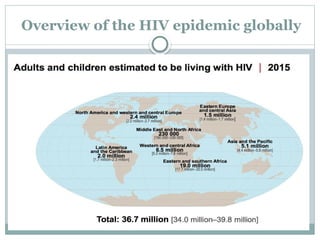
Overview of theHIV epidemic globally…..cnt’d
Globally 36.7 million people living with HIV in 2015, up from 33.3 million
in 2010
Globally prevalence (the percent of people ages 15-49 who are infected)
has levelled since 2001 and was 0.8% in 2015.
In 2015, globally 1.1 million people died of AIDS a 45% decrease since its
peak in 2005.
The decline due in part to antiretroviral treatment (ART) scale up
although HIV and AIDS remain the leading cause of death in SSA
About 2.1 million new infections in 2015 or about 5,700 new infections
per day. While there have been significant declines in new infections since
the mid-199os, new infections among adults have failed to decline over the
past 5 years and incidence is rising in some regions.
4.
Overview of theHIV epidemic globally…..cnt’d
Most infections are transmitted heterosexually, although
risk factors vary.
Although HIV testing capacity has increased over time,
enabling more people to learn their HIV status, about 4 in
10 of people with HIV are still unaware they are infected.
Women represent half (51%) of all adults living with HIV
worldwide. HIV is the leading cause of death among women
of reproductive age.
Gender inequalities, differential access to service, and
sexual violence increase women’s vulnerability to HIV, and
women, especially younger women, are biologically more
susceptible to HIV.
5.
Overview of theHIV epidemic globally…..cnt’d
Young people, ages 15-24, account for approximately 35% of new HIV
infections. In sub-Saharan Africa, young women 15-24 account for 25% of
all new HIV infections among adults, even though they represent only 17%
of the adult population.
Globally, there were 1.8 million children living with HIV, 110,000 AIDS-
related deaths, and 150,000 new infections among children in 2015. Since
2001, new HIV infections among children have declined by more than
70%.
In 2015, World Health Organisation (WHO) reported that r that only 54%
of people with HIV knew their status.
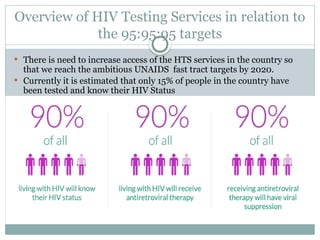
To reach 90:90:90 goals, it is critical that HIV testing services be
strategically expanded to diagnose as many people with HIV as early as
possible.
6.
HIV EPIDEMIC INSOUTH SUDAN
Country has generalized HIV epidemic with a prevalence
of 1.9% and 164,453 people estimated to be living with HIV
including adults and children (South Sudan 2023 GARPR
Report).
HIV prevalence is high in the three Equatorial states:
Eastern, Central and Western Equatoria and also along the
country’s southern region, accounting for 60% of new HIV
infections.
According to the latest Modes of Transmission study (MoT,
2013), sex workers, their clients, and peri-natal
transmission (Mother-to-Child Transmission), account for
7 out of every 1o new HIV infections.
7.
HIV EPIDEMIC INSOUTH SUDAN
HIV prevalence is higher among the key populations than in the
general population.
The HIV treatment response need to be adapted to the country’s
context which is characterized by civil war, high number of
returnees and internally displaced persons (IDPs) facing
humanitarian crisis and refugees.
A large population including PLHIV face food insecurity and its
potential impact on adherence to ARVs and OI medications.
Access to life-saving ARVs may be challenging particularly among
refugees residing in the neighbouring countries and among the
internally displaced communities.
8.
HIV EPIDEMIC INSOUTH SUDAN
Home work: go read on the National Response to
the AIDS Epidemic page 7 and 8 of the Trainers
Manual
Policy response (Read page 8)
In order for the country to reach the 95.95.95 fast
track targets there is need to strengthen HIV
Testing Services through PITC
9.
Overview of HIVTesting Services in relation to
the 95:95:95 targets
There is need to increase access of the HTS services in the country so
that we reach the ambitious UNAIDS fast tract targets by 2020.
Currently it is estimated that only 15% of people in the country have
been tested and know their HIV Status
10.
Overview of HIVTesting Services in Relation to
the 95:95:95 targets
To achieve the 2nd
and 3rd
90s, there is need to
expand HTS coverage strategically among
populations in greatest need to increase access to
services.
11.
HTS Means……..
Theterm HIV Testing Services (HTS) is used to embrace the
full range of services that must be offered with HIV testing.
These include:- counseling (pre-test information and post-
test counseling): linkages to appropriate HIV prevention,
treatment, care, other clinical and support services.
Also includes oordination with laboratory services to support
quality assurance and delivery of correct and accurate
results.
12.
THE NEXTSESSION IS ON UNDERSTANDING HIV,
AIDS AND THE IMMUNE SYSTEM (PART 2)
Thank you




![2014_HIV_prevention_and_control[1].pptx](https://cdn.slidesharecdn.com/ss_thumbnails/2014hivpreventionandcontrol1-220810084127-bc7e0dd9-thumbnail.jpg?width=640&height=640&fit=bounds)


![ONFH[AVN HIP] -TRIPLE REGIME -A NOVAL SURGICAL CONCEPT .pptx](https://cdn.slidesharecdn.com/ss_thumbnails/onfhavnhip2026koaconcalicutdrgokuldevdrmashraf-260210064517-213ec005-thumbnail.jpg?width=640&height=640&fit=bounds)
![PERI-PROSTHETIC FRACTURE NAIL-PLATE CONSTRUCT [NPC].pptx](https://cdn.slidesharecdn.com/ss_thumbnails/drarunkumardrmohamedashrafperiprostheticfrasturenail-plateconstructnpc-260209164459-7e9d15a1-thumbnail.jpg?width=640&height=640&fit=bounds)


