ETHICAL CONFLICT
Hello Learners !!
Welcome to the session on
Ethical Conflict
Ms. Sonali Sharma
Assistant Professor
Department of Business Administration,
School of Business & Commerce, FoMC,
Manipal University Jaipur
Email ID: sonali.sharma@jaipur.manipal.edu
ETHICAL CONFLICT
Contents
Introduction to Ethics
Definition of Ethics
Meaning of Ethics
Importance of Ethics
Meaning of Ethical Conflict
Ends and Means
Character and Intentions
Tests for Decision Making
Summary
Reference Books
ETHICAL CONFLICT
Learning Objectives
At the end of this session, you will be able to:
Understand the meaning and importance of
ethics.
Acquaint with the concept of ethical conflict.
Understand the concept of ends and means &
character and intentions.
Understand the application of various tests for
decision-making.
The word “ethics” is derived from the
Greek word ethos (character), and from
the Latin word ‘mores’ (customers).
Derived from the Greek word “ethos”
which means “way of living”, ethics is a
branch of philosophy that is concerned
with human conduct.
It consists in a code of conduct of human
beings living in a society.
ETHICAL CONFLICT
Introduction to Ethics
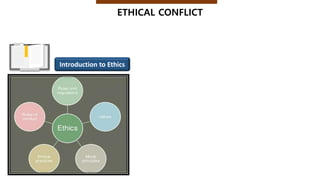
Ethics is an attempt to guide human conduct
and it is also an attempt to help man in leading
good life by applying moral principles.
Ethics refers to well based standards of right
and wrong that prescribe what human ought
to do, usually in terms of right, obligations,
benefits to society, fairness, or specific virtues.
Ethics is related to issues of propriety,
rightness and wrongness.
ETHICAL CONFLICT
Introduction to Ethics
ETHICAL CONFLICT
Introduction to Ethics
Mackenzie defines ethics as “the
study of what is right or good in
human conduct” or the “science of
the ideal involved in human life.” So,
ethics is the study which determines
rightness or wrongness of actions.
Wheelwright (1959), “ethics is that
branch of philosophy which is
systematic study of reflective choice,
of the standards of right and wrong
by which it is to be guided, and of the
goods toward which it may ultimately
be directed.”
ETHICAL CONFLICT
Definition of Ethics
ETHICAL CONFLICT
Meaning of Ethics
 Ethics is simply the notion of knowing right from
wrong. Basically, it means “do unto others as you
would have them do unto you.” Ethics is often used
interchangeably with morality, but they are two
different concepts.
 Ethics is not, however, the study of what people do or
how people act. This is descriptive, not normative.
Ethics is normative; about what ought to be, not
what is so.
 Ethics, is sometimes known as philosophical ethics,
ethical theory, moral theory, and moral philosophy, is
a branch of philosophy that involves systematizing,
defensing and recommending concepts of right and
wrong conduct, often addressing disputes of moral
diversity.
 Ethics provides us with the tools to determine
whether we should do a certain action and the extent
to which a past action should have been done.
It assists in availing legal representation to
all in the society.
It spells out the minimum standards of
practice.
Enhances public confidence in any given
profession.
It builds loyalty between the organization
and client.
Ethics provides the guideline on how to act
in cases of conflict of interests.
It assists in the protection of fundamental
human interests like life, liberty and
property.
ETHICAL CONFLICT
Importance of Ethics
Ethical conflicts arise when individuals are
confronted with a collision between general
belief systems about morality, ethics or justice
and their own personal situations.
Right and wrong are not always perfectly clear,
and some situations involve choosing between
two “evils,” where, perhaps, the ethical decision
might result in personal or social injury or
where an individual stands to gain from an
unethical decision.
Such conflicts could take place at the individual,
professional, or societal level.
ETHICAL CONFLICT
Meaning of Ethical Conflict
Ethical conflicts often involve the question
whether ends justify their means.
In one example, doing what is “morally
right” can create a negative outcome,
while doing what is “morally wrong” or
immoral can create a positive outcome.
Individuals, groups or states must evaluate
which is the more ethical choice given
these considerations.
Further, the moral position could be
substantiated or not substantiated in fact.
ETHICAL CONFLICT
Ends and Means
One viewpoint states that a person’s
character and intentions must be taken
into consideration when evaluating beliefs
and actions during ethical conflict.
For example, someone who is an
inherently “good person” might be
forgiven an ethical lapse if he feels
remorseful or conflicted about his actions
under duress.
However, someone who is an inherently
“bad person” could face less empathy and
compassion for taking the same action if
he does not feel remorseful afterward.
ETHICAL CONFLICT
Character and Intentions
Individuals can apply various tests during
ethical conflicts to make the best decision.
For example, the “publicity test” asks
whether a person would mind if her
decisions were broadcast on the evening
news.
The “role model test” asks whether a person
would mind if her role model knew of her
actions or decisions.
The “golden rule test” asks whether a
person would mind being affected by her
decision in the same way that others might
be.
ETHICAL CONFLICT
Tests for Decision-Making
Summary
Ethics is an attempt to guide human conduct and
it is also an attempt to help man in leading good
life by applying moral principles.
Ethics provides the guideline on how to act in
cases of conflict of interests.
Ethical conflicts arise when individuals are
confronted with a collision between general belief
systems about morality, ethics or justice and their
own personal situations.
Ethical conflicts often involve the question
whether ends justify their means.
One viewpoint states that a person’s character
and intentions must be taken into consideration
when evaluating beliefs and actions during ethical
conflict.
Individuals can apply various tests during ethical
conflicts to make the best decision.
ETHICAL CONFLICT
Reference Books
• R.1 Gaur R.R., Sangal R. and. Bagaria, G.P: ”A
Foundation Course in Human Values Professional
Ethics,” Excel Books, 2010
• R.2 Sadri S & Sadri, J Business Excellence Through
Ethics & Governance, 2nd edition, 2015
• R.3 Mathur, U C Corporate Governance and business
ethics, MacMillan India Ltd, Latest Edition
• R.4 Baxi, C V: Corporate Governance, Excel Books,
Latest Edition
• R.5 Sadri S, Sinha A K and Bonnerjee, P: Business
Ethics: concepts and cases, TMH, Latest Edition
ETHICAL CONFLICT

#13 Ethical Conflict.pptx conflict ethical

  • 1.
    ETHICAL CONFLICT Hello Learners!! Welcome to the session on Ethical Conflict Ms. Sonali Sharma Assistant Professor Department of Business Administration, School of Business & Commerce, FoMC, Manipal University Jaipur Email ID: sonali.sharma@jaipur.manipal.edu
  • 2.
    ETHICAL CONFLICT Contents Introduction toEthics Definition of Ethics Meaning of Ethics Importance of Ethics Meaning of Ethical Conflict Ends and Means Character and Intentions Tests for Decision Making Summary Reference Books
  • 3.
    ETHICAL CONFLICT Learning Objectives Atthe end of this session, you will be able to: Understand the meaning and importance of ethics. Acquaint with the concept of ethical conflict. Understand the concept of ends and means & character and intentions. Understand the application of various tests for decision-making.
  • 4.
    The word “ethics”is derived from the Greek word ethos (character), and from the Latin word ‘mores’ (customers). Derived from the Greek word “ethos” which means “way of living”, ethics is a branch of philosophy that is concerned with human conduct. It consists in a code of conduct of human beings living in a society. ETHICAL CONFLICT Introduction to Ethics
  • 5.
    Ethics is anattempt to guide human conduct and it is also an attempt to help man in leading good life by applying moral principles. Ethics refers to well based standards of right and wrong that prescribe what human ought to do, usually in terms of right, obligations, benefits to society, fairness, or specific virtues. Ethics is related to issues of propriety, rightness and wrongness. ETHICAL CONFLICT Introduction to Ethics
  • 6.
  • 7.
    Mackenzie defines ethicsas “the study of what is right or good in human conduct” or the “science of the ideal involved in human life.” So, ethics is the study which determines rightness or wrongness of actions. Wheelwright (1959), “ethics is that branch of philosophy which is systematic study of reflective choice, of the standards of right and wrong by which it is to be guided, and of the goods toward which it may ultimately be directed.” ETHICAL CONFLICT Definition of Ethics
  • 8.
    ETHICAL CONFLICT Meaning ofEthics  Ethics is simply the notion of knowing right from wrong. Basically, it means “do unto others as you would have them do unto you.” Ethics is often used interchangeably with morality, but they are two different concepts.  Ethics is not, however, the study of what people do or how people act. This is descriptive, not normative. Ethics is normative; about what ought to be, not what is so.  Ethics, is sometimes known as philosophical ethics, ethical theory, moral theory, and moral philosophy, is a branch of philosophy that involves systematizing, defensing and recommending concepts of right and wrong conduct, often addressing disputes of moral diversity.  Ethics provides us with the tools to determine whether we should do a certain action and the extent to which a past action should have been done.
  • 9.
    It assists inavailing legal representation to all in the society. It spells out the minimum standards of practice. Enhances public confidence in any given profession. It builds loyalty between the organization and client. Ethics provides the guideline on how to act in cases of conflict of interests. It assists in the protection of fundamental human interests like life, liberty and property. ETHICAL CONFLICT Importance of Ethics
  • 10.
    Ethical conflicts arisewhen individuals are confronted with a collision between general belief systems about morality, ethics or justice and their own personal situations. Right and wrong are not always perfectly clear, and some situations involve choosing between two “evils,” where, perhaps, the ethical decision might result in personal or social injury or where an individual stands to gain from an unethical decision. Such conflicts could take place at the individual, professional, or societal level. ETHICAL CONFLICT Meaning of Ethical Conflict
  • 11.
    Ethical conflicts ofteninvolve the question whether ends justify their means. In one example, doing what is “morally right” can create a negative outcome, while doing what is “morally wrong” or immoral can create a positive outcome. Individuals, groups or states must evaluate which is the more ethical choice given these considerations. Further, the moral position could be substantiated or not substantiated in fact. ETHICAL CONFLICT Ends and Means
  • 12.
    One viewpoint statesthat a person’s character and intentions must be taken into consideration when evaluating beliefs and actions during ethical conflict. For example, someone who is an inherently “good person” might be forgiven an ethical lapse if he feels remorseful or conflicted about his actions under duress. However, someone who is an inherently “bad person” could face less empathy and compassion for taking the same action if he does not feel remorseful afterward. ETHICAL CONFLICT Character and Intentions
  • 13.
    Individuals can applyvarious tests during ethical conflicts to make the best decision. For example, the “publicity test” asks whether a person would mind if her decisions were broadcast on the evening news. The “role model test” asks whether a person would mind if her role model knew of her actions or decisions. The “golden rule test” asks whether a person would mind being affected by her decision in the same way that others might be. ETHICAL CONFLICT Tests for Decision-Making
  • 14.
    Summary Ethics is anattempt to guide human conduct and it is also an attempt to help man in leading good life by applying moral principles. Ethics provides the guideline on how to act in cases of conflict of interests. Ethical conflicts arise when individuals are confronted with a collision between general belief systems about morality, ethics or justice and their own personal situations. Ethical conflicts often involve the question whether ends justify their means. One viewpoint states that a person’s character and intentions must be taken into consideration when evaluating beliefs and actions during ethical conflict. Individuals can apply various tests during ethical conflicts to make the best decision. ETHICAL CONFLICT
  • 15.
    Reference Books • R.1Gaur R.R., Sangal R. and. Bagaria, G.P: ”A Foundation Course in Human Values Professional Ethics,” Excel Books, 2010 • R.2 Sadri S & Sadri, J Business Excellence Through Ethics & Governance, 2nd edition, 2015 • R.3 Mathur, U C Corporate Governance and business ethics, MacMillan India Ltd, Latest Edition • R.4 Baxi, C V: Corporate Governance, Excel Books, Latest Edition • R.5 Sadri S, Sinha A K and Bonnerjee, P: Business Ethics: concepts and cases, TMH, Latest Edition ETHICAL CONFLICT