Session Objectives
Session Outline
• What is Media and
Information Literacy?
• What is the difference between
Data and Information?
• What are the forms of Media
and Information Literacies?
• What are the Characteristics of
Media and Information
Literate Individuals?
01INTRODUCTION TO MEDIA AND
INFORMATION LITERACY
LECTURE SESSION
Media and Info Literacy
MEDIA AND INFORMATION LITERACY is a set of
competencies that empowers citizens to access,
retrieve, understand, evaluate, use, create, and share
information and media content CRITICALLY,
ETHICALLY, and EFFECTIVELY.
It is considered as an essential and fundamental skill
for both digital natives, immigrants, and aliens.
Terminologies
MEDIA pertains to the means and resources being used for creating,
delivering, sharing, and processing information.
INFORMATION is a broad term that covers processed data and knowledge
derived from study, experience, instruction, signals, or symbols.
LITERACY is the ability to identify, understand, interpret, create,
communicate, and compute using written or unwritten materials
associated with varying contexts.
TECHNOLOGY pertains to synthesized tools that serve to apply knowledge
or technique to perform tasks and obtain results.
Media
• Print Media (Newspapers,
Magazines, Books, Journals,
Comics, Brochures)
• Broadcast Media (Television,
Radio, Satellites, Mobile
Phones, Films)
• Digital Media (Internet,
Social Media, Computers)
Media
MEDIA is the source of credible information where
content is provided through an editorial process
determined by journalistic values and where editorial
accountability can be attributed to an organization or
legal person (obsolete definition).
MEDIA is any object (physical or not) that serves as a
source or channel for information (current definition).
Purposes of Media
• acts as channels of information and knowledge
• facilitates informed debates between diverse social actors
• serves as means by which the society learns about itself and
builds a sense of community
• functions as a watchdog of the government by promoting
transparency in public life and public scrutiny of those with power
• acts as facilitator of democratic processes
Data and Information
Generated in absurdly large quantities each
day, DATA refers to facts, figures, and
values. INFORMATION, on the other hand,
is when these data are processed and
translated into something meaningful or
significant.
Data and Information
For instance, the records and
values of gas liters you pump
and load each morning are
data. When you process these
to identify that you are
spending x amount of money
on gas alone and conclude that
you are overspending, these
become information.
Technology
Digital technology or ‘new media’
commonly pertains to the Internet (the
global system of interconnected computer
networks). It is one of the most valuable
innovations in the 20th
century.
Literacy
Basically, literacy is the ability to read, write, speak, and
listen in a way that lets individuals communicate effectively.
In the context of media and information literacy (MIL),
literacy refers to an individuals ability to receive, assess,
process, share, and create information effectively, ethically,
and properly for the purpose of expressing oneself,
interacting with others, and contributing to society.
Media Literacy
Media literacy is the ability to access, analyze,
evaluate, and create media in a variety of
forms. It aims to empower citizens by providing
them with the necessary competencies
(knowledge and skills) to engage with traditional
media and new technologies.
Information Literacy
Information literacy is the ability to recognize
when information is needed, as well as locate,
evaluate, and effectively communicate
information in its various formats.
Technology Literacy
Technology literacy is the ability of an individual
to use technological tools responsibly,
appropriately, and effectively. With these tools,
an individual can access, manage, integrate,
evaluate, create, and communicate information.
Media and Info Literacy
Media and information literacy is a set of
essential skills and competencies that allow
individuals to engage with media and other
information providers effectively, as well as
develop critical thinking and life-long learning
skills to socialize and become active citizens.
Media and
Information Literate
Individuals
INDEPENDENT
MEDIA AND
INFORMATION
LITERATE
INDIVIDUAL
Independent
Media and information literate
individuals can independently
process digital or printed texts
of varying complexity, discuss
and elaborate ideas with others,
and understand and apply
conventions of vocabulary and
grammar while applying
learning strategies.
CONTENT
KNOWLEDGE
MEDIA AND
INFORMATION
LITERATE
INDIVIDUAL
Knowledgeable
These individuals acquire,
process, share, and translate
deep information about their
fields. They can discuss and
elaborate on discipline-specific
texts and become experts on
their fields.
MEDIA AND
INFORMATION
LITERATE
INDIVIDUAL
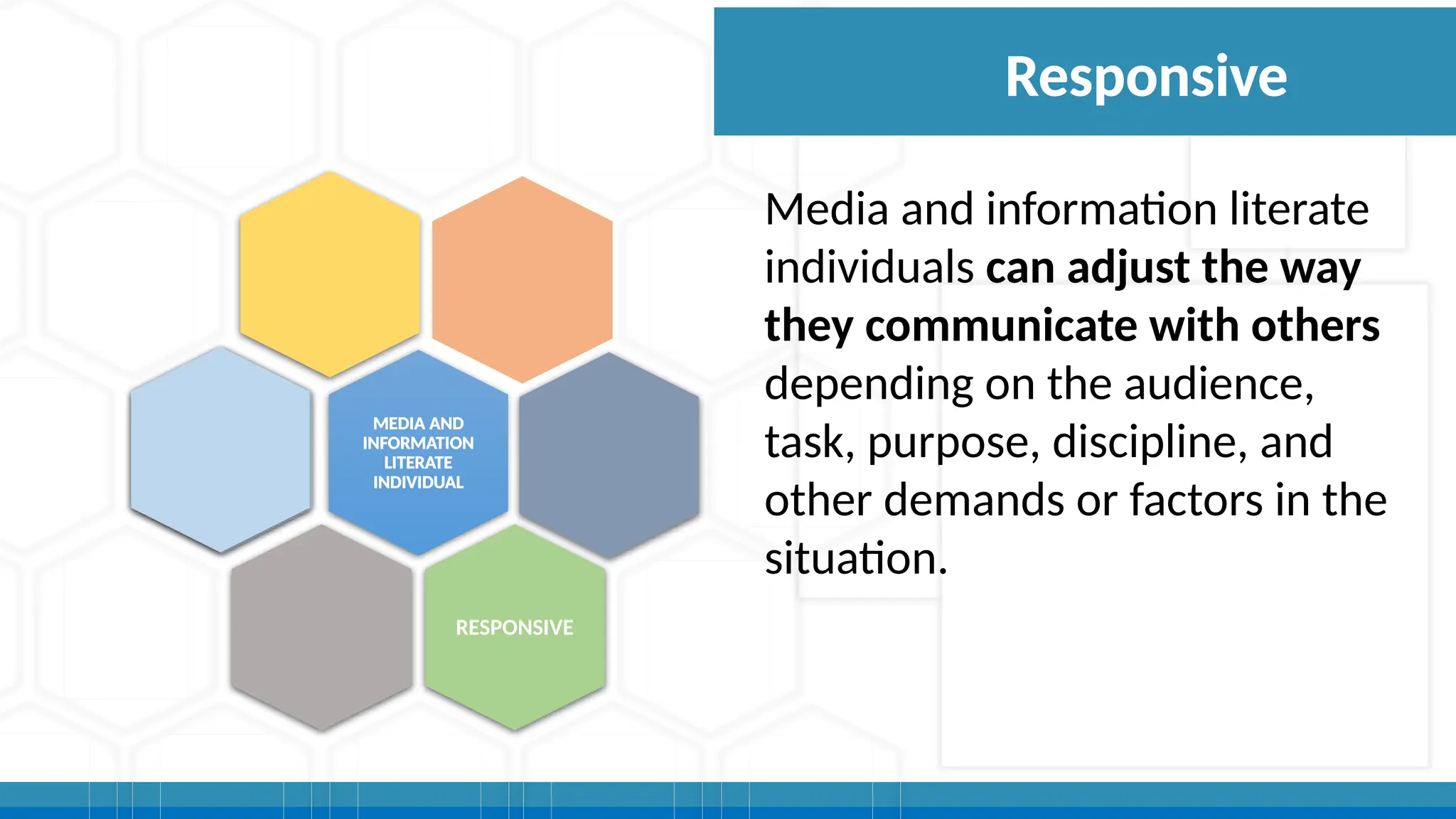
RESPONSIVE
Responsive
Media and information literate
individuals can adjust the way
they communicate with others
depending on the audience,
task, purpose, discipline, and
other demands or factors in the
situation.
MEDIA AND
INFORMATION
LITERATE
INDIVIDUAL
CRITICAL
WITH
INFORMATION
Critical with Information
Not only do they understand
the information being given, but
they also critique the content,
delivery, and processing of
data. The subconsciously
question the media and give
great emphasize on the
provided evidence.
MEDIA AND
INFORMATION
LITERATE
INDIVIDUAL
TECHNOLOGY
SAVVY
Technology Savvy
They are capable. They
effectively make use of
technology and new media in a
way that is highly advantageous
for the purpose of their
communication
CONSIDERATE
MEDIA AND
INFORMATION
LITERATE
INDIVIDUAL
Considerate
They acknowledge,
understand, and respect
others’ perspectives and
cultures. They are aware of
individual differences and keep
these in mind when
communicating.
CONTENT
KNOWLEDGE
CONSIDERATE INDEPENDENT
MEDIA AND
INFORMATION
LITERATE
INDIVIDUAL
TECHNOLOGY
SAVVY
CRITICAL
WITH
INFORMATION
RESPONSIVE
Media and
Information Literate
Individuals
(Summary)
ACTIVITY No.3
Identify the similarities and differences between and among media literacy,
information literacy, and technology literacy by completing the triple Venn
diagram below. Then, answer the guide questions that follow.
ACTIVITY No.3 - Guide Questions
1. What are the similarities of media literacy, information
literacy, and technology literacy?
2. How would you differentiate the media literacy, information
literacy, and technology literacy?
ACTIVITY No.3 - will be graded based on the following rubric.
References
Abdul Wahab, S., Rose, R., & Wati Osman, S. (2012).
Defining the concepts of technology and technology
transfer: A literature analysis. Internation Business
Research, 61-71.
Connolly, M., & Giouroukakis, V. (2016). Achieving next
generation literacy: Using the texts (you think) you hate
to help the students you love. Virginia: Association for
Supervision and Curriculum Development.
United Nations Educational, Scientific, and Cultural
Organization (UNESCO). (2019). Module 1: Citizenship,
freedom of expression and information, access to
information, democratic discourse, and life-long learning.
National Literacy Trust (2019). What is literacy. Retrieved
from https://literacytrust.org.uk/information/what-is-
literacy/
www.AcadShare.com
Lectures and Slides | AcadShare
Lectures and Slides offers a
virtual portfolio of ready-to-execute
presentations in Microsoft Office
PowerPoint formats. Piloted in real
classroom settings, slides are carefully
researched, planned, and designed
for the benefit of both the presenters
and the student audience.

MODULE 1 - MIL (Media and Information Literacy.pptx

  • 1.
  • 2.
    Session Outline • Whatis Media and Information Literacy? • What is the difference between Data and Information? • What are the forms of Media and Information Literacies? • What are the Characteristics of Media and Information Literate Individuals?
  • 3.
    01INTRODUCTION TO MEDIAAND INFORMATION LITERACY LECTURE SESSION
  • 4.
    Media and InfoLiteracy MEDIA AND INFORMATION LITERACY is a set of competencies that empowers citizens to access, retrieve, understand, evaluate, use, create, and share information and media content CRITICALLY, ETHICALLY, and EFFECTIVELY. It is considered as an essential and fundamental skill for both digital natives, immigrants, and aliens.
  • 5.
    Terminologies MEDIA pertains tothe means and resources being used for creating, delivering, sharing, and processing information. INFORMATION is a broad term that covers processed data and knowledge derived from study, experience, instruction, signals, or symbols. LITERACY is the ability to identify, understand, interpret, create, communicate, and compute using written or unwritten materials associated with varying contexts. TECHNOLOGY pertains to synthesized tools that serve to apply knowledge or technique to perform tasks and obtain results.
  • 6.
    Media • Print Media(Newspapers, Magazines, Books, Journals, Comics, Brochures) • Broadcast Media (Television, Radio, Satellites, Mobile Phones, Films) • Digital Media (Internet, Social Media, Computers)
  • 7.
    Media MEDIA is thesource of credible information where content is provided through an editorial process determined by journalistic values and where editorial accountability can be attributed to an organization or legal person (obsolete definition). MEDIA is any object (physical or not) that serves as a source or channel for information (current definition).
  • 8.
    Purposes of Media •acts as channels of information and knowledge • facilitates informed debates between diverse social actors • serves as means by which the society learns about itself and builds a sense of community • functions as a watchdog of the government by promoting transparency in public life and public scrutiny of those with power • acts as facilitator of democratic processes
  • 9.
    Data and Information Generatedin absurdly large quantities each day, DATA refers to facts, figures, and values. INFORMATION, on the other hand, is when these data are processed and translated into something meaningful or significant.
  • 10.
    Data and Information Forinstance, the records and values of gas liters you pump and load each morning are data. When you process these to identify that you are spending x amount of money on gas alone and conclude that you are overspending, these become information.
  • 11.
    Technology Digital technology or‘new media’ commonly pertains to the Internet (the global system of interconnected computer networks). It is one of the most valuable innovations in the 20th century.
  • 12.
    Literacy Basically, literacy isthe ability to read, write, speak, and listen in a way that lets individuals communicate effectively. In the context of media and information literacy (MIL), literacy refers to an individuals ability to receive, assess, process, share, and create information effectively, ethically, and properly for the purpose of expressing oneself, interacting with others, and contributing to society.
  • 13.
    Media Literacy Media literacyis the ability to access, analyze, evaluate, and create media in a variety of forms. It aims to empower citizens by providing them with the necessary competencies (knowledge and skills) to engage with traditional media and new technologies.
  • 14.
    Information Literacy Information literacyis the ability to recognize when information is needed, as well as locate, evaluate, and effectively communicate information in its various formats.
  • 15.
    Technology Literacy Technology literacyis the ability of an individual to use technological tools responsibly, appropriately, and effectively. With these tools, an individual can access, manage, integrate, evaluate, create, and communicate information.
  • 16.
    Media and InfoLiteracy Media and information literacy is a set of essential skills and competencies that allow individuals to engage with media and other information providers effectively, as well as develop critical thinking and life-long learning skills to socialize and become active citizens.
  • 17.
  • 18.
    INDEPENDENT MEDIA AND INFORMATION LITERATE INDIVIDUAL Independent Media andinformation literate individuals can independently process digital or printed texts of varying complexity, discuss and elaborate ideas with others, and understand and apply conventions of vocabulary and grammar while applying learning strategies.
  • 19.
    CONTENT KNOWLEDGE MEDIA AND INFORMATION LITERATE INDIVIDUAL Knowledgeable These individualsacquire, process, share, and translate deep information about their fields. They can discuss and elaborate on discipline-specific texts and become experts on their fields.
  • 20.
    MEDIA AND INFORMATION LITERATE INDIVIDUAL RESPONSIVE Responsive Media andinformation literate individuals can adjust the way they communicate with others depending on the audience, task, purpose, discipline, and other demands or factors in the situation.
  • 21.
    MEDIA AND INFORMATION LITERATE INDIVIDUAL CRITICAL WITH INFORMATION Critical withInformation Not only do they understand the information being given, but they also critique the content, delivery, and processing of data. The subconsciously question the media and give great emphasize on the provided evidence.
  • 22.
    MEDIA AND INFORMATION LITERATE INDIVIDUAL TECHNOLOGY SAVVY Technology Savvy Theyare capable. They effectively make use of technology and new media in a way that is highly advantageous for the purpose of their communication
  • 23.
    CONSIDERATE MEDIA AND INFORMATION LITERATE INDIVIDUAL Considerate They acknowledge, understand,and respect others’ perspectives and cultures. They are aware of individual differences and keep these in mind when communicating.
  • 24.
  • 25.
    ACTIVITY No.3 Identify thesimilarities and differences between and among media literacy, information literacy, and technology literacy by completing the triple Venn diagram below. Then, answer the guide questions that follow.
  • 26.
    ACTIVITY No.3 -Guide Questions 1. What are the similarities of media literacy, information literacy, and technology literacy? 2. How would you differentiate the media literacy, information literacy, and technology literacy?
  • 27.
    ACTIVITY No.3 -will be graded based on the following rubric.
  • 28.
    References Abdul Wahab, S.,Rose, R., & Wati Osman, S. (2012). Defining the concepts of technology and technology transfer: A literature analysis. Internation Business Research, 61-71. Connolly, M., & Giouroukakis, V. (2016). Achieving next generation literacy: Using the texts (you think) you hate to help the students you love. Virginia: Association for Supervision and Curriculum Development. United Nations Educational, Scientific, and Cultural Organization (UNESCO). (2019). Module 1: Citizenship, freedom of expression and information, access to information, democratic discourse, and life-long learning. National Literacy Trust (2019). What is literacy. Retrieved from https://literacytrust.org.uk/information/what-is- literacy/
  • 29.
    www.AcadShare.com Lectures and Slides| AcadShare Lectures and Slides offers a virtual portfolio of ready-to-execute presentations in Microsoft Office PowerPoint formats. Piloted in real classroom settings, slides are carefully researched, planned, and designed for the benefit of both the presenters and the student audience.

Editor's Notes

  • #17 The following are the Characteristics of Media and Information Literate Individuals
  • #25 Identify the similarities and differences between and among media literacy, information literacy, and technology literacy by completing the triple Venn diagram below. Then, answer the guide questions that follow. Guide Questions: 1. What are the similarities of media literacy, information literacy, and technology literacy? 2. How would you differentiate the media literacy, information literacy, and technology literacy?
  • #26 Identify the similarities and differences between and among media literacy, information literacy, and technology literacy by completing the triple Venn diagram below. Then, answer the guide questions that follow. Guide Questions: 1. What are the similarities of media literacy, information literacy, and technology literacy? 2. How would you differentiate the media literacy, information literacy, and technology literacy?
  • #27 Identify the similarities and differences between and among media literacy, information literacy, and technology literacy by completing the triple Venn diagram below. Then, answer the guide questions that follow. Guide Questions: 1. What are the similarities of media literacy, information literacy, and technology literacy? 2. How would you differentiate the media literacy, information literacy, and technology literacy?