Bill Nicholas
Bill Nicholas’ modes of documentary are significant as the different
modes allow for us to recognize the different types of documentaries,
making it much easier to identify all of the different codes and
conventions. This research would be essential when it comes to making
our documentaries. The importance of this research will be seen later on
when shooting the documentary as we are the able to refer back to the
mode we are creating and check if we have the same codes and
conventions present in our final product.
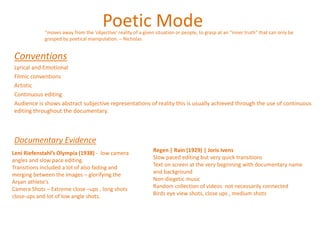
Poetic Mode
Conventions
Lyrical and Emotional
Filmic conventions
Artistic
Continuous editing
Audience is shows abstract subjective representations of reality this is usually achieved through the use of continuous
editing throughout the documentary.
Documentary Evidence
“moves away from the ‘objective’ reality of a given situation or people, to grasp at an “inner truth” that can only be
grasped by poetical manipulation. – Nicholas
Regen | Rain (1929) | Joris Ivens
Slow paced editing but very quick transitions
Text on screen at the very beginning with documentary name
and background
Non-diegetic music
Random collection of videos not necessarily connected
Birds eye view shots, close ups , medium shots
Leni Riefenstahl’s Olympia (1938) - low camera
angles and slow pace editing.
Transitions included a lot of also fading and
merging between the images – glorifying the
Aryan athlete's
Camera Shots – Extreme close –ups , long shots
close-ups and lot of low angle shots.
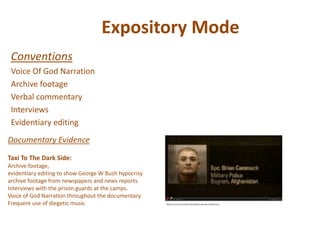
Expository Mode
Conventions
Voice Of God Narration
Archive footage
Verbal commentary
Interviews
Evidentiary editing
Documentary Evidence
Taxi To The Dark Side:
Archive footage,
evidentiary editing to show George W Bush hypocrisy
archive footage from newspapers and news reports.
Interviews with the prison guards at the camps.
Voice of God Narration throughout the documentary
Frequent use of diegetic music
Participatory Mode
CONVENTIONS
These films usually take the form of a series of interviews or other
forms of even more direct involvement from conversations to
provocations.
∆ Archival footage to examine historical issues
∆ Range of different interviews with different subjects
∆ Narration by subject
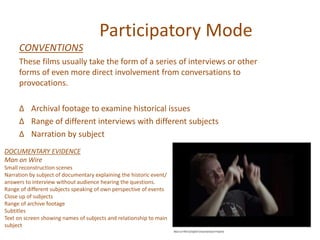
DOCUMENTARY EVIDENCE
Man on Wire
Small reconstruction scenes
Narration by subject of documentary explaining the historic event/
answers to interview without audience hearing the questions.
Range of different subjects speaking of own perspective of events
Close up of subjects
Range of archive footage
Subtitles
Text on screen showing names of subjects and relationship to main
subject
Observational Mode
Conventions
Observe historical events as they happen and can also use the observations of
an unobtrusive camera to create direct engagement with the everyday life of
subjects.
∆ No voice overs
∆ No interviews
∆ No supplementary music
∆ Social actors behave as if the camera is not there
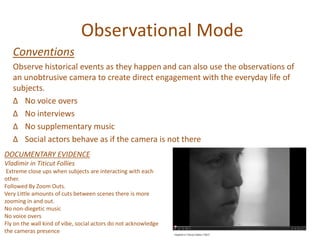
DOCUMENTARY EVIDENCE
Vladimir in Titicut Follies
Extreme close ups when subjects are interacting with each
other.
Followed By Zoom Outs.
Very Little amounts of cuts between scenes there is more
zooming in and out.
No non-diegetic music
No voice overs
Fly on the wall kind of vibe, social actors do not acknowledge
the cameras presence
Reflexive Mode
CONVENTIONS
This mode, which includes the mockumentary format,
calls attention to the assumptions and conventions that
govern documentary filmmaking to increase our
awareness of how films construct representations of
reality
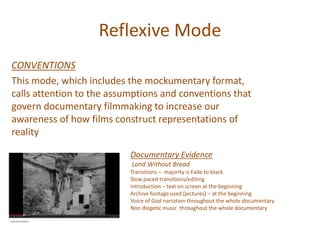
Documentary Evidence
Land Without Bread
Transitions – majority is Fade to black
Slow paced transitions/editing
Introduction – text on screen at the beginning
Archive footage used (pictures) – at the beginning
Voice of God narration throughout the whole documentary
Non diegetic music throughout the whole documentary
Perfomative Mode
CONVENTIONS
Highlights the subjective or expressive aspect of the filmmaker’s own
involvement with a subject.
∆ Reject Objectivity, Favour Emotion
∆ Non-diegetic music
∆ No Narration
∆ Voice- overs
∆ Archive footage
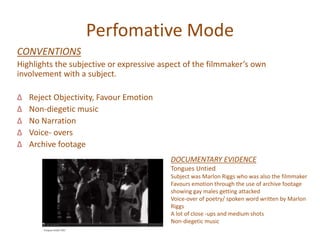
DOCUMENTARY EVIDENCE
Tongues Untied
Subject was Marlon Riggs who was also the filmmaker
Favours emotion through the use of archive footage
showing gay males getting attacked
Voice-over of poetry/ spoken word written by Marlon
Riggs
A lot of close -ups and medium shots
Non-diegetic music

Modes of documentaries2

  • 1.
  • 2.
    Bill Nicholas’ modesof documentary are significant as the different modes allow for us to recognize the different types of documentaries, making it much easier to identify all of the different codes and conventions. This research would be essential when it comes to making our documentaries. The importance of this research will be seen later on when shooting the documentary as we are the able to refer back to the mode we are creating and check if we have the same codes and conventions present in our final product.
  • 3.
    Poetic Mode Conventions Lyrical andEmotional Filmic conventions Artistic Continuous editing Audience is shows abstract subjective representations of reality this is usually achieved through the use of continuous editing throughout the documentary. Documentary Evidence “moves away from the ‘objective’ reality of a given situation or people, to grasp at an “inner truth” that can only be grasped by poetical manipulation. – Nicholas Regen | Rain (1929) | Joris Ivens Slow paced editing but very quick transitions Text on screen at the very beginning with documentary name and background Non-diegetic music Random collection of videos not necessarily connected Birds eye view shots, close ups , medium shots Leni Riefenstahl’s Olympia (1938) - low camera angles and slow pace editing. Transitions included a lot of also fading and merging between the images – glorifying the Aryan athlete's Camera Shots – Extreme close –ups , long shots close-ups and lot of low angle shots.
  • 4.
    Expository Mode Conventions Voice OfGod Narration Archive footage Verbal commentary Interviews Evidentiary editing Documentary Evidence Taxi To The Dark Side: Archive footage, evidentiary editing to show George W Bush hypocrisy archive footage from newspapers and news reports. Interviews with the prison guards at the camps. Voice of God Narration throughout the documentary Frequent use of diegetic music
  • 5.
    Participatory Mode CONVENTIONS These filmsusually take the form of a series of interviews or other forms of even more direct involvement from conversations to provocations. ∆ Archival footage to examine historical issues ∆ Range of different interviews with different subjects ∆ Narration by subject DOCUMENTARY EVIDENCE Man on Wire Small reconstruction scenes Narration by subject of documentary explaining the historic event/ answers to interview without audience hearing the questions. Range of different subjects speaking of own perspective of events Close up of subjects Range of archive footage Subtitles Text on screen showing names of subjects and relationship to main subject
  • 6.
    Observational Mode Conventions Observe historicalevents as they happen and can also use the observations of an unobtrusive camera to create direct engagement with the everyday life of subjects. ∆ No voice overs ∆ No interviews ∆ No supplementary music ∆ Social actors behave as if the camera is not there DOCUMENTARY EVIDENCE Vladimir in Titicut Follies Extreme close ups when subjects are interacting with each other. Followed By Zoom Outs. Very Little amounts of cuts between scenes there is more zooming in and out. No non-diegetic music No voice overs Fly on the wall kind of vibe, social actors do not acknowledge the cameras presence
  • 7.
    Reflexive Mode CONVENTIONS This mode,which includes the mockumentary format, calls attention to the assumptions and conventions that govern documentary filmmaking to increase our awareness of how films construct representations of reality Documentary Evidence Land Without Bread Transitions – majority is Fade to black Slow paced transitions/editing Introduction – text on screen at the beginning Archive footage used (pictures) – at the beginning Voice of God narration throughout the whole documentary Non diegetic music throughout the whole documentary
  • 8.
    Perfomative Mode CONVENTIONS Highlights thesubjective or expressive aspect of the filmmaker’s own involvement with a subject. ∆ Reject Objectivity, Favour Emotion ∆ Non-diegetic music ∆ No Narration ∆ Voice- overs ∆ Archive footage DOCUMENTARY EVIDENCE Tongues Untied Subject was Marlon Riggs who was also the filmmaker Favours emotion through the use of archive footage showing gay males getting attacked Voice-over of poetry/ spoken word written by Marlon Riggs A lot of close -ups and medium shots Non-diegetic music