Modeling meaning and
knowledge: legal knowledge
Anna Ronkainen
Chief Scientist, TrademarkNow Inc
@ronkaine
2016-04-25
My professional background
-  studies in EE/CS, law, linguistics, will finish
my LL.D. in legal theory eventually (all
articles published already)
-  worked in language technology
development since 1995
-  misc stints in academia, including teaching
IP law here and legal tech in U of Turku
-  co-founded TrademarkNow (originally
Onomatics) in 2012
Law is just a bunch of rules, right?
if steal_thing
then go_to_jail
Think about buying a cup of coffee...
Simple enough, right?
-  order
-  pay
-  drink and leave (not necessarily in that
order)
Then think about all the legal issues
involved
-  (un?)specified amount of liquid with
somewhat specified qualities changes owner
Then think about all the legal issues
involved
-  (un?)specified amount of liquid with
somewhat specified qualities changes owner
-  what about ownership of the container?
-  a non-exclusive lease to use some part of the
premises for some amount of time?
-  probably a packet of sugar at no extra cost,
maybe two, or a kilo?
-  plus all the liability issues...
Of course you can also engineer away
all the uncertainties...
...but that kind of limits your options
-  conceptual vagueness is an intrinsic part of
pretty much any situation worth analyzing in
legal terms
-  often it is hidden from view thanks to
human cognition, which is why legal theory
has focused on the most contentious cases
-  but it is unescapable in computational
modelling even for easy/unproblematic cases
Why?
”As we know, there are known knowns. There
are things we know we know. We also know
there are known unknowns, that is to say, we
know there are some things we do not know.
But there are also unknown unknowns, the
ones we don’t know we don’t know.”
– Donald Rumsfeld (2002)
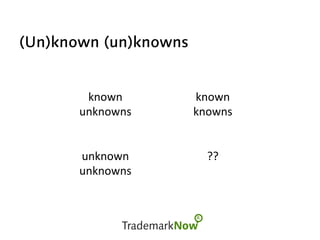
(Un)known (un)knowns
known	
unknowns	
known	
knowns	
unknown	
unknowns	
??
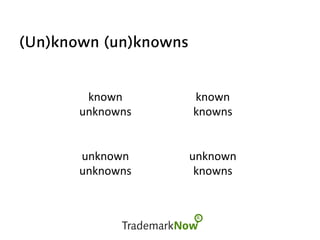
(Un)known (un)knowns
known	
unknowns	
known	
knowns	
unknown	
unknowns	
unknown	
knowns
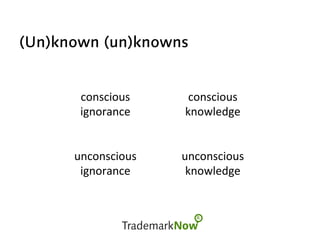
(Un)known (un)knowns
conscious	
ignorance	
conscious	
knowledge	
unconscious	
ignorance	
unconscious	
knowledge
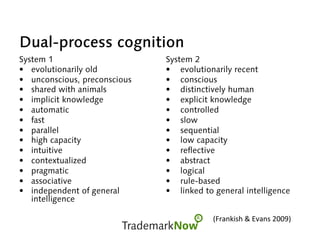
Dual-process cognition
System 1
•  evolutionarily old
•  unconscious, preconscious
•  shared with animals
•  implicit knowledge
•  automatic
•  fast
•  parallel
•  high capacity
•  intuitive
•  contextualized
•  pragmatic
•  associative
•  independent of general
intelligence
System 2
•  evolutionarily recent
•  conscious
•  distinctively human
•  explicit knowledge
•  controlled
•  slow
•  sequential
•  low capacity
•  reflective
•  abstract
•  logical
•  rule-based
•  linked to general intelligence
(Frankish	&	Evans	2009)
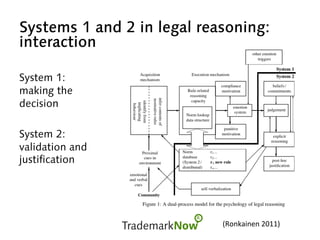
Systems 1 and 2 in legal reasoning:
interaction
System 1:
making the
decision
System 2:
validation and
justification
(Ronkainen	2011)
These are few of my
favourite things...
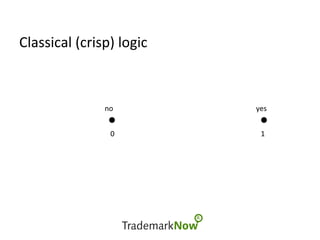
Classical	(crisp)	logic	
0																																																																																	1	
						no																																																																															yes
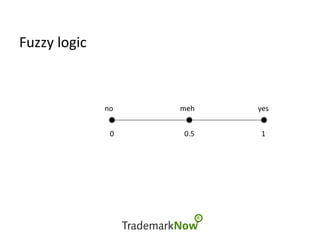
Fuzzy	logic	
0																																							0.5																																					1	
						no																																					meh																																			yes
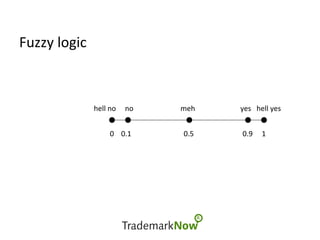
Fuzzy	logic	
0				0.1																													0.5																											0.9					1	
hell	no					no																										meh																									yes			hell	yes
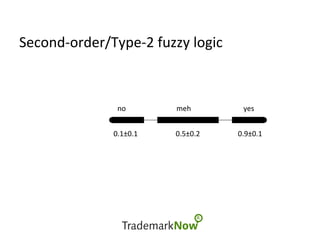
Second-order/Type-2	fuzzy	logic	
		0.1±0.1																					0.5±0.2																					0.9±0.1	
													no																												meh																													yes
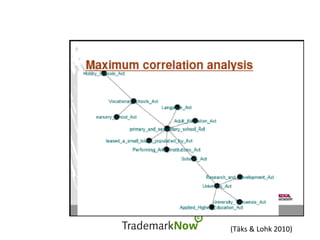
Systematizing Estonian laws through
self-organization
-  project carried out at Tallinn U of Tech by
Täks et al
-  legal acts modelled as term vectors (based
on occurrences of individual words in each
document) which are used to generate a
self-organizing map (SOM, Kohonen)
-  provides a 2-dimensional map of
hypothetical (and also actual) relationships
between statutes
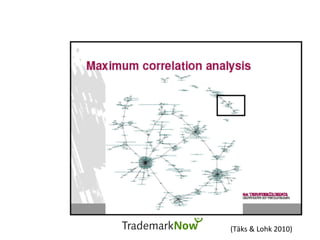
(Täks	&	Lohk	2010)
(Täks	&	Lohk	2010)
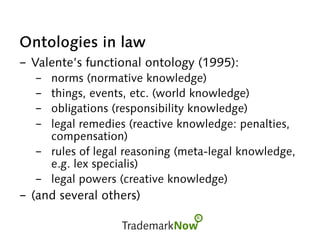
Ontologies in law
-  Valente’s functional ontology (1995):
-  norms (normative knowledge)
-  things, events, etc. (world knowledge)
-  obligations (responsibility knowledge)
-  legal remedies (reactive knowledge: penalties,
compensation)
-  rules of legal reasoning (meta-legal knowledge,
e.g. lex specialis)
-  legal powers (creative knowledge)
-  (and several others)
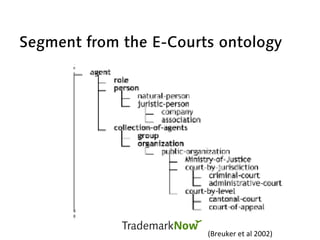
Segment from the E-Courts ontology
(Breuker	et	al	2002)
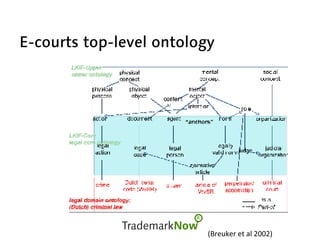
E-courts top-level ontology
(Breuker	et	al	2002)
Use of ontologies
-  always exist in a specific context, built for that
(no Begriffshimmel and no point in aiming for
one)
-  can be generated by hand or by machine
-  two very different ontologies can work just as
well (no Right Answer!)
-  very useful for information retrieval (find similar
things that are called something else)
-  can also be used e.g. for similarity metrics
-  categorization hierarchy also interesting from a
cognitive perspective (basic-level concepts etc.)
Modeling meaning and
knowledge: legal knowledge
Anna Ronkainen
Chief Scientist, TrademarkNow Inc
@ronkaine
2016-04-25
Questions?
Thank you!
A few words about
commercializing academic
research...
The real innovator’s dilemma
1.  do research
2.  ...
3.  profit!
Research commercialization is difficult
in general – not only for AI & law
-  innovation and commercialization are tossed
around as vital research policy goals a lot these
days pretty much wherever you go
-  said tossers* tend to treat it as a black box,
basically thinking that telling academics to be
innovative is all it takes
-  there are two parts in the equation, and only
one of them can be said to be the academics’
responsibility
* sorry, couldn’t resist
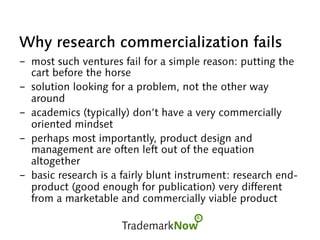
Why research commercialization fails
-  most such ventures fail for a simple reason: putting the
cart before the horse
-  solution looking for a problem, not the other way
around
-  academics (typically) don’t have a very commercially
oriented mindset
-  perhaps most importantly, product design and
management are often left out of the equation
altogether
-  basic research is a fairly blunt instrument: research end-
product (good enough for publication) very different
from a marketable and commercially viable product
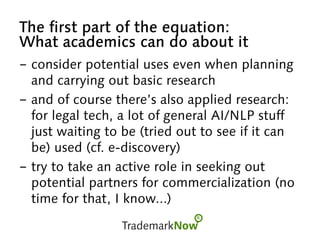
The first part of the equation:
What academics can do about it
-  consider potential uses even when planning
and carrying out basic research
-  and of course there’s also applied research:
for legal tech, a lot of general AI/NLP stuff
just waiting to be (tried out to see if it can
be) used (cf. e-discovery)
-  try to take an active role in seeking out
potential partners for commercialization (no
time for that, I know...)
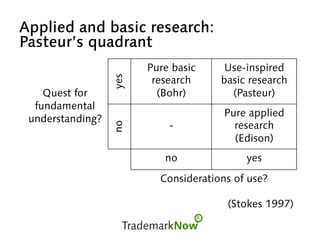
Applied and basic research:
Pasteur’s quadrant
Quest for
fundamental
understanding? yes
Pure basic
research
(Bohr)
Use-inspired
basic research
(Pasteur)
no
-
Pure applied
research
(Edison)
no yes
Considerations of use?
(Stokes 1997)
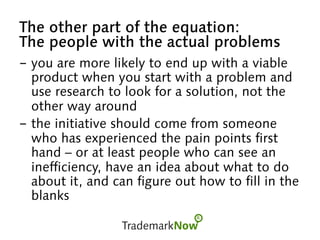
The other part of the equation:
The people with the actual problems
-  you are more likely to end up with a viable
product when you start with a problem and
use research to look for a solution, not the
other way around
-  the initiative should come from someone
who has experienced the pain points first
hand – or at least people who can see an
inefficiency, have an idea about what to do
about it, and can figure out how to fill in the
blanks
Questions?
Thank you!

Modeling meaning and knowledge: legal knowledge

  • 1.
    Modeling meaning and knowledge:legal knowledge Anna Ronkainen Chief Scientist, TrademarkNow Inc @ronkaine 2016-04-25
  • 2.
    My professional background - studies in EE/CS, law, linguistics, will finish my LL.D. in legal theory eventually (all articles published already) -  worked in language technology development since 1995 -  misc stints in academia, including teaching IP law here and legal tech in U of Turku -  co-founded TrademarkNow (originally Onomatics) in 2012
  • 3.
    Law is justa bunch of rules, right? if steal_thing then go_to_jail
  • 4.
    Think about buyinga cup of coffee... Simple enough, right? -  order -  pay -  drink and leave (not necessarily in that order)
  • 5.
    Then think aboutall the legal issues involved -  (un?)specified amount of liquid with somewhat specified qualities changes owner
  • 6.
    Then think aboutall the legal issues involved -  (un?)specified amount of liquid with somewhat specified qualities changes owner -  what about ownership of the container? -  a non-exclusive lease to use some part of the premises for some amount of time? -  probably a packet of sugar at no extra cost, maybe two, or a kilo? -  plus all the liability issues...
  • 7.
    Of course youcan also engineer away all the uncertainties...
  • 8.
    ...but that kindof limits your options -  conceptual vagueness is an intrinsic part of pretty much any situation worth analyzing in legal terms -  often it is hidden from view thanks to human cognition, which is why legal theory has focused on the most contentious cases -  but it is unescapable in computational modelling even for easy/unproblematic cases
  • 9.
  • 10.
    ”As we know,there are known knowns. There are things we know we know. We also know there are known unknowns, that is to say, we know there are some things we do not know. But there are also unknown unknowns, the ones we don’t know we don’t know.” – Donald Rumsfeld (2002)
  • 11.
  • 12.
  • 13.
  • 14.
    Dual-process cognition System 1 • evolutionarily old •  unconscious, preconscious •  shared with animals •  implicit knowledge •  automatic •  fast •  parallel •  high capacity •  intuitive •  contextualized •  pragmatic •  associative •  independent of general intelligence System 2 •  evolutionarily recent •  conscious •  distinctively human •  explicit knowledge •  controlled •  slow •  sequential •  low capacity •  reflective •  abstract •  logical •  rule-based •  linked to general intelligence (Frankish & Evans 2009)
  • 15.
    Systems 1 and2 in legal reasoning: interaction System 1: making the decision System 2: validation and justification (Ronkainen 2011)
  • 16.
    These are fewof my favourite things...
  • 17.
  • 18.
  • 19.
  • 20.
  • 21.
    Systematizing Estonian lawsthrough self-organization -  project carried out at Tallinn U of Tech by Täks et al -  legal acts modelled as term vectors (based on occurrences of individual words in each document) which are used to generate a self-organizing map (SOM, Kohonen) -  provides a 2-dimensional map of hypothetical (and also actual) relationships between statutes
  • 22.
  • 23.
  • 24.
    Ontologies in law - Valente’s functional ontology (1995): -  norms (normative knowledge) -  things, events, etc. (world knowledge) -  obligations (responsibility knowledge) -  legal remedies (reactive knowledge: penalties, compensation) -  rules of legal reasoning (meta-legal knowledge, e.g. lex specialis) -  legal powers (creative knowledge) -  (and several others)
  • 25.
    Segment from theE-Courts ontology (Breuker et al 2002)
  • 26.
  • 27.
    Use of ontologies - always exist in a specific context, built for that (no Begriffshimmel and no point in aiming for one) -  can be generated by hand or by machine -  two very different ontologies can work just as well (no Right Answer!) -  very useful for information retrieval (find similar things that are called something else) -  can also be used e.g. for similarity metrics -  categorization hierarchy also interesting from a cognitive perspective (basic-level concepts etc.)
  • 28.
    Modeling meaning and knowledge:legal knowledge Anna Ronkainen Chief Scientist, TrademarkNow Inc @ronkaine 2016-04-25
  • 29.
  • 30.
    A few wordsabout commercializing academic research...
  • 31.
    The real innovator’sdilemma 1.  do research 2.  ... 3.  profit!
  • 32.
    Research commercialization isdifficult in general – not only for AI & law -  innovation and commercialization are tossed around as vital research policy goals a lot these days pretty much wherever you go -  said tossers* tend to treat it as a black box, basically thinking that telling academics to be innovative is all it takes -  there are two parts in the equation, and only one of them can be said to be the academics’ responsibility * sorry, couldn’t resist
  • 33.
    Why research commercializationfails -  most such ventures fail for a simple reason: putting the cart before the horse -  solution looking for a problem, not the other way around -  academics (typically) don’t have a very commercially oriented mindset -  perhaps most importantly, product design and management are often left out of the equation altogether -  basic research is a fairly blunt instrument: research end- product (good enough for publication) very different from a marketable and commercially viable product
  • 34.
    The first partof the equation: What academics can do about it -  consider potential uses even when planning and carrying out basic research -  and of course there’s also applied research: for legal tech, a lot of general AI/NLP stuff just waiting to be (tried out to see if it can be) used (cf. e-discovery) -  try to take an active role in seeking out potential partners for commercialization (no time for that, I know...)
  • 35.
    Applied and basicresearch: Pasteur’s quadrant Quest for fundamental understanding? yes Pure basic research (Bohr) Use-inspired basic research (Pasteur) no - Pure applied research (Edison) no yes Considerations of use? (Stokes 1997)
  • 36.
    The other partof the equation: The people with the actual problems -  you are more likely to end up with a viable product when you start with a problem and use research to look for a solution, not the other way around -  the initiative should come from someone who has experienced the pain points first hand – or at least people who can see an inefficiency, have an idea about what to do about it, and can figure out how to fill in the blanks
  • 37.