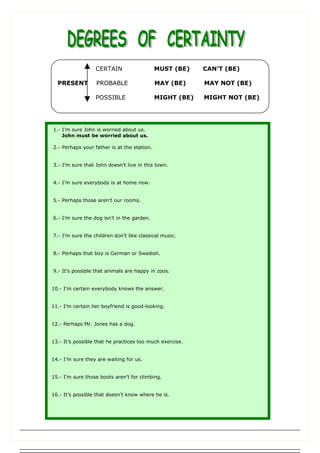
CERTAIN                    MUST (BE)    CAN’T (BE)

  PRESENT         PROBABLE                   MAY (BE)     MAY NOT (BE)

                  POSSIBLE                   MIGHT (BE)   MIGHT NOT (BE)


1.- I’m sure John is worried about us.
    John must be worried about us.

2.- Perhaps your father is at the station.


3.- I’m sure that John doesn’t live in this town.


4.- I’m sure everybody is at home now.


5.- Perhaps those aren’t our rooms.


6.- I’m sure the dog isn’t in the garden.


7.- I’m sure the children don’t like classical music.


8.- Perhaps that boy is German or Swedish.


9.- It’s possible that animals are happy in zoos.


10.- I’m certain everybody knows the answer.


11.- I’m certain her boyfriend is good-looking.


12.- Perhaps Mr. Jones has a dog.


13.- It’s possible that he practices too much exercise.


14.- I’m sure they are waiting for us.


15.- I’m sure those boots aren’t for climbing.


16.- It’s possible that doesn’t know where he is.

Modals

  • 1.
    CERTAIN MUST (BE) CAN’T (BE) PRESENT PROBABLE MAY (BE) MAY NOT (BE) POSSIBLE MIGHT (BE) MIGHT NOT (BE) 1.- I’m sure John is worried about us. John must be worried about us. 2.- Perhaps your father is at the station. 3.- I’m sure that John doesn’t live in this town. 4.- I’m sure everybody is at home now. 5.- Perhaps those aren’t our rooms. 6.- I’m sure the dog isn’t in the garden. 7.- I’m sure the children don’t like classical music. 8.- Perhaps that boy is German or Swedish. 9.- It’s possible that animals are happy in zoos. 10.- I’m certain everybody knows the answer. 11.- I’m certain her boyfriend is good-looking. 12.- Perhaps Mr. Jones has a dog. 13.- It’s possible that he practices too much exercise. 14.- I’m sure they are waiting for us. 15.- I’m sure those boots aren’t for climbing. 16.- It’s possible that doesn’t know where he is.