[email_address]
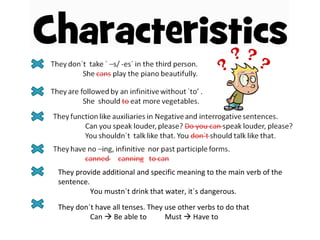
They provide additional and specific meaning to the main verb of the sentence. You mustn´t drink that water, it´s dangerous. They don´t have all tenses. They use other verbs to do that Can    Be able to  Must    Have to
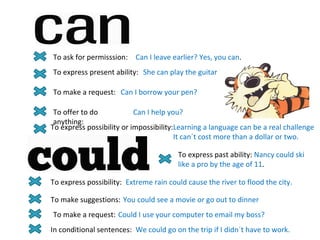
To express present ability: She can play the guitar To make a request: Can I borrow your pen? To offer to do anything: Can I help you? To ask for permisssion: Can I leave earlier? Yes, you can . To express possibility or impossibility: Learning a language can be a real challenge It can´t cost more than a dollar or two. To express past ability:  Nancy could ski like a pro by the age of 11 . To express possibility: Extreme rain could cause the river to flood the city. To make suggestions:  You could see a movie or go out to dinner To make a request:  Could I use your computer to email my boss? In conditional sentences: We could go on the trip if I didn´t have to work.
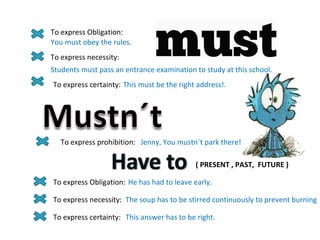
To express Obligation: You must obey the rules. To express necessity: Students must pass an entrance examination to study at this school. To express certainty: This must be the right address!. To express prohibition: Jenny, You mustn´t park there! ( PRESENT , PAST,  FUTURE ) To express Obligation: He has had to leave early. To express necessity: The soup has to be stirred continuously to prevent burning To express certainty: This answer has to be right.
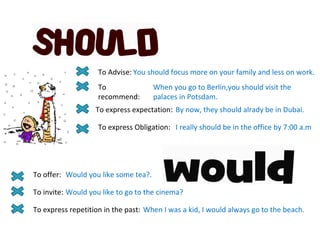
To Advise: You should focus more on your family and less on work. To recommend: When you go to Berlin,you should visit the palaces in Potsdam. To express expectation: By now, they should alrady be in Dubai.  To express Obligation: I really should be in the office by 7:00 a.m To offer: Would you like some tea?. To invite: Would you like to go to the cinema? To express repetition in the past: When I was a kid, I would always go to the beach.
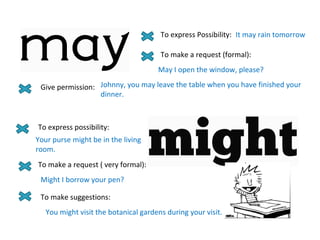
To express Possibility: It may rain tomorrow To make a request (formal): May I open the window, please? Give permission: Johnny, you may leave the table when you have finished your dinner. To express possibility: Your purse might be in the living room. To make a request ( very formal):  Might I borrow your pen? To make suggestions: You might visit the botanical gardens during your visit.
[email_address]

Modal verbs

  • 1.
  • 2.
    They provide additionaland specific meaning to the main verb of the sentence. You mustn´t drink that water, it´s dangerous. They don´t have all tenses. They use other verbs to do that Can  Be able to Must  Have to
  • 3.
    To express presentability: She can play the guitar To make a request: Can I borrow your pen? To offer to do anything: Can I help you? To ask for permisssion: Can I leave earlier? Yes, you can . To express possibility or impossibility: Learning a language can be a real challenge It can´t cost more than a dollar or two. To express past ability: Nancy could ski like a pro by the age of 11 . To express possibility: Extreme rain could cause the river to flood the city. To make suggestions: You could see a movie or go out to dinner To make a request: Could I use your computer to email my boss? In conditional sentences: We could go on the trip if I didn´t have to work.
  • 4.
    To express Obligation:You must obey the rules. To express necessity: Students must pass an entrance examination to study at this school. To express certainty: This must be the right address!. To express prohibition: Jenny, You mustn´t park there! ( PRESENT , PAST, FUTURE ) To express Obligation: He has had to leave early. To express necessity: The soup has to be stirred continuously to prevent burning To express certainty: This answer has to be right.
  • 5.
    To Advise: Youshould focus more on your family and less on work. To recommend: When you go to Berlin,you should visit the palaces in Potsdam. To express expectation: By now, they should alrady be in Dubai. To express Obligation: I really should be in the office by 7:00 a.m To offer: Would you like some tea?. To invite: Would you like to go to the cinema? To express repetition in the past: When I was a kid, I would always go to the beach.
  • 6.
    To express Possibility:It may rain tomorrow To make a request (formal): May I open the window, please? Give permission: Johnny, you may leave the table when you have finished your dinner. To express possibility: Your purse might be in the living room. To make a request ( very formal): Might I borrow your pen? To make suggestions: You might visit the botanical gardens during your visit.
  • 7.