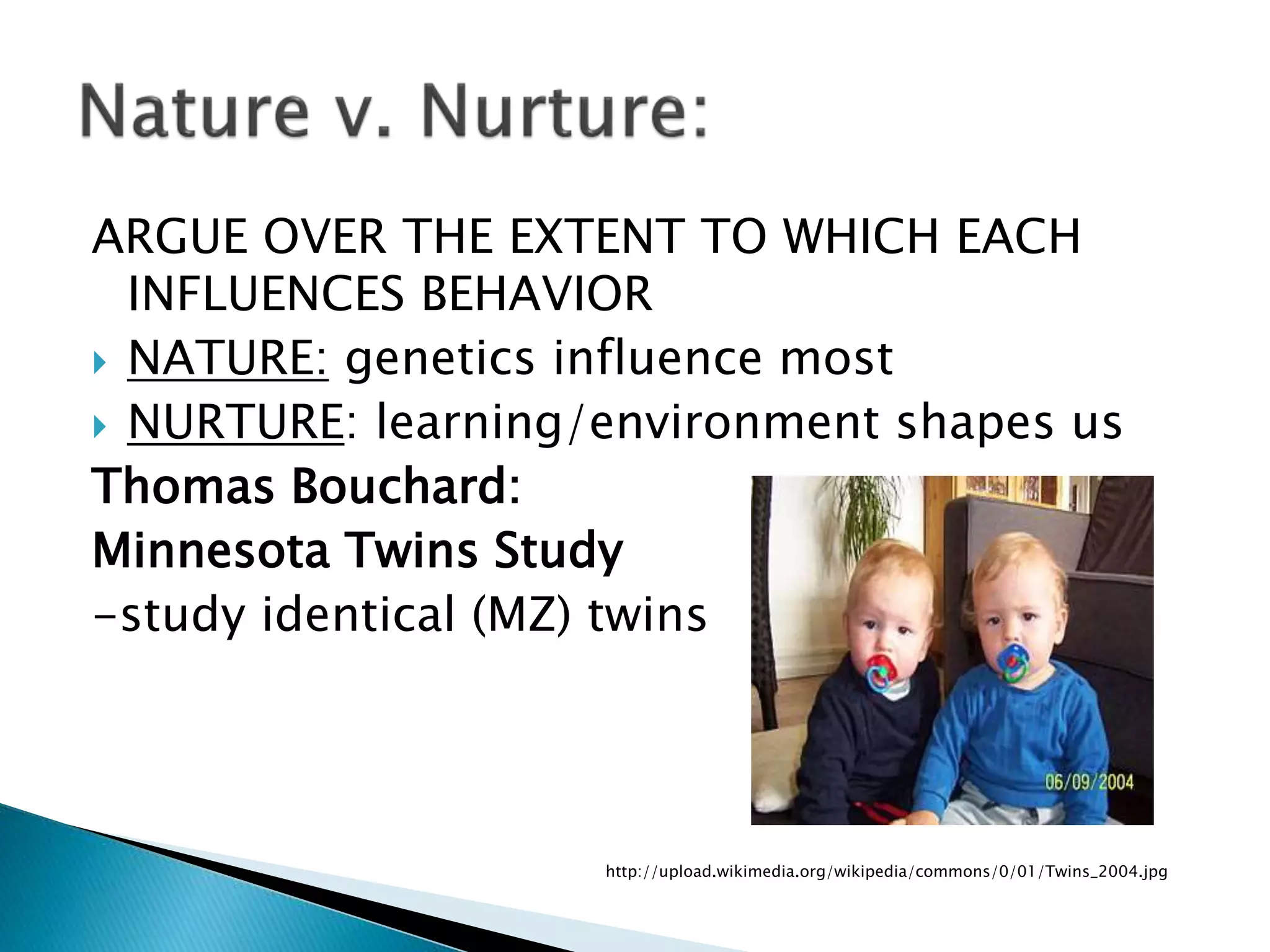
ARGUE OVER THE EXTENT TO WHICH EACH
INFLUENCES BEHAVIOR
 NATURE: genetics influence most
 NURTURE: learning/environment shapes us
Thomas Bouchard:
Minnesota Twins Study
-study identical (MZ) twins
http://upload.wikimedia.org/wikipedia/commons/0/01/Twins_2004.jpg
IS DEVELOPMENT:
CONTINUOUS: a gradual, cumulative change
from birth to death (walking up a hill)
OR
DISCONTINUOUS: a sequence of distinct stages
that build upon one another that every
person goes through (climbing stairs)
 LONGITUDINAL: study same group of people
for a long time
Good: accuracy Bad: costly, long time, lose
participants
 CROSS-SECTIONAL: compare different age
groups now
Good: quick, fast Bad: less accurate
 COHORT-SEQUENTIAL: cross-sectional
groups are studied at least 2 times over
months/years, compared to others of same
age
1. GERMINAL STAGE (lasts about 2 weeks):
zygote
-a fertilized egg, it will divide many times
2. EMBRYONIC STAGE (lasts about 7 weeks):
embryo
-important organs form
3. FETAL STAGE (lasts for rest of pregnancy):
fetus
-growth, interaction of organs, form
bones
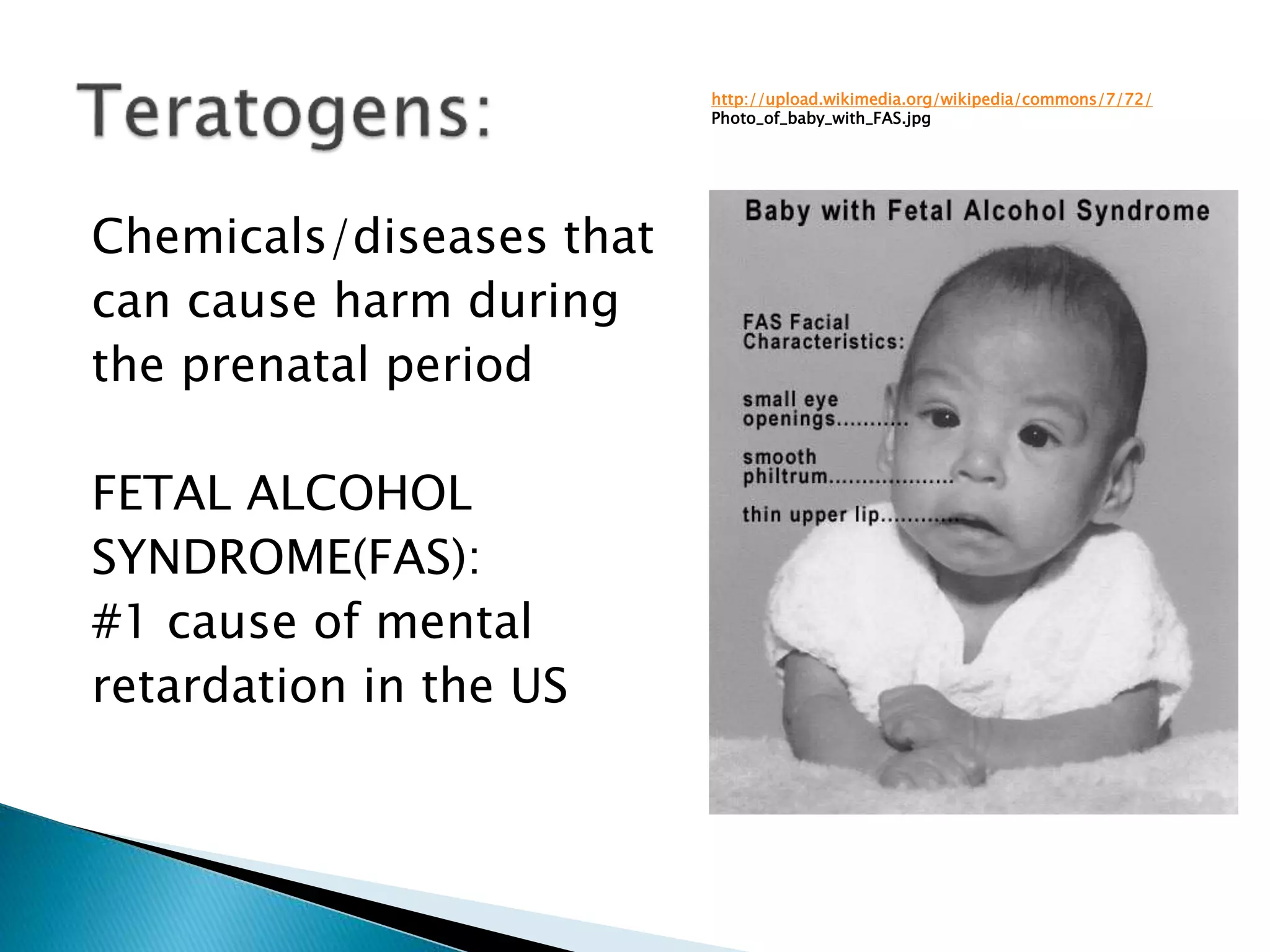
http://upload.wikimedia.org/wikipedia/commons/7/72/
Photo_of_baby_with_FAS.jpg
Chemicals/diseases that
can cause harm during
the prenatal period
FETAL ALCOHOL
SYNDROME(FAS):
#1 cause of mental
retardation in the US
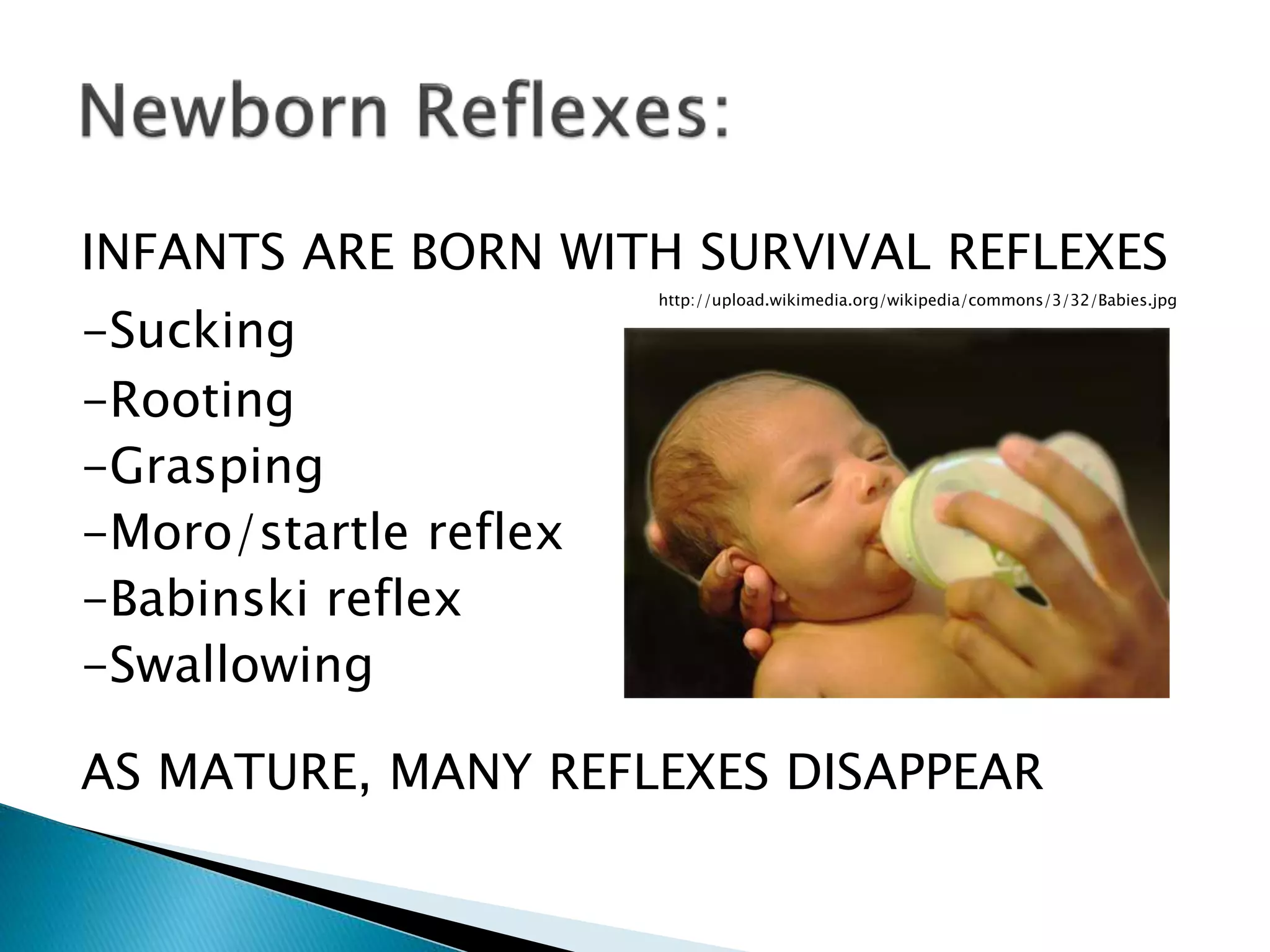
INFANTS ARE BORN WITH SURVIVAL REFLEXES
-Sucking
-Rooting
-Grasping
-Moro/startle reflex
-Babinski reflex
-Swallowing
AS MATURE, MANY REFLEXES DISAPPEAR
http://upload.wikimedia.org/wikipedia/commons/3/32/Babies.jpg
MATURATION: physical development
-genetically influenced, little environment
-development of cerebellum and myelin sheath
2 months-smile at voice
9 months-sits without support
12 months-says at least one word
18 months-can walk independently
http://upload.wikimedia.org/wikipedia/com
mons/3/35/Baby-lifting-weights.jpg
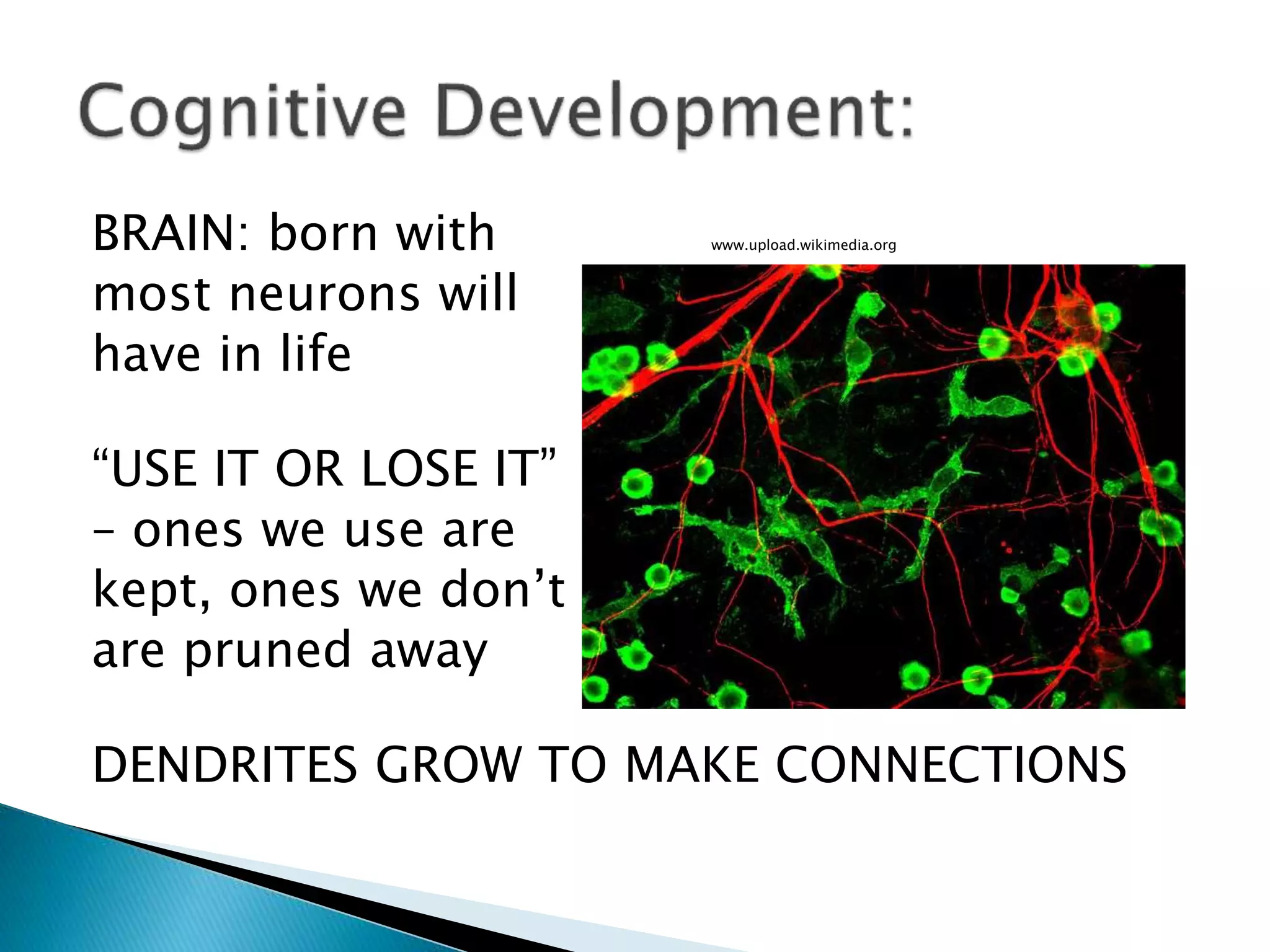
BRAIN: born with www.upload.wikimedia.org
most neurons will
have in life
“USE IT OR LOSE IT”
– ones we use are
kept, ones we don’t
are pruned away
DENDRITES GROW TO MAKE CONNECTIONS
 HABITUATION:
 simple form of learning where infants have
decreased responsiveness with repeated
presentation of the same stimuli
-will look longer at new stimuli, bored with
things they have experienced before
-means kids remember it, stare at it longer
 Children think differently than adults
 Cognitive abilities grow discontinuously with
big leaps
 Schemas-mental categories that organize
information (birds=wings, feathers, fly)
-assimilation: fit new information into schemas
(robins, cardinals)
-accomodation: change our schemas to fit new
information (penguins, ostriches)
1. Sensorimotor stage (0-2): form schemas,
gain object permanence
2. Preoperational stage (2-7): symbolic
thinking, egocentrism, animism
3. Concrete operational stage (7-12):
conservation of matter, simple logic
4. Formal operational stage (12+): abstract,
hypothetical thinking
Criticisms: different rates, go through more
quickly, more continuous
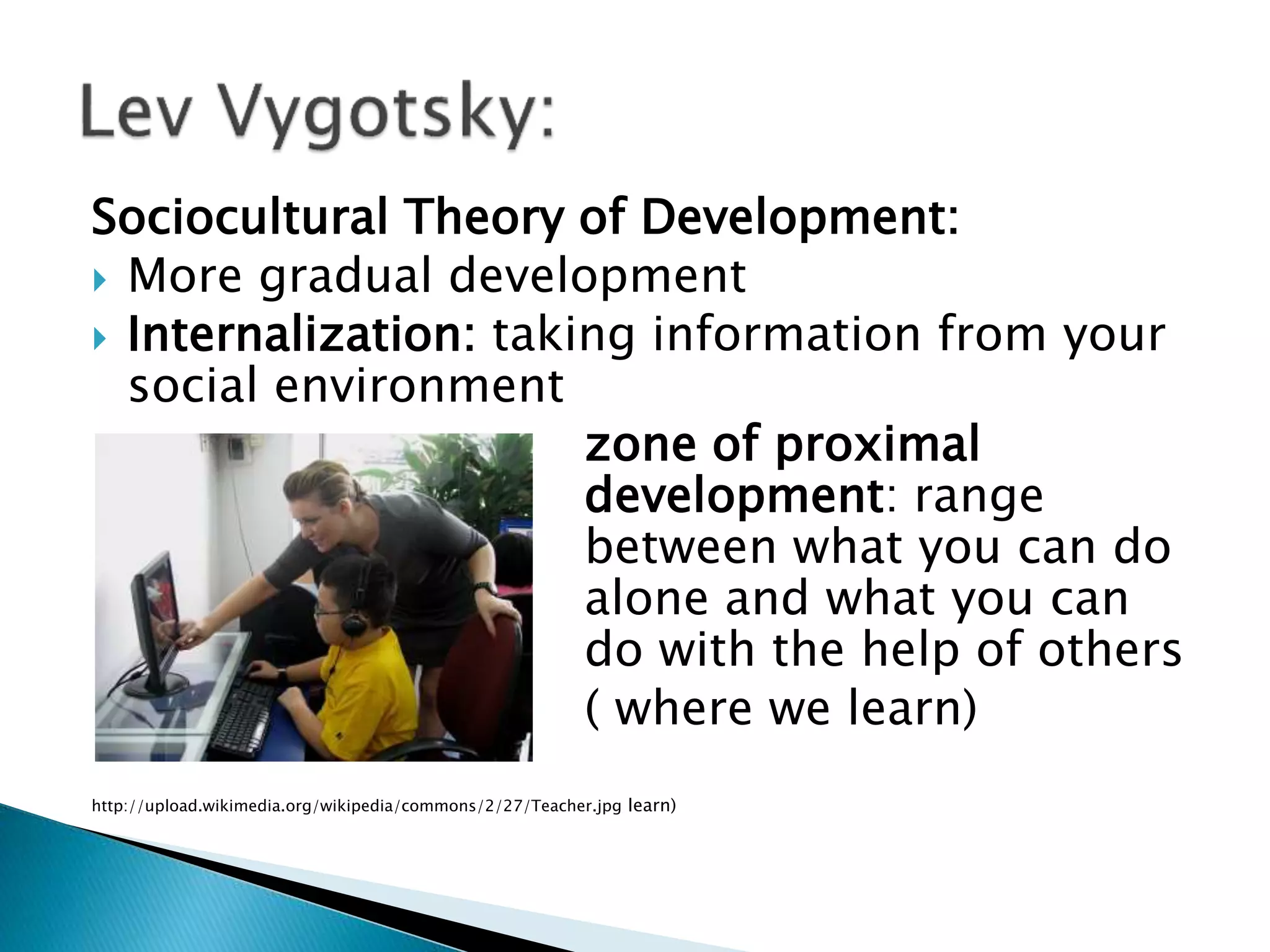
Sociocultural Theory of Development:
 More gradual development
 Internalization: taking information from your
social environment
zone of proximal
development: range
between what you can do
alone and what you can
do with the help of others
( where we learn)
http://upload.wikimedia.org/wikipedia/commons/2/27/Teacher.jpg learn)
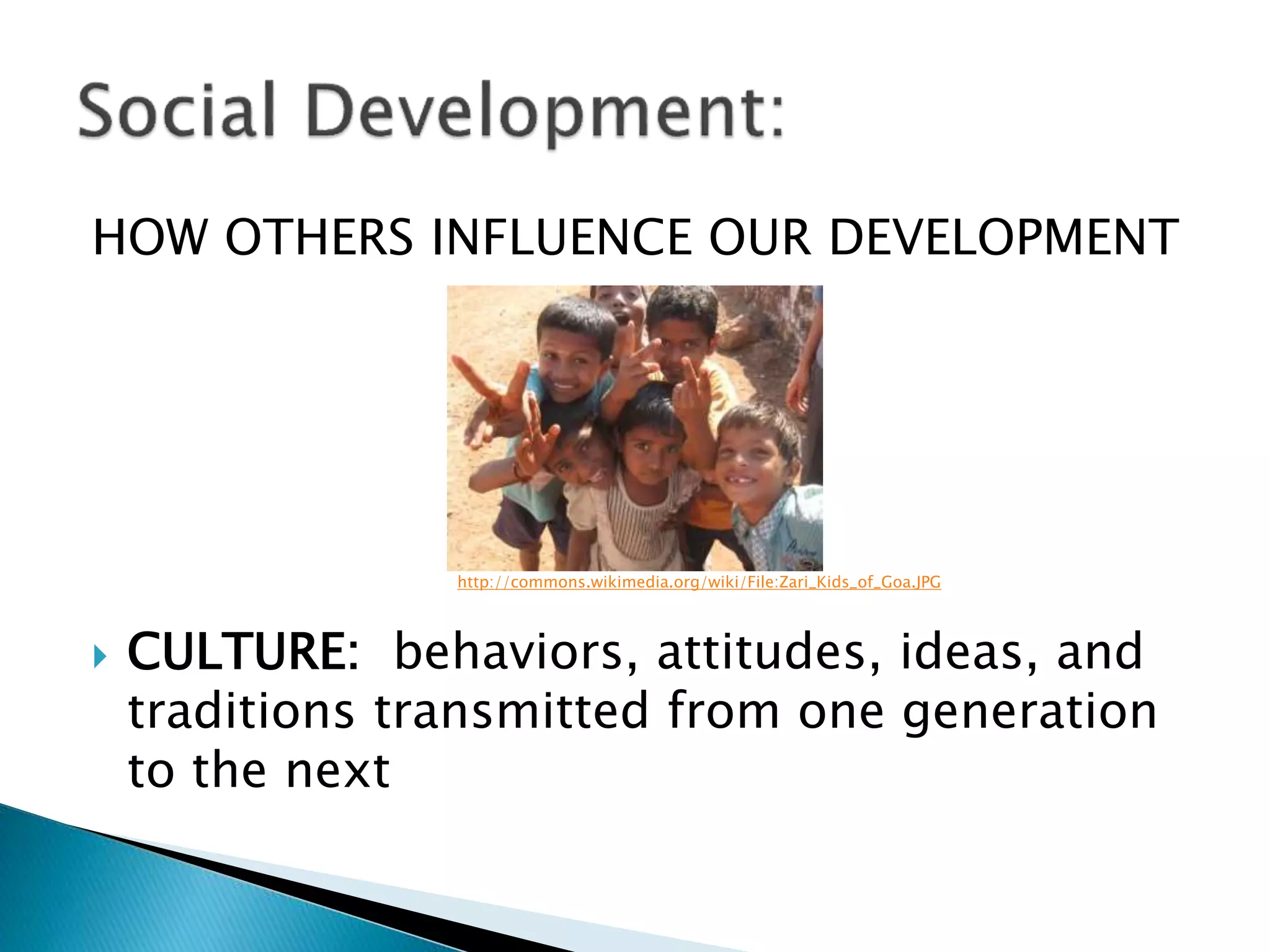
HOW OTHERS INFLUENCE OUR DEVELOPMENT
http://commons.wikimedia.org/wiki/File:Zari_Kids_of_Goa.JPG
 CULTURE: behaviors, attitudes, ideas, and
traditions transmitted from one generation
to the next
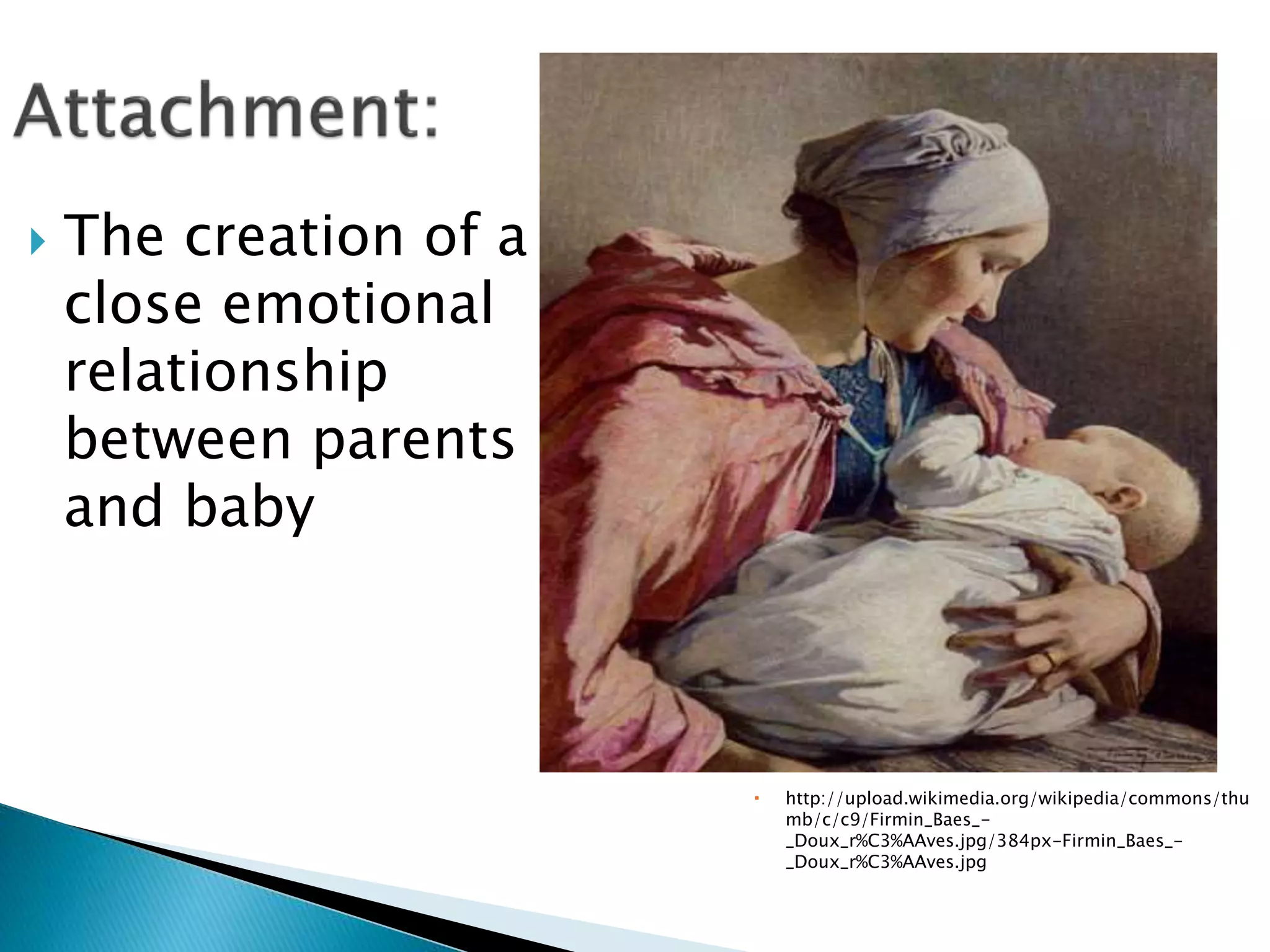
 The creation of a
close emotional
relationship
between parents
and baby
 http://upload.wikimedia.org/wikipedia/commons/thu
mb/c/c9/Firmin_Baes_-
_Doux_r%C3%AAves.jpg/384px-Firmin_Baes_-
_Doux_r%C3%AAves.jpg
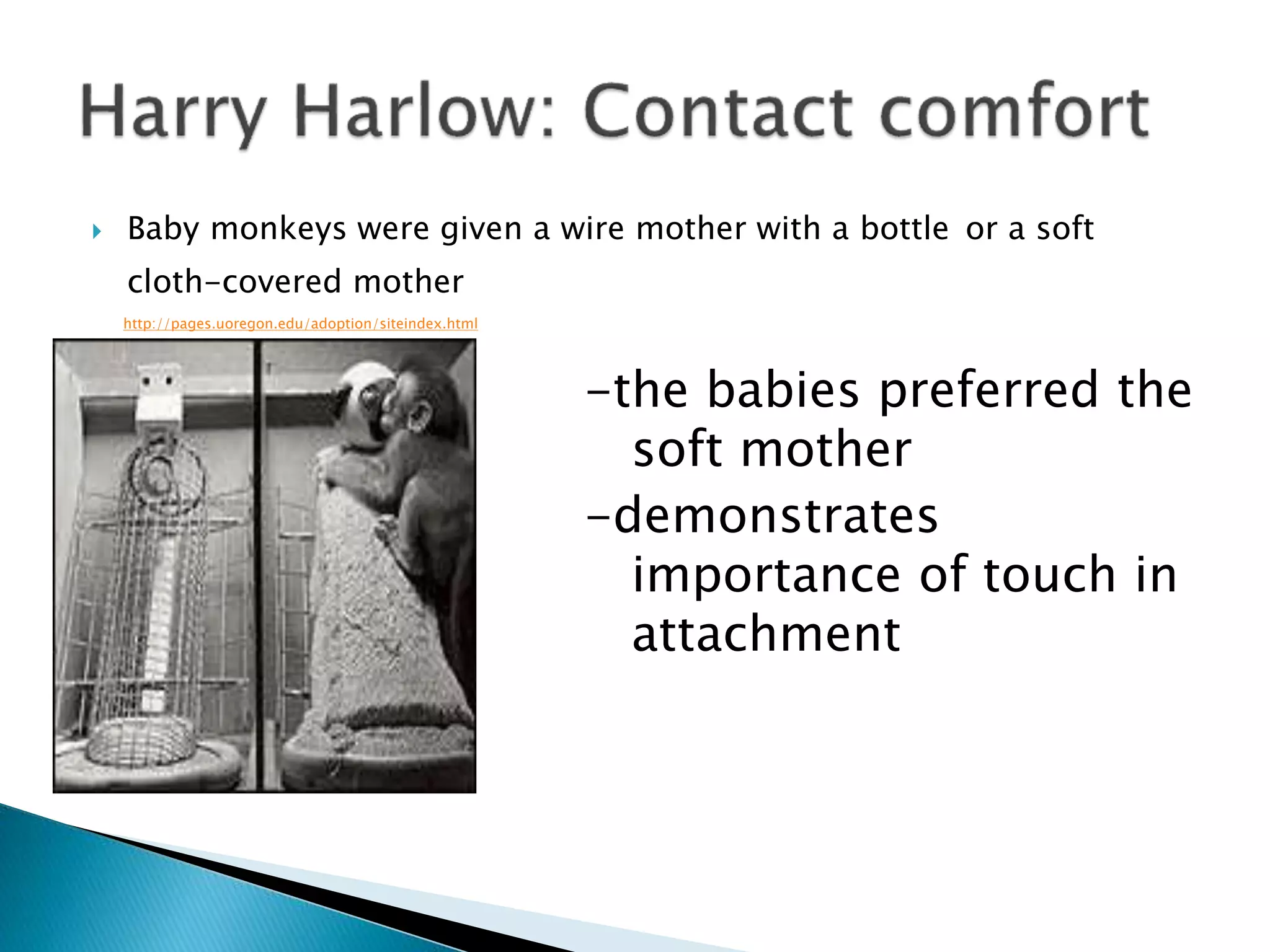
 Baby monkeys were given a wire mother with a bottle or a soft
cloth-covered mother
http://pages.uoregon.edu/adoption/siteindex.html
-the babies preferred the
soft mother
-demonstrates
importance of touch in
attachment
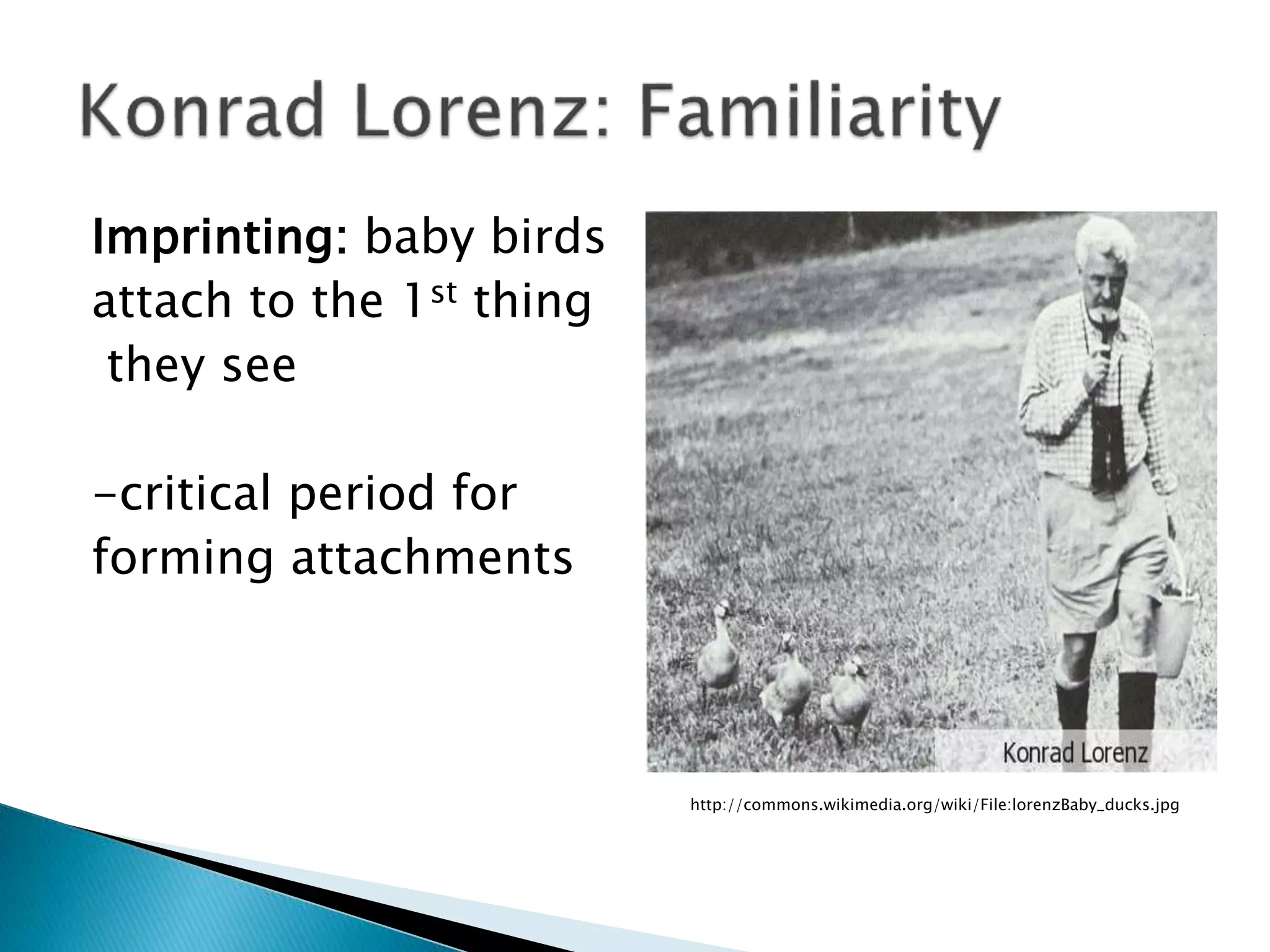
Imprinting: baby birds
attach to the 1st thing
they see
-critical period for
forming attachments
http://commons.wikimedia.org/wiki/File:lorenzBaby_ducks.jpg
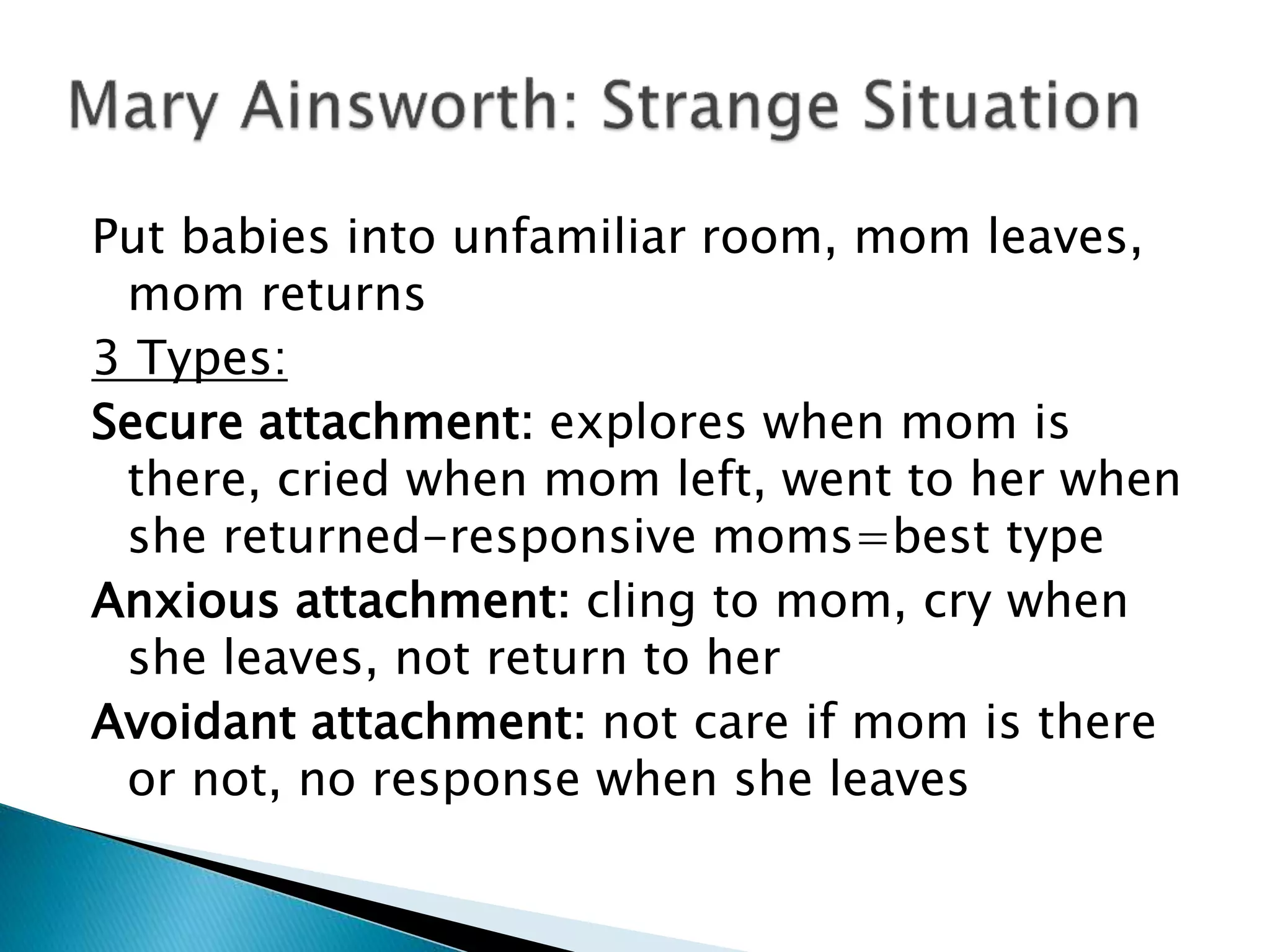
Put babies into unfamiliar room, mom leaves,
mom returns
3 Types:
Secure attachment: explores when mom is
there, cried when mom left, went to her when
she returned-responsive moms=best type
Anxious attachment: cling to mom, cry when
she leaves, not return to her
Avoidant attachment: not care if mom is there
or not, no response when she leaves
Temperament: natural disposition-easy or
difficult
Easy=cheerful, relaxed, predictable
Difficult=intense, irritable, unpredictable
Affects how parents react to child, and how
child reacts to parent
Authoritarian parents: strict rules, expect kids
to follow them, and punish if broken
Permissive parents: don’t set firm guidelines
or enforce the ones that are there
Authoritative parents: set rules but explain the
reason behind them, discuss
Authoritative-most independent, socially
competent, highest self-esteem
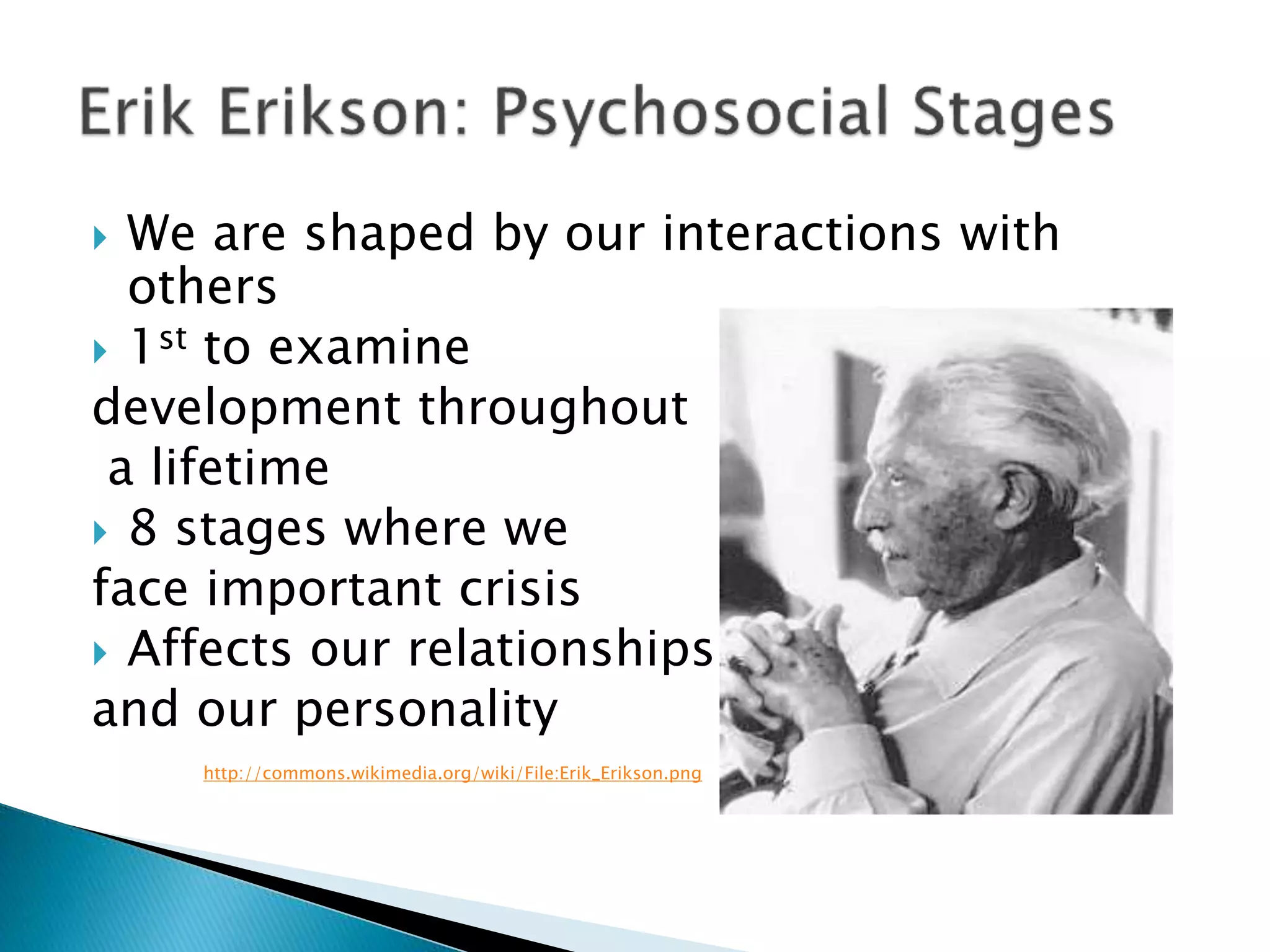
 We are shaped by our interactions with
others
 1st to examine
development throughout
a lifetime
 8 stages where we
face important crisis
 Affects our relationships
and our personality
http://commons.wikimedia.org/wiki/File:Erik_Erikson.png
1.Trust v. Mistrust (0-1)
2. Autonomy v. Shame/doubt(1-3)
3. Initiative v. Guilt (3-5)
4. Industry v. Inferiority (6-12)
5. Identity v. Role confusion (12-20)
6. Intimacy v. Isolation (21-40)
7. Generativity v. Stagnation (41-65)
8. Integrity v. Despair (65+)
 Discontinuous
 Gave moral dilemmas to males to see what
they would do and why (C. Gilligan criticize)
 3 levels of how make moral judgments:
 Preconventional: avoid punishment, seek
rewards
 Conventional: follow rules, other’s opinions
of them
 Postconventional: universal ethical principles
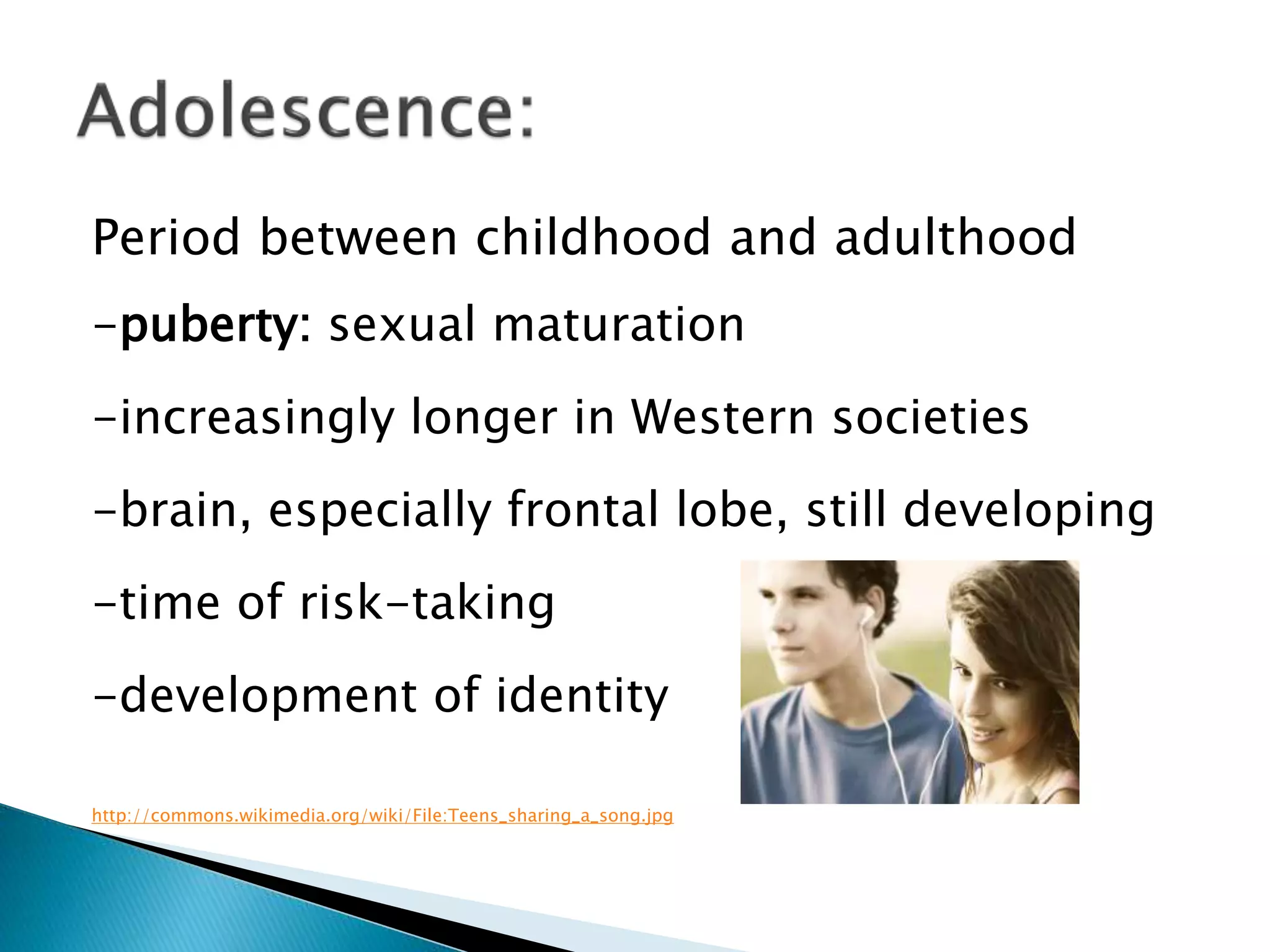
Period between childhood and adulthood
-puberty: sexual maturation
-increasingly longer in Western societies
-brain, especially frontal lobe, still developing
-time of risk-taking
-development of identity
http://commons.wikimedia.org/wiki/File:Teens_sharing_a_song.jpg
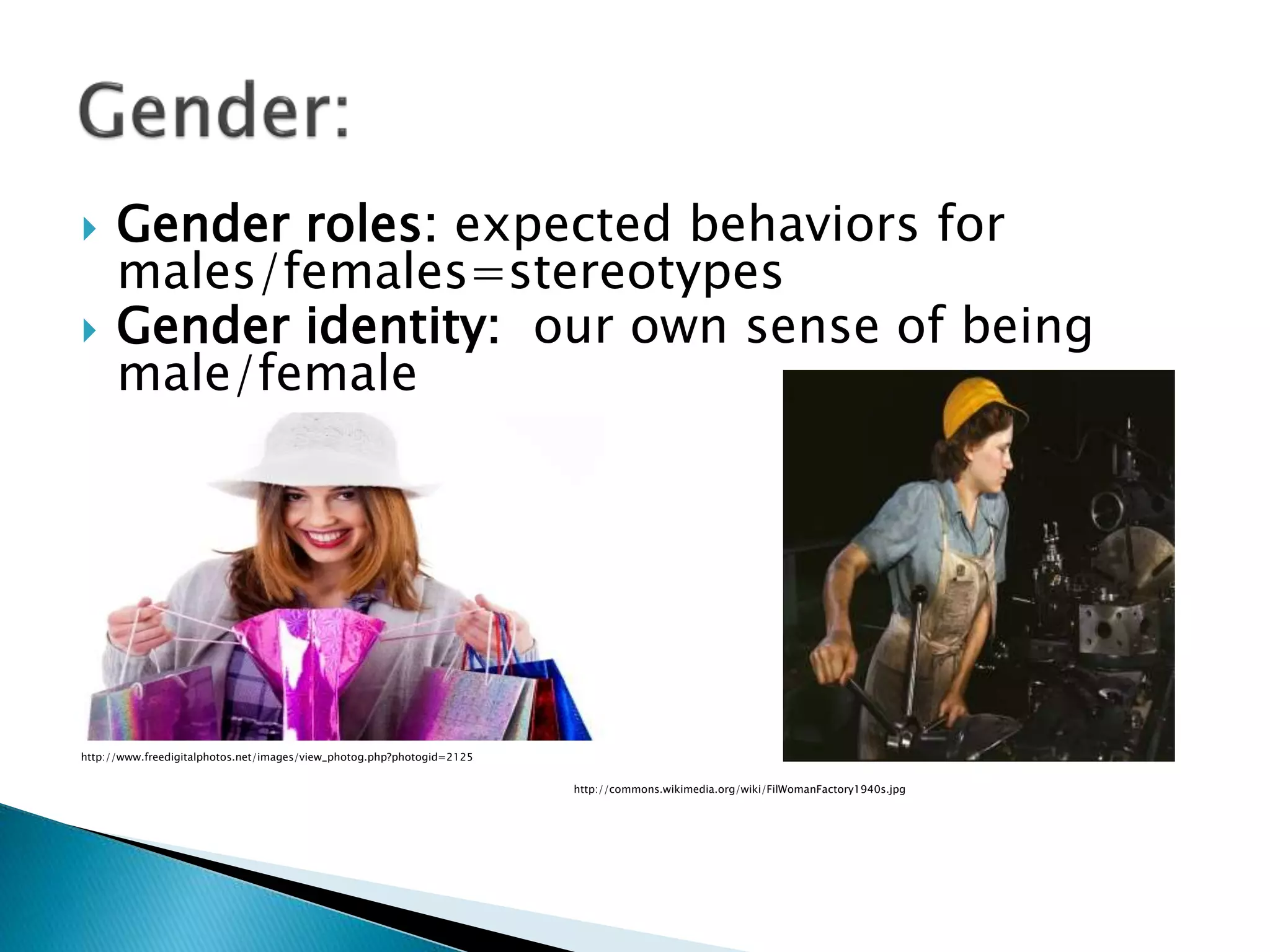
 Gender roles: expected behaviors for
males/females=stereotypes
 Gender identity: our own sense of being
male/female
http://www.freedigitalphotos.net/images/view_photog.php?photogid=2125
http://commons.wikimedia.org/wiki/FilWomanFactory1940s.jpg
Biological perspective: heredity, brain
differences
Evolutionary perspective: help us to
survive/reproduce
Behavioral perspective: rewards and
punishments and social learning
Cognitive perspective: gender-schema theory-
form schemas and act accordingly
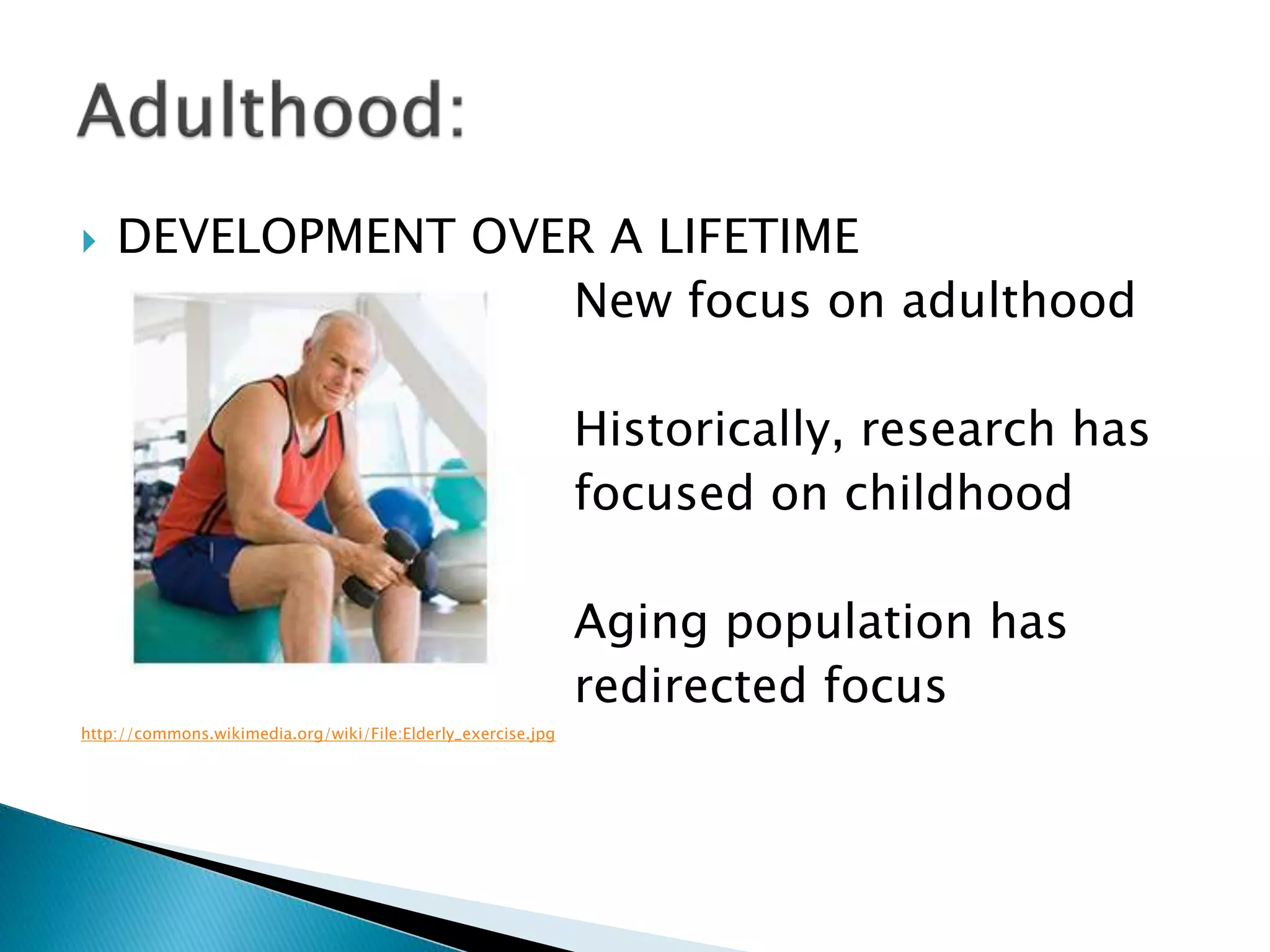
 DEVELOPMENT OVER A LIFETIME
New focus on adulthood
Historically, research has
focused on childhood
Aging population has
redirected focus
http://commons.wikimedia.org/wiki/File:Elderly_exercise.jpg
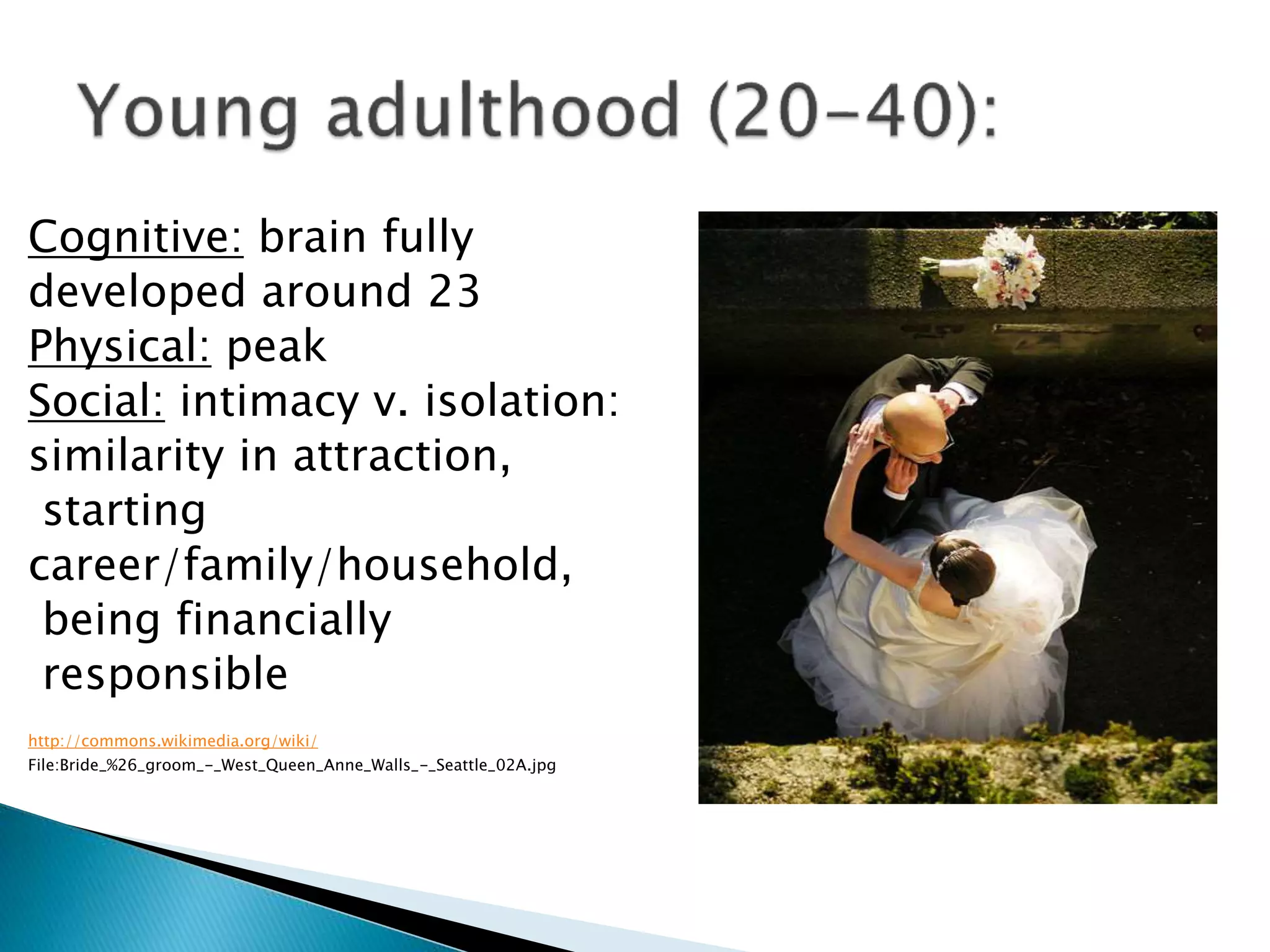
Cognitive: brain fully
developed around 23
Physical: peak
Social: intimacy v. isolation:
similarity in attraction,
starting
career/family/household,
being financially
responsible
http://commons.wikimedia.org/wiki/
File:Bride_%26_groom_-_West_Queen_Anne_Walls_-_Seattle_02A.jpg
Cognitive: Fluid intelligence: problem-solving
=decreases with age
Crystallized intelligence: factual knowledge-
increases with age
Physical: decreased vigor, menopause,
wrinkling, graying hair
Social:generativity v. stagnation, career
mastery, aging parents, empty nest
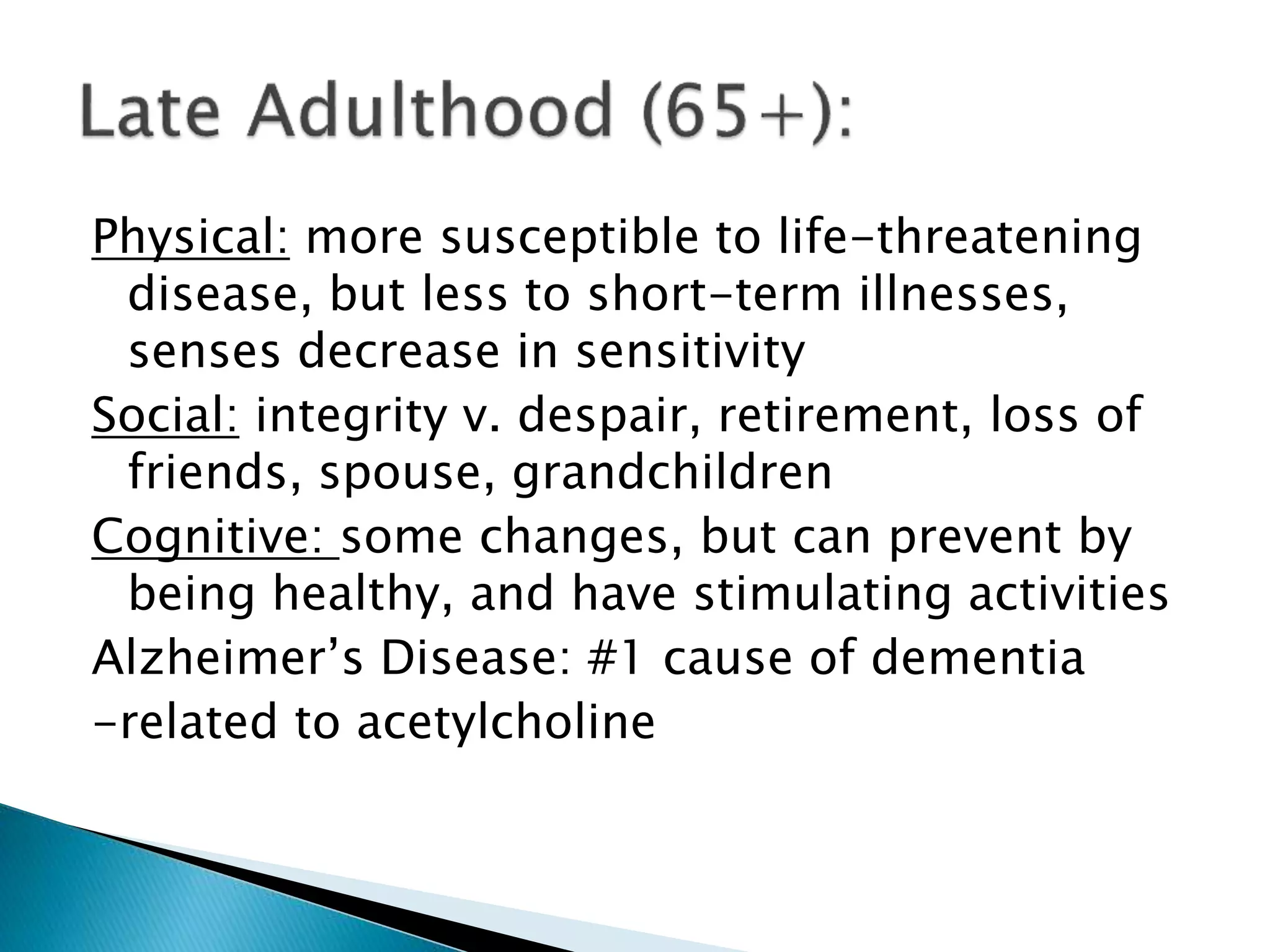
Physical: more susceptible to life-threatening
disease, but less to short-term illnesses,
senses decrease in sensitivity
Social: integrity v. despair, retirement, loss of
friends, spouse, grandchildren
Cognitive: some changes, but can prevent by
being healthy, and have stimulating activities
Alzheimer’s Disease: #1 cause of dementia
-related to acetylcholine
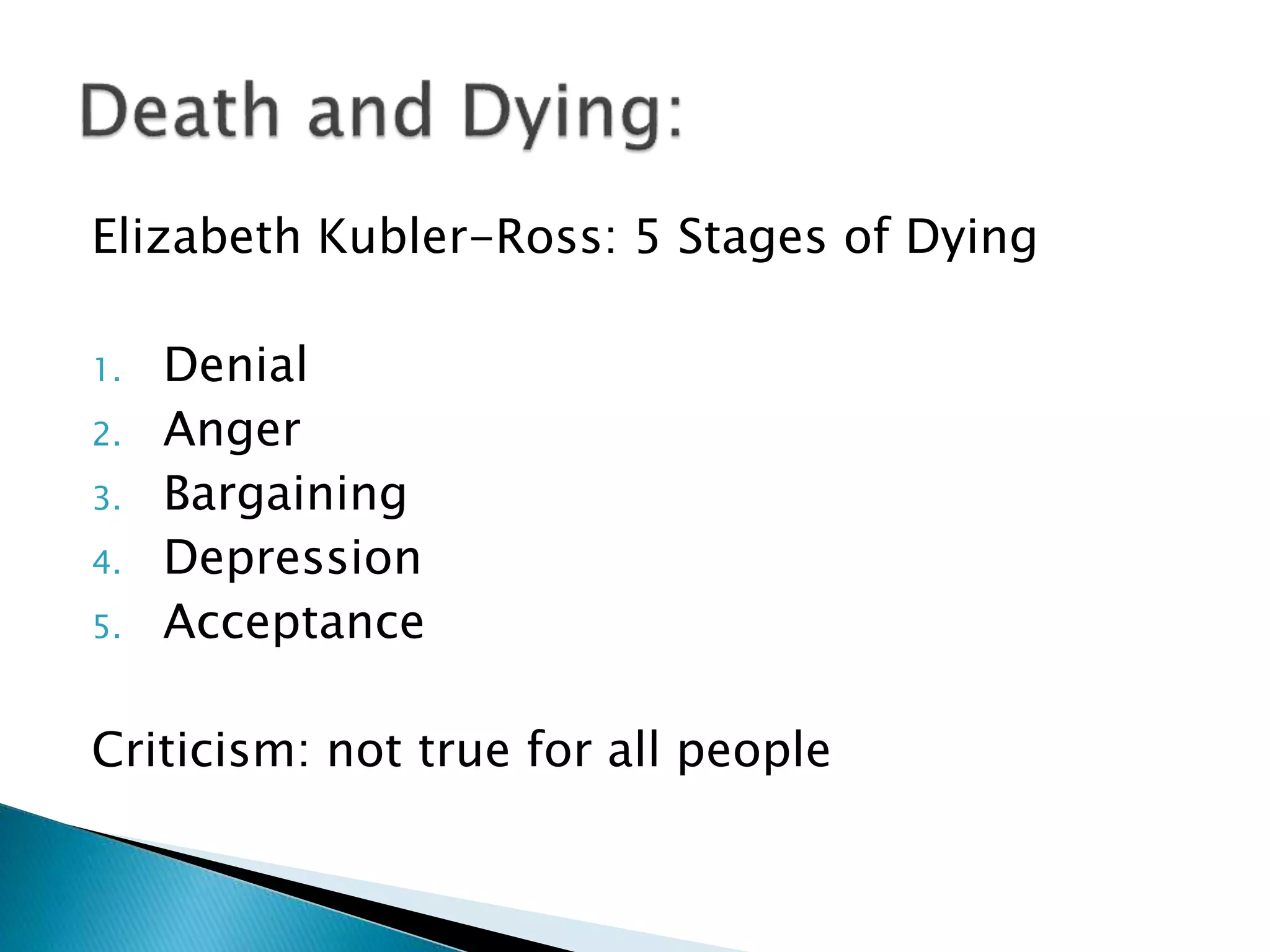
Elizabeth Kubler-Ross: 5 Stages of Dying
1. Denial
2. Anger
3. Bargaining
4. Depression
5. Acceptance
Criticism: not true for all people

Mod 3 development

  • 2.
    ARGUE OVER THEEXTENT TO WHICH EACH INFLUENCES BEHAVIOR  NATURE: genetics influence most  NURTURE: learning/environment shapes us Thomas Bouchard: Minnesota Twins Study -study identical (MZ) twins http://upload.wikimedia.org/wikipedia/commons/0/01/Twins_2004.jpg
  • 3.
    IS DEVELOPMENT: CONTINUOUS: agradual, cumulative change from birth to death (walking up a hill) OR DISCONTINUOUS: a sequence of distinct stages that build upon one another that every person goes through (climbing stairs)
  • 4.
     LONGITUDINAL: studysame group of people for a long time Good: accuracy Bad: costly, long time, lose participants  CROSS-SECTIONAL: compare different age groups now Good: quick, fast Bad: less accurate  COHORT-SEQUENTIAL: cross-sectional groups are studied at least 2 times over months/years, compared to others of same age
  • 5.
    1. GERMINAL STAGE(lasts about 2 weeks): zygote -a fertilized egg, it will divide many times 2. EMBRYONIC STAGE (lasts about 7 weeks): embryo -important organs form 3. FETAL STAGE (lasts for rest of pregnancy): fetus -growth, interaction of organs, form bones
  • 6.
    http://upload.wikimedia.org/wikipedia/commons/7/72/ Photo_of_baby_with_FAS.jpg Chemicals/diseases that can causeharm during the prenatal period FETAL ALCOHOL SYNDROME(FAS): #1 cause of mental retardation in the US
  • 7.
    INFANTS ARE BORNWITH SURVIVAL REFLEXES -Sucking -Rooting -Grasping -Moro/startle reflex -Babinski reflex -Swallowing AS MATURE, MANY REFLEXES DISAPPEAR http://upload.wikimedia.org/wikipedia/commons/3/32/Babies.jpg
  • 8.
    MATURATION: physical development -geneticallyinfluenced, little environment -development of cerebellum and myelin sheath 2 months-smile at voice 9 months-sits without support 12 months-says at least one word 18 months-can walk independently http://upload.wikimedia.org/wikipedia/com mons/3/35/Baby-lifting-weights.jpg
  • 9.
    BRAIN: born withwww.upload.wikimedia.org most neurons will have in life “USE IT OR LOSE IT” – ones we use are kept, ones we don’t are pruned away DENDRITES GROW TO MAKE CONNECTIONS
  • 10.
     HABITUATION:  simpleform of learning where infants have decreased responsiveness with repeated presentation of the same stimuli -will look longer at new stimuli, bored with things they have experienced before -means kids remember it, stare at it longer
  • 11.
     Children thinkdifferently than adults  Cognitive abilities grow discontinuously with big leaps  Schemas-mental categories that organize information (birds=wings, feathers, fly) -assimilation: fit new information into schemas (robins, cardinals) -accomodation: change our schemas to fit new information (penguins, ostriches)
  • 12.
    1. Sensorimotor stage(0-2): form schemas, gain object permanence 2. Preoperational stage (2-7): symbolic thinking, egocentrism, animism 3. Concrete operational stage (7-12): conservation of matter, simple logic 4. Formal operational stage (12+): abstract, hypothetical thinking Criticisms: different rates, go through more quickly, more continuous
  • 13.
    Sociocultural Theory ofDevelopment:  More gradual development  Internalization: taking information from your social environment zone of proximal development: range between what you can do alone and what you can do with the help of others ( where we learn) http://upload.wikimedia.org/wikipedia/commons/2/27/Teacher.jpg learn)
  • 14.
    HOW OTHERS INFLUENCEOUR DEVELOPMENT http://commons.wikimedia.org/wiki/File:Zari_Kids_of_Goa.JPG  CULTURE: behaviors, attitudes, ideas, and traditions transmitted from one generation to the next
  • 15.
     The creationof a close emotional relationship between parents and baby  http://upload.wikimedia.org/wikipedia/commons/thu mb/c/c9/Firmin_Baes_- _Doux_r%C3%AAves.jpg/384px-Firmin_Baes_- _Doux_r%C3%AAves.jpg
  • 16.
     Baby monkeyswere given a wire mother with a bottle or a soft cloth-covered mother http://pages.uoregon.edu/adoption/siteindex.html -the babies preferred the soft mother -demonstrates importance of touch in attachment
  • 17.
    Imprinting: baby birds attachto the 1st thing they see -critical period for forming attachments http://commons.wikimedia.org/wiki/File:lorenzBaby_ducks.jpg
  • 18.
    Put babies intounfamiliar room, mom leaves, mom returns 3 Types: Secure attachment: explores when mom is there, cried when mom left, went to her when she returned-responsive moms=best type Anxious attachment: cling to mom, cry when she leaves, not return to her Avoidant attachment: not care if mom is there or not, no response when she leaves
  • 19.
    Temperament: natural disposition-easyor difficult Easy=cheerful, relaxed, predictable Difficult=intense, irritable, unpredictable Affects how parents react to child, and how child reacts to parent
  • 20.
    Authoritarian parents: strictrules, expect kids to follow them, and punish if broken Permissive parents: don’t set firm guidelines or enforce the ones that are there Authoritative parents: set rules but explain the reason behind them, discuss Authoritative-most independent, socially competent, highest self-esteem
  • 21.
     We areshaped by our interactions with others  1st to examine development throughout a lifetime  8 stages where we face important crisis  Affects our relationships and our personality http://commons.wikimedia.org/wiki/File:Erik_Erikson.png
  • 22.
    1.Trust v. Mistrust(0-1) 2. Autonomy v. Shame/doubt(1-3) 3. Initiative v. Guilt (3-5) 4. Industry v. Inferiority (6-12) 5. Identity v. Role confusion (12-20) 6. Intimacy v. Isolation (21-40) 7. Generativity v. Stagnation (41-65) 8. Integrity v. Despair (65+)
  • 23.
     Discontinuous  Gavemoral dilemmas to males to see what they would do and why (C. Gilligan criticize)  3 levels of how make moral judgments:  Preconventional: avoid punishment, seek rewards  Conventional: follow rules, other’s opinions of them  Postconventional: universal ethical principles
  • 24.
    Period between childhoodand adulthood -puberty: sexual maturation -increasingly longer in Western societies -brain, especially frontal lobe, still developing -time of risk-taking -development of identity http://commons.wikimedia.org/wiki/File:Teens_sharing_a_song.jpg
  • 25.
     Gender roles:expected behaviors for males/females=stereotypes  Gender identity: our own sense of being male/female http://www.freedigitalphotos.net/images/view_photog.php?photogid=2125 http://commons.wikimedia.org/wiki/FilWomanFactory1940s.jpg
  • 26.
    Biological perspective: heredity,brain differences Evolutionary perspective: help us to survive/reproduce Behavioral perspective: rewards and punishments and social learning Cognitive perspective: gender-schema theory- form schemas and act accordingly
  • 27.
     DEVELOPMENT OVERA LIFETIME New focus on adulthood Historically, research has focused on childhood Aging population has redirected focus http://commons.wikimedia.org/wiki/File:Elderly_exercise.jpg
  • 28.
    Cognitive: brain fully developedaround 23 Physical: peak Social: intimacy v. isolation: similarity in attraction, starting career/family/household, being financially responsible http://commons.wikimedia.org/wiki/ File:Bride_%26_groom_-_West_Queen_Anne_Walls_-_Seattle_02A.jpg
  • 29.
    Cognitive: Fluid intelligence:problem-solving =decreases with age Crystallized intelligence: factual knowledge- increases with age Physical: decreased vigor, menopause, wrinkling, graying hair Social:generativity v. stagnation, career mastery, aging parents, empty nest
  • 30.
    Physical: more susceptibleto life-threatening disease, but less to short-term illnesses, senses decrease in sensitivity Social: integrity v. despair, retirement, loss of friends, spouse, grandchildren Cognitive: some changes, but can prevent by being healthy, and have stimulating activities Alzheimer’s Disease: #1 cause of dementia -related to acetylcholine
  • 31.
    Elizabeth Kubler-Ross: 5Stages of Dying 1. Denial 2. Anger 3. Bargaining 4. Depression 5. Acceptance Criticism: not true for all people