NETTIES 2015
(13th International Conference on Networking Entities)
5 – 8 March 2015
"Open Data and Big Data –
The Impact on Digital Society and Smart Cities“
Urban Mobility and Smart Cities –
a perspective from European R&D
Günter Koch, Humboldt Cosmos Multiversity
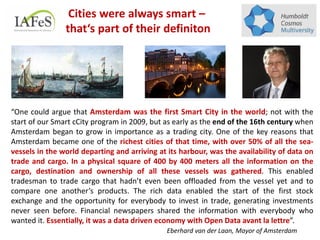
“One could argue that Amsterdam was the first Smart City in the world; not with the
start of our Smart cCity program in 2009, but as early as the end of the 16th century when
Amsterdam began to grow in importance as a trading city. One of the key reasons that
Amsterdam became one of the richest cities of that time, with over 50% of all the sea-
vessels in the world departing and arriving at its harbour, was the availability of data on
trade and cargo. In a physical square of 400 by 400 meters all the information on the
cargo, destination and ownership of all these vessels was gathered. This enabled
tradesman to trade cargo that hadn’t even been offloaded from the vessel yet and to
compare one another’s products. The rich data enabled the start of the first stock
exchange and the opportunity for everybody to invest in trade, generating investments
never seen before. Financial newspapers shared the information with everybody who
wanted it. Essentially, it was a data driven economy with Open Data avant la lettre”.
Eberhard van der Laan, Mayor of Amsterdam
Cities were always smart –
that‘s part of their definiton
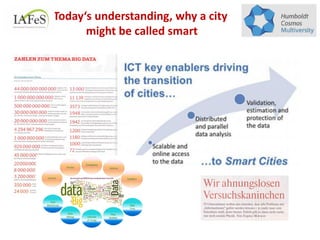
Today‘s understanding, why a city
might be called smart
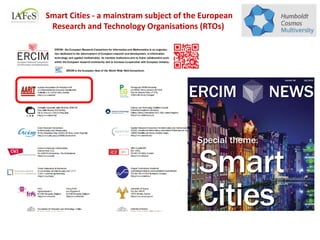
Smart Cities - a mainstram subject of the European
Research and Technology Organisations (RTOs)
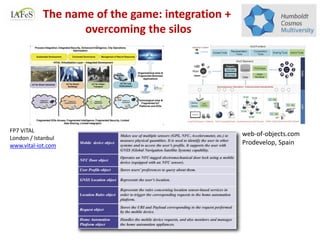
The name of the game: integration +
overcoming the silos
web-of-objects.com
Prodevelop, Spain
FP7 VITAL
London / Istanbul
www.vital-iot.com
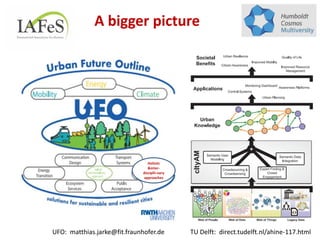
Holistic
&inter-
disciplii-nary
approaches
A bigger picture
TU Delft: direct.tudelft.nl/ahine-117.htmlUFO: matthias.jarke@fit.fraunhofer.de
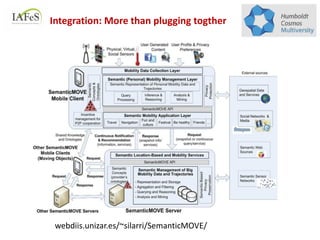
Integration: More than plugging togther
webdiis.unizar.es/~silarri/SemanticMOVE/
An interesting definition: “My understanding of the term "semantics" is that words can
be manipulated to influence human thought and action. George Orwell had a good
grasp of the concept, for example: “Newspeak” . Please look up "semantics" in a
dictionary for a more professional definition”.
by Friend of Tell March 06, 2009 in the “Urban Dictionary”
Semantics is the study of meaning. It focuses on the relation between signifiers, like
words, phrases, signs and symbols and what they stand for, their denotation…forms of
semantics include the semantics of programming languages, formal logics, and semiotics.
In computer science the term semantics refers to the meaning of languages, as opposed
to their form (syntax) . Semantics provides the rules for interpreting the syntax which do
not provide the meaning directly but constrains the possible interpretations of what is
declared. In other words, semantics is about interpretation of an expression. Additionally,
the term is applied to certain types of data structures specifically designed and used for
representing information content.
A semantic network is a network which represents semantic relations between concepts.
This is often used as a form of knowledge representation. It is a directed or undirected
graph consisting of vertices, which represent concepts, and edges
Plugging together
the meanings of data (structures)
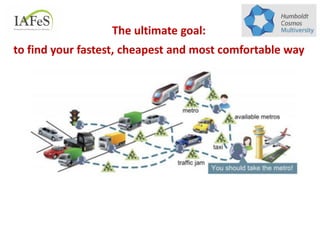
The ultimate goal:
to find your fastest, cheapest and most comfortable way
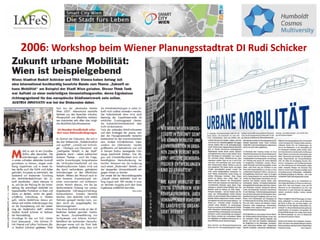
2006: Workshop beim Wiener Planungsstadtrat DI Rudi Schicker
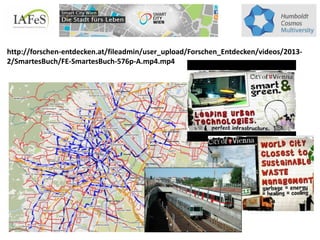
http://forschen-entdecken.at/fileadmin/user_upload/Forschen_Entdecken/videos/2013-
2/SmartesBuch/FE-SmartesBuch-576p-A.mp4.mp4
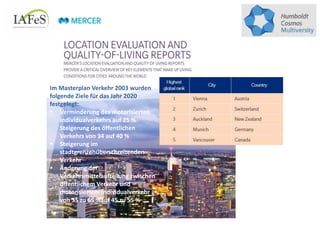
Im Masterplan Verkehr 2003 wurden
folgende Ziele für das Jahr 2020
festgelegt:
 Verminderung des motorisierten
Individualverkehrs auf 25 %
Steigerung des öffentlichen
Verkehrs von 34 auf 40 %
 Steigerung im
stadtgrenzenüberschreitenden
Verkehr
 Änderung der
Verkehrsmittelaufteilung zwischen
öffentlichem Verkehr und
motorisiertem Individualverkehr
von 35 zu 65 %auf 45 zu 55 %
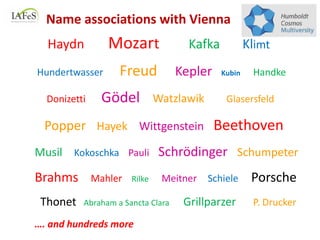
Haydn Mozart Kafka Klimt
Hundertwasser Freud Kepler Kubin Handke
Donizetti Gödel Watzlawik Glasersfeld
Popper Hayek Wittgenstein Beethoven
Musil Kokoschka Pauli Schrödinger Schumpeter
Brahms Mahler Rilke Meitner Schiele Porsche
Thonet Abraham a Sancta Clara Grillparzer P. Drucker
…. and hundreds more
Name associations with Vienna
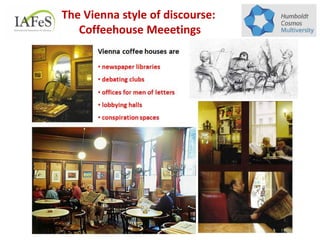
The Vienna style of discourse:
Coffeehouse Meeetings
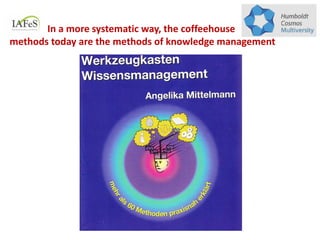
In a more systematic way, the coffeehouse
methods today are the methods of knowledge management
Thank you for your attention!
Questions?
Mobility issues in European Research

Mobility issues in European Research

  • 1.
    NETTIES 2015 (13th InternationalConference on Networking Entities) 5 – 8 March 2015 "Open Data and Big Data – The Impact on Digital Society and Smart Cities“ Urban Mobility and Smart Cities – a perspective from European R&D Günter Koch, Humboldt Cosmos Multiversity
  • 2.
    “One could arguethat Amsterdam was the first Smart City in the world; not with the start of our Smart cCity program in 2009, but as early as the end of the 16th century when Amsterdam began to grow in importance as a trading city. One of the key reasons that Amsterdam became one of the richest cities of that time, with over 50% of all the sea- vessels in the world departing and arriving at its harbour, was the availability of data on trade and cargo. In a physical square of 400 by 400 meters all the information on the cargo, destination and ownership of all these vessels was gathered. This enabled tradesman to trade cargo that hadn’t even been offloaded from the vessel yet and to compare one another’s products. The rich data enabled the start of the first stock exchange and the opportunity for everybody to invest in trade, generating investments never seen before. Financial newspapers shared the information with everybody who wanted it. Essentially, it was a data driven economy with Open Data avant la lettre”. Eberhard van der Laan, Mayor of Amsterdam Cities were always smart – that‘s part of their definiton
  • 3.
    Today‘s understanding, whya city might be called smart
  • 4.
    Smart Cities -a mainstram subject of the European Research and Technology Organisations (RTOs)
  • 5.
    The name ofthe game: integration + overcoming the silos web-of-objects.com Prodevelop, Spain FP7 VITAL London / Istanbul www.vital-iot.com
  • 6.
    Holistic &inter- disciplii-nary approaches A bigger picture TUDelft: direct.tudelft.nl/ahine-117.htmlUFO: matthias.jarke@fit.fraunhofer.de
  • 7.
    Integration: More thanplugging togther webdiis.unizar.es/~silarri/SemanticMOVE/
  • 8.
    An interesting definition:“My understanding of the term "semantics" is that words can be manipulated to influence human thought and action. George Orwell had a good grasp of the concept, for example: “Newspeak” . Please look up "semantics" in a dictionary for a more professional definition”. by Friend of Tell March 06, 2009 in the “Urban Dictionary” Semantics is the study of meaning. It focuses on the relation between signifiers, like words, phrases, signs and symbols and what they stand for, their denotation…forms of semantics include the semantics of programming languages, formal logics, and semiotics. In computer science the term semantics refers to the meaning of languages, as opposed to their form (syntax) . Semantics provides the rules for interpreting the syntax which do not provide the meaning directly but constrains the possible interpretations of what is declared. In other words, semantics is about interpretation of an expression. Additionally, the term is applied to certain types of data structures specifically designed and used for representing information content. A semantic network is a network which represents semantic relations between concepts. This is often used as a form of knowledge representation. It is a directed or undirected graph consisting of vertices, which represent concepts, and edges Plugging together the meanings of data (structures)
  • 9.
    The ultimate goal: tofind your fastest, cheapest and most comfortable way
  • 10.
    2006: Workshop beimWiener Planungsstadtrat DI Rudi Schicker
  • 11.
  • 12.
    Im Masterplan Verkehr2003 wurden folgende Ziele für das Jahr 2020 festgelegt:  Verminderung des motorisierten Individualverkehrs auf 25 % Steigerung des öffentlichen Verkehrs von 34 auf 40 %  Steigerung im stadtgrenzenüberschreitenden Verkehr  Änderung der Verkehrsmittelaufteilung zwischen öffentlichem Verkehr und motorisiertem Individualverkehr von 35 zu 65 %auf 45 zu 55 %
  • 13.
    Haydn Mozart KafkaKlimt Hundertwasser Freud Kepler Kubin Handke Donizetti Gödel Watzlawik Glasersfeld Popper Hayek Wittgenstein Beethoven Musil Kokoschka Pauli Schrödinger Schumpeter Brahms Mahler Rilke Meitner Schiele Porsche Thonet Abraham a Sancta Clara Grillparzer P. Drucker …. and hundreds more Name associations with Vienna
  • 14.
    The Vienna styleof discourse: Coffeehouse Meeetings
  • 15.
    In a moresystematic way, the coffeehouse methods today are the methods of knowledge management
  • 16.
    Thank you foryour attention! Questions?