mobile development platforms
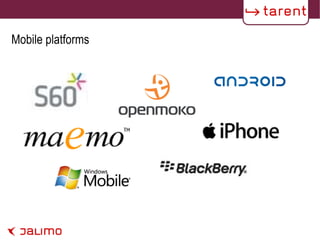
Mobile platforms
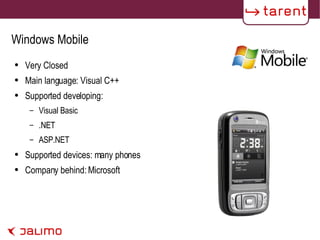
Windows Mobile Very Closed Main language: Visual C++ Supported developing: Visual Basic .NET ASP.NET Supported devices: many phones Company behind: Microsoft
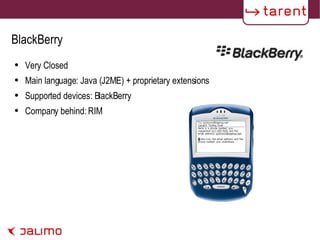
BlackBerry Very Closed Main language: Java (J2ME) + proprietary extensions Supported devices: BlackBerry Company behind: RIM
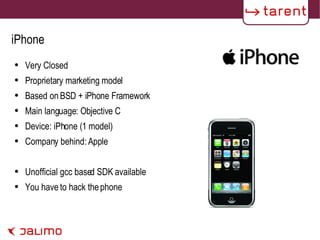
iPhone Very Closed Proprietary marketing model Based on BSD + iPhone Framework Main language: Objective C Device: iPhone (1 model) Company behind: Apple Unofficial gcc based SDK available You have to hack the phone
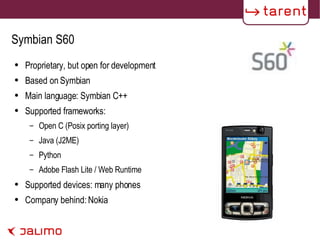
Symbian S60 Proprietary, but open for development Based on Symbian Main language: Symbian C++ Supported frameworks: Open C (Posix porting layer) Java (J2ME) Python Adobe Flash Lite / Web Runtime Supported devices: many phones Company behind: Nokia
Symbian Foundation New initiative of symbian companies Conflation of different symbian flavors S60 UIQ MOAP(S) Goal is to OpenSource Symbian until 2010 Planed License: Eclipse Public License (EPL)
Android Free & Open? Not known yet! Based on Linux + Android runtime GUI Toolkits: Android Language: Java subset only Written from scratch Supported devices: emulator + HTC (announced) Company behind: Google + Open Handset Alliance
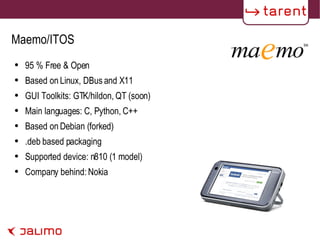
Maemo/ITOS 95 % Free & Open Based on Linux, DBus and X11 GUI Toolkits: GTK/hildon, QT (soon) Main languages: C, Python, C++ Based on Debian (forked) .deb based packaging Supported device: n810 (1 model) Company behind: Nokia
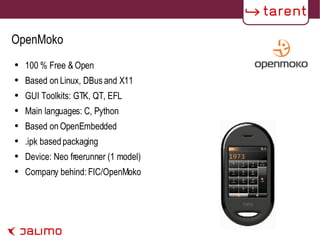
OpenMoko 100 % Free & Open Based on Linux, DBus and X11 GUI Toolkits: GTK, QT, EFL Main languages: C, Python Based on OpenEmbedded .ipk based packaging Device: Neo freerunner (1 model) Company behind: FIC/OpenMoko
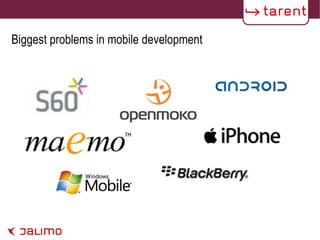
Biggest problems in mobile development
Problem 1: Too many restrictions Only small control over the system Often only limited APIs are available Features are locked, signing processes are forced The core components are not replaceable Free platforms change this:
Problem 2: Too many platforms Large number of different platforms Few standards for cross platform development J2ME HTML/Web Applications J2ME often relies on proprietary extensions Some platforms cover only one device solution: Cross platform development standards Or: Focus on widespreaded platforms
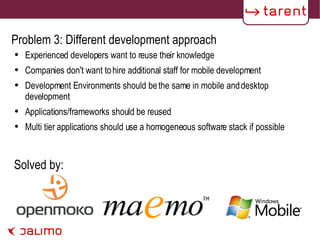
Problem 3: Different development approach Experienced developers want to reuse their knowledge Companies don't want to hire additional staff for mobile development Development Environments should be the same in mobile and desktop development Applications/frameworks should be reused Multi tier applications should use a homogeneous software stack if possible Solved by:
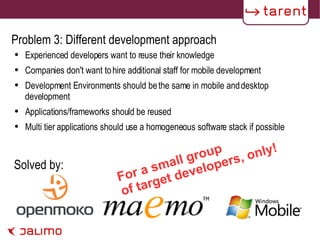
Problem 3: Different development approach Experienced developers want to reuse their knowledge Companies don't want to hire additional staff for mobile development Development Environments should be the same in mobile and desktop development Applications/frameworks should be reused Multi tier applications should use a homogeneous software stack if possible Solved by: For a small group of target developers, only!
What's wrong with J2ME? Targets much of the problems, but .. Has too much restrictions Differs to much from usual Java Completely different APIs No code reuse Even if it is standardized: Every manufacturer has different implementations Applications have to be device specific Not powerful enough for much application types
What's about Android? Targets much of the problems ... has only few restrictions uses real Java promises wide availability still differs from usual Java special APIs code reuse only below the GUI is not standardized is not designed for integration in other platforms does not integrate other approaches ... but ...
What's about Maemo & OpenMoko? They do a lot of things right ... eliminate restrictions use real desktop toolkits each platform has only one device no API standardization (between those platforms) focus only on a very special developer community ... but ...
Cross platform solutions Upcoming solutions QT FreeSmartPhone.org standards LWUIT Jalimo OpenEmbedded Cross platform development is not a language problem, but a problem of cross platforms the libraries and toolkits.
What's about QT? QT has the chance to become a solution! Good, powerful Toolkit Wide availability Windows, Windows Mobile Linux, OpenMoko Good Java bindings: Jambi Acquired by Nokia Soon supported on Symbian and Maemo
FreeSmartPhone.org standards Origin OpenMoko framework initiative Most work founded by OpenMoko Independent Project DBus API design Reference implementation of services Base for any interaction of applications with the platform  Standardisation of Smartphone APIs
LWUIT GUI Library for J2ME Similar to Swing Small but powerful Released as GPL from Sun, just now Usable on all J2ME phones Easy portable backend  Ports in work Java AWT (CDC) Microbackend (X, SWT, AWT, ...) Sun's way to unify mobile and desktop development? Benefits of LWUIT
jalimo Project to bring free full Java to mobile and embedded platforms Support for the development lifecycle to target mobile devices with java Integrative project, doing most work in upstream projects Current targets: maemo, OpenMoko, BugLabs, BeagleBoard, Irex Iliad No additional mobile platform! No additional JVM! What is jalimo not:
Initiated by Tarent Active members from: Bug Labs & MIDPath One technology among the applications! Use the same staff for mobile and server side development! Who is behind jalimo? Why is tarent doing jalimo? Tarent has employed 60 people (~40 Java developer) Most of tarent's projects use java on the server side
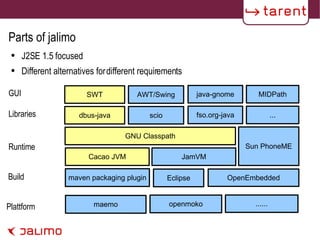
Parts of jalimo Libraries Runtime Build Plattform GUI J2SE 1.5 focused Different alternatives for different requirements Cacao JVM JamVM GNU Classpath Sun PhoneME dbus-java scio fso.org-java ... maven packaging plugin OpenEmbedded Eclipse maemo ...?... openmoko ...... SWT AWT/Swing java-gnome MIDPath
OpenEmbedded cross-compile environment generation of complete distributions support for 1000's packages builds the base for OpenMoko Angstroem Jalimo Buglabs Irex Iliad ... Nice solution for multi platform development
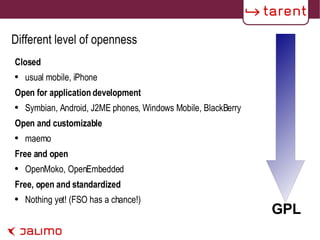
Different level of openness Closed usual mobile, iPhone Open for application development Symbian, Android, J2ME phones, Windows Mobile, BlackBerry Open and customizable maemo Free and open OpenMoko, OpenEmbedded Free, open and standardized Nothing yet! (FSO has a chance!) GPL
Thank you! CC-BY-SA 3.0 or GNU FDL 1.2 or, at your option, any later version. Mobile@FrosCon: Freie Software für das iPhone Ralph Pöllath  11:15 Uhr, HS 4 Openmoko 2008 Michael Lauer 14:00 Uhr,  HS 1

mobile development platforms

  • 1.
  • 2.
  • 3.
    Windows Mobile VeryClosed Main language: Visual C++ Supported developing: Visual Basic .NET ASP.NET Supported devices: many phones Company behind: Microsoft
  • 4.
    BlackBerry Very ClosedMain language: Java (J2ME) + proprietary extensions Supported devices: BlackBerry Company behind: RIM
  • 5.
    iPhone Very ClosedProprietary marketing model Based on BSD + iPhone Framework Main language: Objective C Device: iPhone (1 model) Company behind: Apple Unofficial gcc based SDK available You have to hack the phone
  • 6.
    Symbian S60 Proprietary,but open for development Based on Symbian Main language: Symbian C++ Supported frameworks: Open C (Posix porting layer) Java (J2ME) Python Adobe Flash Lite / Web Runtime Supported devices: many phones Company behind: Nokia
  • 7.
    Symbian Foundation Newinitiative of symbian companies Conflation of different symbian flavors S60 UIQ MOAP(S) Goal is to OpenSource Symbian until 2010 Planed License: Eclipse Public License (EPL)
  • 8.
    Android Free &Open? Not known yet! Based on Linux + Android runtime GUI Toolkits: Android Language: Java subset only Written from scratch Supported devices: emulator + HTC (announced) Company behind: Google + Open Handset Alliance
  • 9.
    Maemo/ITOS 95 %Free & Open Based on Linux, DBus and X11 GUI Toolkits: GTK/hildon, QT (soon) Main languages: C, Python, C++ Based on Debian (forked) .deb based packaging Supported device: n810 (1 model) Company behind: Nokia
  • 10.
    OpenMoko 100 %Free & Open Based on Linux, DBus and X11 GUI Toolkits: GTK, QT, EFL Main languages: C, Python Based on OpenEmbedded .ipk based packaging Device: Neo freerunner (1 model) Company behind: FIC/OpenMoko
  • 11.
    Biggest problems inmobile development
  • 12.
    Problem 1: Toomany restrictions Only small control over the system Often only limited APIs are available Features are locked, signing processes are forced The core components are not replaceable Free platforms change this:
  • 13.
    Problem 2: Toomany platforms Large number of different platforms Few standards for cross platform development J2ME HTML/Web Applications J2ME often relies on proprietary extensions Some platforms cover only one device solution: Cross platform development standards Or: Focus on widespreaded platforms
  • 14.
    Problem 3: Differentdevelopment approach Experienced developers want to reuse their knowledge Companies don't want to hire additional staff for mobile development Development Environments should be the same in mobile and desktop development Applications/frameworks should be reused Multi tier applications should use a homogeneous software stack if possible Solved by:
  • 15.
    Problem 3: Differentdevelopment approach Experienced developers want to reuse their knowledge Companies don't want to hire additional staff for mobile development Development Environments should be the same in mobile and desktop development Applications/frameworks should be reused Multi tier applications should use a homogeneous software stack if possible Solved by: For a small group of target developers, only!
  • 16.
    What's wrong withJ2ME? Targets much of the problems, but .. Has too much restrictions Differs to much from usual Java Completely different APIs No code reuse Even if it is standardized: Every manufacturer has different implementations Applications have to be device specific Not powerful enough for much application types
  • 17.
    What's about Android?Targets much of the problems ... has only few restrictions uses real Java promises wide availability still differs from usual Java special APIs code reuse only below the GUI is not standardized is not designed for integration in other platforms does not integrate other approaches ... but ...
  • 18.
    What's about Maemo& OpenMoko? They do a lot of things right ... eliminate restrictions use real desktop toolkits each platform has only one device no API standardization (between those platforms) focus only on a very special developer community ... but ...
  • 19.
    Cross platform solutionsUpcoming solutions QT FreeSmartPhone.org standards LWUIT Jalimo OpenEmbedded Cross platform development is not a language problem, but a problem of cross platforms the libraries and toolkits.
  • 20.
    What's about QT?QT has the chance to become a solution! Good, powerful Toolkit Wide availability Windows, Windows Mobile Linux, OpenMoko Good Java bindings: Jambi Acquired by Nokia Soon supported on Symbian and Maemo
  • 21.
    FreeSmartPhone.org standards OriginOpenMoko framework initiative Most work founded by OpenMoko Independent Project DBus API design Reference implementation of services Base for any interaction of applications with the platform Standardisation of Smartphone APIs
  • 22.
    LWUIT GUI Libraryfor J2ME Similar to Swing Small but powerful Released as GPL from Sun, just now Usable on all J2ME phones Easy portable backend Ports in work Java AWT (CDC) Microbackend (X, SWT, AWT, ...) Sun's way to unify mobile and desktop development? Benefits of LWUIT
  • 23.
    jalimo Project tobring free full Java to mobile and embedded platforms Support for the development lifecycle to target mobile devices with java Integrative project, doing most work in upstream projects Current targets: maemo, OpenMoko, BugLabs, BeagleBoard, Irex Iliad No additional mobile platform! No additional JVM! What is jalimo not:
  • 24.
    Initiated by TarentActive members from: Bug Labs & MIDPath One technology among the applications! Use the same staff for mobile and server side development! Who is behind jalimo? Why is tarent doing jalimo? Tarent has employed 60 people (~40 Java developer) Most of tarent's projects use java on the server side
  • 25.
    Parts of jalimoLibraries Runtime Build Plattform GUI J2SE 1.5 focused Different alternatives for different requirements Cacao JVM JamVM GNU Classpath Sun PhoneME dbus-java scio fso.org-java ... maven packaging plugin OpenEmbedded Eclipse maemo ...?... openmoko ...... SWT AWT/Swing java-gnome MIDPath
  • 26.
    OpenEmbedded cross-compile environmentgeneration of complete distributions support for 1000's packages builds the base for OpenMoko Angstroem Jalimo Buglabs Irex Iliad ... Nice solution for multi platform development
  • 27.
    Different level ofopenness Closed usual mobile, iPhone Open for application development Symbian, Android, J2ME phones, Windows Mobile, BlackBerry Open and customizable maemo Free and open OpenMoko, OpenEmbedded Free, open and standardized Nothing yet! (FSO has a chance!) GPL
  • 28.
    Thank you! CC-BY-SA3.0 or GNU FDL 1.2 or, at your option, any later version. Mobile@FrosCon: Freie Software für das iPhone Ralph Pöllath 11:15 Uhr, HS 4 Openmoko 2008 Michael Lauer 14:00 Uhr, HS 1