MDO
Overview of Mobile Data Offloading Techniques
in the Next Generation Cellular Networks
Akshay A. Salunkhe
Roll No.: 183021002
Department of Electrical Engineering
Indian Institute of Technology Dharwad
MDO
Overview
1 Introduction to MDO
2 Offloading System Model
Terms
Need of broker
3 Social Welfare Maximization
Lagrangian
KKT
4 Iterated Double Auction Mechanism
5 Results
Evolution of social welfare
Demand Gap
6 Conclusions
MDO
Introduction to MDO
Expected Data Traffic Growth
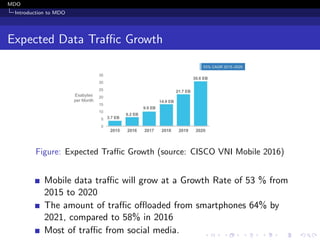
Figure: Expected Traffic Growth (source: CISCO VNI Mobile 2016)
Mobile data traffic will grow at a Growth Rate of 53 % from
2015 to 2020
The amount of traffic offloaded from smartphones 64% by
2021, compared to 58% in 2016
Most of traffic from social media.
MDO
Introduction to MDO
Ways to Support This Huge Demand
Acquiring new spectrum bands
Developing high frequency technology
Upgrading access technology
Building more pico/micro cell sites
Drawbacks...
Need heavy investments
MDO
Introduction to MDO
Other Options
Throttle speed
Time/location/congestion dependent pricing
Mobile Data Offloading (MDO)
MDO
Introduction to MDO
Why MDO?
Huge increase in Wi-Fi enabled devices [Cisco,2016]
Wi-Fi devices: 1.7 Billion
Cellular devices: 548 millions
Can we use these Wi-Fi access points?
MDO
Introduction to MDO
Why MDO?
Beneficial to all
For users,
Reduces monthly bill
Increases battery life of mobile devices
For MNOs,
Reduces installation costs for new BSs
For AP owners,
Compensation for the service
MDO
Introduction to MDO
Objectives
Study offloading techniques
Formulate MDO as an optimization problem
Use Iterated Double Auction mechanism to solve the
optimization problem
Compare results with optimal social welfare
MDO
Introduction to MDO
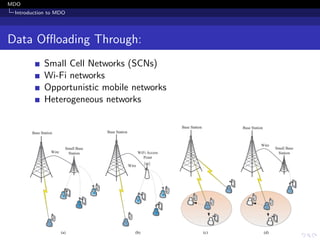
Data Offloading Through:
Small Cell Networks (SCNs)
Wi-Fi networks
Opportunistic mobile networks
Heterogeneous networks
MDO
Offloading System Model
Mobile Data Offloading Scenario
Typical offloading system has
A set of MNOs, κ
∆
= {1, 2, ..., K}
A set of BSs, M
∆
= {1, 2, . . . , M}
A set of APs, I
∆
= {1, 2 . . . , I}
Figure: Offloading scenario [Iosifidis, 2015]
MDO
Offloading System Model
Terms
Terms...
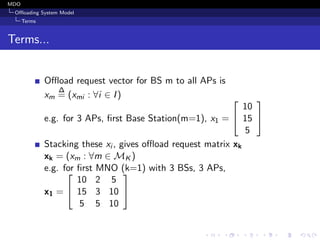
Offload request vector for BS m to all APs is
xm
∆
= (xmi : ∀i ∈ I)
e.g. for 3 APs, first Base Station(m=1), x1 =


10
15
5


Stacking these xi , gives offload request matrix xk
xk = (xm : ∀m ∈ MK )
e.g. for first MNO (k=1) with 3 BSs, 3 APs,
x1 =


10 2 5
15 3 10
5 5 10


MDO
Offloading System Model
Terms
Terms Contd...
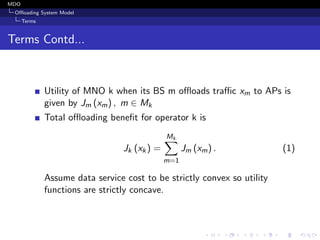
Utility of MNO k when its BS m offloads traffic xm to APs is
given by Jm (xm) , m ∈ Mk
Total offloading benefit for operator k is
Jk (xk) =
Mk
m=1
Jm (xm) . (1)
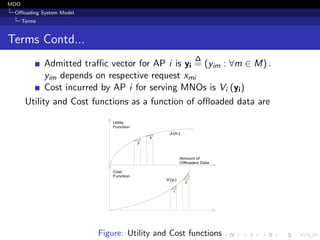
Assume data service cost to be strictly convex so utility
functions are strictly concave.
MDO
Offloading System Model
Terms
Terms Contd...
Admitted traffic vector for AP i is yi
∆
= (yim : ∀m ∈ M) .
yim depends on respective request xmi
Cost incurred by AP i for serving MNOs is Vi (yi)
Utility and Cost functions as a function of offloaded data are
Figure: Utility and Cost functions
MDO
Offloading System Model
Need of broker
Need of Broker
MNO would like to offload its traffic at minimum cost
AP would like to get maximum returns for the offloading
service they provide
Objectives of MNOs and APs conflict,hence a broker is needed.
MDO
Social Welfare Maximization
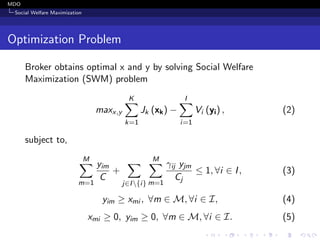
Optimization Problem
Broker obtains optimal x and y by solving Social Welfare
Maximization (SWM) problem
maxx,y
K
k=1
Jk (xk) −
I
i=1
Vi (yi) , (2)
subject to,
M
m=1
yim
C
+
j∈I{i}
M
m=1
γij yjm
Cj
≤ 1, ∀i ∈ I, (3)
yim ≥ xmi , ∀m ∈ M, ∀i ∈ I, (4)
xmi ≥ 0, yim ≥ 0, ∀m ∈ M, ∀i ∈ I. (5)
MDO
Social Welfare Maximization
Lagrangian
Lagrangian for SWM. . .
Lagrangian of the problem can be written as
L (λ, µ, x, y) =
K
k=1
Mk
m=1
Jm(xm) −
I
i=1
Vi (yi) −
I
i=1
λi .


I
j=1
M
m=1
γij yjm
Cj
− 1

 −
M
m=1
I
i=1
µmi . (xmi − yim) ,
(6)
where, λ
∆
= (λi ≥ 0 : ∀i ∈ I) is the vector of lagrange multipliers
and µ
∆
= (µmi ≥ 0 : ∀m ∈ M, ∀i ∈ I) is a matrix of lagrange
multipliers.
MDO
Social Welfare Maximization
KKT
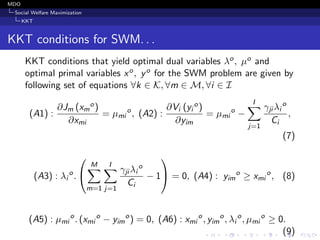
KKT conditions for SWM. . .
KKT conditions that yield optimal dual variables λo, µo and
optimal primal variables xo, yo for the SWM problem are given by
following set of equations ∀k ∈ K, ∀m ∈ M, ∀i ∈ I
(A1) :
∂Jm (xm
o)
∂xmi
= µmi
o
, (A2) :
∂Vi (yi
o)
∂yim
= µmi
o
−
I
j=1
γji λi
o
Ci
,
(7)
(A3) : λi
o
.


M
m=1
I
j=1
γji λi
o
Ci
− 1

 = 0, (A4) : yim
o
≥ xmi
o
, (8)
(A5) : µmi
o
. (xmi
o
− yim
o
) = 0, (A6) : xmi
o
, yim
o
, λi
o
, µmi
o
≥ 0.
(9)
MDO
Social Welfare Maximization
KKT
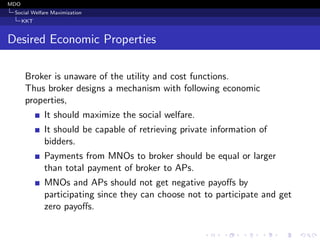
Desired Economic Properties
Broker is unaware of the utility and cost functions.
Thus broker designs a mechanism with following economic
properties,
It should maximize the social welfare.
It should be capable of retrieving private information of
bidders.
Payments from MNOs to broker should be equal or larger
than total payment of broker to APs.
MNOs and APs should not get negative payoffs by
participating since they can choose not to participate and get
zero payoffs.
MDO
Iterated Double Auction Mechanism
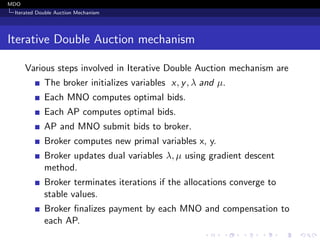
Iterative Double Auction mechanism
Various steps involved in Iterative Double Auction mechanism are
The broker initializes variables x, y, λ and µ.
Each MNO computes optimal bids.
Each AP computes optimal bids.
AP and MNO submit bids to broker.
Broker computes new primal variables x, y.
Broker updates dual variables λ, µ using gradient descent
method.
Broker terminates iterations if the allocations converge to
stable values.
Broker finalizes payment by each MNO and compensation to
each AP.
MDO
Results
Evolution of social welfare
Performance of IDA
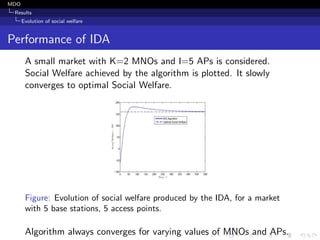
A small market with K=2 MNOs and I=5 APs is considered.
Social Welfare achieved by the algorithm is plotted. It slowly
converges to optimal Social Welfare.
Figure: Evolution of social welfare produced by the IDA, for a market
with 5 base stations, 5 access points.
Algorithm always converges for varying values of MNOs and APs.
MDO
Results
Demand Gap
Gap between requested and admitted data
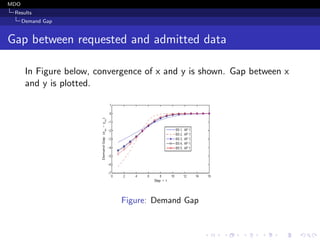
In Figure below, convergence of x and y is shown. Gap between x
and y is plotted.
Figure: Demand Gap
MDO
Conclusions
Conclusions and Future Work
Convergence of IDA was tested
In this study, bidders are assumed to be price takers
In Future, work can be extended to study market mechanisms
considering price anticipating behaviors of MNOs and APs.
MDO
Conclusions
References
George Iosifidis, Lin Gao
A Double-Auction Mechanism for Mobile Data-Offloading Markets
IEEE/ACM Transactions on Networking vol. 23, no. 5, pp. 1634-1647,
Oct. 2015.
Lee K., Chong S.
Mobile Data Offloading: How Much Can WiFi Deliver?
Proceedings of the 6th International Conference, Co-NEXT .
Cisco (2016)
Global Mobile Data Traffic Forecast Update, 2015–2020
Cisco Visual Networking Index Feb. 2016.
Yetim O.B., Martonosi M.
Dynamic adaptive techniques for learning application delay tolerance for
mobile data offloading
Proceedings of IEEE INFOCOM, Apr./May 2015, pp. 1885-1893.
MDO
Conclusions
Thank you !

Mobile data offloading

  • 1.
    MDO Overview of MobileData Offloading Techniques in the Next Generation Cellular Networks Akshay A. Salunkhe Roll No.: 183021002 Department of Electrical Engineering Indian Institute of Technology Dharwad
  • 2.
    MDO Overview 1 Introduction toMDO 2 Offloading System Model Terms Need of broker 3 Social Welfare Maximization Lagrangian KKT 4 Iterated Double Auction Mechanism 5 Results Evolution of social welfare Demand Gap 6 Conclusions
  • 3.
    MDO Introduction to MDO ExpectedData Traffic Growth Figure: Expected Traffic Growth (source: CISCO VNI Mobile 2016) Mobile data traffic will grow at a Growth Rate of 53 % from 2015 to 2020 The amount of traffic offloaded from smartphones 64% by 2021, compared to 58% in 2016 Most of traffic from social media.
  • 4.
    MDO Introduction to MDO Waysto Support This Huge Demand Acquiring new spectrum bands Developing high frequency technology Upgrading access technology Building more pico/micro cell sites Drawbacks... Need heavy investments
  • 5.
    MDO Introduction to MDO OtherOptions Throttle speed Time/location/congestion dependent pricing Mobile Data Offloading (MDO)
  • 6.
    MDO Introduction to MDO WhyMDO? Huge increase in Wi-Fi enabled devices [Cisco,2016] Wi-Fi devices: 1.7 Billion Cellular devices: 548 millions Can we use these Wi-Fi access points?
  • 7.
    MDO Introduction to MDO WhyMDO? Beneficial to all For users, Reduces monthly bill Increases battery life of mobile devices For MNOs, Reduces installation costs for new BSs For AP owners, Compensation for the service
  • 8.
    MDO Introduction to MDO Objectives Studyoffloading techniques Formulate MDO as an optimization problem Use Iterated Double Auction mechanism to solve the optimization problem Compare results with optimal social welfare
  • 9.
    MDO Introduction to MDO DataOffloading Through: Small Cell Networks (SCNs) Wi-Fi networks Opportunistic mobile networks Heterogeneous networks
  • 10.
    MDO Offloading System Model MobileData Offloading Scenario Typical offloading system has A set of MNOs, κ ∆ = {1, 2, ..., K} A set of BSs, M ∆ = {1, 2, . . . , M} A set of APs, I ∆ = {1, 2 . . . , I} Figure: Offloading scenario [Iosifidis, 2015]
  • 11.
    MDO Offloading System Model Terms Terms... Offloadrequest vector for BS m to all APs is xm ∆ = (xmi : ∀i ∈ I) e.g. for 3 APs, first Base Station(m=1), x1 =   10 15 5   Stacking these xi , gives offload request matrix xk xk = (xm : ∀m ∈ MK ) e.g. for first MNO (k=1) with 3 BSs, 3 APs, x1 =   10 2 5 15 3 10 5 5 10  
  • 12.
    MDO Offloading System Model Terms TermsContd... Utility of MNO k when its BS m offloads traffic xm to APs is given by Jm (xm) , m ∈ Mk Total offloading benefit for operator k is Jk (xk) = Mk m=1 Jm (xm) . (1) Assume data service cost to be strictly convex so utility functions are strictly concave.
  • 13.
    MDO Offloading System Model Terms TermsContd... Admitted traffic vector for AP i is yi ∆ = (yim : ∀m ∈ M) . yim depends on respective request xmi Cost incurred by AP i for serving MNOs is Vi (yi) Utility and Cost functions as a function of offloaded data are Figure: Utility and Cost functions
  • 14.
    MDO Offloading System Model Needof broker Need of Broker MNO would like to offload its traffic at minimum cost AP would like to get maximum returns for the offloading service they provide Objectives of MNOs and APs conflict,hence a broker is needed.
  • 15.
    MDO Social Welfare Maximization OptimizationProblem Broker obtains optimal x and y by solving Social Welfare Maximization (SWM) problem maxx,y K k=1 Jk (xk) − I i=1 Vi (yi) , (2) subject to, M m=1 yim C + j∈I{i} M m=1 γij yjm Cj ≤ 1, ∀i ∈ I, (3) yim ≥ xmi , ∀m ∈ M, ∀i ∈ I, (4) xmi ≥ 0, yim ≥ 0, ∀m ∈ M, ∀i ∈ I. (5)
  • 16.
    MDO Social Welfare Maximization Lagrangian Lagrangianfor SWM. . . Lagrangian of the problem can be written as L (λ, µ, x, y) = K k=1 Mk m=1 Jm(xm) − I i=1 Vi (yi) − I i=1 λi .   I j=1 M m=1 γij yjm Cj − 1   − M m=1 I i=1 µmi . (xmi − yim) , (6) where, λ ∆ = (λi ≥ 0 : ∀i ∈ I) is the vector of lagrange multipliers and µ ∆ = (µmi ≥ 0 : ∀m ∈ M, ∀i ∈ I) is a matrix of lagrange multipliers.
  • 17.
    MDO Social Welfare Maximization KKT KKTconditions for SWM. . . KKT conditions that yield optimal dual variables λo, µo and optimal primal variables xo, yo for the SWM problem are given by following set of equations ∀k ∈ K, ∀m ∈ M, ∀i ∈ I (A1) : ∂Jm (xm o) ∂xmi = µmi o , (A2) : ∂Vi (yi o) ∂yim = µmi o − I j=1 γji λi o Ci , (7) (A3) : λi o .   M m=1 I j=1 γji λi o Ci − 1   = 0, (A4) : yim o ≥ xmi o , (8) (A5) : µmi o . (xmi o − yim o ) = 0, (A6) : xmi o , yim o , λi o , µmi o ≥ 0. (9)
  • 18.
    MDO Social Welfare Maximization KKT DesiredEconomic Properties Broker is unaware of the utility and cost functions. Thus broker designs a mechanism with following economic properties, It should maximize the social welfare. It should be capable of retrieving private information of bidders. Payments from MNOs to broker should be equal or larger than total payment of broker to APs. MNOs and APs should not get negative payoffs by participating since they can choose not to participate and get zero payoffs.
  • 19.
    MDO Iterated Double AuctionMechanism Iterative Double Auction mechanism Various steps involved in Iterative Double Auction mechanism are The broker initializes variables x, y, λ and µ. Each MNO computes optimal bids. Each AP computes optimal bids. AP and MNO submit bids to broker. Broker computes new primal variables x, y. Broker updates dual variables λ, µ using gradient descent method. Broker terminates iterations if the allocations converge to stable values. Broker finalizes payment by each MNO and compensation to each AP.
  • 20.
    MDO Results Evolution of socialwelfare Performance of IDA A small market with K=2 MNOs and I=5 APs is considered. Social Welfare achieved by the algorithm is plotted. It slowly converges to optimal Social Welfare. Figure: Evolution of social welfare produced by the IDA, for a market with 5 base stations, 5 access points. Algorithm always converges for varying values of MNOs and APs.
  • 21.
    MDO Results Demand Gap Gap betweenrequested and admitted data In Figure below, convergence of x and y is shown. Gap between x and y is plotted. Figure: Demand Gap
  • 22.
    MDO Conclusions Conclusions and FutureWork Convergence of IDA was tested In this study, bidders are assumed to be price takers In Future, work can be extended to study market mechanisms considering price anticipating behaviors of MNOs and APs.
  • 23.
    MDO Conclusions References George Iosifidis, LinGao A Double-Auction Mechanism for Mobile Data-Offloading Markets IEEE/ACM Transactions on Networking vol. 23, no. 5, pp. 1634-1647, Oct. 2015. Lee K., Chong S. Mobile Data Offloading: How Much Can WiFi Deliver? Proceedings of the 6th International Conference, Co-NEXT . Cisco (2016) Global Mobile Data Traffic Forecast Update, 2015–2020 Cisco Visual Networking Index Feb. 2016. Yetim O.B., Martonosi M. Dynamic adaptive techniques for learning application delay tolerance for mobile data offloading Proceedings of IEEE INFOCOM, Apr./May 2015, pp. 1885-1893.
  • 24.