Mobile CRM for Indian SMB’s – A Analysis for Google Inc
Table of Content


Why Mobile CRM? – A Perspective.............................................................................................................. 3
Why Mobile CRM for Indian SMB? ............................................................................................................... 6
The ROI Analysis – A Perspective .................................................................................................................. 8
Relevance to Google ................................................................................................................................... 10
Marketing Framework – A Perspective....................................................................................................... 12
Why Mobile CRM? – A Perspective

Go the extra mile across the miles


The pace of customer service excellence has been set, and it’s fast. You simply can’t afford to have your
salespeople lagging behind the pack in the race for revenue. Enabling your field workforce with Mobile
CRM will help them do their jobs better, shorten the sales cycle, improve first impressions and follow-
through, access hot leads faster, and generally become more productive. Mobile CRM will help your
management team better supervise and direct sales activities. Plus, increasing adoption of mobile
technology will increase the flow of business information, which, in turn, yields deeper business
intelligence. Mobile CRM empowers you to go the extra mile for your mobile workers today, by giving
them the tools they need to succeed. The payoff will be quick, and will only increase in value as your
field productivity turns from business advantage to business expectation.


Frontline employees drive your competitive edge

As competition becomes increasingly fierce in today’s markets, organizations are intensifying their
search for new efficiencies. Successful companies have long known that a well-trained, highly motivated
and efficiently connected field force is critical to their continued growth and success. These companies
realize that to stay ahead of the competition, they must replace traditional paper and telephone-based
systems with solutions that enable access to key information directly from the field. Mobile technology
holds the greatest promise for creating new business efficiencies and developing competitive
advantage. As such, leading organizations are realizing significant gains in performance by deploying
mobile solutions that allow field workers to share critical data on customers, orders, assets, and
inventory. Whether they are closing sales, managing relationships, helping customers, your company's
remote workers rely on up-to-the minute information access for their success and yours. Equipping your
sales force with Windows Mobile smart phones provides them with immediate access to customer and
product data and also enables them to quickly and efficiently close business. This ensures extraordinary
customer service, and translates into intense customer loyalty, leaving the competition wondering
where they went wrong. Small and mid-sized companies have few IT staff, but they have large
enterprise requirements and expectations of their IT solutions. Mobile CRM is a solution that helps you
better manage your business data, gathering it, storing it, sharing it, analyzing it.
Drivers for Wireless Strategies

The lifeline for today’s mobile workers, particularly sales professionals, is the cell phone. When they
have questions that need immediate answers, need a data look-up, or want to submit an urgent
customer order, they place a call to an administrative assistant and dictate their requests. This is a
process that can take several minutes or more and ties up at least two people until it’s resolved.
Wireless applications turn this into a one-person operation. Without wireless applications, many
salespeople are flying blind when they visit a customer or prospect site. Wireless applications place
information at their fingertips in real time as needed. They improve not only their customer service, but
the customer’s perception of the entire organization’s service. Consider the mobile worker’s time
management abilities. It has been estimated that the typical salesperson spends about 10% of their time
waiting for appointments. Consider what you are paying your sales people, and then take 10% of that
number. It’s a lot of money that would look better on the bottom line. Mobile applications allow them
to use that time productively, either looking up customer call history prior to the meeting, entering
orders, answering e-mail, or taking care of other business tasks. They are able to do significantly more
than they can with a simple cell phone.


A third issue is that salespeople often do not receive new sales leads in a timely fashion. Generally, they
have to wait until they return to the hotel or home office at the end of day. Now, consider a wireless
user sitting at a restaurant with a Wi-Fi hot spot, or one of the latest smart phones. The mobile worker
can sync, and check for new, hot leads and make schedule adjustments to get the best opportunities
first. They can even build customer quotations and instantly deliver an email or faxed copy to their
customer in seconds, versus hours later. Unlike bulky laptop systems, handheld computers turn on
instantly and are very compact. As a result, sales professionals tend to use the devices before, during,
and after sales calls much more readily than they do laptops. This convenience and ease of use
translates into more and better data from representatives in the field, which means better forecasting,
better customer service, and competitive activity tracking for management. Handheld access also allows
representatives to productively use their downtime to prepare for meetings and to follow up with
customer requests. This results in a more effective sales force and better customer interactions.
Wireless devices are making it easier and easier to gather and share data anywhere, anytime. But
productivity won’t be realized if remote workers are not equipped with mobile applications in the first
place.
Finally, there is often a challenge with sales force automation software, particularly Customer
Relationship Management (CRM) systems. CRM applications are designed to provide management data,
rather than improve workflow for people in the field. These applications are typically laden with many
features and functions mobile workers don’t need or can’t use. Navigating the menus and options is
often slow for remote wireless users, which ultimately causes confusion, frustration and abandonment
of the application. A recent Sales Management and Field Sales Representative study found that:
        Less than 50% of sales reps are using their CRM/SFA system the way sales management would
        like
        The top three obstacles for not using the CRM/SFA system more often were that these systems
        are too time consuming, difficult to access and provide limited value in the field
        72% of field sales representatives spend more than 50% of their time away from the office
        Over 80% of those surveyed believed that a PDA sales solution would make them more
        productive in the field
        90% of sales reps would use their CRM/SFA system more if they had handheld mobile access
Widespread adoption among the field sales force ensures that the SFA system contains all your critical
customer data; and with viable customer data, the value of SFA begins to be realized. Sales professionals
are the crucial link between the customer and the enterprise. Consistently, sales representatives pin the
blame for low SFA adoption on their systems’ poor accessibility, usability, and relevance to their day-to-
day job functions. In addition, these systems were deployed primarily as tools for sales management for
more consistent sales process, sales forecasting and pipeline management, rather than as tools for sales
professionals to engage in more effective and efficient customer interactions. The field sales survey
previously referenced studied the potential impact of mobility on SFA adoption:


        90% of sales representatives would use their SFA system more if they had handheld mobile
        access
        Over 80% of sales representatives believe that a mobile SFA solution would make them more
        productive in the field
        Over 50% of sales management believe a mobile SFA solution would increase customer
        satisfaction and contribute to higher revenue growth
Mobile CRM solves these challenges and delivers tangible cost reductions that are realized by increased
sales productivity, sales force retention, reduced data collection/entry, increased information accuracy,
and reduced costs of operations.
Why Mobile CRM for Indian SMB?

Mobile based CRM market is already flourishing in other countries like U.S. and U.K. As compared to
them India's mobile CRM market is still nascent. But India is fast catching up, as it continues to add more
and more mobile subscribers every month. According to Frost & Sullivan, the enterprise mobility market
in India is worth about Rs. 354 crore and growing at 30-40 percent over the past three years. India being
the second largest mobile market in the world provides lot of opportunities for mobile CRM market to
grow. With 3G auction around the corner this year in India (Even though it is getting postponed
everytime!!), there are many companies who are looking to expand their businesses with the expanding
mobile internet market. And, their target would be the nine million SMB market in India. Today, many
SMBs in India are going in for SaaS CRM and agree that a proper CRM plan has helped them increase
customer retention, company profits and offer better service to customers. In such a scenario, a CRM
which also gives mobility will further enhance the productivity and efficiency of the organization.

Even though, mobile CRM only works on smartphones like Apple, Blackberry or the ones using Windows
mobile, the market for mobile CRM continues to expand. India is the third fastest growing smartphone
market in the world. According to Gartner, Asia Pacific recorded a 2.3 percent sequential growth,
reaching 7.5 million unit sales, whiles the overall device sales dropped by 9.2 percent. 19 million smart
phones are expected to be shipped into India over the next three years, as against a global forecast of a
billion by 2011.

There are many barriers to mobile CRM in India, but one of the most crucial one is security. A mobile
theft will also mean theft of crucial information of the company. There are other critical security
concerns like handset security, transmission security, backend security, etc. Also GPRS has to be
affordable for the companies to provide that to its employees for free. mobile CRM is based on internet
and that can be one of its biggest disadvantages when it comes to India. India does not have a good
mobile internet penetration. Currently most of those who have internet use GPRS and Edge technology.


The Current Players

One of the companies which is trying to expand its mobile CRM market in India is Salesforce. The
company has been in India for two years. They already have many clients in India including few SMBs.
"We provide solution that is scalable to any organization in size. Even the smallest organizations that
have internet connectivity can use Salesforce. We have interesting success story from companies like
GIST [Global information system technology] in India," said Andrew Knott, Vice President, Marketing-
APAC region, Salesforce. They also provide mobile CRM to companies like Ocimum Biosolutions and OBI
express in India. Nowadays, sales representatives need to perform many tasks such as managing
appointments, collaborating with sales team members, and connecting with customer contacts and that
too punctually. To serve their need companies like Salesforce are offering their product called Mobile
Lite, which enables users to access the Sales Cloud and Service Cloud from their mobile devices. The
Mobile Lite service allows end users to log calls and emails, update activities and tasks as well as view
account and contact details, leads, opportunities, cases, solutions, assets, and dashboards, all from their
mobile device. Mobile Lite offers a subset of the features available in the full mobile version, and with
just a few clicks, customers can upgrade to the full functionality.
The ROI Analysis – A Perspective

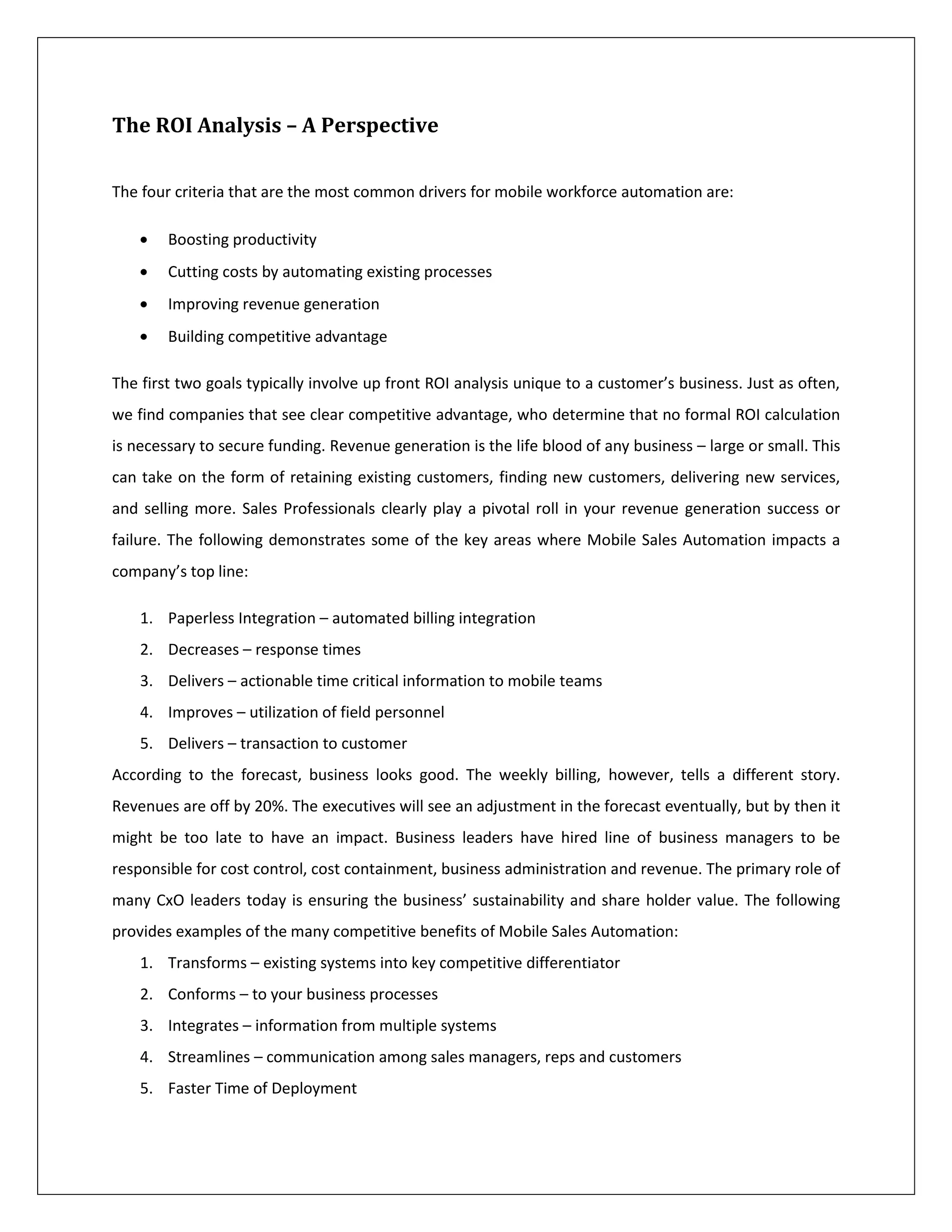
The four criteria that are the most common drivers for mobile workforce automation are:

        Boosting productivity
        Cutting costs by automating existing processes
        Improving revenue generation
        Building competitive advantage

The first two goals typically involve up front ROI analysis unique to a customer’s business. Just as often,
we find companies that see clear competitive advantage, who determine that no formal ROI calculation
is necessary to secure funding. Revenue generation is the life blood of any business – large or small. This
can take on the form of retaining existing customers, finding new customers, delivering new services,
and selling more. Sales Professionals clearly play a pivotal roll in your revenue generation success or
failure. The following demonstrates some of the key areas where Mobile Sales Automation impacts a
company’s top line:

    1. Paperless Integration – automated billing integration
    2. Decreases – response times
    3. Delivers – actionable time critical information to mobile teams
    4. Improves – utilization of field personnel
    5. Delivers – transaction to customer
According to the forecast, business looks good. The weekly billing, however, tells a different story.
Revenues are off by 20%. The executives will see an adjustment in the forecast eventually, but by then it
might be too late to have an impact. Business leaders have hired line of business managers to be
responsible for cost control, cost containment, business administration and revenue. The primary role of
many CxO leaders today is ensuring the business’ sustainability and share holder value. The following
provides examples of the many competitive benefits of Mobile Sales Automation:
    1. Transforms – existing systems into key competitive differentiator
    2. Conforms – to your business processes
    3. Integrates – information from multiple systems
    4. Streamlines – communication among sales managers, reps and customers
    5. Faster Time of Deployment
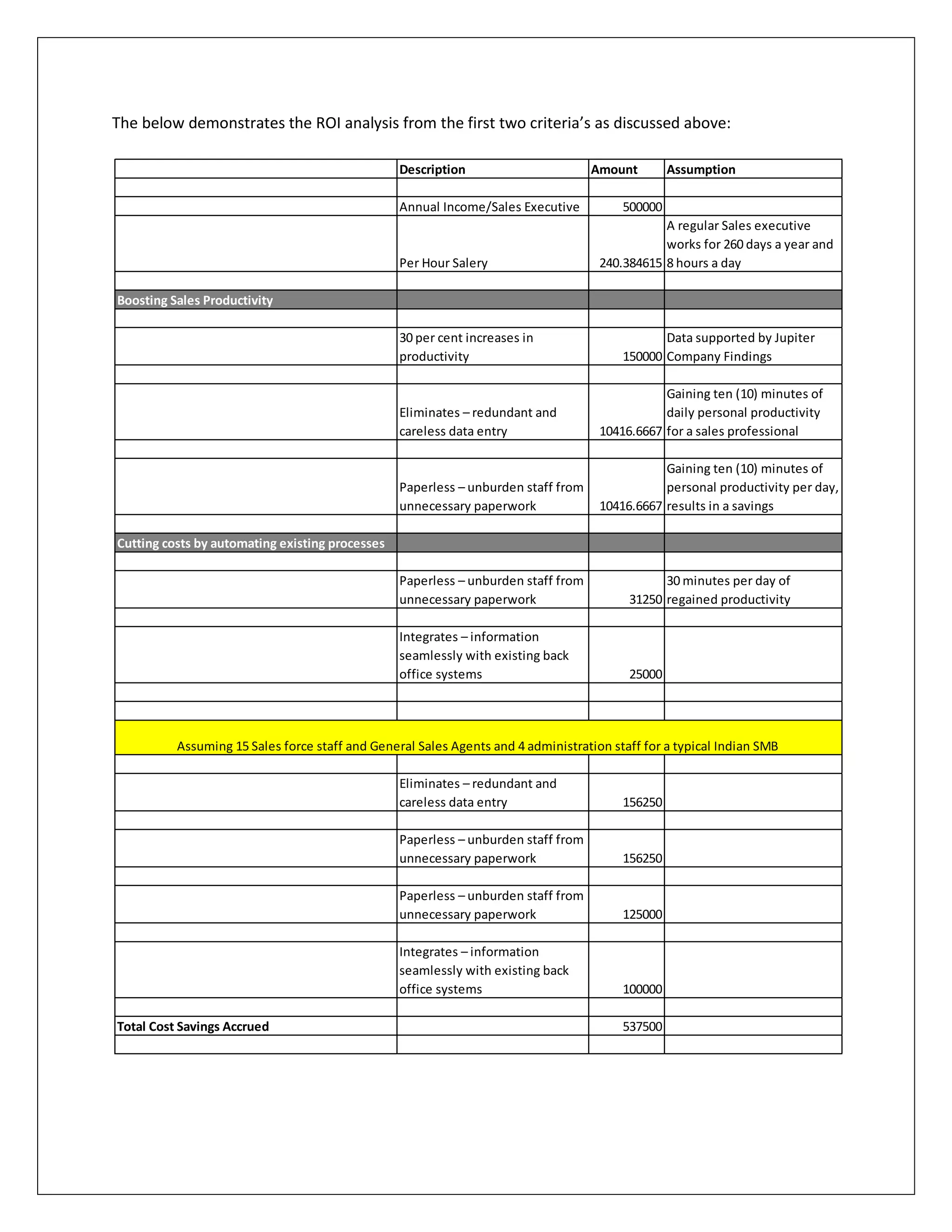
The below demonstrates the ROI analysis from the first two criteria’s as discussed above:

                                                 Description                       Amount        Assumption

                                                 Annual Income/Sales Executive          500000
                                                                                               A regular Sales executive
                                                                                               works for 260 days a year and
                                                 Per Hour Salery                    240.384615 8 hours a day

Boosting Sales Productivity

                                                 30 per cent increases in                      Data supported by Jupiter
                                                 productivity                           150000 Company Findings

                                                                                               Gaining ten (10) minutes of
                                                 Eliminates – redundant and                    daily personal productivity
                                                 careless data entry                10416.6667 for a sales professional

                                                                                               Gaining ten (10) minutes of
                                                 Paperless – unburden staff from               personal productivity per day,
                                                 unnecessary paperwork              10416.6667 results in a savings

Cutting costs by automating existing processes

                                                 Paperless – unburden staff from               30 minutes per day of
                                                 unnecessary paperwork                   31250 regained productivity

                                                 Integrates – information
                                                 seamlessly with existing back
                                                 office systems                          25000


          Assuming 15 Sales force staff and General Sales Agents and 4 administration staff for a typical Indian SMB

                                                 Eliminates – redundant and
                                                 careless data entry                    156250

                                                 Paperless – unburden staff from
                                                 unnecessary paperwork                  156250

                                                 Paperless – unburden staff from
                                                 unnecessary paperwork                  125000

                                                 Integrates – information
                                                 seamlessly with existing back
                                                 office systems                         100000

Total Cost Savings Accrued                                                              537500
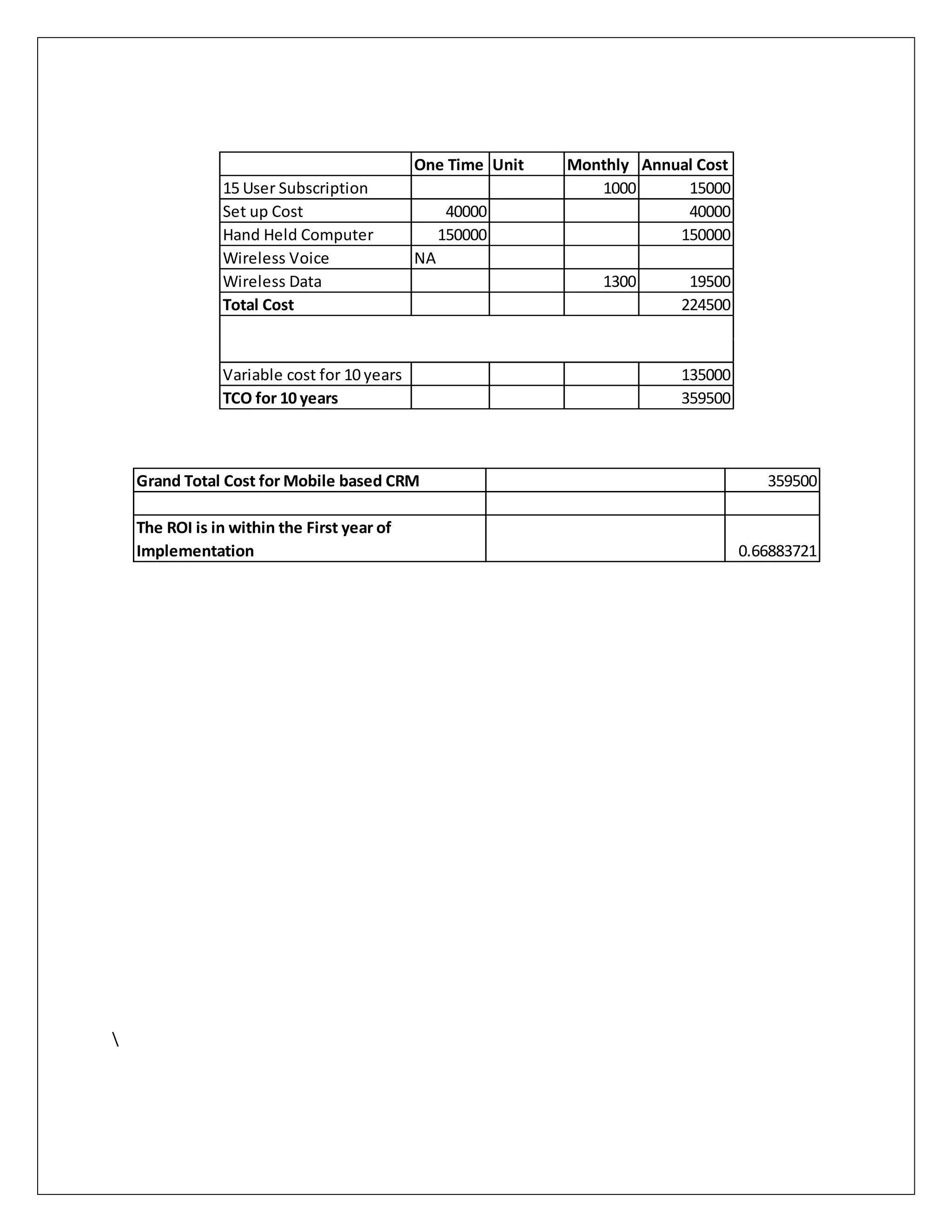
One Time Unit   Monthly Annual Cost
                15 User Subscription                            1000      15000
                Set up Cost                        40000                  40000
                Hand Held Computer                150000                 150000
                Wireless Voice               NA
                Wireless Data                                    1300      19500
                Total Cost                                                224500


                Variable cost for 10 years                                135000
                TCO for 10 years                                          359500


    Grand Total Cost for Mobile based CRM                                             359500

    The ROI is in within the First year of
    Implementation                                                                 0.66883721
Relevance to Google

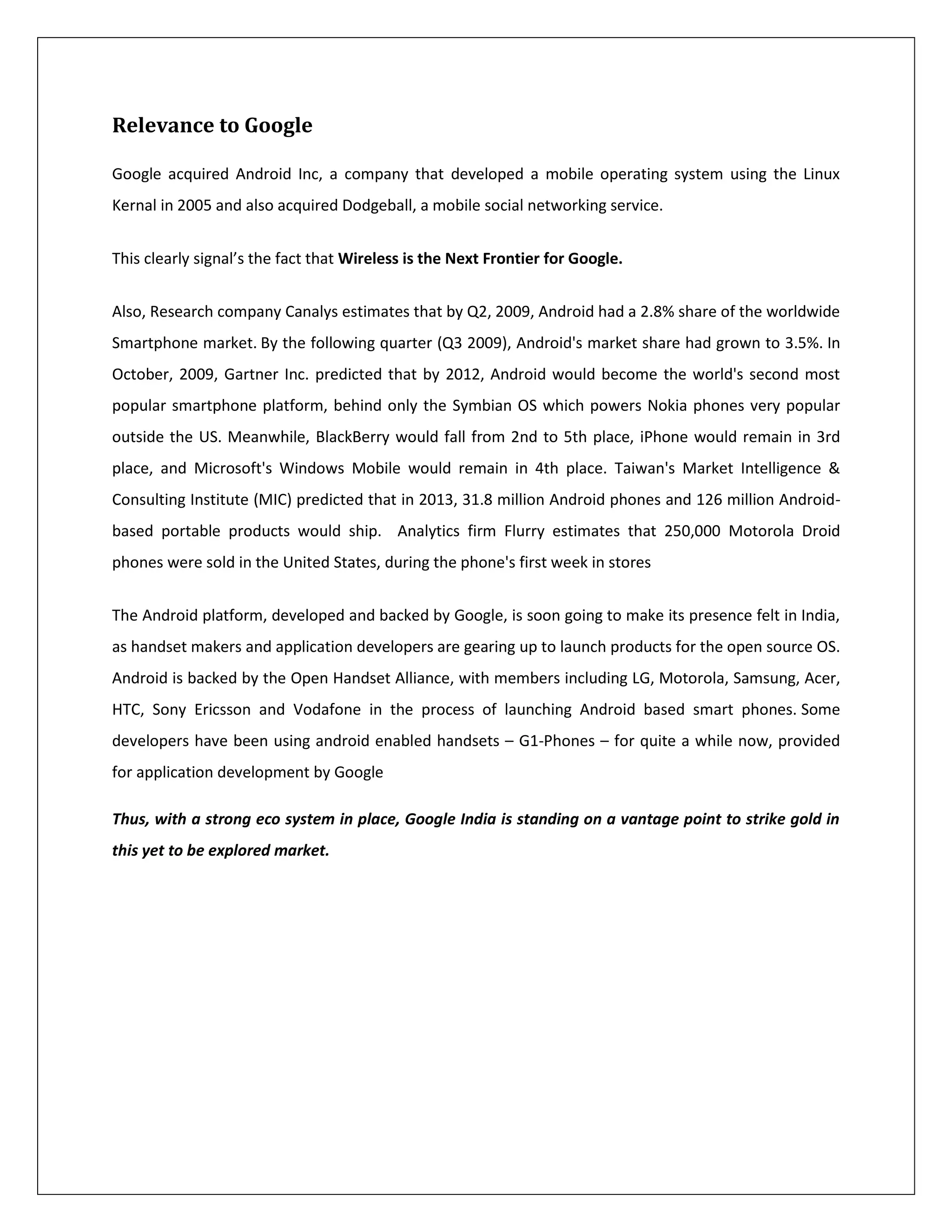
Google acquired Android Inc, a company that developed a mobile operating system using the Linux
Kernal in 2005 and also acquired Dodgeball, a mobile social networking service.


This clearly signal’s the fact that Wireless is the Next Frontier for Google.


Also, Research company Canalys estimates that by Q2, 2009, Android had a 2.8% share of the worldwide
Smartphone market. By the following quarter (Q3 2009), Android's market share had grown to 3.5%. In
October, 2009, Gartner Inc. predicted that by 2012, Android would become the world's second most
popular smartphone platform, behind only the Symbian OS which powers Nokia phones very popular
outside the US. Meanwhile, BlackBerry would fall from 2nd to 5th place, iPhone would remain in 3rd
place, and Microsoft's Windows Mobile would remain in 4th place. Taiwan's Market Intelligence &
Consulting Institute (MIC) predicted that in 2013, 31.8 million Android phones and 126 million Android-
based portable products would ship. Analytics firm Flurry estimates that 250,000 Motorola Droid
phones were sold in the United States, during the phone's first week in stores


The Android platform, developed and backed by Google, is soon going to make its presence felt in India,
as handset makers and application developers are gearing up to launch products for the open source OS.
Android is backed by the Open Handset Alliance, with members including LG, Motorola, Samsung, Acer,
HTC, Sony Ericsson and Vodafone in the process of launching Android based smart phones. Some
developers have been using android enabled handsets – G1-Phones – for quite a while now, provided
for application development by Google

Thus, with a strong eco system in place, Google India is standing on a vantage point to strike gold in
this yet to be explored market.
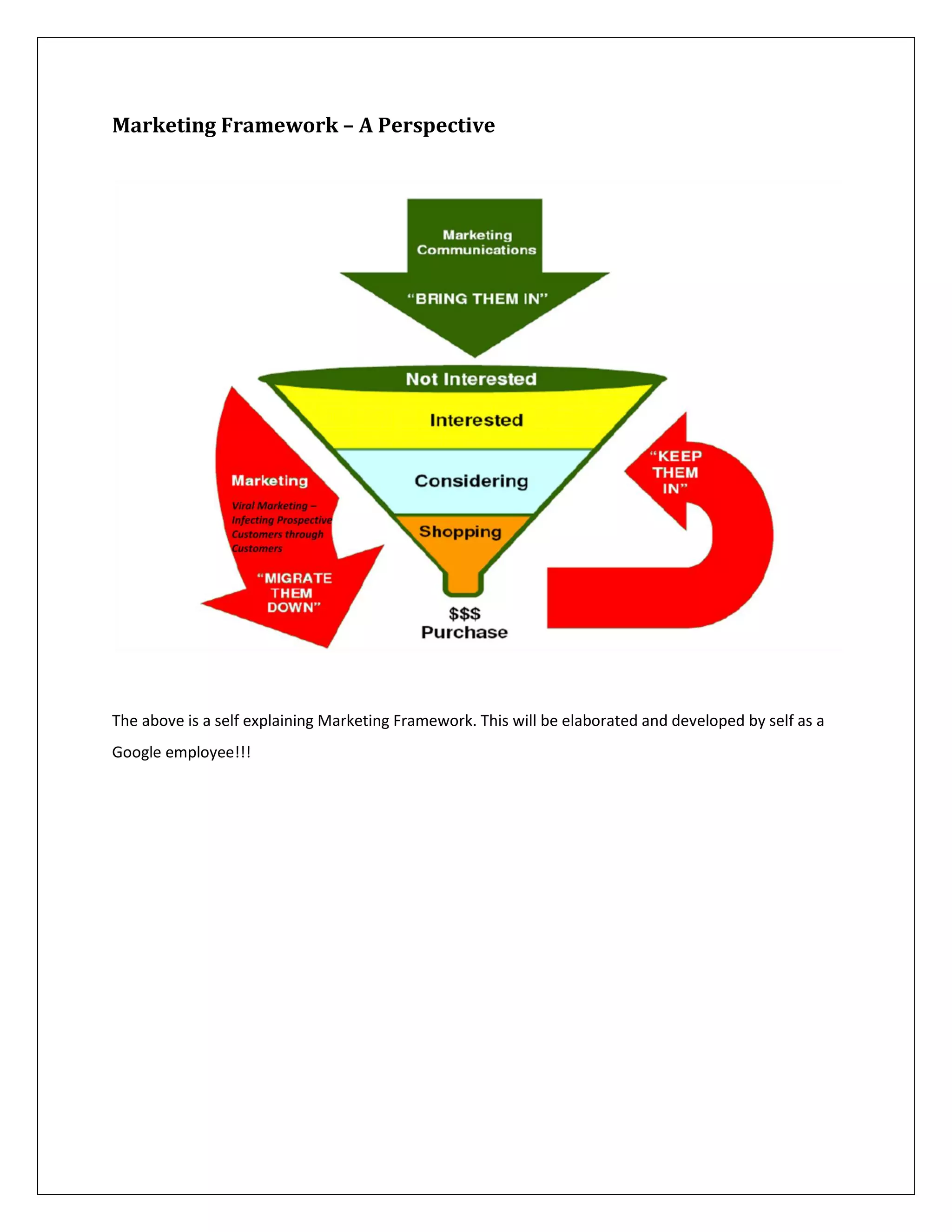
Marketing Framework – A Perspective


The above is a self explaining Marketing Framework. This will be elaborated and developed by self as a
Google employee!!!

Mobile Crm For Indian Smb A Proposition To Google

  • 1.
    Mobile CRM forIndian SMB’s – A Analysis for Google Inc
  • 2.
    Table of Content WhyMobile CRM? – A Perspective.............................................................................................................. 3 Why Mobile CRM for Indian SMB? ............................................................................................................... 6 The ROI Analysis – A Perspective .................................................................................................................. 8 Relevance to Google ................................................................................................................................... 10 Marketing Framework – A Perspective....................................................................................................... 12
  • 3.
    Why Mobile CRM?– A Perspective Go the extra mile across the miles The pace of customer service excellence has been set, and it’s fast. You simply can’t afford to have your salespeople lagging behind the pack in the race for revenue. Enabling your field workforce with Mobile CRM will help them do their jobs better, shorten the sales cycle, improve first impressions and follow- through, access hot leads faster, and generally become more productive. Mobile CRM will help your management team better supervise and direct sales activities. Plus, increasing adoption of mobile technology will increase the flow of business information, which, in turn, yields deeper business intelligence. Mobile CRM empowers you to go the extra mile for your mobile workers today, by giving them the tools they need to succeed. The payoff will be quick, and will only increase in value as your field productivity turns from business advantage to business expectation. Frontline employees drive your competitive edge As competition becomes increasingly fierce in today’s markets, organizations are intensifying their search for new efficiencies. Successful companies have long known that a well-trained, highly motivated and efficiently connected field force is critical to their continued growth and success. These companies realize that to stay ahead of the competition, they must replace traditional paper and telephone-based systems with solutions that enable access to key information directly from the field. Mobile technology holds the greatest promise for creating new business efficiencies and developing competitive advantage. As such, leading organizations are realizing significant gains in performance by deploying mobile solutions that allow field workers to share critical data on customers, orders, assets, and inventory. Whether they are closing sales, managing relationships, helping customers, your company's remote workers rely on up-to-the minute information access for their success and yours. Equipping your sales force with Windows Mobile smart phones provides them with immediate access to customer and product data and also enables them to quickly and efficiently close business. This ensures extraordinary customer service, and translates into intense customer loyalty, leaving the competition wondering where they went wrong. Small and mid-sized companies have few IT staff, but they have large enterprise requirements and expectations of their IT solutions. Mobile CRM is a solution that helps you better manage your business data, gathering it, storing it, sharing it, analyzing it.
  • 4.
    Drivers for WirelessStrategies The lifeline for today’s mobile workers, particularly sales professionals, is the cell phone. When they have questions that need immediate answers, need a data look-up, or want to submit an urgent customer order, they place a call to an administrative assistant and dictate their requests. This is a process that can take several minutes or more and ties up at least two people until it’s resolved. Wireless applications turn this into a one-person operation. Without wireless applications, many salespeople are flying blind when they visit a customer or prospect site. Wireless applications place information at their fingertips in real time as needed. They improve not only their customer service, but the customer’s perception of the entire organization’s service. Consider the mobile worker’s time management abilities. It has been estimated that the typical salesperson spends about 10% of their time waiting for appointments. Consider what you are paying your sales people, and then take 10% of that number. It’s a lot of money that would look better on the bottom line. Mobile applications allow them to use that time productively, either looking up customer call history prior to the meeting, entering orders, answering e-mail, or taking care of other business tasks. They are able to do significantly more than they can with a simple cell phone. A third issue is that salespeople often do not receive new sales leads in a timely fashion. Generally, they have to wait until they return to the hotel or home office at the end of day. Now, consider a wireless user sitting at a restaurant with a Wi-Fi hot spot, or one of the latest smart phones. The mobile worker can sync, and check for new, hot leads and make schedule adjustments to get the best opportunities first. They can even build customer quotations and instantly deliver an email or faxed copy to their customer in seconds, versus hours later. Unlike bulky laptop systems, handheld computers turn on instantly and are very compact. As a result, sales professionals tend to use the devices before, during, and after sales calls much more readily than they do laptops. This convenience and ease of use translates into more and better data from representatives in the field, which means better forecasting, better customer service, and competitive activity tracking for management. Handheld access also allows representatives to productively use their downtime to prepare for meetings and to follow up with customer requests. This results in a more effective sales force and better customer interactions. Wireless devices are making it easier and easier to gather and share data anywhere, anytime. But productivity won’t be realized if remote workers are not equipped with mobile applications in the first place.
  • 5.
    Finally, there isoften a challenge with sales force automation software, particularly Customer Relationship Management (CRM) systems. CRM applications are designed to provide management data, rather than improve workflow for people in the field. These applications are typically laden with many features and functions mobile workers don’t need or can’t use. Navigating the menus and options is often slow for remote wireless users, which ultimately causes confusion, frustration and abandonment of the application. A recent Sales Management and Field Sales Representative study found that: Less than 50% of sales reps are using their CRM/SFA system the way sales management would like The top three obstacles for not using the CRM/SFA system more often were that these systems are too time consuming, difficult to access and provide limited value in the field 72% of field sales representatives spend more than 50% of their time away from the office Over 80% of those surveyed believed that a PDA sales solution would make them more productive in the field 90% of sales reps would use their CRM/SFA system more if they had handheld mobile access Widespread adoption among the field sales force ensures that the SFA system contains all your critical customer data; and with viable customer data, the value of SFA begins to be realized. Sales professionals are the crucial link between the customer and the enterprise. Consistently, sales representatives pin the blame for low SFA adoption on their systems’ poor accessibility, usability, and relevance to their day-to- day job functions. In addition, these systems were deployed primarily as tools for sales management for more consistent sales process, sales forecasting and pipeline management, rather than as tools for sales professionals to engage in more effective and efficient customer interactions. The field sales survey previously referenced studied the potential impact of mobility on SFA adoption: 90% of sales representatives would use their SFA system more if they had handheld mobile access Over 80% of sales representatives believe that a mobile SFA solution would make them more productive in the field Over 50% of sales management believe a mobile SFA solution would increase customer satisfaction and contribute to higher revenue growth Mobile CRM solves these challenges and delivers tangible cost reductions that are realized by increased sales productivity, sales force retention, reduced data collection/entry, increased information accuracy, and reduced costs of operations.
  • 6.
    Why Mobile CRMfor Indian SMB? Mobile based CRM market is already flourishing in other countries like U.S. and U.K. As compared to them India's mobile CRM market is still nascent. But India is fast catching up, as it continues to add more and more mobile subscribers every month. According to Frost & Sullivan, the enterprise mobility market in India is worth about Rs. 354 crore and growing at 30-40 percent over the past three years. India being the second largest mobile market in the world provides lot of opportunities for mobile CRM market to grow. With 3G auction around the corner this year in India (Even though it is getting postponed everytime!!), there are many companies who are looking to expand their businesses with the expanding mobile internet market. And, their target would be the nine million SMB market in India. Today, many SMBs in India are going in for SaaS CRM and agree that a proper CRM plan has helped them increase customer retention, company profits and offer better service to customers. In such a scenario, a CRM which also gives mobility will further enhance the productivity and efficiency of the organization. Even though, mobile CRM only works on smartphones like Apple, Blackberry or the ones using Windows mobile, the market for mobile CRM continues to expand. India is the third fastest growing smartphone market in the world. According to Gartner, Asia Pacific recorded a 2.3 percent sequential growth, reaching 7.5 million unit sales, whiles the overall device sales dropped by 9.2 percent. 19 million smart phones are expected to be shipped into India over the next three years, as against a global forecast of a billion by 2011. There are many barriers to mobile CRM in India, but one of the most crucial one is security. A mobile theft will also mean theft of crucial information of the company. There are other critical security concerns like handset security, transmission security, backend security, etc. Also GPRS has to be affordable for the companies to provide that to its employees for free. mobile CRM is based on internet and that can be one of its biggest disadvantages when it comes to India. India does not have a good mobile internet penetration. Currently most of those who have internet use GPRS and Edge technology. The Current Players One of the companies which is trying to expand its mobile CRM market in India is Salesforce. The company has been in India for two years. They already have many clients in India including few SMBs.
  • 7.
    "We provide solutionthat is scalable to any organization in size. Even the smallest organizations that have internet connectivity can use Salesforce. We have interesting success story from companies like GIST [Global information system technology] in India," said Andrew Knott, Vice President, Marketing- APAC region, Salesforce. They also provide mobile CRM to companies like Ocimum Biosolutions and OBI express in India. Nowadays, sales representatives need to perform many tasks such as managing appointments, collaborating with sales team members, and connecting with customer contacts and that too punctually. To serve their need companies like Salesforce are offering their product called Mobile Lite, which enables users to access the Sales Cloud and Service Cloud from their mobile devices. The Mobile Lite service allows end users to log calls and emails, update activities and tasks as well as view account and contact details, leads, opportunities, cases, solutions, assets, and dashboards, all from their mobile device. Mobile Lite offers a subset of the features available in the full mobile version, and with just a few clicks, customers can upgrade to the full functionality.
  • 8.
    The ROI Analysis– A Perspective The four criteria that are the most common drivers for mobile workforce automation are: Boosting productivity Cutting costs by automating existing processes Improving revenue generation Building competitive advantage The first two goals typically involve up front ROI analysis unique to a customer’s business. Just as often, we find companies that see clear competitive advantage, who determine that no formal ROI calculation is necessary to secure funding. Revenue generation is the life blood of any business – large or small. This can take on the form of retaining existing customers, finding new customers, delivering new services, and selling more. Sales Professionals clearly play a pivotal roll in your revenue generation success or failure. The following demonstrates some of the key areas where Mobile Sales Automation impacts a company’s top line: 1. Paperless Integration – automated billing integration 2. Decreases – response times 3. Delivers – actionable time critical information to mobile teams 4. Improves – utilization of field personnel 5. Delivers – transaction to customer According to the forecast, business looks good. The weekly billing, however, tells a different story. Revenues are off by 20%. The executives will see an adjustment in the forecast eventually, but by then it might be too late to have an impact. Business leaders have hired line of business managers to be responsible for cost control, cost containment, business administration and revenue. The primary role of many CxO leaders today is ensuring the business’ sustainability and share holder value. The following provides examples of the many competitive benefits of Mobile Sales Automation: 1. Transforms – existing systems into key competitive differentiator 2. Conforms – to your business processes 3. Integrates – information from multiple systems 4. Streamlines – communication among sales managers, reps and customers 5. Faster Time of Deployment
  • 9.
    The below demonstratesthe ROI analysis from the first two criteria’s as discussed above: Description Amount Assumption Annual Income/Sales Executive 500000 A regular Sales executive works for 260 days a year and Per Hour Salery 240.384615 8 hours a day Boosting Sales Productivity 30 per cent increases in Data supported by Jupiter productivity 150000 Company Findings Gaining ten (10) minutes of Eliminates – redundant and daily personal productivity careless data entry 10416.6667 for a sales professional Gaining ten (10) minutes of Paperless – unburden staff from personal productivity per day, unnecessary paperwork 10416.6667 results in a savings Cutting costs by automating existing processes Paperless – unburden staff from 30 minutes per day of unnecessary paperwork 31250 regained productivity Integrates – information seamlessly with existing back office systems 25000 Assuming 15 Sales force staff and General Sales Agents and 4 administration staff for a typical Indian SMB Eliminates – redundant and careless data entry 156250 Paperless – unburden staff from unnecessary paperwork 156250 Paperless – unburden staff from unnecessary paperwork 125000 Integrates – information seamlessly with existing back office systems 100000 Total Cost Savings Accrued 537500
  • 10.
    One Time Unit Monthly Annual Cost 15 User Subscription 1000 15000 Set up Cost 40000 40000 Hand Held Computer 150000 150000 Wireless Voice NA Wireless Data 1300 19500 Total Cost 224500 Variable cost for 10 years 135000 TCO for 10 years 359500 Grand Total Cost for Mobile based CRM 359500 The ROI is in within the First year of Implementation 0.66883721
  • 11.
    Relevance to Google Googleacquired Android Inc, a company that developed a mobile operating system using the Linux Kernal in 2005 and also acquired Dodgeball, a mobile social networking service. This clearly signal’s the fact that Wireless is the Next Frontier for Google. Also, Research company Canalys estimates that by Q2, 2009, Android had a 2.8% share of the worldwide Smartphone market. By the following quarter (Q3 2009), Android's market share had grown to 3.5%. In October, 2009, Gartner Inc. predicted that by 2012, Android would become the world's second most popular smartphone platform, behind only the Symbian OS which powers Nokia phones very popular outside the US. Meanwhile, BlackBerry would fall from 2nd to 5th place, iPhone would remain in 3rd place, and Microsoft's Windows Mobile would remain in 4th place. Taiwan's Market Intelligence & Consulting Institute (MIC) predicted that in 2013, 31.8 million Android phones and 126 million Android- based portable products would ship. Analytics firm Flurry estimates that 250,000 Motorola Droid phones were sold in the United States, during the phone's first week in stores The Android platform, developed and backed by Google, is soon going to make its presence felt in India, as handset makers and application developers are gearing up to launch products for the open source OS. Android is backed by the Open Handset Alliance, with members including LG, Motorola, Samsung, Acer, HTC, Sony Ericsson and Vodafone in the process of launching Android based smart phones. Some developers have been using android enabled handsets – G1-Phones – for quite a while now, provided for application development by Google Thus, with a strong eco system in place, Google India is standing on a vantage point to strike gold in this yet to be explored market.
  • 12.
    Marketing Framework –A Perspective The above is a self explaining Marketing Framework. This will be elaborated and developed by self as a Google employee!!!