Mobile App
Development
Architecture
www. digitalhubsolution.com
Key Concepts and Approaches
What is Mobile App
Architecture?
• Definition: Structure that defines how mobile apps
are organized, designed, and developed.
• Importance: Ensures scalability, maintainability, and
performance.
• Core Components: UI, business logic, data, and
APIs.
Types of Mobile App Architectures
• Native: Platform-specific apps (iOS
or Android).
• Hybrid: One codebase for multiple
platforms (React Native, Flutter).
• Web-Based: Progressive Web Apps
(PWAs)
Key Architecture Components
• UI Layer: Visual interface and user interaction.
• Business Logic Layer: Handles app functionality.
• Data Layer: Stores and retrieves data.
• API Layer: Facilitates communication between
mobile app and backend.
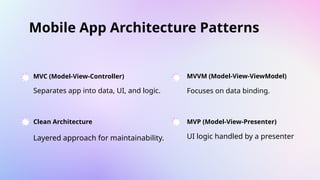
Mobile App Architecture Patterns
MVC (Model-View-Controller) MVVM (Model-View-ViewModel)
MVP (Model-View-Presenter)
Clean Architecture
Separates app into data, UI, and logic. Focuses on data binding.
UI logic handled by a presenter
Layered approach for maintainability.
Best Practices
.
• Modularization: Reusable components.
• Separation of Concerns: Keep UI, logic, and data
separate.
• Scalability & Performance: Optimize for growth
and smooth interactions.
• Security: Secure data handling and encryption.
Thank You

Mobile Application dev architecture..pptx

  • 1.
  • 2.
    What is MobileApp Architecture? • Definition: Structure that defines how mobile apps are organized, designed, and developed. • Importance: Ensures scalability, maintainability, and performance. • Core Components: UI, business logic, data, and APIs.
  • 3.
    Types of MobileApp Architectures • Native: Platform-specific apps (iOS or Android). • Hybrid: One codebase for multiple platforms (React Native, Flutter). • Web-Based: Progressive Web Apps (PWAs)
  • 4.
    Key Architecture Components •UI Layer: Visual interface and user interaction. • Business Logic Layer: Handles app functionality. • Data Layer: Stores and retrieves data. • API Layer: Facilitates communication between mobile app and backend.
  • 5.
    Mobile App ArchitecturePatterns MVC (Model-View-Controller) MVVM (Model-View-ViewModel) MVP (Model-View-Presenter) Clean Architecture Separates app into data, UI, and logic. Focuses on data binding. UI logic handled by a presenter Layered approach for maintainability.
  • 6.
    Best Practices . • Modularization:Reusable components. • Separation of Concerns: Keep UI, logic, and data separate. • Scalability & Performance: Optimize for growth and smooth interactions. • Security: Secure data handling and encryption.
  • 7.