Mobile Application Development: A
Step-by-Step Guide
1. Overview of Mobile Application Development
Mobile application development involves the creation of software designed to run
on mobile devices, such as smartphones and tablets. With billions of smartphone
users worldwide, mobile apps have become a key driver of digital transformation
across industries.
• Growing Importance of Mobile Apps
Mobile applications enhance customer experiences by providing on-the-go
access to products, services, and information. Companies leverage mobile
platforms to improve business operations, increase user engagement, and
generate revenue through in-app purchases and ads.
2. Mobile Platforms: iOS vs. Android
The two primary platforms for mobile app development are iOS (developed by
Apple) and Android (developed by Google). Understanding their differences is
crucial for developers:
• iOS
iOS applications are developed using Swift or Objective-C. Known for its
secure ecosystem and controlled environment, iOS ensures smooth
performance across a limited range of devices (iPhones and iPads).
• Android
Android apps are developed using Kotlin or Java. With a more open-source
nature, Android caters to a wide variety of devices from multiple
manufacturers, offering greater customization.
3. Key Stages of Mobile Application Development
Building a mobile app is a structured process that involves several stages. Each
stage is critical for the app’s success:
• 1. Idea and Research
Every successful app starts with an idea. Developers must assess market
needs, research competitors, and identify their unique selling proposition
(USP). Conducting thorough research helps in understanding user
expectations and trends.
• 2. Wireframing and Prototyping
A wireframe is a blueprint of the app’s user interface (UI) and flow.
Developers use prototyping tools to create interactive designs that
demonstrate how the app will work. This helps stakeholders visualize the
final product.
• 3. Development
Development is broken down into two parts:
o Frontend: Involves the user interface, including the app’s design,
navigation, and interactivity.
o Backend: Manages databases, servers, APIs, and business logic to
ensure smooth functionality.
Choosing the right development framework (such as Flutter, React Native, or
native SDKs) is essential based on the app’s scope and platform requirements.
• 4. Testing and Quality Assurance
After development, rigorous testing is performed to ensure that the app
functions correctly. Testing types include:
o Unit Testing: Testing individual components or features.
o UI/UX Testing: Ensuring a smooth user interface and experience.
o Performance Testing: Checking the app's speed, memory usage, and
battery consumption.
o Security Testing: Protecting sensitive data and maintaining user
privacy.
• 5. Launch and Maintenance
Once the app is ready, it is submitted to the relevant app stores (Apple App
Store and Google Play Store). Maintenance includes regular updates to
address bugs, enhance features, and keep up with platform updates.
4. Cross-Platform Development: Advantages and Challenges
With the rise of cross-platform frameworks like Flutter, React Native, and Xamarin,
developers can create apps for both iOS and Android with a single codebase.
• Advantages:
o Cost-effective: Reduces development costs and time.
o Faster Deployment: With a unified codebase, the app can be
launched on multiple platforms simultaneously.
o Easier Maintenance: Simplifies app updates across platforms.
• Challenges:
o Performance Limitations: Cross-platform apps may not match the
performance of native apps, especially for high-performance
applications like games.
o Limited Access to Native Features: Some platform-specific features
may not be fully accessible in a cross-platform environment.
5. Monetizing Mobile Applications
There are various methods of monetizing mobile apps:
• Freemium Model
Apps are free to download but offer premium features via in-app purchases.
This model is popular for mobile games and fitness apps.
• In-App Advertising
Integrating ads within an app can generate revenue, especially for apps with
a large user base. Developers can choose between banner ads, video ads, or
native ads.
• Paid Apps
Users pay a one-time fee to download the app. This model works well for
highly specialized or professional apps.
• Subscription Services
Users pay recurring fees to access exclusive content or features, making this
model ideal for content-driven apps like streaming services.
6. Popular Mobile Application Development Tools
Developers rely on various tools to streamline mobile app development:
• Android Studio: The official integrated development environment (IDE) for
Android app development.
• Xcode: The IDE for iOS app development.
• Flutter: A UI toolkit for building cross-platform apps using a single
codebase.
• React Native: A popular framework for building native mobile apps using
JavaScript and React.
• Firebase: A platform for backend services, including cloud storage, real-time
databases, and authentication.
7. Future of Mobile Application Development
The mobile app industry is continuously evolving, with several trends shaping the
future of development:
• IoT Integration: Mobile apps are increasingly interacting with IoT devices,
enabling smart homes, connected wearables, and automated systems.
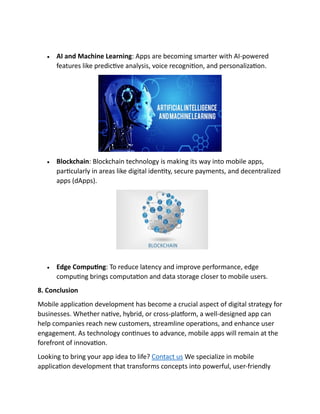
• AI and Machine Learning: Apps are becoming smarter with AI-powered
features like predictive analysis, voice recognition, and personalization.
• Blockchain: Blockchain technology is making its way into mobile apps,
particularly in areas like digital identity, secure payments, and decentralized
apps (dApps).
• Edge Computing: To reduce latency and improve performance, edge
computing brings computation and data storage closer to mobile users.
8. Conclusion
Mobile application development has become a crucial aspect of digital strategy for
businesses. Whether native, hybrid, or cross-platform, a well-designed app can
help companies reach new customers, streamline operations, and enhance user
engagement. As technology continues to advance, mobile apps will remain at the
forefront of innovation.
Looking to bring your app idea to life? Contact us We specialize in mobile
application development that transforms concepts into powerful, user-friendly
This Photo by Unknown Author is
mobile solutions. Whether you're a startup or an established business, our team
delivers custom apps that engage users and drive growth. Let's create your next
big success.

Mobile Application Development: A Step-by-Step Guide

  • 1.
    Mobile Application Development:A Step-by-Step Guide 1. Overview of Mobile Application Development Mobile application development involves the creation of software designed to run on mobile devices, such as smartphones and tablets. With billions of smartphone users worldwide, mobile apps have become a key driver of digital transformation across industries. • Growing Importance of Mobile Apps Mobile applications enhance customer experiences by providing on-the-go access to products, services, and information. Companies leverage mobile platforms to improve business operations, increase user engagement, and generate revenue through in-app purchases and ads. 2. Mobile Platforms: iOS vs. Android The two primary platforms for mobile app development are iOS (developed by Apple) and Android (developed by Google). Understanding their differences is crucial for developers: • iOS iOS applications are developed using Swift or Objective-C. Known for its secure ecosystem and controlled environment, iOS ensures smooth performance across a limited range of devices (iPhones and iPads). • Android Android apps are developed using Kotlin or Java. With a more open-source nature, Android caters to a wide variety of devices from multiple manufacturers, offering greater customization.
  • 2.
    3. Key Stagesof Mobile Application Development Building a mobile app is a structured process that involves several stages. Each stage is critical for the app’s success: • 1. Idea and Research Every successful app starts with an idea. Developers must assess market needs, research competitors, and identify their unique selling proposition (USP). Conducting thorough research helps in understanding user expectations and trends. • 2. Wireframing and Prototyping A wireframe is a blueprint of the app’s user interface (UI) and flow. Developers use prototyping tools to create interactive designs that demonstrate how the app will work. This helps stakeholders visualize the final product. • 3. Development Development is broken down into two parts: o Frontend: Involves the user interface, including the app’s design, navigation, and interactivity. o Backend: Manages databases, servers, APIs, and business logic to ensure smooth functionality. Choosing the right development framework (such as Flutter, React Native, or native SDKs) is essential based on the app’s scope and platform requirements. • 4. Testing and Quality Assurance After development, rigorous testing is performed to ensure that the app functions correctly. Testing types include: o Unit Testing: Testing individual components or features. o UI/UX Testing: Ensuring a smooth user interface and experience. o Performance Testing: Checking the app's speed, memory usage, and battery consumption.
  • 3.
    o Security Testing:Protecting sensitive data and maintaining user privacy. • 5. Launch and Maintenance Once the app is ready, it is submitted to the relevant app stores (Apple App Store and Google Play Store). Maintenance includes regular updates to address bugs, enhance features, and keep up with platform updates. 4. Cross-Platform Development: Advantages and Challenges With the rise of cross-platform frameworks like Flutter, React Native, and Xamarin, developers can create apps for both iOS and Android with a single codebase. • Advantages: o Cost-effective: Reduces development costs and time. o Faster Deployment: With a unified codebase, the app can be launched on multiple platforms simultaneously. o Easier Maintenance: Simplifies app updates across platforms. • Challenges: o Performance Limitations: Cross-platform apps may not match the performance of native apps, especially for high-performance applications like games. o Limited Access to Native Features: Some platform-specific features may not be fully accessible in a cross-platform environment. 5. Monetizing Mobile Applications There are various methods of monetizing mobile apps: • Freemium Model Apps are free to download but offer premium features via in-app purchases. This model is popular for mobile games and fitness apps. • In-App Advertising Integrating ads within an app can generate revenue, especially for apps with a large user base. Developers can choose between banner ads, video ads, or native ads.
  • 4.
    • Paid Apps Userspay a one-time fee to download the app. This model works well for highly specialized or professional apps. • Subscription Services Users pay recurring fees to access exclusive content or features, making this model ideal for content-driven apps like streaming services. 6. Popular Mobile Application Development Tools Developers rely on various tools to streamline mobile app development: • Android Studio: The official integrated development environment (IDE) for Android app development. • Xcode: The IDE for iOS app development. • Flutter: A UI toolkit for building cross-platform apps using a single codebase. • React Native: A popular framework for building native mobile apps using JavaScript and React. • Firebase: A platform for backend services, including cloud storage, real-time databases, and authentication. 7. Future of Mobile Application Development The mobile app industry is continuously evolving, with several trends shaping the future of development: • IoT Integration: Mobile apps are increasingly interacting with IoT devices, enabling smart homes, connected wearables, and automated systems.
  • 5.
    • AI andMachine Learning: Apps are becoming smarter with AI-powered features like predictive analysis, voice recognition, and personalization. • Blockchain: Blockchain technology is making its way into mobile apps, particularly in areas like digital identity, secure payments, and decentralized apps (dApps). • Edge Computing: To reduce latency and improve performance, edge computing brings computation and data storage closer to mobile users. 8. Conclusion Mobile application development has become a crucial aspect of digital strategy for businesses. Whether native, hybrid, or cross-platform, a well-designed app can help companies reach new customers, streamline operations, and enhance user engagement. As technology continues to advance, mobile apps will remain at the forefront of innovation. Looking to bring your app idea to life? Contact us We specialize in mobile application development that transforms concepts into powerful, user-friendly This Photo by Unknown Author is
  • 6.
    mobile solutions. Whetheryou're a startup or an established business, our team delivers custom apps that engage users and drive growth. Let's create your next big success.