A BEGINNER’S GUIDE
FOR MOBILE APP
DEVELOPMENT IN 2024
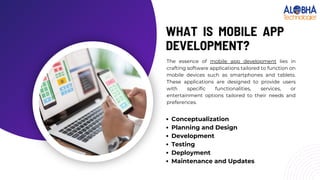
The essence of mobile app development lies in
crafting software applications tailored to function on
mobile devices such as smartphones and tablets.
These applications are designed to provide users
with specific functionalities, services, or
entertainment options tailored to their needs and
preferences.
WHAT IS MOBILE APP
DEVELOPMENT?
Conceptualization
Planning and Design
Development
Testing
Deployment
Maintenance and Updates
UNDERSTANDING THE
BASICS OF MOBILE APP
DEVELOPMENT
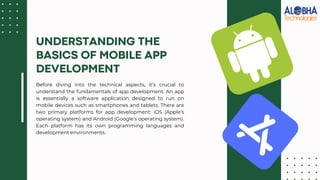
Before diving into the technical aspects, it’s crucial to
understand the fundamentals of app development. An app
is essentially a software application designed to run on
mobile devices such as smartphones and tablets. There are
two primary platforms for app development: iOS (Apple’s
operating system) and Android (Google’s operating system).
Each platform has its own programming languages and
development environments.
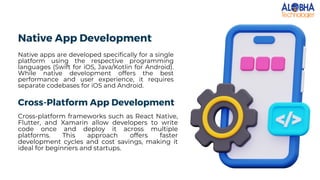
Native App Development
Native apps are developed specifically for a single
platform using the respective programming
languages (Swift for iOS, Java/Kotlin for Android).
While native development offers the best
performance and user experience, it requires
separate codebases for iOS and Android.
Cross-Platform App Development
Cross-platform frameworks such as React Native,
Flutter, and Xamarin allow developers to write
code once and deploy it across multiple
platforms. This approach offers faster
development cycles and cost savings, making it
ideal for beginners and startups.
Choosing the Right Mobile
App Development Approach
Once you’ve defined your app idea, it’s
time to choose the appropriate
development approach. There are several
options available, including
No-Code/Low-Code
App Development
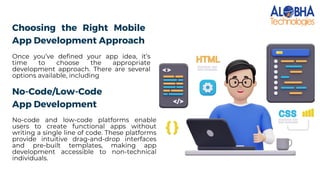
No-code and low-code platforms enable
users to create functional apps without
writing a single line of code. These platforms
provide intuitive drag-and-drop interfaces
and pre-built templates, making app
development accessible to non-technical
individuals.
Upon establishing a prototype, the next step is to
commence the development of your application. If
you’re building a native app, familiarize yourself with the
relevant programming languages and development
tools.
DEVELOPING AND TESTING
YOUR MOBILE APP
Once your app is developed and thoroughly tested, it’s
time to prepare for its launch. If you’re targeting
multiple platforms, submit your app to the respective
app stores (Apple App Store for iOS and Google Play
Store for Android).
PUBLISHING AND LAUNCHING
YOUR MOBILE APP
/AlobhaTechnology
/alobha_technologies
/AlobhaTech
/alobha-technologies
/alobhatechnologies.com
THANK YOU
- alobhatechnologies.com

A Beginner’s Guide for Mobile App Development in 2024.pdf

  • 1.
    A BEGINNER’S GUIDE FORMOBILE APP DEVELOPMENT IN 2024
  • 2.
    The essence ofmobile app development lies in crafting software applications tailored to function on mobile devices such as smartphones and tablets. These applications are designed to provide users with specific functionalities, services, or entertainment options tailored to their needs and preferences. WHAT IS MOBILE APP DEVELOPMENT? Conceptualization Planning and Design Development Testing Deployment Maintenance and Updates
  • 3.
    UNDERSTANDING THE BASICS OFMOBILE APP DEVELOPMENT Before diving into the technical aspects, it’s crucial to understand the fundamentals of app development. An app is essentially a software application designed to run on mobile devices such as smartphones and tablets. There are two primary platforms for app development: iOS (Apple’s operating system) and Android (Google’s operating system). Each platform has its own programming languages and development environments.
  • 4.
    Native App Development Nativeapps are developed specifically for a single platform using the respective programming languages (Swift for iOS, Java/Kotlin for Android). While native development offers the best performance and user experience, it requires separate codebases for iOS and Android. Cross-Platform App Development Cross-platform frameworks such as React Native, Flutter, and Xamarin allow developers to write code once and deploy it across multiple platforms. This approach offers faster development cycles and cost savings, making it ideal for beginners and startups.
  • 5.
    Choosing the RightMobile App Development Approach Once you’ve defined your app idea, it’s time to choose the appropriate development approach. There are several options available, including No-Code/Low-Code App Development No-code and low-code platforms enable users to create functional apps without writing a single line of code. These platforms provide intuitive drag-and-drop interfaces and pre-built templates, making app development accessible to non-technical individuals.
  • 6.
    Upon establishing aprototype, the next step is to commence the development of your application. If you’re building a native app, familiarize yourself with the relevant programming languages and development tools. DEVELOPING AND TESTING YOUR MOBILE APP Once your app is developed and thoroughly tested, it’s time to prepare for its launch. If you’re targeting multiple platforms, submit your app to the respective app stores (Apple App Store for iOS and Google Play Store for Android). PUBLISHING AND LAUNCHING YOUR MOBILE APP
  • 7.
  • 8.