The Small OpenEconomy Under Floating Exchange Rates
Before analyzing the impact of policies in an open economy, we must specify the
international monetary system in which the country has chosen to operate. We start
with the system relevant for most major economies today: floating exchange rates.
Under floating exchange rates, the exchange rate is allowed to fluctuate in response to
changing economic conditions.
Fiscal Policy
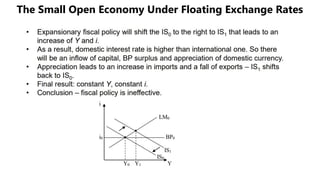
Suppose that the government stimulates domestic spending by increasing
government purchases or by cutting taxes. Because such expansionary fiscal policy
increases planned expenditure, it shifts the IS* curve to the right. As a result, the
exchange rate appreciates, whereas the level of income remains the same.
Notice that fiscal policy has very different effects in a small open economy than it does
in a closed economy. In the closed-economy IS–LM model, a fiscal expansion raises
income, whereas in a small open economy with a floating exchange rate, a fiscal
expansion leaves income at the same level.
3.
The Small OpenEconomy Under Floating Exchange Rates
• Why the difference? When income rises in a closed economy, the interest rate rises,
because higher income increases the demand for money. That is not possible in a
small open economy: as soon as the interest rate tries to rise above the world
interest rate r*, capital flows in from abroad.
• This capital inflow increases the demand for the domestic currency in the market for
foreign-currency exchange and, thus, bids up the value of the domestic currency.
• The appreciation of the exchange rate makes domestic goods expensive relative to
foreign goods, and this reduces net exports causing the IS Curve to revert to its
original position.
• Therefore, an expansionary fiscal policy in a floating exchange rate regime is
ineffective.
The Small OpenEconomy Under Floating Exchange Rates
Monetary Policy
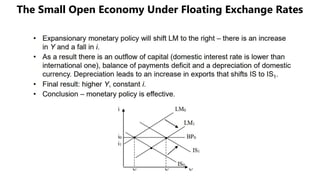
• Suppose now that the central bank increases the money supply. Because the price
level is assumed to be fixed, the increase in the money supply means an increase in
real balances.
• The increase in real balances shifts the LM* curve to the right. Hence, an increase in
the money supply raises money and lowers the exchange rate.
• As soon as an increase in the money supply puts downward pressure on the
domestic interest rate, capital flows out of the economy as investors seek a higher
return elsewhere.
• This capital outflow prevents the domestic interest rate from falling. In addition,
because the capital outflow increases the supply of the domestic currency in the
market for foreign-currency exchange, the exchange rate depreciates. The fall in the
exchange rate makes domestic goods inexpensive relative to foreign goods and,
thereby, stimulates net exports.
• Hence, in a small open economy, monetary policy influences income by altering the
exchange rate rather than the interest rate.
The Small OpenEconomy Under Fixed Exchange Rates
Fiscal Policy
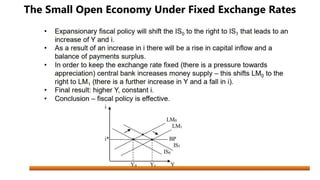
• Suppose that the government stimulates domestic spending by increasing
government purchases or by cutting taxes. This policy shifts the IS* curve to the
right, as in putting upward pressure on the exchange rate.
• But because the central bank stands ready to trade foreign and domestic currency
at the fixed exchange rate, arbitrageurs (individuals who earn profits by taking
advantage of changes in currency) quickly respond to the rising exchange rate by
selling foreign currency to the central bank, leading to an automatic monetary
expansion. The rise in the money supply shifts the LM* curve to the right.
• Thus, under a fixed exchange rate, a fiscal expansion raises aggregate income and
thus effective.
The Small OpenEconomy Under Fixed Exchange Rates
Monetary Policy
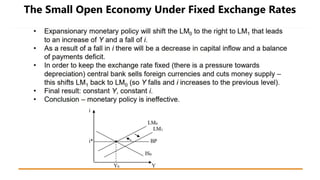
• Imagine that a central bank operating with a fixed exchange rate were to try to
increase the money supply—for example, by buying bonds from the public. What
would happen?
• The initial impact of this policy is to shift the LM* curve to the right, lowering the
exchange rate. But, because the central bank is committed to trading foreign and
domestic currency at a fixed exchange rate, arbitrageurs quickly respond to the
falling exchange rate by selling the domestic currency to the central bank, causing
the money supply and the LM* curve to return to their initial positions.
• Hence, monetary policy as usually conducted is ineffectual under a fixed exchange
rate. By agreeing to fix the exchange rate, the central bank gives up its control over
the money supply.