Anneka Pierzga
MLT 2015
Professor Tiffany Gill
December 12th, 2016
College of Southern Maryland
History and presentation
 68 year old Caucasian male
 Hx: Peripheral vascular disease
 Atrial fibrillation, hypertension, hyperlipidemia, benign prostatic hypertrophy
 Smoking (75 pack/year)
 Chronic alcohol consumption
 Denies history of MI, but does have a familial history of myocardial infarction
 Denies history of diabetes mellitus
 14 months post R popliteal artery bypass graft
 Current medications
 Aspirin 81mg PO QD (antiplatelet/anticoagulant)
 Atorvastatin (Lipitor) PO QD (hyperlipidemia)
 Plavix PO QD (antiplatelet/anticoagulant)
 Losartan PO QD (hypertension)
 Metoprolol PO QD (hypertension)
 Pentoxifylline PO QD (anti-inflammatory and vasodilator)
 Tamsulosin PO QD (for treatment of urinary retention in BPH)
 Rivaroxaban (anticoagulant)
 Folic acid QD
 Allergies
 Iodine
 Penicillin
 Physical exam
 2 week history of numbness/coolness of the surgical limb
 Extremities: both legs cool to the touch
 Feet: pink with CRT
 No evidence carotid bruits
 Femoral pulses slow R leg, WNL on L
 Pedal pulses absent bilaterally
Diagnosis, plan and treatment
 Diagnosis on Admission
1. Subacute occlusion of the R femoral popliteal bypass graft for 11 days!
2. Ischemic leg
3. Dyslipidemia
4. Atrial fibrillation
5. Benign prostatic hypertrophy
 Plan
 Admission with STAT CT/Angiogram
 Transluminal angioplasty with placement of a stent
 Anticoagulant therapy
Angioplasty and stent placement:
https://www.youtube.com/watch?v=veP5R-
pzJVk
 Post-operative medications
 TPN (nutritional support)
 Famotidine PO (gastroprotectant)
 Lipitor PO (hyperlipidemia)
 Metoprolol PO (beta blocker)
 Tamsulosin PO (treat urinary retention)
 Hydromorphone IV (pain management)
 Lorazepam IV (sedative and anxiolytic)
 Heparin IV (anticoagulant)
 UA
 CBC
 CMP/BMP
 Coagulation studies
Specimen 1
Date:11/19/16
Time: 11:35am
Analyte Test Results
Color yellow
Clarity clear
Specific Gravity 1.016
Glucose negative
Bilirubin Negative
Ketones Negative
Blood Negative
Ph 6.0
Protein Negative
Urobilinogen
< 2.0 mg/dL
Nitrite Negative
Negative
Unremarkable; microscopic
examination not performed
CBC Laboratory Results
Analyte Specimen 1
Date: 11/18/16
Time: 11:54am
Specimen 3
Date:11/21/16
Time:17:59p
Specimen 5
Date:11/22/16
Time:4:40a
Specimen 7
Date:11/23/16
Time:6:03a
WBC (x103/mcL) 7.5 4.7 6.0 9.3
RBC (x106/mcL) 4.88 3.5L 4.07L 4.00L
Hgb (g/dL) 17.3H 12.4L 14.2 13.8
Hct (%) 48.9 36.3L 41.5 40.2
MCV (fL) 100.2 103.7H 102.0 100.5
MCH (pg) 35.5H 35.4H 34.9H 34.5H
MCHC (g/dL) 35.4 34.2 34.2 34.3
RDW (%) 12.9 12.9 12.8 12.7
Platelets (x103/mcL) 177 77L 100 123L
Neutrophils (x103/mcL) 5.3 3.9 4.9 6.8
Lymphocytes (x103/mcL) 1.6 0.5L 0.7 1.5
Monocytes (x103/mcL) 0.6 0.3 0.4 0.9
Eosinophils (x103/mcL) 0.1 0 0 0
Basophils (x103/mcL) 0 0 0 0
 Thrombocytopenia due to anticoagulant therapy
 Anemia (decreased hematocrit, Hgb) day of surgery, likely due
to bleeding during surgery
 Increased MCH – macrocytosis, possible that patient had
been taking Folic acid supplements for management of a
megaloblastic anemia due to folate deficiency from chronic
alcoholism?
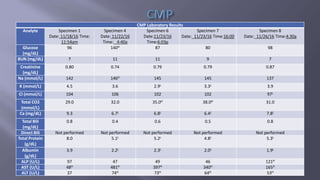
CMP Laboratory Results
Analyte Specimen 1
Date: 11/18/16 Time:
11:54am
Specimen 4
Date: 11/22/16
Time:_ 4:40a
Specimen 6
Date:11/23/16
Time:6:03p
Specimen 7
Date:_11/23/16 Time:16:00
Specimen 8
Date:_11/26/16 Time:4:30a
Glucose
(mg/dL)
96 140H 87 80 98
BUN (mg/dL) 7 11 11 9 7
Creatinine
(mg/dL)
0.80 0.74 0.79 0.79 0.87
Na (mmol/L) 142 146H 145 145 137
K (mmol/L) 4.5 3.6 2.9L 3.3L 3.9
Cl (mmol/L) 104 106 102 102 97L
Total CO2
(mmol/L)
29.0 32.0 35.0H 38.0H 31.0
Ca (mg/dL) 9.3 6.7L 6.8L 6.4L 7.8L
Total Bili
(mg/dL)
0.8 0.4 0.6 0.5 0.8
Direct Bili Not performed Not performed Not performed Not performed Not performed
Total Protein
(g/dL)
8.0 5.1L 5.2L 4.8L 5.3L
Albumin
(g/dL)
3.9 2.2L 2.3L 2.0L 1.9L
ALP (U/L) 97 47 49 46 121H
AST (U/L) 48H 481H 397H 340H 165H
ALT (U/L) 37 74H 73H 64H 53H
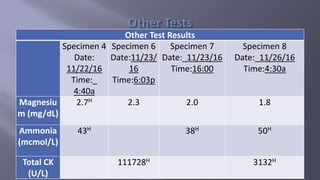
Other Test Results
Specimen 4
Date:
11/22/16
Time:_
4:40a
Specimen 6
Date:11/23/
16
Time:6:03p
Specimen 7
Date:_11/23/16
Time:16:00
Specimen 8
Date:_11/26/16
Time:4:30a
Magnesiu
m (mg/dL)
2.7H 2.3 2.0 1.8
Ammonia
(mcmol/L)
43H 38H 50H
Total CK
(U/L)
111728H 3132H
 Evidence of alcoholic hepatitis, possibly cirrhosis? ↑↑ AST>ALT,
hyperammonemia, hypoalbuminemia, hypomagnesemia,
hypocalcemia – abnormalities could be exacerbated by alcohol
withdrawal
 Elevated total CK likely due to recent surgical manipulation of tissues
(no reports of chest pain or other to suggest AMI, and no CK-
MB/Troponin I ordered)
 Transient hyperglycemia – possibly stress related, as patient had
denied a history of DM. Could also be post-prandial samples. Patient
had been receiving TPN  could cause hyperglycemia
Coagulation Laboratory Results
Analyte Specimen 1
Date:11/21/16
Time:1:55a
Specimen 2
Date:11/21/16_
Time:17:59p
Specimen 3
Date:11/22/16
Time:0:13a
Specimen 5
Date:11/23/16
Time:6:03a
Specimen 7
Date:
11/24/16
Time:5:19a
Specimen 8
Date:11/25/16
Time:5:40a
PT (sec) 14.7H 15.2H 13.0H 12.0 Not
performed
18.5H
PTT (sec) 31.5H 36.9H 29.7H 26.7 Not
performed
Not performed
Anti-Xa
(IU/mL)
Not performed Not performed Not performed 0.56 0.55 0.63
INR 1.40 1.44 1.24 1.15 NP 1.75
Monitoring of coagulation parameters seems to have started after initiation of
heparin therapy, so unsure of what coagulation status was prior to this. Patient
has been on aspirin and rivaroxaban for some time prior to admission (aspirin
causes decreased platelet aggregation and increased bleeding time,
rivaroxaban inhibits factor Xa).
Patient also appears to have alcoholic liver disease, which may also affect
coagulation studies (usually by prolongation of PT)
Patient was treated with heparin therapy during hospitalization, which can
produce prolongation of both the PT and PTT, although the PTT is a more
sensitive measure of heparin effect. Heparin also inactivates factor Xa, and
over the course of the patient’s hospitalization, we see his measured anti-Xa
fall into the laboratory defined therapeutic range of 0.3-0.7IU/mL as
therapeutic for treatment of DVT/A-Fib
Prognosis and recommendations
 Admitted 11/18, discharged 11/30
 At discharge, patient appeared to be doing well with good evidence of
revascularization of the affected limb
 Patients with symptomatic peripheral vascular disease tend to have
poor long-term prognosis
 Cease smoking and alcohol intake
 Exercise, improve dietary habits
American Heart Association. (2016). What is Atrial Fibrillation? Retrieved from
http://www.heart.org/HEARTORG/Conditions/Arrhythmia/AboutArrhythmia/What-is-Atrial-Fibrillation- AFib-or-
AF_UCM_423748_Article.jsp#.WE4Vw1wW5s4
Conejero, A. M., & Hernando, F. J. S. (2007). Peripheral Artery Disease: Pathophysiology, Diagnosis and Treatment. Revista Española
De Cardiología, 60(9), 969-982.
Eltzschig, H. K., & Collard, C. D. (2004). Vascular Ischaemia and Reperfusion injury. British Medical Bulletin, 70(1), 71-86.
Johns Hopkins Medicine Health Library. (2016). Fmoral Popliteal Bypass Surgery. Retrieved from
http://www.hopkinsmedicine.org/healthlibrary/test_procedures/cardiovascular/femoral_popliteal_bypas
s_surgery_92,p08294/
Lau, Y. F., Siu, C. W., Tse, H. F., & Yiu, K. H. (2012). Hypertension and Atrial Fibrillation: Epidemiology, Pathophysiology and
Therapeutic Implications. Journal of Human Hypertension, 26, 563-569.
MedicalExhibits. (2016). Femoral-Popliteal Bypass Surgery: Medical Exhibits, Demonstrative Aids, Illustrations and more.
Mosquera, D. (2013). Angiogram and Angioplasty.
National Heart, L., and Blood Institute,. (2016). What are the Signs and Symptoms of Carotid Artery Disease? Retrieved from
https://www.nhlbi.nih.gov/health/health-topics/topics/catd/signs
National Heart, L., and Blood Institute. (2016). Smoking and Atherosclerosis.
Pierce, S. M. (2016). Acute Lower Extremity Compartment Syndrome. Retrieved from http://nurse-
practitioners-and-physician-assistants.advanceweb.com/Continuing-Education/CE-Articles/Acute-Lower-Extremity-
Compartment-Syndrome.aspx
Santilli MD, J. D., & Steven M. Santilli, M., PHD. (1991). Chronic Critical Limb Ischemia: Diagnosis, Treatment and Prognosis.
American Family Physician, 59(7), 1899-1908.
StockUnlimited. (2016). Medical Clipboard.

MLT Clinical Case Study

  • 1.
    Anneka Pierzga MLT 2015 ProfessorTiffany Gill December 12th, 2016 College of Southern Maryland
  • 2.
  • 3.
     68 yearold Caucasian male  Hx: Peripheral vascular disease  Atrial fibrillation, hypertension, hyperlipidemia, benign prostatic hypertrophy  Smoking (75 pack/year)  Chronic alcohol consumption  Denies history of MI, but does have a familial history of myocardial infarction  Denies history of diabetes mellitus  14 months post R popliteal artery bypass graft
  • 4.
     Current medications Aspirin 81mg PO QD (antiplatelet/anticoagulant)  Atorvastatin (Lipitor) PO QD (hyperlipidemia)  Plavix PO QD (antiplatelet/anticoagulant)  Losartan PO QD (hypertension)  Metoprolol PO QD (hypertension)  Pentoxifylline PO QD (anti-inflammatory and vasodilator)  Tamsulosin PO QD (for treatment of urinary retention in BPH)  Rivaroxaban (anticoagulant)  Folic acid QD
  • 5.
  • 8.
     Physical exam 2 week history of numbness/coolness of the surgical limb  Extremities: both legs cool to the touch  Feet: pink with CRT  No evidence carotid bruits  Femoral pulses slow R leg, WNL on L  Pedal pulses absent bilaterally
  • 9.
  • 10.
     Diagnosis onAdmission 1. Subacute occlusion of the R femoral popliteal bypass graft for 11 days! 2. Ischemic leg 3. Dyslipidemia 4. Atrial fibrillation 5. Benign prostatic hypertrophy
  • 11.
     Plan  Admissionwith STAT CT/Angiogram  Transluminal angioplasty with placement of a stent  Anticoagulant therapy
  • 12.
    Angioplasty and stentplacement: https://www.youtube.com/watch?v=veP5R- pzJVk
  • 13.
     Post-operative medications TPN (nutritional support)  Famotidine PO (gastroprotectant)  Lipitor PO (hyperlipidemia)  Metoprolol PO (beta blocker)  Tamsulosin PO (treat urinary retention)  Hydromorphone IV (pain management)  Lorazepam IV (sedative and anxiolytic)  Heparin IV (anticoagulant)
  • 14.
     UA  CBC CMP/BMP  Coagulation studies
  • 15.
    Specimen 1 Date:11/19/16 Time: 11:35am AnalyteTest Results Color yellow Clarity clear Specific Gravity 1.016 Glucose negative Bilirubin Negative Ketones Negative Blood Negative Ph 6.0 Protein Negative Urobilinogen < 2.0 mg/dL Nitrite Negative Negative Unremarkable; microscopic examination not performed
  • 16.
    CBC Laboratory Results AnalyteSpecimen 1 Date: 11/18/16 Time: 11:54am Specimen 3 Date:11/21/16 Time:17:59p Specimen 5 Date:11/22/16 Time:4:40a Specimen 7 Date:11/23/16 Time:6:03a WBC (x103/mcL) 7.5 4.7 6.0 9.3 RBC (x106/mcL) 4.88 3.5L 4.07L 4.00L Hgb (g/dL) 17.3H 12.4L 14.2 13.8 Hct (%) 48.9 36.3L 41.5 40.2 MCV (fL) 100.2 103.7H 102.0 100.5 MCH (pg) 35.5H 35.4H 34.9H 34.5H MCHC (g/dL) 35.4 34.2 34.2 34.3 RDW (%) 12.9 12.9 12.8 12.7 Platelets (x103/mcL) 177 77L 100 123L Neutrophils (x103/mcL) 5.3 3.9 4.9 6.8 Lymphocytes (x103/mcL) 1.6 0.5L 0.7 1.5 Monocytes (x103/mcL) 0.6 0.3 0.4 0.9 Eosinophils (x103/mcL) 0.1 0 0 0 Basophils (x103/mcL) 0 0 0 0
  • 17.
     Thrombocytopenia dueto anticoagulant therapy  Anemia (decreased hematocrit, Hgb) day of surgery, likely due to bleeding during surgery  Increased MCH – macrocytosis, possible that patient had been taking Folic acid supplements for management of a megaloblastic anemia due to folate deficiency from chronic alcoholism?
  • 18.
    CMP Laboratory Results AnalyteSpecimen 1 Date: 11/18/16 Time: 11:54am Specimen 4 Date: 11/22/16 Time:_ 4:40a Specimen 6 Date:11/23/16 Time:6:03p Specimen 7 Date:_11/23/16 Time:16:00 Specimen 8 Date:_11/26/16 Time:4:30a Glucose (mg/dL) 96 140H 87 80 98 BUN (mg/dL) 7 11 11 9 7 Creatinine (mg/dL) 0.80 0.74 0.79 0.79 0.87 Na (mmol/L) 142 146H 145 145 137 K (mmol/L) 4.5 3.6 2.9L 3.3L 3.9 Cl (mmol/L) 104 106 102 102 97L Total CO2 (mmol/L) 29.0 32.0 35.0H 38.0H 31.0 Ca (mg/dL) 9.3 6.7L 6.8L 6.4L 7.8L Total Bili (mg/dL) 0.8 0.4 0.6 0.5 0.8 Direct Bili Not performed Not performed Not performed Not performed Not performed Total Protein (g/dL) 8.0 5.1L 5.2L 4.8L 5.3L Albumin (g/dL) 3.9 2.2L 2.3L 2.0L 1.9L ALP (U/L) 97 47 49 46 121H AST (U/L) 48H 481H 397H 340H 165H ALT (U/L) 37 74H 73H 64H 53H
  • 19.
    Other Test Results Specimen4 Date: 11/22/16 Time:_ 4:40a Specimen 6 Date:11/23/ 16 Time:6:03p Specimen 7 Date:_11/23/16 Time:16:00 Specimen 8 Date:_11/26/16 Time:4:30a Magnesiu m (mg/dL) 2.7H 2.3 2.0 1.8 Ammonia (mcmol/L) 43H 38H 50H Total CK (U/L) 111728H 3132H
  • 20.
     Evidence ofalcoholic hepatitis, possibly cirrhosis? ↑↑ AST>ALT, hyperammonemia, hypoalbuminemia, hypomagnesemia, hypocalcemia – abnormalities could be exacerbated by alcohol withdrawal  Elevated total CK likely due to recent surgical manipulation of tissues (no reports of chest pain or other to suggest AMI, and no CK- MB/Troponin I ordered)  Transient hyperglycemia – possibly stress related, as patient had denied a history of DM. Could also be post-prandial samples. Patient had been receiving TPN  could cause hyperglycemia
  • 21.
    Coagulation Laboratory Results AnalyteSpecimen 1 Date:11/21/16 Time:1:55a Specimen 2 Date:11/21/16_ Time:17:59p Specimen 3 Date:11/22/16 Time:0:13a Specimen 5 Date:11/23/16 Time:6:03a Specimen 7 Date: 11/24/16 Time:5:19a Specimen 8 Date:11/25/16 Time:5:40a PT (sec) 14.7H 15.2H 13.0H 12.0 Not performed 18.5H PTT (sec) 31.5H 36.9H 29.7H 26.7 Not performed Not performed Anti-Xa (IU/mL) Not performed Not performed Not performed 0.56 0.55 0.63 INR 1.40 1.44 1.24 1.15 NP 1.75
  • 22.
    Monitoring of coagulationparameters seems to have started after initiation of heparin therapy, so unsure of what coagulation status was prior to this. Patient has been on aspirin and rivaroxaban for some time prior to admission (aspirin causes decreased platelet aggregation and increased bleeding time, rivaroxaban inhibits factor Xa). Patient also appears to have alcoholic liver disease, which may also affect coagulation studies (usually by prolongation of PT) Patient was treated with heparin therapy during hospitalization, which can produce prolongation of both the PT and PTT, although the PTT is a more sensitive measure of heparin effect. Heparin also inactivates factor Xa, and over the course of the patient’s hospitalization, we see his measured anti-Xa fall into the laboratory defined therapeutic range of 0.3-0.7IU/mL as therapeutic for treatment of DVT/A-Fib
  • 23.
  • 24.
     Admitted 11/18,discharged 11/30  At discharge, patient appeared to be doing well with good evidence of revascularization of the affected limb  Patients with symptomatic peripheral vascular disease tend to have poor long-term prognosis  Cease smoking and alcohol intake  Exercise, improve dietary habits
  • 25.
    American Heart Association.(2016). What is Atrial Fibrillation? Retrieved from http://www.heart.org/HEARTORG/Conditions/Arrhythmia/AboutArrhythmia/What-is-Atrial-Fibrillation- AFib-or- AF_UCM_423748_Article.jsp#.WE4Vw1wW5s4 Conejero, A. M., & Hernando, F. J. S. (2007). Peripheral Artery Disease: Pathophysiology, Diagnosis and Treatment. Revista Española De Cardiología, 60(9), 969-982. Eltzschig, H. K., & Collard, C. D. (2004). Vascular Ischaemia and Reperfusion injury. British Medical Bulletin, 70(1), 71-86. Johns Hopkins Medicine Health Library. (2016). Fmoral Popliteal Bypass Surgery. Retrieved from http://www.hopkinsmedicine.org/healthlibrary/test_procedures/cardiovascular/femoral_popliteal_bypas s_surgery_92,p08294/ Lau, Y. F., Siu, C. W., Tse, H. F., & Yiu, K. H. (2012). Hypertension and Atrial Fibrillation: Epidemiology, Pathophysiology and Therapeutic Implications. Journal of Human Hypertension, 26, 563-569. MedicalExhibits. (2016). Femoral-Popliteal Bypass Surgery: Medical Exhibits, Demonstrative Aids, Illustrations and more. Mosquera, D. (2013). Angiogram and Angioplasty. National Heart, L., and Blood Institute,. (2016). What are the Signs and Symptoms of Carotid Artery Disease? Retrieved from https://www.nhlbi.nih.gov/health/health-topics/topics/catd/signs National Heart, L., and Blood Institute. (2016). Smoking and Atherosclerosis. Pierce, S. M. (2016). Acute Lower Extremity Compartment Syndrome. Retrieved from http://nurse- practitioners-and-physician-assistants.advanceweb.com/Continuing-Education/CE-Articles/Acute-Lower-Extremity- Compartment-Syndrome.aspx Santilli MD, J. D., & Steven M. Santilli, M., PHD. (1991). Chronic Critical Limb Ischemia: Diagnosis, Treatment and Prognosis. American Family Physician, 59(7), 1899-1908. StockUnlimited. (2016). Medical Clipboard.

Editor's Notes

  • #3 StockUnlimited. (2016). Medical Clipboard.
  • #7 Johns Hopkins Medicine Health Library. (2016). Fmoral Popliteal Bypass Surgery. Retrieved from http://www.hopkinsmedicine.org/healthlibrary/test_procedures/cardiovascular/femoral_popliteal_bypass_surger y_92,p08294/ MedicalExhibits. (2016). Femoral-Popliteal Bypass Surgery: Medical Exhibits, Demonstrative Aids, Illustrations and more. National Heart, L., and Blood Institute. (2016). Smoking and Atherosclerosis. Publications, H. H. (2011). Atrial Fibrillation.
  • #8 American Heart Association. (2016). What is Atrial Fibrillation? Retrieved from http://www.heart.org/HEARTORG/Conditions/Arrhythmia/AboutArrhythmia/What-is-Atrial-Fibrillation- AFib-or-AF_UCM_423748_Article.jsp#.WE4Vw1wW5s4 Lau, Y. F., Siu, C. W., Tse, H. F., & Yiu, K. H. (2012). Hypertension and Atrial Fibrillation: Epidemiology, Pathophysiology and Therapeutic Implications. Journal of Human Hypertension, 26, 563-569. Santilli MD, J. D., & Steven M. Santilli, M., PHD. (1991). Chronic Critical Limb Ischemia: Diagnosis, Treatment and Prognosis. American Family Physician, 59(7), 1899-1908.
  • #9 National Heart, L., and Blood Institute,. (2016). What are the Signs and Symptoms of Carotid Artery Disease? Retrieved from https://www.nhlbi.nih.gov/health/health- topics/topics/catd/signs
  • #13 Conejero, A. M., & Hernando, F. J. S. (2007). Peripheral Artery Disease: Pathophysiology, Diagnosis and Treatment. Revista Española De Cardiología, 60(9), 969-982. Eltzschig, H. K., & Collard, C. D. (2004). Vascular Ischaemia and Reperfusion injury. British Medical Bulletin, 70(1), 71-86. Mosquera, D. (2013). Angiogram and Angioplasty. Pierce, S. M. (2016). Acute Lower Extremity Compartment Syndrome. Retrieved from http://nurse-practitioners-and-physician- assistants.advanceweb.com/Continuing-Education/CE-Articles/Acute-Lower-Extremity-Compartment- Syndrome.aspx Sorrentino, S. (2016). Percutaneous angioplasty of a superficial femoral artery stenosis.
  • #19 http://emedicine.medscape.com/article/819502-workup http://www.diapedia.org/associated-disorders/61040851258/hyperglycaemia-without-diabetes
  • #22 http://atvb.ahajournals.org/content/21/7/1094 http://www.pathologystudent.com/?p=6519
  • #25 Santilli MD, J. D. and M. Steven M. Santilli, PHD (1991). "Chronic Critical Limb Ischemia: Diagnosis, Treatment and Prognosis." American Family Physician 59(7): 1899-1908.