Grade 7 Science
Mixtures &
Pure
Substances
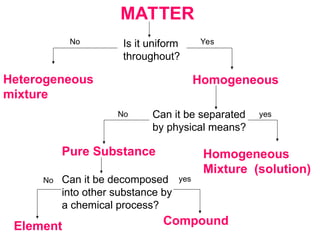
MATTER
Heterogeneous
mixture
Is it uniform
throughout?
No
Homogeneous
Yes
Can it be separated
by physical means?
Pure Substance Homogeneous
Mixture (solution)
Can it be decomposed
into other substance by
a chemical process?
Element Compound
No yes
No yes
Mixed or Pure?
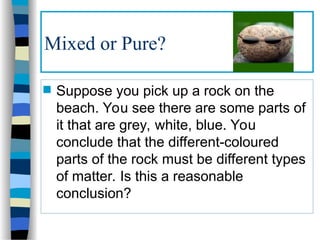
 Suppose you pick up a rock on the
beach. You see there are some parts of
it that are grey, white, blue. You
conclude that the different-coloured
parts of the rock must be different types
of matter. Is this a reasonable
conclusion?
Mixed or Pure?
 With a partner, select two of the
following pairs of items and list as many
differences as you can:
 Vinegar and water
 Aluminum foil and plastic wrap
 Steel and glass
 Molasses and cooking oil
 Metal paper clips and saw dust
Mixtures vs. Pure
Substances
Mixtures...
 MAY have distinct visible
components.
 MAY appear uniform
throughout.
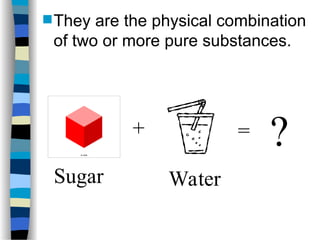
 They are the physical combination
of two or more pure substances.
+
Sugar Water
= ?
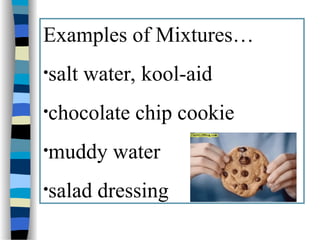
Examples of Mixtures…
•salt water, kool-aid
•chocolate chip cookie
•muddy water
•salad dressing
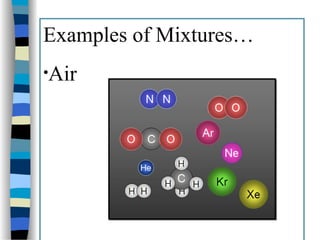
Examples of Mixtures…
•Air
Pure Substances...
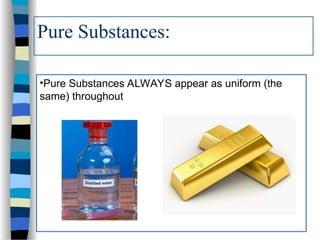
 ALWAYS appear as
uniform throughout
 They contain either a single
atom or two or more atoms
chemically combined to
form a different substance.
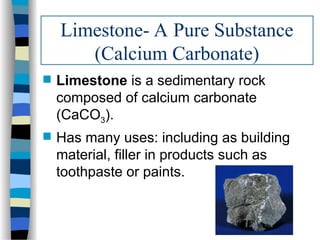
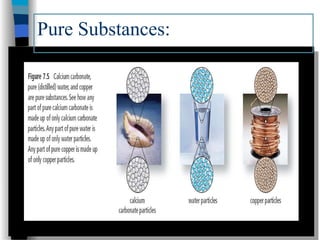
Limestone- A Pure Substance
(Calcium Carbonate)
 Limestone is a sedimentary rock
composed of calcium carbonate
(CaCO3).
 Has many uses: including as building
material, filler in products such as
toothpaste or paints.
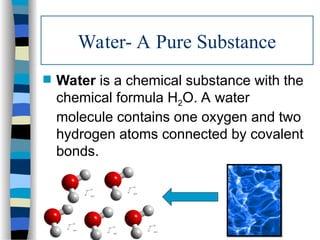
Water- A Pure Substance
 Water is a chemical substance with the
chemical formula H2O. A water
molecule contains one oxygen and two
hydrogen atoms connected by covalent
bonds.
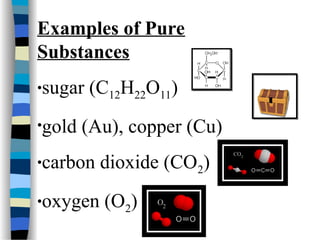
Examples of Pure
Substances
•sugar (C12H22O11)
•gold (Au), copper (Cu)
•carbon dioxide (CO2)
•oxygen (O2)
USING THE PARTICLE THEORY OF MATTER WE
CAN DISTINGUISH BETWEEN A PURE
SUBSTANCE AND A MIXTURE
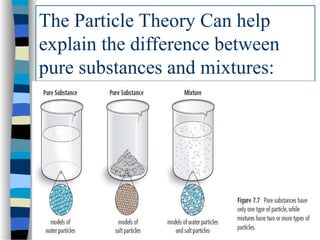
Pure Substance: has only ONE type of particle
Example: gold, iron
Mixture: has 2 or more types of substance in it. We can also
say it has 2 or more types of particles mixed together
Example: sweetened water
A Quick Review of chapter so far:
Pure Substances:
•Pure Substances ALWAYS appear as uniform (the
same) throughout
Pure Substances:
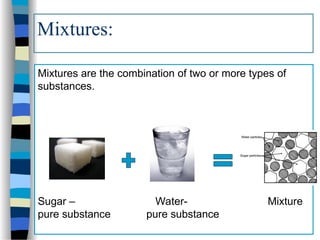
Mixtures are the combination of two or more types of
substances.
Sugar – Water- Mixture
pure substance pure substance
Mixtures:
The Particle Theory Can help
explain the difference between
pure substances and mixtures:
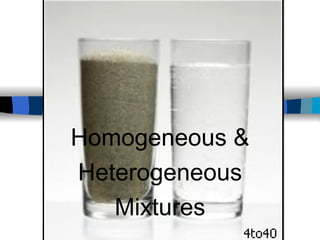
Homogeneous &
Heterogeneous
Mixtures
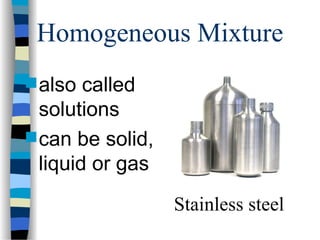
Homogeneous Mixture
 also called
solutions
 can be solid,
liquid or gas
Stainless steel
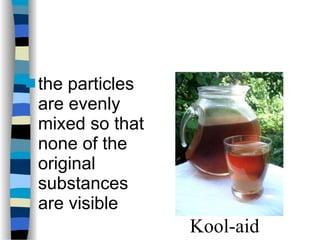
 the particles
are evenly
mixed so that
none of the
original
substances
are visible
Kool-aid
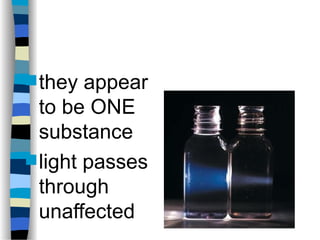
 they appear
to be ONE
substance
 light passes
through
unaffected
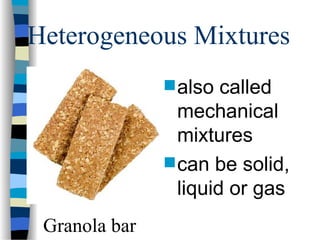
Heterogeneous Mixtures
 also called
mechanical
mixtures
 can be solid,
liquid or gas
Granola bar
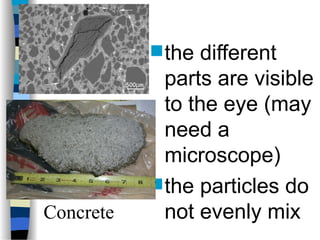
 the different
parts are visible
to the eye (may
need a
microscope)
 the particles do
not evenly mix
Concrete
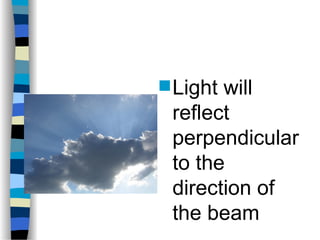
 Light will
reflect
perpendicular
to the
direction of
the beam
The Tyndall Effect
 A phenomenon that can be
used to distinguish between
solutions and what appears to
be a solution
 cannot be used to distinguish
between a solution and a
pure liquid
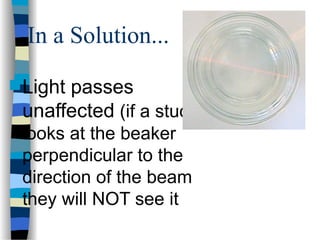
In a Solution...
 Light passes
unaffected (if a student
looks at the beaker
perpendicular to the
direction of the beam
they will NOT see it
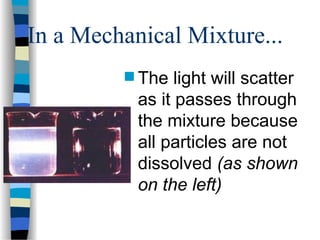
In a Mechanical Mixture...
 The light will scatter
as it passes through
the mixture because
all particles are not
dissolved (as shown
on the left)

Mixture-Substances powerpoint presentation

  • 1.
    Grade 7 Science Mixtures& Pure Substances
  • 2.
    MATTER Heterogeneous mixture Is it uniform throughout? No Homogeneous Yes Canit be separated by physical means? Pure Substance Homogeneous Mixture (solution) Can it be decomposed into other substance by a chemical process? Element Compound No yes No yes
  • 3.
    Mixed or Pure? Suppose you pick up a rock on the beach. You see there are some parts of it that are grey, white, blue. You conclude that the different-coloured parts of the rock must be different types of matter. Is this a reasonable conclusion?
  • 4.
    Mixed or Pure? With a partner, select two of the following pairs of items and list as many differences as you can:  Vinegar and water  Aluminum foil and plastic wrap  Steel and glass  Molasses and cooking oil  Metal paper clips and saw dust
  • 5.
    Mixtures vs. Pure Substances Mixtures... MAY have distinct visible components.  MAY appear uniform throughout.
  • 6.
     They arethe physical combination of two or more pure substances. + Sugar Water = ?
  • 7.
    Examples of Mixtures… •saltwater, kool-aid •chocolate chip cookie •muddy water •salad dressing
  • 8.
  • 9.
    Pure Substances...  ALWAYSappear as uniform throughout  They contain either a single atom or two or more atoms chemically combined to form a different substance.
  • 10.
    Limestone- A PureSubstance (Calcium Carbonate)  Limestone is a sedimentary rock composed of calcium carbonate (CaCO3).  Has many uses: including as building material, filler in products such as toothpaste or paints.
  • 11.
    Water- A PureSubstance  Water is a chemical substance with the chemical formula H2O. A water molecule contains one oxygen and two hydrogen atoms connected by covalent bonds.
  • 12.
    Examples of Pure Substances •sugar(C12H22O11) •gold (Au), copper (Cu) •carbon dioxide (CO2) •oxygen (O2)
  • 13.
    USING THE PARTICLETHEORY OF MATTER WE CAN DISTINGUISH BETWEEN A PURE SUBSTANCE AND A MIXTURE Pure Substance: has only ONE type of particle Example: gold, iron Mixture: has 2 or more types of substance in it. We can also say it has 2 or more types of particles mixed together Example: sweetened water A Quick Review of chapter so far:
  • 14.
  • 15.
    •Pure Substances ALWAYSappear as uniform (the same) throughout Pure Substances:
  • 16.
    Mixtures are thecombination of two or more types of substances. Sugar – Water- Mixture pure substance pure substance Mixtures:
  • 17.
    The Particle TheoryCan help explain the difference between pure substances and mixtures:
  • 18.
  • 19.
    Homogeneous Mixture  alsocalled solutions  can be solid, liquid or gas Stainless steel
  • 20.
     the particles areevenly mixed so that none of the original substances are visible Kool-aid
  • 21.
     they appear tobe ONE substance  light passes through unaffected
  • 22.
    Heterogeneous Mixtures  alsocalled mechanical mixtures  can be solid, liquid or gas Granola bar
  • 23.
     the different partsare visible to the eye (may need a microscope)  the particles do not evenly mix Concrete
  • 24.
     Light will reflect perpendicular tothe direction of the beam
  • 25.
    The Tyndall Effect A phenomenon that can be used to distinguish between solutions and what appears to be a solution  cannot be used to distinguish between a solution and a pure liquid
  • 26.
    In a Solution... Light passes unaffected (if a student looks at the beaker perpendicular to the direction of the beam they will NOT see it
  • 27.
    In a MechanicalMixture...  The light will scatter as it passes through the mixture because all particles are not dissolved (as shown on the left)