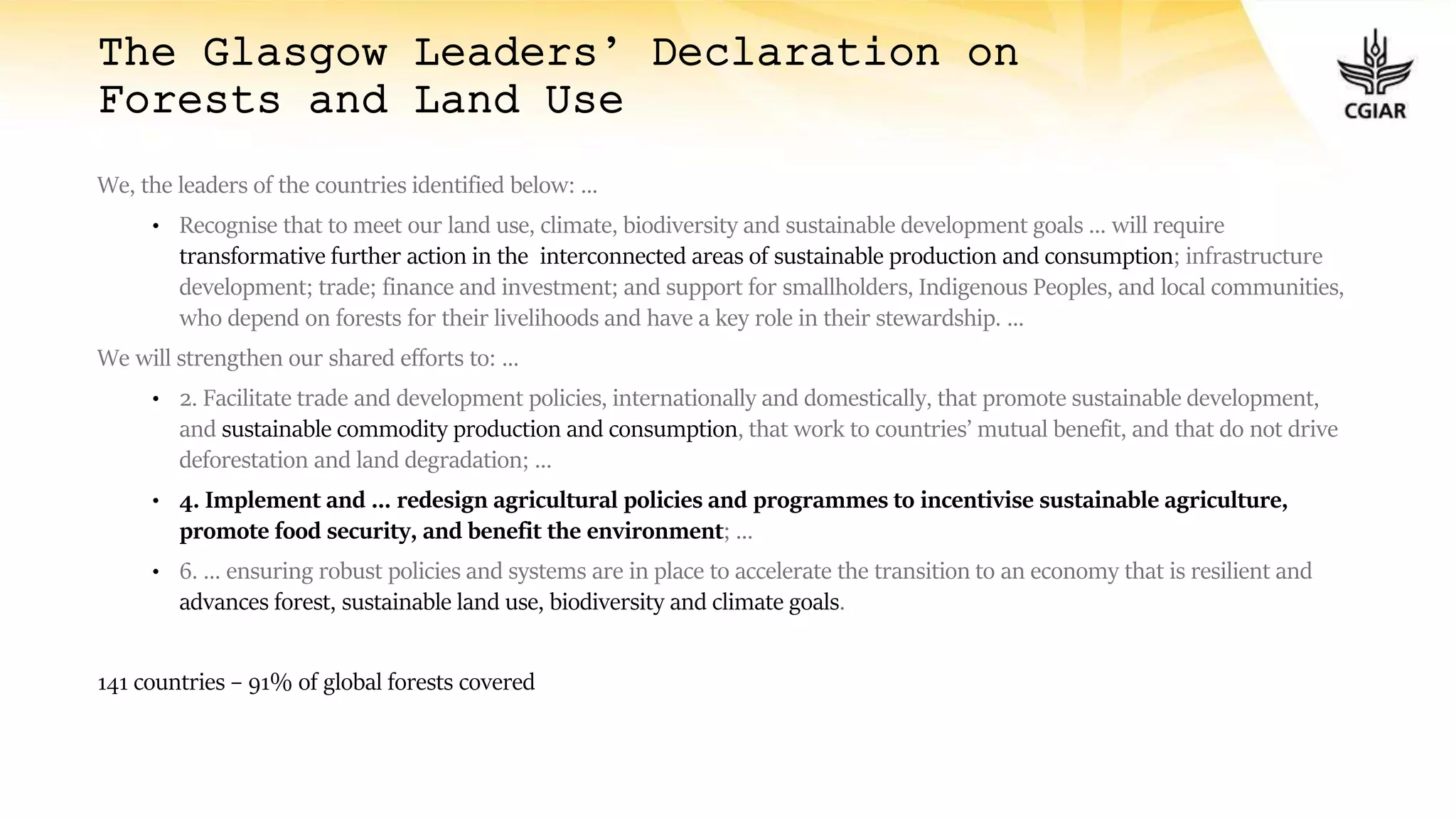
The Glasgow Leaders’ Declaration on
Forests and Land Use
We, the leaders of the countries identified below: ...
• Recognise that to meet our land use, climate, biodiversity and sustainable development goals … will require
transformative further action in the interconnected areas of sustainable production and consumption; infrastructure
development; trade; finance and investment; and support for smallholders, Indigenous Peoples, and local communities,
who depend on forests for their livelihoods and have a key role in their stewardship. ...
We will strengthen our shared efforts to: ...
• 2. Facilitate trade and development policies, internationally and domestically, that promote sustainable development,
and sustainable commodity production and consumption, that work to countries’ mutual benefit, and that do not drive
deforestation and land degradation; …
• 4. Implement and … redesign agricultural policies and programmes to incentivise sustainable agriculture,
promote food security, and benefit the environment; …
• 6. … ensuring robust policies and systems are in place to accelerate the transition to an economy that is resilient and
advances forest, sustainable land use, biodiversity and climate goals.
141 countries – 91% of global forests covered
Mitigate+: Research for
low-emission food systems
SBSTA 56, 14 June 2022, Bonn, Germany
Christopher Martius, Louis Verchot, Wei
Zhang
c.martius@cgiar.org
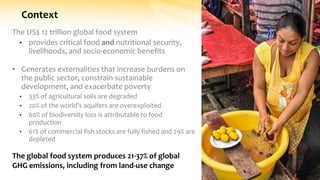
Context
The US$ 12 trillion global food system
• provides critical food and nutritional security,
livelihoods, and socio-economic benefits
• Generates externalities that increase burdens on
the public sector, constrain sustainable
development, and exacerbate poverty
• 33% of agricultural soils are degraded
• 20% of the world’s aquifers are overexploited
• 60% of biodiversity loss is attributable to food
production
• 61% of commercial fish stocks are fully fished and 29% are
depleted
The global food system produces 21-37% of global
GHG emissions, including from land-use change
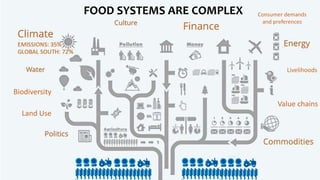
FOOD SYSTEMS ARE COMPLEX
Value chains
Biodiversity
Land Use
Consumer demands
and preferences
Livelihoods
What does the program address?
• Land use and LU change
• Reducing forest conversion to cropland and pasture
• Improving resource use efficiency in major commodity production
(rice, livestock)
• Increasing mitigation-adaptation synergies
• Post-harvest activities
• Improving value chain efficiencies: processing, transport,
preservation, retail
• Reducing post-harvest food waste
• Integrating biomass production (bioenergy, raw materials)
• Influencing long-term consumption and offtake trends (e.g. meat
consumption, maize-to-fructose)
We build on over 2 decades of CGIAR work on climate change I
REDD+
• Quantification of deforestation drivers and
associated emissions
• Quantification of sink potential from SMF
and forest restoration
• Enabling environment and political economy
of deforestation
• Forest landscape restoration – Bonn
Challenge
Climate smart agriculture
• Reduced CH4 emissions
- residue and water management in rice
- animal and feed management, diet formulation,
and rumen manipulation
• Reduced N2O emissions
- biological nitrification inhibition and pro-poor
precision agriculture
• Increased soil C
- integrated soil fertility management, agroecology,
and regenerative practices
Emissions associated with food loss and waste
We build on over 2 decades of CGIAR work on climate change
II
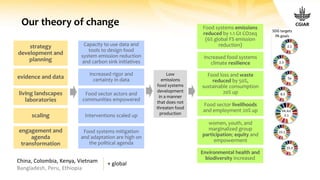
Our theory of change
engagement and
agenda
transformation
living landscapes
laboratories
evidence and data
scaling
strategy
development and
planning
Food systems mitigation
and adaptation are high on
the political agenda
Food sector actors and
communities empowered
Increased rigor and
certainty in data
Interventions scaled up
Capacity to use data and
tools to design food
system emission reduction
and carbon sink initiatives
Environmental health and
biodiversity increased
Food sector livelihoods
and employment 20% up
Food loss and waste
reduced by 50%,
sustainable consumption
20% up
women, youth, and
marginalized group
participation; equity and
empowerment
Food systems emissions
reduced by 1.1 Gt CO2eq
(6% global FS emission
reduction)
Low
emissions
food systems
development
in a manner
that does not
threaten food
production
Increased food systems
climate resilience
China, Colombia, Kenya, Vietnam
Bangladesh, Peru, Ethiopia
+ global
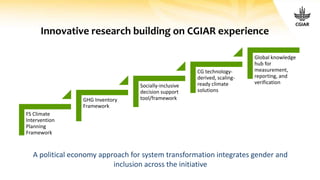
Innovative research building on CGIAR experience
FS Climate
Intervention
Planning
Framework
GHG Inventory
Framework
Socially-inclusive
decision support
tool/framework
CG technology-
derived, scaling-
ready climate
solutions
Global knowledge
hub for
measurement,
reporting, and
verification
A political economy approach for system transformation integrates gender and
inclusion across the initiative
“You cannot protect the environment unless
you empower people, you inform them, and
you help them understand that these
resources are their own, that they must
protect them.”
– Wangari Maathai

Mitigate+: Research for low-emission food systems

  • 1.
    The Glasgow Leaders’Declaration on Forests and Land Use We, the leaders of the countries identified below: ... • Recognise that to meet our land use, climate, biodiversity and sustainable development goals … will require transformative further action in the interconnected areas of sustainable production and consumption; infrastructure development; trade; finance and investment; and support for smallholders, Indigenous Peoples, and local communities, who depend on forests for their livelihoods and have a key role in their stewardship. ... We will strengthen our shared efforts to: ... • 2. Facilitate trade and development policies, internationally and domestically, that promote sustainable development, and sustainable commodity production and consumption, that work to countries’ mutual benefit, and that do not drive deforestation and land degradation; … • 4. Implement and … redesign agricultural policies and programmes to incentivise sustainable agriculture, promote food security, and benefit the environment; … • 6. … ensuring robust policies and systems are in place to accelerate the transition to an economy that is resilient and advances forest, sustainable land use, biodiversity and climate goals. 141 countries – 91% of global forests covered
  • 2.
    Mitigate+: Research for low-emissionfood systems SBSTA 56, 14 June 2022, Bonn, Germany Christopher Martius, Louis Verchot, Wei Zhang c.martius@cgiar.org
  • 3.
    Context The US$ 12trillion global food system • provides critical food and nutritional security, livelihoods, and socio-economic benefits • Generates externalities that increase burdens on the public sector, constrain sustainable development, and exacerbate poverty • 33% of agricultural soils are degraded • 20% of the world’s aquifers are overexploited • 60% of biodiversity loss is attributable to food production • 61% of commercial fish stocks are fully fished and 29% are depleted The global food system produces 21-37% of global GHG emissions, including from land-use change
  • 4.
    FOOD SYSTEMS ARECOMPLEX Value chains Biodiversity Land Use Consumer demands and preferences Livelihoods
  • 5.
    What does theprogram address? • Land use and LU change • Reducing forest conversion to cropland and pasture • Improving resource use efficiency in major commodity production (rice, livestock) • Increasing mitigation-adaptation synergies • Post-harvest activities • Improving value chain efficiencies: processing, transport, preservation, retail • Reducing post-harvest food waste • Integrating biomass production (bioenergy, raw materials) • Influencing long-term consumption and offtake trends (e.g. meat consumption, maize-to-fructose)
  • 6.
    We build onover 2 decades of CGIAR work on climate change I REDD+ • Quantification of deforestation drivers and associated emissions • Quantification of sink potential from SMF and forest restoration • Enabling environment and political economy of deforestation • Forest landscape restoration – Bonn Challenge
  • 7.
    Climate smart agriculture •Reduced CH4 emissions - residue and water management in rice - animal and feed management, diet formulation, and rumen manipulation • Reduced N2O emissions - biological nitrification inhibition and pro-poor precision agriculture • Increased soil C - integrated soil fertility management, agroecology, and regenerative practices Emissions associated with food loss and waste We build on over 2 decades of CGIAR work on climate change II
  • 8.
    Our theory ofchange engagement and agenda transformation living landscapes laboratories evidence and data scaling strategy development and planning Food systems mitigation and adaptation are high on the political agenda Food sector actors and communities empowered Increased rigor and certainty in data Interventions scaled up Capacity to use data and tools to design food system emission reduction and carbon sink initiatives Environmental health and biodiversity increased Food sector livelihoods and employment 20% up Food loss and waste reduced by 50%, sustainable consumption 20% up women, youth, and marginalized group participation; equity and empowerment Food systems emissions reduced by 1.1 Gt CO2eq (6% global FS emission reduction) Low emissions food systems development in a manner that does not threaten food production Increased food systems climate resilience China, Colombia, Kenya, Vietnam Bangladesh, Peru, Ethiopia + global
  • 9.
    Innovative research buildingon CGIAR experience FS Climate Intervention Planning Framework GHG Inventory Framework Socially-inclusive decision support tool/framework CG technology- derived, scaling- ready climate solutions Global knowledge hub for measurement, reporting, and verification A political economy approach for system transformation integrates gender and inclusion across the initiative
  • 10.
    “You cannot protectthe environment unless you empower people, you inform them, and you help them understand that these resources are their own, that they must protect them.” – Wangari Maathai