Mitigating the June 2007 International Space
 Station (ISS) Russian Segment Computer
          Anomaly in your Design
         Project Management Challenge 2008
               Daytona Beach, Florida
                February 26 - 27, 2008

                    Mitchell Davis
            NASA Technical Fellow for Avionics
            NASA Engineering & Safety Center
Summary


Purpose: This presentation considers the resulting design features on the ISS
   computers and redundancy implementation in relationship to the June 2007
   ISS computer shutdown anomaly.

•   The resulting design features dictate how each subsystem responds to
    particular fault, which in turn dictates the entire system response.

•   The first section covers the anomaly and recovery

•   The second sections covers the lower level implementation details in
    connection to the threat

•   This paper in intended to provide an example of the design decisions
    covered in earlier NESC “risk-based design” presentations.

                                                                            2
Anomaly Timeline
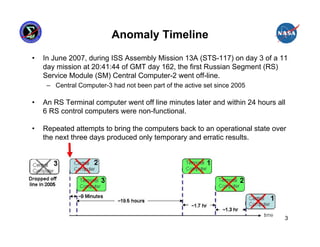
•   In June 2007, during ISS Assembly Mission 13A (STS-117) on day 3 of a 11
    day mission at 20:41:44 of GMT day 162, the first Russian Segment (RS)
    Service Module (SM) Central Computer-2 went off-line.
     – Central Computer-3 had not been part of the active set since 2005

•   An RS Terminal computer went off line minutes later and within 24 hours all
    6 RS control computers were non-functional.

•   Repeated attempts to bring the computers back to an operational state over
    the next three days produced only temporary and erratic results.


                                                                              3
ISS/Shuttle Impact
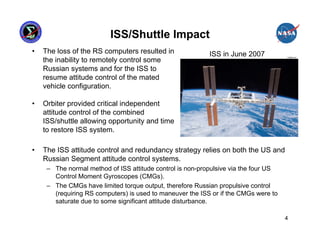
•   The loss of the RS computers resulted in               ISS in June 2007
    the inability to remotely control some
    Russian systems and for the ISS to
    resume attitude control of the mated
    vehicle configuration.

•   Orbiter provided critical independent
    attitude control of the combined
    ISS/shuttle allowing opportunity and time
    to restore ISS system.

•   The ISS attitude control and redundancy strategy relies on both the US and
    Russian Segment attitude control systems.
     – The normal method of ISS attitude control is non-propulsive via the four US
       Control Moment Gyroscopes (CMGs).
     – The CMGs have limited torque output, therefore Russian propulsive control
       (requiring RS computers) is used to maneuver the ISS or if the CMGs were to
       saturate due to some significant attitude disturbance.

                                                                                     4
Temporary Mitigation

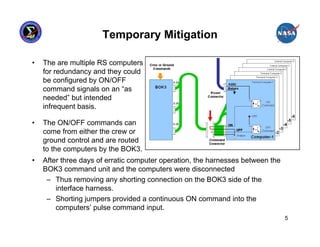
•   The are multiple RS computers
    for redundancy and they could
    be configured by ON/OFF
    command signals on an “as
    needed” but intended
    infrequent basis.

•   The ON/OFF commands can
    come from either the crew or
    ground control and are routed
    to the computers by the BOK3.
•   After three days of erratic computer operation, the harnesses between the
    BOK3 command unit and the computers were disconnected
     – Thus removing any shorting connection on the BOK3 side of the
        interface harness.
     – Shorting jumpers provided a continuous ON command into the
        computers’ pulse command input.
                                                                                5
BOK3 & Harness Photographs

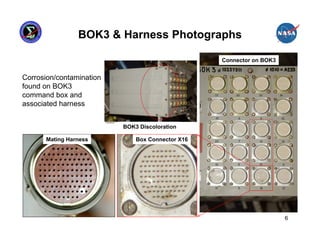
                                                  Connector on BOK3


Corrosion/contamination
found on BOK3
command box and
associated harness


                          BOK3 Discoloration

      Mating Harness          Box Connector X16


                                                                      6
Moisture & Condensation
•   The ISS has a requirement for no condensation
    in the pressurized environment and historically,
    the ISS vehicle has been very dry with no
    reports of condensation by the crew.

•   Both the US and Russian segments have
    condensing heat exchangers as part of their air
    conditioning systems. The condensed water is
    recycled only by the Russian environmental
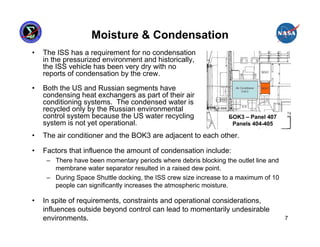
    control system because the US water recycling                БOK3 – Panel 407
    system is not yet operational.                                Panels 404-405

•   The air conditioner and the BOK3 are adjacent to each other.

•   Factors that influence the amount of condensation include:
     – There have been momentary periods where debris blocking the outlet line and
       membrane water separator resulted in a raised dew point.
     – During Space Shuttle docking, the ISS crew size increase to a maximum of 10
       people can significantly increases the atmospheric moisture.

•   In spite of requirements, constraints and operational considerations,
    influences outside beyond control can lead to momentarily undesirable
    environments.                                                                    7
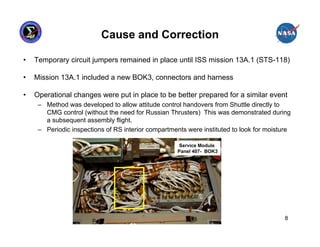
Cause and Correction

•   Temporary circuit jumpers remained in place until ISS mission 13A.1 (STS-118)

•   Mission 13A.1 included a new BOK3, connectors and harness

•   Operational changes were put in place to be better prepared for a similar event
     – Method was developed to allow attitude control handovers from Shuttle directly to
       CMG control (without the need for Russian Thrusters) This was demonstrated during
       a subsequent assembly flight.
     – Periodic inspections of RS interior compartments were instituted to look for moisture

                                                     Service Module
                                                     Panel 407- BOK3


                                                                                         8
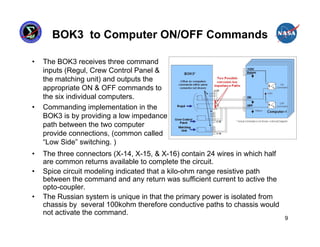
BOK3 to Computer ON/OFF Commands

•   The BOK3 receives three command
    inputs (Regul, Crew Control Panel &
    the matching unit) and outputs the
    appropriate ON & OFF commands to
    the six individual computers.
•   Commanding implementation in the
    BOK3 is by providing a low impedance
    path between the two computer
    provide connections, (common called
    “Low Side” switching. )
•   The three connectors (X-14, X-15, & X-16) contain 24 wires in which half
    are common returns available to complete the circuit.
•   Spice circuit modeling indicated that a kilo-ohm range resistive path
    between the command and any return was sufficient current to active the
    opto-coupler.
•   The Russian system is unique in that the primary power is isolated from
    chassis by several 100kohm therefore conductive paths to chassis would
    not activate the command.
                                                                               9
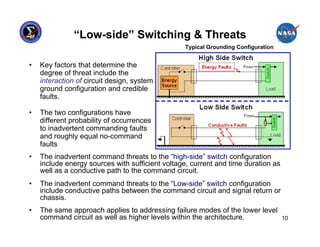
“Low-side” Switching & Threats
                                                 Typical Grounding Configuration


•   Key factors that determine the
    degree of threat include the
    interaction of circuit design, system
    ground configuration and credible
    faults.

•   The two configurations have
    different probability of occurrences
    to inadvertent commanding faults
    and roughly equal no-command
    faults
•   The inadvertent command threats to the “high-side” switch configuration
    include energy sources with sufficient voltage, current and time duration as
    well as a conductive path to the command circuit.
•   The inadvertent command threats to the “Low-side” switch configuration
    include conductive paths between the command circuit and signal return or
    chassis.
•   The same approach applies to addressing failure modes of the lower level
    command circuit as well as higher levels within the architecture.              10
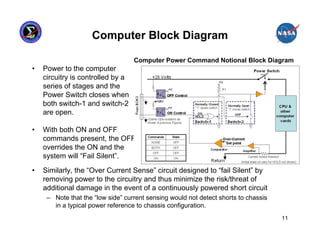
Computer Block Diagram

                                   Computer Power Command Notional Block Diagram
•   Power to the computer
    circuitry is controlled by a
    series of stages and the
    Power Switch closes when
    both switch-1 and switch-2
    are open.

•   With both ON and OFF
    commands present, the OFF
    overrides the ON and the
    system will “Fail Silent”.
•   Similarly, the “Over Current Sense” circuit designed to “fail Silent” by
    removing power to the circuitry and thus minimize the risk/threat of
    additional damage in the event of a continuously powered short circuit
     – Note that the “low side” current sensing would not detect shorts to chassis
       in a typical power reference to chassis configuration.
                                                                                     11
Fail Silent System Architecture

•   A Fail Silent subsystem is a valid approach and has several advantages:
     – Decreases the threat of a Byzantine fault (the computer unknowingly
       providing an incorrect answer)
     – Mitigates the separate risk/treat of collateral damage to the power system
       from continuous short
     – Provides a predictable system response with multiple redundant systems

•   A Fail Silent system architecture requires a multi-tiered configuration where
    the “last line of defense” is a “never give up” or “Safe-hold” system to take
    over when all computers go silent.

•   A typical NASA robotic satellite utilizes a “Safe-hold” mode where a
    dissimilar, simple attitude control system is used to keep the spacecraft
    attitude stable and power positive in the event of an emergency.

•   The presents of the Orbiter docked to ISS at this critical time and provided
    the dissimilar attitude control.


                                                                                   12
“Risk Based” Approach

 •   The NESC’s Design Development Test and Evaluation (DDT&E)
     Considerations for Safe and Reliable Human Rated Spacecraft Systems
     (Volume-II) focuses on creating a system that mitigates specific threats or
     risks to a given implementation
                              [Predictability: subsystem’s fault
      1                       response consistent with system
         Eliminate the                  architecture]
      threat/risk from the
             design
                                2
                                   Reduce the
                                  Likelihood by
 [Reduce the threat/risk to
                                decoupling system        3   Mitigate the
                                   interactions
equal probability/impact of                               consequences by
other system threats/risks]                                 adding diverse
                                                             redundancy

                                                [Diverse redundant systems not
                                            simultaneously susceptible to threat/risk]
                                                                                   13
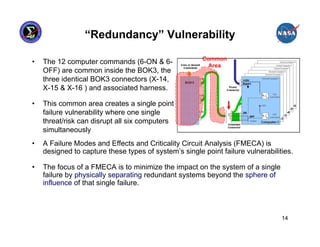
“Redundancy” Vulnerability
                                                       Common
•   The 12 computer commands (6-ON & 6-                  Area
    OFF) are common inside the BOK3, the
    three identical BOK3 connectors (X-14,
    X-15 & X-16 ) and associated harness.

•   This common area creates a single point
    failure vulnerability where one single
    threat/risk can disrupt all six computers
    simultaneously
•   A Failure Modes and Effects and Criticality Circuit Analysis (FMECA) is
    designed to capture these types of system’s single point failure vulnerabilities.

•   The focus of a FMECA is to minimize the impact on the system of a single
    failure by physically separating redundant systems beyond the sphere of
    influence of that single failure.


                                                                                 14
Redundant Systems’ Degree of Separation

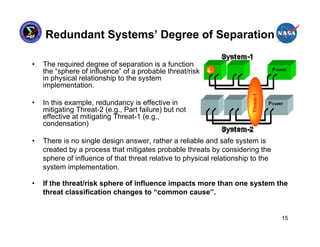
•   The required degree of separation is a function
                                                          -2
    the “sphere of influence” of a probable threat/risk
    in physical relationship to the system
    implementation.


                                                                        Threat-1
•   In this example, redundancy is effective in
    mitigating Threat-2 (e.g., Part failure) but not
    effective at mitigating Threat-1 (e.g.,
    condensation)

•   There is no single design answer, rather a reliable and safe system is
    created by a process that mitigates probable threats by considering the
    sphere of influence of that threat relative to physical relationship to the
    system implementation.

•   If the threat/risk sphere of influence impacts more than one system the
    threat classification changes to “common cause”.


                                                                                   15
Conclusion
•   Regardless of requirements, constraints and operational considerations
    momentary undesirable environments or interactions will occur eventually.

•   How each and every individual subsystem responds to probable threats
    must be aligned in a system architecture to achieve a predictable and
    robust system.

•   A reliable and safe system is created by a process that mitigates probable
    threats by considering the sphere of influence of each threat relative to the
    specific design implementation.

•   A “common cause” threat/risk can be any threat/risk that impacts more than
    one system in a given implementation.

•   For redundancy system architectures, the threat/risk mitigation
    effectiveness is a function of physical separation and/or dissimilar design
    implementation.
     – A dissimilar design has the advantage of reduced functionally to focus on safely
       and reliability. [less functions = less complexity = more predictability]

•   Fail Silent system architecture requires a multi-tiered configuration where
    the “last line of defense” is a “never give up” or “Safe-hold” system to
    provide critical functions when all computers go silent.
                                                                                      16
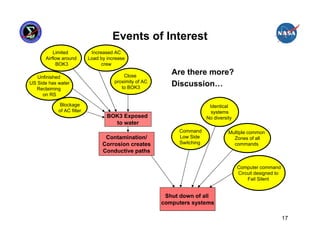
Events of Interest
          Limited           Increased AC
      Airflow around       Load by increase
           BOK3                  crew

                                          Close
                                                           Are there more?
   Unfinished
US Side has water                     proximity of AC
                                         to BOK3
                                                           Discussion…
   Reclaiming
     on RS

             Blockage                                                     Identical
            of AC filter                                                   systems
                                   BOK3 Exposed                          No diversity
                                     to water
                                                             Command               Multiple common
                                  Contamination/             Low Side                Zones of all
                                 Corrosion creates           Switching               commands
                                 Conductive paths

                                                                                        Computer command
                                                                                        Circuit designed to
                                                                                            Fail Silent


                                                         Shut down of all
                                                        computers systems

                                                                                                              17

Mitchell.davis

  • 1.
    Mitigating the June2007 International Space Station (ISS) Russian Segment Computer Anomaly in your Design Project Management Challenge 2008 Daytona Beach, Florida February 26 - 27, 2008 Mitchell Davis NASA Technical Fellow for Avionics NASA Engineering & Safety Center
  • 2.
    Summary Purpose: This presentationconsiders the resulting design features on the ISS computers and redundancy implementation in relationship to the June 2007 ISS computer shutdown anomaly. • The resulting design features dictate how each subsystem responds to particular fault, which in turn dictates the entire system response. • The first section covers the anomaly and recovery • The second sections covers the lower level implementation details in connection to the threat • This paper in intended to provide an example of the design decisions covered in earlier NESC “risk-based design” presentations. 2
  • 3.
    Anomaly Timeline • In June 2007, during ISS Assembly Mission 13A (STS-117) on day 3 of a 11 day mission at 20:41:44 of GMT day 162, the first Russian Segment (RS) Service Module (SM) Central Computer-2 went off-line. – Central Computer-3 had not been part of the active set since 2005 • An RS Terminal computer went off line minutes later and within 24 hours all 6 RS control computers were non-functional. • Repeated attempts to bring the computers back to an operational state over the next three days produced only temporary and erratic results. 3
  • 4.
    ISS/Shuttle Impact • The loss of the RS computers resulted in ISS in June 2007 the inability to remotely control some Russian systems and for the ISS to resume attitude control of the mated vehicle configuration. • Orbiter provided critical independent attitude control of the combined ISS/shuttle allowing opportunity and time to restore ISS system. • The ISS attitude control and redundancy strategy relies on both the US and Russian Segment attitude control systems. – The normal method of ISS attitude control is non-propulsive via the four US Control Moment Gyroscopes (CMGs). – The CMGs have limited torque output, therefore Russian propulsive control (requiring RS computers) is used to maneuver the ISS or if the CMGs were to saturate due to some significant attitude disturbance. 4
  • 5.
    Temporary Mitigation • The are multiple RS computers for redundancy and they could be configured by ON/OFF command signals on an “as needed” but intended infrequent basis. • The ON/OFF commands can come from either the crew or ground control and are routed to the computers by the BOK3. • After three days of erratic computer operation, the harnesses between the BOK3 command unit and the computers were disconnected – Thus removing any shorting connection on the BOK3 side of the interface harness. – Shorting jumpers provided a continuous ON command into the computers’ pulse command input. 5
  • 6.
    BOK3 & HarnessPhotographs Connector on BOK3 Corrosion/contamination found on BOK3 command box and associated harness BOK3 Discoloration Mating Harness Box Connector X16 6
  • 7.
    Moisture & Condensation • The ISS has a requirement for no condensation in the pressurized environment and historically, the ISS vehicle has been very dry with no reports of condensation by the crew. • Both the US and Russian segments have condensing heat exchangers as part of their air conditioning systems. The condensed water is recycled only by the Russian environmental control system because the US water recycling БOK3 – Panel 407 system is not yet operational. Panels 404-405 • The air conditioner and the BOK3 are adjacent to each other. • Factors that influence the amount of condensation include: – There have been momentary periods where debris blocking the outlet line and membrane water separator resulted in a raised dew point. – During Space Shuttle docking, the ISS crew size increase to a maximum of 10 people can significantly increases the atmospheric moisture. • In spite of requirements, constraints and operational considerations, influences outside beyond control can lead to momentarily undesirable environments. 7
  • 8.
    Cause and Correction • Temporary circuit jumpers remained in place until ISS mission 13A.1 (STS-118) • Mission 13A.1 included a new BOK3, connectors and harness • Operational changes were put in place to be better prepared for a similar event – Method was developed to allow attitude control handovers from Shuttle directly to CMG control (without the need for Russian Thrusters) This was demonstrated during a subsequent assembly flight. – Periodic inspections of RS interior compartments were instituted to look for moisture Service Module Panel 407- BOK3 8
  • 9.
    BOK3 to ComputerON/OFF Commands • The BOK3 receives three command inputs (Regul, Crew Control Panel & the matching unit) and outputs the appropriate ON & OFF commands to the six individual computers. • Commanding implementation in the BOK3 is by providing a low impedance path between the two computer provide connections, (common called “Low Side” switching. ) • The three connectors (X-14, X-15, & X-16) contain 24 wires in which half are common returns available to complete the circuit. • Spice circuit modeling indicated that a kilo-ohm range resistive path between the command and any return was sufficient current to active the opto-coupler. • The Russian system is unique in that the primary power is isolated from chassis by several 100kohm therefore conductive paths to chassis would not activate the command. 9
  • 10.
    “Low-side” Switching &Threats Typical Grounding Configuration • Key factors that determine the degree of threat include the interaction of circuit design, system ground configuration and credible faults. • The two configurations have different probability of occurrences to inadvertent commanding faults and roughly equal no-command faults • The inadvertent command threats to the “high-side” switch configuration include energy sources with sufficient voltage, current and time duration as well as a conductive path to the command circuit. • The inadvertent command threats to the “Low-side” switch configuration include conductive paths between the command circuit and signal return or chassis. • The same approach applies to addressing failure modes of the lower level command circuit as well as higher levels within the architecture. 10
  • 11.
    Computer Block Diagram Computer Power Command Notional Block Diagram • Power to the computer circuitry is controlled by a series of stages and the Power Switch closes when both switch-1 and switch-2 are open. • With both ON and OFF commands present, the OFF overrides the ON and the system will “Fail Silent”. • Similarly, the “Over Current Sense” circuit designed to “fail Silent” by removing power to the circuitry and thus minimize the risk/threat of additional damage in the event of a continuously powered short circuit – Note that the “low side” current sensing would not detect shorts to chassis in a typical power reference to chassis configuration. 11
  • 12.
    Fail Silent SystemArchitecture • A Fail Silent subsystem is a valid approach and has several advantages: – Decreases the threat of a Byzantine fault (the computer unknowingly providing an incorrect answer) – Mitigates the separate risk/treat of collateral damage to the power system from continuous short – Provides a predictable system response with multiple redundant systems • A Fail Silent system architecture requires a multi-tiered configuration where the “last line of defense” is a “never give up” or “Safe-hold” system to take over when all computers go silent. • A typical NASA robotic satellite utilizes a “Safe-hold” mode where a dissimilar, simple attitude control system is used to keep the spacecraft attitude stable and power positive in the event of an emergency. • The presents of the Orbiter docked to ISS at this critical time and provided the dissimilar attitude control. 12
  • 13.
    “Risk Based” Approach • The NESC’s Design Development Test and Evaluation (DDT&E) Considerations for Safe and Reliable Human Rated Spacecraft Systems (Volume-II) focuses on creating a system that mitigates specific threats or risks to a given implementation [Predictability: subsystem’s fault 1 response consistent with system Eliminate the architecture] threat/risk from the design 2 Reduce the Likelihood by [Reduce the threat/risk to decoupling system 3 Mitigate the interactions equal probability/impact of consequences by other system threats/risks] adding diverse redundancy [Diverse redundant systems not simultaneously susceptible to threat/risk] 13
  • 14.
    “Redundancy” Vulnerability Common • The 12 computer commands (6-ON & 6- Area OFF) are common inside the BOK3, the three identical BOK3 connectors (X-14, X-15 & X-16 ) and associated harness. • This common area creates a single point failure vulnerability where one single threat/risk can disrupt all six computers simultaneously • A Failure Modes and Effects and Criticality Circuit Analysis (FMECA) is designed to capture these types of system’s single point failure vulnerabilities. • The focus of a FMECA is to minimize the impact on the system of a single failure by physically separating redundant systems beyond the sphere of influence of that single failure. 14
  • 15.
    Redundant Systems’ Degreeof Separation • The required degree of separation is a function -2 the “sphere of influence” of a probable threat/risk in physical relationship to the system implementation. Threat-1 • In this example, redundancy is effective in mitigating Threat-2 (e.g., Part failure) but not effective at mitigating Threat-1 (e.g., condensation) • There is no single design answer, rather a reliable and safe system is created by a process that mitigates probable threats by considering the sphere of influence of that threat relative to physical relationship to the system implementation. • If the threat/risk sphere of influence impacts more than one system the threat classification changes to “common cause”. 15
  • 16.
    Conclusion • Regardless of requirements, constraints and operational considerations momentary undesirable environments or interactions will occur eventually. • How each and every individual subsystem responds to probable threats must be aligned in a system architecture to achieve a predictable and robust system. • A reliable and safe system is created by a process that mitigates probable threats by considering the sphere of influence of each threat relative to the specific design implementation. • A “common cause” threat/risk can be any threat/risk that impacts more than one system in a given implementation. • For redundancy system architectures, the threat/risk mitigation effectiveness is a function of physical separation and/or dissimilar design implementation. – A dissimilar design has the advantage of reduced functionally to focus on safely and reliability. [less functions = less complexity = more predictability] • Fail Silent system architecture requires a multi-tiered configuration where the “last line of defense” is a “never give up” or “Safe-hold” system to provide critical functions when all computers go silent. 16
  • 17.
    Events of Interest Limited Increased AC Airflow around Load by increase BOK3 crew Close Are there more? Unfinished US Side has water proximity of AC to BOK3 Discussion… Reclaiming on RS Blockage Identical of AC filter systems BOK3 Exposed No diversity to water Command Multiple common Contamination/ Low Side Zones of all Corrosion creates Switching commands Conductive paths Computer command Circuit designed to Fail Silent Shut down of all computers systems 17