Probability: Terminology and Examples

18.05 Spring 2014

Jeremy Orloff and Jonathan Bloom
Discussion Boards

April 22, 2014 2 / 22
Board Question
Deck of 52 cards
13 ranks: 2, 3, . . . , 9, 10, J, Q, K, A
4 suits: ♥, ♠, ♦, ♣,
Poker hands
Consists of 5 cards
A one-pair hand consists of two cards having one rank and the
remaining three cards having three other rank

Example: {2♥, 2♠, 5♥, 8♣, K♦}

Question
a) How many different 5 card hands have exactly one pair?
Hint: practice with how many 2 card hands have exactly one pair.
Hint for hint: use the rule of product.
b) What is the probability of getting a one pair poker hand?
April 22, 2014 3 / 22
Clicker Test
Set your clicker channel to 41.
Do you have your clicker with you?
No = 0
Yes = 1
April 22, 2014 4 / 22
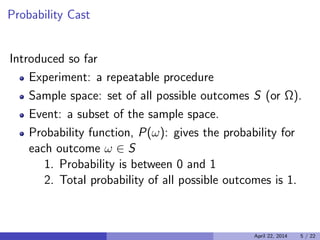
Probability Cast

Introduced so far
Experiment: a repeatable procedure
Sample space: set of all possible outcomes S (or Ω).
Event: a subset of the sample space.
Probability function, P(ω): gives the probability for
each outcome ω ∈ S
1. Probability is between 0 and 1
2. Total probability of all possible outcomes is 1.
April 22, 2014 5 / 22
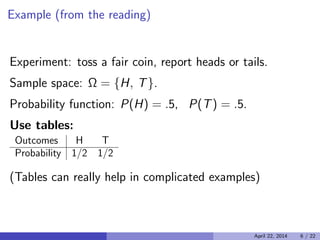
Example (from the reading)

Experiment: toss a fair coin, report heads or tails.

Sample space: Ω = {H, T}.

Probability function: P(H) = .5, P(T) = .5.

Use tables:
Outcomes H T

Probability
 1/2 1/2
(Tables can really help in complicated examples)

April 22, 2014 6 / 22
Discrete sample space

Discrete = listable
Examples:
{a, b, c, d} (finite)
{0, 1, 2, . . . } (infinite)
April 22, 2014 7 / 22
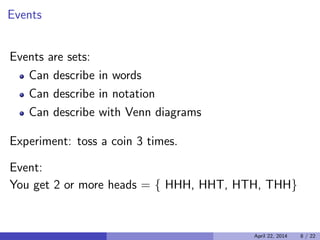
Events

Events are sets:
Can describe in words
Can describe in notation
Can describe with Venn diagrams
Experiment: toss a coin 3 times.
Event:

You get 2 or more heads = { HHH, HHT, HTH, THH}

April 22, 2014 8 / 22
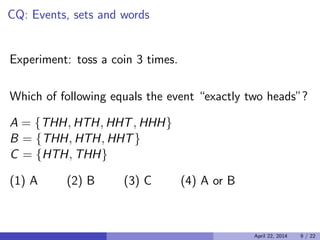
CQ: Events, sets and words

Experiment: toss a coin 3 times.
Which of following equals the event “exactly two heads”?
A = {THH, HTH, HHT, HHH}

B = {THH, HTH, HHT}

C = {HTH, THH}

(1) A (2) B (3) C (4) A or B
April 22, 2014 9 / 22
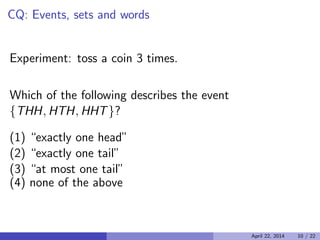
CQ: Events, sets and words

Experiment: toss a coin 3 times.
Which of the following describes the event
{THH, HTH, HHT}?
(1) “exactly one head”
(2) “exactly one tail”
(3) “at most one tail”
(4) none of the above
April 22, 2014 10 / 22
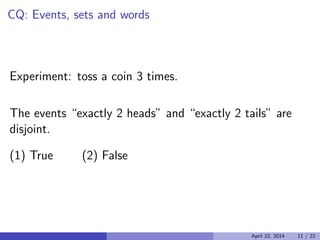
CQ: Events, sets and words

Experiment: toss a coin 3 times.
The events “exactly 2 heads” and “exactly 2 tails” are
disjoint.
(1) True (2) False
April 22, 2014 11 / 22
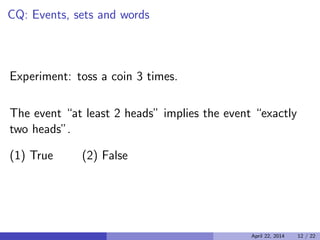
CQ: Events, sets and words
Experiment: toss a coin 3 times.
The event “at least 2 heads” implies the event “exactly
two heads”.
(1) True (2) False
April 22, 2014 12 / 22
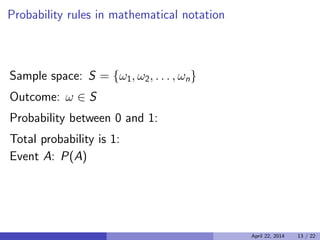
Probability rules in mathematical notation

Sample space: S = {ω1, ω2, . . . , ωn}

Outcome: ω ∈ S

Probability between 0 and 1:

Total probability is 1:

Event A: P(A)
April 22, 2014 13 / 22
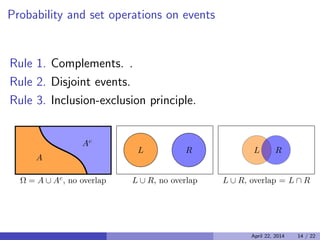
Probability and set operations on events

Rule 1. Complements. .
Rule 2. Disjoint events.
Rule 3. Inclusion-exclusion principle.
A
Ac
Ω = A ∪ Ac
, no overlap
L R
L ∪ R, no overlap
L R
L ∪ R, overlap = L ∩ R
April 22, 2014 14 / 22
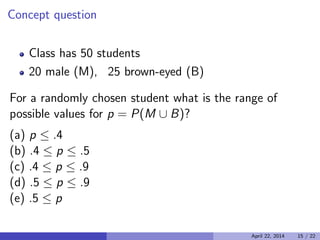
Concept question

Class has 50 students
20 male (M), 25 brown-eyed (B)
For a randomly chosen student what is the range of
possible values for p = P(M ∪ B)?
(a) p ≤ .4

(b) .4 ≤ p ≤ .5

(c) .4 ≤ p ≤ .9

(d) .5 ≤ p ≤ .9

(e) .5 ≤ p
April 22, 2014 15 / 22
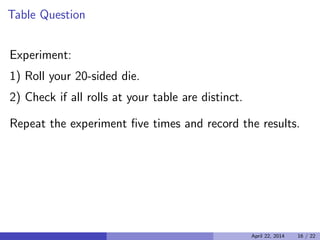
Table Question

Experiment:

1) Roll your 20-sided die.

2) Check if all rolls at your table are distinct.

Repeat the experiment five times and record the results.

April 22, 2014 16 / 22
Table Question

Experiment:

1) Roll your 20-sided die.

2) Check if all rolls at your table are distinct.

Repeat the experiment five times and record the results.

For this experiment, how would you define the sample
space, probability function, and event?
Compute the exact probability that all rolls are distinct.
April 22, 2014 16 / 22
Concept Question

Lucky Larry has a coin that you’re quite sure is not fair.
He will flip the coin twice
It’s your job to bet whether the outcomes will be the
same (HH, TT) or different (HT, TH).
Which should you choose?
1. Same
2. Different
3. It doesn’t matter, same and different are equally likely
April 22, 2014 17 / 22
Board Question

Lucky Larry has a coin that you’re quite sure is not fair.
He will flip the coin twice
It’s your job to bet whether the outcomes will be the
same (HH, TT) or different (HT, TH).
Which should you choose?
1. Same 2. Different 3. Doesn’t matter
Question: Let p be the probability of heads and use
probability to answer the question.
(If you don’t see the symbolic algebra try p = .2, p=.5)

April 22, 2014 18 / 22
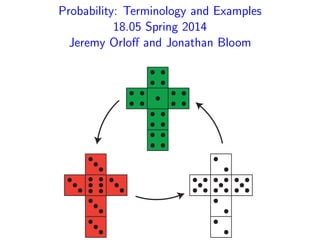
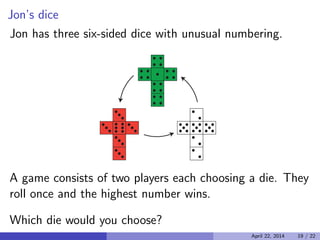
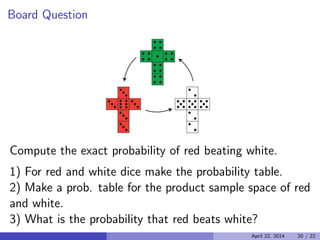
Jon’s dice

Jon has three six-sided dice with unusual numbering.

A game consists of two players each choosing a die. They
roll once and the highest number wins.
Which die would you choose?
April 22, 2014 19 / 22
Board Question

Compute the exact probability of red beating white.

1) For red and white dice make the probability table.

2) Make a prob. table for the product sample space of red

and white.

3) What is the probability that red beats white?

April 22, 2014 20 / 22
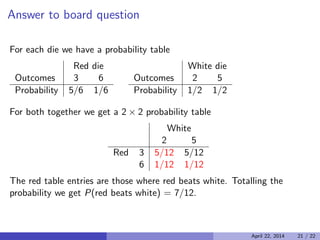
Answer to board question
For each die we have a probability table
Red die White die
Outcomes 3 6 Outcomes 2 5
Probability 5/6 1/6 Probability 1/2 1/2
For both together we get a 2 × 2 probability table

White
2 5
Red 3 5/12 5/12
6 1/12 1/12
The red table entries are those where red beats white. Totalling the
probability we get P(red beats white) = 7/12.
April 22, 2014 21 / 22
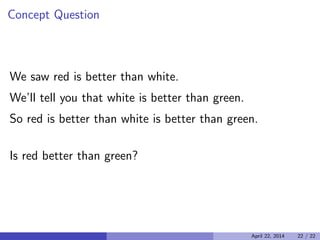
Concept Question

We saw red is better than white.

We’ll tell you that white is better than green.

So red is better than white is better than green.

Is red better than green?

April 22, 2014 22 / 22
0,7 2SHQ&RXUVH:DUH
KWWSRFZPLWHGX
 ,QWURGXFWLRQ WR 3UREDELOLW DQG 6WDWLVWLFV
6SULQJ 
)RU LQIRUPDWLRQ DERXW FLWLQJ WKHVH PDWHULDOV RU RXU 7HUPV RI 8VH YLVLW KWWSRFZPLWHGXWHUPV

Mit18 05 s14_class2slides

  • 1.
    Probability: Terminology andExamples 18.05 Spring 2014 Jeremy Orloff and Jonathan Bloom
  • 2.
  • 3.
    Board Question Deck of52 cards 13 ranks: 2, 3, . . . , 9, 10, J, Q, K, A 4 suits: ♥, ♠, ♦, ♣, Poker hands Consists of 5 cards A one-pair hand consists of two cards having one rank and the remaining three cards having three other rank Example: {2♥, 2♠, 5♥, 8♣, K♦} Question a) How many different 5 card hands have exactly one pair? Hint: practice with how many 2 card hands have exactly one pair. Hint for hint: use the rule of product. b) What is the probability of getting a one pair poker hand? April 22, 2014 3 / 22
  • 4.
    Clicker Test Set yourclicker channel to 41. Do you have your clicker with you? No = 0 Yes = 1 April 22, 2014 4 / 22
  • 5.
    Probability Cast Introduced sofar Experiment: a repeatable procedure Sample space: set of all possible outcomes S (or Ω). Event: a subset of the sample space. Probability function, P(ω): gives the probability for each outcome ω ∈ S 1. Probability is between 0 and 1 2. Total probability of all possible outcomes is 1. April 22, 2014 5 / 22
  • 6.
    Example (from thereading) Experiment: toss a fair coin, report heads or tails. Sample space: Ω = {H, T}. Probability function: P(H) = .5, P(T) = .5. Use tables: Outcomes H T Probability 1/2 1/2 (Tables can really help in complicated examples) April 22, 2014 6 / 22
  • 7.
    Discrete sample space Discrete= listable Examples: {a, b, c, d} (finite) {0, 1, 2, . . . } (infinite) April 22, 2014 7 / 22
  • 8.
    Events Events are sets: Candescribe in words Can describe in notation Can describe with Venn diagrams Experiment: toss a coin 3 times. Event: You get 2 or more heads = { HHH, HHT, HTH, THH} April 22, 2014 8 / 22
  • 9.
    CQ: Events, setsand words Experiment: toss a coin 3 times. Which of following equals the event “exactly two heads”? A = {THH, HTH, HHT, HHH} B = {THH, HTH, HHT} C = {HTH, THH} (1) A (2) B (3) C (4) A or B April 22, 2014 9 / 22
  • 10.
    CQ: Events, setsand words Experiment: toss a coin 3 times. Which of the following describes the event {THH, HTH, HHT}? (1) “exactly one head” (2) “exactly one tail” (3) “at most one tail” (4) none of the above April 22, 2014 10 / 22
  • 11.
    CQ: Events, setsand words Experiment: toss a coin 3 times. The events “exactly 2 heads” and “exactly 2 tails” are disjoint. (1) True (2) False April 22, 2014 11 / 22
  • 12.
    CQ: Events, setsand words Experiment: toss a coin 3 times. The event “at least 2 heads” implies the event “exactly two heads”. (1) True (2) False April 22, 2014 12 / 22
  • 13.
    Probability rules inmathematical notation Sample space: S = {ω1, ω2, . . . , ωn} Outcome: ω ∈ S Probability between 0 and 1: Total probability is 1: Event A: P(A) April 22, 2014 13 / 22
  • 14.
    Probability and setoperations on events Rule 1. Complements. . Rule 2. Disjoint events. Rule 3. Inclusion-exclusion principle. A Ac Ω = A ∪ Ac , no overlap L R L ∪ R, no overlap L R L ∪ R, overlap = L ∩ R April 22, 2014 14 / 22
  • 15.
    Concept question Class has50 students 20 male (M), 25 brown-eyed (B) For a randomly chosen student what is the range of possible values for p = P(M ∪ B)? (a) p ≤ .4 (b) .4 ≤ p ≤ .5 (c) .4 ≤ p ≤ .9 (d) .5 ≤ p ≤ .9 (e) .5 ≤ p April 22, 2014 15 / 22
  • 16.
    Table Question Experiment: 1) Rollyour 20-sided die. 2) Check if all rolls at your table are distinct. Repeat the experiment five times and record the results. April 22, 2014 16 / 22
  • 17.
    Table Question Experiment: 1) Rollyour 20-sided die. 2) Check if all rolls at your table are distinct. Repeat the experiment five times and record the results. For this experiment, how would you define the sample space, probability function, and event? Compute the exact probability that all rolls are distinct. April 22, 2014 16 / 22
  • 18.
    Concept Question Lucky Larryhas a coin that you’re quite sure is not fair. He will flip the coin twice It’s your job to bet whether the outcomes will be the same (HH, TT) or different (HT, TH). Which should you choose? 1. Same 2. Different 3. It doesn’t matter, same and different are equally likely April 22, 2014 17 / 22
  • 19.
    Board Question Lucky Larryhas a coin that you’re quite sure is not fair. He will flip the coin twice It’s your job to bet whether the outcomes will be the same (HH, TT) or different (HT, TH). Which should you choose? 1. Same 2. Different 3. Doesn’t matter Question: Let p be the probability of heads and use probability to answer the question. (If you don’t see the symbolic algebra try p = .2, p=.5) April 22, 2014 18 / 22
  • 20.
    Jon’s dice Jon hasthree six-sided dice with unusual numbering. A game consists of two players each choosing a die. They roll once and the highest number wins. Which die would you choose? April 22, 2014 19 / 22
  • 21.
    Board Question Compute theexact probability of red beating white. 1) For red and white dice make the probability table. 2) Make a prob. table for the product sample space of red and white. 3) What is the probability that red beats white? April 22, 2014 20 / 22
  • 22.
    Answer to boardquestion For each die we have a probability table Red die White die Outcomes 3 6 Outcomes 2 5 Probability 5/6 1/6 Probability 1/2 1/2 For both together we get a 2 × 2 probability table White 2 5 Red 3 5/12 5/12 6 1/12 1/12 The red table entries are those where red beats white. Totalling the probability we get P(red beats white) = 7/12. April 22, 2014 21 / 22
  • 23.
    Concept Question We sawred is better than white. We’ll tell you that white is better than green. So red is better than white is better than green. Is red better than green? April 22, 2014 22 / 22
  • 24.
    0,7 2SHQ&RXUVH:DUH KWWSRFZPLWHGX ,QWURGXFWLRQWR 3UREDELOLW DQG 6WDWLVWLFV 6SULQJ )RU LQIRUPDWLRQ DERXW FLWLQJ WKHVH PDWHULDOV RU RXU 7HUPV RI 8VH YLVLW KWWSRFZPLWHGXWHUPV