MISRA C Presentation
Safety and Security
... and future plans for MISRA C
Device Developer Conference, Cambridge (April 2016)
Andrew Banks
BSc IEng MIET FBCS CITP
Frazer-Nash Research Limited, and
Chairman, MISRA C Working Group
The C Language
A Quick History
April 27, 20162
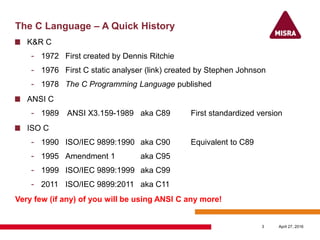
The C Language – A Quick History
K&R C
- 1972 First created by Dennis Ritchie
- 1976 First C static analyser (link) created by Stephen Johnson
- 1978 The C Programming Language published
ANSI C
- 1989 ANSI X3.159-1989 aka C89 First standardized version
ISO C
- 1990 ISO/IEC 9899:1990 aka C90 Equivalent to C89
- 1995 Amendment 1 aka C95
- 1999 ISO/IEC 9899:1999 aka C99
- 2011 ISO/IEC 9899:2011 aka C11
Very few (if any) of you will be using ANSI C any more!
April 27, 20163
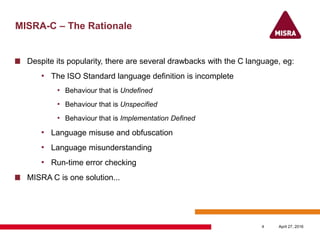
MISRA-C – The Rationale
Despite its popularity, there are several drawbacks with the C language, eg:
• The ISO Standard language definition is incomplete
• Behaviour that is Undefined
• Behaviour that is Unspecified
• Behaviour that is Implementation Defined
• Language misuse and obfuscation
• Language misunderstanding
• Run-time error checking
MISRA C is one solution...
April 27, 20164
MISRA C
A Quick History
April 27, 20165
Original MISRA publications
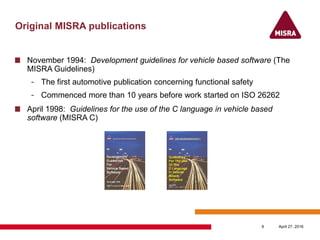
November 1994: Development guidelines for vehicle based software (The
MISRA Guidelines)
- The first automotive publication concerning functional safety
- Commenced more than 10 years before work started on ISO 26262
April 1998: Guidelines for the use of the C language in vehicle based
software (MISRA C)
April 27, 20166
MISRA C - A brief history
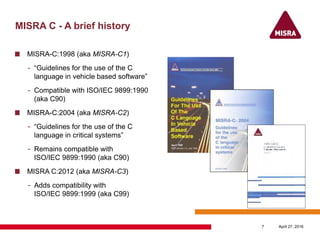
MISRA-C:1998 (aka MISRA-C1)
- “Guidelines for the use of the C
language in vehicle based software”
- Compatible with ISO/IEC 9899:1990
(aka C90)
MISRA-C:2004 (aka MISRA-C2)
- “Guidelines for the use of the C
language in critical systems”
- Remains compatible with
ISO/IEC 9899:1990 (aka C90)
MISRA C:2012 (aka MISRA-C3)
- Adds compatibility with
ISO/IEC 9899:1999 (aka C99)
April 27, 20167
MISRA C - A brief history
April 27, 20168
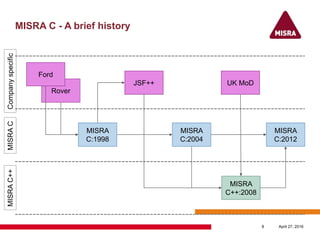
CompanyspecificMISRACMISRAC++
MISRA
C++:2008
MISRA
C:2012
MISRA
C:2004
MISRA
C:1998
JSF++
Rover
Ford
UK MoD
MISRA-C – The Vision
The vision of MISRA C is set out in the opening paragraph of the
Guidelines:
The MISRA C Guidelines define a subset of the C language in which
the opportunity to make mistakes is either removed or reduced.
Many standards for the development of safety-related software
require, or recommend, the use of a language subset, and this can
also be used to develop any application with high integrity or high
reliability requirements.
April 27, 20169
MISRA C:2012 – The Document
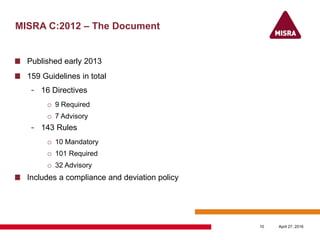
Published early 2013
159 Guidelines in total
- 16 Directives
o 9 Required
o 7 Advisory
- 143 Rules
o 10 Mandatory
o 101 Required
o 32 Advisory
Includes a compliance and deviation policy
April 27, 201610
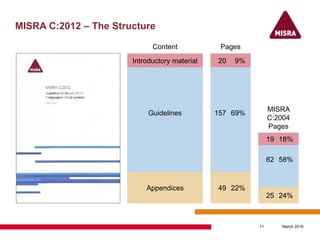
MISRA C:2012 – The Structure
March 201611
20 9%
157 69%
49 22%
Pages
Introductory material
Guidelines
Appendices
Content
19 18%
62 58%
25 24%
MISRA
C:2004
Pages
MISRA C
Misunderstandings
April 27, 201612
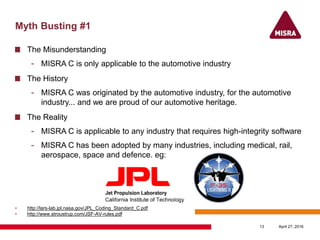
Myth Busting #1
The Misunderstanding
- MISRA C is only applicable to the automotive industry
The History
- MISRA C was originated by the automotive industry, for the automotive
industry... and we are proud of our automotive heritage.
The Reality
- MISRA C is applicable to any industry that requires high-integrity software
- MISRA C has been adopted by many industries, including medical, rail,
aerospace, space and defence. eg:
• http://lars-lab.jpl.nasa.gov/JPL_Coding_Standard_C.pdf
• http://www.stroustrup.com/JSF-AV-rules.pdf
April 27, 201613
Myth Busting #2
The Misunderstanding
- MISRA C is only a safety coding standard, not a secure/security one
The History
- MISRA C suggests (in its vision) its use in safety-related software
The Reality
- MISRA C also suggests (in its vision) its applicability to any application
with high integrity or high reliability requirements
- The difference between safety and security are largely semantic
- Unfortunately, a perception remains...
April 27, 201614
MISRA Compliance
April 27, 201615
MISRA-C – Published Today
MISRA Compliance
- Enhances guidance for compliance guidance
- Clarifies/tightens the Deviation process
- Standalone document
o Compatible with MISRA C:2012 (and any future versions)
o Compatible with MISRA C++:20xx
o No reason it cannot be applied to earlier versions of either document!
April 27, 201616
Safety v Security
Comparison with other guidelines
April 27, 201617
ISO/IEC TS 17961
C Secure Coding Rules
April 27, 201618
ISO/IEC TS 17961 – C Secure Coding Rules
Produced by ISO/IEC JTC 1/SC 22/WG 14 – the same people responsible for
the C standard itself
Originally proposed to be based on CERT-C (see later) but significantly
rationalised
From the document’s Background:
- “In practice, security-critical and safety-critical code have the same
requirements”
- “The purpose of this Technical Specification is to specify analyzable
secure coding rules that can be automatically enforced to detect security
flaws in C-conforming applications”
April 27, 201619
ISO/IEC TS 17961 – C Secure Coding Coverage
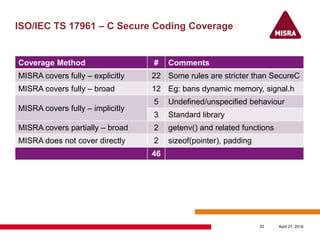
Coverage Method # Comments
MISRA covers fully – explicitly 22 Some rules are stricter than SecureC
MISRA covers fully – broad 12 Eg: bans dynamic memory, signal.h
MISRA covers fully – implicitly
5 Undefined/unspecified behaviour
3 Standard library
MISRA covers partially – broad 2 getenv() and related functions
MISRA does not cover directly 2 sizeof(pointer), padding
46
April 27, 201620
ISO/IEC TS 17961 – C Secure Coding Coverage
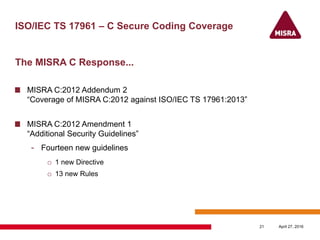
The MISRA C Response...
MISRA C:2012 Addendum 2
“Coverage of MISRA C:2012 against ISO/IEC TS 17961:2013”
MISRA C:2012 Amendment 1
“Additional Security Guidelines”
- Fourteen new guidelines
o 1 new Directive
o 13 new Rules
April 27, 201621
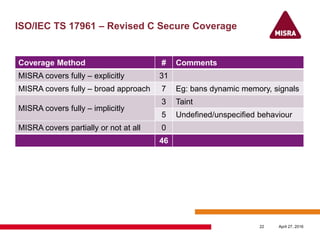
ISO/IEC TS 17961 – Revised C Secure Coverage
Coverage Method # Comments
MISRA covers fully – explicitly 31
MISRA covers fully – broad approach 7 Eg: bans dynamic memory, signals
MISRA covers fully – implicitly
3 Taint
5 Undefined/unspecified behaviour
MISRA covers partially or not at all 0
46
April 27, 201622
CERT-C
C Secure Coding Rules
April 27, 201623
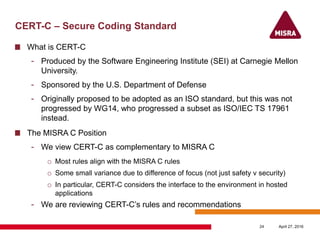
CERT-C – Secure Coding Standard
What is CERT-C
- Produced by the Software Engineering Institute (SEI) at Carnegie Mellon
University.
- Sponsored by the U.S. Department of Defense
- Originally proposed to be adopted as an ISO standard, but this was not
progressed by WG14, who progressed a subset as ISO/IEC TS 17961
instead.
The MISRA C Position
- We view CERT-C as complementary to MISRA C
o Most rules align with the MISRA C rules
o Some small variance due to difference of focus (not just safety v security)
o In particular, CERT-C considers the interface to the environment in hosted
applications
- We are reviewing CERT-C’s rules and recommendations
April 27, 201624
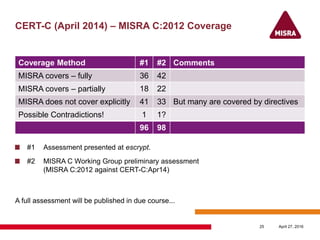
CERT-C (April 2014) – MISRA C:2012 Coverage
Coverage Method #1 #2 Comments
MISRA covers – fully 36 42
MISRA covers – partially 18 22
MISRA does not cover explicitly 41 33 But many are covered by directives
Possible Contradictions! 1 1?
96 98
#1 Assessment presented at escrypt.
#2 MISRA C Working Group preliminary assessment
(MISRA C:2012 against CERT-C:Apr14)
A full assessment will be published in due course...
April 27, 201625
Road Map and
Work In Progress
April 27, 201626
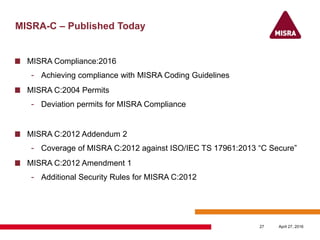
MISRA-C – Published Today
MISRA Compliance:2016
- Achieving compliance with MISRA Coding Guidelines
MISRA C:2004 Permits
- Deviation permits for MISRA Compliance
MISRA C:2012 Addendum 2
- Coverage of MISRA C:2012 against ISO/IEC TS 17961:2013 “C Secure”
MISRA C:2012 Amendment 1
- Additional Security Rules for MISRA C:2012
April 27, 201627
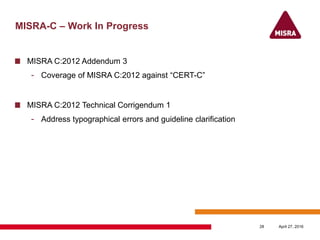
MISRA-C – Work In Progress
MISRA C:2012 Addendum 3
- Coverage of MISRA C:2012 against “CERT-C”
MISRA C:2012 Technical Corrigendum 1
- Address typographical errors and guideline clarification
April 27, 201628
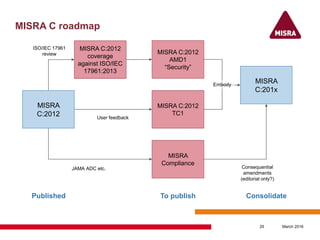
MISRA C roadmap
March 201629
MISRA
C:2012
MISRA C:2012
coverage
against ISO/IEC
17961:2013
MISRA C:2012
AMD1
“Security”
MISRA C:2012
TC1
MISRA
Compliance
MISRA
C:201x
ISO/IEC 17961
review
User feedback
Embody
JAMA ADC etc. Consequential
amendments
(editorial only?)
Published To publish Consolidate
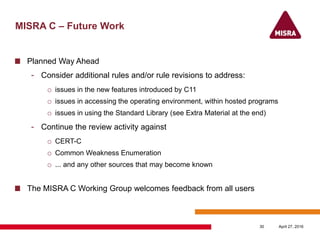
MISRA C – Future Work
Planned Way Ahead
- Consider additional rules and/or rule revisions to address:
o issues in the new features introduced by C11
o issues in accessing the operating environment, within hosted programs
o issues in using the Standard Library (see Extra Material at the end)
- Continue the review activity against
o CERT-C
o Common Weakness Enumeration
o ... and any other sources that may become known
The MISRA C Working Group welcomes feedback from all users
April 27, 201630
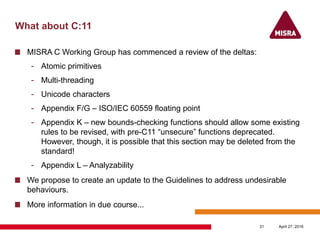
What about C:11
MISRA C Working Group has commenced a review of the deltas:
- Atomic primitives
- Multi-threading
- Unicode characters
- Appendix F/G – ISO/IEC 60559 floating point
- Appendix K – new bounds-checking functions should allow some existing
rules to be revised, with pre-C11 “unsecure” functions deprecated.
However, though, it is possible that this section may be deleted from the
standard!
- Appendix L – Analyzability
We propose to create an update to the Guidelines to address undesirable
behaviours.
More information in due course...
April 27, 201631
In Summary
April 27, 201632
MISRA C – In Summary
MISRA C is
- widely respected as a safety-related coding standard
- equally applicable as a security-related coding standard
MISRA C has
- evolved from an automotive standard into a pan-industry standard
MISRA C will
- continue to evolve as new editions of the C standard are produced
- seek to address other constraints as they become identified
MISRA C welcomes
- feedback from the user community
- approaches from prospective Working Group members
April 27, 201633
Any Questions?
April 27, 201634
Thank You!
I would like to acknowledge the support of the members of the MISRA C Working Group for their
assistance in preparing this presentation.
April 27, 201635
References
MISRA C:2012
http://misra.org.uk/
Embedded Security in Cars (November 2014, Hamburg)
https://www.escar.info/history/escar-europe/escar-europe-2014-lectures-and-program-committee.html
ISO/IEC TS 17961:2013 – C secure coding rules
http://www.iso.org/iso/catalogue_detail.htm?csnumber=61134
CERT-C
https://www.securecoding.cert.org
ISO/IEC 9899 CD2 comments and decisions
http://www.open-std.org/jtc1/sc22/wg14/www/docs/n847.htm
http://www.open-std.org/jtc1/sc22/wg14/www/docs/n872.htm
April 27, 201636
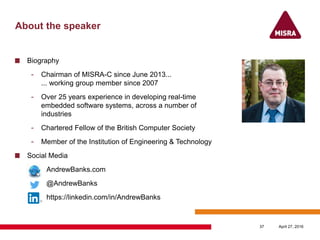
About the speaker
Biography
- Chairman of MISRA-C since June 2013...
... working group member since 2007
- Over 25 years experience in developing real-time
embedded software systems, across a number of
industries
- Chartered Fellow of the British Computer Society
- Member of the Institution of Engineering & Technology
Social Media
AndrewBanks.com
@AndrewBanks
https://linkedin.com/in/AndrewBanks
April 27, 201637
Extra Material
April 27, 201638
ISO/IEC TS 17961
C Secure Coding Rules
April 27, 201639
ISO/IEC TS 17961 – The Gaps
The gaps (partial or not covered) can be grouped as follows:
- Taintedness as a concept
- The use of getenv(), localeconv(), setlocale() and strerror() 2 rules
[or indeed other library functions relating to a hosted environment]
- Use of sizeof() on a pointer function parameter 1 rule
- Comparisons of padding data 1 rule
Proposal
- MISRA C:2012 be enhanced to address these gaps
April 27, 201640
ISO/IEC TS 17961 – The Broad Approaches
Some C Secure rules are implicitly fully covered by broad approaches
- MISRA C:2012 prohibits the use of the restrict keyword 1 rule
- MISRA C:2012 prohibits the use of dynamic memory allocation 3 rules
- MISRA C:2012 prohibits the use of the features in <signal.h> 3 rules
- MISRA C:2012 prohibits the use of the features in <stdio.h> 5 rules
Rationale
- MISRA C’s scope was originally freestanding application, without an
operating system and/or external environment
Proposal
- Keep these broad approaches under review
- Establish more targeted rules where appropriate
April 27, 201641
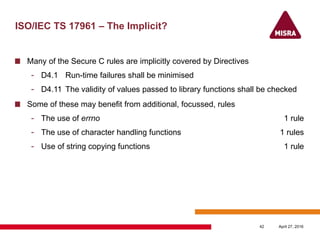
ISO/IEC TS 17961 – The Implicit?
Many of the Secure C rules are implicitly covered by Directives
- D4.1 Run-time failures shall be minimised
- D4.11 The validity of values passed to library functions shall be checked
Some of these may benefit from additional, focussed, rules
- The use of errno 1 rule
- The use of character handling functions 1 rules
- Use of string copying functions 1 rule
April 27, 201642
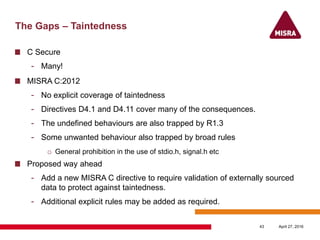
The Gaps – Taintedness
C Secure
- Many!
MISRA C:2012
- No explicit coverage of taintedness
- Directives D4.1 and D4.11 cover many of the consequences.
- The undefined behaviours are also trapped by R1.3
- Some unwanted behaviour also trapped by broad rules
o General prohibition in the use of stdio.h, signal.h etc
Proposed way ahead
- Add a new MISRA C directive to require validation of externally sourced
data to protect against taintedness.
- Additional explicit rules may be added as required.
April 27, 201643
Standard Conformance
Freestanding v Hosted
April 27, 201644
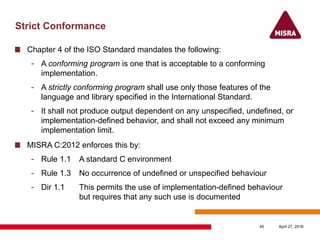
Strict Conformance
Chapter 4 of the ISO Standard mandates the following:
- A conforming program is one that is acceptable to a conforming
implementation.
- A strictly conforming program shall use only those features of the
language and library specified in the International Standard.
- It shall not produce output dependent on any unspecified, undefined, or
implementation-defined behavior, and shall not exceed any minimum
implementation limit.
MISRA C:2012 enforces this by:
- Rule 1.1 A standard C environment
- Rule 1.3 No occurrence of undefined or unspecified behaviour
- Dir 1.1 This permits the use of implementation-defined behaviour
but requires that any such use is documented
April 27, 201645
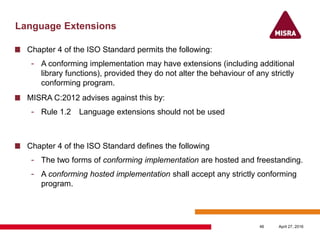
Language Extensions
Chapter 4 of the ISO Standard permits the following:
- A conforming implementation may have extensions (including additional
library functions), provided they do not alter the behaviour of any strictly
conforming program.
MISRA C:2012 advises against this by:
- Rule 1.2 Language extensions should not be used
Chapter 4 of the ISO Standard defines the following
- The two forms of conforming implementation are hosted and freestanding.
- A conforming hosted implementation shall accept any strictly conforming
program.
April 27, 201646
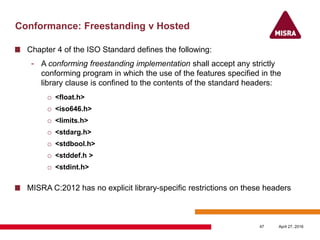
Conformance: Freestanding v Hosted
Chapter 4 of the ISO Standard defines the following:
- A conforming freestanding implementation shall accept any strictly
conforming program in which the use of the features specified in the
library clause is confined to the contents of the standard headers:
o <float.h>
o <iso646.h>
o <limits.h>
o <stdarg.h>
o <stdbool.h>
o <stddef.h >
o <stdint.h>
MISRA C:2012 has no explicit library-specific restrictions on these headers
April 27, 201647
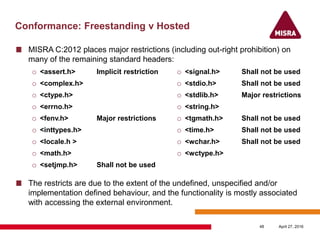
Conformance: Freestanding v Hosted
o <assert.h> Implicit restriction
o <complex.h>
o <ctype.h>
o <errno.h>
o <fenv.h> Major restrictions
o <inttypes.h>
o <locale.h >
o <math.h>
o <setjmp.h> Shall not be used
o <signal.h> Shall not be used
o <stdio.h> Shall not be used
o <stdlib.h> Major restrictions
o <string.h>
o <tgmath.h> Shall not be used
o <time.h> Shall not be used
o <wchar.h> Shall not be used
o <wctype.h>
April 27, 201648
MISRA C:2012 places major restrictions (including out-right prohibition) on
many of the remaining standard headers:
The restricts are due to the extent of the undefined, unspecified and/or
implementation defined behaviour, and the functionality is mostly associated
with accessing the external environment.

MISRA C Chairman - Device Developer Conference 2016

  • 1.
    MISRA C Presentation Safetyand Security ... and future plans for MISRA C Device Developer Conference, Cambridge (April 2016) Andrew Banks BSc IEng MIET FBCS CITP Frazer-Nash Research Limited, and Chairman, MISRA C Working Group
  • 2.
    The C Language AQuick History April 27, 20162
  • 3.
    The C Language– A Quick History K&R C - 1972 First created by Dennis Ritchie - 1976 First C static analyser (link) created by Stephen Johnson - 1978 The C Programming Language published ANSI C - 1989 ANSI X3.159-1989 aka C89 First standardized version ISO C - 1990 ISO/IEC 9899:1990 aka C90 Equivalent to C89 - 1995 Amendment 1 aka C95 - 1999 ISO/IEC 9899:1999 aka C99 - 2011 ISO/IEC 9899:2011 aka C11 Very few (if any) of you will be using ANSI C any more! April 27, 20163
  • 4.
    MISRA-C – TheRationale Despite its popularity, there are several drawbacks with the C language, eg: • The ISO Standard language definition is incomplete • Behaviour that is Undefined • Behaviour that is Unspecified • Behaviour that is Implementation Defined • Language misuse and obfuscation • Language misunderstanding • Run-time error checking MISRA C is one solution... April 27, 20164
  • 5.
    MISRA C A QuickHistory April 27, 20165
  • 6.
    Original MISRA publications November1994: Development guidelines for vehicle based software (The MISRA Guidelines) - The first automotive publication concerning functional safety - Commenced more than 10 years before work started on ISO 26262 April 1998: Guidelines for the use of the C language in vehicle based software (MISRA C) April 27, 20166
  • 7.
    MISRA C -A brief history MISRA-C:1998 (aka MISRA-C1) - “Guidelines for the use of the C language in vehicle based software” - Compatible with ISO/IEC 9899:1990 (aka C90) MISRA-C:2004 (aka MISRA-C2) - “Guidelines for the use of the C language in critical systems” - Remains compatible with ISO/IEC 9899:1990 (aka C90) MISRA C:2012 (aka MISRA-C3) - Adds compatibility with ISO/IEC 9899:1999 (aka C99) April 27, 20167
  • 8.
    MISRA C -A brief history April 27, 20168 CompanyspecificMISRACMISRAC++ MISRA C++:2008 MISRA C:2012 MISRA C:2004 MISRA C:1998 JSF++ Rover Ford UK MoD
  • 9.
    MISRA-C – TheVision The vision of MISRA C is set out in the opening paragraph of the Guidelines: The MISRA C Guidelines define a subset of the C language in which the opportunity to make mistakes is either removed or reduced. Many standards for the development of safety-related software require, or recommend, the use of a language subset, and this can also be used to develop any application with high integrity or high reliability requirements. April 27, 20169
  • 10.
    MISRA C:2012 –The Document Published early 2013 159 Guidelines in total - 16 Directives o 9 Required o 7 Advisory - 143 Rules o 10 Mandatory o 101 Required o 32 Advisory Includes a compliance and deviation policy April 27, 201610
  • 11.
    MISRA C:2012 –The Structure March 201611 20 9% 157 69% 49 22% Pages Introductory material Guidelines Appendices Content 19 18% 62 58% 25 24% MISRA C:2004 Pages
  • 12.
  • 13.
    Myth Busting #1 TheMisunderstanding - MISRA C is only applicable to the automotive industry The History - MISRA C was originated by the automotive industry, for the automotive industry... and we are proud of our automotive heritage. The Reality - MISRA C is applicable to any industry that requires high-integrity software - MISRA C has been adopted by many industries, including medical, rail, aerospace, space and defence. eg: • http://lars-lab.jpl.nasa.gov/JPL_Coding_Standard_C.pdf • http://www.stroustrup.com/JSF-AV-rules.pdf April 27, 201613
  • 14.
    Myth Busting #2 TheMisunderstanding - MISRA C is only a safety coding standard, not a secure/security one The History - MISRA C suggests (in its vision) its use in safety-related software The Reality - MISRA C also suggests (in its vision) its applicability to any application with high integrity or high reliability requirements - The difference between safety and security are largely semantic - Unfortunately, a perception remains... April 27, 201614
  • 15.
  • 16.
    MISRA-C – PublishedToday MISRA Compliance - Enhances guidance for compliance guidance - Clarifies/tightens the Deviation process - Standalone document o Compatible with MISRA C:2012 (and any future versions) o Compatible with MISRA C++:20xx o No reason it cannot be applied to earlier versions of either document! April 27, 201616
  • 17.
    Safety v Security Comparisonwith other guidelines April 27, 201617
  • 18.
    ISO/IEC TS 17961 CSecure Coding Rules April 27, 201618
  • 19.
    ISO/IEC TS 17961– C Secure Coding Rules Produced by ISO/IEC JTC 1/SC 22/WG 14 – the same people responsible for the C standard itself Originally proposed to be based on CERT-C (see later) but significantly rationalised From the document’s Background: - “In practice, security-critical and safety-critical code have the same requirements” - “The purpose of this Technical Specification is to specify analyzable secure coding rules that can be automatically enforced to detect security flaws in C-conforming applications” April 27, 201619
  • 20.
    ISO/IEC TS 17961– C Secure Coding Coverage Coverage Method # Comments MISRA covers fully – explicitly 22 Some rules are stricter than SecureC MISRA covers fully – broad 12 Eg: bans dynamic memory, signal.h MISRA covers fully – implicitly 5 Undefined/unspecified behaviour 3 Standard library MISRA covers partially – broad 2 getenv() and related functions MISRA does not cover directly 2 sizeof(pointer), padding 46 April 27, 201620
  • 21.
    ISO/IEC TS 17961– C Secure Coding Coverage The MISRA C Response... MISRA C:2012 Addendum 2 “Coverage of MISRA C:2012 against ISO/IEC TS 17961:2013” MISRA C:2012 Amendment 1 “Additional Security Guidelines” - Fourteen new guidelines o 1 new Directive o 13 new Rules April 27, 201621
  • 22.
    ISO/IEC TS 17961– Revised C Secure Coverage Coverage Method # Comments MISRA covers fully – explicitly 31 MISRA covers fully – broad approach 7 Eg: bans dynamic memory, signals MISRA covers fully – implicitly 3 Taint 5 Undefined/unspecified behaviour MISRA covers partially or not at all 0 46 April 27, 201622
  • 23.
    CERT-C C Secure CodingRules April 27, 201623
  • 24.
    CERT-C – SecureCoding Standard What is CERT-C - Produced by the Software Engineering Institute (SEI) at Carnegie Mellon University. - Sponsored by the U.S. Department of Defense - Originally proposed to be adopted as an ISO standard, but this was not progressed by WG14, who progressed a subset as ISO/IEC TS 17961 instead. The MISRA C Position - We view CERT-C as complementary to MISRA C o Most rules align with the MISRA C rules o Some small variance due to difference of focus (not just safety v security) o In particular, CERT-C considers the interface to the environment in hosted applications - We are reviewing CERT-C’s rules and recommendations April 27, 201624
  • 25.
    CERT-C (April 2014)– MISRA C:2012 Coverage Coverage Method #1 #2 Comments MISRA covers – fully 36 42 MISRA covers – partially 18 22 MISRA does not cover explicitly 41 33 But many are covered by directives Possible Contradictions! 1 1? 96 98 #1 Assessment presented at escrypt. #2 MISRA C Working Group preliminary assessment (MISRA C:2012 against CERT-C:Apr14) A full assessment will be published in due course... April 27, 201625
  • 26.
    Road Map and WorkIn Progress April 27, 201626
  • 27.
    MISRA-C – PublishedToday MISRA Compliance:2016 - Achieving compliance with MISRA Coding Guidelines MISRA C:2004 Permits - Deviation permits for MISRA Compliance MISRA C:2012 Addendum 2 - Coverage of MISRA C:2012 against ISO/IEC TS 17961:2013 “C Secure” MISRA C:2012 Amendment 1 - Additional Security Rules for MISRA C:2012 April 27, 201627
  • 28.
    MISRA-C – WorkIn Progress MISRA C:2012 Addendum 3 - Coverage of MISRA C:2012 against “CERT-C” MISRA C:2012 Technical Corrigendum 1 - Address typographical errors and guideline clarification April 27, 201628
  • 29.
    MISRA C roadmap March201629 MISRA C:2012 MISRA C:2012 coverage against ISO/IEC 17961:2013 MISRA C:2012 AMD1 “Security” MISRA C:2012 TC1 MISRA Compliance MISRA C:201x ISO/IEC 17961 review User feedback Embody JAMA ADC etc. Consequential amendments (editorial only?) Published To publish Consolidate
  • 30.
    MISRA C –Future Work Planned Way Ahead - Consider additional rules and/or rule revisions to address: o issues in the new features introduced by C11 o issues in accessing the operating environment, within hosted programs o issues in using the Standard Library (see Extra Material at the end) - Continue the review activity against o CERT-C o Common Weakness Enumeration o ... and any other sources that may become known The MISRA C Working Group welcomes feedback from all users April 27, 201630
  • 31.
    What about C:11 MISRAC Working Group has commenced a review of the deltas: - Atomic primitives - Multi-threading - Unicode characters - Appendix F/G – ISO/IEC 60559 floating point - Appendix K – new bounds-checking functions should allow some existing rules to be revised, with pre-C11 “unsecure” functions deprecated. However, though, it is possible that this section may be deleted from the standard! - Appendix L – Analyzability We propose to create an update to the Guidelines to address undesirable behaviours. More information in due course... April 27, 201631
  • 32.
  • 33.
    MISRA C –In Summary MISRA C is - widely respected as a safety-related coding standard - equally applicable as a security-related coding standard MISRA C has - evolved from an automotive standard into a pan-industry standard MISRA C will - continue to evolve as new editions of the C standard are produced - seek to address other constraints as they become identified MISRA C welcomes - feedback from the user community - approaches from prospective Working Group members April 27, 201633
  • 34.
  • 35.
    Thank You! I wouldlike to acknowledge the support of the members of the MISRA C Working Group for their assistance in preparing this presentation. April 27, 201635
  • 36.
    References MISRA C:2012 http://misra.org.uk/ Embedded Securityin Cars (November 2014, Hamburg) https://www.escar.info/history/escar-europe/escar-europe-2014-lectures-and-program-committee.html ISO/IEC TS 17961:2013 – C secure coding rules http://www.iso.org/iso/catalogue_detail.htm?csnumber=61134 CERT-C https://www.securecoding.cert.org ISO/IEC 9899 CD2 comments and decisions http://www.open-std.org/jtc1/sc22/wg14/www/docs/n847.htm http://www.open-std.org/jtc1/sc22/wg14/www/docs/n872.htm April 27, 201636
  • 37.
    About the speaker Biography -Chairman of MISRA-C since June 2013... ... working group member since 2007 - Over 25 years experience in developing real-time embedded software systems, across a number of industries - Chartered Fellow of the British Computer Society - Member of the Institution of Engineering & Technology Social Media AndrewBanks.com @AndrewBanks https://linkedin.com/in/AndrewBanks April 27, 201637
  • 38.
  • 39.
    ISO/IEC TS 17961 CSecure Coding Rules April 27, 201639
  • 40.
    ISO/IEC TS 17961– The Gaps The gaps (partial or not covered) can be grouped as follows: - Taintedness as a concept - The use of getenv(), localeconv(), setlocale() and strerror() 2 rules [or indeed other library functions relating to a hosted environment] - Use of sizeof() on a pointer function parameter 1 rule - Comparisons of padding data 1 rule Proposal - MISRA C:2012 be enhanced to address these gaps April 27, 201640
  • 41.
    ISO/IEC TS 17961– The Broad Approaches Some C Secure rules are implicitly fully covered by broad approaches - MISRA C:2012 prohibits the use of the restrict keyword 1 rule - MISRA C:2012 prohibits the use of dynamic memory allocation 3 rules - MISRA C:2012 prohibits the use of the features in <signal.h> 3 rules - MISRA C:2012 prohibits the use of the features in <stdio.h> 5 rules Rationale - MISRA C’s scope was originally freestanding application, without an operating system and/or external environment Proposal - Keep these broad approaches under review - Establish more targeted rules where appropriate April 27, 201641
  • 42.
    ISO/IEC TS 17961– The Implicit? Many of the Secure C rules are implicitly covered by Directives - D4.1 Run-time failures shall be minimised - D4.11 The validity of values passed to library functions shall be checked Some of these may benefit from additional, focussed, rules - The use of errno 1 rule - The use of character handling functions 1 rules - Use of string copying functions 1 rule April 27, 201642
  • 43.
    The Gaps –Taintedness C Secure - Many! MISRA C:2012 - No explicit coverage of taintedness - Directives D4.1 and D4.11 cover many of the consequences. - The undefined behaviours are also trapped by R1.3 - Some unwanted behaviour also trapped by broad rules o General prohibition in the use of stdio.h, signal.h etc Proposed way ahead - Add a new MISRA C directive to require validation of externally sourced data to protect against taintedness. - Additional explicit rules may be added as required. April 27, 201643
  • 44.
    Standard Conformance Freestanding vHosted April 27, 201644
  • 45.
    Strict Conformance Chapter 4of the ISO Standard mandates the following: - A conforming program is one that is acceptable to a conforming implementation. - A strictly conforming program shall use only those features of the language and library specified in the International Standard. - It shall not produce output dependent on any unspecified, undefined, or implementation-defined behavior, and shall not exceed any minimum implementation limit. MISRA C:2012 enforces this by: - Rule 1.1 A standard C environment - Rule 1.3 No occurrence of undefined or unspecified behaviour - Dir 1.1 This permits the use of implementation-defined behaviour but requires that any such use is documented April 27, 201645
  • 46.
    Language Extensions Chapter 4of the ISO Standard permits the following: - A conforming implementation may have extensions (including additional library functions), provided they do not alter the behaviour of any strictly conforming program. MISRA C:2012 advises against this by: - Rule 1.2 Language extensions should not be used Chapter 4 of the ISO Standard defines the following - The two forms of conforming implementation are hosted and freestanding. - A conforming hosted implementation shall accept any strictly conforming program. April 27, 201646
  • 47.
    Conformance: Freestanding vHosted Chapter 4 of the ISO Standard defines the following: - A conforming freestanding implementation shall accept any strictly conforming program in which the use of the features specified in the library clause is confined to the contents of the standard headers: o <float.h> o <iso646.h> o <limits.h> o <stdarg.h> o <stdbool.h> o <stddef.h > o <stdint.h> MISRA C:2012 has no explicit library-specific restrictions on these headers April 27, 201647
  • 48.
    Conformance: Freestanding vHosted o <assert.h> Implicit restriction o <complex.h> o <ctype.h> o <errno.h> o <fenv.h> Major restrictions o <inttypes.h> o <locale.h > o <math.h> o <setjmp.h> Shall not be used o <signal.h> Shall not be used o <stdio.h> Shall not be used o <stdlib.h> Major restrictions o <string.h> o <tgmath.h> Shall not be used o <time.h> Shall not be used o <wchar.h> Shall not be used o <wctype.h> April 27, 201648 MISRA C:2012 places major restrictions (including out-right prohibition) on many of the remaining standard headers: The restricts are due to the extent of the undefined, unspecified and/or implementation defined behaviour, and the functionality is mostly associated with accessing the external environment.