More Related Content

PDF
「Html sql」で図書館hpにアクセスしてみよう 
PDF

PDF

PDF

PDF

KEY

PPTX
Deep dive into oss written in swift 
PDF
What's hot

PDF

KEY

PDF

ODP

PPTX

PDF
for JSDeferred Code Reading 
PDF
FxUG in Toyama - ASphalt2 container - 
PDF

PDF

PDF

PDF

PDF

PDF

PDF
20120422i phonedeveloperworkshoppublished 
PDF

PPTX

PDF

PDF

PDF

KEY
Development app-with-elixir Viewers also liked

PDF

PDF

PDF

PDF

PDF

PDF
FAMSとchooseLDを用いたインシリコ創薬パイプライン 
PDF

PDF

PDF

PDF
主成分分析を用いた教師なし学習による変数選択を用いたヒストン脱アセチル化酵素阻害剤の機能探索 
PPTX

PPTX

PPTX

PDF

PDF

PDF
Python東海Vol.5 IPythonをマスターしよう 
PDF

PDF

KEY
『繋がり』を見る: Cytoscapeと周辺ツールを使ったグラフデータ可視化入門 
PDF
IPAB2017 深層学習を使った新薬の探索から創造へ mishimasyk#4
- 1.
- 2.
- 3.
- 4.
Cytoscape.js でアクセスする要素
cy;core• ベース
eles; ノードもしくはエッジの集合
ele; ノードもしくはエッジ
nodes; ノードの集合
node; ノード
edges; エッジの集合
edge; エッジ
object.function1().function2()....
- 5.
- 6.
- 7.
- 8.
- 9.
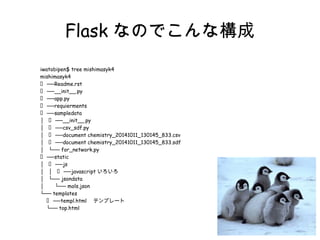
Flask なのでこんな構成
iwatobipen$tree mishimasyk4
mishimasyk4
├ ── Readme.rst
├ ── __init__.py
├ ── app.py
├ ── requierments
├ ── sampledata
│ ├ ── __init__.py
│ ├ ── csv_sdf.py
│ ├ ── document chemistry_20141011_130145_833.csv
│ ├ ── document chemistry_20141011_130145_833.sdf
│ └── for_network.py
├ ── static
│ ├ ── js
│ │ ├ ── javascript いろいろ
│ └── jsondata
│ └── mols.json
└── templates
├ ── templ.html テンプレート
└── top.html
- 10.
- 11.
“nodes”:
ネットワークをJSON で
[{ "data": {
"degree": 1,
"molwt": 379.5,
後ほどリンクで画像をとる
"href": "http://cactus.nci.nih.gov/chemical/structure/smi/image",
"smi": "COc1cc2[nH]c(C)c(CCN3CCN(c4ccccc4)CC3)c2cc1OC",
"id": "mol_0",
"molid": 0
}}, ],
“edges”:
[ {
"data": {
"source": "mol_237",
"target": "mol_207",
"id": "237>>207",
"similarity": 0.75
}, ]
結合次数
エッジの向きも表現できます
- 12.
RDKit でつくりました。
classNode(object):
def __init__(self,mol):
self.mol = mol
def mw( self ):
return round( Descriptors.MolWt( self.mol ), 2 )
def smi( self ):
return Chem.MolToSmiles( self.mol )
class Edge(object):
def __init__(self, mol1, mol2 ):
self.mol1 = mol1
self.mol2 = mol2
def source( self ):
return Chem.MolToSmiles( self.mol1 )
def target( self ):
return Chem.MolToSmiles( self.mol2 )
def sim(self):
fp1 = AllChem.GetMorganFingerprintAsBitVect(self.mol1, 2)
fp2 = AllChem.GetMorganFingerprintAsBitVect(self.mol2, 2)
tc = DataStructs.TanimotoSimilarity(fp1,fp2)
return tc
Node class
Edge class
- 13.
前のコードで作ったファイルを読む
<script>
//load JSON
items = []
$.getJSON(("static/jsondata/mols.json"),
function(data){
items = data;
return items;
});
</script>
JSON ファイルを読み込んでおく
- 14.
- 15.
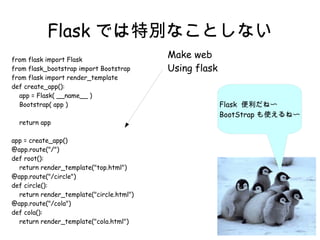
Flask では特別なことしない
Flask便利だね〜
BootStrap も使えるね〜
from flask import Flask
from flask_bootstrap import Bootstrap
from flask import render_template
def create_app():
app = Flask( __name__ )
Bootstrap( app )
return app
app = create_app()
@app.route("/")
def root():
return render_template("top.html")
@app.route("/circle")
def circle():
return render_template("circle.html")
@app.route("/cola")
def cola():
return render_template("cola.html")
Make web
Using flask
- 16.
Template 側のjavascript
cyというID のdiv にバインドする
static なグラフは
mapData を使える
$(function(){
$("#cy").cytoscape({
style: cytoscape.stylesheet()
.selector('node')
.css({
'background-color': 'gray',
'border-color' : 'black',
'border-width' : 3
'width': 'mapData(degree,1,10,10,50)',
'height': 'mapData(degree,1,10,10,50)'
})
.selector('edge')
.css hogehoge
mapData メソッド
要素の属性を指定値で可視化
( 次数, 最小, 最大,10,50) にスケーリング
- 17.
Javascript であれこれ
描画の準備DOM全部読み込んだら動作させる
クリックしたらsmiles を表示
static なグラフは
mapData を使える
ready: function(){
// this refer cy
console.log("ready2");
window.cy = this;
cy.load(items);
// insert some events!
cy.on('tap', 'node', function(){
alert("smiles is "+this.data('smi'));
cy.on('tap', 'node', function(){
window.open(this.data('href'));
$('#mol_wt').text("mol_wt is; "+this.data('molwt'));
});
}
クリックしたら構造を取得する
- 18.
Layout
null
random
preset
grid
circle
concentric
breadthfirst
dagre
cose
cola
arbor
springy
複数のアルゴリズムがあります
- 19.
- 20.
- 21.


![たとえば。。。selectors
cy.style()
.selector('node[degree >= 5]')
.css({'hoge' : 'huga'}).update()
ノードオブジェクトのうち
結合次数 > 5 のノードに関して
hoge を huga とする
変更を反映させる](https://image.slidesharecdn.com/cytoscape-141024080756-conversion-gate01/85/mishimasyk-4-5-320.jpg)




![“nodes”:
ネットワークをJSON で
[{ "data": {
"degree": 1,
"molwt": 379.5,
後ほどリンクで画像をとる
"href": "http://cactus.nci.nih.gov/chemical/structure/smi/image",
"smi": "COc1cc2[nH]c(C)c(CCN3CCN(c4ccccc4)CC3)c2cc1OC",
"id": "mol_0",
"molid": 0
}}, ],
“edges”:
[ {
"data": {
"source": "mol_237",
"target": "mol_207",
"id": "237>>207",
"similarity": 0.75
}, ]
結合次数
エッジの向きも表現できます](https://image.slidesharecdn.com/cytoscape-141024080756-conversion-gate01/85/mishimasyk-4-11-320.jpg)

![前のコードで作ったファイルを読む
<script>
// load JSON
items = []
$.getJSON(("static/jsondata/mols.json"),
function(data){
items = data;
return items;
});
</script>
JSON ファイルを読み込んでおく](https://image.slidesharecdn.com/cytoscape-141024080756-conversion-gate01/85/mishimasyk-4-13-320.jpg)