Pharmaco-therapy of DepressionPharmaco-therapy of Depression
From “theoretical” data toFrom “theoretical” data to “clinical”“clinical” practice!practice!
Dr.T.AsaadDr.T.Asaad
Agenda & ObjectivesAgenda & Objectives
• Disclosure.
• Neuro-anatomical model of depression.
• Neuro-biochemical model of depression.
• Cellular & Molecular theory of depression.
• Summary of “integrative” approaches to
understand depression.
• How does treatment work?
• Neuro-biology of adverse effects ?
• Future perspectives.
Recent ReportsRecent Reports
• Archives of General Psych. (Jan.,2010) :
-1 out of 5 in USA follow APA guidelines
in treatment of depression !?
• Journal of American Medical Association
(January, 2010) :
-AD effective only for severe
depression !?
• Archives of Int.Med. (Dec.,2009) :
-AD & increased risk of stroke & sudden
death !?
PRE-TESTPRE-TEST..
Match the following AD,with its possible mechanism
of action :
• 1-Milnacipran. A)- SSSRI.
• 2-Reboxetine. B)-SNRI.
• 3-Mirtazapine. C)-SARI.
• 4-Nefazodone. D)-SNDI &NDDI (NASSA)
• 5-Duloxetine. E)-NARI.
• 6-Bupropion. F)-NDRI.
• 7-Escitalopram. G)-DRI.
• 8-Tianeptine. H)-none of the above.
The “Emotional Brain”The “Emotional Brain”
(Neuro-anatomical Model(Neuro-anatomical Model))
Brain Area
(substrate)
NORMAL DEPRESSION
(1)-VMPFC
(emot. execu.a)
(ENGINE
GEARBOX!)
a-autonomic /
neuroendocrine
b-
pain,agg.,sex,
eating behavior
Activated by
“sadness” (Lt.?)
(2)-LOPFC
(emot. inhibit.a)
(BRAKE !)
Inhibits
emotional
response to
maladaptive s.
Increased
activity in
dep.,OCD, PD
& PTSD
(3)-DLPFC
(cognitive
executive area)
(DRIVER !)
Mediation of
executive
functions
Hypoactivity in
depression
(4)AMYGDALA
(activation by
emotional stim.
= emotional
expression)
-cortical arousal
&endocrinal
resonse to
ambigous
stimuli
-emotion,
learning
&memory
Activated by
“negative”
memories
(emotional bias)
(5)-HIPPO-
CAMPUS
-episodic
contextual mem
–HPA -axis
Inappropriate
emotional &
cog. response
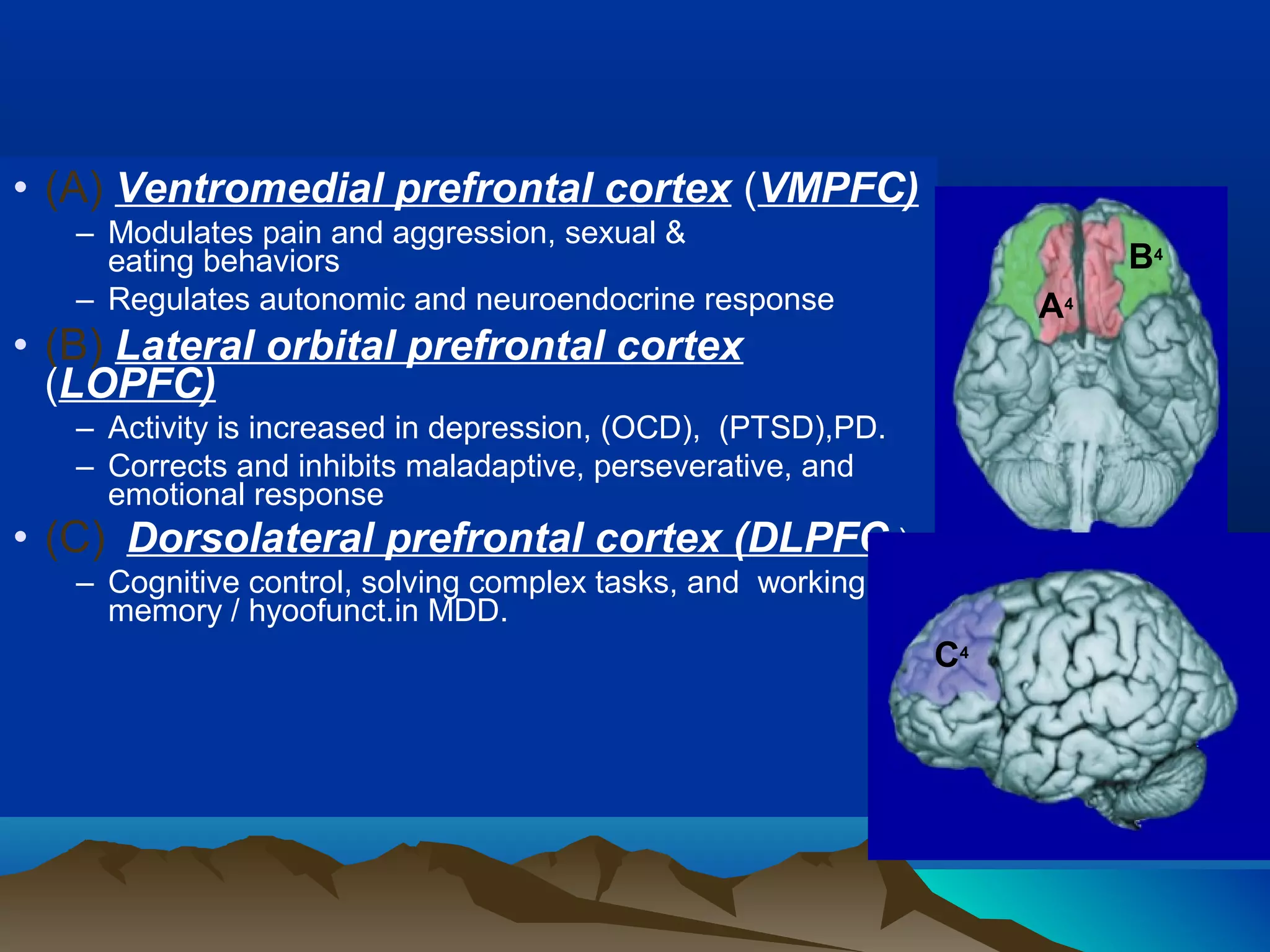
• (A) Ventromedial prefrontal cortex (VMPFC)
– Modulates pain and aggression, sexual &
eating behaviors
– Regulates autonomic and neuroendocrine response
• (B) Lateral orbital prefrontal cortex
(LOPFC)
– Activity is increased in depression, (OCD), (PTSD),PD.
– Corrects and inhibits maladaptive, perseverative, and
emotional response
• (C) Dorsolateral prefrontal cortex (DLPFC )
– Cognitive control, solving complex tasks, and working
memory / hyoofunct.in MDD.
A4
B4
C4
• (A) Amygdala: regulates cortical arousal and
neuroendocrine response to surprising / ambigous
– Role in emotional learning and memory
– Activation of amygdala correlates with degree of
depression
– Implicated in tendency to ruminate on
negative memories
• (B) Hippocampus: has a role in episodic, learning and
memory
– Rich in corticosteroid receptors
– Regulatory feedback to HPA-axis
– Hippocampal dysfunction may be responsible for
inappropriate emotional responses
A6
B6
6
Brain atrophy in depressionBrain atrophy in depression??
1. Bremner JD, et al. Am J Psychiatry. 2000;157(1):115-118.
2. Images courtesy of J Douglas Bremner, MD, Yale University.
Atrophy of the Hippocampus in Depression1
Normal2
Depression2
Hippocampus: The “weak linkHippocampus: The “weak link”?”?
• 5-HT and NE influence the balance between
excitatory (glutaminergic) and inhibitory
(GABAergic) activity in the prefrontal cortex and
limbic system
• Excitatory (glutaminergic) neurons from the
prefrontal cortex have regulatory influence on the
locus coeruleus (LC-NE) and the dorsal nuclei
raphe (DNR-5-HT)
• A combination of excessive excitatory input from
VMPFC and increased levels of GCs may be
toxic to hippocampus.
Hippocampal dysfunction &Hippocampal dysfunction &
neuroendocrine dysregulationneuroendocrine dysregulation
Nestler EJ, et al. Neuron. 2002;34(1):13-25.
Hippocampus
Amygdala
Hippocampus
Hypothalamus -
+-
-
Adrenal
cortex
ACTH
Pituitary
CRF
Glucocorticoids
Dexamethasone
MDD as a systemic disorderMDD as a systemic disorder!?!?
1. Hypothalamus stimulates
the pituitary gland to
release excessive ACTH,
continuously driving the
adrenal gland
3. Increase in catecholamines can
lead to myocardial ischemia,
diminished heart rate variability,
and can contribute to ventricular
arrhythmias
2. The adrenal gland releases
excessive amounts of
catecholamines and cortisol
4. Increase in catecholamines
causes platelet activation;
increase in cytokines and
interleukins may also
contribute to atherosclerosis
and eventual hypertension
5. Cortisol antagonizes insulin and
contributes to dyslipidemia, type
2 diabetes, and obesity;
increases in cortisol also
suppress the immune system
ACTH
Adapted from: Musselman DL, et al. Arch Gen Psychiatry. 1998;55(7):580-592.
(6)-RAS
(BF, TH, HY)
Regulation of
arousal & vital
functions
Sleep & biologic
symptoms of
depression
(7)-
BRAINSTEM
(monoamine
regulation)
(RF,NA,LC)
Mood, hedonic
sense, energy..
(8)-MOTOR A.
(striatum &
cerebellum)
Psycho-motor
activity
Agitation or
retardation
(9)-SPINAL
CORD
Control of
physical &
emotional pain
Painful &
physical
symptoms
Neuro-biochemical ModelNeuro-biochemical Model
NEUROTRANSMITTER ABNORMALITY IN
DEPRESSION
(1)-Da Hyopofunction in
NA,meso-limbic &
mesocortical pathways
(2)-NE Regulates 5HT (A2
autoeceptors control
5HT(axonal) & dendritic
A1 accelerates it)
Alpha-1 Alpha-2 B-1& B-2 B-3 ?
(a)-
Agonism:
-increased ABP
(sp.c)
-agitation
-decreased
cholinergic activity
(Psudo- ??)
Anti-hypertensive
effect
-motor = tremors
-amygdala &
limbic system =
agitation
-heart = rate
-Sp.c.= ABP
High density in
amygdala,
regulating VMPFC
, so , may have
AD effect ?
example SNRI ? Some NE Ads ? amibegron
(b)-
Antagonism:
-ortho-static
hypotension
-sedation
SNDI :
-increase NE
increase 5HT
( stim.of alpha-
1,that increases
5HT & block of
alpha2heterocept
or action(
-decreased
anxiety & tremors
-decreased HR &
ABP
-may increase
depression ?
example -AP (quetiapine)
-AD
(TCA,trazadone,
mianserine..)
-mirtazepine,
mianserin..
-quet.,clz,risp.,
asenapine…
B-blockers
(3)-5HT a-upregulation of
somatodendritic 5HT1A
b-5HT2A& 5HT2C
regulate NE & DA in pre-
frontal cortex, through
GABA interneurones
c-possible role of other
5HT receptors ?
(4)-GABA &
GLUTAMATE
-GABA mediates 5HT
effect on DA & NE.
-Wear-off or “pooping”
may be related to
glutamate hyperactivity
(role in TRD)
5HT1 5HT2a 5HT2c 5HT3
Site Pre-
synaptic
Post-
syna
Post-
synaptic
post-
synaptic
Agonism. Anti-
depres.
Anxiety
Psychos.
sexual ?
Sleep ?
appetite
cognition
Sleep ?
GIT
upsets
Antagon. Dep.,
anxiety,
OCD
Anti-
psychot.
-NDDI ?
increase
appetite
Possible
anti-
emetic?
Limbic SystemLimbic System
PrefrontalPrefrontal
CortexCortex LocusLocus
CoeruleusCoeruleus
(NE source)(NE source)11
Raphe NucleiRaphe Nuclei
(5-HT source)(5-HT source)11
((55--HT) and (NE) pathwaysHT) and (NE) pathways
in the human brainin the human brain
AmygdalaAmygdala
HippocampusHippocampus
Descending 5-HT
pathways1
Descending
NE pathways1
Based on: Cooper JR, et al. The Biochemical Basis of Neuropharmacology. 8th ed. New York: Oxford University Press; 2003.
Stahl SM. Essential Psychopharmacology: Neuroscientific Basis and Practical Applications; 2000:254.
Interactions between serotonin andInteractions between serotonin and
norepinephrine neuronsnorepinephrine neurons
Beyond synapse: 5HT and NEBeyond synapse: 5HT and NE
aid BDNF synthesis (preclinicalaid BDNF synthesis (preclinical))
Manji HK, et al. Biol Psychiatry. 2003;53(8):707-742.
Tsankova NM, et al. Nat Neurosci. 2006;9:519-525.
(5)-ACh -possible role of nicotinic
receptors (DA?)
-M ??
(6)-SUBSTANCE-P &
NK
Stress ….excessive
release of endogenous
NK & depression ?
(7)-OTHERS :) sigma ,
gluco-corticoids , CRF ,
new pentapeptides
( e.g.Nemifitide),…..
Act through other NTs or
through 3rd
& 4th
messenger systems ?
Cellular & Molecular Theory ofCellular & Molecular Theory of
DepressionDepression
• Whatever treatment…stimulation of cAMP
…….increased function & expression of
“transcription factor” (phospho-CREB)……
this activated phospho-CREB regulates
specific target genes ………increased
expression of BDNF (hippocampus).
• BDNF………Neuro-genesis, Neuro-
plasticity & Neuronal resilience.
BDNF, depression, andBDNF, depression, and
antidepressantsantidepressants
• BDNF is downregulated in MDD and
increased with AD.
• BDNF has a hypothetical neurotrophic
effect that
influences regulation of mood &pain.
• 5-HT and/or NE are believed to play roles in
the modulation of BDNF.
BDNF, depression, andBDNF, depression, and
antidepressantsantidepressants
Increase in BDNF promotes the 3 Ns
Neuroplasticity, neurogenesis, and
neuroprotection (cellular resilience)
An Integrated ApproachAn Integrated Approach
(Brain Circuits in Depression(Brain Circuits in Depression((
SYMPTOM(S( BRAIN AREAS NTs INVOLVED
(1(-Depressed
mood
-BS (RF,NA,LC(
–Amygdala
-VMPFC
All monoamines
(2(-Apathy ,
lack of interest
-NA
-PFC
-HY
-DA (NA , HY(
-NE (PFC, HY(
(3(-Sleep
disturbance
-TH & HY
-BF
All monoamines
(4(-Fatigue /
lack of energy
-mental=PFC
-physical=motor
cortex & sp.ch.
-mental= DA
-physical = NE
(5(-Executive
functions
DLPFC NE & DA
(6(-Psycho-
motor circuit
-FC
-striatum
-cerebellum
-NA
DA , 5HT & NE
(7(-Guilt /
worthlessness
-Amygdala
-VMPFC
(emotional
bias(
5HT
(8(-Wt &
Appetite
HY 5HT & may be
others?
(9(-Suicide -Amygdala
-VMPFC
-OFC
5HT
(10(-Autonomic
&endocrinal
-VMPFC
-hippocampus
-Amygdala
-HY
All monoamines
An Integrated ApproachAn Integrated Approach
(Positive & Negative Affect(Positive & Negative Affect((
REDUCED
POSITIVE
AFFECT
INCREASED
NEGATIVE
AFFECT
Manifestations Low mood ,
lack of pleasure
, energy, ….
Guilt , fear ,
anxiety…..
System
involved
NE & DA
(Dopamine
Deficiency
Syndrome ?!(
NE & 5HT
(Serotonin
Deficiency
Syndrome ?!)
DA
reuptake
inhibition
Reduce depression
Psychomotor activation
Antiparkinsonian effects
5HT2
block
Reduce depression
Reduce suicidal behavior
Antipsychotic effects
Hypotension
Ejaculatory dysfunction
Sedation
NE
reuptake
inhibition
Reduce depression
Antianxiety effects
Tremors
Tachycardia
Erectile/ejaculatory dysfunction
5HT reuptake
inhibition
Reduce depression
Antianxiety effects
GI disturbances
Sexual dysfunction
Alpha1
block
Postural hypotension
Dizziness
Reflex tachycardia
Memory dysfunction
Anxiety
ACh
block
Blurred vision
Dry mouth
Constipation
Sinus tachycardia
Urinary retention
Cognitive dysfunction
H1
block
Sedation/drowsiness
Hypotension
Weight gain
AntidepressantAntidepressant
Richelson. In: Current Psychiatric Therapy. 1997: 286-295.
Alpha2
block
Pharmacologic effectsPharmacologic effects
of antidepressantsof antidepressants
Sedation drowsinessSedation drowsiness
Blurred vision
Dry mouth
Constipation
Sinus
tachycardia
Urinary retention
Memory
dysfunction
Blurred vision
Dry mouth
Constipation
Sinus
tachycardia
Urinary retention
Memory
dysfunction
PriapismPriapism Postural hypotension
Dizziness
Reflex tachycardia
Postural hypotension
Dizziness
Reflex tachycardia
Dry mouth
Urinary retention
Erectile dysfunction
Activating effects
Tremor
Dry mouth
Urinary retention
Erectile dysfunction
Activating effects
Tremor
Psychomotor activation
Psychosis
Psychomotor activation
Psychosis Sexual dysfunction
Activating side effects
Sexual dysfunction
Activating side effects
NauseaNausea
Gl disturbances
Sexual
dysfunction
Activating
effects
Gl disturbances
Sexual
dysfunction
Activating
effects
ANTIDEPRESSANTANTIDEPRESSANT
H
1 B
lock
Ach block
DA
Reuptake
inhibition
Alpha2
block
Alpha1
block
5-HT
Reuptake
inhibition
NE
Reuptake
inhibition
5-H
T 2
5-HT3
Adapted from Richelson E.
Current Psychiatry Therapy.
1993:232-239
Adverse Effects of NeurotransmitterAdverse Effects of Neurotransmitter
Activity and Receptor BindingActivity and Receptor Binding
Neuro-biochemical Model ofNeuro-biochemical Model of
“Adverse Effects“Adverse Effects””
Adverse effect Mechanism Management
1-GIT side effects -5HT3
-cholinergic
-Dose titration & GIT
drugs ?
-CR forms
-5HT3 antagonists ?
2-Sleep disturbance -5HT2a&c
-H1
-M ?
-NA, Da..
-Dose & timing
-Drugs ?
3-Sexual -5HT2
-Adrenergic
-Cholinergic
-effect on NO
-Dose & Timing
–Education
-Drugs ?
4-Anxiety / irritability 5HT2a ?
-NE ?
Sedative ?
5-EPS, jittering. 5HT2a…..Da Anti-parkinson.
6-Hesitancy, retention.. -Cholinergic
-Na ?? (pseudo-anti-
cholinergic syndrome(
Dose adjustment
7-Wt gain -5HT2c
-H1
Life style
Drugs ?
Rather unusual (under-reported(Rather unusual (under-reported(
adverse effectsadverse effects?!?!
• The cocept of “apathetic recovery” ? :
-Relief of “increased negative affect” , but with still
“decreased positive affect”.
-Drugs acting on Da may help ??
• Excessive “yawning without sleep” ?!
• Sensori-motor manifestations ??
• Others (increase risk of stroke & sudden death in post-
menopausal women( (Archives of Int.Med.,Dec.2009(
Mechanism of abrupt ADMechanism of abrupt AD
withdrawal symptomswithdrawal symptoms::
( Effect upon
withdrawal )
( Possible
mechanism (s) )
Agitation
Anxiety
D2 / H1 / 5HT2A / others
Akathisia
EPS
D2 / M1 / 5HT2A
Insomnia 5HT2A / H1
GIT upsets M1 / 5HT3? / others
Mech.of abrupt AP withdrawalMech.of abrupt AP withdrawal
symptoms (contsymptoms (cont.( :.( :
(Effect upon
withdrawal )
( Possible
Mechanism )
Autonomic mainly M ?
Dyskinesia mainly D2
Headache M1 / H ? / 5HT?
Confusion
Disequilibrium ?
Sensory symptoms ?
M1 / H1 / 5HT2c /other?
NE (B1,2 in cerebellum( ?
NE &5HT (Sp.Th.(?
Determinants of D/C symptomsDeterminants of D/C symptoms
• Pharmaco-dynamic factors :
-action on different receptor sites ?
• Pharmaco-kinetic factors :
-T1/2 ?
-Effect on cytochrome system ?
• Idiosyncratic : ? Individual differences ?
Strategies for managingStrategies for managing
transient emerging eventstransient emerging events
References:
1. Weiden PJ. Postgrad Med 2006; 27-44. 2. Travis MJ et al. Int J Clin Pract 2005; 59(4): 485-495. 3. Lambert TJ, Castle DJ. MJA 2003; 178:
S57-S61. 4. Weiden PJ et al. J Clin Psychiatry 1997; 58(suppl 10): 63-72.
Potential event Consider…
Insomnia
• A sedative agent – such as a short term
benzodiazepine
Agitation
• A sedative agent– such as a short term
benzodiazepine
Nausea • An antiemetic agent2
Anticholinergic
rebound
(flu-like illness)
• Anticholinergic therapy
Rebound akathisia or
parkinsonism
• Anti-EPS therapy
Dual Action A.Ds. : whyDual Action A.Ds. : why??
• Limitations of single action drug:
Questionable efficacy in moderate and severe
cases & relapse prvt.
Still undesirable adverse effect
Drug-drug interaction in combined or poly
pharmacy
Spectrum of activity
Dual Action AntidepressantsDual Action Antidepressants ::
A)-A)- Non serotonergic :Non serotonergic : DNRIDNRI
B)-
SNRI
NaSSA SARI Dual serotoninDual serotonin
actionaction
EscitalopraVenlafaxine
Deluxetine
Milnacipra
n
Mirtazepin
e
Trazodone
Nefazodone
M.SelectiveM.Selective M.SelectiveM.Selective Non-Non-
SelectiveSelective
S.selecS.selec
tivetive
Pharmacology of “MirtazepinePharmacology of “Mirtazepine””
Receptor
Action
Clinical Effect
Alpha-2
antagonism
-decrease inhibition of NE = more NE
-Alpha-2 “hetero-receptor” block & Alpha-1 increase by NE
= decrease inhibition of 5HT = more 5HT
SO, it is considered “SNDI” !
5HT2a /
5HT2c
antagonism
-Increase both NE & Da release in PFC by antagonizing
their disinhibition
SO, it is considered “NDDI”!
-5HT2c = sleep restoring effect & Wt gain ?
5HT3
antagonism
Anti-nausea & vomitting
H1 antagonism -sleep
-Wt. gain
Pharmacology of “MirtazepinePharmacology of “Mirtazepine””
Clinical Observation Mechanism ?
1-anti-dep.effect : Effect of 5HT itself on 5HT1a
2-anti-anxiety effect: 5HT2a/5HT2c , 5HT1a, H1..
3-effect on sleep : 5HT2c , H1
4-anti-emetic effect: 5HT3 inhibition
5-effect on Wt. : H1 , 5HT2c
6-sexual sparing : 5HT2a,c , no alpha1,Ach,…
Dose-related Effects ofDose-related Effects of
“Mirtazepine“Mirtazepine””
Dose Receptor action Clinical effect
Low dose
( 15 mgs )
Potent action on H1
( es-mirtazepine ? )
Good hypnotic
effect
Average
dose
( 30 mgs )
Potent action on
5HT2a / 5HT2c
(=more NE,5HT,less
Da ?)
AD & anxiolytic
effect
(agitated dep.)
Higher
dose
( 45 mgs )
Potent action on
5HT2c = more Da ?
(in addition to NE &
5HT)
AD & cognitive
effect
(retarded dep.?!)
(Mrz “paradox”)?
Merits of “Mirtazepine” as an ADMerits of “Mirtazepine” as an AD
• Good efficacy in even severe cases. Why?
• Sleep restorative & anxiolytic effect.
• Absence of “serotonin” side effects,
common with SSRIs & SNRIs.
• Least sexual side effects.
• Can be combined with others in resistent
cases, like SNRIs (California Rocket Fuel)!
• Fair drug – drug interaction.
Future Perspectives :Future Perspectives :
(Anti-depressants in Development(Anti-depressants in Development))
• Triple Reuptake Inhibitors (TRI or SNDRI)
• NDDIs : Agomelatin (Valdoxan) (MT1&2)
& Fibanserin (5HT1A agon.-role in HSDD?)
• B3 agonist : Amibergon
• Drugs acting on other 5HT receptors
• Drus acting on other sites like sigma , NK , GC &
CRF antagonists,…L-methyl folate….
• DBS , TMS…
• BDNF & drug acting on neurogenesis e.g. GSK
inhibitors..
Pharmaco-therapy of Depression ~Prof. Dr.Tarek Asaad

Pharmaco-therapy of Depression ~Prof. Dr.Tarek Asaad

  • 1.
    Pharmaco-therapy of DepressionPharmaco-therapyof Depression From “theoretical” data toFrom “theoretical” data to “clinical”“clinical” practice!practice! Dr.T.AsaadDr.T.Asaad
  • 2.
    Agenda & ObjectivesAgenda& Objectives • Disclosure. • Neuro-anatomical model of depression. • Neuro-biochemical model of depression. • Cellular & Molecular theory of depression. • Summary of “integrative” approaches to understand depression. • How does treatment work? • Neuro-biology of adverse effects ? • Future perspectives.
  • 3.
    Recent ReportsRecent Reports •Archives of General Psych. (Jan.,2010) : -1 out of 5 in USA follow APA guidelines in treatment of depression !? • Journal of American Medical Association (January, 2010) : -AD effective only for severe depression !? • Archives of Int.Med. (Dec.,2009) : -AD & increased risk of stroke & sudden death !?
  • 4.
    PRE-TESTPRE-TEST.. Match the followingAD,with its possible mechanism of action : • 1-Milnacipran. A)- SSSRI. • 2-Reboxetine. B)-SNRI. • 3-Mirtazapine. C)-SARI. • 4-Nefazodone. D)-SNDI &NDDI (NASSA) • 5-Duloxetine. E)-NARI. • 6-Bupropion. F)-NDRI. • 7-Escitalopram. G)-DRI. • 8-Tianeptine. H)-none of the above.
  • 5.
    The “Emotional Brain”The“Emotional Brain” (Neuro-anatomical Model(Neuro-anatomical Model)) Brain Area (substrate) NORMAL DEPRESSION (1)-VMPFC (emot. execu.a) (ENGINE GEARBOX!) a-autonomic / neuroendocrine b- pain,agg.,sex, eating behavior Activated by “sadness” (Lt.?) (2)-LOPFC (emot. inhibit.a) (BRAKE !) Inhibits emotional response to maladaptive s. Increased activity in dep.,OCD, PD & PTSD
  • 6.
    (3)-DLPFC (cognitive executive area) (DRIVER !) Mediationof executive functions Hypoactivity in depression (4)AMYGDALA (activation by emotional stim. = emotional expression) -cortical arousal &endocrinal resonse to ambigous stimuli -emotion, learning &memory Activated by “negative” memories (emotional bias) (5)-HIPPO- CAMPUS -episodic contextual mem –HPA -axis Inappropriate emotional & cog. response
  • 7.
    • (A) Ventromedialprefrontal cortex (VMPFC) – Modulates pain and aggression, sexual & eating behaviors – Regulates autonomic and neuroendocrine response • (B) Lateral orbital prefrontal cortex (LOPFC) – Activity is increased in depression, (OCD), (PTSD),PD. – Corrects and inhibits maladaptive, perseverative, and emotional response • (C) Dorsolateral prefrontal cortex (DLPFC ) – Cognitive control, solving complex tasks, and working memory / hyoofunct.in MDD. A4 B4 C4
  • 8.
    • (A) Amygdala:regulates cortical arousal and neuroendocrine response to surprising / ambigous – Role in emotional learning and memory – Activation of amygdala correlates with degree of depression – Implicated in tendency to ruminate on negative memories • (B) Hippocampus: has a role in episodic, learning and memory – Rich in corticosteroid receptors – Regulatory feedback to HPA-axis – Hippocampal dysfunction may be responsible for inappropriate emotional responses A6 B6 6
  • 9.
    Brain atrophy indepressionBrain atrophy in depression?? 1. Bremner JD, et al. Am J Psychiatry. 2000;157(1):115-118. 2. Images courtesy of J Douglas Bremner, MD, Yale University. Atrophy of the Hippocampus in Depression1 Normal2 Depression2
  • 10.
    Hippocampus: The “weaklinkHippocampus: The “weak link”?”? • 5-HT and NE influence the balance between excitatory (glutaminergic) and inhibitory (GABAergic) activity in the prefrontal cortex and limbic system • Excitatory (glutaminergic) neurons from the prefrontal cortex have regulatory influence on the locus coeruleus (LC-NE) and the dorsal nuclei raphe (DNR-5-HT) • A combination of excessive excitatory input from VMPFC and increased levels of GCs may be toxic to hippocampus.
  • 11.
    Hippocampal dysfunction &Hippocampaldysfunction & neuroendocrine dysregulationneuroendocrine dysregulation Nestler EJ, et al. Neuron. 2002;34(1):13-25. Hippocampus Amygdala Hippocampus Hypothalamus - +- - Adrenal cortex ACTH Pituitary CRF Glucocorticoids Dexamethasone
  • 12.
    MDD as asystemic disorderMDD as a systemic disorder!?!? 1. Hypothalamus stimulates the pituitary gland to release excessive ACTH, continuously driving the adrenal gland 3. Increase in catecholamines can lead to myocardial ischemia, diminished heart rate variability, and can contribute to ventricular arrhythmias 2. The adrenal gland releases excessive amounts of catecholamines and cortisol 4. Increase in catecholamines causes platelet activation; increase in cytokines and interleukins may also contribute to atherosclerosis and eventual hypertension 5. Cortisol antagonizes insulin and contributes to dyslipidemia, type 2 diabetes, and obesity; increases in cortisol also suppress the immune system ACTH Adapted from: Musselman DL, et al. Arch Gen Psychiatry. 1998;55(7):580-592.
  • 13.
    (6)-RAS (BF, TH, HY) Regulationof arousal & vital functions Sleep & biologic symptoms of depression (7)- BRAINSTEM (monoamine regulation) (RF,NA,LC) Mood, hedonic sense, energy.. (8)-MOTOR A. (striatum & cerebellum) Psycho-motor activity Agitation or retardation (9)-SPINAL CORD Control of physical & emotional pain Painful & physical symptoms
  • 14.
    Neuro-biochemical ModelNeuro-biochemical Model NEUROTRANSMITTERABNORMALITY IN DEPRESSION (1)-Da Hyopofunction in NA,meso-limbic & mesocortical pathways (2)-NE Regulates 5HT (A2 autoeceptors control 5HT(axonal) & dendritic A1 accelerates it)
  • 15.
    Alpha-1 Alpha-2 B-1&B-2 B-3 ? (a)- Agonism: -increased ABP (sp.c) -agitation -decreased cholinergic activity (Psudo- ??) Anti-hypertensive effect -motor = tremors -amygdala & limbic system = agitation -heart = rate -Sp.c.= ABP High density in amygdala, regulating VMPFC , so , may have AD effect ? example SNRI ? Some NE Ads ? amibegron (b)- Antagonism: -ortho-static hypotension -sedation SNDI : -increase NE increase 5HT ( stim.of alpha- 1,that increases 5HT & block of alpha2heterocept or action( -decreased anxiety & tremors -decreased HR & ABP -may increase depression ? example -AP (quetiapine) -AD (TCA,trazadone, mianserine..) -mirtazepine, mianserin.. -quet.,clz,risp., asenapine… B-blockers
  • 16.
    (3)-5HT a-upregulation of somatodendritic5HT1A b-5HT2A& 5HT2C regulate NE & DA in pre- frontal cortex, through GABA interneurones c-possible role of other 5HT receptors ? (4)-GABA & GLUTAMATE -GABA mediates 5HT effect on DA & NE. -Wear-off or “pooping” may be related to glutamate hyperactivity (role in TRD)
  • 17.
    5HT1 5HT2a 5HT2c5HT3 Site Pre- synaptic Post- syna Post- synaptic post- synaptic Agonism. Anti- depres. Anxiety Psychos. sexual ? Sleep ? appetite cognition Sleep ? GIT upsets Antagon. Dep., anxiety, OCD Anti- psychot. -NDDI ? increase appetite Possible anti- emetic?
  • 18.
    Limbic SystemLimbic System PrefrontalPrefrontal CortexCortexLocusLocus CoeruleusCoeruleus (NE source)(NE source)11 Raphe NucleiRaphe Nuclei (5-HT source)(5-HT source)11 ((55--HT) and (NE) pathwaysHT) and (NE) pathways in the human brainin the human brain AmygdalaAmygdala HippocampusHippocampus Descending 5-HT pathways1 Descending NE pathways1 Based on: Cooper JR, et al. The Biochemical Basis of Neuropharmacology. 8th ed. New York: Oxford University Press; 2003.
  • 19.
    Stahl SM. EssentialPsychopharmacology: Neuroscientific Basis and Practical Applications; 2000:254. Interactions between serotonin andInteractions between serotonin and norepinephrine neuronsnorepinephrine neurons
  • 20.
    Beyond synapse: 5HTand NEBeyond synapse: 5HT and NE aid BDNF synthesis (preclinicalaid BDNF synthesis (preclinical)) Manji HK, et al. Biol Psychiatry. 2003;53(8):707-742. Tsankova NM, et al. Nat Neurosci. 2006;9:519-525.
  • 21.
    (5)-ACh -possible roleof nicotinic receptors (DA?) -M ?? (6)-SUBSTANCE-P & NK Stress ….excessive release of endogenous NK & depression ? (7)-OTHERS :) sigma , gluco-corticoids , CRF , new pentapeptides ( e.g.Nemifitide),….. Act through other NTs or through 3rd & 4th messenger systems ?
  • 22.
    Cellular & MolecularTheory ofCellular & Molecular Theory of DepressionDepression • Whatever treatment…stimulation of cAMP …….increased function & expression of “transcription factor” (phospho-CREB)…… this activated phospho-CREB regulates specific target genes ………increased expression of BDNF (hippocampus). • BDNF………Neuro-genesis, Neuro- plasticity & Neuronal resilience.
  • 23.
    BDNF, depression, andBDNF,depression, and antidepressantsantidepressants • BDNF is downregulated in MDD and increased with AD. • BDNF has a hypothetical neurotrophic effect that influences regulation of mood &pain. • 5-HT and/or NE are believed to play roles in the modulation of BDNF.
  • 24.
    BDNF, depression, andBDNF,depression, and antidepressantsantidepressants Increase in BDNF promotes the 3 Ns Neuroplasticity, neurogenesis, and neuroprotection (cellular resilience)
  • 25.
    An Integrated ApproachAnIntegrated Approach (Brain Circuits in Depression(Brain Circuits in Depression(( SYMPTOM(S( BRAIN AREAS NTs INVOLVED (1(-Depressed mood -BS (RF,NA,LC( –Amygdala -VMPFC All monoamines (2(-Apathy , lack of interest -NA -PFC -HY -DA (NA , HY( -NE (PFC, HY( (3(-Sleep disturbance -TH & HY -BF All monoamines
  • 26.
    (4(-Fatigue / lack ofenergy -mental=PFC -physical=motor cortex & sp.ch. -mental= DA -physical = NE (5(-Executive functions DLPFC NE & DA (6(-Psycho- motor circuit -FC -striatum -cerebellum -NA DA , 5HT & NE (7(-Guilt / worthlessness -Amygdala -VMPFC (emotional bias( 5HT
  • 27.
    (8(-Wt & Appetite HY 5HT& may be others? (9(-Suicide -Amygdala -VMPFC -OFC 5HT (10(-Autonomic &endocrinal -VMPFC -hippocampus -Amygdala -HY All monoamines
  • 28.
    An Integrated ApproachAnIntegrated Approach (Positive & Negative Affect(Positive & Negative Affect(( REDUCED POSITIVE AFFECT INCREASED NEGATIVE AFFECT Manifestations Low mood , lack of pleasure , energy, …. Guilt , fear , anxiety….. System involved NE & DA (Dopamine Deficiency Syndrome ?!( NE & 5HT (Serotonin Deficiency Syndrome ?!)
  • 29.
    DA reuptake inhibition Reduce depression Psychomotor activation Antiparkinsonianeffects 5HT2 block Reduce depression Reduce suicidal behavior Antipsychotic effects Hypotension Ejaculatory dysfunction Sedation NE reuptake inhibition Reduce depression Antianxiety effects Tremors Tachycardia Erectile/ejaculatory dysfunction 5HT reuptake inhibition Reduce depression Antianxiety effects GI disturbances Sexual dysfunction Alpha1 block Postural hypotension Dizziness Reflex tachycardia Memory dysfunction Anxiety ACh block Blurred vision Dry mouth Constipation Sinus tachycardia Urinary retention Cognitive dysfunction H1 block Sedation/drowsiness Hypotension Weight gain AntidepressantAntidepressant Richelson. In: Current Psychiatric Therapy. 1997: 286-295. Alpha2 block Pharmacologic effectsPharmacologic effects of antidepressantsof antidepressants
  • 30.
    Sedation drowsinessSedation drowsiness Blurredvision Dry mouth Constipation Sinus tachycardia Urinary retention Memory dysfunction Blurred vision Dry mouth Constipation Sinus tachycardia Urinary retention Memory dysfunction PriapismPriapism Postural hypotension Dizziness Reflex tachycardia Postural hypotension Dizziness Reflex tachycardia Dry mouth Urinary retention Erectile dysfunction Activating effects Tremor Dry mouth Urinary retention Erectile dysfunction Activating effects Tremor Psychomotor activation Psychosis Psychomotor activation Psychosis Sexual dysfunction Activating side effects Sexual dysfunction Activating side effects NauseaNausea Gl disturbances Sexual dysfunction Activating effects Gl disturbances Sexual dysfunction Activating effects ANTIDEPRESSANTANTIDEPRESSANT H 1 B lock Ach block DA Reuptake inhibition Alpha2 block Alpha1 block 5-HT Reuptake inhibition NE Reuptake inhibition 5-H T 2 5-HT3 Adapted from Richelson E. Current Psychiatry Therapy. 1993:232-239 Adverse Effects of NeurotransmitterAdverse Effects of Neurotransmitter Activity and Receptor BindingActivity and Receptor Binding
  • 31.
    Neuro-biochemical Model ofNeuro-biochemicalModel of “Adverse Effects“Adverse Effects”” Adverse effect Mechanism Management 1-GIT side effects -5HT3 -cholinergic -Dose titration & GIT drugs ? -CR forms -5HT3 antagonists ? 2-Sleep disturbance -5HT2a&c -H1 -M ? -NA, Da.. -Dose & timing -Drugs ? 3-Sexual -5HT2 -Adrenergic -Cholinergic -effect on NO -Dose & Timing –Education -Drugs ?
  • 32.
    4-Anxiety / irritability5HT2a ? -NE ? Sedative ? 5-EPS, jittering. 5HT2a…..Da Anti-parkinson. 6-Hesitancy, retention.. -Cholinergic -Na ?? (pseudo-anti- cholinergic syndrome( Dose adjustment 7-Wt gain -5HT2c -H1 Life style Drugs ?
  • 33.
    Rather unusual (under-reported(Ratherunusual (under-reported( adverse effectsadverse effects?!?! • The cocept of “apathetic recovery” ? : -Relief of “increased negative affect” , but with still “decreased positive affect”. -Drugs acting on Da may help ?? • Excessive “yawning without sleep” ?! • Sensori-motor manifestations ?? • Others (increase risk of stroke & sudden death in post- menopausal women( (Archives of Int.Med.,Dec.2009(
  • 34.
    Mechanism of abruptADMechanism of abrupt AD withdrawal symptomswithdrawal symptoms:: ( Effect upon withdrawal ) ( Possible mechanism (s) ) Agitation Anxiety D2 / H1 / 5HT2A / others Akathisia EPS D2 / M1 / 5HT2A Insomnia 5HT2A / H1 GIT upsets M1 / 5HT3? / others
  • 35.
    Mech.of abrupt APwithdrawalMech.of abrupt AP withdrawal symptoms (contsymptoms (cont.( :.( : (Effect upon withdrawal ) ( Possible Mechanism ) Autonomic mainly M ? Dyskinesia mainly D2 Headache M1 / H ? / 5HT? Confusion Disequilibrium ? Sensory symptoms ? M1 / H1 / 5HT2c /other? NE (B1,2 in cerebellum( ? NE &5HT (Sp.Th.(?
  • 36.
    Determinants of D/CsymptomsDeterminants of D/C symptoms • Pharmaco-dynamic factors : -action on different receptor sites ? • Pharmaco-kinetic factors : -T1/2 ? -Effect on cytochrome system ? • Idiosyncratic : ? Individual differences ?
  • 37.
    Strategies for managingStrategiesfor managing transient emerging eventstransient emerging events References: 1. Weiden PJ. Postgrad Med 2006; 27-44. 2. Travis MJ et al. Int J Clin Pract 2005; 59(4): 485-495. 3. Lambert TJ, Castle DJ. MJA 2003; 178: S57-S61. 4. Weiden PJ et al. J Clin Psychiatry 1997; 58(suppl 10): 63-72. Potential event Consider… Insomnia • A sedative agent – such as a short term benzodiazepine Agitation • A sedative agent– such as a short term benzodiazepine Nausea • An antiemetic agent2 Anticholinergic rebound (flu-like illness) • Anticholinergic therapy Rebound akathisia or parkinsonism • Anti-EPS therapy
  • 38.
    Dual Action A.Ds.: whyDual Action A.Ds. : why?? • Limitations of single action drug: Questionable efficacy in moderate and severe cases & relapse prvt. Still undesirable adverse effect Drug-drug interaction in combined or poly pharmacy Spectrum of activity
  • 39.
    Dual Action AntidepressantsDualAction Antidepressants :: A)-A)- Non serotonergic :Non serotonergic : DNRIDNRI B)- SNRI NaSSA SARI Dual serotoninDual serotonin actionaction EscitalopraVenlafaxine Deluxetine Milnacipra n Mirtazepin e Trazodone Nefazodone M.SelectiveM.Selective M.SelectiveM.Selective Non-Non- SelectiveSelective S.selecS.selec tivetive
  • 40.
    Pharmacology of “MirtazepinePharmacologyof “Mirtazepine”” Receptor Action Clinical Effect Alpha-2 antagonism -decrease inhibition of NE = more NE -Alpha-2 “hetero-receptor” block & Alpha-1 increase by NE = decrease inhibition of 5HT = more 5HT SO, it is considered “SNDI” ! 5HT2a / 5HT2c antagonism -Increase both NE & Da release in PFC by antagonizing their disinhibition SO, it is considered “NDDI”! -5HT2c = sleep restoring effect & Wt gain ? 5HT3 antagonism Anti-nausea & vomitting H1 antagonism -sleep -Wt. gain
  • 41.
    Pharmacology of “MirtazepinePharmacologyof “Mirtazepine”” Clinical Observation Mechanism ? 1-anti-dep.effect : Effect of 5HT itself on 5HT1a 2-anti-anxiety effect: 5HT2a/5HT2c , 5HT1a, H1.. 3-effect on sleep : 5HT2c , H1 4-anti-emetic effect: 5HT3 inhibition 5-effect on Wt. : H1 , 5HT2c 6-sexual sparing : 5HT2a,c , no alpha1,Ach,…
  • 42.
    Dose-related Effects ofDose-relatedEffects of “Mirtazepine“Mirtazepine”” Dose Receptor action Clinical effect Low dose ( 15 mgs ) Potent action on H1 ( es-mirtazepine ? ) Good hypnotic effect Average dose ( 30 mgs ) Potent action on 5HT2a / 5HT2c (=more NE,5HT,less Da ?) AD & anxiolytic effect (agitated dep.) Higher dose ( 45 mgs ) Potent action on 5HT2c = more Da ? (in addition to NE & 5HT) AD & cognitive effect (retarded dep.?!) (Mrz “paradox”)?
  • 43.
    Merits of “Mirtazepine”as an ADMerits of “Mirtazepine” as an AD • Good efficacy in even severe cases. Why? • Sleep restorative & anxiolytic effect. • Absence of “serotonin” side effects, common with SSRIs & SNRIs. • Least sexual side effects. • Can be combined with others in resistent cases, like SNRIs (California Rocket Fuel)! • Fair drug – drug interaction.
  • 44.
    Future Perspectives :FuturePerspectives : (Anti-depressants in Development(Anti-depressants in Development)) • Triple Reuptake Inhibitors (TRI or SNDRI) • NDDIs : Agomelatin (Valdoxan) (MT1&2) & Fibanserin (5HT1A agon.-role in HSDD?) • B3 agonist : Amibergon • Drugs acting on other 5HT receptors • Drus acting on other sites like sigma , NK , GC & CRF antagonists,…L-methyl folate…. • DBS , TMS… • BDNF & drug acting on neurogenesis e.g. GSK inhibitors..

Editor's Notes

  • #8 KEY POINT There is a reciprocal polysynaptic connection between the ventromedial prefrontal cortex (VMPFC) and the dorsolateral prefrontal cortex (DLPFC) that leads through the cingulate and hippocampus. Increased activity in the DLPFC is often associated with diminished activity of the VMPFC. It is postulated that excessive excitatory (glutaminergic) input from the VMPFC, combined with elevated glucocorticoids, results in hippocampal injury. BACKGROUND Ventromedial PFC: receives integrated sensory information from the orbital PFC as well as fear- and reward-related input from the amygdala, medial temporal lobe, and ventral striatum (nucleus accumbens). It projects to the hippocampus, diencephalon, and brainstem, where it regulates autonomic and neuroendocrine response, pain modulation, aggression, and sexual and eating behaviors.1 Lateral orbital PFC (lateral and posterior): receives highly processed and integrated sensory information from the parietal cortex. It is also connected to the amygdala, ventral striatum, and lateral hypothalamus. Activity is increased in depression, obsessive-compulsive disorder (OCD), posttraumatic stress disorder (PTSD), and panic disorder. Orbital PFC plays a role in correcting and inhibiting maladaptive, perseverative, and emotional responses (in part, generated by the amygdala).2 Dorsolateral PFC: has been implicated in cognitive control, solving complex tasks, maintenance, and manipulation of information in working memory. Hypoactivity of the DLPFC in depression has been associated with psychomotor retardation and anhedonia.2,3 REFERENCES 1. Öngür D, Price JL. The organization of networks within the orbital and medial prefrontal cortex of rats, monkeys and humans. Cereb Cortex. 2000;10(3):206-219. 2. Drevets WC. Functional neuroimaging studies of depression: the anatomy of melancholia. Annu Rev Med. 1998;49:341-361. 3. MacDonald AW III, Cohen JD, Stenger VA, Carter CS. Dissociating the role of the dorsolateral prefrontal and anterior cingulate cortex in cognitive control. Science. 2000;288(5472):1835-1838.
  • #9 KEY POINT The prefrontal cortex and limbic system are organized in intricate networks involved in processing emotional and cognitive information. These areas predominantly utilize GABA and glutamate for neurotransmission. Information processing and mutual relationships are significantly influenced by monoaminergic (5-HT, NE, and DA) projections. BACKGROUND Amygdala: is involved in recruiting and coordinating cortical arousal and neuroendocrine response to underdetermined (surprising and ambiguous) stimuli. The amygdala is also involved in emotional learning and memory. Abnormal activation of the amygdala correlates with degree of depression. (It has also been noted in bipolar depression and anxiety.) The amygdala may be implicated in a tendency to ruminate on emotionally negative memories.1 Hippocampus: has a critical role in episodic, contextual learning, and memory. It is rich in corticosteroid receptors and provides inhibitory feedback to hypothalamic-pituitary-adrenal axis. Hippocampal dysfunction may be responsible for inappropriate context-dependent emotional responses.2 REFERENCES 1. Davidson RJ. Affective neuroscience and psychophysiology: toward a synthesis. Psychophysiology. 2003;40(5):655-665. 2. Davidson RJ, Pizzagalli D, Nitschke JB, Putnam K. Depression: perspectives from affective neuroscience. Annu Rev Psychol. 2002;53:545-574.
  • #10 KEY POINTS The hippocampus, a region of the brain involved in conscious memory, may begin to atrophy in depression. The hippocampus is at a “vulnerable intersection” of cognitive, emotional, and neuroendocrine regulation. It is rich in glucocorticoid receptors and is a recipient of significant excitatory glutaminergic innervation. A combined “toxic” impact may precipitate trophic changes. BACKGROUND The MRI scans above were obtained from a healthy control (L) and a person with severe depression (R). Indications of hippocampal atrophy are apparent in the diminished size of the area outlined in red in the enlargement of the scan obtained from the patient with depression. Investigators have found that about half of persons with severe depression exhibit high levels of the stress hormone, cortisol, which is thought to be toxic to neurons. (Source: J. Douglas Bremner, MD, Yale University). REFERENCE Bremner JD, Narayan M, Anderson ER, et al. Hippocampal volume reduction in major depression. Am J Psychiatry. 2000;157(1):115-118.
  • #11 KEY POINTS Not only do 5-HT and NE influence the balance between excitatory (Glu) and inhibitory (GABA) transmission in key areas involved in processing of emotional/cognitive information, prefrontal Glu neurons have a regulatory (mostly inhibitory) impact on monoaminergic nuclei.1 A combination of excessive excitatory input, elevated glucocorticoids, and compromised monoaminergic function may result in prefrontal and hippocampal atrophy and disrupt adaptive emotional processing.2 Hippocampal dysfunction may also contribute to neuroendocrine imbalance and perpetuate this vicious cycle. REFERENCES 1. Paul IA, Skolnick P. Glutamate and depression: clinical and preclinical studies. Ann NY Acad Sci. 2003;1003:250-272. 2. Sheline YI. 3D MRI studies of neuroanatomic changes in unipolar major depression: the role of stress and medical comorbidity. Biol Psychiatry. 2000;48(8):791-800.
  • #12 KEY POINTS During periods of prolonged stress, such as during depressive episodes, normal mechanisms for dealing with stress may malfunction and lead to damage of the hippocampus. This damage can then lead to disruption of feedback loops designed to restore homeostasis, leading to a runaway system and even more neuronal damage. REFERENCE Nestler EJ, Barrot M, DiLeone RJ, et al. Neurobiology of depression. Neuron. 2002;34(1):13-25.
  • #13 KEY POINTS MDD may not only be a “psychiatric disease,” as there is evidence of widespread systemic consequences. Neuroendocrine dysregulation and elevated sympathetic tone may result in cardiovascular morbidity and increased risk of metabolic syndrome. Immune response may be compromised in MDD. Major depression and depressive symptoms, although commonly encountered in medical populations, are frequently underdiagnosed and undertreated in patients with cardiovascular disease (CVD). This is of particular importance because several studies have shown depression and its associated symptoms to be a major risk factor for both the development of CVD and death after an index myocardial infarction. Treatment of depression in patients with CVD may be able to improve their dysphoria and other signs and symptoms of depression and improve quality of life. BACKGROUND “This review of the extant literature is derived from MEDLINE searches (1966-1997) using the search terms “major depression,” “psychiatry,” “cardiovascular disease,” and “pathophysiology.” “Studies investigating pathophysiological alterations related to CVD in patients with depression are reviewed.” “The few studies on treatment of depression in patients with CVD are also described.” REFERENCE Musselman DL, Evans DL, Nemeroff CB. The relationship of depression to cardiovascular disease: epidemiology, biology, and treatment. Arch Gen Psychiatry. 1998;55(7):580-592.
  • #19 KEY POINTS Both serotonin (5-HT) and norepinephrine (NE) are neurotransmitters that have ascending tracts to the cerebral cortex and limbic area, as well as descending tracts to the spinal cord.1 The cell bodies for these tracts originate in major nuclei of the midbrain. Most of the 5-HT cell bodies in the central nervous system are located in the raphe nuclei.1 The largest cluster of noradrenergic cells in the central nervous system is located in the locus coeruleus.1 Each of these midbrain nuclei has ascending tracts, which project to brain regions thought to be involved in depressive symptoms as well as ascending and descending tracts involved in pain suppression. Decreased neurotransmission of 5-HT and NE is believed to be associated with depression.2 5-HT and NE secreting neurons project upward from their respective nuclei in the brainstem and directly stimulate many areas of the brain, including the prefrontal cortex and the limbic system. The prefrontal cortex is involved in executive function, while the limbic system is comprised of many anatomical structures, including the hippocampus, anterior cingulate cortex, hypothalamus, and amygdala; these are areas of the brain that are involved in behavior, motivation, and emotion. REFERENCES 1. Mega MS, Cummings JL, Salloway S, Malloy P. The limbic system: An anatomic, phylogenetic, and clinical perspective. J Neuropsychiatry Clin Neurosci. 1997;9(3):315-330. 2. Hales RE, Yudofsky SC. Mood disorders. In: Textbook of Clinical Psychiatry. 4th ed. Arlington: American Psychiatric Publishing; 2003:479-486.
  • #20 KEY POINTS There is “cross-talk” between 5-HT and NE. Pharmacologic selectivity may not translate into physiologic selectivity. 5-HT and NE modulate each other’s release at the point of origin and at the terminal end. REFERENCE Stahl SM. Essential Psychopharmacology: Neuroscientific Basis and Practical Applications. 2nd ed. New York, NY: Cambridge University Press; 2000:254.
  • #21 KEY POINTS Elevation of glucocorticoids and excitatory neurotransmitters, due to chronic mood disorders, may impair neuroplasticity and cellular resilience.1 Use of antidepressants can regulate the expression of BDNF, leading to enhancement of neuroplasticity and cellular resilience.2,3 5-HT and/or NE activate intracellular cascades that can independently lead to activation of transcription factor (CREB) and eventual synthesis of BDNF. BDNF interacts with TrkB receptor to enhance neuroplasticity and neurogenesis. By facilitating synthesis of a neuroprotective factor, Bcl-2, BDNF helps improve cellular resilience.4 REFERENCES 1. Manji HK, Quiroz JA, Sporn J, et al. Enhancing neuronal plasticity and cellular resilience to develop novel, improved therapeutics for difficult-to-treat depression. Biol Psychiatry. 2003;53(8):707-742. 2. Malberg JE, Eisch AJ, Nestler EJ, Duman RS. Chronic antidepressant treatment increases neurogenesis in adult rat hippocampus. J Neurosci. 2000;20(24):9104-9110. 3. Shimizu E, Hashimoto K, Okamura N, et al. Alterations of serum levels of brain-derived neurotrophic factor (BDNF) in depressed patients with or without antidepressants. Biol Psychiatry. 2003;54(1):70-75. 4. Manji HK, Drevets WC, Charney DS. The cellular neurobiology of depression. Nat Med. 2001;7(5):541-547.
  • #24 KEY POINTS 5-HT and NE regulate BDNF synthesis through mostly independent pathways. (They converge on synthesis of CREB.)1 In preclinical studies, chronic (≥2 weeks), but not acute, administration of antidepressants can result in increase in BDNF synthesis.1 Direct injection of BDNF into brain parenchyma, can result in sustained antidepressant2 (mesencephalon and ventricles) and analgesic effect3 (periaqueductal gray) in rat studies. REFERENCES 1. Duman RS, Heninger GR, Nestler EJ. A molecular and cellular theory of depression. Arch Gen Psychiatry. 1997;54(7):597-606. 2. Siuciak JA, Lewis DR, Wiegand SJ, Lindsay RM. Antidepressant-like effect of brain-derived neurotrophic factor (BDNF). Pharmacol Biochem Behav. 1997;56(1):131-137. 3. Siuciak JA, Clark MS, Rind HB, Whittemore SR, Russo AF. BDNF induction of tryptophan hydroxylase mRNA levels in the rat brain. J Neurosci Res. 1998;52(2):149-158.
  • #25 KEY POINTS 5-HT and NE regulate BDNF synthesis through mostly independent pathways. (They converge on synthesis of CREB.)1 In preclinical studies, chronic (≥2 weeks), but not acute, administration of antidepressants can result in increase in BDNF synthesis.1 Direct injection of BDNF into brain parenchyma, can result in sustained antidepressant2 (mesencephalon and ventricles) and analgesic effect3 (periaqueductal gray) in rat studies. REFERENCES 1. Duman RS, Heninger GR, Nestler EJ. A molecular and cellular theory of depression. Arch Gen Psychiatry. 1997;54(7):597-606. 2. Siuciak JA, Lewis DR, Wiegand SJ, Lindsay RM. Antidepressant-like effect of brain-derived neurotrophic factor (BDNF). Pharmacol Biochem Behav. 1997;56(1):131-137. 3. Siuciak JA, Clark MS, Rind HB, Whittemore SR, Russo AF. BDNF induction of tryptophan hydroxylase mRNA levels in the rat brain. J Neurosci Res. 1998;52(2):149-158.